Reported Speech in News Reports and Media English

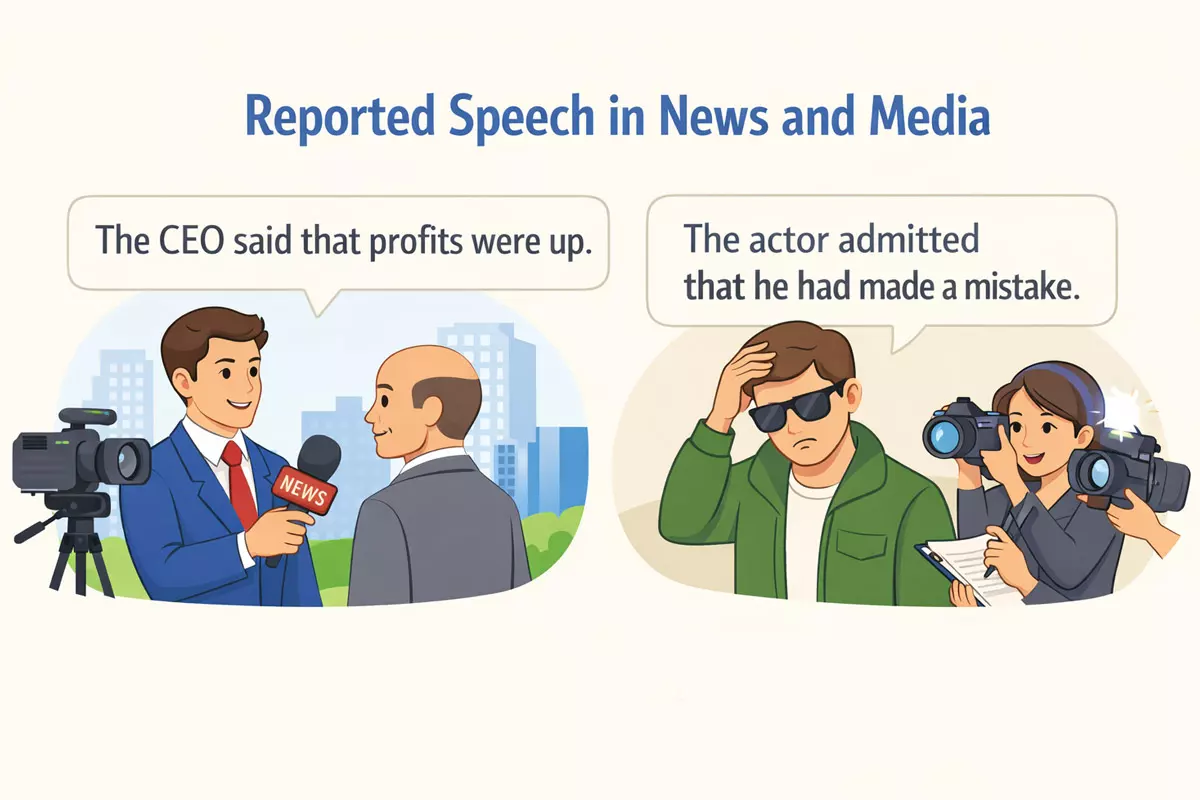 Here we how reported speech is used in news writing, emphasizing neutral style, frequent reporting verbs, tense selection, and clear source attribution. It also discusses common headline and article patterns in media texts.
Journalists often use indirect language when reporting what others have said to present information accurately and maintain objectivity. By paraphrasing or summarizing statements rather than quoting them directly, reporters can clarify complex points and avoid misrepresentation. This approach allows the media to distill key messages while minimizing bias and ensuring that the context is preserved. Understanding how journalists adapt and communicate statements is important for readers who want to critically evaluate the reliability and nuance of modern news coverage.
Role of reported speech in news writing
Journalists rely on reported speech to present information from sources, witnesses, and officials in a way that maintains both accuracy and neutrality. By quoting or paraphrasing what others have said, news writers can convey facts, opinions, and reactions without injecting their own bias. This approach allows readers to distinguish between what is directly observed by the reporter and what has been relayed by others.
Why news writers use reported speech
- To attribute statements to specific people or organizations
- To present multiple viewpoints on a single issue
- To avoid legal responsibility for contested or controversial statements
- To reflect the original speaker’s tone and intent
- To maintain journalistic objectivity
- To capture breaking news quickly when direct quotes are unavailable
- To summarize complex or lengthy statements for clarity
- To indicate uncertainty or distance from the information
Common patterns and verbs in news reporting
Writers often choose specific reporting verbs to convey the manner or certainty of a statement. These verbs help readers interpret the reliability and context of the information.
- said → The spokesperson said the company would release an update soon.
- stated → The minister stated that the new policy would take effect immediately.
- announced → The agency announced that flights would resume on Monday.
- claimed → Officials claimed that the operation had been completed successfully.
- reported → Local media reported that the storm caused widespread outages.
- explained → The scientist explained that the results were still being reviewed.
- added → She added that further details would be shared later.
- admitted → The company admitted that it had made an error in the report.
- denied → The spokesperson denied that any data had been leaked.
- confirmed → Police confirmed that no one was injured in the incident.
- warned → Experts warned that prices could rise in the coming months.
- suggested → Analysts suggested that demand might slow down this quarter.
- described → Witnesses described the scene as chaotic and loud.
- argued → The report argued that the changes were necessary for safety.
- insisted → The official insisted that the decision was final.
- commented → The mayor commented that the city was prepared for the event.
- noted → Researchers noted that the trend had continued for years.
- estimated → Economists estimated that inflation would fall by the end of the year.
Direct vs. indirect speech in media

Both direct and indirect speech are common in news stories. Direct speech presents the exact words spoken, often within quotation marks, while indirect speech paraphrases the original message. The choice between these forms can affect the perceived credibility and immediacy of the report.
| Feature | Direct Speech | Indirect Speech |
|---|---|---|
| Basic form | "I am tired," she said. | She said that she was tired. |
| Quotation marks | Used — "..." | Not used |
| Introductory verb | Often optional | Required (said, told, asked, etc.) |
| Exact wording | Always preserved | May be changed (paraphrased) |
| Verb tense | "I work here." | He said that he worked there. |
| Pronouns | "I like my job." | She said that she liked her job. |
| Time expressions | "I will call you tomorrow." | He said he would call me the next day. |
| Word order | "Where are you going?" | He asked where I was going. |
| Questions | "Do you like coffee?" | She asked if I liked coffee. |
| Commands | "Close the door." | He told me to close the door. |
| Reporting conjunction | Not needed | that / if / whether / to |
| Flexibility | Low — must repeat exactly | High — can summarize meaning |
| Typical use | Dialogues, fiction, quotes | News, reports, storytelling |
Impact on credibility and audience trust
How journalists handle reported statements directly affects a story’s trustworthiness. Clearly attributing information and accurately representing sources helps build credibility. When readers see that a report distinguishes between a fact and a claim, they are more likely to trust the news outlet.
Neutral and objective reporting style
News reports and media English aim to present information in a way that avoids personal bias, emotional language, or subjective judgment. This approach helps maintain credibility and allows audiences to form their own opinions based on the facts provided. Journalists often use reported speech as a tool to keep their writing detached, attributing statements to sources rather than expressing opinions directly.
Key features of impartial news language
- Attribution: Using verbs like "said," "stated," or "reported" to show the source of information.
- Absence of emotive words: Avoiding adjectives and adverbs that express approval, disapproval, or strong feelings.
- Balanced representation: Including multiple perspectives or quoting different stakeholders.
- Use of indirect speech: Transforming direct quotations to indirect forms to distance the reporter from the statement.
- Use of hedging: Employing phrases such as "allegedly," "according to," or "reportedly" to signal uncertainty or distance.
- Consistent tense: Typically using the past tense for reported events and statements.
- Objective vocabulary: Selecting neutral terms over loaded or emotionally charged alternatives.
- Fact-based reporting: Prioritizing verifiable details and avoiding speculation.
- Minimal first-person references: Rarely using "I" or "we" in news reports.
- Clarity in source identification: Clearly indicating who made each statement or claim.
Common reporting verbs and their effects
The choice of reporting verb can subtly influence the tone and perceived reliability of information. Here are some widely used verbs in journalistic English, each carrying a slightly different nuance:
- asserted → The manager asserted that the figures were accurate.
- alleged → The witness alleged that the suspect had left early.
- predicted → Analysts predicted that sales would increase next quarter.
- emphasized → The teacher emphasized that regular practice was essential.
- maintained → The lawyer maintained that his client was innocent.
- revealed → The report revealed that several errors had been overlooked.
- remarked → She remarked that the situation had improved slightly.
- acknowledged → The company acknowledged that delays had occurred.
- clarified → The spokesperson clarified that the meeting had been postponed.
- reassured → The doctor reassured her that the symptoms were temporary.
- objected → He objected that the proposal would increase costs.
- complained → Customers complained that the service had declined.
- boasted → He boasted that his team had achieved record results.
- conceded → The minister conceded that mistakes had been made.
- speculated → Experts speculated that interest rates might fall soon.
Direct vs. indirect speech in news reporting
Journalists choose between quoting sources directly and paraphrasing their words. Indirect speech is more common in formal reporting, as it allows for summarizing and clarifying statements while maintaining a neutral stance. The table below provides a comparison between these two approaches:
| Direct Speech | Indirect (Reported) Speech |
|---|---|
| The minister said, "We will invest in education." | The minister said that they would invest in education. |
| "It's too early to comment," the spokesperson replied. | The spokesperson replied that it was too early to comment. |
| "Prices are rising quickly," experts warned. | Experts warned that prices were rising quickly. |
| "We deny all allegations," the company stated. | The company stated that they denied all allegations. |
By consistently applying these principles, media outlets strive to provide information that readers can trust, minimizing the risk of misinterpretation or bias. The use of reported speech, careful verb selection, and neutral vocabulary all play a central role in achieving an impartial reporting style.
Common reporting verbs in media texts
When journalists write news stories or media articles, they often use a set of specific verbs to introduce what someone else has said. These verbs do more than just show that information is coming from another source—they also suggest the speaker’s attitude, the level of certainty, or the way the message was delivered. The choice of verb can subtly influence how readers understand the original statement.
Typical verbs used to report speech
Writers in newsrooms rely on a core group of verbs to signal reported information. Some of these verbs simply present the facts, while others add nuance, such as skepticism, agreement, or distance. Here are some of the most frequently used options:
- say → She said that the meeting would start at nine.
- report → Local media reported that several roads had been closed.
- claim → The company claimed that the product was completely safe.
- state → The minister stated that the reform would begin next year.
- announce → The airline announced that all flights would be delayed.
- suggest → Experts suggested that demand might decline soon.
- allege → The witness alleged that the documents had been falsified.
- admit → He admitted that he had made a serious mistake.
- deny → The spokesperson denied that any agreement had been reached.
- argue → The report argued that the changes were necessary.
- insist → She insisted that the decision was final.
- maintain → The lawyer maintained that his client was innocent.
- explain → The scientist explained that the process required more time.
- warn → Doctors warned that the illness could spread quickly.
- confirm → Police confirmed that no injuries had been reported.
- reveal → The investigation revealed that key data had been hidden.
- concede → The leader conceded that the plan had failed.
- predict → Analysts predicted that prices would rise next year.
- add → She added that further details would follow later.
- note → Researchers noted that the trend had continued for decades.
These verbs help writers clarify whether information is being presented as fact, opinion, speculation, or accusation.
How reporting verbs affect meaning
The verb chosen can shape the reader’s perception of the speaker’s intent or the reliability of the statement. For example, "claim" can imply doubt, while "state" or "confirm" suggests more certainty. Similarly, "allege" is commonly used when something is unproven or disputed.
| Reporting Verb | Typical Use in Media | Implied Attitude |
|---|---|---|
| say | Neutral reporting of speech | None/neutral |
| claim | Presenting statements that may be disputed or unverified | Possible doubt |
| admit | Reporting reluctant or unexpected agreement | Reluctance/acceptance |
| allege | Attributing statements not yet proven | Uncertainty |
| insist | Emphasizing strong or repeated assertion | Strong affirmation |
| deny | Reporting explicit rejection of an idea or accusation | Rejection |
| announce | Reporting official or public statements | Formality/authority |
| suggest | Introducing ideas that are not definite | Tentativeness |
Choosing the right verb for context
A good journalist matches the reporting verb to the context. For example, "warn" is used if the speaker is highlighting a risk or threat, while "predict" fits when someone is making a forecast. Careful selection of these verbs helps maintain journalistic objectivity and makes it clear when a statement is a matter of fact or opinion. In summary, reporting verbs are a toolkit for conveying not only what was said, but also how it was said and perceived. The subtleties behind each verb allow media writers to provide readers with important context and perspective.
Tense choices in news reporting
News articles and broadcasts rely on careful verb tense selection to convey facts, statements, and events with clarity. The use of tense shapes how readers interpret the timing and reliability of reported information. Understanding which tense is chosen—and why—can help readers and writers alike navigate the nuances of media English.
Common tense uses in news reports

Present tenses often appear in headlines and breaking news, signaling immediacy and ongoing relevance. In contrast, past tenses dominate the main body of reports, especially when recounting events that have already happened. Sometimes, the present perfect is used to connect past events to the current moment, emphasizing consequences or developments.
| Tense | Typical Function in News | Example |
|---|---|---|
| Simple Present | Headlines, general truths, live reporting | Government approves new law |
| Present Perfect | Recent events with effects now, updates | Police have arrested two suspects |
| Simple Past | Completed actions in the past | The president visited Paris yesterday |
| Past Continuous | Background actions, ongoing past events | Witnesses were leaving the scene |
| Past Perfect | Events before another past event | The company had denied the allegations |
| Future (will) | Predictions, scheduled events | The summit will begin tomorrow |
Stylistic choices and their effects
- Headlines often omit auxiliary verbs for brevity, using the simple present: Fire destroys warehouse.
- Reported speech usually shifts tenses back (backshifting) in line with English grammar conventions.
- Live updates might keep the present continuous or present simple to create a sense of immediacy.
- Analysis pieces may blend tenses, especially when connecting past events to ongoing issues.
Examples of tense patterns in media English
- Simple present: "Experts warn of rising costs."
- Present perfect: "Scientists have discovered a new variant."
- Simple past: "Officials confirmed the results."
- Past continuous: "Rescuers were searching the area."
- Past perfect: "He had left before the meeting started."
- Future simple: "The minister will address the nation."
- Conditional: "If approved, the law would change procedures."
- Passive voice: "The decision was announced late Monday."
- Backshifted reported speech: "She said the project was delayed."
- Non-backshifted reported speech (when still true): "He says the plan is effective."
These tense patterns help establish the timeframe, reliability, and urgency of information. By paying attention to how and why certain verb forms are used, readers can better interpret both the explicit and implicit messages in journalistic writing.
Attribution and source clarity
Identifying who is speaking and where information originates is a core function of reported speech in news reporting. Readers rely on these cues to judge the credibility and reliability of the statements presented. News writers use a range of verbs and phrases to signal attribution, and the way these are deployed can subtly influence how audiences interpret both facts and opinions.
Common attribution verbs and phrases
Writers do not always use "said" to introduce reported speech. A variety of verbs convey nuances about the source’s attitude, certainty, or involvement. Here are some frequently used options:
- stated → The minister stated that negotiations would continue.
- claimed → The company claimed that all safety standards had been met.
- announced → The president announced that elections would be held in May.
- reported → Journalists reported that the fire had spread rapidly.
- explained → The engineer explained that the system required further testing.
- argued → The report argued that immediate action was necessary.
- asserted → The witness asserted that he had seen the suspect earlier.
- confirmed → Officials confirmed that the bridge had been reopened.
- denied → The spokesperson denied that any funds had been misused.
- suggested → Experts suggested that the market might recover soon.
- admitted → She admitted that important details had been overlooked.
- added → He added that further discussions would take place tomorrow.
- noted → Analysts noted that inflation had slowed slightly.
- warned → Scientists warned that temperatures could rise sharply.
- emphasized → The teacher emphasized that accuracy was essential.
- insisted → The official insisted that the agreement was binding.
- outlined → The director outlined that the project would begin in June.
- estimated → Economists estimated that growth would reach three percent.
- predicted → Forecasters predicted that heavy rain would continue.
- revealed → The investigation revealed that key records had been destroyed.
Levels of specificity in attribution
Sometimes, sources are named in detail; other times, reporters use vague references, like “officials” or “sources close to the matter.” The degree of specificity impacts transparency and trust. Consider the following approaches:
- Full name and title: “Dr. Susan Lee, chief epidemiologist, said…”
- Organization only: “A spokesperson for the Ministry of Health stated…”
- Anonymous or generic: “Sources familiar with the negotiations revealed…”
Direct vs. indirect speech
The choice between quoting a source’s exact words and paraphrasing their message affects clarity and potential bias. Here’s a comparison:
| Form | Example |
|---|---|
| Direct speech | “We will increase funding,” the minister said. |
| Indirect speech | The minister said that they would increase funding. |
| Partial quote | The minister promised to “increase funding.” |
| Summary | The minister promised more resources for the project. |
Impact on audience understanding
Precise attribution helps readers distinguish between verified facts, personal opinions, and unconfirmed information. Misattribution or vague sourcing can undermine trust and lead to confusion. Effective reporters carefully select attribution strategies to maintain transparency, minimize ambiguity, and clearly separate reporting from commentary.
Typical patterns in headlines and articles
News writing often relies on established conventions when representing what people say. These patterns help ensure clarity, brevity, and neutrality, especially in headlines and lead paragraphs. Understanding the most common structures used to convey reported speech in media English can help readers and learners decode the intended meaning and identify the source of information.
Common headline structures for reported speech
Headlines frequently use condensed forms to report statements or claims. Direct and indirect speech are usually simplified, omitting quotation marks and introductory verbs. Here are frequent headline patterns:
- Subject + verb + claim: "Minister denies allegations"
- Quote marks for short statements: "‘Unacceptable,’ says union"
- Colon to introduce statements: "PM: Reforms will proceed"
- Accusation or allegation verbs: "Opposition accuses government of bias"
- Passive voice to avoid direct attribution: "Deal hailed as breakthrough"
- Use of 'amid', 'as', or 'after' clauses: "Talks resume amid protests"
- Infinitive for future reported actions: "CEO to announce merger"
- “Says” or “claims” as reporting verb: "Expert says risk is low"
- Question format, often rhetorical: "Will rates rise? Analysts weigh in"
- Attribution at the end: "No threat to jobs, company insists"
- Ellipsis or omission of reporting verb: "Schools closed after outbreak"
Reported speech in article bodies
Within articles themselves, writers use a wider variety of structures, often alternating between direct and indirect forms. The choice depends on the need for accuracy, emphasis, or brevity.
- Direct quotes with quotation marks: “We are committed to change,” the spokesperson said.
- Indirect or paraphrased speech: The spokesperson said they were committed to change.
- Partial quotes for key phrases: The company described the results as “unexpected.”
- Attribution before or after the statement: According to officials, the plan will proceed.
- Reporting verbs: announce, claim, warn, suggest, deny, admit, explain, maintain, insist, add, emphasize
- Backshifting of tenses in indirect speech: He said the project had started.
- Use of “allegedly” or “reportedly” for distancing: The funds were allegedly misused.
- Summary of multiple sources: Several witnesses reported seeing smoke.
- Use of modals for uncertainty: The results could indicate a trend, experts say.
- Shortened or omitted reporting clauses for flow: “We’re ready,” she added.
Comparison: Direct vs. Indirect Reporting
| Direct Reporting | Indirect Reporting |
|---|---|
| “We will act immediately,” the minister said. | The minister said they would act immediately. |
| “There is no danger,” officials stated. | Officials stated that there was no danger. |
| “Prices are too high,” consumers complain. | Consumers complain that prices are too high. |
| “This is a historic moment,” she declared. | She declared that it was a historic moment. |
These conventions make news content efficient and accessible, while also signaling the reliability or distance of the information presented. Recognizing the typical forms of reported speech in journalistic writing helps readers understand both the message and how it is being shaped.
Homework: Tense Choices in News Reporting
Practice how news writers choose tenses for headlines, breaking updates, and full reports. Focus on clarity, timing, and whether the event is finished, ongoing, or still developing.
Task 1: Choose the best tense for a news-style sentence
- Police ________ two suspects after the investigation. (arrest / arrested / have arrested)
- The prime minister ________ the new plan in a short statement yesterday. (announces / announced / has announced)
- Fire ________ a warehouse overnight, officials said. (destroys / destroyed / has destroyed)
- Witnesses said people ________ the building when the alarm went off. (leave / were leaving / had left)
- By the time firefighters arrived, the roof ________. (collapsed / was collapsing / had collapsed)
- The summit ________ tomorrow in Brussels, according to organizers. (begins / began / has begun)
- Economists say prices ________ this year if energy costs rise. (increase / increased / will increase)
- Scientists ________ a new variant, raising concerns among experts. (discover / discovered / have discovered)
- At the moment, rescue teams ________ the area for survivors. (search / are searching / searched)
- The company said it ________ the allegations earlier, but provided no documents. (denies / denied / had denied)
Show answers
- have arrested
- announced
- destroyed
- were leaving
- had collapsed
- begins
- will increase
- have discovered
- are searching
- had denied
Task 2: Rewrite as a headline (use a typical news headline tense)
- The government has approved a new law on online safety.
- Police arrested two people in connection with the robbery.
- Scientists have discovered a new treatment method.
- Officials confirmed that the bridge was reopened after repairs.
- Rescue teams were searching the mountains all night.
- The company announced that it will cut prices next month.
- Analysts said the market would recover later this year.
- Witnesses reported that smoke had filled the station.
- Experts warned that temperatures could rise sharply.
- The minister said the talks were continuing despite delays.
Show answers
- Government approves new online safety law
- Police arrest two in robbery case
- Scientists discover new treatment method
- Officials confirm bridge reopens after repairs
- Rescuers search mountains overnight
- Company to cut prices next month
- Analysts: Market to recover later this year
- Witnesses report smoke filled station
- Experts warn temperatures could rise sharply
- Minister says talks continue despite delays