Reported Speech in Academic and Formal Writing Style

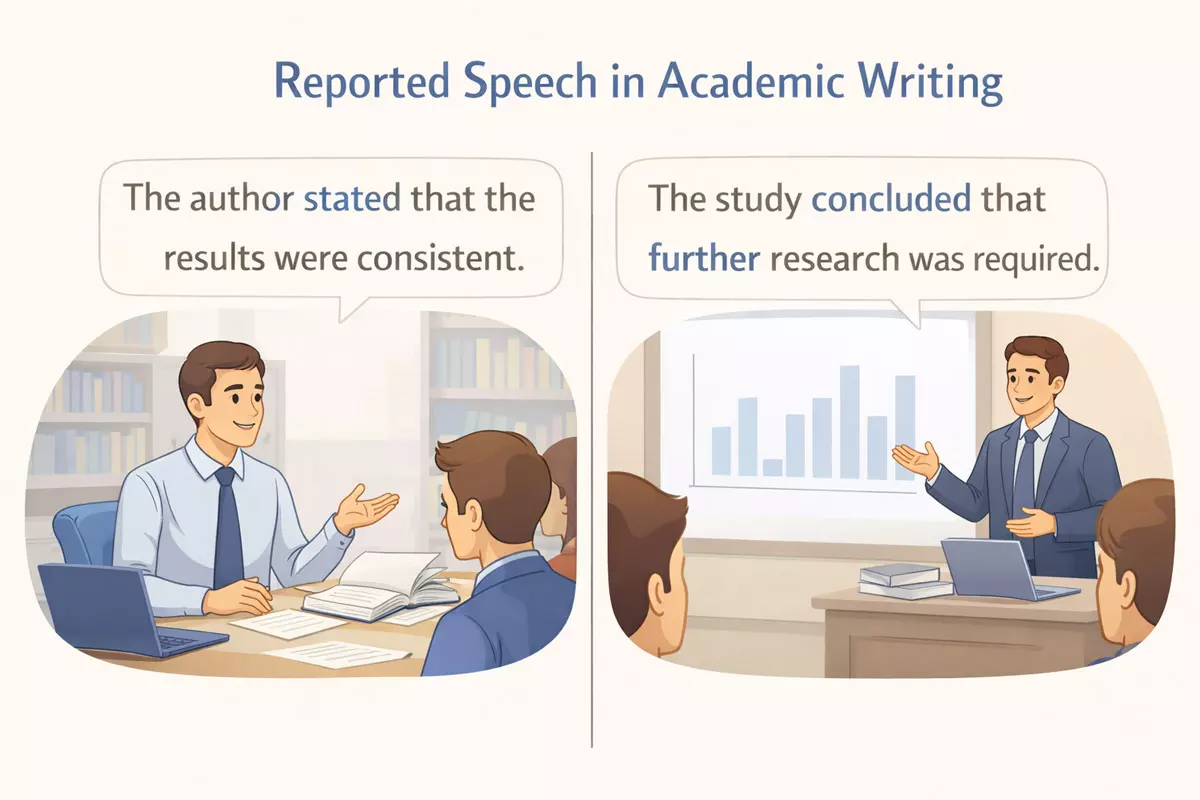 Here we the use of reported speech in academic writing, focusing on formal reporting verbs, maintaining objectivity, correct tense usage, and proper citation of sources. It also addresses common stylistic issues in academic reporting.
Accurately conveying others’ ideas is crucial in academic and professional settings, as it ensures information is represented faithfully and maintains the integrity of the original message. Mastering the skill of relaying information secondhand requires careful attention to detail and a clear understanding of context, which helps prevent misinterpretation or distortion. Adhering to established conventions not only promotes clarity but also enhances credibility, making formal communication more effective and reliable.
Purpose of reported speech in academic texts
Academic writing often involves referencing what others have said, written, or concluded. Using reported speech allows writers to integrate outside voices smoothly, which supports arguments, clarifies the relationship between sources, and maintains a formal, objective tone. By paraphrasing or summarizing others' ideas, scholars can demonstrate critical engagement with existing research while avoiding plagiarism.
Key Functions in Scholarly Communication
- Attribution: Clearly indicates whose ideas or findings are being discussed, which maintains transparency.
- Objectivity: Helps present information neutrally, distancing the writer’s voice from the original claim.
- Comparison: Enables the writer to juxtapose different viewpoints or findings without direct citation overload.
- Cohesion: Links the literature to the current discussion, weaving together various sources in a logical narrative.
- Summarization: Condenses lengthy passages or complex arguments into more concise and relevant statements.
- Critical Evaluation: Allows the author to highlight agreement, disagreement, or limitations in previous work.
- Clarification: Offers a way to simplify or rephrase technical content for broader academic audiences.
- Supporting Evidence: Strengthens arguments by grounding them in established research or authoritative statements.
- Distinguishing Voice: Makes it clear when the writer is summarizing others versus presenting original ideas.
- Avoiding Plagiarism: Properly acknowledges sources, which is essential for academic integrity.
Common Patterns and Reporting Verbs
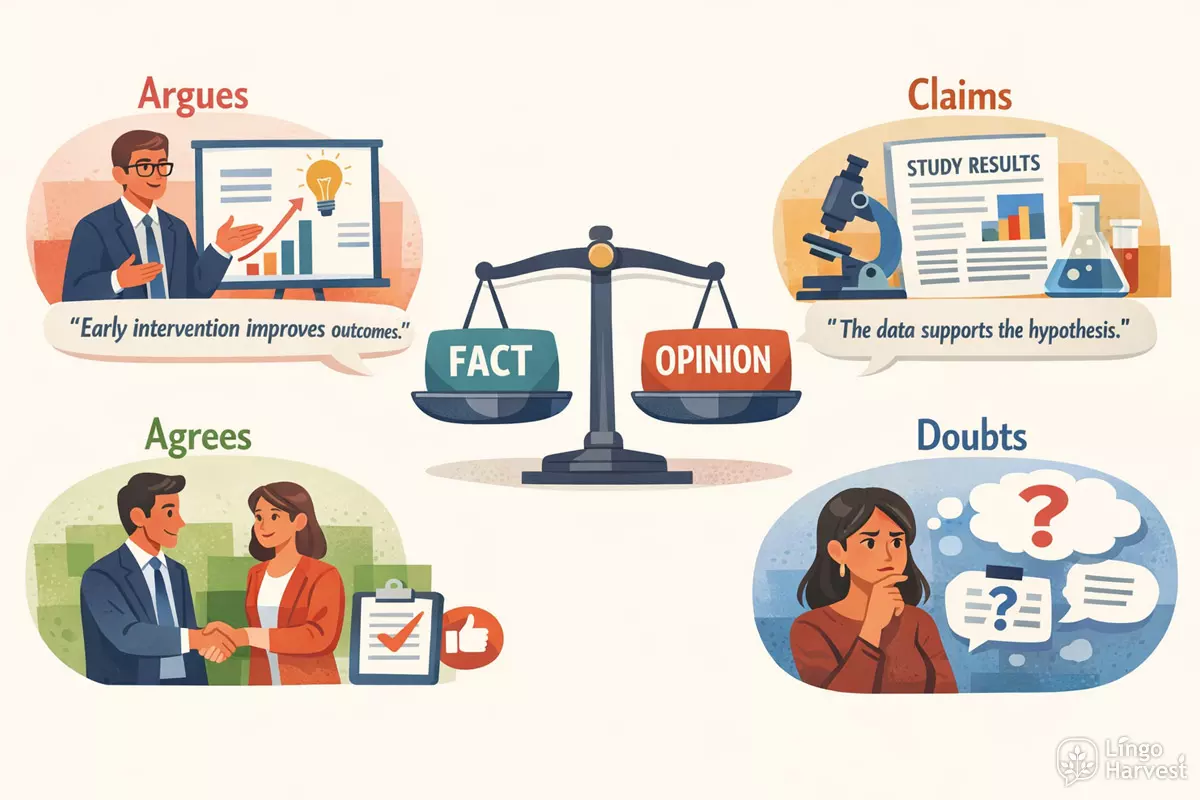
Writers use a range of reporting verbs to signal their relationship with the original material and to convey nuance. Choosing the right verb reflects the writer’s attitude (e.g., agreement, neutrality, doubt) and the nature of the information (e.g., fact, opinion, claim).
- argues → The author argues that early intervention improves long-term outcomes.
- claims → The study claims that the data support the initial hypothesis.
- suggests → The analysis suggests that further research is required.
- states → The report states that funding will be reduced next year.
- notes → The reviewer notes that several variables were not controlled.
- asserts → The witness asserts that the contract was signed under pressure.
- maintains → The company maintains that all procedures were followed correctly.
- points out → The professor points out that the sample size was limited.
- explains → The researcher explains that the anomaly resulted from measurement error.
- observes → The paper observes that similar patterns appear in related studies.
- describes → The article describes how the policy evolved over time.
- reports → The journal reports that several trials were discontinued.
- emphasizes → The author emphasizes that transparency is essential for credibility.
- proposes → The team proposes that a new framework be adopted.
- concludes → The study concludes that the treatment is both safe and effective.
- contends → The critic contends that the theory lacks empirical support.
- speculates → The commentator speculates that political pressure influenced the decision.
- finds → The investigation finds that compliance rates remain low.
- warns → The report warns that delays could undermine public confidence.
- reveals → The audit reveals that several accounts were improperly managed.
Direct vs. Indirect Reporting
Writers must decide whether to use direct quotations or indirect (reported) speech. Each method serves different functions and has distinct stylistic implications:
| Direct Speech | Reported Speech |
|---|---|
| Uses the exact words of the original author | Paraphrases or summarizes the original message |
| Typically enclosed in quotation marks | No quotation marks; often uses reporting verbs |
| Emphasizes precision or unique phrasing | Emphasizes interpretation or relevance to the new context |
| Best for definitions, striking statements, or controversies | Best for integrating information smoothly and concisely |
Ultimately, reported speech is fundamental for connecting scholarly work to the broader academic conversation, enabling writers to build upon, critique, and synthesize existing knowledge in a clear and ethical manner.
Formal reporting verbs and structures
Academic and formal writing often relies on precise verbs to introduce reported information. Selecting the right reporting verb clarifies the relationship between the source and the writer’s stance, indicating whether the original idea is being summarized, questioned, or critically evaluated. In scholarly contexts, these verbs help convey nuance and strengthen credibility.
Common Reporting Verbs in Academic Contexts
Writers use a wide range of verbs to attribute ideas, research findings, or arguments to other scholars. Each verb can subtly change the meaning of the sentence, so it is important to choose one that accurately reflects the original intent. Here are some widely used reporting verbs:
- acknowledge → The author acknowledges that the sample size was limited.
- question → The researcher questions whether the results can be generalized.
- challenge → The paper challenges the assumption that motivation is purely intrinsic.
- endorse → Several scholars endorse the proposed classification system.
- verify → The study verifies that the findings are statistically significant.
- document → The article documents how language use has evolved over time.
- identify → The analysis identifies several key factors influencing performance.
- measure → The experiment measures how stress affects decision-making.
- compare → The review compares results across three independent studies.
- evaluate → The researcher evaluates the effectiveness of the new intervention.
- attribute → The author attributes the discrepancy to methodological differences.
- interpret → The paper interprets the data as evidence of cognitive decline.
- classify → The study classifies responses into four distinct categories.
- trace → The historian traces the origins of the concept to early theories.
- define → The article defines creativity as a multidimensional construct.
- summarize → The conclusion summarizes the main implications of the findings.
- critique → The reviewer critiques the methodology for lacking transparency.
- justify → The author justifies the choice of variables used in the model.
- replicate → The team replicates the experiment to confirm earlier results.
- generalize → The study generalizes the findings to broader educational contexts.
Patterns for Reporting Speech and Ideas
Academic writers frequently use specific structures to express reported speech or ideas. These structures can involve direct or indirect speech, but formal writing typically favors indirect forms. Some common patterns include:
- Author + reporting verb + (that) + clause: Smith argues that the data supports the hypothesis.
- It + passive reporting verb + (that) + clause: It is suggested that further research is needed.
- According to + source, + clause: According to Jones (2020), the results were inconclusive.
- Reporting verb + noun phrase: The study highlights the importance of early intervention.
Comparing Reporting Verbs by Function
Different verbs serve different functions, such as presenting facts, expressing doubt, or evaluating evidence. Understanding these distinctions helps writers choose the most appropriate term for each context.
| Function | Examples of Reporting Verbs |
|---|---|
| Presenting facts or information | state, report, describe, note |
| Expressing opinion or stance | argue, claim, assert, contend |
| Suggesting or implying | suggest, imply, indicate, propose |
| Evaluating or emphasizing | emphasize, highlight, stress, point out |
| Questioning or doubting | question, challenge, doubt |
Tips for Using Reporting Structures Effectively
- Select verbs that match the intention of the original source (e.g., “claim” for controversial statements, “report” for neutral findings).
- Avoid overusing a single verb—variety makes writing clearer and more engaging.
- Be cautious with verbs that imply judgment or doubt, as they can change the perceived reliability of the source.
- Use passive structures when the actor is unknown or unimportant: It has been demonstrated that…
- When summarizing multiple sources, group ideas using neutral verbs like “state” or “report.”
Mastering these verbs and sentence patterns is essential for clear, objective, and effective academic communication. They help writers accurately reflect sources and maintain a formal tone throughout their work.
Maintaining objectivity and distance
Academic and formal writing often uses reported speech to present information in a neutral, measured way. This approach helps writers avoid personal bias, ensuring that arguments are based on evidence rather than individual opinions. By reporting what others have said, claimed, or argued, authors can introduce a range of perspectives and demonstrate critical engagement with existing research, all while keeping their own stance understated.
How reported speech supports a neutral tone
Using reported speech allows writers to describe others’ viewpoints without directly endorsing or challenging them. This technique is especially valuable when analyzing controversial topics or summarizing a variety of scholarly positions. By shifting the focus from the writer to the source, the language remains impersonal and objective.
- “Smith (2021) suggests that…” instead of “I think…”
- “According to recent studies,…” avoids direct involvement
- “It has been argued that…” keeps the writer at a distance
- “The data indicate…” focuses on evidence, not opinion
- “Researchers have found…” generalizes findings
- “The results appear to support…” implies careful interpretation
- “It is claimed that…” presents information without bias
- “Some scholars believe…” introduces alternative views
- “The author maintains that…” attributes the stance clearly
- “The study reports a correlation…” avoids speculation
- “It has been suggested…” uses passive voice for neutrality
- “Evidence shows that…” highlights data over opinion
Direct vs. indirect reporting: effects on objectivity
Choosing between direct and indirect reported speech can subtly influence the level of detachment in writing. Indirect forms, in particular, help writers maintain a formal distance, while direct quotes may still introduce a trace of the original speaker’s emotion or style.
| Form | Effect on Objectivity |
|---|---|
| Indirect reported speech (e.g., Smith stated that the results were inconclusive.) |
Enhances neutrality by paraphrasing and filtering out subjective language. |
| Direct quotation (e.g., Smith said, "The results are inconclusive.") |
Retains the original voice, which may introduce tone or bias from the source. |
| Passive constructions (e.g., It has been argued that...) |
Removes focus from the agent, increasing the sense of impartiality. |
| Attribution to groups (e.g., Researchers have found...) |
Generalizes claims and distances the writer from individual views. |
Summary
Writers in academic or professional contexts use reported speech to introduce evidence, summarize debates, and present different viewpoints without overtly aligning themselves with any side. Strategic use of reporting verbs, passive voice, and indirect phrasing ensures that the writing remains measured and credible, fostering trust and clarity for readers.
Tense usage in academic reporting
Choosing the right tense is essential for clarity and precision when presenting reported information in academic and formal writing. The selection of tense often signals whether the information is considered a general truth, an established finding, or a context-specific observation. This careful use of verb tenses helps readers distinguish between current consensus, previous research, and ongoing debates.

Common tense choices in reporting research
Writers frequently use different tenses depending on the context and purpose of the statement. For example, the present simple is used for general truths or widely accepted knowledge, while the past simple often introduces specific studies or completed research. The present perfect can connect past research to the present context. The following list highlights typical patterns:
- Present simple: "Smith argues that..." (for current beliefs or accepted theories)
- Past simple: "Jones (2015) found that..." (for completed, dated studies)
- Present perfect: "Researchers have suggested that..." (for ongoing or recent research trends)
- Past perfect: "By 2010, several studies had established..." (for background context relative to another past event)
- Present continuous: "Several authors are investigating..." (for ongoing research activities)
- Modal verbs: "It has been proposed that..." (for tentative or debated claims)
- Present simple passive: "It is believed that..." (for general statements where the actor is unknown or unimportant)
- Past simple passive: "It was demonstrated that..." (for specific results by unnamed researchers)
- Future: "Further studies will examine..." (for anticipated work or implications)
- Present perfect passive: "It has been shown that..." (for results relevant to the current discussion)
Comparing tense use for different reporting functions
Different reporting tasks in scholarly writing require attention to how time and evidence are presented. The table below outlines common scenarios and their preferred verb tense, helping writers make informed choices.
| Reporting Function | Typical Tense | Example |
|---|---|---|
| General knowledge or theory | Present simple | “The theory states that...” |
| Specific past study/result | Past simple | “Lee (2017) discovered that...” |
| Ongoing area of inquiry | Present continuous | “Researchers are exploring...” |
| Research with present relevance | Present perfect | “Studies have shown that...” |
| Background before a past event | Past perfect | “Earlier work had indicated...” |
| Future research or implications | Future simple | “Further research will address...” |
Practical tips for tense consistency
- Maintain the same tense within a reporting sequence unless a shift in time or context is required.
- Use the past tense for reporting specific studies or experiments, even if the work remains influential.
- Adopt the present tense for established facts, current theories, or widely accepted ideas.
- Apply the present perfect to connect previous research to ongoing discussions or trends.
A clear understanding of tense use in reporting not only enhances readability but also demonstrates a writer’s awareness of academic conventions. Consistency, precision, and appropriateness in tense choice are hallmarks of effective scholarly communication.
Citing opinions and research statements
When integrating others’ viewpoints or findings into academic or formal writing, it is essential to present these sources accurately and objectively. Reported speech is a central tool for referencing arguments, theories, or empirical results, enabling writers to distinguish their own analysis from those of others. This practice not only strengthens credibility but also shows engagement with the scholarly conversation.
Common Patterns for Presenting Sources
Writers often rely on specific grammatical structures to attribute information. These structures clarify whose perspective is being represented and whether the statement is direct or indirect. Here are some typical patterns:
- Author (year) + reporting verb + that-clause: Smith (2020) argues that the data support the hypothesis.
- Reporting verb + that-clause (author at end): It has been suggested that climate change is accelerating (Jones, 2021).
- Passive structure: It is believed that the policy will have widespread effects.
- Noun phrase: According to recent research, early intervention is effective.
Direct vs. Indirect Reporting
Writers must decide whether to quote directly or paraphrase. Direct quotations provide precise wording, while indirect speech allows for summarizing or restating the original idea. Both have their place in scholarly texts, depending on the context and the importance of the exact phrasing.
| Reporting Type | Example |
|---|---|
| Direct Quotation | Smith (2019) states, “The results are inconclusive.” |
| Indirect (Reported) Speech | Smith (2019) states that the results are inconclusive. |
| Summary | Smith (2019) concludes that more research is needed. |
| Reporting Uncertainty | Smith (2019) suggests that the evidence may be insufficient. |
Tips for Effective Academic Attribution
- Always make it clear whose idea or finding is being referenced.
- Vary reporting verbs and structures to avoid monotonous writing.
- Be precise with dates and author names to maintain academic rigor.
- Use indirect speech to paraphrase or condense longer passages.
- Reserve direct quotations for particularly significant or eloquent statements.
Mastering these conventions enables writers to participate confidently in formal discourse, accurately representing others’ contributions while developing their own arguments.
Common stylistic issues
Academic and formal writing often requires careful handling of indirect quotations. Writers frequently encounter pitfalls when converting direct statements into indirect ones, especially in maintaining clarity, accuracy, and appropriate tone. Below, we examine several recurring challenges and mistakes associated with reported speech in scholarly contexts.
Frequent mistakes in reported speech
- Tense inconsistency: Shifting tenses incorrectly when reporting statements can confuse readers. For example, using present tense in the reporting clause with a past event often creates ambiguity.
- Pronoun ambiguity: Unclear referents for pronouns like "he," "she," or "they" may leave readers guessing who is being discussed.
- Overuse of reporting verbs: Relying too heavily on "said" or "stated" instead of varying with verbs like "argued," "suggested," or "claimed" can make writing repetitive and dull.
- Loss of original meaning: Failing to accurately capture the original intent or nuance of the quoted material when paraphrasing or summarizing.
- Incorrect word order: Especially for questions or requests, word order often needs adjustment to fit indirect speech conventions.
- Punctuation errors: Misplacing commas, quotation marks, or omitting necessary commas after introductory reporting phrases.
- Neglecting academic tone: Using casual or conversational phrasing when a more formal approach is expected.
- Inadequate attribution: Omitting the reporting clause, which can make it unclear whose idea is being discussed.
- Improper modal verb usage: Confusing "can" with "could," or "will" with "would," resulting in an inaccurate reflection of the original statement.
- Unnecessary repetition: Repeating the original words too closely instead of synthesizing or integrating them into the writer's own narrative.
Comparison of direct and reported speech forms
| Direct Speech | Reported Speech |
|---|---|
| "The results are significant," she said. | She said that the results were significant. |
| "I will submit the paper tomorrow," he stated. | He stated that he would submit the paper the next day. |
| "Why did the experiment fail?" they asked. | They asked why the experiment had failed. |
| "Please review the data," the supervisor requested. | The supervisor requested that the data be reviewed. |
| "Can we replicate these findings?" the group wondered. | The group wondered whether they could replicate those findings. |
Best practices for clarity and tone
- Ensure the reporting verb matches the intended meaning (e.g., "suggested" for tentative statements, "demonstrated" for evidence-based claims).
- Maintain consistent tense throughout a passage unless a shift is necessary for chronology.
- Double-check pronoun references after changing sentence structure.
- Introduce reported statements with clear attribution to avoid confusion about authorship or perspective.
- Revise for conciseness, integrating indirect quotes smoothly into the surrounding text.
Attention to these aspects helps maintain the precision, credibility, and coherence expected in scholarly and professional writing.
Homework: Tense Usage in Academic Reporting
Choose the most appropriate tense for academic reporting. Focus on the difference between general truths (often present), specific past studies (often past), and research with current relevance (often present perfect). Use the context clues in each sentence.
Exercise 1: Choose the best tense for reporting research
| Smith (2018) ________ that the sample size was too small. | (A) argues (B) argued (C) has argued |
| Several studies ________ that early intervention improves outcomes. | (A) show (B) showed (C) have shown |
| In 2015, Lee ________ that the method reduced errors by 20%. | (A) finds (B) found (C) has found |
| Researchers ________ the long-term effects of the treatment. | (A) investigate (B) are investigating (C) investigated |
| By 2010, earlier work ________ that the model was incomplete. | (A) indicates (B) had indicated (C) has indicated |
| It ________ that bilingualism supports cognitive flexibility. | (A) is believed (B) was believed (C) has been believed |
| Recent meta-analyses ________ that the findings are robust across contexts. | (A) suggested (B) have suggested (C) suggest |
| Garcia (2022) ________ a significant correlation between stress and sleep quality. | (A) reported (B) reports (C) has reported |
| It ________ that the data were collected under controlled conditions. | (A) is demonstrated (B) was demonstrated (C) has demonstrated |
| Further studies ________ the limitations of this approach. | (A) will examine (B) examined (C) have examined |
Show answers
- B
- C
- B
- B
- B
- A
- B
- A
- B
- A
Exercise 2: Select the most natural academic reporting option
| The theory ________ that language shapes perception. | (A) states (B) stated (C) has stated |
| In their 2009 paper, the authors ________ that the effect was temporary. | (A) conclude (B) concluded (C) have concluded |
| Multiple scholars ________ that the term is used inconsistently. | (A) note (B) noted (C) have noted |
| It ________ that the results are applicable beyond the original sample. | (A) is suggested (B) was suggested (C) had suggested |
| Over the last decade, researchers ________ increasing interest in mixed methods. | (A) observed (B) have observed (C) observe |
| By the time the policy was introduced, several studies ________ similar outcomes. | (A) established (B) had established (C) have established |
| Johnson (2016) ________ that the instrument required calibration before use. | (A) explains (B) explained (C) has explained |
| It ________ that participants gave informed consent. | (A) is confirmed (B) was confirmed (C) has confirmed |
| Current work ________ how these variables interact in real settings. | (A) investigates (B) is investigating (C) investigated |
| The literature ________ that the mechanism remains unclear. | (A) indicates (B) indicated (C) has indicated |
Show answers
- A
- B
- A
- A
- B
- B
- B
- B
- A
- A