Formal vs Informal Usage of Reported Speech Compared

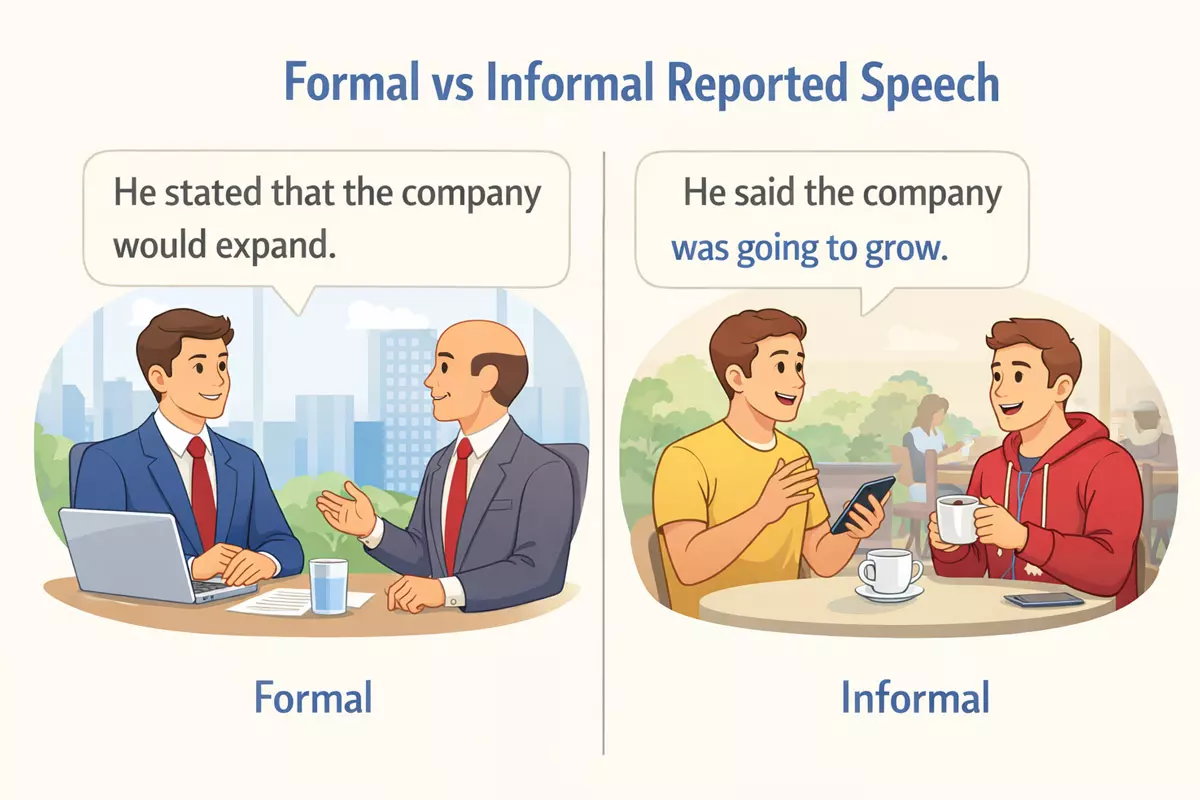 The article outlines how formal and informal reported speech differ, focusing on verb choice, sentence structure, tense use in conversation, ellipsis, contrasts between writing and speaking, and typical points of confusion for learners.
Relaying what others have said can be challenging, particularly as the tone and context often differ between professional settings and casual conversations. In formal environments, indirect speech tends to be more precise and respectful, carefully maintaining the intent and tone of the original speaker while avoiding direct quotations. In everyday conversations, however, indirect speech is usually more relaxed, and people may paraphrase or summarize freely, focusing on the main idea rather than the exact wording. Recognizing these differences helps ensure clear and appropriate communication in any context.
Key differences between formal and informal usage
When comparing how reported speech is used in formal versus informal settings, several distinctions become clear. The way speakers select reporting verbs, adjust verb tenses, and structure quotations can shift based on the context and their relationship with the audience. Formal contexts, such as academic writing or professional communication, typically follow stricter grammatical conventions, whereas casual conversation allows for more flexibility and less rigid adherence to rules.
Vocabulary and Structure
One of the most noticeable contrasts lies in the choice of reporting verbs and the structure of sentences. Formal language favors precise and varied reporting verbs and tends to avoid contractions or colloquialisms. Informal speech, on the other hand, often relies on simpler verbs and direct forms.
| Feature | Formal Usage | Informal Usage |
|---|---|---|
| Reporting Verbs | States, claims, explains, asserts, remarks, suggests | Says, tells, asks, goes, is like |
| Verb Tense Shifts | Consistent backshifting (e.g., "He said he was coming") | Often keeps original tense (e.g., "He said he's coming") |
| Pronoun Usage | Maintains third person or neutral forms | Frequent use of first and second person; more direct references |
| Quotation | Indirect speech preferred; minimal direct quoting | Direct speech or mixed forms common |
| Contractions & Slang | Rarely used; avoided for clarity | Common; "didn't," "wasn't," "gonna," etc. |
| Detail & Precision | Greater detail, nuance, and careful attribution | Summarized or paraphrased; less attribution |
Common Patterns and Examples
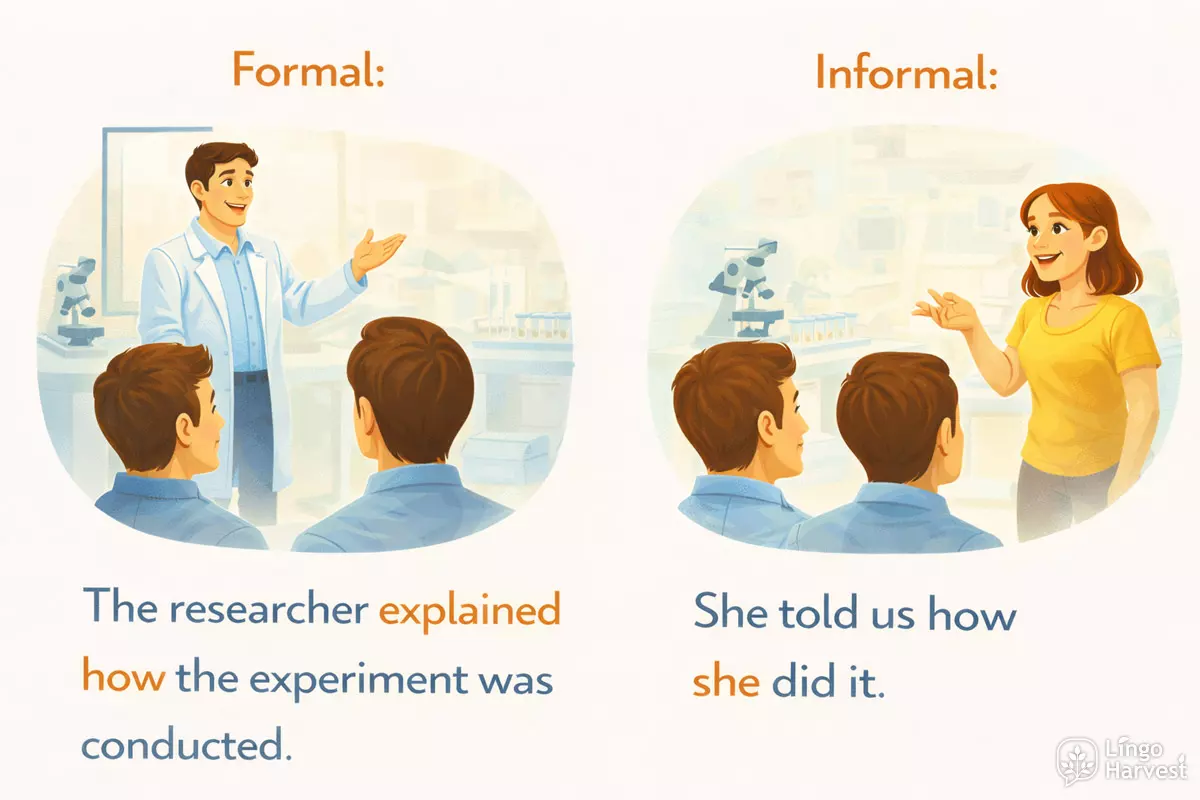
- Formal: She stated that the results were inconclusive.
- Informal: She said the results weren’t clear.
- Formal: The manager requested that the documents be submitted by Friday.
- Informal: The boss said to send it by Friday.
- Formal: The researcher explained how the experiment was conducted.
- Informal: She told us how she did it.
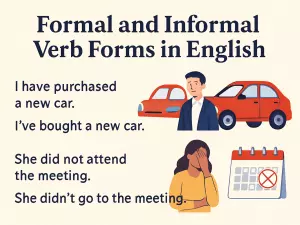
- Formal: No contractions: "He did not attend the meeting."
- Informal: Frequent contractions: "He didn't go to the meeting."
- Formal: Avoids slang: "The proposal was rejected."
- Informal: May use slang: "They shot down the idea."
Context and Audience
The context determines which style is appropriate. In academic journals, business reports, or official correspondence, indirect speech and formal vocabulary dominate. In everyday conversations, text messages, or casual storytelling, people default to shorter sentences, direct speech, and even mimicry ("She was like, 'No way!'").
Understanding these distinctions can help you shift your reporting style to suit the situation, ensuring your message is both clear and appropriate for your listeners or readers.
Verb choice and sentence structure
The way we report what someone else has said changes depending on how formal or informal the context is. In more official settings, people tend to use standard reporting verbs and carefully structured sentences. By contrast, everyday conversations often feature simpler verbs and more relaxed sentence constructions.
Common reporting verbs: formal vs informal
- Formal: state, declare, announce, explain, inform, assert, remark, indicate, confirm, emphasize
- Informal: say, tell, ask, go (as in "He goes..."), be like, mention, add, point out, note, claim, reply
In formal English, reporting verbs are usually followed by a that-clause, and the sentence structure remains closer to written standards. Informal usage often drops "that" and may use more direct or conversational phrasing.
Sentence structure differences
- Formal speech typically follows subject + reporting verb + (that) + reported clause.
Example: She stated that the meeting would begin at noon. - Informal speech may omit "that" and use contractions or colloquial expressions.
Example: She said the meeting's at noon. - In casual conversation, people sometimes use "like" or "go" as reporting verbs.
Example: He was like, "I can't believe it!"
Side-by-side comparison
| Formal Usage | Informal Usage |
|---|---|
| He stated that he would attend the conference. | He said he'd go to the conference. |
| She informed us that the deadline had been extended. | She told us the deadline got pushed back. |
| They announced that the results would be published soon. | They said the results are coming out soon. |
| He requested that I submit the report by Monday. | He asked me to send the report by Monday. |
Other features to notice
- Formality often requires backshifting tenses (e.g., "She said she was coming"), while in informal settings, speakers sometimes keep the original tense.
- Pronoun and time reference changes are more strictly followed in formal contexts.
- Informal reporting may use direct speech or paraphrase freely.
Choosing the right reporting verb and sentence type helps convey the appropriate tone and clarity for your audience, whether in a business report or chatting with friends.
Tense flexibility in informal speech
In everyday conversations, speakers often relax the strict grammar rules that are more common in formal settings. One key area where this happens is with the choice of tense in reported speech. Whereas formal English tends to follow established sequence of tenses (for example, shifting “I am going” to “he said he was going”), casual interactions frequently skip these tense changes, especially when the original statement is still true or the context is clear to both parties.
Common patterns in casual reported speech
Native speakers often keep verbs in the present tense, even after past reporting verbs like “said” or “told.” This is especially true for recent events, general truths, or when retelling something that feels current or relevant. The flexibility allows for quicker, more natural exchanges without worrying about perfect grammatical formality.
- “She said she’s coming later.” (instead of “she was coming”)
- “He told me he needs help.” (not “needed”)
- “They said it’s raining.” (not “it was raining”)
- “You said you want pizza, right?”
- “My mom said she doesn’t mind.”
- “He said he’s tired.”
- “She told me she can’t make it.”
- “They said they’re on their way.”
- “You said you have the keys?”
- “He said he’ll call me.”
- “She said she likes this movie.”
- “He told me he has to go.”
- “They said they forgot.”
- “You said you finished already?”
- “He said he’s not sure.”
Why speakers skip tense shifts
People tend to prioritize clarity and speed over strict grammatical accuracy in informal contexts. If the listener understands the meaning, there's little pressure to backshift tenses. This habit is especially strong when the reported information feels current, unchanged, or is a well-known fact.
| Formal Usage | Informal Usage |
|---|---|
| She said she was busy. | She said she’s busy. |
| He told me he had finished. | He told me he’s finished. |
| They said they would come. | They said they’ll come. |
| I thought you wanted tea. | I thought you want tea. |
It’s important to note that while this relaxed approach is widely accepted in speech, it may be considered inappropriate in formal writing or official contexts. Still, understanding these flexible patterns is essential for natural-sounding, fluent spoken English.
Ellipsis and simplification in conversation
In everyday speech, people often shorten their sentences and leave out words that would be required in more formal or written contexts. This tendency to drop elements—like auxiliary verbs, pronouns, or reporting verbs—is especially noticeable when relaying what others have said. Such informal strategies make exchanges quicker and more efficient, but they also result in structures that differ significantly from standard reported speech.
Common Patterns and Examples
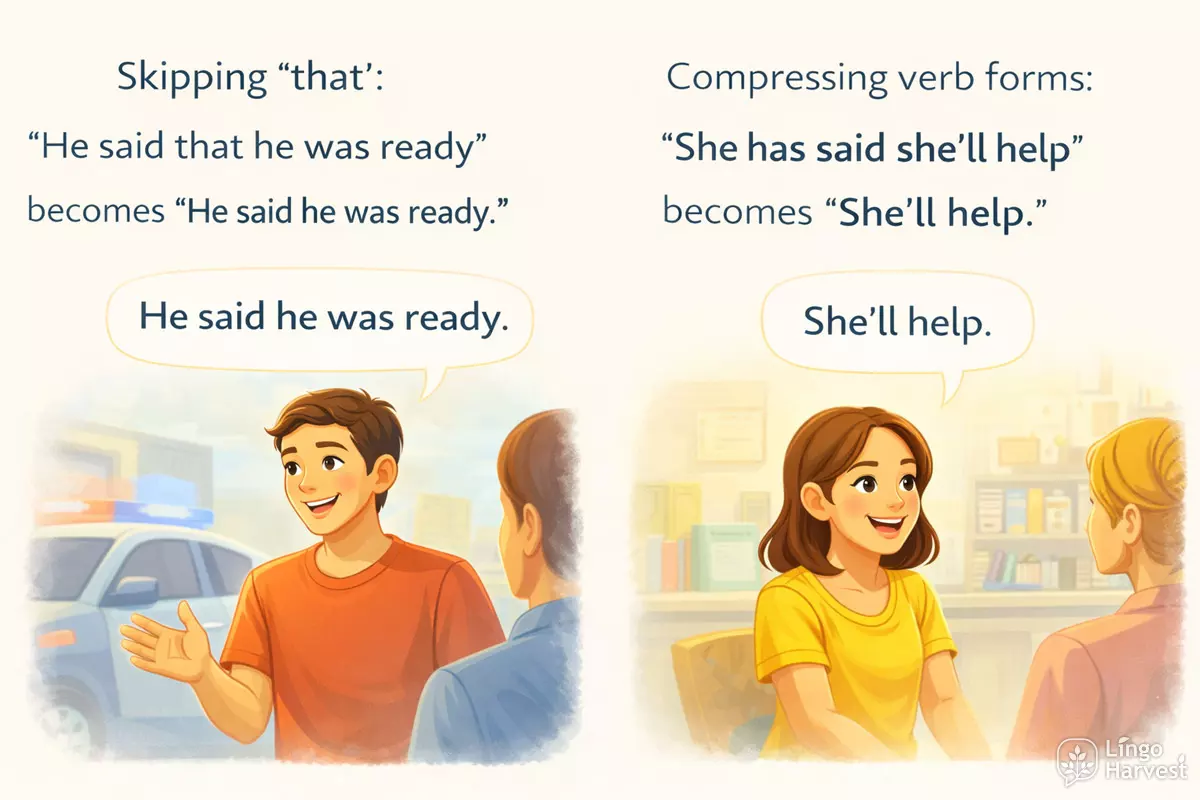
Speakers regularly omit or condense parts of reported speech. Here are some typical ways this occurs in conversation:
- Leaving out the reporting verb: “She said she’d come” becomes “She’ll come.”
- Dropping pronouns: “I told him I was tired” becomes “Told him I was tired.”
- Skipping ‘that’: “He said that he was ready” becomes “He said he was ready.”
- Compressing verb forms: “She has said she’ll help” becomes “She’ll help.”
- Using direct speech for indirect meaning: “He goes, ‘I’m late’.”
- Short answers: “Did she say yes?” “Said yes.”
- Omitting subjects in responses: “Asked if coming.”
- Replacing full clauses with a single word: “Promised.”
- Using gestures or tone instead of words to imply the reporting verb.
- Relying on context to fill in missing information: “Coming later.”
- Eliding auxiliary verbs: “She’s coming” becomes “She coming.” (very informal)
- Abbreviating indirect questions: “Wondered why.”
- Swapping full forms for contracted or reduced forms: “Would have” becomes “Would’ve.”
- Leaving out time references when obvious: “Told you.”
- Dropping modal verbs: “Might join us” instead of “She said she might join us.”
Comparison: Formal vs. Informal Usage
The contrast between formal and conversational approaches is clear when comparing full reported speech structures with their everyday counterparts. The following table highlights some of the most common differences:
| Formal Reported Speech | Informal Conversation |
|---|---|
| She said that she would be late. | She’ll be late. |
| I asked him if he could help me. | Asked if he could help. |
| They told us they were leaving. | They’re leaving. |
| He mentioned that he had finished. | Finished, he said. |
| She replied that she was busy. | Busy, she said. |
| He said that he didn't know. | Didn’t know. |
| She asked whether it was ready. | It ready? |
Why Do Speakers Simplify?
Speed and efficiency are the main motivations behind these condensed forms. In face-to-face interaction, context fills in many gaps, so listeners can easily infer what was meant even when elements are left out. This flexibility is one of the defining features of informal spoken English, setting it apart from written or formal speech, where clarity and completeness are prioritized.
Ultimately, understanding these conversational shortcuts is key for both effective communication and accurate interpretation of everyday English.
Formality in writing vs speaking
How we relay what others have said often depends on whether we are communicating through written or spoken language. Written communication tends to favor more structured, precise, and formal constructions when reporting speech, while everyday conversation usually relies on simpler, more direct forms. This difference affects both the vocabulary we choose and the grammatical patterns we use.
Key distinctions between written and spoken reported speech
- Written language often uses full reporting clauses, such as “He stated that…” or “She explained that…”, whereas spoken language frequently opts for shorter forms like “He said…” or even drops the reporting verb after the first mention.
- In formal writing, tense shifts and backshifting (e.g., “says” becomes “said”; “am” becomes “was”) are carefully observed. In conversation, these rules are often relaxed, especially if the context is clear.
- Pronouns and references are chosen more carefully in text to avoid ambiguity, while in speech, gestures and context fill in many gaps.
- Spoken English allows for interruptions, fillers (“um,” “like”), and informal tags (“you know,” “right?”), which are generally omitted in formal writing.
- Use of direct speech (“She said, ‘I’m leaving now.’”) is more common in narratives and storytelling, while indirect speech (“She said she was leaving.”) is standard in reports and academic writing.
- Colloquialisms and contractions (“He’s gonna go”) are typical in speech but usually avoided in formal documents.
Common reporting verbs and phrases: formal vs informal
| Formal (Writing) | Informal (Speaking) |
|---|---|
| stated | said |
| asserted | went on |
| explained | told |
| informed | was like |
| reported | went |
| mentioned | brought up |
| claimed | said to me |
| remarked | goes |
| declared | told me |
| pointed out | was all |
Grammar and style: what to watch for
Writers are expected to maintain clarity and avoid ambiguity by using complete sentences and formal connectors when reporting speech. For example, “The spokesperson stated that the event would be postponed.” In contrast, speakers may use fragments, informal linking words, or even mimic the original speaker’s tone: “He was like, ‘We’re not doing it today.’”
Finally, while correctness and clarity are priorities in written forms, naturalness and efficiency often guide spoken choices. Adjusting your use of reported speech to fit the context—whether in a business email or a casual chat—helps ensure your message is both appropriate and effective.
Typical learner confusion
Learners often stumble when deciding whether to use formal or informal reported speech. The difference isn’t always obvious, especially since both can sometimes appear in similar contexts. Complicating matters, textbooks and real-life conversations don’t always match up, which can leave students feeling uncertain about which form sounds natural or appropriate.
Common areas where students get mixed up
- Verb tense backshifting: Deciding when to shift tenses, particularly in formal writing, versus when to keep present tenses in more casual situations.
- Choice of reporting verbs: Knowing when to use "said," "told," or more formal verbs like "stated" or "announced."
- Pronoun changes: Remembering to adjust pronouns so the meaning stays clear, especially when the original speaker and the reporter are different people.
- Direct vs. indirect structures: Confusion about when to use exact words (direct speech) or paraphrase (reported speech), especially in informal chat.
- Omission of "that": Understanding when dropping "that" is acceptable and when it’s required for clarity or formality.
- Use of modals: Learners may not be sure if modals like "can" or "will" should be backshifted ("could," "would") in less formal reporting.
- Questions and word order: Struggling to form reported questions correctly, especially when the word order changes between formal and informal English.
- Politeness and distance: Judging how much to soften or distance the original statement, particularly in business or academic contexts.
- Mixed registers in one sentence: Accidentally combining formal and informal elements, creating awkward or unnatural phrasing.
- Colloquial contractions: Uncertainty about using contractions ("he'd said," "they're telling") in reported speech, especially in writing.
- Reporting general truths: Not realizing that some statements (like facts) often don’t require tense changes, regardless of register.
- Idiom and slang transfer: Difficulty knowing if idioms or slang from direct speech can be carried over into reported speech, and whether to adjust them for formality.
Formal vs. informal reporting: patterns at a glance
| Formal Usage | Informal Usage |
|---|---|
| He stated that he would arrive at noon. | He said he’d be here at noon. |
| They announced that the event had been postponed. | They said the event’s off. |
| She requested that I submit the report by Friday. | She asked me to get the report in by Friday. |
| It was reported that sales had increased. | They said sales went up. |
| He inquired whether assistance was available. | He asked if anyone could help. |
| She explained that the changes were necessary. | She said the changes had to happen. |
| They confirmed that delivery would occur on Monday. | They said it’s coming Monday. |
| He indicated that further discussion was required. | He said we need to talk more. |
Why these issues persist
A lot of confusion stems from exposure to mixed models: classroom English tends to emphasize more formal structures, while most real-world interactions—especially among friends or online—favor informal patterns. Learners may also overcorrect, using overly formal language in casual situations or, conversely, slipping into informal habits in academic or professional settings. Exposure to more examples, along with practice distinguishing context and register, can help clear up these persistent misunderstandings.