Using Passive Voice in Reported Speech Correctly

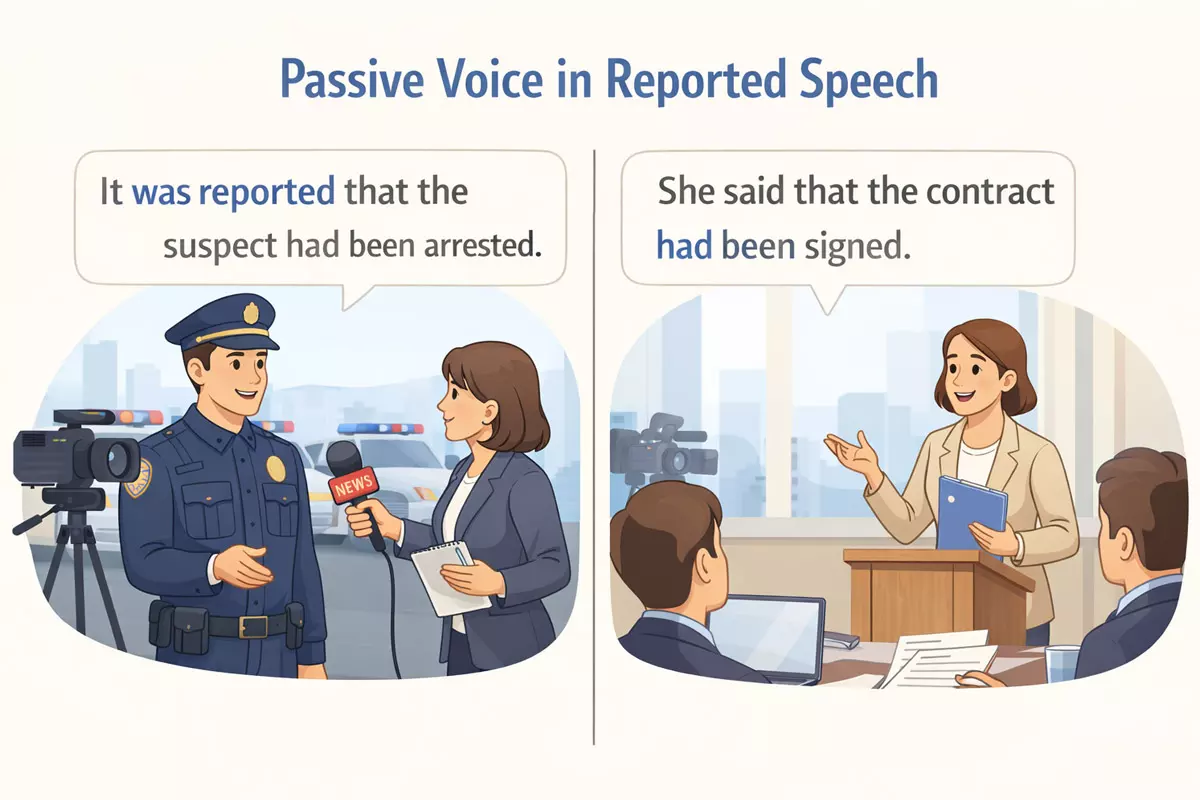 This article explains the reasons for using passive voice in reported speech, how to form passive structures in indirect reporting, and when to shift focus from the agent to the action.
Mastering the art of transforming statements into indirect speech, particularly by using less active sentence structures, is a valuable skill that can enhance the polish and objectivity of your writing. By focusing on indirect speech, you are able to report information in a way that is both clear and professional, which is especially important in academic and formal contexts. Developing this ability not only improves your communication but also helps you convey information more effectively and with the appropriate level of formality.
Why passive voice is used in reported speech
Passive constructions are a practical choice in indirect speech when the focus needs to shift away from who performed an action to what happened or to the recipient of the action. This helps speakers and writers avoid naming the agent, which is especially useful if the agent is unknown, unimportant, or obvious from context. Passive voice can also make sentences sound more objective or formal, which is often preferred in academic, news, or official contexts.
Shifting Emphasis in Reported Information
One of the main reasons for using passive forms is to emphasize the action or result rather than the person responsible. For example, instead of “They said that someone stole the documents,” you might hear “It was reported that the documents were stolen.” This puts attention on the documents and the action, not on the unnamed individual.
- Agent is unknown: “The window was broken.” (Who did it is not specified.)
- Agent is irrelevant: “The law was changed in 2020.” (Who changed it matters less than the fact it changed.)
- Agent is obvious: “He was arrested.” (By the police, which is assumed.)
- Politeness or tact: “Mistakes were made.” (Avoids blaming anyone directly.)
- Objectivity: “It is believed that…” (Creates formal or academic tone.)
- Focus on results: “The vaccine was developed.” (Highlights the outcome.)
- Generalizations: “It is said that…” (No specific speaker needed.)
- News reporting: “The bill was passed yesterday.”
- Instructions or rules: “Mobile phones are not allowed.”
- Scientific writing: “The experiment was conducted…”
Comparison: Active vs. Passive in Reported Speech

| Active Reported Speech | Passive Reported Speech |
|---|---|
| They claimed that someone had solved the problem. | It was claimed that the problem had been solved. |
| Experts announced that they would review the policy. | It was announced that the policy would be reviewed. |
| People say that the castle is haunted. | It is said that the castle is haunted. |
| Officials confirmed that they found the cause. | It was confirmed that the cause had been found. |
Choosing the passive structure in indirect speech offers flexibility. It allows the speaker to remain neutral, maintain focus on the event or result, and avoid unnecessary repetition of agents or pronouns. This is especially effective in formal, academic, or official communication, where clarity and impartiality are valued.
Forming passive structures in indirect reporting
When reporting what someone has done or said, especially in formal or objective contexts, the passive voice is often useful. Instead of focusing on who performed the action, these structures shift attention to the action itself or its recipient. This is common in news, academic writing, and official statements, where the agent is unknown, unimportant, or deliberately omitted.
Basic Structure of Passive Voice in Reported Speech
The passive in indirect speech typically follows this pattern: It is said that… or Subject + is/are said to + infinitive. These forms help convey information without specifying the original speaker or doer.
- It is believed that the results are accurate.
- The company is reported to have increased profits.
- She is thought to be living abroad.
- The suspect is said to have left the country.
- They are understood to be negotiating a deal.
- He is expected to announce the decision soon.
- The law is considered to be outdated.
- The victim is known to have called the police.
- The team is rumored to be signing a new player.
- The city is believed to be safe at night.
- The project is reported to be behind schedule.
- The policy is thought to benefit everyone.
- The event is said to attract thousands of visitors.
- The manager is known to be strict.
- The results are expected to improve next year.
Transforming Active to Passive in Indirect Reporting
To change an active structure into a passive one for indirect statements, focus on the object or result of the action. This can reduce bias and keep the tone neutral.
| Active (Direct Speech) | Passive (Indirect Reporting) |
|---|---|
| “People say he lied.” | He is said to have lied. |
| “Experts believe the plan will work.” | The plan is believed to work. |
| “They reported that sales increased.” | Sales are reported to have increased. |
| “We expect prices to rise.” | Prices are expected to rise. |
| “People think the project failed.” | The project is thought to have failed. |
Common Reporting Verbs Used in Passive Structures
Certain reporting verbs are frequently used in these constructions. Some of the most typical include: say, report, believe, expect, consider, know, think, suppose, understand, allege, estimate, claim, announce, predict, suggest, rumor. Using passive voice in this way helps you present information in a more objective or impersonal tone. This is especially useful when the source is unknown, or when the focus should be on the information itself rather than who provided it.
Emphasis on action vs agent
When using passive voice in reported speech, the focus often shifts from who performed the action to what was done. This subtle difference can change the way information is received by the reader or listener. Instead of highlighting the person or thing responsible, passive constructions put the result or event at the center. For example, while direct speech might say, “The manager announced the new policy,” reported passive speech would be, “It was announced that a new policy would be implemented.” Here, the announcement itself is what matters, not who made it.
This approach is useful in situations where the agent is unknown, irrelevant, or intentionally left out. In news reports, academic writing, and formal documents, drawing attention to the action instead of the doer can keep the tone objective and impersonal. It also helps avoid assigning blame or credit, which can be important in sensitive scenarios.
When to prioritize the result over the doer
- When the agent is unknown: “The documents were misplaced.”
- If the agent is obvious or unimportant: “The meeting was scheduled for Friday.”
- To maintain neutrality or formality: “It was decided that the contract would be renewed.”
- When reporting general truths or widely accepted facts: “It is believed that the earth orbits the sun.”
- To avoid direct blame: “Mistakes were made during the process.”
- When summarizing group decisions: “It was agreed that changes were necessary.”
- If the subject is less significant than the action: “The law was passed in 2020.”
- For technical or procedural contexts: “The device was assembled according to instructions.”
- To keep the focus on outcomes: “The project was completed ahead of schedule.”
- When highlighting achievements: “A new record was set in the marathon.”
Comparing focus: active vs passive in reported speech
| Active Reported Speech | Passive Reported Speech |
|---|---|
| They said that someone had solved the problem. | It was said that the problem had been solved. |
| The committee confirmed that they would approve the budget. | It was confirmed that the budget would be approved. |
| Experts believe that climate change affects rainfall. | It is believed that rainfall is affected by climate change. |
| The journalist reported that the company launched a new product. | It was reported that a new product was launched. |
As shown above, shifting to passive voice in reported statements moves attention away from the agent and centers it on the event or outcome. This can be especially valuable in formal or objective writing, where the main concern is what happened rather than who did it.
Passive voice in formal contexts
In academic, legal, and scientific writing, the passive structure is often favored to focus on actions or results rather than on the people performing them. This approach can help maintain objectivity, emphasize outcomes, or present information when the doer is unknown or irrelevant. For example, instead of saying “The researchers conducted the experiment,” a formal report might use “The experiment was conducted.” This subtle shift can make texts sound more impartial and authoritative.
Common uses in professional and academic writing
- Describing processes: “The samples were analyzed in the laboratory.”
- Reporting findings: “It was found that the solution reacted quickly.”
- Stating procedures: “Consent forms were distributed to all participants.”
- Summarizing previous work: “The theory was first proposed in 1920.”
- Highlighting results: “A significant increase was observed.”
- Legal or official tone: “The contract was signed by both parties.”
- Impersonal recommendations: “It is recommended that the policy be reviewed.”
- When the agent is unknown: “The data was lost during transmission.”
- Objectivity in scientific texts: “The hypothesis was tested.”
- Instructions and manuals: “The device should be turned off after use.”
Passive voice versus active voice in formal reporting
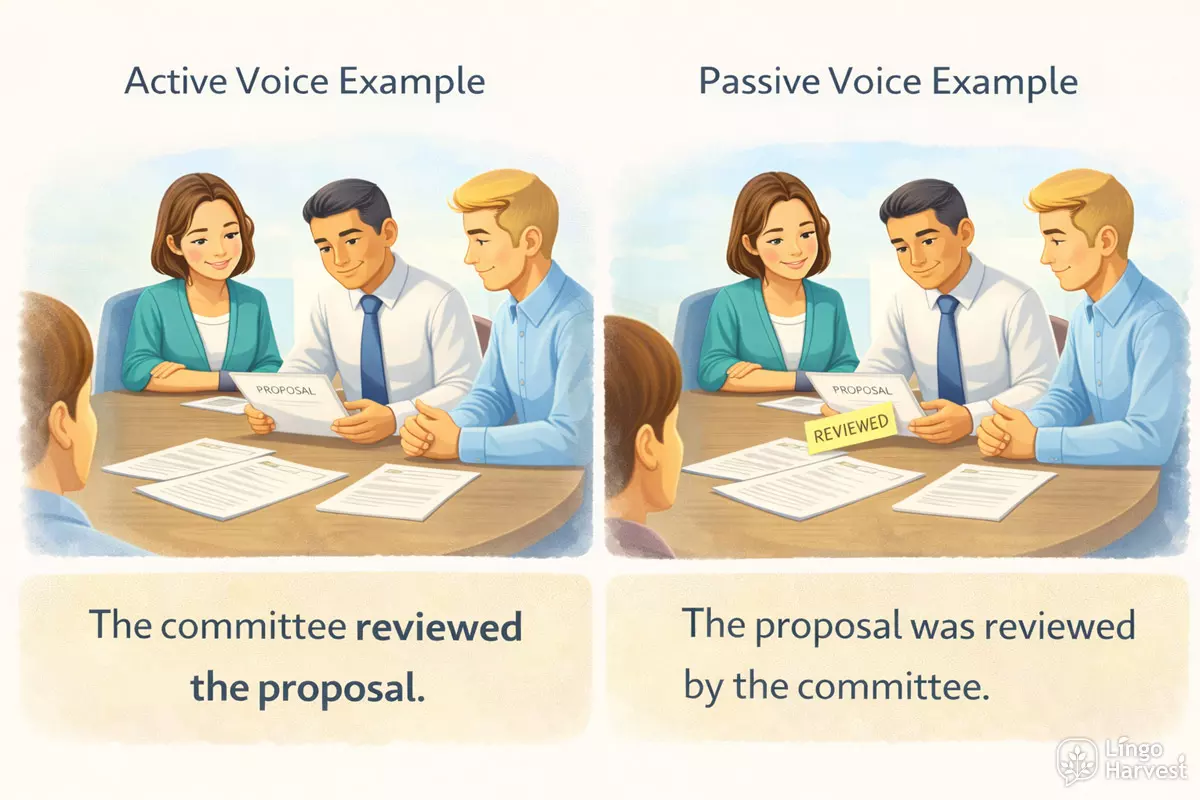
Choosing between passive and active forms depends on the writer’s intent and the context. The passive is particularly useful when the focus should stay on the action or result, not the actor. However, overuse can make writing less direct or harder to read, so a balance is important.
| Active Voice Example | Passive Voice Example |
|---|---|
| The committee reviewed the proposal. | The proposal was reviewed by the committee. |
| Scientists discovered a new element. | A new element was discovered. |
| We analyzed the results. | The results were analyzed. |
| The manager approved the budget. | The budget was approved. |
| They will announce the findings tomorrow. | The findings will be announced tomorrow. |
Points to consider
- Clarity: Make sure the passive structure does not make sentences ambiguous.
- Variety: Mix passive and active forms to keep writing engaging.
- Appropriateness: Use passive alternatives mainly when the actor is less important or unknown.
- Consistency: Maintain a consistent tone within sections of formal documents.
Mastering the use of indirect constructions helps writers produce text that is both professional and objective, especially in formal settings where neutrality is valued.
Combining passive voice with reporting verbs
Understanding how to use reporting verbs in the passive form is essential for clear and formal reported speech. Instead of directly stating who performed the action, English often highlights the information or the action itself, especially in academic or formal contexts. This allows the speaker or writer to focus on the message rather than the source.
Why use passive with reporting verbs?
Passive structures with reporting verbs are useful when the subject is unknown, unimportant, or obvious from context. They also help maintain an impersonal tone, which is common in news reports, scientific writing, and formal communication.
Common reporting verbs used in the passive
Some verbs frequently appear in passive reporting structures. Here are several you’ll encounter in formal English:
- say → It is said that the new law will affect small businesses.
- believe → He is believed to have left the country last night.
- think → She is thought to be working on a new project.
- report → The suspect is reported to have been arrested earlier.
- expect → The company is expected to announce results tomorrow.
- know → The island is known to attract thousands of tourists each year.
- consider → The proposal is considered to be highly controversial.
- understand → The system is understood to operate automatically.
- claim → The document is claimed to contain sensitive information.
- suggest → The results are suggested to indicate a positive trend.
- estimate → The cost is estimated to exceed five million dollars.
- allege → He is alleged to have accepted illegal payments.
- assume → The meeting is assumed to begin at ten o’clock.
- find → The device was found to be defective.
- suppose → The manager is supposed to arrive later this evening.
- announce → The changes were announced to take effect in July.
- observe → The pattern has been observed to repeat regularly.
- state → The rule is stated to apply in all circumstances.
Passive reporting patterns
There are two main ways to structure sentences when combining the passive voice and reporting verbs:
- It + passive reporting verb + that-clause: It is said that she will resign.
- Subject + passive reporting verb + to-infinitive: She is believed to be living abroad.
| Active Reporting | Passive Reporting |
|---|---|
| People say that the company is expanding. | It is said that the company is expanding. |
| Experts believe the drug is effective. | The drug is believed to be effective. |
| They report he left the country. | He is reported to have left the country. |
| Many think she knows the answer. | She is thought to know the answer. |
| Analysts expect the market will recover. | It is expected that the market will recover. |
Tips for using passive reporting structures
- Choose the pattern that fits your focus—use the “it” structure to highlight the action or information, or the “subject + passive + infinitive” structure to emphasize the subject.
- For past actions, use perfect infinitives: He is thought to have left (not to leave).
- These forms are common in news, academic writing, and situations where the source is general or unimportant.
Mastering these patterns helps you write and speak more formally and objectively, which is especially valuable in professional and academic settings.
Common grammatical mistakes
Writers and speakers often encounter pitfalls when forming sentences with passive voice in indirect speech. These errors can lead to confusion or misrepresentation of the original meaning. Below are some frequent issues and misunderstandings, along with practical ways to avoid them.
Mixing up tense changes
A common error is neglecting the correct sequence of tenses. When converting direct speech to reported speech, especially with passive voice, the verb tense should often shift back (backshifting). For example, present simple becomes past simple, and present perfect becomes past perfect. Failing to do this can make the sentence grammatically incorrect or unclear.
- Incorrect: She says, "The book is written by him." → She said that the book is written by him. ❌
- Correct: She said that the book was written by him. ✅
Confusing subject and object
Another mistake is confusing who performs the action and who receives it. In passive constructions, the focus shifts from the doer to the receiver. This can be especially tricky when reporting speech, as the original subject might become less important or even omitted.
- Incorrect: He said that by them the project would be finished. ❌
- Correct: He said that the project would be finished by them. ✅
Incorrect reporting verbs
Sometimes, people use the wrong reporting verb or fail to adjust the sentence structure to match the passive construction. Not every reporting verb works naturally with passive voice, so choosing verbs like "say," "report," or "announce" is safer than verbs that require a direct object.
Forgetting to remove quotation marks
Quotation marks are not used in indirect speech. Keeping them can make the sentence look like a direct quote, which is misleading in reported statements.
Misplacing adverbs and time expressions
Time words often need to change when reporting speech, such as "today" becoming "that day," or "now" becoming "then." This mistake is common and can alter the intended meaning.
| Direct Speech | Reported Speech (Passive Voice) |
|---|---|
| "They are building the bridge now." | He said that the bridge was being built then. |
| "Someone has cleaned the office today." | She said that the office had been cleaned that day. |
| "People will announce the results tomorrow." | They said that the results would be announced the next day. |
| "They make cars in Germany." | He said that cars were made in Germany. |
| "They are investigating the cause of the explosion." | Officials said that the cause of the explosion was being investigated. |
| "Someone had stolen confidential files before the audit." | She said that confidential files had been stolen before the audit. |
| "They will complete the negotiations by Friday." | He said that the negotiations would be completed by Friday. |
| "People were monitoring the situation throughout the night." | They said that the situation had been monitored throughout the night. |
| "They are reviewing the company’s financial records." | She said that the company’s financial records were being reviewed. |
| "Someone has altered the original agreement." | He said that the original agreement had been altered. |
| "They will release the final report after the inquiry." | They said that the final report would be released after the inquiry. |
| "People had already implemented the new security measures." | She said that the new security measures had already been implemented. |
Other frequent slip-ups
- Using active instead of passive forms after reporting verbs.
- Omitting the agent ("by…") when it’s necessary for clarity.
- Overusing passive constructions, making sentences awkward or wordy.
- Confusing modal verbs in passive (e.g., "can be done" vs. "could be done").
- Not matching subject-verb agreement in passive forms.
- Leaving out necessary auxiliary verbs ("was," "were," "been," etc.).
- Using the wrong participle ("been" instead of "being," or vice versa).
- Incorrectly mixing direct and indirect speech within the same sentence.
Being mindful of these issues can help you construct clear, accurate, and natural-sounding sentences when using passive forms in indirect speech. Reviewing reported speech rules and practicing with examples is a reliable way to avoid these common errors.
Homework: Passive Voice with Reporting Verbs
These tasks help you practice formal passive reporting structures (It is said that…, He is believed to…, He is reported to have…) and avoid common mistakes with tense, word order, and infinitive forms.
Task 1: Rewrite into passive reporting (use the structure shown)
- People say that the company is expanding. (Use: It is said that…) → ________
- Experts believe that the drug is effective. (Use: The drug is believed to…) → ________
- They report that he left the country. (Use: He is reported to have…) → ________
- Many think that she knows the answer. (Use: She is thought to…) → ________
- Analysts expect that the market will recover soon. (Use: It is expected that…) → ________
- People consider that the plan is risky. (Use: The plan is considered to…) → ________
- Scientists claim that the new method reduces errors. (Use: The new method is claimed to…) → ________
- They estimate that the costs will rise next year. (Use: It is estimated that…) → ________
- Many assume that the witness saw the suspect. (Use: The witness is assumed to have…) → ________
- Researchers found that the results were inaccurate. (Use: It was found that…) → ________
Show answers
- It is said that the company is expanding.
- The drug is believed to be effective.
- He is reported to have left the country.
- She is thought to know the answer.
- It is expected that the market will recover soon.
- The plan is considered to be risky.
- The new method is claimed to reduce errors.
- It is estimated that the costs will rise the following year.
- The witness is assumed to have seen the suspect.
- It was found that the results were inaccurate.
Task 2: Choose the correct passive reporting form
| Sentence | Options |
|---|---|
| People say she lives abroad. | (A) She is said to live abroad. (B) She is said living abroad. (C) She is said to lives abroad. |
| They report he left yesterday. | (A) He is reported to leave yesterday. (B) He is reported to have left the day before. (C) He is reported leaving yesterday. |
| Experts believe the policy will change soon. | (A) The policy is believed will change soon. (B) The policy is believed to change soon. (C) The policy is believed that it will change soon. |
| People think the data was manipulated. | (A) The data is thought to be manipulated. (B) The data is thought to have been manipulated. (C) The data is thought to manipulated. |
| They expect the results to be published next week. | (A) It is expected that the results will be published the following week. (B) It is expected the results published next week. (C) The results are expected that they will be published. |
| People understand that the system is unsafe. | (A) The system is understood to be unsafe. (B) The system is understood being unsafe. (C) The system is understood unsafe. |
| They claim the suspect is innocent. | (A) The suspect is claimed to be innocent. (B) The suspect is claimed being innocent. (C) It is claimed the suspect innocent. |
| They allege he stole the documents. | (A) He is alleged to steal the documents. (B) He is alleged to have stolen the documents. (C) He is alleged stole the documents. |
| People say the bridge is being repaired now. | (A) It is said that the bridge is being repaired now. (B) It is said that the bridge was being repaired now. (C) The bridge is said that it is repaired now. |
| They found that the samples were contaminated. | (A) It was found that the samples had been contaminated. (B) It was found the samples were contaminated. (C) The samples were found that contaminated. |
Show answers
- A
- B
- B
- B
- A
- A
- A
- B
- A
- A