Advanced Reporting Verbs for C1 and C2 Learners

 Here we the importance of advanced reporting verbs, how they convey nuance and attitude, suitable verbs for formal or academic contexts, common verb patterns at C1–C2 level, and tips for choosing precise verbs while avoiding overuse and mistakes.
To elevate your academic or professional English, it is crucial to learn how to accurately and effectively communicate what others have said. Mastering this skill enables you to present information with clarity and credibility, which is highly valued in both academic writing and workplace communication. This article introduces a range of sophisticated vocabulary and expressions that advanced learners can use to report ideas, opinions, and findings with greater precision and style, helping you stand out in your writing and discussions.
Why advanced reporting verbs matter
Choosing more sophisticated reporting verbs helps learners at higher levels express subtle differences in meaning, attitude, and certainty. Instead of relying on basic verbs like "say" or "tell," C1 and C2 users can select from a much wider range, allowing their writing and speech to sound more precise and academic.
Communicating nuance and stance
Advanced verbs let you show exactly how you feel about what someone said. For example, "claim" suggests doubt, while "insist" shows determination. These choices help you signal agreement, skepticism, or neutrality. This is especially important in essays, reports, and debates, where your attitude toward the information matters.
Expanding beyond basic verbs
- acknowledge → She acknowledged that the evidence was incomplete.
- argue → The columnist argued that the policy would deepen inequality.
- assert → He asserted that the figures had been independently verified.
- assume → They assumed that the delay was caused by technical issues.
- concede → The minister conceded that the rollout had been poorly managed.
- contend → Critics contend that the reform benefits only a small group.
- deny → The spokesperson denied that any documents had been altered.
- emphasize → She emphasized that confidentiality was non-negotiable.
- imply → His remarks implied that the decision was politically motivated.
- maintain → The company maintained that the data had not been shared.
- observe → The researcher observed that errors increased under time pressure.
- point out → He pointed out that the comparison was based on outdated data.
- propose → The committee proposed that the deadline be extended.
- recommend → Experts recommend that the protocol be revised.
- refute → The study refuted the claim that the treatment was ineffective.
- suggest → The results suggest that the trend is reversing.
- warn → Analysts warned that the market could react sharply.
- speculate → Commentators speculated that a reshuffle might be imminent.
Each verb adds its own shade of meaning, so your language becomes richer and more versatile.
Comparing meaning and register
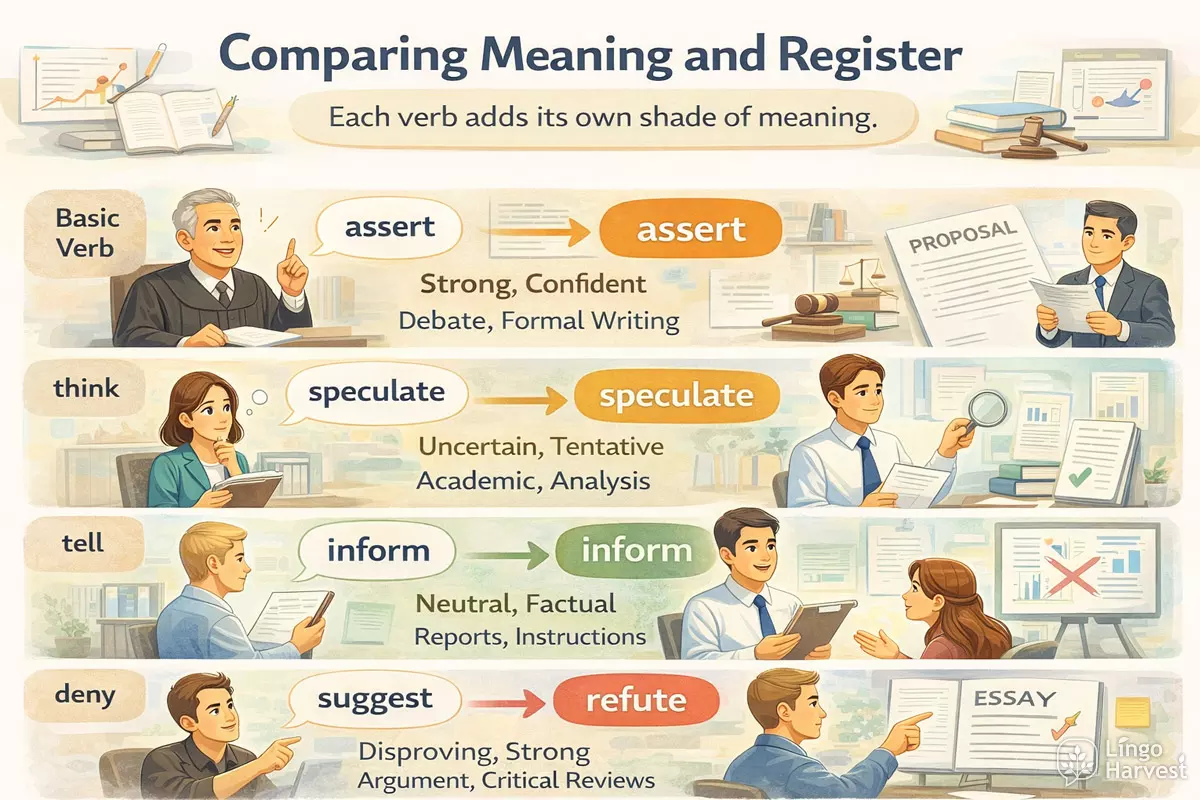
Some reporting verbs are more formal or academic, while others fit informal contexts. Knowing which to use boosts both accuracy and appropriateness. Here’s a comparison of common choices:
| Basic Verb | Advanced Alternative | Connotation | Typical Use |
|---|---|---|---|
| say | assert | Strong, confident | Formal writing, debate |
| think | speculate | Uncertain, tentative | Academic, analysis |
| tell | inform | Neutral, factual | Reports, instructions |
| say | suggest | Implied, indirect | Discussion, essays |
| deny | refute | Disproving, strong | Argument, critical review |
Why it matters for C1 and C2 learners
Mastering a wider set of reporting verbs is a clear sign of advanced proficiency. It allows you to summarize sources, report opinions, and present arguments with subtlety and authority. This skill is essential for higher-level exams, university assignments, and professional communication, making your English more effective and impressive.
Nuance and attitude in advanced verbs
When moving beyond basic reporting verbs, learners start to notice the subtle shades of meaning that advanced choices can convey. These verbs don’t just report what someone said; they can reveal the speaker’s attitude, intention, or the level of certainty behind the statement. Choosing the right verb is about more than vocabulary—it’s about expressing perspective and feeling precisely.
How advanced verbs shape meaning
The verb you select can suggest agreement, doubt, neutrality, or even criticism. For example, “claim” often implies skepticism about the truth of a statement, while “acknowledge” signals reluctant agreement or acceptance. These distinctions are vital in academic writing, journalism, and formal discussions where subtle differences matter.
Common nuances expressed by advanced reporting verbs
- Certainty: “Assert,” “insist,” and “maintain” all show strong belief in what’s being said, but with different levels of forcefulness.
- Uncertainty: “Suggest,” “speculate,” and “imply” indicate a lack of full confidence or present an idea without strong commitment.
- Agreement: “Concede,” “admit,” and “acknowledge” show the speaker agreeing to a point, often reluctantly or after some discussion.
- Disagreement: “Contradict,” “deny,” and “refute” are used to express opposition or rejection of a statement.
- Objectivity: “State,” “report,” and “note” are generally neutral, focusing on the information rather than the speaker’s attitude.
- Criticism: “Accuse,” “allege,” and “condemn” suggest a negative judgment or blame assigned to someone or something.
- Emphasis: “Highlight,” “stress,” and “underscore” draw special attention to a detail or idea.
- Minimizing: “Downplay,” “minimize,” and “dismiss” all reduce the importance or seriousness of what’s being discussed.
- Encouragement: “Urge,” “advise,” and “recommend” convey a positive push towards a particular action or belief.
- Warning: “Warn,” “caution,” and “alert” signal danger or risk.
Comparing attitude and nuance in reporting verbs
| Verb | Attitude/Nuance |
|---|---|
| Assert | Expresses strong certainty or confidence ✅ |
| Allege | Suggests accusation without proof; often neutral or skeptical |
| Concede | Shows reluctant agreement or partial acceptance |
| Refute | Directly challenges or disproves a statement ❌ |
| Imply | Indicates something indirectly; subtle or suggestive |
| Emphasize | Draws attention to a specific point or detail |
| Downplay | Minimizes the significance or seriousness of an issue |
| Urge | Encourages strong action or belief → |
Tips for choosing the right verb
- Think about the speaker’s intention and how much they believe what they’re saying.
- Consider the context: is the tone neutral, supportive, critical, or doubtful?
- Check if your verb choice matches the evidence or certainty available.
- When in doubt, look up example sentences to see how the verb is typically used.
Mastering these distinctions allows you to express yourself with precision and subtlety, making your writing and speaking more effective at advanced levels.
Formal and academic reporting verbs
When writing at advanced levels, it’s essential to choose verbs that accurately convey the relationship between a writer and the ideas or evidence they discuss. Such verbs allow you to express degrees of certainty, distance, or agreement with a source, which is especially important in academic contexts. Using precise vocabulary not only demonstrates linguistic control but also helps clarify your stance and the strength of your claims.
Common categories and functions
Some verbs are neutral and simply introduce information, while others show agreement, disagreement, or suggest doubt. Consider these functions:
- Introducing information: state, report, describe, explain
- Showing agreement: concur, support, endorse, affirm
- Expressing disagreement: dispute, challenge, contradict, reject
- Suggesting doubt or caution: question, doubt, speculate, imply
- Emphasizing importance: highlight, stress, underline, emphasize
Expanded list of advanced verbs
Advanced learners benefit from a wide range of reporting verbs. Here are some useful options to diversify your academic writing:
- challenge → The author challenges the view that intelligence is fixed.
- endorse → Several experts endorse the proposed analytical framework.
- question → The reviewer questions whether the method is sufficiently robust.
- justify → The paper justifies the exclusion of incomplete responses.
- verify → The experiment verifies that the correlation is statistically significant.
- document → The study documents how urban patterns have changed over decades.
- attribute → The author attributes the decline to environmental factors.
- interpret → The analysis interprets the outcome as evidence of adaptation.
- evaluate → The committee evaluates the impact of the new guidelines.
- classify → The research classifies participants into four performance groups.
- trace → The historian traces the theory back to early philosophical debates.
- define → The article defines resilience as a dynamic psychological process.
- summarize → The conclusion summarizes the principal findings of the study.
- critique → The reviewer critiques the sampling strategy for potential bias.
- replicate → The team replicates the procedure to confirm earlier results.
- generalize → The author generalizes the conclusions to similar populations.
- compare → The paper compares outcomes across three experimental conditions.
- measure → The test measures how memory capacity varies with age.
- identify → The analysis identifies key predictors of academic success.
- recommend → The panel recommends that future studies adopt a longitudinal design.
Comparison of reporting verbs: certainty and stance
The following table shows how different verbs can signal varying degrees of certainty or author stance:
| Verb | Typical Use / Degree of Certainty |
|---|---|
| Claim | Suggests some doubt; often used when the writer is skeptical |
| Argue | Indicates a reasoned opinion, usually with supporting evidence |
| Demonstrate | Shows high certainty; evidence is considered strong |
| Suggest | Implies a tentative idea or interpretation |
| Conclude | Used when the evidence strongly supports the statement |
| Imply | Indicates an indirect or inferred meaning |
| Assert | Expresses a strong, sometimes subjective, position |
| Speculate | Shows uncertainty or lack of definite proof |
Tips for choosing the right verb
Choosing the most suitable verb depends on your intended meaning:
- Match the verb to the strength of the evidence.
- Avoid repeating the same reporting verb in close succession.
- Consider the nuance: “demonstrate” is much stronger than “suggest.”
- Use verbs like “propose” or “recommend” when reporting suggestions or advice.
Expanding your range of reporting verbs will make your academic and formal writing more precise and engaging.
Verb patterns used at C1–C2 level

At the advanced stages of English, learners encounter a broader range of reporting verbs, each with its own syntactic rules. Mastering these patterns allows for more precise and nuanced communication. Instead of relying on basic structures like “say that” or “tell someone,” advanced speakers select from a variety of patterns that reflect subtle differences in meaning and formality.
Common reporting verb structures
Advanced reporting verbs are often followed by specific grammatical patterns. Some require an object, others a gerund, infinitive, or even a full clause. Choosing the correct form is essential for accuracy and clarity.
- Verb + (that) clause: admit, claim, deny, insist, suggest
- Verb + object + (that) clause: assure, convince, inform, remind, warn
- Verb + to-infinitive: agree, refuse, promise, threaten, offer
- Verb + object + to-infinitive: advise, encourage, invite, persuade, tell, warn
- Verb + gerund: deny, recommend, suggest, admit
- Verb + preposition + gerund: accuse (of), apologise (for), congratulate (on), blame (for), suspect (of)
- Verb + object + preposition + gerund: thank (someone for), accuse (someone of), blame (someone for)
Examples of advanced reporting patterns
Here is a selection of advanced verbs and their common patterns, illustrating the diversity at higher proficiency levels:
- accuse → accuse someone of doing something
- assure → assure someone that...
- convince → convince someone to do something
- deny → deny doing something / deny that...
- insist → insist on doing something / insist that...
- persuade → persuade someone to do something
- recommend → recommend doing something / recommend that...
- remind → remind someone to do something / remind someone that...
- suggest → suggest doing something / suggest that...
- warn → warn someone not to do something / warn someone that...
- apologise → apologise for doing something
- offer → offer to do something
- threaten → threaten to do something
- blame → blame someone for doing something
- inform → inform someone that...
- invite → invite someone to do something
- encourage → encourage someone to do something
Comparing verb patterns
Some reporting verbs can be confusing because they allow more than one construction, or their meaning changes depending on the structure. The table below summarizes key differences between selected advanced verbs and their most frequent patterns.
| Verb | Typical Patterns | Example |
|---|---|---|
| suggest | verb + gerund verb + (that) clause |
She suggested going together. He suggested that we wait. |
| persuade | verb + object + to-infinitive | They persuaded him to join. |
| advise | verb + object + to-infinitive verb + gerund |
The doctor advised me to rest. I advise checking first. |
| remind | verb + object + to-infinitive verb + object + (that) clause |
Please remind me to call. She reminded him that he was late. |
| warn | verb + object + to-infinitive verb + object + (that) clause |
They warned us not to enter. He warned me that it was dangerous. |
Developing a strong command of these structures enables learners to report speech, intentions, and opinions with a high degree of sophistication. Practice with a variety of reporting verbs and their patterns helps build both accuracy and flexibility in advanced English usage.
Choosing precise verbs for meaning
Strong reporting verbs help advanced learners communicate subtle differences in tone, intent, and accuracy. Selecting the right verb can clarify whether a source is simply stating a fact, speculating, or strongly asserting a claim. Rather than relying on broad terms like “say” or “tell,” higher-level English requires more nuanced choices to reflect the original speaker’s attitude and the writer’s interpretation.
Why verb selection matters
The verb you use when reporting speech or ideas shapes how readers understand the original message. For example, “assert” suggests confidence, while “suggest” implies a softer, less certain approach. Misusing these verbs may lead to misinterpretation or overstatement, both of which can weaken academic or professional writing.
Common categories of reporting verbs
Advanced writers group reporting verbs by function. Here are some typical categories:
- Neutral reporting: describe, state, report, note, observe
- Suggesting or hypothesizing: propose, hypothesize, speculate, imply, suggest
- Arguing or persuading: claim, argue, assert, contend, maintain
- Agreeing or supporting: concur, endorse, confirm, support, acknowledge
- Disagreeing or criticizing: dispute, refute, challenge, reject, criticize
- Warning or advising: caution, warn, advise, recommend, urge
- Emphasizing or highlighting: emphasize, stress, highlight, underline, point out
- Explaining or clarifying: clarify, explain, elaborate, illustrate, define
- Conceding: admit, concede, recognize, accept, allow
- Doubting or questioning: question, doubt, query, wonder, challenge
Comparing similar verbs
Sometimes, verbs appear similar but carry different implications. Consider the following distinctions:
| Verb | Typical meaning/connotation |
|---|---|
| Assert | State something confidently, often without evidence |
| Suggest | Imply or propose an idea, often less directly |
| Argue | Present reasons to support an opinion or position |
| Imply | Hint at something without stating it explicitly |
| Claim | State something as true, sometimes disputed |
| Concede | Acknowledge an opposing point, often reluctantly |
| Refute | Prove a statement or theory to be wrong or false |
| Endorse | Express formal support or approval |
| Highlight | Draw special attention to something important |
| Clarify | Make an idea or statement less confusing and more comprehensible |
Tips for choosing the right verb
- Consider the original speaker’s intent and level of certainty.
- Match the verb to the level of formality and objectivity required.
- Avoid overusing general verbs like “say” or “tell” in formal writing.
- Check example sentences to see how each verb is typically used.
- Be aware that some verbs require specific grammatical patterns (e.g., “argue that”, “advise + -ing”).
With practice, selecting accurate reporting verbs will make your academic and professional writing clearer and more persuasive. The right verb not only conveys information, but also respects the nuance and intention behind the original statement.
Common overuse and misuse
Learners at advanced levels often encounter pitfalls when choosing reporting verbs. Relying too heavily on basic verbs such as "say," "tell," or "ask" can make writing repetitive and limit the nuance of reported information. Additionally, some advanced verbs are frequently misused due to confusion over their meanings or grammatical patterns.
Frequent pitfalls in verb selection
It's easy to default to familiar verbs, but overusing a narrow set can weaken your writing. Variety enhances clarity and precision. However, simply swapping verbs without understanding their context or collocations leads to awkward or incorrect sentences.
- Using "state" for opinions rather than facts
- Mixing up "claim" (assert without proof) and "argue" (provide reasons)
- Confusing "suggest" (imply, propose) with "advise" (recommend action)
- Overusing "report" in academic writing instead of more specific choices
- Applying "announce" where public declaration is not intended
- Using "insist" for neutral reporting, rather than forceful assertion
- Employing "mention" for detailed explanations
- Mixing forms, e.g. "He denied to go" instead of "He denied going"
- Incorrectly pairing verbs with objects, e.g. "He explained me" instead of "He explained to me"
- Choosing verbs that don’t fit the source’s intention, e.g. "admit" for positive news
Common confusion: verb meanings and structures
Some reporting verbs may look similar but differ in how they are used and what they imply. Making the wrong choice can change the intended meaning or produce grammatical errors. The table below highlights frequent confusions and illustrates correct usage patterns.
| Verb | Typical Use & Example | Common Mistake | Correction |
|---|---|---|---|
| suggest | Propose an idea: "She suggested going early." | "She suggested me to go." | "She suggested that I go." |
| advise | Recommend: "He advised us to wait." | "He advised that we wait." | "He advised us to wait." |
| claim | State without evidence: "They claimed it was true." | Using for proven facts | Use "state" or "report" for facts |
| insist | Strong assertion: "She insisted on paying." | "She insisted to pay." | "She insisted on paying." |
| explain | Clarify: "He explained the rules to us." | "He explained us the rules." | "He explained the rules to us." |
| argue | Present reasons: "They argued that it was unfair." | Using for simple statements | Use "say" or "state" for neutral reporting |
Tips for avoiding mistakes
- Check the verb’s pattern (e.g., verb + object + to-infinitive, or verb + -ing)
- Match the verb to the intention of the original speaker or writer
- Use a variety of reporting verbs, but only when the meaning fits
- Review examples in context to reinforce proper usage
- Be cautious with direct translations from your native language
Awareness of these tendencies and careful attention to context will make your reporting more precise and sophisticated.