Reported Speech Tasks and Traps in English Exams

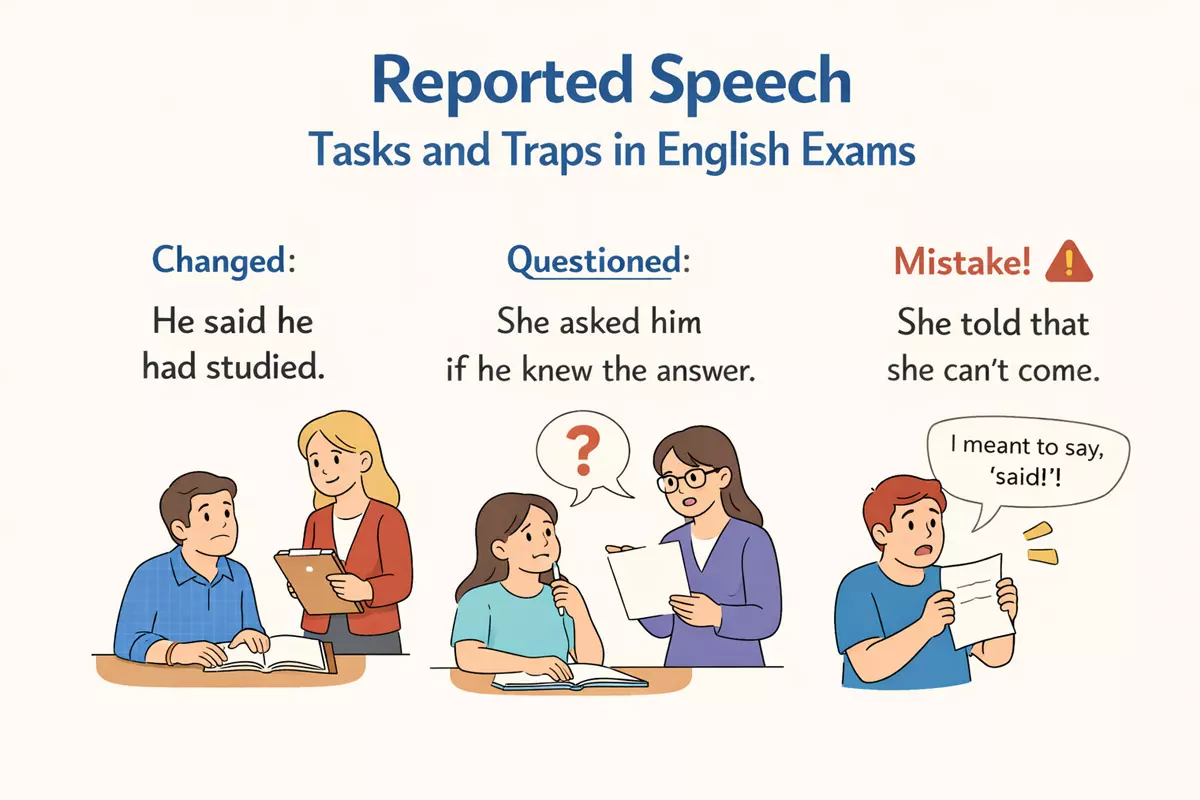 The article explains why reported speech causes exam errors, outlines typical exam tasks, and highlights common tense and pronoun traps. It also discusses challenges with reporting questions and commands, overusing backshifting, and practical ways to avoid mistakes.
Mastering indirect statements and accurately retelling what others have said are skills that often challenge even strong students during language exams. Many common errors arise from confusion over tense changes, pronoun shifts, or word order, which can lead to misunderstandings and lost points. By carefully studying the rules and consistently practicing these transformations, you can avoid typical mistakes and approach test questions with greater confidence, ultimately improving your language proficiency and exam performance.
Why reported speech causes exam errors
Transforming direct statements into indirect ones trips up many exam-takers because it demands attention to several grammatical details at once. Candidates often miss subtle shifts in verb tenses, pronouns, and adverbs of time or place. Even students who understand the theory can make mistakes under exam pressure, especially when sentences are long or contain complex time references.
Common trouble spots in indirect speech tasks
- Tense backshifting: Forgetting to change the verb tense when reporting past statements.
- Pronoun confusion: Misidentifying who is speaking or being spoken about, leading to incorrect pronouns.
- Time expression errors: Failing to adapt time words (e.g. “today” to “that day”).
- Question and command forms: Struggling to restructure questions or commands correctly in indirect speech.
- Reporting verb misuse: Overusing “say” or “tell” without considering if another verb is more accurate.
Examples of time and place changes
One of the most frequent stumbling blocks for learners is remembering how time and place words shift in reported sentences. Here are some typical changes:
- now → then
- today → that day
- yesterday → the day before / the previous day
- tomorrow → the next day / the following day
- here → there
- this → that
- these → those
- last week → the week before / the previous week
- next year → the following year
- ago → before
How verb tenses shift in reported speech
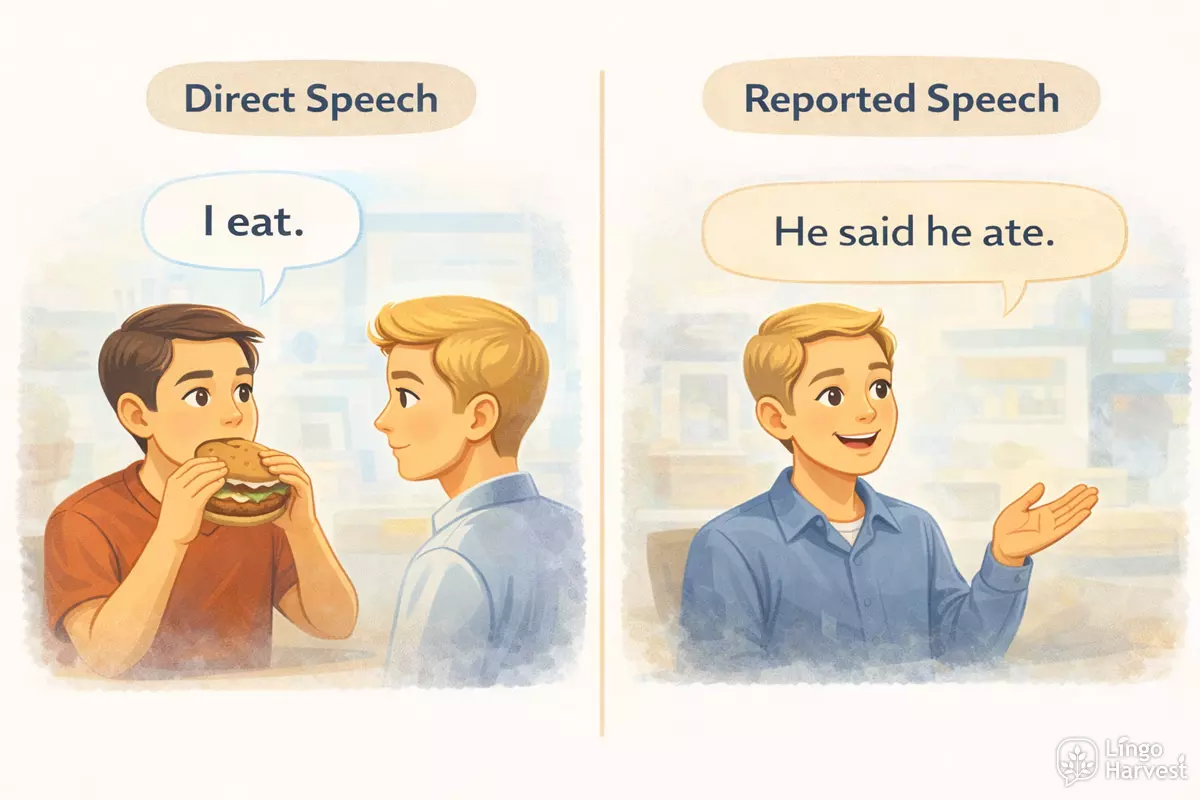
Switching tenses is a classic exam pitfall. Learners often forget which tenses correspond in indirect speech. The following table summarizes the most common tense transformations:
| Direct Speech | Reported Speech |
|---|---|
| Present Simple (“I eat”) |
Past Simple (He said he ate) |
| Present Continuous (“I am eating”) |
Past Continuous (He said he was eating) |
| Past Simple (“I saw”) |
Past Perfect (He said he had seen) |
| Will (“I will go”) |
Would (He said he would go) |
| Can (“I can help”) |
Could (He said he could help) |
Exam stress and time limits
It’s easy to overlook a necessary change when racing against the clock. Under exam conditions, students may focus on only part of the sentence—such as the reporting verb—while neglecting tense shifts or changes in time expressions. This combination of grammatical complexity and time pressure explains why even advanced learners can slip up on reported speech tasks.
Typical task formats in exams
English exams often test reported speech through several common task structures. Recognizing these formats helps students anticipate what to expect and practice more effectively. Tasks range from straightforward sentence transformations to more complex dialogues or error correction exercises. Below are some of the most frequent types you might encounter.
Common types of reported speech tasks
- Direct to reported speech conversion: Transforming a direct quote into indirect speech, adjusting pronouns, tense, and time expressions as needed.
- Reported to direct speech: Rewriting an indirect statement as a direct quote, often requiring careful attention to punctuation and word order.
- Error correction: Identifying and correcting mistakes in given reported speech sentences.
- Dialogue transformation: Turning a conversation or exchange of lines into a narrative using indirect speech.
- Multiple-choice questions: Selecting the correct indirect version of a given direct sentence from several options.
- Matching tasks: Linking direct statements with their accurate reported speech equivalents.
- Gap-fill exercises: Completing sentences with the correct reported speech form, often focusing on tense changes or pronoun shifts.
- Editing tasks: Revising a short text to ensure all reported speech is used correctly.
- Paraphrasing: Rewriting sentences so that the meaning is preserved but the structure is changed to reported speech.
- Identify the speaker: Reading a reported speech sentence and deciding who originally said it or to whom it was said.
Typical transformation patterns
Some tasks focus on specific language changes that occur when moving from direct to indirect speech. The table below summarizes the main shifts students are often required to make:
| Change Type | Example |
|---|---|
| Pronoun shift | He said, "I am tired." → He said he was tired. |
| Tense backshift | She said, "I will call you." → She said she would call me. |
| Time expression change | They said, "We’ll go tomorrow." → They said they would go the next day. |
| Question transformation | He asked, "Where are you going?" → He asked where I was going. |
| Command/request reporting | She said, "Please sit down." → She asked me to sit down. |
Sample practice tasks
- Rewrite the following in reported speech:
a) "I have finished my homework," Mark said.
b) "Can you help me?" she asked. - Choose the correct reported speech form:
"We are leaving now," they said.
a) They said they leave now.
b) They said they were leaving then.
c) They said they had left now. - Spot and correct the error:
He told that he will come tomorrow. - Rewrite the sentence in reported speech:
"I saw the accident yesterday," the witness said. - Choose the correct option:
"Have you finished the report?" she asked.
a) She asked had I finished the report.
b) She asked if I have finished the report.
c) She asked if I had finished the report. - Rewrite using reported commands:
"Please close the window," the teacher said to us. - Spot and correct the error:
She asked me where do I live. - Rewrite the sentence in reported speech:
"We will announce the results tomorrow," the manager said. - Choose the correct form:
"I can solve the problem," he said.
a) He said that he can solve the problem.
b) He said that he could solve the problem.
c) He said that he solves the problem. - Rewrite the sentence in reported speech:
"Do not touch the equipment," the technician warned us.
Show answers
- a) Mark said he had finished his homework.
b) She asked if I could help her. - b) They said they were leaving then.
- He said (that) he would come the next day.
- The witness said that he had seen the accident the day before.
- c) She asked if I had finished the report.
- The teacher told us to close the window.
- She asked me where I lived.
- The manager said that they would announce the results the next day.
- b) He said that he could solve the problem.
- The technician warned us not to touch the equipment.
By familiarizing yourself with these task types and transformation patterns, you can better prepare for the variety of ways reported speech is assessed in English language exams.
Frequent tense and pronoun traps
When tackling reported speech in English exams, students often fall into predictable pitfalls with verb forms and pronoun choices. These mistakes can easily lower scores if not spotted and corrected. In particular, tense shifts and incorrect pronoun references are stumbling blocks that appear again and again. Understanding how to navigate these changes is crucial for both accuracy and clarity.
Tense Shifts in Reported Speech
One of the main challenges lies in backshifting tenses correctly. When reporting what someone said, the verbs frequently need to move one step back in time. However, not all statements require this shift, and some exceptions can confuse even advanced learners. For example, if the reporting verb is in the past, the original present simple often becomes past simple, and so on. Direct questions and commands also follow their own patterns, adding complexity.
| Direct Speech | Reported Speech |
|---|---|
| “I am tired,” she said. | She said (that) she was tired. |
| “He has finished,” they told us. | They told us (that) he had finished. |
| “We will go,” Mark replied. | Mark replied (that) they would go. |
| “Can you help me?” she asked. | She asked if I could help her. |
| “Don’t touch that!” the teacher warned. | The teacher warned us not to touch that. |
Common Pronoun Confusion
Pronouns must be adapted to reflect the new speaker and listener in reported sentences. Errors often happen when students forget to change “I,” “we,” “you,” or other references to match the context of the reporting sentence. This is especially tricky when the original speaker and the reporter are different people, or when the group referenced changes.
- I becomes he/she: “I lost my keys,” → He said he had lost his keys.
- We may become they/we depending on inclusion: “We will win,” → They said they would win.
- You often becomes I/he/she/they: “You must study,” → She told me I must study.
- My/your/our must also shift: “This is my book,” → He said it was his book.
- It’s easy to mix up him/her/them if context is unclear.
Other Typical Traps
Beyond verbs and pronouns, several other details can trip up exam-takers:
- Forgetting to change time expressions (today → that day, tomorrow → the next day, now → then).
- Neglecting to adjust place words (here → there).
- Omitting “that” in reported statements when it clarifies meaning.
- Misordering reported questions (subject comes before verb, no question mark).
- Leaving out necessary modal changes (can → could, will → would).
- Mistaking whether a shift is needed at all (universal truths and facts often don’t shift).
- Missing indirect question words (if/whether for yes-no questions).
- Direct commands should be reported with “to + verb” or “not to + verb.”
- Confusing reported requests (“Could you help me?” → She asked me to help her).
- Retaining original punctuation (reported speech never uses quotation marks).
Careful attention to these patterns makes a significant difference on exam day. Practice with a variety of examples and always double-check who is speaking, who is being addressed, and when the action occurs. Spotting these traps early can help you avoid unnecessary errors and boost your reported speech accuracy.
Problems with reporting questions and commands
Students often find it tricky to report questions and commands in English, especially under exam conditions. Unlike statements, these forms require more than just shifting tenses and pronouns—word order, auxiliary verbs, and reporting verbs all change. This can lead to mistakes that cost valuable points, even for advanced learners.
Common mistakes when reporting questions
Indirect questions (reported questions) do not keep the same word order as direct questions, and students often forget this. Typical issues include:
- Keeping the question word order (e.g., "He asked Where are you going?" ❌ instead of "He asked where I was going." ✅)
- Forgetting to change the tense after reporting verbs in the past
- Omitting or misusing "if" or "whether" when reporting yes/no questions
- Leaving out the subject in the reported clause
- Using "do/does/did" in the reported question unnecessarily
Reporting commands and requests: typical pitfalls
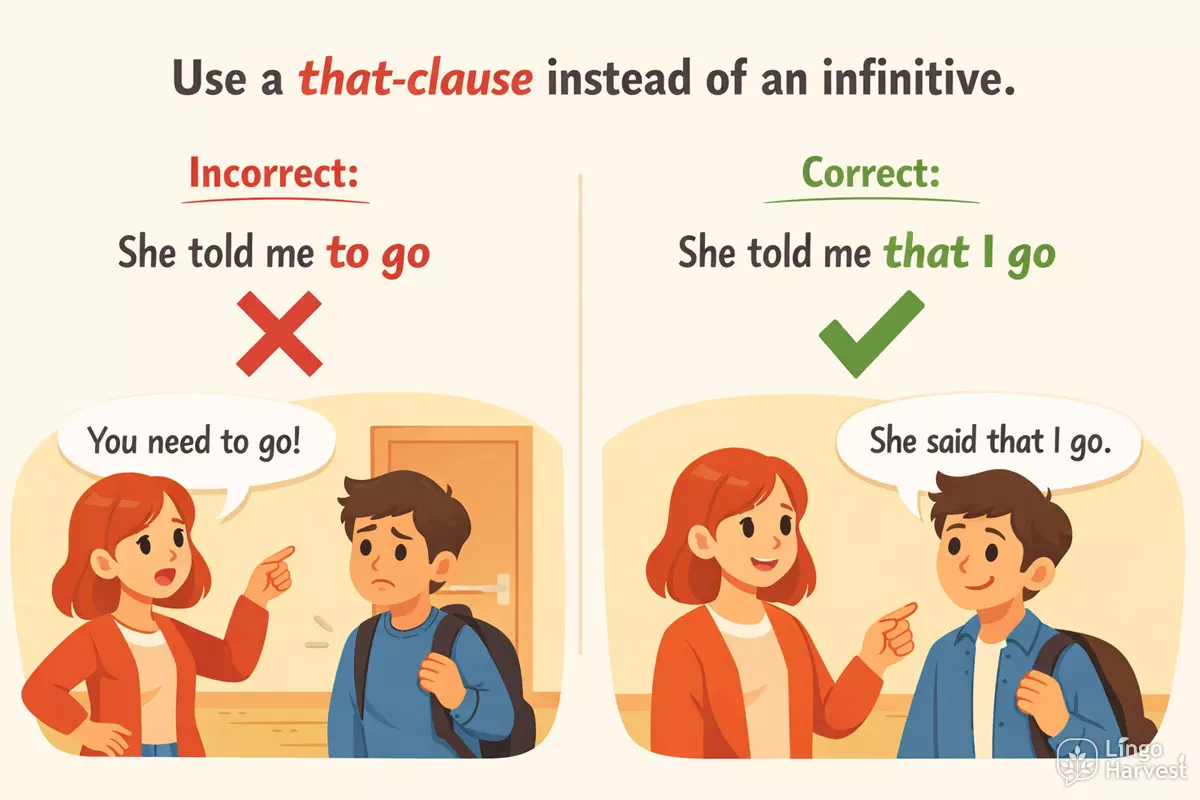
Commands and requests are usually reported with an infinitive structure. However, errors happen when students:
- Use a that-clause instead of an infinitive (e.g., "She told me that I go" ❌ instead of "She told me to go" ✅)
- Forget to adjust pronouns based on context
- Choose the wrong reporting verb (e.g., "ask" vs. "tell" vs. "order")
- Miss out on including the object ("He told go home" ❌ vs. "He told me to go home" ✅)
- Mix up negative commands (forgetting "not" before the infinitive)
Direct vs. Indirect Question Structure
To clarify the contrast between direct and reported questions, here is a reference table:
| Direct Question | Reported Form |
|---|---|
| Where are you going? | He asked where I was going. |
| Did she finish her homework? | He asked if she had finished her homework. |
| What time does the train leave? | She wanted to know what time the train left. |
| Can you help me? | He asked if I could help him. |
| Why did you call? | She wondered why I had called. |
Quick tips for avoiding errors
- Always check if a question needs "if" or "whether" (for yes/no questions).
- After reporting verbs, use statement word order, not question order.
- For commands, use "to" + infinitive; for negative commands, use "not to" + verb.
- Match pronouns and time expressions to the context of the report.
- Practice with a range of verbs: ask, tell, order, advise, invite, warn, instruct, remind, beg, urge, command, request, suggest, recommend, encourage, forbid, permit, advise against.
Mastering these patterns helps avoid common traps in English exams and ensures clarity in both written and spoken reporting.
Overgeneralizing backshifting rules
A common challenge for English learners in reported speech tasks is applying tense changes too broadly. While many indirect speech sentences require a shift in tense—like turning “I am tired” into “He said he was tired”—this isn’t always necessary. Misunderstanding when to backshift can lead to errors that examiners frequently spot.
When tense changes are NOT required
Certain situations in reported speech don’t call for a change in tense. These include:
- Reporting facts, general truths, or universal statements (e.g., “The sun rises in the east” stays the same)
- When the reporting verb is in the present, present perfect, or future (e.g., “She says she likes tea”)
- Conditional statements or hypothetical situations that remain true (“If it rains, the ground gets wet”)
- Statements where the original meaning would change with backshifting (e.g., “I would go if I could”)
- Direct speech already in the past perfect (“He had finished his work”)
Common mistakes from over-applying tense changes
Students sometimes shift tenses even when not needed, resulting in awkward or incorrect English. Here are typical pitfalls:
- Changing present simple to past simple for general truths (“He said the Earth was round” ❌)
- Shifting past perfect further back (“He said he had gone” → “He said he had had gone” ❌)
- Turning present continuous into past continuous even when the situation is still true (“She says she is living in Paris” → “She says she was living in Paris” ❌)
- Applying tense changes even when the reporting verb is present (“He says he went to school” is already correct)
Typical tense changes and exceptions
To clarify, here is an overview of standard tense shifts and when not to apply them:
| Direct Speech | Indirect Speech (Standard Change) | No Change Needed If... |
|---|---|---|
| Simple present (e.g., "I eat") |
Simple past ("He said he ate") |
Reporting fact or general truth ("He said the sun rises") |
| Present continuous ("I am working") |
Past continuous ("He said he was working") |
Reporting verb in present ("He says he is working") |
| Past simple ("I saw her") |
Past perfect ("He said he had seen her") |
Action is still true/relevant ("He says he saw her") |
| Past perfect ("I had finished") |
(No change) ("He said he had finished") |
Never shift past perfect further |
| Modal verbs ("I can go") |
Could/would ("He said he could go") |
Should/might/ought to often remain unchanged |
Tips to avoid overgeneralizing
- Always check whether the statement is a permanent fact or an up-to-date reality.
- Identify the reporting verb’s tense before changing anything.
- Remember some modals and past perfect forms do not need alteration.
- When in doubt, consider if the meaning would change with a tense shift.
Understanding these subtleties helps avoid unnecessary mistakes and improves both accuracy and confidence in handling reported speech.
Strategies for avoiding common traps
Mastering indirect speech in English exams requires more than just memorizing rules; it’s about recognizing tricky patterns and avoiding frequent pitfalls. Many students lose marks not from lack of knowledge, but from subtle mistakes like incorrect tense shifts, misused pronouns, or missing reporting verbs. Below are practical methods and reminders to help you sidestep these issues and boost your confidence during reported speech tasks.
1. Double-check tense changes
One of the most frequent errors is forgetting to change the verb tense when moving from direct to indirect speech. Always review the original statement and ensure you’ve shifted tenses according to the rules (e.g., present simple becomes past simple).
2. Watch out for pronoun errors
Pronouns often trip up test-takers. After converting speech, make sure all pronouns reflect the new perspective. For instance, “I” might become “he” or “she” depending on context.
3. Don’t overlook time and place words
Words like “today,” “tomorrow,” and “here” usually need to be modified (e.g., “today” → “that day”). Forgetting this step can lead to confusion in your reported sentences.
| Direct Speech | Reported Speech |
|---|---|
| “I am leaving now.” | He said he was leaving then. |
| “She will call you tomorrow.” | He said she would call me the next day. |
| “We saw them here.” | They said they had seen them there. |
| “I finished my work yesterday.” | She said she had finished her work the day before. |
4. Use reporting verbs appropriately
Selecting the right reporting verb (“say,” “tell,” “ask,” “advise,” etc.) is essential. Remember, “tell” is followed by an object, while “say” usually isn’t. Using the wrong verb or structure can change the meaning or make your sentence ungrammatical.
5. Be alert to question and command forms
- Change question word order to statement order in reported questions.
- Use “if” or “whether” for yes/no questions.
- For commands, use the infinitive (“to do something”) after verbs like “tell” or “ask.”
6. Common words and their changes
- now → then
- today → that day
- yesterday → the day before
- tomorrow → the next day
- this → that
- these → those
- here → there
- ago → before
- last week → the previous week
- next year → the following year
7. Practice and review
After writing your answers, take a moment to reread them. Look for tense, pronoun, and adverb changes. Practice with a partner or work through sample tasks to reinforce accuracy and speed.
By keeping these practical tips in mind, you’ll be better equipped to avoid the most common mistakes and handle reported speech tasks with greater confidence and precision.
Practice Exercises
Exercise 1. Report questions and commands accurately
- Rewrite the questions in reported speech:
a) "Where did you leave the keys?" he asked.
b) "Have you ever worked abroad?" she asked me.
c) "Why are you staring at the screen?" the teacher asked.
d) "Do you still live here?" they asked.
e) "What time does the lecture start?" he asked. - Rewrite the commands and requests in reported speech:
a) "Please don’t mention my name," she said to him.
b) "Hand in the forms by noon," the coordinator told us.
c) "Don’t open the attachment," the IT officer warned me.
d) "Remember to lock the door," he reminded her.
e) "Could you speak a little more slowly?" she asked the interviewer.
Show answers
- a) He asked where I had left the keys.
b) She asked me if I had ever worked abroad.
c) The teacher asked why I was staring at the screen.
d) They asked if I still lived there.
e) He asked what time the lecture started. - a) She asked him not to mention her name.
b) The coordinator told us to hand in the forms by noon.
c) The IT officer warned me not to open the attachment.
d) He reminded her to lock the door.
e) She asked the interviewer to speak a little more slowly.
Exercise 2. Fix common exam mistakes
- Spot and correct the error:
He asked where was I going. - Spot and correct the error:
She asked me do I need any help. - Spot and correct the error:
They told that they would arrive at 6. - Spot and correct the error:
The teacher said me to stop talking. - Rewrite the sentence without unnecessary backshifting:
"Water boils at 100°C," the instructor said. - Rewrite the sentence without unnecessary backshifting:
"The Earth orbits the Sun," she said. - Rewrite the sentence with correct time reference:
"I will send the file tomorrow," he said. - Rewrite the sentence with correct negative command form:
"Don’t touch the settings," she told me.
Show answers
- He asked where I was going.
- She asked me if I needed any help.
- They said that they would arrive at 6.
- The teacher told me to stop talking.
- The instructor said that water boils at 100°C.
- She said that the Earth orbits the Sun.
- He said that he would send the file the next day.
- She told me not to touch the settings.