Reported Speech Without Backshifting: Rules and Examples

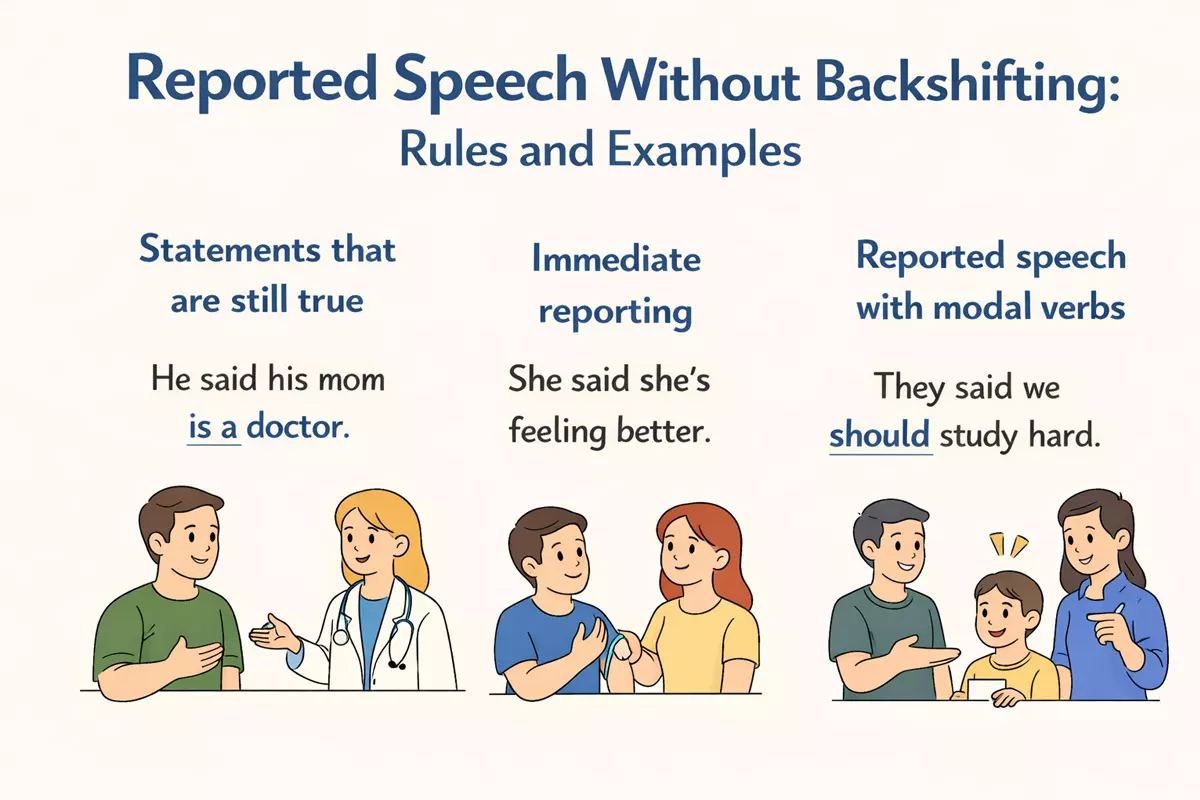 Here we the meaning of backshifting in reported speech, situations where it is not used, and how present relevance or unchanged facts affect its use. It also discusses the role of speaker intention, context, and typical confusion about optional backshifting.
When turning direct statements into indirect ones, it's common to adjust the verb tense, but there are important cases in English where the tense remains unchanged. For example, if the reporting verb is in the present, or if the original statement expresses a general truth or something that is still true, the tense does not shift. Recognizing these exceptions is crucial for clear and accurate communication, as it prevents unnecessary changes that might alter the intended meaning or confuse the listener.
What backshifting means in reported speech
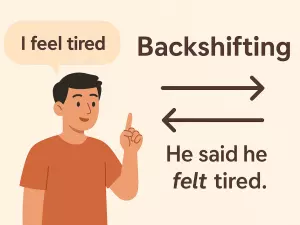
When people report what someone else has said, they often change the verb tense in the original statement. This process is known as backshifting. It involves shifting the tense of the verb one step back into the past. For example, if the original sentence is in the present, it typically moves to the past in reported speech. This shift helps indicate that the statement was made at an earlier time.
How does backshifting work?
Backshifting usually follows specific patterns. Here are some common examples:
- Present simple → Past simple: "I eat breakfast." → He said he ate breakfast.
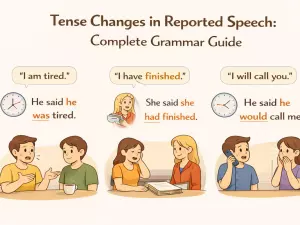
- Present continuous → Past continuous: "She is reading." → She said she was reading.
- Present perfect → Past perfect: "They have arrived." → He said they had arrived.
- Past simple → Past perfect: "I saw the movie." → She said she had seen the movie.
- Will → Would: "I will call you." → He said he would call me.
- Can → Could: "I can help." → She said she could help.
- May → Might: "It may rain." → He said it might rain.
- Must → Had to: "You must go." → She said I had to go.
The main reason for this change is to reflect that the information is being repeated at a later time. Backshifting is especially common in formal writing and storytelling. However, there are cases where changing the tense is not necessary—such as when the information is still true or when reporting general facts.
Summary of common tense changes
| Direct Speech Tense | Reported Speech (Backshifted) |
|---|---|
| Present Simple | Past Simple |
| Present Continuous | Past Continuous |
| Present Perfect | Past Perfect |
| Past Simple | Past Perfect |
| Will | Would |
| Can | Could |
| May | Might |
| Must | Had to |
Understanding this process helps learners recognize why verb tenses sometimes change when statements are reported. It also clarifies the difference between standard reported speech and situations where the tense remains the same, which is the focus of reported speech without backshifting.
Situations where backshifting is not applied
There are several times when tense changes are not necessary in reported speech. Understanding these exceptions helps learners report what others say more accurately, especially in everyday conversation or when the meaning must remain unchanged. Below are some of the most common scenarios where the verb tense in the reported clause does not shift back.
General truths and facts
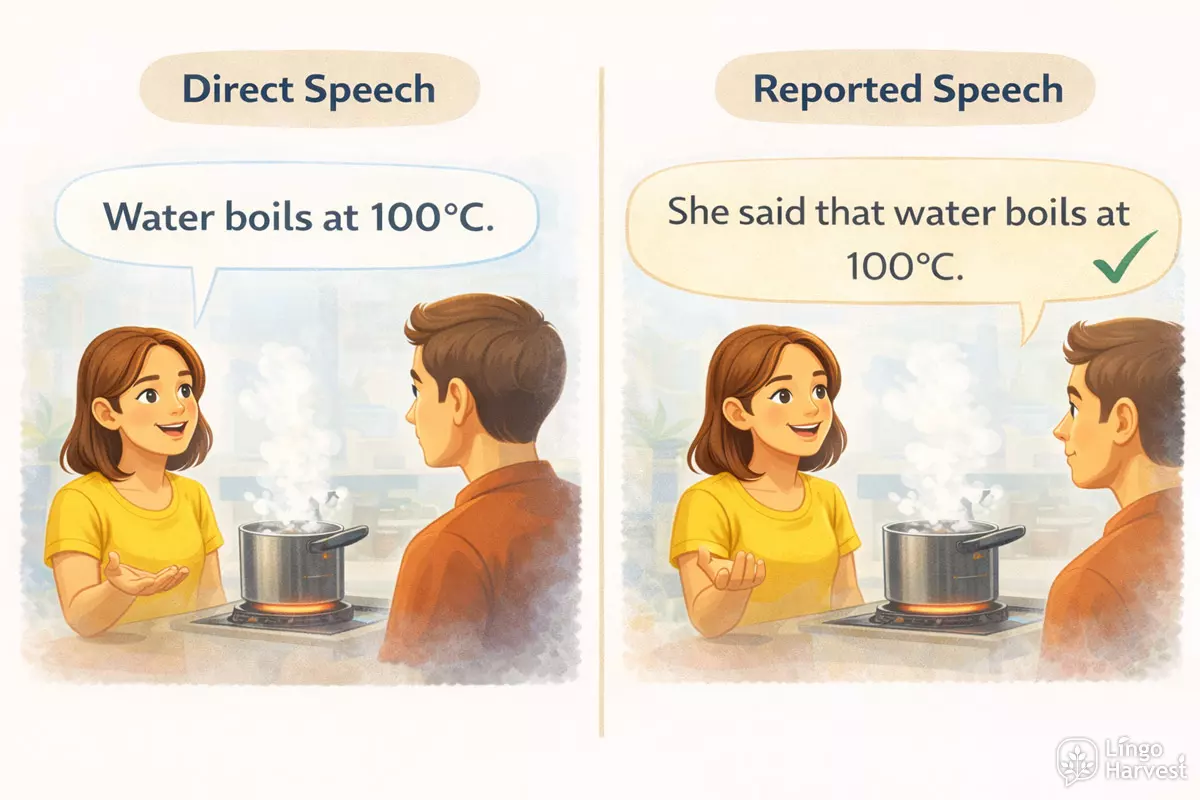
When the original statement expresses something that is always true (such as scientific facts, general truths, or universally accepted information), the tense remains the same in reported speech. This is because the truth of the statement is not affected by time.
- Direct: "Water boils at 100°C."
- Reported: She said that water boils at 100°C. ✅
- Direct: "Dogs are mammals."
- Reported: He told me that dogs are mammals. ✅
Reporting recent speech with unchanged relevance
If the reporting verb is in the past, but the information is still current or relevant, the original tense is often kept. This is common in news reporting, academic discussions, and personal updates.
- Direct: "The train leaves at 6 PM."
- Reported: She said the train leaves at 6 PM. ✅
- Direct: "I feel sick."
- Reported: He said he feels sick. ✅
Reporting statements with modal verbs
Some modal verbs do not change in reported speech, especially could, would, should, might, and ought to. These modals stay the same because they already refer to the past or are not tied to a particular time.
- Direct: "I could help you."
- Reported: She said she could help me.
- Direct: "You should see a doctor."
- Reported: He advised that I should see a doctor.
Conditional sentences and hypothetical statements
When reporting conditionals (especially second and third conditionals) or hypothetical situations, the tense typically does not shift, as the structure already expresses unreality or a hypothetical state.
- Direct: "If I were rich, I would travel the world."
- Reported: She said that if she were rich, she would travel the world.
- Direct: "If you had told me, I would have helped."
- Reported: He said if I had told him, he would have helped.
Direct speech in the present or future
When the reporting verb is in the present, present perfect, or future tense, backshifting is not required. The original verb tense in the reported clause stays the same.
- Direct: "I am tired."
- Reported (present): She says she is tired.
- Direct: "We will win."
- Reported (future): He will say they will win.
Table: Summary of Common Exceptions
| Situation | Reported Speech Example |
|---|---|
| General Truth | She said that the sun rises in the east. |
| Current Relevance | He said he feels fine (and he still does). |
| Modal Verbs | She said she might come later. |
| Present/Future Reporting Verb | He says he wants pizza. |
| Hypothetical/Conditional | She said if she won the lottery, she would travel. |
In summary, reported speech does not always require a tense shift. When reporting facts, ongoing situations, or statements with certain modal verbs or conditionals, the tense can remain unchanged. Recognizing these patterns helps maintain clarity and accuracy in communication.
Present relevance and unchanged meaning
In reported speech, backshifting the tense is not always necessary. When the original statement still holds true or is of current importance, English often keeps the verb tense unchanged in the reported form. This approach is especially common when the information given is a fact, a general truth, or remains accurate at the time of reporting. The choice to avoid shifting tenses helps preserve the original meaning and ensures clarity for the listener.
When not to backshift: Key situations
- General truths and facts: If the statement is universally true or scientifically proven, the present tense usually remains.
- Current relevance: When the reported idea still applies or is important now, tense changes are often unnecessary.
- Recent speech: If the reporting verb is in the present (e.g., "says," "explains"), the original tense is typically kept.
- Direct instructions or requests: Commands reported soon after they are made may not require backshifting.
- Permanent situations: Descriptions of routines, jobs, or characteristics that have not changed.
Examples: No backshift needed
- Direct: “Water boils at 100°C.”
Reported: She says that water boils at 100°C. ✅ - Direct: “The store opens at nine.”
Reported: He tells me the store opens at nine. ✅ - Direct: “I live in London.”
Reported: She says she lives in London. ✅ - Direct: “The Earth revolves around the Sun.”
Reported: The teacher explains that the Earth revolves around the Sun. ✅ - Direct: “I am allergic to peanuts.”
Reported: He says he is allergic to peanuts. ✅ - Direct: “My brother plays the piano.”
Reported: She says her brother plays the piano. ✅ - Direct: “Our office is in the city center.”
Reported: They say their office is in the city center. ✅ - Direct: “Cats hate water.”
Reported: She claims cats hate water. ✅ - Direct: “The train leaves at 6 PM.”
Reported: He says the train leaves at 6 PM. ✅ - Direct: “I need help.”
Reported: She says she needs help. (if she still needs help) ✅
Comparison: Backshifted vs. unchanged tense
| Original Statement | Reported Speech (Unchanged) | Reported Speech (Backshifted) |
|---|---|---|
| “The museum opens at 10.” | She says the museum opens at 10. | She said the museum opened at 10. |
| “I live here.” | He says he lives here. | He said he lived there. |
| “Water freezes at zero degrees.” | She explains water freezes at zero degrees. | She explained water froze at zero degrees. |
| “My mother speaks French.” | He says his mother speaks French. | He said his mother spoke French. |
| “The sun rises in the east.” | They say the sun rises in the east. | They said the sun rose in the east. |
Choosing not to backshift helps avoid confusion, especially when the statement is still true. This practice is particularly helpful in academic writing, news reporting, and everyday conversations where accuracy and clarity are important.
Reporting statements that are still true
When we report information that remains accurate or unchanged, English often allows us to keep the original verb tense in reported speech, rather than shifting it back. This is called “no backshifting.” The main reason for this is that the truth of the statement is still valid at the time of reporting. This approach is especially common in academic writing, news, and everyday conversation when facts, general truths, or ongoing situations are described.
When is backshifting unnecessary?
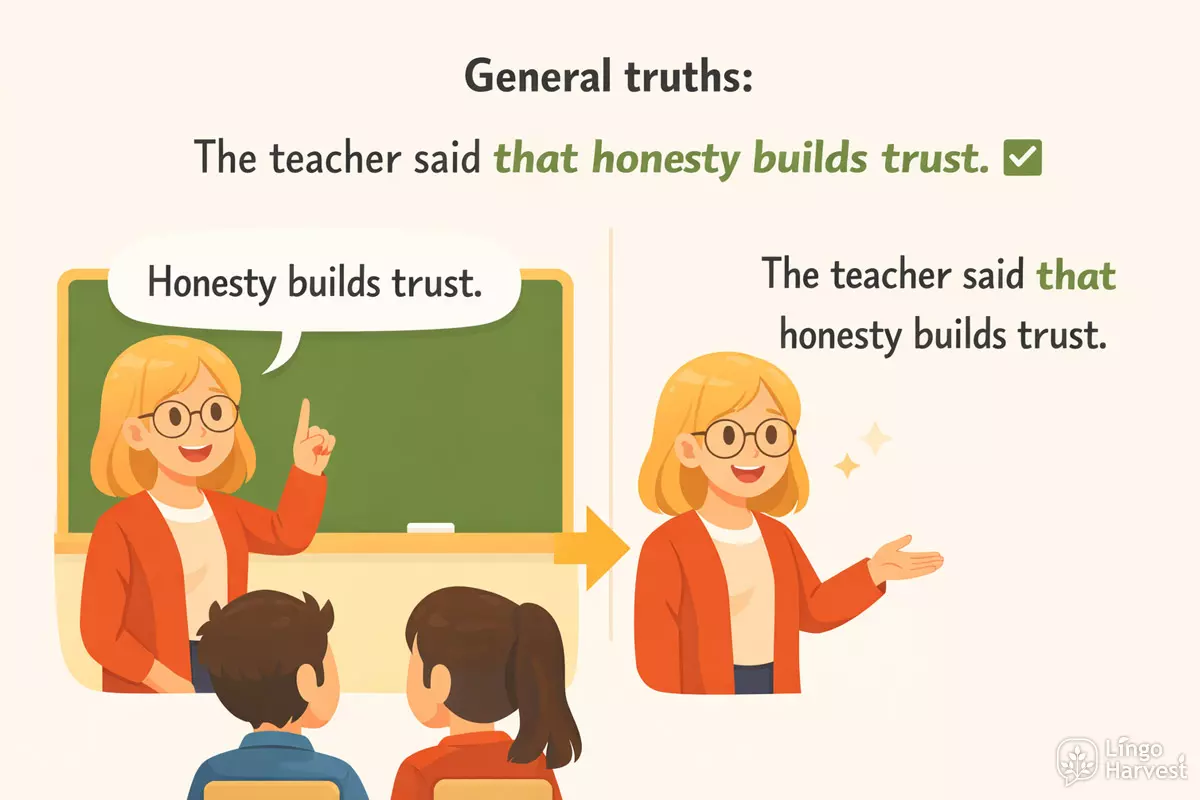
Backshifting can be skipped if the content of the original statement is still true or considered a universal fact. For example, scientific facts, habitual actions, and current situations usually do not require tense change when reported. This helps preserve the clarity of meaning and avoids confusion about what is currently true.
- Scientific facts: The guide said, "Light travels faster than sound." → The guide said that light travels faster than sound. ✅
- General truths: The teacher said, "Honesty builds trust." → The teacher said that honesty builds trust. ✅
- Current situations: They said, "We work remotely." → They said that they work remotely. ✅
- Ongoing states: She said, "I am responsible for the project." → She said that she is responsible for the project. ✅
- Habits: He said, "I drink green tea every evening." → He said that he drinks green tea every evening. ✅
- Current plans: He said, "We are planning a trip." → He said that they are planning a trip. ✅
- Permanent qualities: She said, "Gold is expensive." → She said that gold is expensive. ✅
- Timeless statements: He said, "Honesty is important." → He said that honesty is important. ✅
- Personal facts that haven't changed: She said, "I have two brothers." → She said that she has two brothers. ✅
- Company rules or policies: They said, "Employees must wear badges." → They said that employees must wear badges. ✅
- Unchanged beliefs: He said, "I believe in hard work." → He said that he believes in hard work. ✅
- Geographical facts: She said, "Mount Everest is the highest mountain." → She said that Mount Everest is the highest mountain. ✅
- Ongoing relationships: He said, "John is my friend." → He said that John is his friend. ✅
Comparing backshifted and non-backshifted reporting
To see the difference, compare these two approaches. When the statement is still true, the present tense can be kept. If the situation has changed or is no longer true, backshifting is more appropriate.
| Original Statement | Reported (No Backshift) | Reported (With Backshift) |
|---|---|---|
| “The Earth orbits the sun.” | He said that the Earth orbits the sun. ✅ | He said that the Earth orbited the sun. ❌ |
| “I live in Paris.” (still true) | She said that she lives in Paris. ✅ | She said that she lived in Paris. ❌ |
| “It is raining.” (still raining) | They said that it is raining. ✅ | They said that it was raining. ❌ |
| “He has three children.” (still true) | She said that he has three children. ✅ | She said that he had three children. ❌ |
Key takeaways
- If the information is still factual or current, keeping the original tense is not only acceptable but often preferred.
- Backshifting is necessary only if the situation has changed or if you want to emphasize the time distance from the original statement.
- Using non-backshifted reported speech makes your meaning clearer when talking about facts or ongoing situations.
Speaker intention and context influence
When reporting speech without backshifting, the speaker’s purpose and the situation play a crucial role in determining verb tense. Rather than following automatic grammatical rules, speakers often make choices based on what they wish to communicate, how closely they want to reflect the original words, and the immediacy of the reported information. For example, if the information is still true or relevant at the time of reporting, the present tense is frequently retained.
How speaker goals affect tense choice
Speakers may avoid backshifting to preserve the original meaning or to emphasize that the statement remains valid. If the intention is to reproduce the source’s words as faithfully as possible, or to highlight ongoing truth, sticking with the original tense makes sense. Conversely, if distancing from the original utterance or indicating a change in circumstances, backshifting may be preferred.
- Reporting current facts: "She says she likes coffee." (The preference is still true.)
- Emphasizing unchanged truth: "He told me the Earth orbits the sun." (Scientific fact — no backshifting needed.)
- Describing instructions or rules: "The manual says you press this button to start." (Instructions are current.)
- Expressing ongoing plans: "Anna said she is visiting next week." (The plan is still relevant.)
- Quoting for accuracy: "He said, 'I am ready.'" (Exact words, no shift.)
- Highlighting general truths: "The teacher explained that water boils at 100°C."
- Reporting habitual actions: "He said he always walks to work."
- Announcing scheduled events: "She announced the train leaves at 6 PM."
- Describing ongoing states: "They mentioned the company is growing."
- Referring to recently stated facts: "You just said you feel fine."
How context shapes reporting
The context—such as time, place, and relationship to the original utterance—can override standard backshifting. For example, when the reporting verb is in the past but the reported information is still current, speakers often keep the present tense for clarity. Similarly, in news reporting or storytelling, maintaining present tenses can create immediacy or keep the narrative vivid.
| Situation | Typical Reported Speech |
|---|---|
| Current fact | He said he lives in London. |
| General truth | She explained that ice melts at 0°C. |
| Unchanged plan | They told us the meeting starts at nine. |
| Exact quotation | He said, "I am leaving now." |
| Ongoing state | Anna mentioned she is feeling better. |
Understanding the speaker’s intention and the surrounding context helps explain why backshifting is often optional. This flexibility allows reported speech to match real-world communication needs and nuances.
Typical confusion with optional backshifting
Many learners struggle to understand when backshifting is truly required in reported speech and when it can be left out. The confusion often arises because some grammar rules make backshifting sound mandatory, while in real-life English, especially with recent statements or unchanged truths, it’s often optional. This leads to uncertainty about how to report what someone said without sounding unnatural or making mistakes.
Common misunderstandings
- Believing that all verb tenses must always shift back in reported statements, regardless of context.
- Assuming that omitting backshifting is incorrect, even when the original statement is still true or very recent.
- Not recognizing that backshifting is less common in informal spoken English, leading to over-formal or awkward sentences.
- Failing to distinguish between universal truths (which rarely require tense changes) and specific past events (which often do).
- Mixing up the rules for questions, commands, and statements when it comes to tense changes.
- Believing that time expressions always need to be changed, even if the meaning remains clear.
- Overusing backshifting with modal verbs, even when the original meaning is lost.
- Assuming British and American English treat tense shifts identically in reported speech.
Illustrative examples
Let’s look at how these misunderstandings appear in practice. Compare the following direct and reported speech pairs to see where optional tense changes may cause confusion:
| Direct Speech | Reported Speech (with/without backshifting) |
|---|---|
| "I feel sick." | She said she feels sick. ✅ She said she felt sick. ✅ |
| "The Earth goes around the Sun." | He said the Earth goes around the Sun. ✅ He said the Earth went around the Sun. ❌ (sounds odd, but possible) |
| "I will call you." | She said she will call me. ✅ She said she would call me. ✅ |
| "I am leaving now." | He said he is leaving now. ✅ He said he was leaving then. ✅ |
| "I can swim." | She said she can swim. ✅ She said she could swim. ✅ |
| "I have finished my homework." | He said he has finished his homework. ✅ He said he had finished his homework. ✅ |
| "I like pizza." | She said she likes pizza. ✅ She said she liked pizza. ✅ |
| "Water boils at 100°C." | He said water boils at 100°C. ✅ He said water boiled at 100°C. ❌ (rarely used) |
| "I saw John yesterday." | She said she saw John yesterday. ✅ She said she had seen John the day before. ✅ |
| "We are meeting at 5." | He said they are meeting at 5. ✅ He said they were meeting at 5. ✅ |
Why the confusion persists
The problem is made worse by inconsistent guidance in textbooks and different habits in spoken versus written English. Some teachers emphasize formality and always shift tenses, while others focus on natural usage. To avoid mistakes, pay attention to context: ask if the original situation is still true, and consider whether the information is general, recent, or permanent. This will help you choose the most natural and accurate form.
Homework: Optional Backshifting in Reported Speech
Exercise 1. Decide whether backshifting is necessary
- Rewrite the sentence, keeping the tense if the statement is still true:
"The library opens at nine," she said. - Rewrite the sentence, choosing the most natural form:
"I live near the university," he said. - Rewrite without unnecessary backshifting:
"Water freezes at zero degrees," the teacher said. - Rewrite the sentence, keeping the present tense if appropriate:
"We work with international clients," they said. - Rewrite the sentence naturally:
"My sister studies medicine," Anna said. - Rewrite the sentence, choosing the correct tense:
"The train leaves at six," the conductor said. - Rewrite the sentence without changing the meaning:
"I believe in lifelong learning," he said. - Rewrite the sentence, keeping the tense if the fact is permanent:
"Copper conducts electricity," the lecturer said. - Rewrite the sentence, choosing the best form:
"We are preparing a new report," the manager said. - Rewrite the sentence naturally:
"I have two passports," she said.
Show answers
- She said that the library opens at nine.
- He said that he lives near the university.
- The teacher said that water freezes at zero degrees.
- They said that they work with international clients.
- Anna said that her sister studies medicine.
- The conductor said that the train leaves at six.
- He said that he believes in lifelong learning.
- The lecturer said that copper conducts electricity.
- The manager said that they are preparing a new report.
- She said that she has two passports.
Exercise 2. Choose between backshifted and non-backshifted forms
- Rewrite both correctly, then choose the more natural option:
"I feel much better," she said. - Rewrite the sentence in two ways:
"We will finish the project soon," they said. - Rewrite, keeping the tense if the fact is still true:
"The company employs over 500 people," the director said. - Rewrite, choosing the best form:
"I am waiting for the results," he said. - Rewrite naturally:
"She knows the answer," the teacher said. - Rewrite in two correct ways:
"I can speak three languages," Maria said. - Rewrite, keeping the present if appropriate:
"The Earth has one moon," the guide said. - Rewrite, choosing the clearer form:
"We are meeting the clients at noon," they said. - Rewrite in two possible ways:
"I have finished the analysis," he said. - Rewrite naturally:
"My parents live abroad," she said.
Show answers
- She said that she feels much better. / She said that she felt much better. (Both correct; first is more natural if still true.)
- They said that they will finish the project soon. / They said that they would finish the project soon.
- The director said that the company employs over 500 people.
- He said that he is waiting for the results. / He said that he was waiting for the results.
- The teacher said that she knows the answer.
- Maria said that she can speak three languages. / Maria said that she could speak three languages.
- The guide said that the Earth has one moon.
- They said that they are meeting the clients at noon. / They said that they were meeting the clients at noon.
- He said that he has finished the analysis. / He said that he had finished the analysis.
- She said that her parents live abroad.