Tense Changes in Reported Speech: Complete Grammar Guide

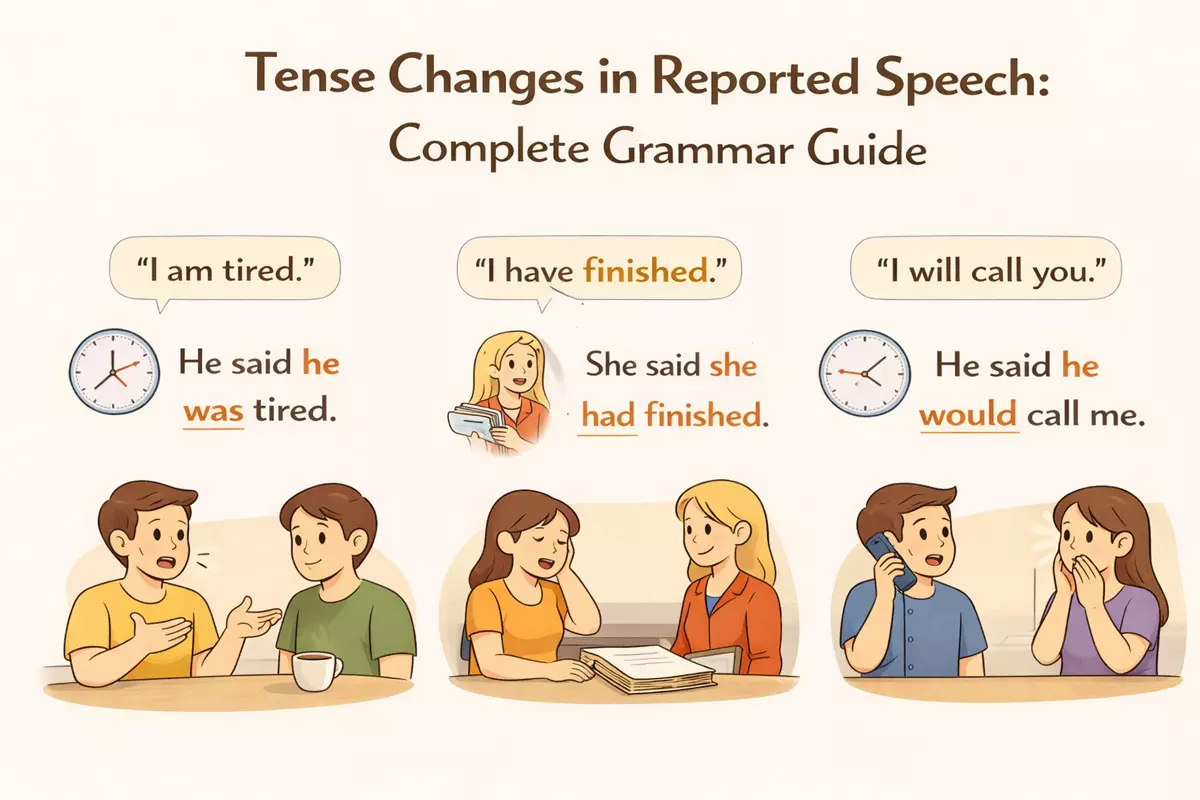 Here we why tenses change in reported speech, explains present and past tense shifts, addresses how to report future intentions, discusses the impact of time references, and points out common mistakes with tense logic.
Learning to shift verb forms correctly when reporting what someone else has said is crucial for effective communication in English. This process, known as reported or indirect speech, involves changing the tense of verbs and sometimes adjusting pronouns or time expressions to accurately convey the original message. Recognizing these patterns not only helps you follow grammar rules but also enables you to express ideas clearly and avoid misunderstandings in both spoken and written English.
Purpose of tense changes in reported speech
When we report what someone else has said, we often shift the verb tense. This change helps clarify that the statement was made in the past and may no longer be current. Using the correct tense shift avoids confusion about what information is still true and what is being relayed as past communication. It also shows the relationship between the time the original words were spoken and the time they are being reported.
Tense shifts in indirect speech help listeners or readers understand if the information is still true or if it was true only at the time of speaking. This is especially important in English, where context and timing can affect meaning. By changing tenses, we signal whether a statement is a direct quote or a summary of someone's earlier words.
Key reasons for shifting tenses in indirect statements
- Clarifies time reference: Tense changes show when the original statement was made compared to now.
- Distinguishes fact from report: Listeners can tell whether the information is being quoted directly or summarized.
- Indicates possible changes: The shift suggests that circumstances or facts may have changed since the original statement.
- Follows English grammar conventions: Native speakers expect these changes for correct, natural-sounding speech.
- Shows formality and accuracy: Using proper tense shifts is often required in academic, professional, and journalistic contexts.
- Prevents ambiguity: Without tense changes, reported speech can be unclear or misleading.
Common tense changes in reported speech
Here’s an overview of how verb tenses usually change when moving from direct to indirect speech:
| Direct Speech (Original) | Reported Speech (Changed) |
|---|---|
| Present Simple (“I work here.”) |
Past Simple (He said he worked there.) |
| Present Continuous (“She is reading.”) |
Past Continuous (He said she was reading.) |
| Present Perfect (“They have left.”) |
Past Perfect (He said they had left.) |
| Past Simple (“I saw him.”) |
Past Perfect (He said he had seen him.) |
| Will (“I will call you.”) |
Would (He said he would call me.) |
| Can (“She can swim.”) |
Could (He said she could swim.) |
| May (“I may leave.”) |
Might (He said he might leave.) |
These shifts are not always required, especially if the information is still true or in situations where the reporting verb is in the present tense. However, understanding why and when to change tenses is essential for clear, accurate communication in English.
Summary of when tense changes matter
- Reporting past statements after some time has passed
- Conveying information that may have changed
- Formal writing, journalism, and academic work
- Ensuring the listener understands what was said versus what is true now
Mastering these tense shifts allows for precise, reliable communication, especially when relaying information from others.
Present tense transformations explained
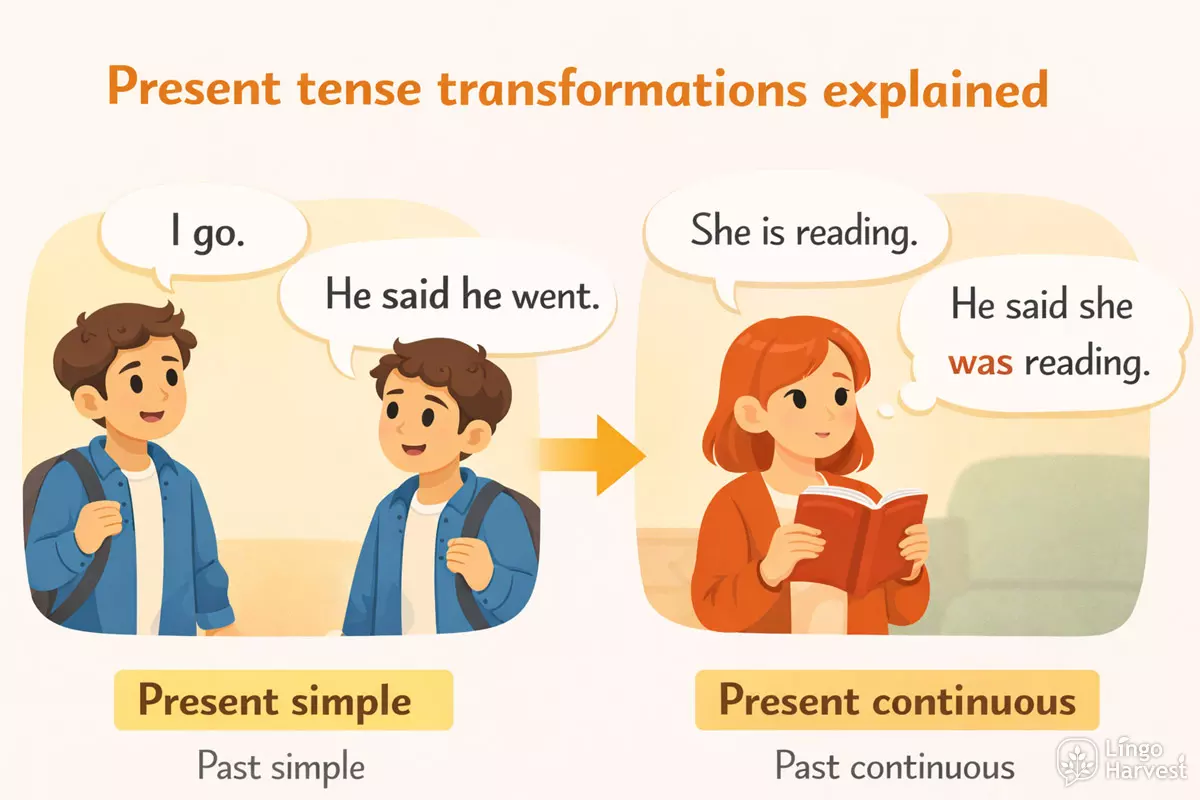
When shifting direct speech into reported (or indirect) speech, present tense verbs often change form to reflect the speaker’s perspective and the time of reporting. This adjustment helps clarify that the original words are being reported after the fact. Understanding these transformations is essential for accurate and natural-sounding indirect statements.
How present simple and present continuous change
In reported speech, the present simple and present continuous typically move one step back in time. This means:
- Present simple becomes past simple (“I go” → he said he went)
- Present continuous becomes past continuous (“She is reading” → he said she was reading)
Patterns for present tense shifts
It’s helpful to recognize common changes when reporting speech originally in the present tense. Here is a summary of the main transformation patterns:
| Direct Speech (Present) | Reported Speech |
|---|---|
| Present simple “I play tennis.” |
Past simple He said he played tennis. |
| Present continuous “She is eating.” |
Past continuous He said she was eating. |
| Present perfect “We have finished.” |
Past perfect They said they had finished. |
| Present perfect continuous “I have been working.” |
Past perfect continuous He said he had been working. |
Common present tense reporting examples
- “I like coffee.” → She said she liked coffee.
- “They are coming.” → He said they were coming.
- “He has a cat.” → She said he had a cat.
- “We have seen that movie.” → They said they had seen that movie.
- “I am learning English.” → She said she was learning English.
- “She has finished her homework.” → He said she had finished her homework.
- “You are making progress.” → The teacher said I was making progress.
- “It is raining.” → He said it was raining.
- “I have been waiting.” → She said she had been waiting.
- “They are watching TV.” → He said they were watching TV.
- “We have been talking.” → She said they had been talking.
- “He is studying.” → She said he was studying.
- “I do my homework every day.” → She said she did her homework every day.
- “You have finished your project.” → He said I had finished my project.
- “She is not feeling well.” → He said she was not feeling well.
Important notes and exceptions
Sometimes, if the reporting verb is in the present or the situation is still true, present tense forms may remain unchanged. However, the usual rule is to shift tenses back. Modals like must and should often do not change, and some universal truths can stay in the present.
- “The sun rises in the east.” → She said the sun rises in the east. (Universal truth)
- “I must go.” → He said he must go.
Mastering these changes helps you communicate reported information clearly and accurately.
Past tense shifts and their limits
When moving from direct to indirect speech, English often requires a shift in verb tense—usually one step back in time. This process is called "backshifting." For example, if the original speaker uses the present simple ("She says, 'I like tea.'"), it typically changes to the past simple in reported speech ("She said that she liked tea."). However, not every tense changes automatically, and certain situations limit or even prevent these shifts.
Common past tense changes in reported speech
The table below shows some standard transformations from direct to reported speech. These are the most frequently encountered patterns when reporting statements, questions, and commands:
| Direct Speech (Original Tense) | Reported Speech (Backshifted Tense) |
|---|---|
| Present simple (She says, "I work.") |
Past simple She said (that) she worked. |
| Present continuous ("I am reading.") |
Past continuous He said he was reading. |
| Present perfect ("I have finished.") |
Past perfect She said she had finished. |
| Past simple ("I saw him.") |
Past perfect He said he had seen him. |
| Will ("I will go.") |
Would He said he would go. |
| Can ("I can help.") |
Could She said she could help. |
| May ("I may leave.") |
Might He said he might leave. |
When tense changes are optional or blocked
Sometimes, the usual shift to a past tense isn't necessary or even possible. Here are some common scenarios where the tense in reported speech stays the same:
- General truths: If the original statement refers to a fact that is still true, the tense often does not change.
Direct: "The sun rises in the east."
Reported: She said that the sun rises in the east. - Recent speech: If the reporting verb ("say," "tell," etc.) is in the present or future, backshifting is usually not needed.
Direct: "I am tired."
Reported: She says (that) she is tired. - Unchanged circumstances: When the situation hasn't changed since the original statement, keeping the original tense is acceptable.
- Modal verbs without past forms: Some modals (like "might," "should," "would") remain unchanged because they already have a past or conditional sense.
Limits and exceptions in tense shifting
There are clear boundaries to how and when backshifting applies. For example, the past perfect tense in direct speech usually stays the same in reported speech: "I had left" → He said he had left. Also, if a speaker is reporting what someone said about the future, "will" often becomes "would," but if the statement is about a scheduled event, it might not shift.
- Past perfect does not change further: "She said, 'I had eaten.'" → She said she had eaten.
- Universal facts and scientific laws often skip tense change.
- Conditional sentences may keep "if" clauses unchanged for clarity.
- Direct speech embedded in literature or storytelling sometimes preserves the original tense for dramatic effect.
Understanding which tenses shift and which remain stable is key for accurate reported speech. The context, the reporting verb, and the nature of the original statement all influence whether a tense change is required or not.
Future forms and reported intention
When converting direct speech to reported speech, future tenses and expressions of intention often need to be adjusted. The way we report someone's plans, promises, or predictions depends on the specific verb form or modal used in the original statement. Understanding these changes helps maintain the intended meaning and time reference.
How future tenses change in reported speech
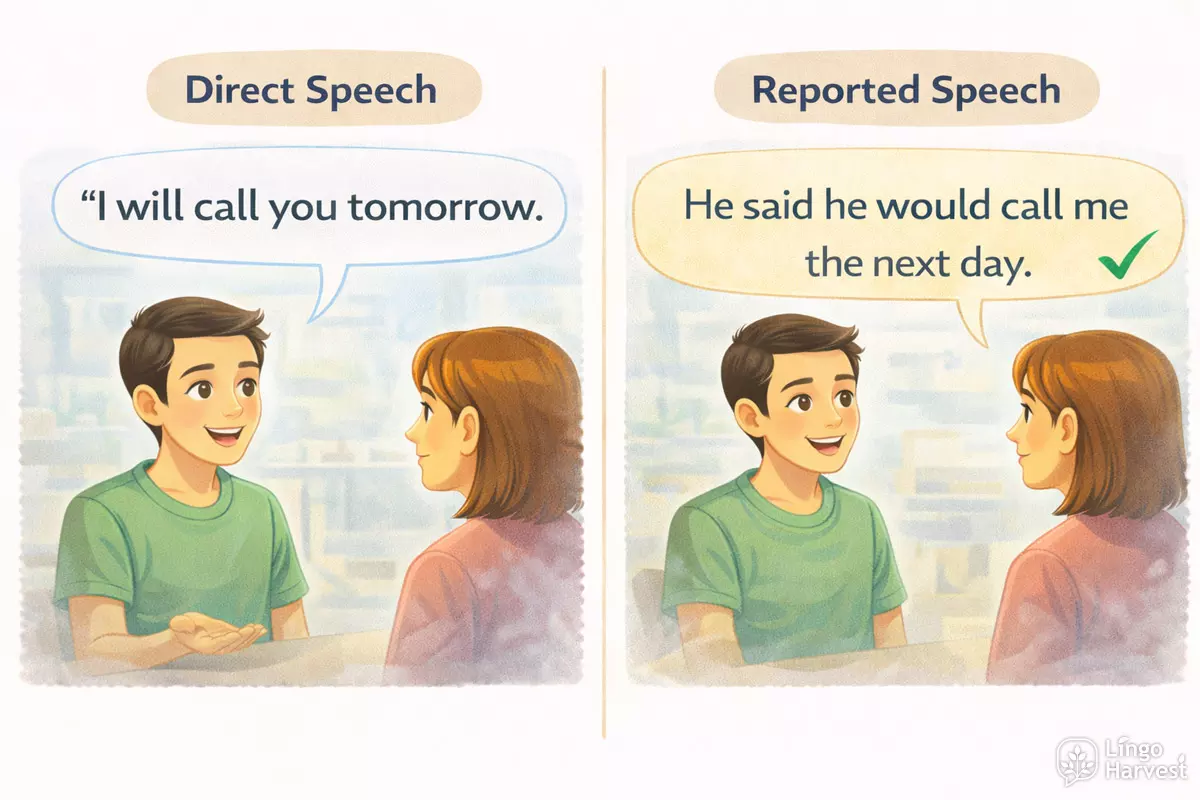
In direct speech, we frequently use “will,” “shall,” “be going to,” and other future forms to express what someone intends or expects to do. When reporting these, the tense usually shifts to reflect the past perspective. For example, “will” typically becomes “would,” and “am/are/is going to” changes to “was/were going to.” This shift clarifies that the statement was made in the past.
| Direct Speech | Reported Speech |
|---|---|
| “I will call you tomorrow.” | He said he would call me the next day. |
| “She is going to start a new job.” | He said she was going to start a new job. |
| “We shall arrive at eight.” | They said they would arrive at eight. |
| “I can help you later.” | He said he could help me later. |
| “They will not come.” | She said they would not come. |
| “I am going to travel next month.” | She said she was going to travel the following month. |
Reporting intention, promises, and offers
Intention isn’t only shown with future forms. Verbs such as “promise,” “offer,” “plan,” or “intend” also express what someone meant to do. When reporting these, the reporting verb is often followed by an infinitive or “that” clause, depending on the structure of the original sentence.
- “I promise I will help.” → She promised to help.
- “We intend to move soon.” → They said they intended to move soon.
- “I’ll do it for you.” → He offered to do it for me.
- “We plan to visit Paris.” → They said they planned to visit Paris.
- “I’m thinking of leaving.” → He said he was thinking of leaving.
- “I might join you later.” → She said she might join us later.
- “We will help you.” → They promised they would help me.
- “I am going to call her.” → He said he was going to call her.
- “I’ll always love you.” → She promised that she would always love me.
- “I should arrive on time.” → He said he should arrive on time.
Key points and common patterns
- “Will” → “Would” for predictions, promises, and offers.
- “Shall” → “Would,” but “shall” is rare except in formal English.
- “Be going to” → “Was/were going to” for plans and intentions.
- Intentions with verbs like “promise,” “plan,” “intend” usually keep their form but may shift tense as needed.
- Time expressions may also change: “tomorrow” → “the next day,” “next week” → “the following week.”
Recognizing these patterns helps you accurately report statements about the future and people’s intentions, preserving both the time frame and the speaker’s meaning.
Role of time reference in tense choice
When transforming direct speech into reported speech, the original time context plays a crucial part in determining which verb tense should be used. The speaker’s reference to the past, present, or future can lead to shifts in verb forms, ensuring that the meaning remains clear and accurate in the new context. Paying close attention to time markers—such as “now,” “yesterday,” “tomorrow,” and “ago”—helps guide these tense adjustments.
How time expressions affect reported speech
Time expressions often change when reporting someone’s words, especially if the reporting verb is in the past. This is because the perspective or “reference point” shifts from the moment of speaking to the moment of reporting. For example, “today” becomes “that day,” and “tomorrow” changes to “the next day.” These shifts help maintain clarity about when actions occurred relative to the reporting moment.
- now → then / at that time
- today → that day
- yesterday → the day before / the previous day
- tomorrow → the next day / the following day
- this week → that week
- last week → the week before / the previous week
- next year → the following year / the year after
- ago → before / earlier
- here → there
- tonight → that night
Choosing the correct tense: main patterns
The original tense in direct speech and the time reference both influence the tense used in reported speech. Typically, if the reporting verb is in the past, tenses “shift back” (backshifting). However, if the reported information is still true or a universal fact, the tense might not change. The following table summarizes common shifts based on time reference:
| Direct Speech Tense | Reported Speech Tense | Example |
|---|---|---|
| Present Simple | Past Simple | “I work today.” → He said he worked that day. |
| Present Continuous | Past Continuous | “She is eating now.” → He said she was eating then. |
| Past Simple | Past Perfect | “They left yesterday.” → She said they had left the day before. |
| Future (will) | Would | “I will call tomorrow.” → He said he would call the next day. |
| Present Perfect | Past Perfect | “We have finished.” → They said they had finished. |
Exceptions and special cases
Some time references do not require a tense change, particularly when reporting facts, general truths, or when the situation is still current. For instance, “The sun rises in the east” remains unchanged in reported speech. Additionally, if the reporting verb is in the present or future, backshifting is usually unnecessary.
- General truths: “Water boils at 100°C.” → She said water boils at 100°C.
- Still true situations: “I live in London.” → He says he lives in London.
In summary, understanding the original time reference helps speakers and writers accurately adjust tenses in reported speech, maintaining both grammatical correctness and meaning.
Common tense logic mistakes
When reporting speech, even advanced English learners sometimes misjudge how and when verb tenses should shift. This usually happens when people try to apply direct translation from their native language or overlook the sequence of tenses. The result can be sentences that sound unnatural or even change the intended meaning. Let's break down some of the most frequent pitfalls and how to avoid them.
Mixing up tense shifts
- Forgetting to shift the tense back in reported speech (e.g., using present instead of past after a reporting verb in the past).
- Unnecessarily changing the tense when the reporting verb is in the present or future (no change is needed).
- Applying backshifting to modal verbs that do not require it (e.g., using "could" instead of "can" when "can" is still possible).
Confusing time references
- Failing to adjust time expressions: “today” should become “that day”, “tomorrow” becomes “the next day”, etc.
- Keeping time words unchanged, which can cause confusion about when an event happened.
Mismatching reported and original meaning
- Changing the tense so much that the sentence no longer matches the original speaker’s intent.
- Using past perfect when only simple past is needed, which can make sentences sound overly formal or incorrect.
Incorrect backshifting: Examples
Notice how incorrect tense changes can alter the meaning or clarity of a sentence. Here are some classic examples:
| Direct Speech | Incorrect Reported Speech | Correct Reported Speech |
|---|---|---|
| "I am tired," she said. | She said she is tired. ❌ | She said she was tired. ✅ |
| "They will arrive soon," he said. | He said they arrive soon. ❌ | He said they would arrive soon. ✅ |
| "I have finished," John said. | John said he finishes. ❌ | John said he had finished. ✅ |
| "I can help," Anna said. | Anna said she could helps. ❌ | Anna said she could help. ✅ |
Other common errors
- Reporting questions as statements without using the correct word order.
- Forgetting to use "if" or "whether" for yes/no questions in reported speech.
- Changing pronouns incorrectly, which can confuse who is being referred to.
- Omitting crucial reporting verbs like "say" or "tell".
Awareness of these typical logical errors helps avoid embarrassing misunderstandings and ensures your reported speech is both accurate and clear. Practice by checking each tense shift and time reference, and you’ll gradually develop a natural sense for these grammar rules.
Homework: Future Forms and Reported Intention
This homework helps you practice how future forms and expressions of intention change in reported speech. Pay special attention to shifts from will to would, from be going to to was/were going to, and to changes in time expressions such as tomorrow, next week, and tonight. Try to preserve the original meaning while keeping the time reference clear and natural.
Exercise 1. Rewrite the sentences in reported speech
- "I will finish the report tomorrow," she said.
- "We are going to move next year," they explained.
- "I’ll call you later," he promised.
- "She will probably arrive late," Tom said.
- "I am going to start a new course," Anna said.
- "We shall meet again soon," the director said.
- "I might join you this evening," she said.
- "They will open the store next week," he announced.
- "I’m planning to change jobs," he admitted.
- "I’ll always remember this day," she said.
Show answers
- She said that she would finish the report the next day.
- They explained that they were going to move the following year.
- He promised that he would call me later.
- Tom said that she would probably arrive late.
- Anna said that she was going to start a new course.
- The director said that they would meet again soon.
- She said that she might join us that evening.
- He announced that they would open the store the following week.
- He admitted that he was planning to change jobs.
- She said that she would always remember that day.
Exercise 2. Correct the tense or time reference
- He said he will call me tomorrow.
- She said that she is going to travel next month.
- They said they will finish the project soon.
- He promised he calls me later.
- Anna said she is meeting them at six yesterday.
- They explained that they are going to leave the next day.
- He said he would go tomorrow.
- She said she plans to start a business last year.
- Tom said that the train leaves the following day.
- They said they are opening the office next week.
Show answers
- He said he would call me the next day.
- She said that she was going to travel the following month.
- They said they would finish the project soon.
- He promised that he would call me later.
- Anna said she was meeting them at six the day before.
- They explained that they were going to leave the next day.
- He said he would go the next day.
- She said she had planned to start a business the year before.
- Tom said that the train would leave the following day.
- They said they would open the office the following week.