Using Conditional Sentences in Reported Speech

 This article explains how to report conditional sentences in indirect speech. It covers reporting zero, first, second, and third conditionals, how to adjust tenses and modals, preserve meaning, and avoid common errors with conditionals.
Learning to transform if-clauses when reporting what someone else said can be challenging for English learners, but understanding these structures is essential for accurate and confident communication. By mastering reported speech and knowing how to adjust if-clauses appropriately, you can convey information more clearly, avoid misunderstandings, and express yourself more naturally in both spoken and written English. Practicing these transformations will make your language skills more advanced and effective.
Conditionals inside reported speech
When reporting conditional sentences, the verb tenses and structures often shift to reflect indirect speech. This can sometimes make the original meaning less direct or change the time frame. Understanding how to convert conditionals into reported forms is essential for clarity in both spoken and written English.
How conditional sentences change in reported speech
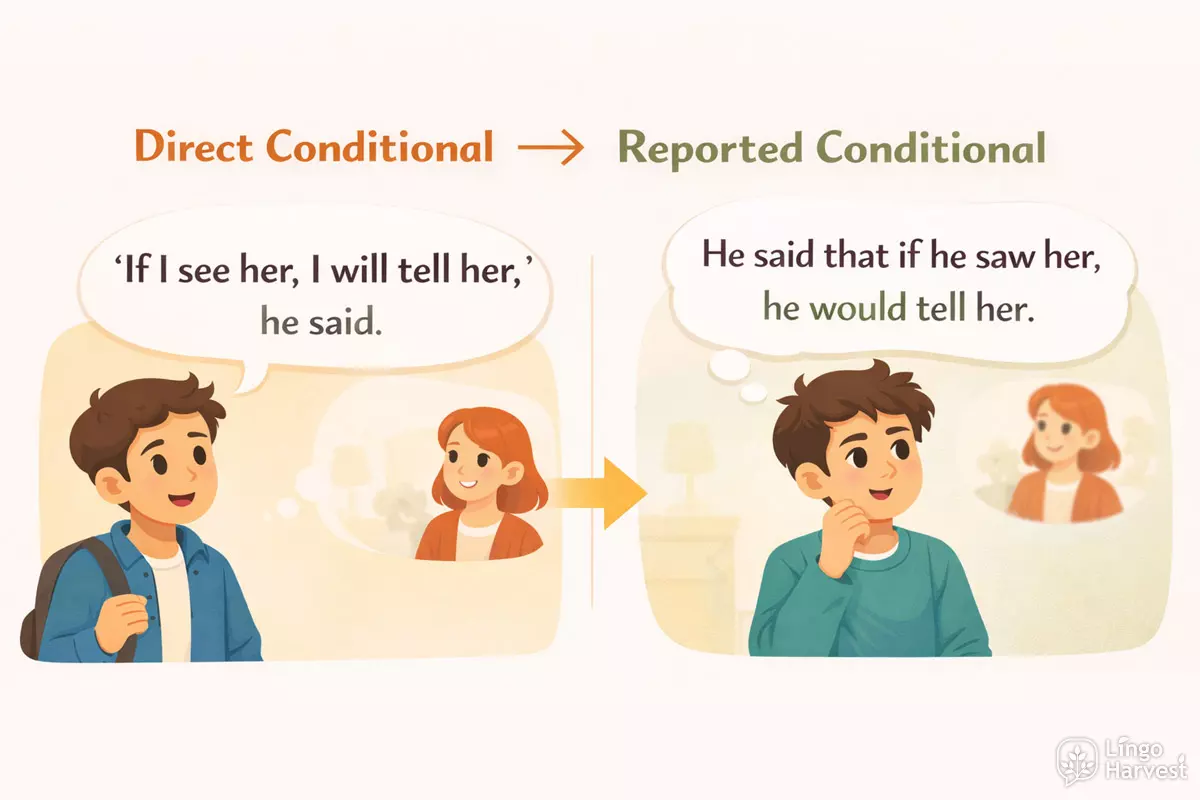
Typically, direct conditional statements use forms like "If I see her, I will tell her." When these are reported, the verb tenses usually move one step back in time, and pronouns or time markers may also change. The type of conditional (first, second, or third) affects how it is transformed.
| Direct Conditional | Reported Conditional |
|---|---|
| "If I see her, I will tell her," he said. | He said that if he saw her, he would tell her. |
| "If you studied, you would pass," she said. | She said that if I studied, I would pass. |
| "If they had arrived earlier, they would have met us," John said. | John said that if they had arrived earlier, they would have met them. |
| "If it rains, the match will be canceled," the coach said. | The coach said that if it rained, the match would be canceled. |
| "If you eat too much, you'll feel sick," Mom said. | Mom said that if I ate too much, I would feel sick. |
Key points for transforming conditionals
- First conditionals (real possibility): "will" changes to "would," and present tense shifts to simple past.
- Second conditionals (unreal, hypothetical): Often, no change in "would" or "could," but pronouns and time expressions may shift.
- Third conditionals (impossible past situations): Structure usually remains, but pronouns and time markers adapt to the reporting context.
- Time expressions like "today" may become "that day," and "tomorrow" changes to "the next day."
- Reporting verbs ("said," "told," "explained") influence how the sentence is constructed.
- Questions in conditional form (e.g., "What will you do if...?") require careful rephrasing in indirect speech.
Common transformations in context
- If you finish early, you can leave. → He said that if I finished early, I could leave.
- If she calls, tell her I’m busy. → He told me that if she called, I was busy.
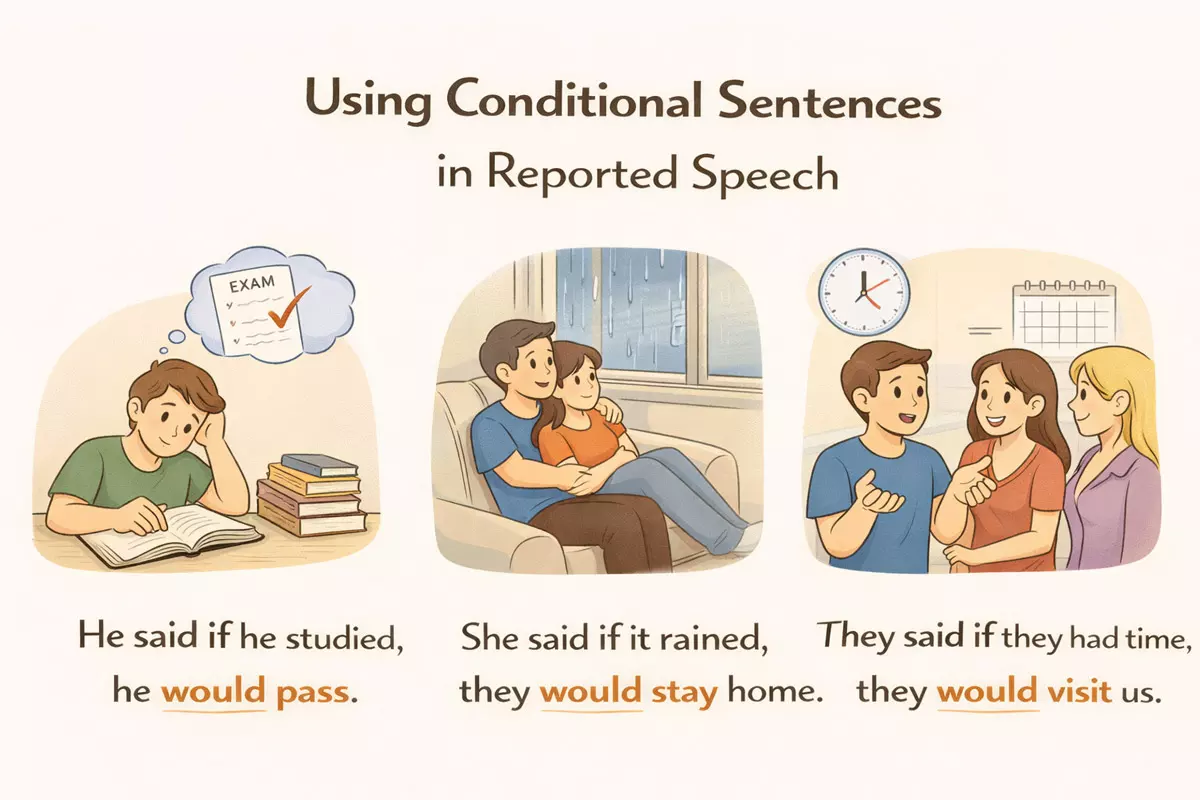
- If we had more time, we would visit. → They said that if they had more time, they would visit.
- If I had known, I would have helped. → She said that if she had known, she would have helped.
- If you need help, just ask. → He said that if I needed help, I should just ask.
- If it snows, school will close. → The teacher said that if it snowed, school would close.
- If they work hard, they might win. → The coach said that if they worked hard, they might win.
- If you saw him, would you recognize him? → She asked if I would recognize him if I saw him.
- If you had listened, you would understand. → He said that if I had listened, I would understand.
- If I buy a ticket, I will invite you. → She said that if she bought a ticket, she would invite me.
Mastering the changes needed when reporting conditionals helps maintain accuracy and avoids confusion, especially when dealing with complex sentence structures or shifting time frames.
Reporting zero and first conditionals
When turning direct speech with conditional sentences into reported speech, the way you transform the sentence depends on whether it expresses a “zero” or “first” conditional. Each type has its own patterns and nuances in reported speech.
Zero conditionals in reported speech
Zero conditional sentences describe general truths, facts, or routines (for example: “If you heat ice, it melts”). When reporting these, the verb tenses usually remain unchanged because the facts are still true at the time of reporting. The reporting verb can be in the past, but the conditional itself is not shifted.
- Direct: “If water boils, it evaporates.”
- Reported: She said that if water boils, it evaporates.
- Direct: “If you mix red and blue, you get purple.”
- Reported: He explained that if you mix red and blue, you get purple.
First conditionals in reported speech
First conditional sentences talk about real and possible situations in the future (“If it rains, I will stay home”). In reported speech, the verb tenses usually shift back one step: the present simple in the ‘if’ clause often becomes past simple, and “will” in the main clause becomes “would”.
| Direct Speech | Reported Speech |
|---|---|
| If it rains, I will stay home. | She said that if it rained, she would stay home. |
| If you call me, I will help. | He promised that if I called him, he would help. |
| If they finish early, they will join us. | He said that if they finished early, they would join us. |
| If you study, you will pass. | She encouraged him that if he studied, he would pass. |
Key points to remember
- Zero conditionals keep their present tense structure when reported, since the facts remain true.
- First conditionals generally shift tenses: present simple → past simple, will → would.
- Reporting verbs like “said,” “explained,” and “promised” are often used to introduce the reported statement.
- Pronouns and time markers may need to be adjusted for context.
- Sometimes, zero conditionals can be reported with minimal or no change, especially in scientific or universally true statements.
- First conditional sentences in reported speech do not use “will” directly; instead, use “would.”
- It’s important to consider the original meaning—keep the sense of possibility or fact in your transformation.
Examples of common patterns
- “If you touch fire, it burns.” → She said that if you touch fire, it burns.
- “If I see him, I will tell him the news.” → She said that if she saw him, she would tell him the news.
- “If the sun sets, it gets dark.” → He explained that if the sun sets, it gets dark.
- “If you arrive early, we will start on time.” → They said that if we arrived early, we would start on time.
- “If you heat metal, it expands.” → The teacher said that if you heat metal, it expands.
- “If it rains tomorrow, we will cancel the picnic.” → She said that if it rained the next day, they would cancel the picnic.
Being clear about the difference in how general truths and real possibilities are reported helps ensure your sentences are both accurate and natural in indirect speech.
Reporting second and third conditionals
When moving unreal conditional sentences (often called the second and third conditionals) into reported speech, the process involves subtle but important changes. These structures typically express hypothetical or impossible situations, and reporting them requires careful attention to verb forms and tense shifts.
How second conditional sentences change in reported speech
Second conditional sentences describe unreal or unlikely present or future situations. When these are reported, the tense of the verbs usually shifts back, but since "would" is already used, it often stays the same. The reporting verb is usually in the past (e.g., "said," "told me"), and pronouns/time references may need adjustment.
- Direct: "If I won the lottery, I would travel the world," she said.
- Reported: She said that if she won the lottery, she would travel the world.
- Direct: "If he had more time, he would learn Spanish," John said.
- Reported: John said that if he had more time, he would learn Spanish.
- Direct: "If it rained, we would cancel the picnic," they said.
- Reported: They said that if it rained, they would cancel the picnic.
Notice that the structure of the condition ("If + past simple") and result ("would + base verb") usually remains unchanged in reporting because the hypothetical nature is already clear.
How third conditional sentences are reported
Third conditional sentences refer to unreal past situations—things that did not happen. In reported speech, the "would have" structure is kept, and the condition part ("if + past perfect") is usually not changed.
- Direct: "If I had known about the meeting, I would have attended," she said.
- Reported: She said that if she had known about the meeting, she would have attended.
- Direct: "If they had left earlier, they would have caught the train," he explained.
- Reported: He explained that if they had left earlier, they would have caught the train.
- Direct: "If you had told me, I would have helped," Tom said.
- Reported: Tom said that if I had told him, he would have helped.
Comparing direct and reported forms
To make the differences and similarities clearer, here is a comparison of how these conditionals are handled in both direct and reported speech:
| Direct Conditional | Reported Speech |
|---|---|
| "If I were rich, I would buy a yacht," she said. | She said that if she were rich, she would buy a yacht. |
| "If we had studied harder, we would have passed," they said. | They said that if they had studied harder, they would have passed. |
| "If you left now, you would catch the bus," he said. | He said that if I left then, I would catch the bus. |
| "If I had seen her, I would have spoken to her," John said. | John said that if he had seen her, he would have spoken to her. |
Common adjustments when reporting unreal conditionals
When changing these sentences into reported speech, keep these points in mind:
- Pronouns often change (I → he/she, you → I/he/she/they, etc.).
- Time references may shift ("now" → "then," "today" → "that day").
- The verb tense in the condition usually remains the same, as the hypothetical meaning is preserved.
- Reporting verbs are typically in the past ("said," "told," "explained").
By following these patterns, you can accurately report unreal or hypothetical statements and maintain their intended meaning.
Modal and tense adjustments
When turning conditional sentences into reported speech, you often need to change both the verb tense and the modal verbs to reflect the shift from direct to indirect language. This ensures that the meaning remains clear and accurate, especially when the reporting verb is in the past tense.
Shifting tenses in conditionals
Conditional sentences typically contain two clauses: the "if" clause and the main clause. When reporting these, the verb tenses usually move one step back in time. For example, present simple changes to past simple, and will becomes would. This backshift helps to indicate that the original statement was made in the past.
- If she studies, she will pass. → He said that if she studied, she would pass.
- If it rains, we won't go. → She explained that if it rained, they wouldn’t go.
- If you had listened, you would have understood. → He mentioned that if I had listened, I would have understood.
Changes in modal verbs
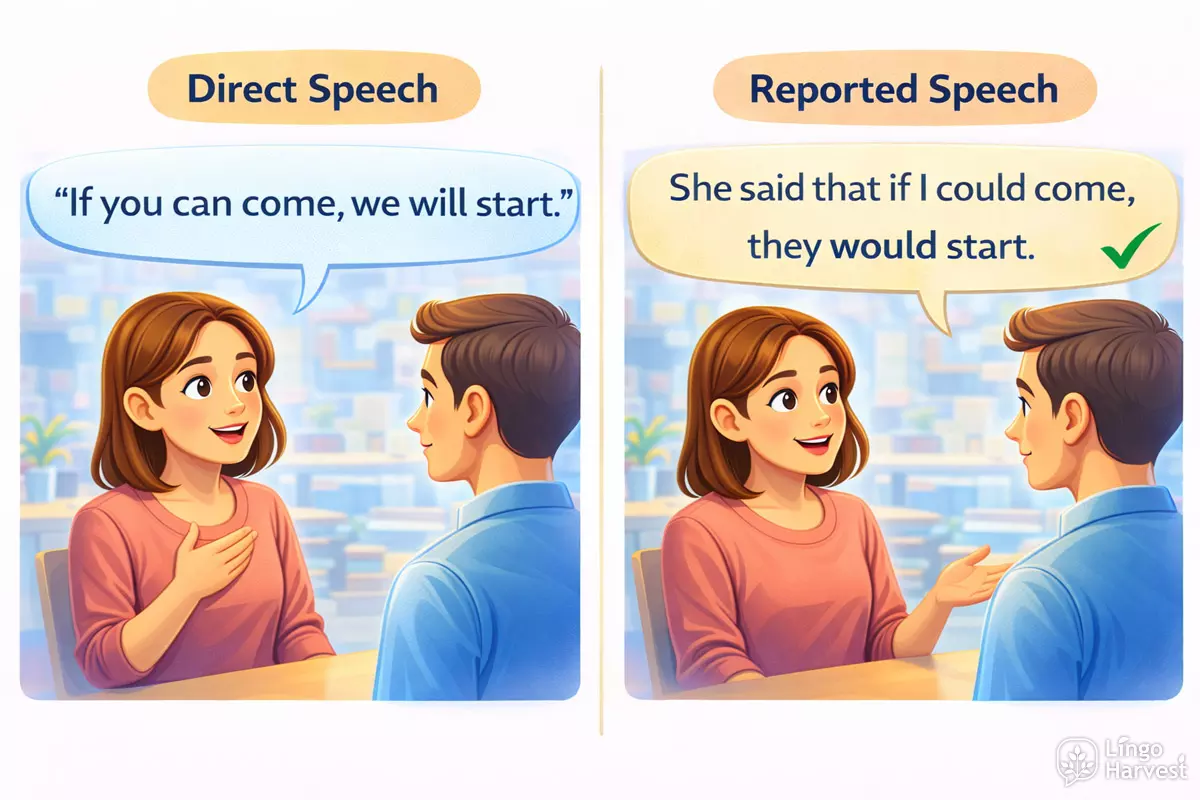
Modal verbs like will, can, may, and must often need to be adjusted when reporting conditional sentences. The most common transformations are will → would, can → could, may → might, and must → had to. Some modals, such as would, could, and might, typically remain unchanged.
| Direct Speech | Reported Speech |
|---|---|
| "If you can come, we will start." | She said that if I could come, they would start. |
| "If you may need help, ask me." | He told me that if I might need help, I should ask him. |
| "If you must leave, let me know." | She said that if I had to leave, I should let her know. |
| "If you would like more, let me know." | He said that if I would like more, I should let him know. |
| "If you could help, I’d be grateful." | She said that if I could help, she would be grateful. |
Special considerations
Not all modals or tenses shift in every case. For example, in second and third conditionals, the forms often remain unchanged because they already refer to unreal or hypothetical situations. It’s important to consider the context and meaning when making these adjustments.
Summary of common shifts
- will → would
- can → could
- may → might
- must → had to (obligation)
- would / could / might → usually unchanged
- present simple → past simple
- present continuous → past continuous
- present perfect → past perfect
- past simple → past perfect
- am / is / are going to → was / were going to
Paying attention to these changes helps maintain the intended meaning and timeline when reporting conditional statements.
Preserving original meaning
When reporting conditional sentences, it’s essential to maintain the speaker’s original intent, logical relationships, and any implied consequences. Shifts in tense, pronouns, or modal verbs can easily change the sense of the condition or result if not handled carefully. The goal is to accurately convey what was meant, not just what was said.
Key considerations when reporting conditionals
- Sequence of tenses: Adjust verb tenses appropriately, but ensure the cause-and-effect relationship remains clear.
- Conditional type: Recognize whether the condition is real, unreal, or hypothetical and match the appropriate structure in reported speech.
- Modal verbs: Words like would, could, or might often change in reported speech; use them to reflect the original sense of possibility or certainty.
- Time references: Update time expressions (e.g., today becomes that day) only if they are necessary for clarity and context.
- Pronoun changes: Adapt pronouns to match the new speaker or listener, but ensure the logic of the sentence remains intact.
- If/whether: Use whether or if carefully, especially when reporting indirect questions or alternatives.
- Negative conditions: Maintain the original meaning in negative or unless-type clauses.
- Implied promises or warnings: Retain any implied meaning, such as advice, warnings, or offers, when rephrasing.
- Mixed conditionals: If the original uses a mix of time frames, preserve this balance in the reported version.
- Ambiguity: Avoid introducing ambiguity by being as precise as the original statement.
Examples: Direct vs. Reported Conditional Sentences
Below is a comparison of typical conditional sentences and how they are reported, illustrating how to maintain the intended meaning:
| Direct Speech | Reported Speech |
|---|---|
| "If you study hard, you will pass." | He said that if I studied hard, I would pass. |
| "If I were you, I would apologize." | She said that if she were me, she would apologize. |
| "If it rains, we can't go." | He said that if it rained, they couldn't go. |
| "If I had known, I would have called." | She said that if she had known, she would have called. |
| "If you see Tom, tell him." | He asked me to tell Tom if I saw him. |
| "If you had left earlier, you might have caught the bus." | She said that if I had left earlier, I might have caught the bus. |
Common pitfalls to avoid
- Changing the condition so it no longer reflects the original possibility or impossibility.
- Losing track of who is being referred to due to incorrect pronoun changes.
- Forgetting to update modals, resulting in statements that sound unnatural or lose their intended nuance.
- Omitting time references, which can cause confusion about when the condition applies.
Careful attention to these details ensures that when you report conditional statements, the original message, intention, and logical connections are all preserved.
Common reporting mistakes with conditionals
When using conditional sentences in reported speech, learners often stumble over tense shifts, overlooked modal changes, and confusion about which reporting verb to use. These difficulties can make indirect statements unclear or even alter the original meaning. Let's explore where things typically go wrong and how to avoid these pitfalls.
Frequent errors with tense backshifting
One major source of mistakes is incorrect backshifting of tenses, especially when dealing with the different types of conditional sentences. For example, students sometimes forget to change "will" to "would" or leave present tenses unchanged when reporting second or third conditionals. This can make the reported sentence sound unnatural or incorrect.
| Direct Conditional | Incorrect Reported | Correct Reported |
|---|---|---|
| "If it rains, we will stay home." | He said if it rains, we will stay home. | He said if it rained, they would stay home. |
| "If I had more time, I would travel." | She said if she has more time, she would travel. | She said if she had more time, she would travel. |
| "If you had called, I would have helped." | He said if you had called, he will have helped. | He said if I had called, he would have helped. |
| "If you study, you can pass." | She said if you study, you can pass. | She said if you studied, you could pass. |
Mixing up pronouns and time expressions
Another issue is the failure to adjust pronouns and time references. In reported speech, "I" or "we" often needs to become "he," "she," or "they," and expressions like "tomorrow" might need to change to "the next day." Forgetting these changes can create confusion.
- Not changing "I" to "he/she" or "we" to "they"
- Leaving "today" instead of using "that day"
- Using "my" when "his/her" is needed
- Forgetting to shift "tomorrow" to "the next day"
Incorrect modal verb changes
Reported conditionals often require shifting modals. Learners sometimes forget that "can" becomes "could," "will" becomes "would," and "may" becomes "might" when reporting. Missing these shifts leads to sentences that sound inconsistent or ungrammatical.
- Leaving "will" in reported speech instead of changing it to "would"
- Using "can" instead of "could"
- Failing to change "may" to "might"
- Using "shall" instead of "should" or "would"
Confusing conditional types
It’s common to confuse which conditional structure to use when reporting. Some learners mix up first, second, and third conditional forms, especially after backshifting. This can lead to sentences that don't match the intended meaning of the original statement.
- Reporting a first conditional as a second conditional
- Mixing second and third conditional forms
- Using present tense in place of past perfect for third conditionals
Summary of common pitfalls
To avoid these mistakes, always check tense shifts, modal changes, pronoun and time reference adjustments, and the correct conditional structure. Practicing with varied examples can help build confidence in reporting conditional sentences accurately.
Homework
This homework focuses on reporting conditional sentences accurately. Pay attention to tense backshifting, modal changes, pronoun adjustments, and time references. Try to preserve the original logic and meaning of each condition while converting it into reported speech.
Task 1. Rewrite the conditional sentences in reported speech
- "If it rains, we will cancel the trip," she said.
- "If I finish early, I can help you," he said.
- "If you study harder, you will pass the exam," the teacher said.
- "If I had more time, I would learn Spanish," Anna said.
- "If you had called me, I would have come," he said.
- "If we see John, we will tell him," she said.
- "If you can fix this, I will be grateful," he said.
- "If I were you, I would accept the offer," she said.
- "If they arrive late, we won’t wait," the manager said.
- "If you had listened, you might have avoided the problem," he said.
Show answers
- She said that if it rained, they would cancel the trip.
- He said that if he finished early, he could help me.
- The teacher said that if I studied harder, I would pass the exam.
- Anna said that if she had more time, she would learn Spanish.
- He said that if I had called him, he would have come.
- She said that if they saw John, they would tell him.
- He said that if I could fix it, he would be grateful.
- She said that if she were me, she would accept the offer.
- The manager said that if they arrived late, they wouldn’t wait.
- He said that if I had listened, I might have avoided the problem.
Task 2. Spot and correct the mistake in each reported conditional
- He said if it rains, they would stay at home.
- She said that if I will finish early, I could leave.
- They said if they had more money, they will travel more.
- He said that if you had asked, he will help you.
- Anna said if she studies harder, she would pass.
- She said that if I can call earlier, she would explain.
- He said if it rained yesterday, they would cancel the match.
- They said that if we had left earlier, we catch the train.
- She said if I were careful, I will avoid mistakes.
- He said that if you see Tom, you would tell him.
Show answers
- He said that if it rained, they would stay at home.
- She said that if I finished early, I could leave.
- They said that if they had more money, they would travel more.
- He said that if I had asked, he would have helped me.
- Anna said that if she studied harder, she would pass.
- She said that if I could call earlier, she would explain.
- He said that if it had rained the day before, they would have cancelled the match.
- They said that if they had left earlier, they would have caught the train.
- She said that if I were careful, I would avoid mistakes.
- He said that if I saw Tom, I should tell him.