When Modal Verbs Do Not Change in Reported Speech

 This article explains why some modal verbs do not change in reported speech, focusing on their use for general truths and present or future situations. It also covers logical vs. grammatical changes, speaker intention, and common learner mistakes.
Have you ever wondered why certain helping verbs such as can, might, or should sometimes remain unchanged when reporting what someone said? In English, these particular verbs are called modal verbs, and they often do not shift in indirect or reported speech, especially when the meaning remains the same or the situation is still true. Recognizing when modals stay the same can help your English sound more accurate and natural in conversations and writing.
Why some modal verbs stay the same
Some modal verbs do not change form when we shift from direct to reported speech. This happens because these particular verbs already express meanings that do not require tense adjustment, such as ability, permission, or necessity that is fixed in time or unchangeable by context. Unlike most verbs, certain modals are considered “defective,” meaning they lack past or future forms, so there is nothing to shift.
Which modal verbs are unchanged in reported speech?
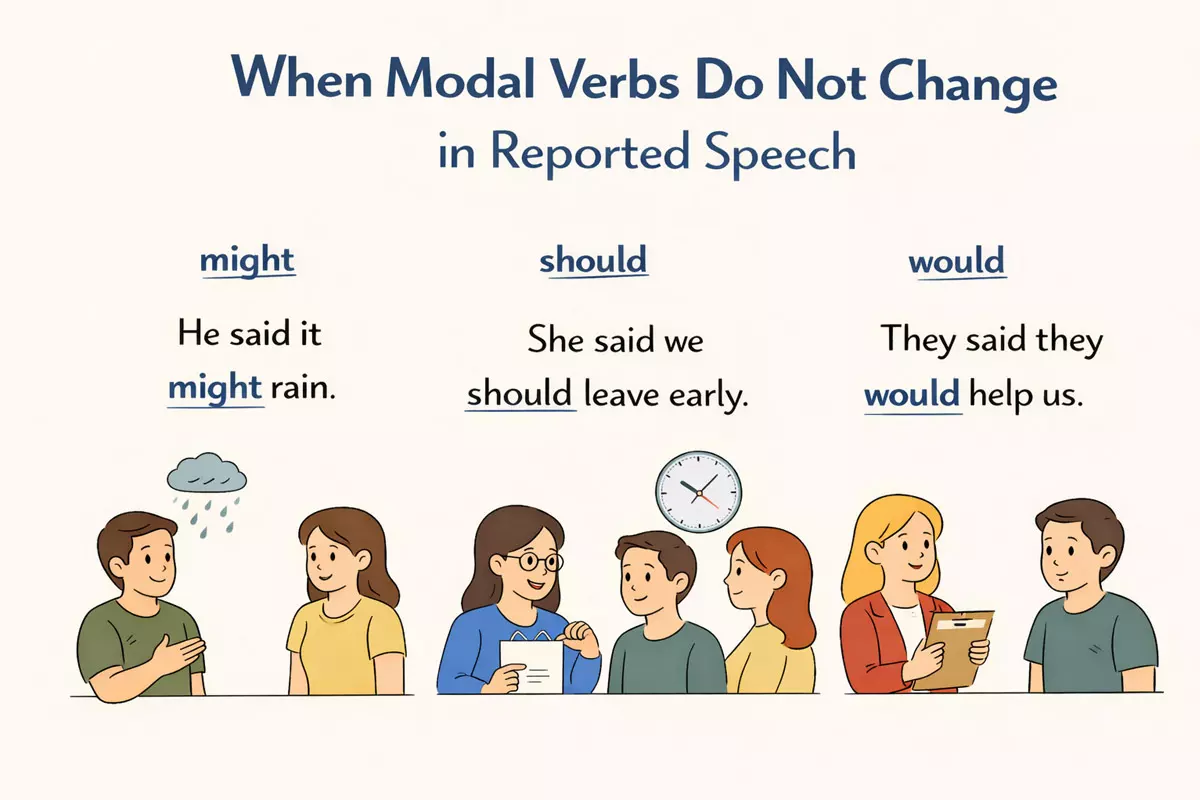
The main modal verbs that keep their original form are: might, could, would, should, ought to, and must (sometimes). These modals either already act as past forms or express meanings that don’t depend on the speaker’s time frame.
- Might: “I might come.” → She said she might come.
- Could: “He could help.” → She said he could help.
- Would: “I would go.” → He said he would go.
- Should: “You should try.” → She said you should try.
- Ought to: “You ought to listen.” → He said you ought to listen.
- Must: “You must stop.” → She said you must stop. (when expressing obligation)
Reasons for unchanged forms
- No distinct past form: These modals lack a separate past tense, so there’s nothing to convert.
- Fixed meaning: The meaning does not shift over time (e.g., advice, possibility, unchangeable necessity).
- Already “backshifted”: ‘Could’, ‘would’, and ‘might’ are already the past forms of ‘can’, ‘will’, and ‘may’.
Common patterns in reported speech

| Direct Speech | Reported Speech |
|---|---|
| “I could swim.” | He said he could swim. |
| “You might win.” | She said you might win. |
| “They would help.” | He said they would help. |
| “We should leave.” | They said we should leave. |
| “You must finish.” | She said you must finish. |
| “He ought to stay.” | She said he ought to stay. |
Special notes on “must”
The verb must is sometimes replaced by had to when reporting past necessity, but it stays the same when referring to rules, laws, or strong advice. For example: “You must be quiet” (rule) → He said you must be quiet. But: “I must go now” (personal necessity) → She said she had to go then.
In summary, the unchanged form of these modal verbs in reported speech is due to their unique grammatical roles and the fact that their meaning generally remains constant regardless of when the speech is reported.
Modals expressing general truths
When reporting speech that includes modal verbs used to state facts, laws of nature, or other universally accepted realities, these modals often remain unchanged. This is because the truth they express is not tied to a particular moment in time and doesn't depend on the speaker's perspective. Instead, the statement holds true regardless of who says it or when it is said.
Why modals stay the same for universal statements
Reported speech usually requires shifting tenses back, but when a modal verb reflects a general rule or a permanent situation, this shift is unnecessary. For example, "can," "must," and "may" frequently occur in scientific, mathematical, or universally accepted statements. In these cases, the meaning is not altered by time, so the modal verb is left as is.
- Physical laws: "Water can boil at 100°C." → He said that water can boil at 100°C.
- Abilities that are always true: "Birds can fly." → She said birds can fly.
- Obligations that are permanent: "You must stop at red lights." → He explained that you must stop at red lights.
- Possibility in general: "Anyone may enter the competition." → They said anyone may enter the competition.
- Logical deduction: "That must be the answer." (when it's always the case) → He said that must be the answer.
- Permission that is ongoing: "You may use the library at any time." → She mentioned you may use the library at any time.
- Universal habits: "People will make mistakes." → He said people will make mistakes.
- General ability: "Humans can learn languages." → They said humans can learn languages.
- Permanent prohibition: "You must not touch the wires." → The instructor said you must not touch the wires.
- General possibility: "Accidents can happen." → He said accidents can happen.
- Universal permission: "One may not shout in the library." → The librarian said one may not shout in the library.
Examples in reported speech
Below is a summary table comparing how modal verbs behave when expressing timeless truths versus when they refer to specific past situations:
| Original Statement | Reported Speech (General Truth) |
|---|---|
| Water can freeze at 0°C. | He said water can freeze at 0°C. |
| People must breathe to live. | She explained people must breathe to live. |
| Anyone may apply for the job. | They said anyone may apply for the job. |
| Children will make mistakes. | He mentioned children will make mistakes. |
| Electricity can be dangerous. | She warned electricity can be dangerous. |
Key takeaway
When modal verbs convey facts or truths that are always valid, they generally do not change in reported speech. This helps maintain the original meaning and ensures the statement remains universally true, regardless of who is reporting it.
Present and future reference modals
Some modal verbs, such as can, may, might, shall, should, and will, often remain unchanged when reporting speech about current events or future intentions. This is especially true when the original meaning still applies at the time of reporting or when the modal does not have a distinct past form. Understanding which modals stay the same—and why—can help you report statements accurately and naturally.
When modals do not change in reported speech
Certain modal verbs lack a past tense form or their meaning would be altered if you tried to "backshift" them. In reported speech, these modals typically remain the same, especially if the context is still true or relates to the future. For example, will stays will when the promise or intention is still relevant.
- Direct: "I can meet you tomorrow."
Reported: She said she can meet me tomorrow. - Direct: "We may go to the party."
Reported: They said they may go to the party. - Direct: "He should finish by noon."
Reported: She said he should finish by noon. - Direct: "You will love this movie."
Reported: He said I will love that movie. - Direct: "I might call you later."
Reported: She said she might call me later. - Direct: "We shall see what happens."
Reported: They said they shall see what happens. - Direct: "You must be quiet."
Reported: The teacher said we must be quiet. - Direct: "He could help us."
Reported: She said he could help us. - Direct: "I ought to study more."
Reported: He said he ought to study more. - Direct: "You need to see this."
Reported: She said I need to see that.
Comparison: Modals that do and do not change
| Modal Verb | Reported Speech Form | Example | Notes |
|---|---|---|---|
| can | can / could | She said she can/could help. | Both forms possible, but "can" stays for present/future ability. |
| may | may / might | He said he may/might join us. | "May" often remains unchanged for present/future possibility. |
| will | will | They said they will call. | No change for definite future statements. |
| should | should | She said I should try harder. | Form does not change in reported speech. |
| must | must / had to | He said I must/had to go. | "Must" usually stays for necessity; "had to" used for past obligations. |
| might | might | She said she might be late. | No change, as "might" is already a past form of "may." |
| shall | shall | He said we shall see. | Rare in modern English, but form remains unchanged. |
In summary, when reporting statements about current facts, ongoing situations, or future plans, most modals remain unchanged. Always consider the time frame and intended meaning before deciding whether to shift the verb form or keep it the same.
Difference between logical and grammatical change
When discussing reported speech, it's important to understand why some modal verbs stay the same, while others shift their form. This distinction comes down to whether the change is logical (based on meaning or context) or grammatical (required by English grammar rules). Recognizing the difference helps learners decide when a modal verb can remain unchanged in reported speech and when it must be altered.
Grammatical Change: Following the Rules
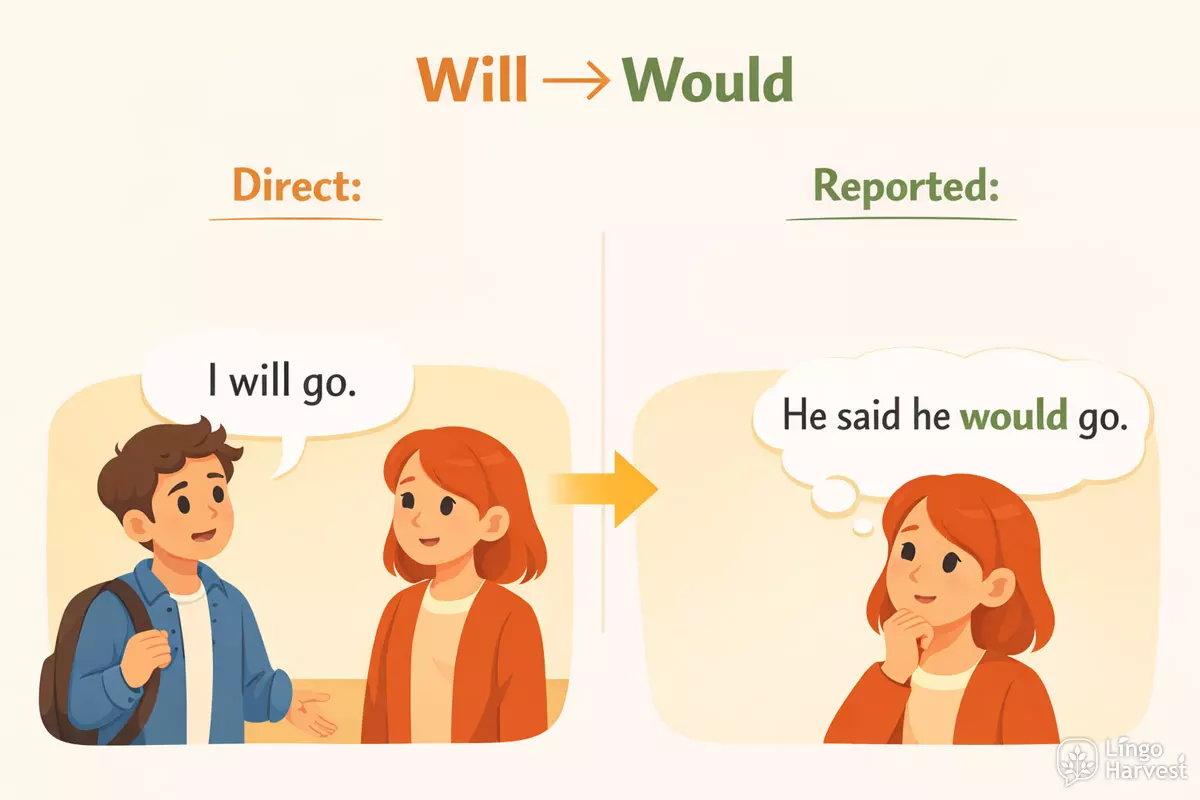
Some changes in reported speech are strictly grammatical. English typically requires backshifting of tenses, including modals with clear past forms. For example, can often becomes could, and will becomes would. This shift does not depend on the speaker’s intention or the sentence’s logic, but follows set patterns in English grammar.
- Can → Could ("She said, 'I can help.' " → She said she could help.)
- Will → Would ("He said, 'I will go.' " → He said he would go.)
- May → Might ("They said, 'We may come.' " → They said they might come.)
Logical Change: Based on Meaning
Other times, modals remain unchanged because changing them would alter the intended meaning or because no clear past form exists. This is a logical decision, not a grammatical rule. For example, modal verbs like must (when expressing obligation), might, should, could, and would often do not shift in reported speech.
- Must (obligation): "You must finish." → She said I must finish. (Changing to "had to" is possible, but "must" is often kept to preserve the sense of obligation.)
- Should: "You should see a doctor." → He said I should see a doctor.
- Could: "I could help." → She said she could help.
- Would: "I would go." → He said he would go.
Comparing Logical and Grammatical Changes in Modals
| Type of Change | Example in Reported Speech | Explanation |
|---|---|---|
| Grammatical Change | She said, "I can swim." → She said she could swim. | Follows grammar rule: 'can' changes to 'could' in reported speech. |
| Logical Change (No Change) | He said, "You should try." → He said I should try. | 'Should' stays the same—no past form, meaning does not change. |
| Logical Change (Optional) | She said, "You must go." → She said I must go. / She said I had to go. | Both forms possible; 'must' often kept to retain the original sense of necessity. |
| Grammatical Change | He said, "I will call you." → He said he would call me. | Standard backshift: 'will' becomes 'would' in reported speech. |
Key Takeaways
- Grammatical changes are automatic and follow strict English rules.
- Logical changes depend on context, meaning, and whether a modal has a true past form.
- Some modals never change, while others do so only if the meaning stays consistent.
- Understanding these differences helps in accurately reporting speech without distorting the original message.
Speaker attitude and intention
How a speaker feels or what they mean to express plays a key role in whether modal verbs change in reported speech. Sometimes, the original meaning or the intent behind the modal verb is so specific that changing it would cause confusion or alter the nuance. In these cases, the modal often stays the same, especially with verbs like “must,” “might,” “could,” and “should.” When reporting what someone said, if the modal expresses the speaker’s attitude—such as certainty, necessity, or suggestion—it is usually left unchanged to keep the original meaning clear. For example, “must” can show personal obligation or strong advice. If you reported “You must see this movie!” as “He said I had to see that movie,” it might lose the sense of urgency or recommendation. Keeping the modal helps preserve the original force and color of the statement.
Modal verbs and subtle meanings
Modals often carry subtle shades of meaning that reflect how the speaker views the situation. Changing the form in indirect speech can blur these nuances. Here are some common attitudes and intentions expressed by modals that are typically kept the same when reported:
- Obligation: “You must finish your homework.”
- Possibility: “It might rain tomorrow.”
- Ability: “She could solve the puzzle.”
- Advice: “You should see a doctor.”
- Permission: “You may leave early.”
- Deduction: “That must be the answer.”
- Lack of necessity: “You needn’t worry.”
- Uncertainty: “He might be at home.”
- Polite requests: “Could you help me?”
- Suggestions: “We could try a different approach.”
- Expectation: “He should arrive soon.”
- Prohibition: “You mustn’t touch that.”
- Possibility (past): “She might have missed the train.”
- Advice (past): “You should have called earlier.”
- Ability (past): “He could have won.”
- Permission (past): “I could go out whenever I wanted.”
- Probability: “That should be enough.”
- Possibility (future): “It might snow tonight.”
Comparing intention: modal change vs. no change
Sometimes, changing the modal in reported speech alters the intent. Here’s a comparison of how keeping or changing the modal can affect the meaning:
| Direct Speech | Reported Speech (modal unchanged) | Reported Speech (modal changed) |
|---|---|---|
| "You must be tired." | He said I must be tired. | He said I had to be tired. |
| "She might come." | He said she might come. | He said she would come. |
| "You should see this." | He said I should see it. | He said I ought to see it. |
| "I could help you." | He said he could help me. | He said he would be able to help me. |
| "You may leave early." | She said I may leave early. | She said I could leave early. |
| "You can use my charger." | He said I can use his charger. | He said I could use his charger. |
| "It may take a while." | She said it may take a while. | She said it might take a while. |
| "You must finish this today." | He said I must finish it that day. | He said I had to finish it that day. |
Retaining the original modal often preserves the intended meaning or feeling behind the words. When reporting speech, pay attention to what the speaker was trying to express—certainty, doubt, advice, or necessity—and keep the modal verb unchanged if it helps convey the same idea. This not only maintains accuracy but also respects the nuance of the original statement.
Frequent learner misunderstandings
Learners often assume that all verbs must change tense in reported speech, but certain modal verbs actually remain unchanged. This creates confusion, especially when students try to apply backshifting rules universally. Below are common misconceptions and pitfalls related to reporting statements with modal verbs.
Confusing which modals change
Some modals do shift in reported speech, while others do not. For example, "can" often becomes "could," but "might," "should," "would," "could," and "ought to" typically stay the same. Many students mistakenly alter these forms, thinking all modals follow the same pattern.
Common mistakes with unchanged modals
Learners sometimes incorrectly backshift modals that should remain the same, or forget to change those that do shift. Here are frequent errors and correct forms:
- Changing "should" to "should have" when reporting advice: ❌ He said I should have study more. ✅ He said I should study more.
- Altering "would" to "will" or "would have": ❌ She said she would have come. ✅ She said she would come.
- Backshifting "might" to "might have": ❌ He said he might have go. ✅ He said he might go.
- Forgetting that "could" can stay the same: ❌ She said she could have help. ✅ She said she could help.
Mixing up modal meanings
Another issue is confusing the meaning of modals when reporting speech. For instance, learners might use "would" instead of "could," changing the sense of the original statement.
- "Can" vs. "could": In reported speech, "can" usually becomes "could," but "could" does not change further.
- "May" vs. "might": "May" often changes to "might," but "might" remains unchanged.
- "Must": Sometimes "must" stays the same, but in some contexts it becomes "had to." Learners often over-apply one rule.
- "Should," "would," "might," "could," "ought to": These generally do not change, but are sometimes mistakenly backshifted.
Comparison of modal changes in reported speech
| Direct Speech | Reported Speech |
|---|---|
| can | could |
| may | might |
| must | must / had to |
| should | should |
| would | would |
| might | might |
| could | could |
| ought to | ought to |
Overgeneralizing tense changes
A widespread misunderstanding is believing every verb—including all modals—must shift tense in reported statements. This leads to unnatural sentences and miscommunication. Remember, only certain modals require a change, while others retain their original form.
Summary of typical errors
Learners can avoid confusion by remembering these key points:
- Not all modals shift in reported speech; learn which ones do and don't.
- Changing modals unnecessarily can alter the meaning.
- Overusing backshifting rules results in incorrect forms.
- Consistent practice helps reinforce correct patterns.
By focusing on these distinctions, students can report speech more naturally and accurately.
Homework: Logical vs. Grammatical Changes in Reported Modals
In this homework, focus on why a modal changes — or why it stays the same. Some shifts are grammatical (standard backshifting), while others are logical (you keep the modal to preserve meaning). For each item, choose the most accurate reported form and make sure the intention stays clear (obligation, advice, deduction, possibility, permission, or ability).
Exercise 1. Rewrite the sentences in reported speech (keep the intended meaning)
- "I can stay a little longer," Nina said.
- "I will email you the final version tonight," he said.
- "You may leave early today," the supervisor said.
- "You should double-check the figures," the editor said.
- "It might take longer than expected," the technician said.
- "That must be the correct address," she said.
- "You must submit the form by Friday," the administrator said.
- "I could fix it if I had the right tools," he said.
- "We might have missed a key detail," they said.
- "You needn’t apologize," she said.
Show answers
- Nina said that she could stay a little longer.
- He said that he would email me the final version that night.
- The supervisor said that I could leave early that day.
- The editor said that I should double-check the figures.
- The technician said that it might take longer than expected.
- She said that that must be the correct address.
- The administrator said that I had to submit the form by Friday.
- He said that he could fix it if he had the right tools.
- They said that they might have missed a key detail.
- She said that I needn’t apologize.
Exercise 2. Spot and correct the modal mistake (rewrite each sentence correctly)
- He said that he can join the call later.
- She said that she will send the files the next day.
- They said that it mighted be risky.
- The coach said I shoulded train more consistently.
- He said that I could to leave early.
- She said that I musted finish the draft by noon.
- They said that the result would have to be wrong.
- He said that I had to be exhausted.
- She said that he might have goes home already.
- They said that I ought change my approach.
Show answers
- He said that he could join the call later.
- She said that she would send the files the next day.
- They said that it might be risky.
- The coach said I should train more consistently.
- He said that I could leave early.
- She said that I had to finish the draft by noon.
- They said that the result had to be wrong.
- He said that I must be exhausted.
- She said that he might have gone home already.
- They said that I ought to change my approach.