Reporting Verbs Followed by Infinitives Explained

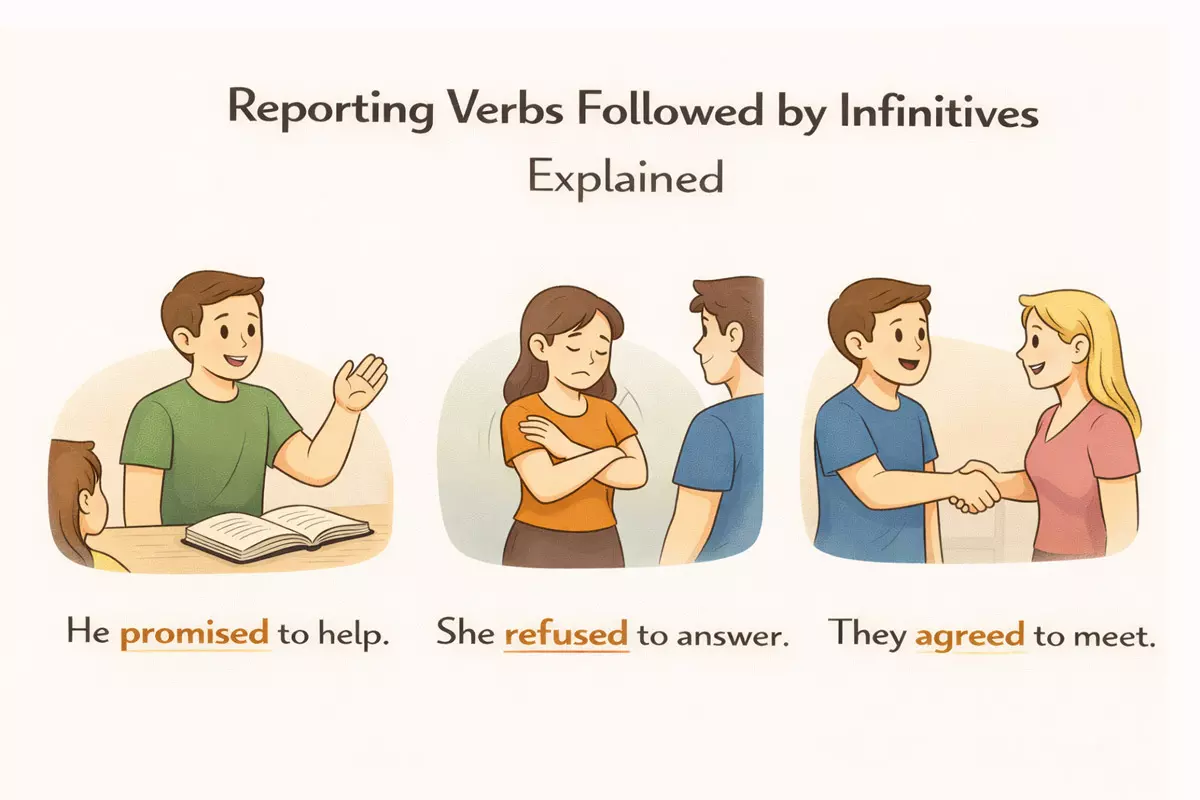 Here we how infinitive structures work in reported speech, lists common reporting verbs with infinitives, and explains object plus infinitive patterns. It also discusses meaning differences, negative forms, and common structural mistakes.
Learning how specific verbs that report what others say or think are followed by the infinitive form of another verb can be challenging for English learners. This article explains these verb patterns in a straightforward way, helping you use them correctly in both speaking and writing. By mastering these structures, you can make your communication sound more natural and precise, which is especially useful for formal contexts such as essays, reports, or presentations. Understanding these patterns not only improves your grammar but also boosts your confidence when expressing ideas attributed to others.
Infinitive structures in reported speech
When reporting what someone said, English often uses infinitive forms after certain verbs. These structures are common with reporting verbs like advise, ask, tell, and promise. Instead of repeating the original sentence word for word, speakers adapt the message using an infinitive phrase, which sounds more natural and concise.
How infinitive forms work after reporting verbs
Reporting verbs followed by an object and an infinitive create clear, indirect statements or commands. For example, instead of "He said, 'Close the window'," you can say "He told me to close the window." This structure is especially useful for relaying requests, orders, advice, or offers.
- advise someone to do something
- ask someone to do something
- beg someone to do something
- command someone to do something
- encourage someone to do something
- forbid someone to do something
- invite someone to do something
- order someone to do something
- persuade someone to do something
- remind someone to do something
- tell someone to do something
- warn someone (not) to do something
- promise to do something
- offer to do something
- agree to do something
- refuse to do something
Word order and pronoun changes
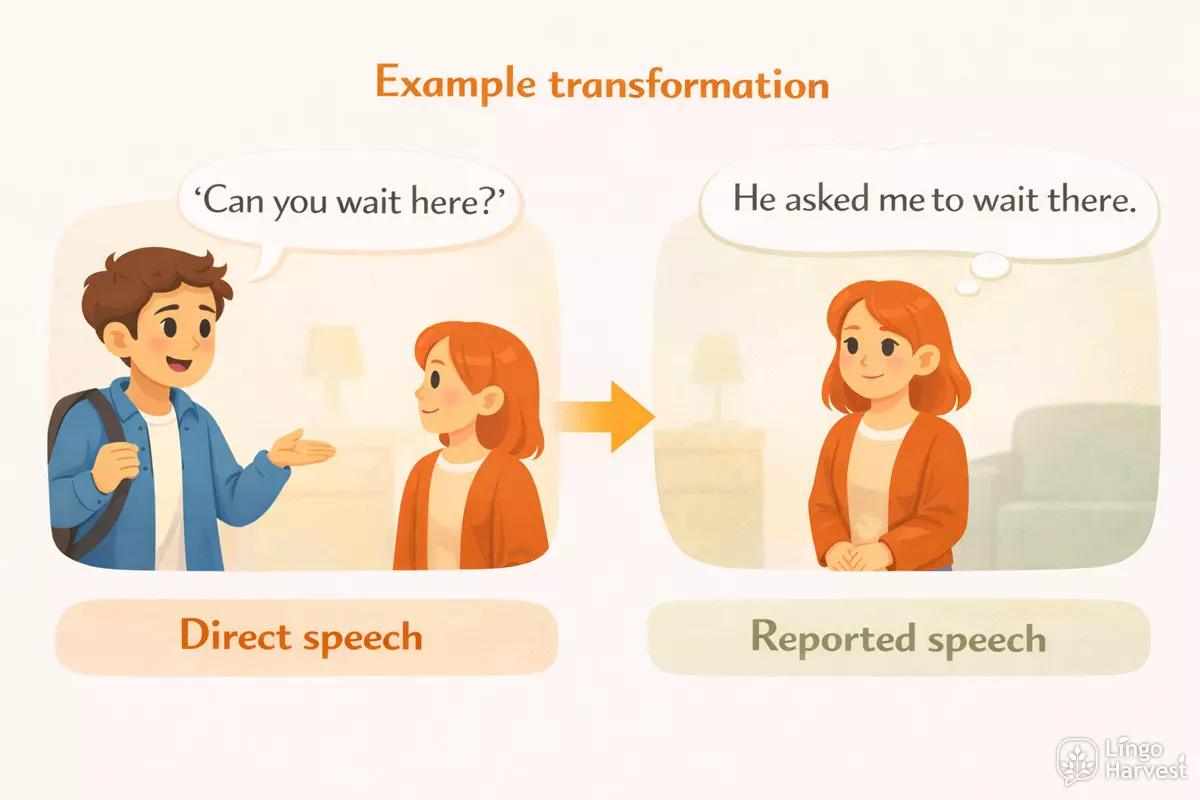
When transforming direct speech into this pattern, pay attention to pronoun and tense shifts. The reporting verb is followed by the person (object), then the infinitive. For example, "She said, 'I'll help you'" becomes "She promised to help me."
| Reporting verb | Example transformation |
|---|---|
| ask | "Can you wait here?" → He asked me to wait there. |
| tell | "Finish your homework." → She told him to finish his homework. |
| remind | "Don't forget to call." → They reminded her to call. |
| promise | "I will return early." → He promised to return early. |
| warn | "Be careful!" → She warned us to be careful. |
| offer | "Shall I help you?" → He offered to help me. |
Negative infinitive forms
To express a negative idea, simply add not before the infinitive. For example, "She warned me not to touch it" or "He told us not to worry." This pattern keeps the intended meaning clear and polite.
Summary of key points
- Many reporting verbs require an object plus an infinitive.
- Pronouns and tenses may need adjustment during transformation.
- Negative requests use not + infinitive.
- These structures make indirect speech more fluid and precise.
Common reporting verbs with infinitives
Certain verbs are frequently used to report what someone says, thinks, or feels, and these are often followed by a to-infinitive form. Using these structures helps add variety and clarity when retelling information or giving instructions. Typically, these verbs allow us to specify what action was suggested, promised, or decided, rather than quoting exact words.
Typical verbs followed by an infinitive
Many reporting verbs naturally combine with a to-infinitive, sometimes with a direct object in between. Here is a selection of verbs that fit this pattern:
- Agree
- Offer
- Promise
- Refuse
- Decide
- Plan
- Threaten
- Arrange
- Fail
- Afford
- Demand
- Hope
- Manage
- Prepare
- Swear
- Volunteer
- Vow
- Would like
Some of these verbs can also take an object before the infinitive, especially when reporting what someone told or advised another person to do.
Examples in context
To see how these verbs are used, compare the following sentences:
| Verb | Example sentence |
|---|---|
| Promise | She promised to call me later. |
| Offer | He offered to help with the project. |
| Refuse | They refused to cooperate. |
| Threaten | The manager threatened to fire anyone who was late. |
| Agree | We agreed to meet at noon. |
| Advise (with object) | She advised him to rest before the exam. |
| Remind (with object) | Please remind me to send the email. |
| Encourage (with object) | They encouraged her to apply for the job. |
| Warn (with object) | He warned them not to touch the wires. |
| Invite (with object) | Tom invited us to join the event. |
Key points to remember
- Some verbs are always followed by a to-infinitive, while others require an object before the infinitive.
- Negative forms use "not to": e.g., She refused to leave, He warned me not to touch.
- Choosing the correct structure helps make your reporting clear and precise.
Practicing these reporting verbs with infinitives will make your spoken and written English sound more natural and accurate.
Object plus infinitive constructions
Many reporting verbs in English allow for a structure where an object comes directly before an infinitive verb. This pattern is particularly common after verbs like advise, ask, encourage, and tell. In these sentences, the object is the person or thing that receives the action, and the infinitive expresses what is to be done. For example, in "She advised him to wait," him is the object and to wait is the infinitive phrase describing the action.
How the structure works
The basic form is: Subject + reporting verb + object + to-infinitive. This construction is used to report instructions, requests, advice, or other communicated actions. Choosing the right reporting verb will change the meaning slightly, but the grammatical structure remains consistent.
| Reporting Verb | Example Sentence |
|---|---|
| advise | The doctor advised her to rest. |
| ask | They asked us to leave early. |
| encourage | She encouraged him to apply for the job. |
| expect | We expect them to finish soon. |
| invite | He invited me to join the meeting. |
| order | The officer ordered the troops to advance. |
| persuade | She persuaded her friend to try sushi. |
| remind | Please remind me to send the email. |
| tell | I told him to be quiet. |
| warn | The teacher warned the students not to cheat. |
Common verbs used with this pattern
- allow
- beg
- cause
- convince
- force
- get
- instruct
- invite
- order
- persuade
- remind
- teach
- tell
- warn
With these verbs, the presence of the object is essential. Omitting the object often makes the sentence ungrammatical or changes its meaning. Compare: "She told to leave" ❌ (incorrect) versus "She told him to leave" ✅ (correct). Some reporting verbs, like promise or agree, do not take an object before the infinitive.
Negative forms and variations
To make the infinitive negative, simply add not before the verb: "The teacher warned us not to run in the hallways." This construction is also used with passive forms: "We were told to wait here."
In summary, using reporting verbs with an object and infinitive provides a flexible way to convey instructions, requests, or advice in English. Mastering this structure helps you report speech and actions more accurately and naturally.
Meaning differences between patterns
When reporting verbs are followed by infinitives, the structure chosen can subtly shift the nuance of the sentence. Some verbs can take different reporting patterns, and these choices can reflect changes in meaning, focus, or grammaticality. Understanding these differences is useful for clear and accurate communication, especially in formal or academic writing.
Infinitive patterns and their implications

Certain reporting verbs allow for more than one grammatical structure, but not all patterns mean the same thing. Here are some commonly used reporting verbs with infinitive forms, showing how their patterns affect meaning:
- Agree to do (expresses willingness or consent): She agreed to help.
- Offer to do (volunteering): He offered to carry the bags.
- Pretend to do (not genuine): They pretended to listen.
- Promise to do (commitment): I promised to call her.
- Refuse to do (denial): He refused to answer the question.
- Threaten to do (warning): She threatened to leave.
- Decide to do (choice): We decided to stay.
- Plan to do (intention): They plan to travel soon.
- Arrange to do (organization): He arranged to meet them at noon.
- Hope to do (expectation): I hope to see you there.
- Swear to do (strong promise): She swore to tell the truth.
- Fail to do (did not succeed): He failed to notice the sign.
- Manage to do (succeeded): They managed to finish on time.
- Offer to do (voluntary action): He offered to help with the chores.
- Prepare to do (get ready): She prepared to leave early.
- Wait to do (delay): We waited to speak until the end.
- Learn to do (acquire a skill): He learned to swim as a child.
- Neglect to do (omit): She neglected to mention the problem.
- Arrange for someone to do (cause or organize): They arranged for a technician to fix it.
- Ask someone to do (request): She asked him to stay.
Comparing similar reporting patterns
Some verbs can be followed by either an infinitive or another structure, but with a shift in focus or agency. For example, compare "advise to do" (less common) versus "advise someone to do" (standard), or "offer to do" (subject acts) versus "offer someone to do" (ungrammatical).
| Verb + Infinitive | Verb + Object + Infinitive | Typical Meaning/Focus |
|---|---|---|
| promise to do | promise someone to do | First is a self-promise; second is rare/awkward in English |
| ask to do | ask someone to do | First: request permission for oneself; second: request action from another |
| advise to do | advise someone to do | First: rarely used; second: recommend action to another |
| tell to do | tell someone to do | First: ungrammatical; second: give an order |
| offer to do | offer someone to do | First: volunteer oneself; second: not used in this meaning |
Summary of key distinctions
Choosing between different reporting verb patterns is not just about grammar, but about who is responsible for the action, the strength of the statement, and the overall intent. Paying close attention to these distinctions helps avoid misunderstandings and makes your writing clearer and more precise.
Negative infinitive forms
When using reporting verbs followed by infinitives, it’s sometimes necessary to express a negative meaning. This is done by inserting not before the infinitive: not to + base verb. The negative infinitive is especially important when you want to clarify that the reported action did not happen or was not intended.
Some reporting verbs commonly used with infinitives include agree, decide, promise, refuse, ask, tell, advise, expect, remind, warn, allow, and encourage. The placement of not always comes before to and the main verb, regardless of which reporting verb you use.
How to form the negative infinitive
To express a negative idea, simply put not before to and the verb. Here are some patterns:
- verb + not to + base verb
- verb + object + not to + base verb
For example:
- She promised not to tell anyone.
- They agreed not to leave early.
- He refused not to participate (less common, but possible for double negatives).
- The teacher reminded us not to forget our homework.
- We decided not to go to the party.
- She advised him not to worry.
- He warned me not to touch the stove.
- The doctor told her not to run after surgery.
- They encouraged us not to give up.
- My parents allowed me not to attend the meeting.
- I expected you not to be late.
- She asked me not to call after 10 p.m.
Examples: Affirmative vs. negative infinitive
| Affirmative Infinitive | Negative Infinitive |
|---|---|
| He promised to help. | He promised not to help. |
| They agreed to meet us. | They agreed not to meet us. |
| She told me to wait. | She told me not to wait. |
| The doctor advised him to rest. | The doctor advised him not to rest. |
| We decided to travel together. | We decided not to travel together. |
| She reminded us to submit the form. | She reminded us not to submit the form. |
| He asked me to call him later. | He asked me not to call him during the meeting. |
| They warned us to stay on the path. | They warned us not to leave the path. |
| She encouraged him to apply for the job. | She encouraged him not to give up after the rejection. |
| We arranged to meet at the station. | We arranged not to meet inside the crowded terminal. |
| He offered to drive me home. | He offered not to mention the mistake to anyone. |
| She decided to take a short break. | She decided not to check her phone during dinner. |
| The manager told us to finish the report by noon. | The manager told us not to share the draft outside the team. |
| He reminded her to lock the door. | He reminded her not to forget her keys. |
| They advised me to take the earlier train. | They advised me not to travel during the storm. |
| She agreed to join the call. | She agreed not to bring up the topic in front of clients. |
| He refused to sign the contract. | He refused not to answer the question. (rare; sounds like a double negative) |
| They instructed us to keep our receipts. | They instructed us not to throw away any documents. |
| She expected him to arrive on time. | She expected him not to be late again. |
| We chose to stay in a smaller hotel. | We chose not to spend too much on accommodation. |
| He managed to fix the issue quickly. | He managed not to panic during the presentation. |
Common points and mistakes
- Always place not directly before to and the verb.
- Don’t confuse the negative infinitive with other negative forms (like “don’t” or “didn’t”).
- Some verbs, like refuse, are already negative in meaning. Using a negative infinitive after them can create a double negative, which should be avoided unless you want that effect.
- With verbs that take an object (e.g., tell, advise, warn), the negative infinitive follows the object: She told me not to worry.
Mastering negative forms with infinitives helps you report speech and intentions accurately, especially when the original message was a warning, prohibition, or negative instruction.
Typical structural errors
When using reporting verbs followed by infinitives, learners often make recurring mistakes that can lead to awkward or grammatically incorrect sentences. Many of these issues arise from confusion over verb patterns, incorrect word order, or omitting essential elements in the structure.
Common mistakes with reporting verbs + infinitive
- Using a gerund instead of an infinitive (e.g., She promised going instead of She promised to go).
- Omitting "to" before the infinitive (e.g., He agreed help instead of He agreed to help).
- Incorrect verb form after the reporting verb (e.g., They decided went instead of They decided to go).
- Confusing direct and indirect objects (e.g., She advised him to study vs. She advised to study).
- Using the base form instead of the infinitive (e.g., He refused answer instead of He refused to answer).
- Placing the object in the wrong position (e.g., She told to me go instead of She told me to go).
- Mixing up reporting verbs that require an object with those that do not (e.g., He encouraged to try vs. He encouraged her to try).
- Confusing verbs that take infinitives with those that take gerunds (e.g., He suggested to leave instead of He suggested leaving).
- Using modal verbs with the wrong structure after reporting verbs (e.g., They asked can they leave instead of They asked to leave).
- Incorrect tense agreement in the infinitive phrase (e.g., She promised to went instead of She promised to go).
Confusing verb patterns: direct object or not?
Learners sometimes struggle to determine whether a reporting verb needs a direct object before the infinitive. For example, "advise" and "remind" require an object, while "agree" and "offer" do not. This confusion can lead to sentences that sound unnatural or are simply incorrect.
| Verb | Correct Pattern | Example | Common Error |
|---|---|---|---|
| advise | verb + object + to-infinitive | She advised him to wait. | She advised to wait. |
| agree | verb + to-infinitive | He agreed to help. | He agreed him to help. |
| ask | verb + object + to-infinitive | They asked her to leave. | They asked to leave. |
| promise | verb + to-infinitive | I promise to call. | I promise him to call. |
| tell | verb + object + to-infinitive | She told me to hurry. | She told to hurry. |
Word order and omission errors
Word order can be tricky, especially with longer sentences or when using indirect objects. Learners may accidentally omit the object or misplace the infinitive, leading to confusion. For instance, He reminded to lock the door (missing object) should be He reminded her to lock the door.
Quick tips to avoid mistakes
- Memorize which reporting verbs require an object before the infinitive.
- Double-check the use of "to" before the main verb.
- Review example sentences for each reporting verb pattern.
- Practice transforming direct speech into reported speech with infinitive structures.
- Be cautious not to mix up verbs that use gerunds versus infinitives.
By being aware of these structural errors and reviewing the correct patterns, you can use reporting verbs with infinitives more accurately and confidently in your writing and speech.
Homework
This homework trains your accuracy with reporting verbs followed by infinitives. Focus on choosing the correct pattern (verb + to-infinitive vs verb + object + to-infinitive vs verb + -ing), using negative infinitives (not to + verb) correctly, and avoiding common structural mistakes such as missing objects or incorrect word order.
Task 1. Choose the correct structure
- Complete the sentence:
She agreed ___ (help) with the presentation. - Complete the sentence:
They offered ___ (drive) us to the airport. - Complete the sentence:
He advised me ___ (take) a break. - Complete the sentence:
I promised ___ (call) you after the meeting. - Complete the sentence:
She reminded him ___ (not / forget) his ID badge. - Complete the sentence:
The manager told us ___ (submit) the form by Friday. - Complete the sentence:
He refused ___ (answer) the question. - Complete the sentence:
They encouraged her ___ (apply) for the scholarship. - Complete the sentence:
We arranged ___ (meet) outside the venue at noon. - Complete the sentence:
She asked me ___ (not / call) after 10 p.m.
Show answers
- She agreed to help with the presentation.
- They offered to drive us to the airport.
- He advised me to take a break.
- I promised to call you after the meeting.
- She reminded him not to forget his ID badge.
- The manager told us to submit the form by Friday.
- He refused to answer the question.
- They encouraged her to apply for the scholarship.
- We arranged to meet outside the venue at noon.
- She asked me not to call after 10 p.m.
Task 2. Spot and correct the mistake
- Correct the sentence:
She promised going early. - Correct the sentence:
He agreed help with the project. - Correct the sentence:
They told to me to wait outside. - Correct the sentence:
She advised to take the train. - Correct the sentence:
He suggested to leave immediately. - Correct the sentence:
They asked can they leave early. - Correct the sentence:
He reminded to lock the door. - Correct the sentence:
She encouraged try again. - Correct the sentence:
I expected you to not be late. - Correct the sentence:
He refused not to participate.
Show answers
- She promised to leave early.
- He agreed to help with the project.
- They told me to wait outside.
- She advised me to take the train. / She advised him to take the train.
- He suggested leaving immediately.
- They asked if they could leave early.
- He reminded her to lock the door. / He reminded me to lock the door.
- She encouraged me to try again. / She encouraged him to try again.
- I expected you not to be late.
- He refused to participate.