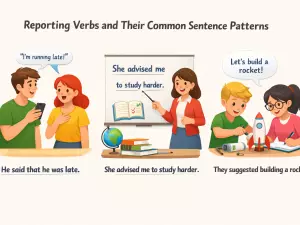
Reporting Verbs with Object and Infinitive Structure

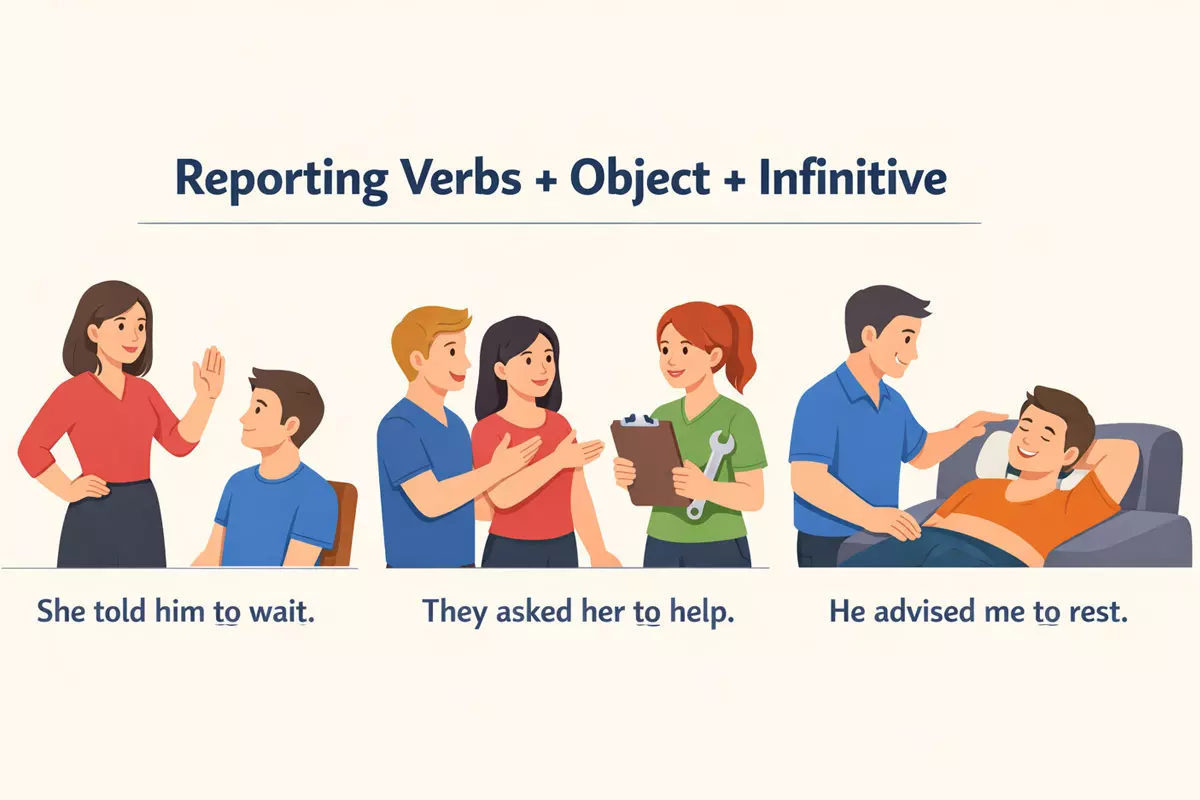 The article defines the object-infinitive structure, names verbs that use it, explains where to place pronouns, and shows how meaning or emphasis may shift. It also covers negative and passive forms, plus common mistakes learners make.
In English, when you want to report what someone else said, thought, or instructed, it is common to use reporting verbs such as advise, ask, tell, or encourage, followed by a person and then to plus the base form of a verb. For example, you might say, She advised him to study harder or They encouraged us to participate. Using these patterns correctly can make your communication more precise and easier to understand, especially when conveying information or instructions from others.
What object-infinitive structure means
When discussing reporting verbs in English, the object + infinitive structure refers to sentences where a reporting verb is followed by an object (usually a person) and then an infinitive verb (to + base form). This pattern is common with certain verbs, especially when we want to indicate that someone caused or asked another person to do something. For example, in “She advised him to wait,” “him” is the object, and “to wait” is the infinitive.
How the pattern works
The structure typically looks like: Subject + reporting verb + object + to-infinitive. This allows the speaker to specify who should perform the action. Without the object, the meaning changes or becomes unclear. Not all reporting verbs can be used this way; only specific verbs allow an object before the infinitive.
Common verbs used with object + infinitive
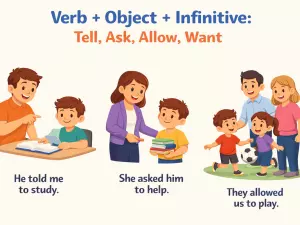
Here are some reporting verbs that frequently use this pattern, with examples showing how direct speech changes into reported speech:
- advise: “You should rest more.” → She advised him to rest more.
- allow: “You may leave early.” → The teacher allowed her to leave early.
- ask: “Please help me.” → He asked her to help him.
- beg: “Please don’t go.” → She begged him to stay.
- cause: “The noise made me wake up.” → The noise caused him to wake up.
- convince: “You should try again.” → She convinced him to try again.
- encourage: “Try applying for the job.” → They encouraged her to apply for the job.
- expect: “Be ready by six.” → He expected them to be ready by six.
- forbid: “Don’t enter this room.” → The guard forbade them to enter the room.
- force: “You must sign the form.” → They forced him to sign the form.
- invite: “Come to my party.” → She invited him to come to her party.
- order: “Stand up at once.” → The officer ordered the soldiers to stand up at once.
- persuade: “Join our team.” → They persuaded her to join their team.
- remind: “Don’t forget the meeting.” → She reminded him to remember the meeting.
- teach: “Use this program correctly.” → He taught her to use this program correctly.
- tell: “Finish your work.” → The manager told him to finish his work.
- urge: “Please act quickly.” → She urged them to act quickly.
- warn: “Don’t touch the wire.” → He warned her not to touch the wire.
Examples of the structure
Notice how the meaning of the sentence depends on both the object and the infinitive. Here are some sample sentences:
- The teacher encouraged the students to participate.
- They persuaded her to join the team.
- He reminded me to lock the door.
- We invited them to speak at the event.
Structure vs. other verb patterns

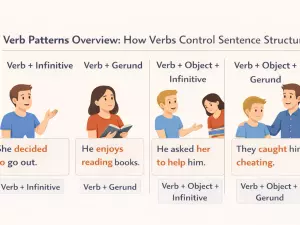
Not all reporting verbs accept the object + infinitive construction. Some verbs only work with infinitives without an object, or require a different structure altogether. It’s important to recognize which verbs use this pattern to avoid mistakes.
| Reporting Verb | Correct Structure |
|---|---|
| advise | She advised him to leave. |
| persuade | They persuaded us to try. |
| allow | The rules allow you to bring food. |
| remind | Please remind me to call. |
| invite | She invited them to attend. |
| tell | I told him to stop. |
| order | The officer ordered us to move. |
| encourage | Parents encourage children to read. |
Understanding this grammatical pattern helps you use reporting verbs more accurately and express requests, instructions, or advice clearly in English.
Verbs commonly using this pattern
Many English reporting verbs are followed by an object and an infinitive, forming sentences like "She advised him to wait" or "They allowed us to enter." This structure often appears in both formal and informal contexts, especially when relaying instructions, requests, or permissions. Recognizing which verbs use this construction helps learners build accurate and varied sentences when reporting speech or actions.
Semantic groups of verbs with object + infinitive
Instead of memorizing long verb lists, it is more useful to understand why these verbs use the object + infinitive pattern. Most of them fall into clear semantic groups based on intention: commands, permission, persuasion, reminders, and expectations.
| Function | Typical Verbs | Example |
|---|---|---|
| Commands & orders | tell, order, command, instruct | The officer ordered the soldiers to retreat. |
| Requests & appeals | ask, beg, urge | She begged him to stay. |
| Advice & recommendations | advise, encourage, warn | The doctor advised her to rest more. |
| Permission & prohibition | allow, forbid | The teacher allowed the students to leave early. |
| Persuasion & influence | persuade, convince, force | They persuaded her to change her mind. |
| Expectations & intentions | expect, want | He expected them to arrive on time. |
| Memory & attention | remind, teach | She reminded me to call my parents. |
| Social interaction | invite | They invited us to join the meeting. |
| Result / consequence | cause | The delay caused him to miss the flight. |
This classification helps learners choose the correct reporting verb based on intention — command, request, advice, permission, or influence — rather than relying only on memorized lists.
Examples in context
To illustrate how these verbs work in sentences, see the examples below. Notice the structure: verb + object + to-infinitive.
| Verb | Example Sentence |
|---|---|
| advise | The doctor advised her to rest. |
| allow | They didn't allow us to take photos. |
| ask | He asked me to help him. |
| encourage | She encouraged her son to try again. |
| force | The situation forced them to reconsider. |
| order | The manager ordered the team to start early. |
| persuade | We persuaded him to join us. |
| remind | Please remind me to call her. |
| tell | She told him to wait outside. |
| warn | I warned them not to touch it. |
Some verbs, like warn, can also take a negative infinitive ("not to...") to express prohibitions or advice against an action. This structure is flexible and widely used in both spoken and written English, making it a valuable tool for effective communication.
Pronoun placement in object-infinitive forms
When using reporting verbs like advise, ask, or tell with an object and an infinitive, the object typically comes directly after the reporting verb, followed by the infinitive. This object can be a noun or a pronoun, and its correct placement is essential for clarity. The pronoun acts as the person receiving the action or advice, so it must appear immediately after the reporting verb, before the infinitive.
Standard pattern for pronouns with reporting verbs
In sentences with this structure, the pronoun replaces the object noun and sits between the reporting verb and the infinitive. For example, in "She advised him to wait," him is the object pronoun placed directly after "advised."
- He told me to call back later.
- They want us to join the meeting.
- I asked her to help me.
- We expect them to arrive soon.
- She persuaded me to try.
- The coach encouraged him to practice more.
- My parents allowed me to stay out late.
- The teacher reminded us to submit the forms.
- He invited her to speak at the event.
- I warned you not to touch it.
Common mistakes with pronoun order
Learners often misplace the pronoun, putting it after the infinitive or omitting it altogether. This can lead to confusion or change the meaning. The object pronoun should never follow the infinitive in these structures.
| Incorrect | Correct |
|---|---|
| She advised to wait him. | She advised him to wait. |
| He told to come me early. | He told me to come early. |
| They asked to help us. | They asked us to help. |
| We reminded to bring her ID. | We reminded her to bring her ID. |
| The manager persuaded to accept the offer. | The manager persuaded him to accept the offer. |
| She convinced to change the schedule. | She convinced them to change the schedule. |
| They encouraged applying for the position him. | They encouraged him to apply for the position. |
| He warned not to mention it her. | He warned her not to mention it. |
| The officer ordered to leave us immediately. | The officer ordered us to leave immediately. |
| She forbade to enter them the building. | She forbade them to enter the building. |
| He allowed use his laptop me. | He allowed me to use his laptop. |
| They expected to finish the report us by noon. | They expected us to finish the report by noon. |
| She urged to reconsider the plan him. | She urged him to reconsider the plan. |
| We invited to join the webinar her. | We invited her to join the webinar. |
| The instructor taught to format citations us properly. | The instructor taught us to format citations properly. |
| He instructed to back up the data them. | He instructed them to back up the data. |
| They forced sign the contract him. | They forced him to sign the contract. |
| The delay caused miss the connection us. | The delay caused us to miss the connection. |
| She wanted to explain the decision me. | She wanted me to explain the decision. |
| He asked me help him with the draft. | He asked me to help him with the draft. |
Quick reference: pronoun forms
Always use object pronouns (me, you, him, her, us, them, it) in these positions. Subject pronouns (I, you, he, she, we, they, it) are not correct after reporting verbs in this structure.
- Correct: The manager wants them to finish early.
- Incorrect: The manager wants they to finish early.
To sum up, place the object pronoun directly after the verb and before the infinitive. This ensures your meaning is clear and your sentences are natural in English.
Meaning and emphasis differences
When using reporting verbs followed by an object and infinitive (such as advise, tell, or ask), the choice of structure can subtly change the focus or shade of meaning in a sentence. The object + infinitive pattern clearly identifies both who receives the message and what action is expected. This structure often puts more responsibility or attention on the person being addressed, while also emphasizing the intended action.
Shifting focus: agent vs. action
With some reporting verbs, the structure can highlight either the agent (the person who is supposed to act) or the action itself. Using an object before the infinitive makes it explicit who should perform the action, rather than leaving it ambiguous.
- She advised him to wait. (Clear focus on him as the person who should wait.)
- She advised to wait. (Much less common and less clear; who should wait?)
- The teacher told the students to listen. (Emphasizes the students as the listeners.)
Comparing common reporting verbs

Some reporting verbs naturally take the object + infinitive pattern, while others do not. The emphasis can also shift depending on the verb chosen. The table below compares several reporting verbs and illustrates how their meaning or emphasis can change with the object + infinitive structure:
| Reporting Verb | Example with Object + Infinitive | Emphasis/Effect |
|---|---|---|
| ask | He asked her to help. | Focus on the person who is expected to help. |
| tell | They told us to hurry. | Strongly directs the object (us) to act. |
| remind | She reminded me to call. | Highlights the reminder for a specific person. |
| warn | I warned him to be careful. | Emphasizes the person who should take caution. |
| advise | The doctor advised her to rest. | Focus on the recommended action for a specific person. |
| encourage | They encouraged us to try again. | Highlights support directed at a particular group. |
| persuade | She persuaded him to join. | Focus on the successful influence on a person. |
| invite | He invited me to speak. | Emphasizes the invitation extended to someone specific. |
| order | The officer ordered them to leave. | Strong, authoritative direction to the object. |
| forbid | She forbade him to go out. | Explicitly prohibits the object from acting. |
Choosing the right structure for clarity
Selecting the object + infinitive form makes it clear who is expected to do what, reducing possible confusion. This is especially important in instructions, advice, or requests where the agent matters. Using just the infinitive or omitting the agent can make the statement vague or even change the meaning. Careful use of this structure ensures both clarity and the intended emphasis in reported speech.
Negative and passive variations
When reporting verbs are used with an object and infinitive, both negative forms and passive structures play a key role in expressing meaning accurately. Adjusting word order and inserting “not” allows us to show that something did not happen, while the passive voice shifts focus from the performer of the action to the receiver. These variations are especially common in academic, journalistic, or formal writing where neutral or indirect reporting is needed.
Forming negative structures with object and infinitive
To make a negative, “not” is placed before the infinitive. The main reporting verb remains unchanged, but the meaning flips:
- They advised him not to speak.
- The teacher told her not to worry.
- We persuaded them not to participate.
- She reminded me not to forget.
- He warned us not to touch the wires.
- The doctor asked the patient not to eat before surgery.
- Management instructed employees not to share passwords.
- They encouraged her not to give up.
- Police ordered protesters not to block the road.
- His parents allowed him not to attend the event.
Using the passive with object and infinitive verbs
The passive form is useful when the person performing the action is unknown, less important, or deliberately omitted. The object becomes the subject, and the structure typically uses “to be” plus the past participle of the reporting verb, followed by the infinitive.
- She was advised to take a break.
- They were told to wait outside.
- He was persuaded to join the team.
- The students were reminded to submit their work.
- The children were warned not to play near the river.
- The staff were instructed to evacuate the building.
- The witness was encouraged to speak out.
- We were allowed to leave early.
- The guests were asked not to bring gifts.
- The team was ordered to prepare a report.
Comparing active, negative, and passive forms
| Active (Affirmative) | Negative | Passive |
|---|---|---|
| The manager told them to start work. | The manager told them not to start work. | They were told to start work. |
| She advised him to see a doctor. | She advised him not to see a doctor. | He was advised to see a doctor. |
| They encouraged us to continue. | They encouraged us not to continue. | We were encouraged to continue. |
| The teacher reminded students to revise. | The teacher reminded students not to revise. | Students were reminded to revise. |
Negative and passive forms add nuance and flexibility to reporting verbs with object and infinitive structures. Mastering these patterns helps you convey instructions, advice, or information more precisely, whether reporting on what was said, suggested, or required.
Typical learner errors
Many English learners struggle with the correct use of reporting verbs that require an object followed by an infinitive (for example: advise someone to do, remind someone to go). These difficulties often come from confusion with similar verbs, differences between learners’ native languages and English, or simply not remembering which verbs need this structure.
Common mistakes with reporting verb patterns
One frequent issue is using the infinitive directly after the reporting verb, leaving out the necessary object, or confusing reporting verbs that take different structures. Learners may also mix up verbs that require gerunds, base forms, or clauses instead of the object + infinitive pattern. Here are some typical missteps:
- Leaving out the object: She told to leave ❌ instead of She told him to leave ✅
- Using “that” instead of an object + infinitive: He advised that go early ❌ instead of He advised me to go early ✅
- Confusing with gerund structures: They encouraged coming ❌ vs. They encouraged us to come ✅
- Using a bare infinitive: She asked me wait ❌ instead of She asked me to wait ✅
- Omitting “to”: He persuaded me eat ❌ vs. He persuaded me to eat ✅
- Applying the wrong verb pattern: She suggested me to try ❌ (suggest doesn’t use object + infinitive)
- Transferring patterns from other reporting verbs: He said me to come ❌ (say doesn’t use this structure)
- Double objects: They told to us to stay ❌ instead of They told us to stay ✅
- Incorrect pronoun reference: She reminded to bring my book ❌ instead of She reminded me to bring my book ✅
- Using “for” unnecessarily: He asked for me to help ❌ instead of He asked me to help ✅
Verbs commonly confused in this structure
It can be challenging to remember which reporting verbs require an object + infinitive and which do not. Here is a comparison of some frequently used reporting verbs and their correct patterns:
| Verb | Correct Pattern | Example |
|---|---|---|
| advise | object + to + verb | She advised him to wait. |
| ask | object + to + verb | I asked her to help. |
| persuade | object + to + verb | They persuaded me to join. |
| suggest | verb + gerund/ that + clause |
She suggested going early. She suggested that we go early. |
| tell | object + to + verb | He told them to leave. |
| say | to + object + clause | She said to me that it was late. |
| remind | object + to + verb | Remind me to call. |
| encourage | object + to + verb | They encouraged us to participate. |
| warn | object + to + verb | I warned him not to touch. |
| recommend | verb + gerund/ that + clause |
I recommend taking a break. I recommend that you take a break. |
Tips to avoid these mistakes
- Memorize which reporting verbs require an object + infinitive structure.
- Check example sentences when learning new verbs.
- Compare patterns with verbs you know to spot differences.
- Practice by rewriting incorrect sentences in the correct form.
- Review and test yourself using lists of reporting verbs and their patterns.
By focusing on these patterns and common pitfalls, learners can improve their accuracy and confidence when using reporting verbs with the object and infinitive structure.
Homework
Practice makes these patterns automatic. Focus on two things: (1) using the correct structure (object + to-infinitive), and (2) keeping meaning and emphasis the same when you rewrite sentences. Work through both tasks, then check your answers in the answer blocks.
Task 1
Rewrite each sentence so it uses the object + to-infinitive pattern. Keep the meaning the same.
- She told to wait outside.
- He advised to take a short break.
- They reminded to submit the form by Friday.
- The manager instructed to update the spreadsheet.
- We encouraged to apply early.
- The officer ordered to move back.
- She warned not to mention the password.
- He persuaded to accept the offer.
- They invited to join the meeting.
- I asked to send the file again.
Показать ответы
- She told me to wait outside.
- He advised me to take a short break.
- They reminded us to submit the form by Friday.
- The manager instructed them to update the spreadsheet.
- We encouraged him to apply early.
- The officer ordered us to move back.
- She warned me not to mention the password.
- He persuaded her to accept the offer.
- They invited me to join the meeting.
- I asked him to send the file again.
Task 2
Choose the correct option to complete each sentence. Only one option is correct.
- The doctor advised me ____ late at night. (not to work / to not work)
- They reminded her ____ the attachment. (to include / include)
- He warned us ____ the link from unknown emails. (not to open / to not open)
- The teacher encouraged the class ____ questions. (to ask / asking)
- She asked him ____ her after the meeting. (to call / call)
- Our manager instructed us ____ the deadline in the report. (to mention / mention)
- They persuaded him ____ the complaint in writing. (to file / filing)
- His parents allowed him ____ the exam next week. (to retake / retake)
- The guard ordered everyone ____ behind the line. (to stay / stay)
- I reminded them ____ the document before sending it. (to check / check)
Показать ответы
- not to work
- to include
- not to open
- to ask
- to call
- to mention
- to file
- to retake
- to stay
- to check