Verb + Object + Infinitive: Tell, Ask, Allow, Want

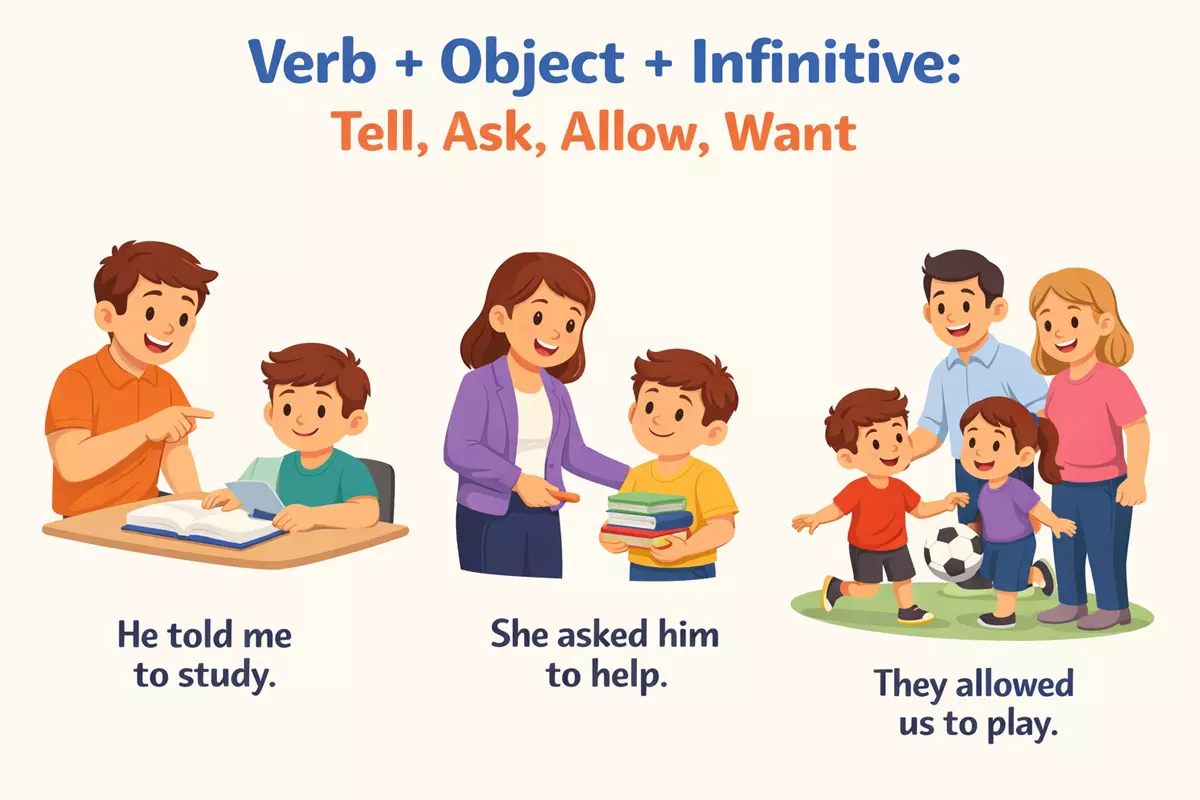 Here we the verb plus object plus infinitive pattern, including common verbs, sentence structure, and how meaning changes with or without objects. It also discusses negatives, questions, typical mistakes, similar patterns, and offers practice exercises.
Understanding how to use verbs such as tell, ask, allow, and want is essential for expressing requests, permissions, or desires in English. These verbs often connect with objects and are typically followed by another verb in the infinitive form, as in sentences like She asked him to help or They allowed us to enter. Paying attention to this structure helps your speech and writing sound more fluent and natural, making it easier for others to understand your intentions and respond appropriately.
What verb + object + infinitive means
This structure is used when one person causes, tells, allows, or wants another person to do something. In English, certain verbs are followed by an object (usually a person) and then an infinitive (the base form of the verb with "to"). This pattern helps us express actions where someone influences or requests another to act.
How the pattern works
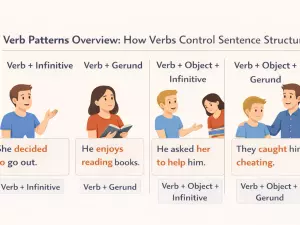
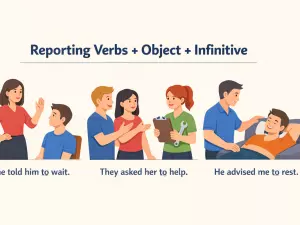
The typical word order is: Verb + Object + Infinitive. For example, in the sentence "She told him to wait," "told" is the verb, "him" is the object, and "to wait" is the infinitive. This pattern is common with verbs such as tell, ask, want, allow, expect, advise, order, remind, force, persuade, encourage, teach, enable, invite, warn, require, and more.
Why use this structure?
This construction is useful for expressing requests, commands, permissions, intentions, or obligations involving another person. It allows for clear communication about who should perform the action.
- He asked me to help.
- They want you to join the team.
- She allowed the children to play outside.
- The teacher reminded us to finish our homework.
- My parents encouraged me to study abroad.
- The doctor advised her to rest.
- The manager ordered the staff to leave early.
- We expect you to arrive on time.
- He persuaded his friend to try sushi.
- Please tell them to be quiet.
- The law requires drivers to wear seat belts.
- They invited us to attend the event.
- Her joke made us laugh.
- The app enables users to track expenses.
- The sign warns people not to enter.
Common verbs that use this pattern
Some verbs always require this structure. Here are several frequently used ones:
- tell → She told him to wait outside.
- ask → He asked me to help with the report.
- want → They want her to join the team.
- allow → The teacher allowed the students to leave early.
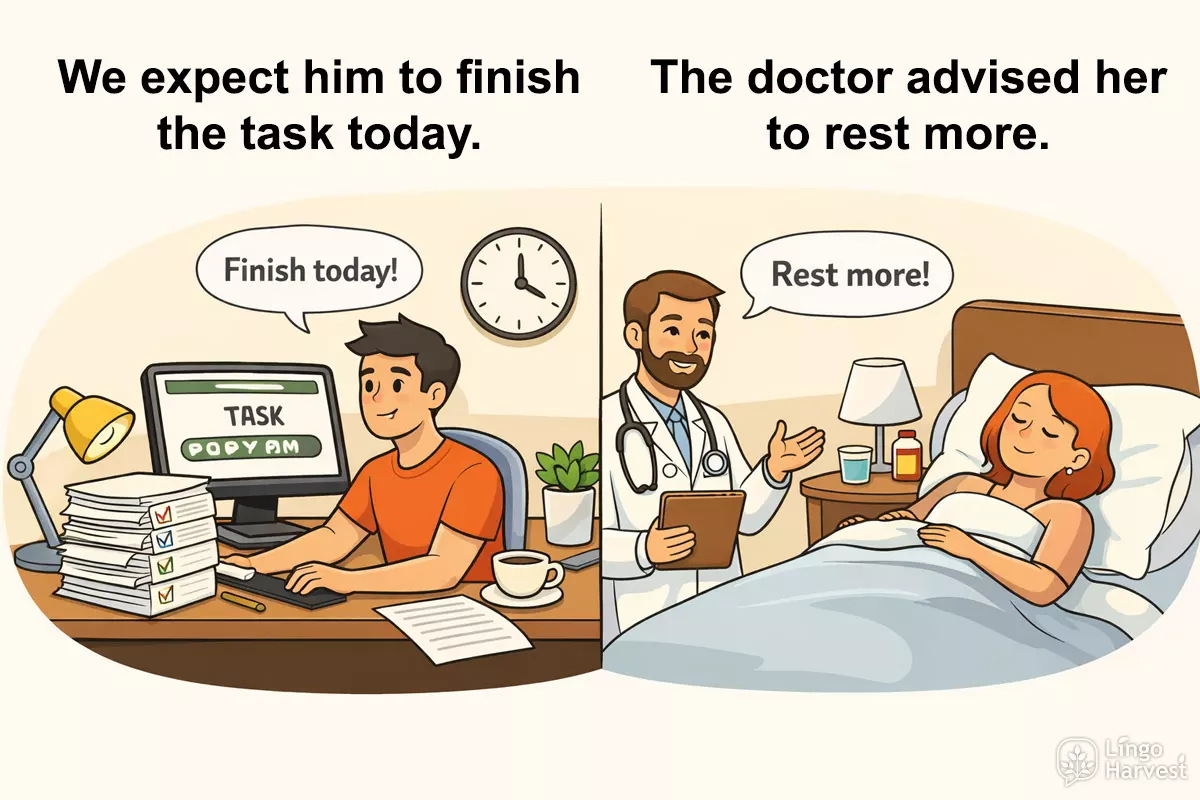
- expect → We expect him to finish the task today.
- advise → The doctor advised her to rest more.
- order → The officer ordered them to stop.
- remind → She reminded me to call my parents.
- force → They forced him to admit the truth.
- persuade → She persuaded him to change his mind.
- encourage → The coach encouraged the players to try again.
- teach → He taught his son to ride a bike.
- enable → This feature enables users to save time.
- invite → They invited us to attend the ceremony.
- warn → She warned him not to touch the wire.
- require → The job requires employees to work weekends.
Comparing patterns: Verb + Object + Infinitive vs. Verb + Infinitive
| Pattern | Example Sentence |
|---|---|
| Verb + Infinitive | She wants to leave. ✅ |
| Verb + Object + Infinitive | She wants him to leave. ✅ |
| Incorrect Form | She wants him leave. ❌ |
| Incorrect Form | She wants that he leaves. ❌ |
Notice how the meaning changes depending on the pattern. Adding the object shows who is expected to perform the action. Using this structure correctly helps you communicate more precisely in English.
Common verbs used in this pattern
Many English verbs can be followed by an object and then an infinitive (to + base verb). This construction is especially useful for expressing instructions, requests, permissions, and desires. Some verbs are far more frequently used in this way than others, and learners often encounter them in everyday communication. Understanding which verbs fit this structure helps you form natural sentences and avoid common mistakes.
Frequently used verbs in the "verb + object + infinitive" structure
Here are some of the most common verbs that fit this pattern. Some are used to give orders or suggestions, while others express wishes, permissions, or requirements.
- appoint → The company appointed her to lead the project.
- authorize → The manager authorized him to sign the contract.
- compel → The situation compelled them to act quickly.
- convince → She convinced him to reconsider his decision.
- designate → The committee designated her to represent the team.
- empower → The new law empowers citizens to access information.
- entitle → This ticket entitles you to enter the museum.
- forbid → The rules forbid students to use phones in class.
- hire → They hired him to manage the department.
- inspire → Her speech inspired people to take action.
- oblige → The contract obliged them to complete the work.
- prompt → His comment prompted her to ask a question.
- select → The jury selected her to receive the award.
- train → The company trained employees to use the new system.
- trust → They trusted him to handle the negotiations.
- urge → The doctor urged her to quit smoking.
- assign → The teacher assigned students to write an essay.
- license → The authority licensed the firm to operate legally.
- nominate → They nominated him to become chairperson.
- pressure → His colleagues pressured him to resign.
Examples of usage
These verbs are typically followed by a person or thing (the object), and then the infinitive form of another verb. Here are a few example sentences:
- She told him to wait outside.
- We asked them to join us.
- They allowed us to leave early.
- I want you to succeed.
- The manager encouraged her to apply for the job.
Verb patterns and meaning differences
Some verbs can be confusing because they change meaning or usage depending on whether they are followed by an infinitive or another structure. The table below shows some typical verbs and their patterns for clarity:
| Verb | Example with object + infinitive |
|---|---|
| Tell | She told him to be quiet. |
| Ask | They asked me to help. |
| Allow | We allow students to use calculators. |
| Want | I want you to listen carefully. |
| Persuade | He persuaded her to try again. |
| Force | The storm forced us to leave early. |
| Remind | Please remind me to call John. |
| Warn | I warned them not to touch it. |
Choosing the right verb for this structure depends on your intended meaning. For instance, "ask" is used for requests, "allow" for giving permission, and "want" for expressing desires. Note that some verbs (like "help") can also be used with or without "to" in certain cases, but the main verbs listed above almost always require "to" before the infinitive.
Sentence structure and word order
When using verbs like "tell," "ask," "allow," and "want" followed by an object and an infinitive, English follows a clear grammatical pattern. The construction typically places the main verb first, then the object (the person or thing affected), and finally the infinitive verb form (to + base verb). This pattern helps make instructions, requests, permissions, or desires clear and direct.
Basic construction
The general format looks like this:
- Subject + verb + object + infinitive
- Examples: She told him to wait. / They want us to join.
This structure is common with certain verbs. Not all verbs can take this pattern, but "tell," "ask," "allow," and "want" are among the most frequent.
Word order examples
To illustrate, here are several verbs commonly used in this pattern with sample sentences:
- tell: I told her to call me.
- ask: He asked them to leave early.
- allow: The teacher allowed us to use calculators.
- want: She wants you to finish the project.
- invite: They invited me to attend the ceremony.
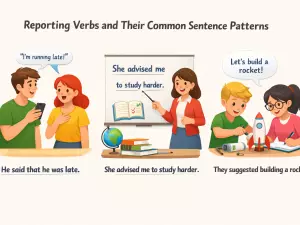
- advise: The doctor advised him to rest.
- order: The officer ordered the soldiers to retreat.
- expect: We expect you to arrive on time.
- remind: Please remind me to buy milk.
- force: She forced her brother to apologize.
- encourage: Parents encourage children to read more.
- persuade: I persuaded him to join us.
- enable: This tool enables users to create reports quickly.
- forbid: The rules forbid students to use phones.
- teach: He taught me to swim.
Negative forms and questions
To make these sentences negative, insert "not" before the infinitive. For questions, invert the subject and auxiliary verb:
- Negative: She told him not to worry.
- Question: Did you ask them to help?
Comparison: Verb + Infinitive vs. Verb + Object + Infinitive
Some verbs use only the infinitive, while others require an object. Here’s a comparison for clarity:
| Verb Type | Example Structure |
|---|---|
| Verb + Infinitive | He wants to leave. |
| Verb + Object + Infinitive | He wants her to leave. |
| Verb + Infinitive | She decided to go. |
| Verb + Object + Infinitive | She told me to go. |
Understanding the correct order of words and identifying which verbs fit this pattern will help you form more natural and accurate English sentences. Pay attention to the verb choice and whether an object is necessary in the construction.
Meaning changes with and without objects
The verbs tell, ask, allow, and want behave differently depending on whether there is an object (someone) before the infinitive. Including or omitting the object can significantly affect the meaning of the sentence, or even make a sentence ungrammatical.
How the object affects the verb
Some verbs require an object before the infinitive to be correct, while others can be used both ways, but with a change in meaning. Let’s look at the patterns:
- Tell and allow almost always need an object before the infinitive.
- Ask can be used with or without an object, but the meaning changes.
- Want changes meaning: "want to do" (subject wants) vs. "want someone to do" (the subject wants another person to do something).
Examples: With and without objects
Compare these example sentences to see how the presence or absence of an object changes the meaning or grammaticality:
| Verb | With Object + Infinitive | Without Object + Infinitive | Notes |
|---|---|---|---|
| tell | She told me to wait. | ❌ She told to wait. | "Tell" needs an object. |
| ask | He asked her to help. | He asked to help. | With object: request someone else; without object: offer/request for the subject. |
| allow | They allowed us to enter. | ❌ They allowed to enter. | "Allow" requires an object. |
| want | I want you to stay. | I want to stay. | With object: desire for another; without object: desire for self. |
Summary of usage patterns
- Tell [someone] to do: Always needs an object. "She told him to leave."
- Ask [someone] to do: Request someone else. "He asked her to join."
- Ask to do: The subject wants permission or offers. "He asked to join."
- Allow [someone] to do: Needs an object. "They allowed us to enter."
- Want [someone] to do: The subject wants another person to act. "I want you to listen."
- Want to do: The subject wants to act. "I want to listen."
Key takeaways
- Some verbs, like tell and allow, are ungrammatical without an object before the infinitive.
- With ask and want, including or omitting the object can change who is expected to perform the action.
- Always check both the structure and the meaning you want to express when choosing to include or omit the object.
Negative forms and questions
Making negatives and questions with verbs like "tell," "ask," "allow," and "want" followed by an object and infinitive requires careful attention to word order and auxiliary verbs. The structure changes slightly depending on whether you're forming a negative statement or asking a question, but the core elements remain: verb + object + (to) infinitive.
How to form negatives
To make a negative, add "not" before the infinitive ("to" + verb). The main verb (tell, ask, allow, want) stays positive unless you want to express the negative with it. For example:
- She told him not to come.
- They asked us not to speak.
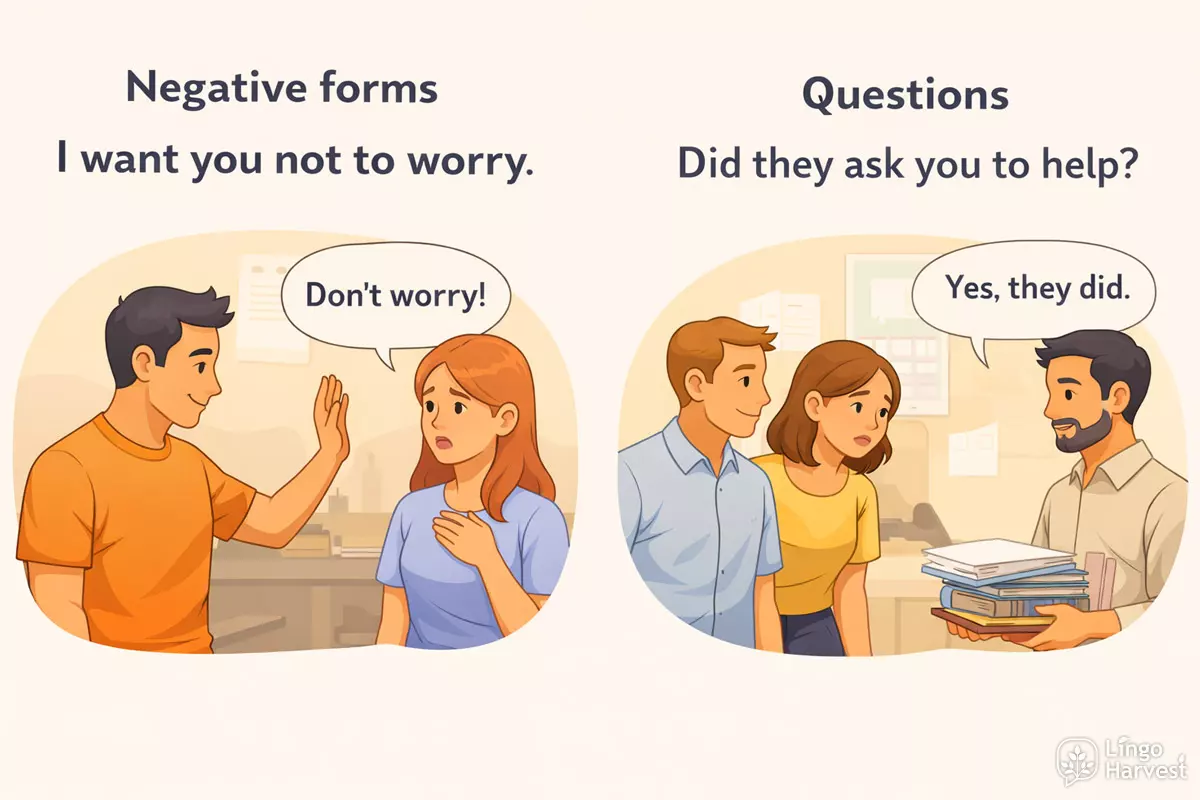
- I want you not to worry.
- He allowed the children not to eat the vegetables.
Notice that "not" always comes directly before "to" and the verb. If you want to negate the main verb (for example, "didn't tell"), use the auxiliary "do/does/did" as usual.
Making questions
To form questions, use the appropriate auxiliary verb ("do," "does," "did," etc.) before the subject. The object comes after the main verb, followed by the infinitive. See these examples:
- Did she tell you to call?
- Does he want us to leave?
- Did they ask you to help?
- Did your parents allow you to stay up late?
Examples: positive, negative, and questions
Below is a table comparing positive, negative, and question forms with different verbs. This helps illustrate the patterns clearly:
| Verb | Positive | Negative | Question |
|---|---|---|---|
| tell | She told him to wait. | She told him not to wait. | Did she tell him to wait? |
| ask | I asked her to help. | I asked her not to help. | Did you ask her to help? |
| allow | They allowed us to enter. | They allowed us not to enter. | Did they allow you to enter? |
| want | He wants me to come. | He wants me not to come. | Does he want you to come? |
| advise | The doctor advised her to rest. | The doctor advised her not to work. | Did the doctor advise her to rest? |
| encourage | The teacher encouraged them to speak. | The teacher encouraged them not to be afraid. | Did the teacher encourage them to speak? |
| persuade | She persuaded him to stay. | She persuaded him not to leave. | Did she persuade him to stay? |
| remind | She reminded me to call. | She reminded me not to forget. | Did she remind you to call? |
| warn | They warned us to be careful. | They warned us not to touch it. | Did they warn you to be careful? |
| order | The officer ordered them to stop. | The officer ordered them not to move. | Did the officer order them to stop? |
| invite | They invited her to join. | They invited her not to worry. | Did they invite her to join? |
| force | They forced him to apologize. | They forced him not to argue. | Did they force him to apologize? |
Common points to remember
- The negative "not" comes before "to" + verb in the infinitive phrase.
- For questions, use the correct auxiliary verb at the start of the sentence.
- Word order: main verb + object + (not) + to + verb.
- With "want," "ask," "tell," and "allow," the object is always required before the infinitive.
- Don't use "don't/doesn't/didn't" with the infinitive itself—these auxiliaries only affect the main verb.
Practicing both negative and question forms will help you use these verb patterns naturally in conversation and writing.
Typical learner mistakes
When using verbs like "tell," "ask," "allow," and "want" followed by an object and an infinitive, English learners often mix up the sentence structure or forget required elements. These errors can lead to confusion or sentences that sound unnatural to native speakers. Understanding the correct word order and knowing which verbs require an object before the infinitive is crucial for fluency.
Common errors with verb + object + infinitive
- Omitting the object after the verb (e.g., She told go instead of She told him to go).
- Using the gerund instead of the infinitive (They want me going instead of They want me to go).
- Forgetting "to" with the infinitive (He asked me help instead of He asked me to help).
- Placing the object after the infinitive (I want to see you is correct, but I want you to see changes the meaning).
- Confusing "ask" and "tell" with direct speech patterns (He told to leave instead of He told me to leave).
Verbs that require an object before the infinitive
Some verbs always need an object before the infinitive, while others do not. Learners sometimes forget this distinction, leading to incomplete or incorrect sentences. The following table compares common verbs and their correct patterns:
| Verb | Correct Structure | Incorrect Example | Correct Example |
|---|---|---|---|
| Tell | tell + object + to-infinitive | She told to go | She told him to go |
| Ask | ask + object + to-infinitive | He asked to help | He asked me to help |
| Allow | allow + object + to-infinitive | They allowed leave | They allowed us to leave |
| Want | want + object + to-infinitive | I want go | I want you to go |
| Want (no object) | want + to-infinitive | I want you go | I want to go |
Other pitfalls and confusion
- Overusing the object with verbs that do not take it (e.g., He decided me to leave ❌).
- Using "let" with "to" (Let him to go instead of Let him go).
- Mixing up direct and indirect objects (She told to me to wait instead of She told me to wait).
- Using passive forms incorrectly (I was told go instead of I was told to go).
- Forgetting to change the pronoun in the object position (She allowed I to leave instead of She allowed me to leave).
To master these verb patterns, pay close attention to which verbs require an object before the infinitive, and always check the sentence for missing elements. Practice with real examples helps reinforce the correct structures and avoid frequent mistakes.
Comparing similar verb patterns
Understanding how different verbs work with objects and infinitives can help you avoid common mistakes in English. While verbs like tell, ask, allow, and want often take the pattern verb + object + infinitive (for example, ask him to help), other verbs use different patterns. Some use a gerund, others require a direct infinitive without an object, and some don’t use an infinitive at all.
Common alternative patterns
- Verb + infinitive (no object): decide to go, hope to see, plan to leave
- Verb + object + infinitive: want him to come, allow them to enter
- Verb + gerund: enjoy reading, suggest going
- Verb + object + bare infinitive: make her cry, let them play
Some verbs easily confuse learners because they look similar but use different structures. For example, let and make take a bare infinitive (no "to"), while ask and want require "to" before the verb. Knowing which structure to use is essential for accurate communication.
Side-by-side comparison
| Verb | Pattern Example |
|---|---|
| ask | ask someone to do something She asked him to help. |
| want | want someone to do something I want you to listen. |
| let | let someone do something They let us leave early. |
| make | make someone do something The teacher made her apologize. |
| allow | allow someone to do something We allow guests to smoke outside. |
| help | help someone (to) do something He helped me (to) carry my bags. |
| advise | advise someone to do something The doctor advised her to rest. |
| suggest | suggest doing something I suggest going now. |
| tell | tell someone to do something She told him to call. |
| invite | invite someone to do something They invited us to join them. |
Key points to remember
- Some verbs always need an object before the infinitive (e.g., tell someone to do).
- Verbs like let and make do not use "to" with the following verb.
- Others, like suggest, do not take the object + infinitive pattern at all.
- Double-check the structure after verbs, especially when switching between similar meanings.
By comparing these patterns, you can choose the correct verb structure and sound more natural in English conversations and writing.
Practice exercises on verb + object + infinitive
Understanding how to use verbs like tell, ask, allow, and want followed by an object and an infinitive is essential for accurate English communication. The following activities will help you recognize and practice this structure in different contexts.
Complete the sentences
Fill in each blank with the correct form of the verb in brackets. Pay attention to the pattern: verb + object + to + infinitive.
- She didn’t ________ (allow / her son / go) outside after dark.
- Could you ________ (ask / them / help) us with the project?
- The teacher ________ (tell / the students / finish) their homework by Friday.
- I ________ (want / you / come) with me to the meeting.
- We ________ (allow / visitors / take) photos inside the museum.
- She ________ (remind / me / call) her later.
- They ________ (persuade / him / stay) a bit longer.
- The doctor ________ (advise / her / rest) for a few days.
- He ________ (expect / us / arrive) on time.
- The coach ________ (encourage / the team / try) again.
Show answers
- allow her son to go
- ask them to help
- told the students to finish
- want you to come
- allow visitors to take
- reminded me to call
- persuaded him to stay
- advised her to rest
- expected us to arrive
- encouraged the team to try
Identify the correct structure
Decide which sentences use the correct verb + object + infinitive pattern. If the sentence is incorrect, rewrite it correctly.
- The manager asked to finish the report by noon.
- My parents allowed me to stay up late.
- She told go home early.
- We want them to join us for dinner.
- He asked his friend help him move.
- The teacher advised study harder.
- They encouraged us to participate.
- She reminded call her back.
- The officer ordered them to stop.
- He expected finish the task today.
Show answers
- Incorrect. Correct: The manager asked us/them to finish the report by noon.
- Correct.
- Incorrect. Correct: She told me/him/us to go home early.
- Correct.
- Incorrect. Correct: He asked his friend to help him move.
- Incorrect. Correct: The teacher advised us/students to study harder.
- Correct.
- Incorrect. Correct: She reminded me/him to call her back.
- Correct.
- Incorrect. Correct: He expected me/us to finish the task today.
Make your own sentences
Choose four verbs from the list above and write your own sentences using the verb + object + to + infinitive structure. Try to use a variety of objects and infinitives.
Show answers
- The teacher reminded the students to bring their books.
- My friend persuaded me to try a new restaurant.
- They invited us to join their team.
- His parents encouraged him to apply for the job.