Reporting Imperatives and Negative Commands Correctly

 This article explains how to report positive and negative commands, how to use tell and ask, and how to change pronouns and references. It also points out common mistakes learners make when reporting imperatives.
Learning to accurately express instructions and prohibitions in indirect speech can be challenging, particularly when dealing with negative commands that require careful transformation. Developing this skill is important because it allows you to communicate what others have said with clarity and precision, avoiding misunderstandings. By practicing how to report both positive and negative commands, you enhance your ability to convey messages effectively in both spoken and written communication.
Imperatives in reported speech
When commands or instructions are reported, the structure changes compared to direct speech. Instead of quoting the exact words, we usually transform the imperative into an infinitive phrase. This shift helps clarify who is expected to perform the action and removes the direct address. Reporting verbs such as tell, ask, order, and advise are commonly used, depending on the context and the level of authority or politeness.
How to report commands and instructions
To report a direct command, we typically use a reporting verb followed by the object (who is being addressed) and the infinitive form of the verb. Negative commands require a slight change: we use not to + base form of the verb.
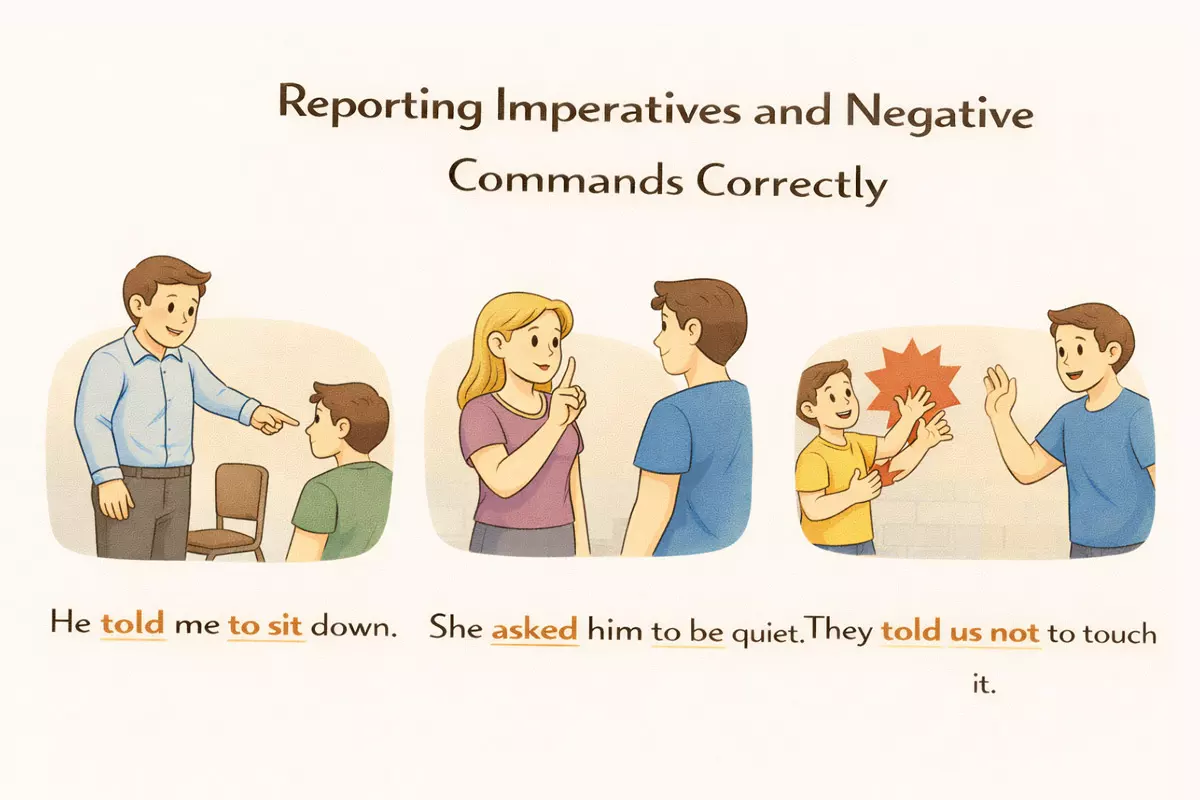
- Direct: "Sit down." → Reported: She told him to sit down.
- Direct: "Please be quiet." → Reported: The teacher asked us to be quiet.
- Direct: "Don't touch that." → Reported: He warned me not to touch that.
- Direct: "Finish your homework." → Reported: Mom told me to finish my homework.
- Direct: "Leave the building immediately." → Reported: The officer ordered everyone to leave the building immediately.
- Direct: "Don't forget your keys." → Reported: She reminded me not to forget my keys.
- Direct: "Write your name here." → Reported: He instructed me to write my name there.
- Direct: "Open your books." → Reported: The teacher told them to open their books.
- Direct: "Don't make a noise." → Reported: He told us not to make a noise.
- Direct: "Stand up." → Reported: The coach told the players to stand up.
- Direct: "Please turn off your phones." → Reported: They requested us to turn off our phones.
- Direct: "Don't run in the hallway." → Reported: The principal warned the students not to run in the hallway.
Choosing the right reporting verb
The choice of reporting verb depends on the speaker’s intention and the tone of the original command. Here are some common options:
- Tell – for general commands or instructions
- Ask – for polite requests
- Order – for authoritative or official commands
- Warn – for instructions involving danger or caution
- Advise – for suggestions or recommendations
- Remind – for reminders about tasks or duties
- Request – for formal or polite demands
- Instruct – for detailed or procedural directions
Pattern summary
| Direct Command | Reported Structure |
|---|---|
| Verb (base form) | Reporting verb + object + to + verb |
| Don't + verb | Reporting verb + object + not to + verb |
| Please + verb | Reporting verb (ask/request) + object + to + verb |
| Never + verb | Reporting verb + object + not to + verb |
Remember, when changing commands into indirect speech, pronouns, time, and place references may also need adjustment. For example, "here" can become "there," and "now" may change to "then," depending on the situation. Practicing various examples helps build confidence in transforming both positive and negative commands when reporting what others have said.
Positive command structures
When expressing direct requests or instructions, the imperative mood is used to give clear, affirmative directions. These forms are straightforward: the base verb is used without a subject, and the tone signals that the speaker wants the listener to perform an action. Understanding how to report these directives accurately is essential, as the structure shifts when changing from direct speech to reported speech.
Forming direct imperatives
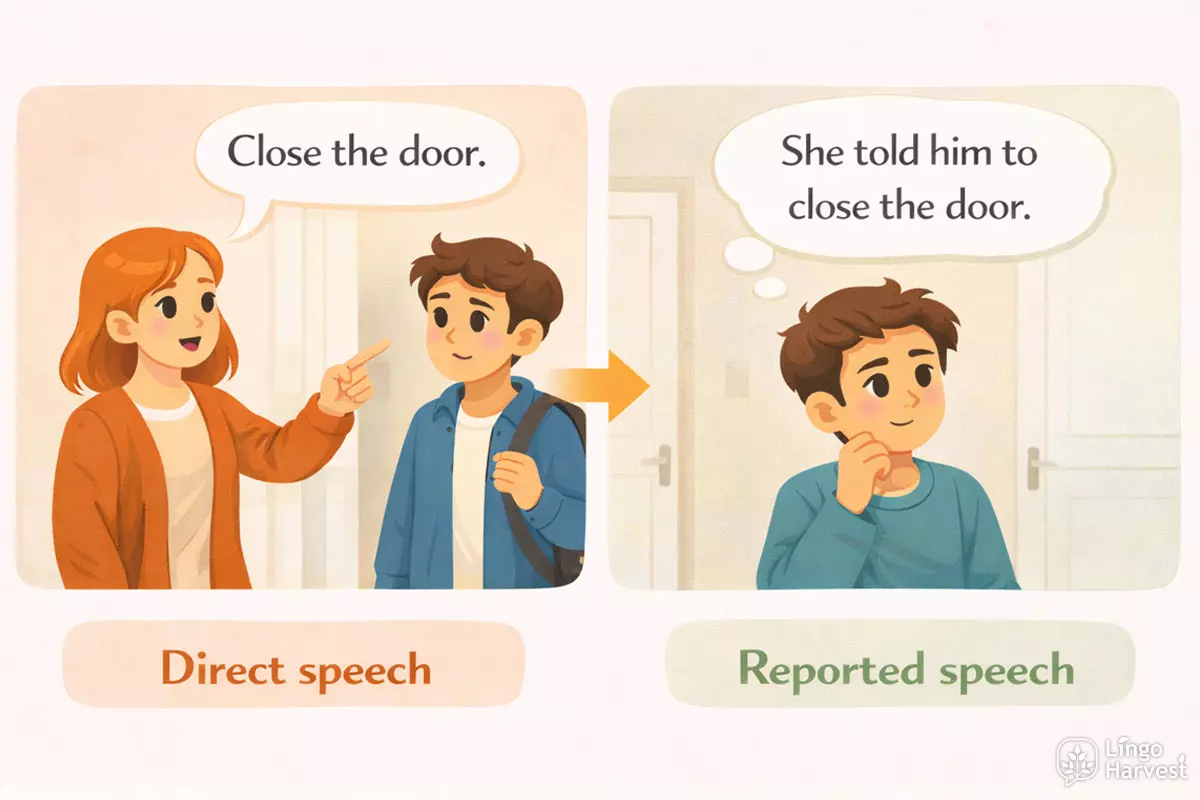
Affirmative commands use the bare infinitive (the verb without "to") and often omit the subject "you," which is understood. For example, "Open the window" or "Please sit down." When reporting these instructions, the reporting verb (such as "tell" or "ask") is often followed by an object and an infinitive with "to."
- Direct: "Close the door." → Reported: She told him to close the door.
- Direct: "Take a seat." → Reported: He asked us to take a seat.
- Direct: "Speak clearly." → Reported: The teacher advised the student to speak clearly.
- Direct: "Finish your homework." → Reported: They instructed her to finish her homework.
- Direct: "Call me later." → Reported: She reminded him to call her later.
Common patterns in reporting positive commands
Reporting affirmative instructions usually follows this pattern: reporting verb + object + to-infinitive. The reporting verb may vary depending on the context (tell, ask, order, advise, remind, etc.).
| Direct Command | Reported Speech |
|---|---|
| "Stand up." | She told him to stand up. |
| "Write your name." | The teacher asked the student to write his name. |
| "Turn off the lights." | He told them to turn off the lights. |
| "Listen carefully." | The coach advised the team to listen carefully. |
| "Bring your ID." | The receptionist reminded us to bring our ID. |
| "Read the instructions." | They instructed her to read the instructions. |
Key points for accurate reporting
- Use the correct reporting verb to reflect the original intent (e.g., "ask" for requests, "order" for commands).
- Include the object (the person receiving the command) before the infinitive.
- Change pronouns and time references as needed to fit the context of the reported speech.
- Retain the positive meaning of the original command—avoid inserting "not" unless reporting a negative instruction.
By understanding these structures, you can report clear and accurate affirmative instructions, preserving the intent and tone of the original command.
Negative command reporting
Accurately conveying instructions that tell someone not to do something requires special attention to both form and meaning. When transforming direct negative imperatives into reported speech, the structure shifts to maintain the negative intent while fitting into the reporting sentence. Typically, this involves replacing the imperative verb with a reporting verb (such as "tell" or "order") and using a negative infinitive or a negative "not to" clause.
How to report negative imperatives
To change a direct negative command into reported speech, follow these steps:
- Identify the negative imperative (e.g., "Don't touch that!")
- Choose an appropriate reporting verb (tell, warn, advise, order, etc.)
- Convert the command into a "not to" infinitive structure (e.g., "He told me not to touch that.")
This transformation keeps the prohibition clear and grammatically correct.
Common reporting verbs for negative commands
Different verbs can be used depending on the context and the speaker’s intention. Here are some frequent choices (with natural reporting patterns and examples):
- tell → The manager told me not to share the draft outside the team.
- warn → The guide warned us not to step too close to the edge.
- order → The judge ordered him not to contact the witness.
- advise → The pharmacist advised me not to take the tablets on an empty stomach.
- instruct → The technician instructed us not to restart the system during the update.
- ask (not to) → She asked me not to mention the surprise party.
- request → The receptionist requested that guests not to smoke near the entrance.
- remind → He reminded me not to forget my ID at security.
- urge → Doctors urged people not to ignore persistent symptoms.
- beg → She begged him not to leave before they talked.
- forbid → The sign forbids visitors to not enter the restricted area.
- prohibit → The policy prohibits employees to not use personal drives.
- encourage (not to) → Teachers encourage students not to rely on translation apps during speaking practice.
- recommend (not to) → The travel clinic recommended not to drink tap water in that region.
- caution → The manual cautions users not to touch the hot surface.
- invite (not to) → The host invited guests not to bring gifts.
Examples: direct to reported negative commands
Here are several examples illustrating how direct negative imperatives are reported:
- "Don't open the window." → She told me not to open the window.
- "Don't forget your keys." → He reminded her not to forget her keys.
- "Don't make a sound." → The teacher warned us not to make a sound.
- "Don't be late." → My mother told me not to be late.
- "Don't touch that!" → He ordered me not to touch that.
- "Don't use your phone here." → The guard asked us not to use our phones there.
- "Don't eat in class." → The professor instructed us not to eat in class.
- "Don't lie to me." → She told him not to lie to her.
- "Don't leave the door open." → He advised me not to leave the door open.
- "Don't forget to call." → She reminded me not to forget to call.
Key points for accuracy and clarity
- Always use the negative infinitive ("not to" + base verb) after the reporting verb.
- Adjust pronouns and time expressions as needed for context and indirect speech.
- Choose a reporting verb that accurately reflects the original speaker’s tone or intent.
Direct vs. reported forms: comparison
Below is a structured comparison of direct negative commands and their reported forms:
| Direct Negative Command | Reported Speech |
|---|---|
| Don't touch that! | He told me not to touch that. |
| Don't be late. | She warned me not to be late. |
| Don't eat in class. | The teacher instructed us not to eat in class. |
| Don't forget your homework. | He reminded us not to forget our homework. |
| Don't make a noise. | She told them not to make a noise. |
Mastering the shift from direct negative commands to reported speech helps ensure clear, accurate communication—especially in formal writing, storytelling, and relaying instructions.
Use of tell and ask
When changing direct imperatives and negative commands into reported speech, it’s important to select the appropriate reporting verb. “Tell” and “ask” are the most common choices, but they serve different functions. “Tell” is typically used when reporting orders or instructions, while “ask” is reserved for requests or when politeness is needed. Understanding their distinct roles helps avoid confusion and ensures your reported speech sounds natural and correct.
Choosing between "tell" and "ask"
The verb “tell” is direct and authoritative, suitable for strict instructions or commands. In contrast, “ask” softens the delivery, making it more appropriate for requests or polite suggestions. Both verbs require an object (the person being spoken to) before the reported command.
- Tell + object + (not) + to-infinitive: Used for commands or firm instructions.
Example: She told him to sit down. - Ask + object + (not) + to-infinitive: Used for requests or when the imperative is polite.
Example: He asked her to close the window. - For negative commands, insert “not” before the infinitive.
Example: The teacher told the students not to talk.
Examples of reporting imperatives

To master reporting, it helps to see common patterns. Here are examples transforming direct commands and requests into reported speech:
- “Open the door!” → She told him to open the door.
- “Don’t be late!” → He told them not to be late.
- “Please wait here.” → The receptionist asked us to wait here.
- “Turn off your phones.” → The instructor told everyone to turn off their phones.
- “Don’t touch that!” → The guard told the children not to touch that.
- “Help me, please.” → She asked him to help her.
- “Clean your room.” → Their mother told them to clean their room.
- “Don’t make noise.” → The librarian told the students not to make noise.
- “Finish your homework.” → The teacher told him to finish his homework.
- “Don’t forget your keys.” → He told her not to forget her keys.
- “Be quiet.” → She told the class to be quiet.
- “Please call me later.” → He asked her to call him later.
Summary of reporting verbs and their uses
| Reporting Verb | Typical Context |
|---|---|
| Tell | Orders, instructions, strong advice |
| Ask | Requests, suggestions, polite commands |
| Warn | Cautions, threats, warnings |
| Advise | Recommendations, guidance |
In summary, selecting between “tell” and “ask” (and sometimes other verbs like “warn” or “advise”) depends on the original meaning, tone, and level of authority in the imperative. Remember to include the object and adjust for negatives as needed. This approach leads to accurate and clear reported speech.
Pronoun and reference changes
When converting direct imperatives and negative commands into reported speech, it's essential to adjust pronouns and references so that the meaning remains accurate and clear for the new context. The person being addressed in direct speech often changes in reported speech, so the pronouns must reflect who is giving the command and to whom it is directed.
Understanding Shifts in Perspective
The original speaker's perspective can shift in reported statements. For example, "me" and "you" in direct speech might become "him," "her," "us," or "them" depending on who is reporting and who is being referred to. The same applies to possessive adjectives like "my" and "your," which may become "his," "her," "our," etc.
Typical Pronoun Changes in Reporting
- "You" (in direct speech) usually becomes "him," "her," "them," or the person's name in reported speech.
- "Me" may become "her," "him," or another third-person pronoun, according to context.
- "My" changes to "his," "her," "their," or another possessive as needed.
- "Our" may shift to "their" or a specific group referenced in the narrative.
- Demonstratives like "this" and "these" often become "that" and "those."
- Time references may also change: "today" becomes "that day," "tomorrow" becomes "the next day," etc.
Reference Changes in Context
Besides pronouns, it's also important to adjust references to places, times, and objects. These changes help keep the reported command accurate for the listener or reader. For instance, "here" in direct speech may turn into "there" when reported.
| Direct Speech | Reported Speech |
|---|---|
| She said, "Help me!" | She told him to help her. |
| He said, "Don’t touch my bag." | He told her not to touch his bag. |
| Mother said, "Clean your room." | Mother told me to clean my room. |
| Teacher said, "Don’t be late." | Teacher warned us not to be late. |
| John said, "Finish this by tomorrow." | John asked them to finish that by the next day. |
Common Reference and Pronoun Adjustments
- "I" → "he," "she"
- "You" → "me," "him," "her," "us," "them"
- "We" → "they"
- "My" → "his," "her"
- "Your" → "my," "his," "her," "their"
- "Our" → "their"
- "This" → "that"
- "These" → "those"
- "Here" → "there"
- "Today" → "that day"
- "Tomorrow" → "the next day"
- "Yesterday" → "the previous day"
Getting these changes right ensures that the reported commands and prohibitions are both grammatically correct and true to the original intent. Always consider who is speaking, who is being addressed, and the context of the command when making adjustments.
Typical learner mistakes
When learning to report imperatives and negative commands, students often struggle with changes in sentence structure, reporting verbs, and word order. Many errors stem from confusion over how imperative forms shift in indirect speech, especially with negative instructions. These issues can lead to misunderstandings or incorrect written and spoken English.
Common sources of confusion
- Forgetting to use the correct reporting verb, such as "tell," "order," "advise," or "warn."
- Omitting "to" before the verb in reported imperatives (e.g., saying "He told me close the door" instead of "He told me to close the door").
- Using the imperative form instead of the infinitive in reported commands.
- Incorrectly reporting negative commands by using "not to" or misplacing "not."
- Maintaining the original subject or pronoun instead of changing it according to the context.
- Forgetting to backshift tenses where necessary, even in reporting commands.
- Confusing direct speech with indirect speech punctuation and word order.
- Mixing up the reporting of requests and commands.
Frequent mistakes in reporting
| Incorrect Example | Corrected Version |
|---|---|
| He said me to sit down. | He told me to sit down. |
| She told me don't be late. | She told me not to be late. |
| They said close the window. | They asked me to close the window. |
| My mother ordered to eat vegetables. | My mother ordered me to eat vegetables. |
| He told that I open the door. | He told me to open the door. |
| The teacher said not talk. | The teacher told us not to talk. |
| She told me to not forget. | She told me not to forget. |
| He said me not to go there. | He told me not to go there. |
| She said me to help her. | She asked me to help her. |
| My boss told to finish the report. | My boss told me to finish the report. |
Other pitfalls to avoid
- Using "said" with imperatives, which is incorrect; "told" or another verb is needed.
- Neglecting to clarify the indirect object (who is being told or ordered).
- Misreporting negative commands as positive ones, or vice versa.
- Translating directly from one’s native language, leading to awkward or incorrect constructions.
- Forgetting to adjust time markers or pronouns when necessary.
Paying attention to these problem areas helps learners avoid common traps and communicate instructions or prohibitions accurately in reported speech.
Homework
Practice is the fastest way to stop mixing up tell and ask, and to get comfortable with negative commands (not to) and pronoun/reference changes. Complete the tasks below, then check your answers in the collapsible key.
Task 1: Report the commands and requests (tell / ask)
- “Close the window, please,” she said to me.
- “Don’t open this file,” the manager said to him.
- “Please sit down,” the nurse said to the patient.
- “Don’t touch the screen,” the technician said to us.
- “Send me the link,” Tom said to Anna.
- “Please don’t mention my name,” he said to her.
- “Turn off your phones,” the instructor said to the class.
- “Please wait here,” the receptionist said to the guests.
- “Don’t be late tomorrow,” my boss said to me.
- “Please help me with this box,” she said to him.
Show answers
- She asked me to close the window.
- The manager told him not to open that file.
- The nurse asked the patient to sit down.
- The technician told us not to touch the screen.
- Tom told Anna to send him the link.
- He asked her not to mention his name.
- The instructor told the class to turn off their phones.
- The receptionist asked the guests to wait there.
- My boss told me not to be late the next day.
- She asked him to help her with that box.
Task 2: Fix the mistakes (imperatives, negatives, pronouns, references)
- He said me to not be late.
- She told that I close the door.
- The teacher asked us don’t talk.
- My mother ordered to clean my room.
- He asked me close the laptop.
- They told me don’t park here.
- She told him not touch her phone.
- Anna said Tom to call her later.
- The guard told the visitors not to enter here.
- He asked her to wait here yesterday.
Show answers
- He told me not to be late.
- She told me to close the door.
- The teacher told us not to talk.
- My mother ordered me to clean my room.
- He asked me to close the laptop.
- They told me not to park there.
- She told him not to touch her phone.
- Anna told Tom to call her later.
- The guard told the visitors not to enter there.
- He asked her to wait there the day before.