Reporting Exclamations and Emphasis in Indirect Speech

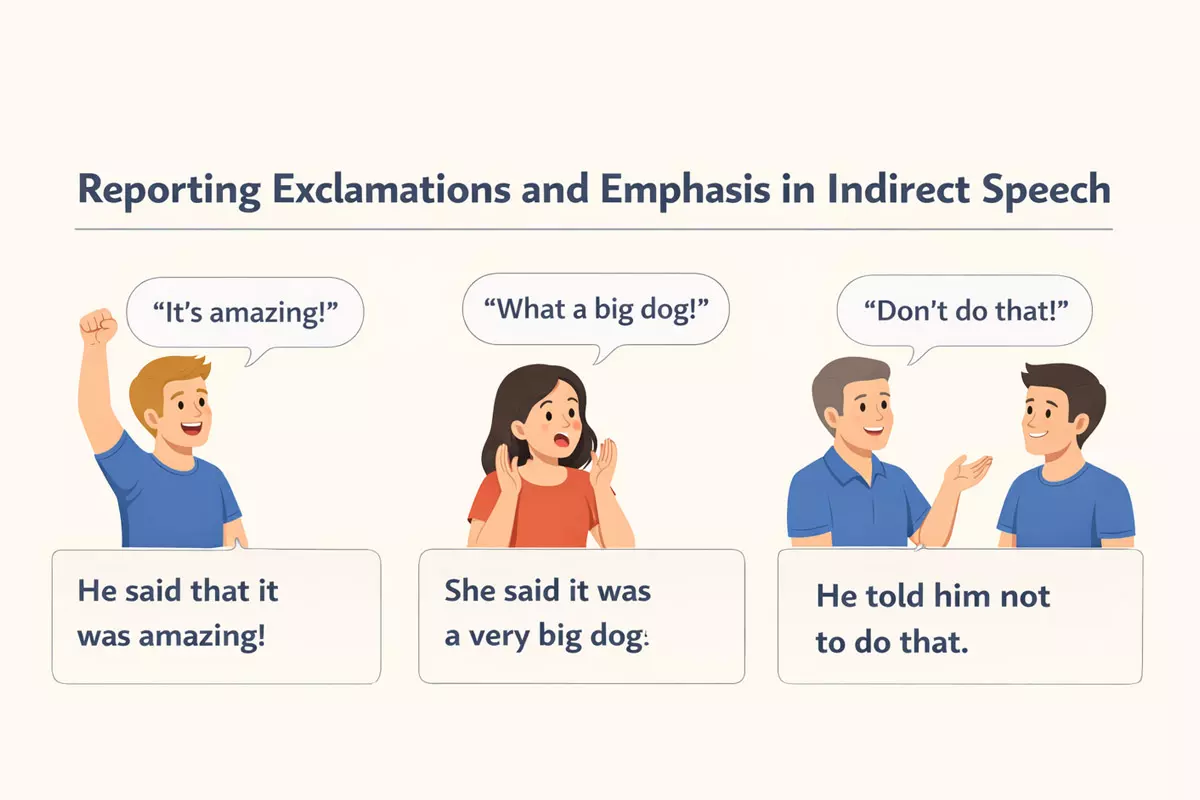 This article explains how exclamations in direct speech are reported indirectly. It covers removing exclamatory structures, verbs for reporting exclamations, maintaining emotion and emphasis, tone changes, and common learner mistakes.
When sharing someone’s strong reactions or emotional statements secondhand, it takes more than simply altering pronouns and verb tenses. To accurately convey the excitement or emphasis present in the original words, you need to pay close attention to both the feeling and intent behind what was said. Successfully relaying these emotions requires thoughtful phrasing and an understanding of the context, so that the impact of the original message is not lost or diminished when communicated to others.
Nature of exclamations in direct speech
Exclamations in direct speech serve to express strong emotions, surprise, admiration, or other heightened feelings. They often rely on specific sentence structures, intonation, and punctuation—most notably, the exclamation mark. Instead of merely stating facts, these utterances convey the speaker’s emotional response or emphasis, making dialogue more vivid and authentic.
How exclamations are formed
In English, exclamatory statements typically use special introductory words or altered word order. The most common patterns include starting with what or how, omitting the subject-verb inversion found in questions. Sometimes, interjections or intensifiers are added for further emphasis.
- What + (a/an) + adjective + noun + (subject + verb): What a beautiful day!
- How + adjective/adverb + (subject + verb): How quickly he ran!
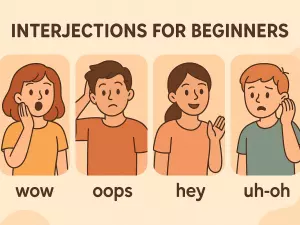
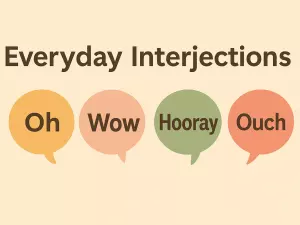
- Interjections: Wow! Oh no! Alas!
- Standalone exclamatory phrases: Goodness!, Fantastic!
- Emphatic repetition: So, so lucky!
- Use of intensifiers: Such an amazing performance!
- Elliptical exclamations (incomplete sentences): What luck!
- Exclamatory questions (expressing surprise, not seeking information): Isn’t it wonderful!
- Direct address with emotion: Oh, John!
- Emotional imperatives: Look at that!
- Expressive sounds: Ugh!, Yikes!
- Echoing emotion: Incredible!
- Exclamation through repetition: Run, run, run!
- Combination with gestures (sometimes described in writing): Wow! (claps hands)
- Exclamatory fragments: What a mess!
Role of punctuation and intonation
The exclamation mark is the most visible marker of emotional utterances in writing. In spoken language, rising or emphatic intonation signals surprise or strong feeling, even if the sentence structure is otherwise neutral. Sometimes, the same words can be exclamatory or neutral, depending on voice or punctuation.
| Direct Speech Example | Emotion Conveyed |
|---|---|
| What a surprise! | Astonishment, excitement |
| How cold it is! | Discomfort, shock |
| Oh no! | Dismay, disappointment |
| Fantastic! | Joy, approval |
| Yuck! | Disgust |
| Run, run, run! | Urgency, alarm |
Summary
Exclamatory language in direct speech adds emotional depth and immediacy to communication. Recognizing these structures helps when transitioning to reported speech, where the original intensity or emphasis is often transformed or softened.
Removing exclamatory structure
When converting direct exclamations into indirect speech, the key step is to rephrase the sentence so that it fits into a reported statement format. Since exclamatory sentences often rely on word order, punctuation, and intonation to convey strong emotion or surprise, these features must be adapted or omitted in indirect speech. Instead of maintaining the original exclamatory construction, we use reporting verbs and transform the grammar to match standard declarative or interrogative forms.
Typical Changes When Rewriting Exclamations
- Replace exclamation marks with periods.
- Use neutral or descriptive reporting verbs (e.g., said, exclaimed, cried, remarked).
- Change word order to that of a standard statement or question, if necessary.
- Introduce reporting clauses such as that or how.
- Adjust pronouns and verb tenses according to indirect speech rules.
- Convert emotional adjectives or adverbs to fit the reporting context.
- Omit interjections (e.g., oh, wow, alas) or paraphrase them for clarity.
- Use phrases like with delight, in surprise, or with regret to retain emotional nuance.
- Avoid the original exclamatory word order (e.g., subject-verb inversion).
- Paraphrase idiomatic or culture-specific exclamations if needed for clarity.
Examples: Direct vs. Indirect Forms
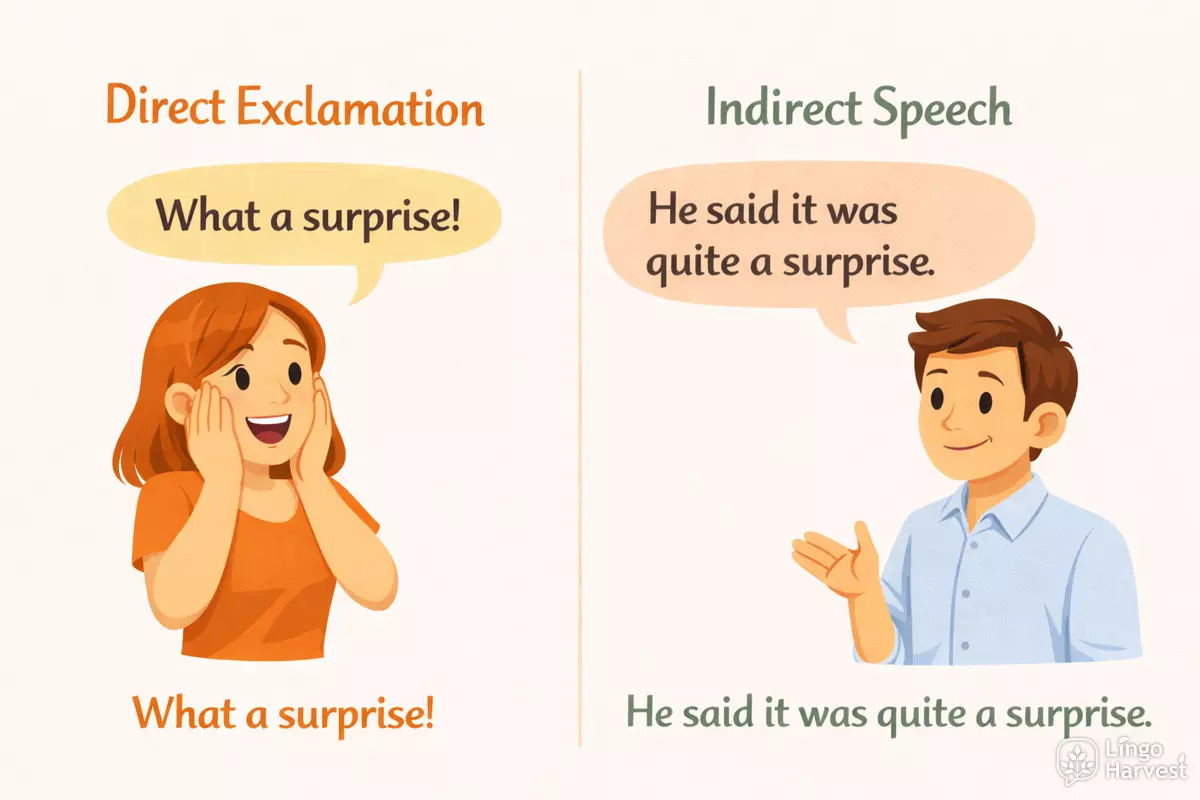
| Direct Exclamation | Indirect Speech |
|---|---|
| "How beautiful this garden is!" | She exclaimed that the garden was very beautiful. |
| "What a surprise!" | He said it was quite a surprise. |
| "Oh no, I've lost my keys!" | She cried out that she had lost her keys. |
| "Bravo! You did it!" | They cheered that he had done it. |
| "Alas! We are too late." | He lamented that they were too late. |
| "How fast he runs!" | She remarked how fast he ran. |
| "What an amazing story!" | He said it was an amazing story. |
| "Wow, this is incredible!" | She said that it was incredible. |
| "What a mess you've made!" | He complained that a mess had been made. |
| "Hurrah! We won the match!" | They exclaimed with joy that they had won the match. |
Summary of Strategies
- Transform emotional tone into descriptive reporting verbs or adverbial phrases.
- Adjust the sentence structure to match typical indirect speech patterns.
- Ensure the core meaning and emotional content are preserved, even as the original exclamatory grammar is removed.
Mastering these changes helps make indirect speech sound natural and clear, while still conveying the intended emphasis or emotion.
Verbs used to report exclamations
When changing direct exclamations into indirect speech, specific reporting verbs help convey emotion, surprise, or emphasis from the original utterance. These verbs do more than simply state facts; they reflect the speaker’s attitude or reaction, such as astonishment, delight, or indignation. Choosing the right verb is essential for accurately capturing the tone and force of the original exclamation.
Common reporting verbs for exclamations
Writers and speakers use a range of verbs to relay exclamatory remarks indirectly. Some verbs are more neutral, while others express stronger emotional responses. Here’s a list of frequently used verbs for this purpose:
- exclaim → “What a surprise!” → He exclaimed what a surprise it was.
- cry → “Help!” → She cried for help.
- shout → “Get out!” → He shouted at them to get out.
- yell → “Stop!” → She yelled for him to stop.
- remark → “That’s interesting.” → He remarked that it was interesting.
- gasp → “Oh no!” → She gasped in horror.
- declare → “I am innocent!” → He declared that he was innocent.
- mutter → “This is ridiculous.” → He muttered that it was ridiculous.
- protest → “That’s not fair!” → She protested that it wasn’t fair.
- insist → “I didn’t do it!” → He insisted that he hadn’t done it.
- announce → “We are ready!” → She announced that they were ready.
- complain → “This is too loud!” → He complained that it was too loud.
- sob → “I can’t go on!” → She sobbed that she couldn’t go on.
- groan → “Not again!” → He groaned that it was happening again.
- cheer → “We won!” → They cheered that they had won.
- laugh → “That’s funny!” → She laughed that it was funny.
- murmur → “I agree.” → He murmured that he agreed.
- whisper → “Be careful.” → She whispered to be careful.
- roar → “Victory!” → The crowd roared in victory.
- howl → “No way!” → He howled in disbelief.
How reporting verbs affect the tone
The verb you select can shift the nuance of the reported statement. For example, using exclaim highlights surprise or excitement, while protest shows disagreement or objection. It’s important to match the reporting verb to the speaker’s intended emotion, especially when the original sentence contains strong emphasis or feeling.
Examples of usage
Let’s look at how different verbs can change the flavor of indirect exclamations:
- “What a beautiful day!” she exclaimed → She exclaimed that it was a beautiful day.
- “I can’t believe it!” he cried → He cried that he couldn’t believe it.
- “That’s not fair!” they protested → They protested that it wasn’t fair.
- “How wonderful this is!” she gasped → She gasped that it was wonderful.
Comparison of reporting verbs and their typical use
| Reporting Verb | Emotion/Tone Expressed |
|---|---|
| exclaim | surprise, excitement, strong feeling |
| protest | disagreement, objection, indignation |
| gasp | shock, amazement |
| cheer | joy, encouragement, approval |
| groan | disappointment, frustration |
| shout | intensity, urgency, anger |
| sob | sadness, distress |
| mutter | discontent, secrecy, irritation |
In summary, the choice of verb when reporting exclamations in indirect speech shapes the perceived emotion and clarity of the original statement. Selecting the most accurate verb ensures the speaker’s intention is preserved, whether the exclamation expresses joy, anger, disbelief, or another strong feeling.
Conveying emotion and emphasis
When transforming direct exclamations or emphatic statements into reported speech, it’s important to find ways to reflect the original speaker’s feelings or stress. Unlike direct speech, which uses punctuation and intonation for emotional effect, indirect speech often relies on descriptive verbs and adverbs to communicate the same force or excitement.
Expressing emotion in reported speech

When reporting emotional statements, English speakers often choose verbs that show not only what was said, but also the speaker’s attitude, tone, or feeling. These verbs help the listener understand whether the speaker was angry, surprised, pleased, or upset.
- burst out → “I can’t believe it!” → She burst out that she couldn’t believe it.
- snap → “Mind your own business!” → He snapped at her to mind her own business.
- murmur → “It’s finally over…” → She murmured that it was finally over.
- moan → “This is unbearable!” → He moaned that it was unbearable.
- beam → “I passed the exam!” → She beamed that she had passed the exam.
- shriek → “There’s a spider!” → She shrieked that there was a spider.
- grumble → “Nothing ever works.” → He grumbled that nothing ever worked.
- boast → “I did it myself!” → He boasted that he had done it himself.
- confess → “I was wrong.” → She confessed that she had been wrong.
- plead → “Please don’t leave!” → He pleaded with her not to leave.
- joke → “I’m the boss now!” → He joked that he was the boss now.
- scold → “You should be ashamed!” → She scolded him for his behaviour.
- mutter → “Typical…” → He muttered that it was typical.
- rejoice → “We’re finally free!” → They rejoiced that they were finally free.
- lament → “Everything is lost.” → She lamented that everything was lost.
Adverbs can also intensify or clarify the emotional tone. Words like angrily, happily, in surprise, or with relief are frequently added to reporting clauses.
Shifting exclamations to indirect speech
Direct exclamations (e.g., “What a wonderful day!”) are rarely transferred word for word into indirect speech. Instead, the structure changes to express the underlying emotion. For example, “He said, ‘How amazing this is!’” becomes “He exclaimed that it was amazing.” Sometimes, phrases such as expressed surprise that… or commented with delight that… are used.
| Direct Exclamation | Reported (Indirect) Form |
|---|---|
| “What a mess!” | She exclaimed that it was a mess. |
| “How beautiful!” | He remarked that it was beautiful. |
| “I can’t believe it!” | She said in disbelief that she couldn’t believe it. |
| “Fantastic!” | He exclaimed that it was fantastic. |
| “You must be joking!” | She protested that he must be joking. |
| “Oh no!” | He cried out in alarm. |
| “What a relief!” | She sighed with relief. |
| “Wonderful news!” | He announced joyfully that it was wonderful news. |
Tips for preserving emphasis
- Choose reporting verbs that reflect the original emotion or emphasis.
- Use adverbs or descriptive phrases to clarify tone where needed.
- Restructure sentences to focus on the feeling or reaction, not just the content.
- If the original exclamation is very important for context or style, consider blending direct and indirect forms for clarity.
Capturing the spirit of the original statement is a key part of reporting speech with emotional depth. Thoughtful selection of verbs and supporting details can help keep that emotional resonance intact.
Tone changes in indirect reporting
When converting exclamations or emphatic statements into indirect speech, the emotional intensity and tone often shift. Direct exclamations typically carry strong feelings, whether surprise, anger, joy, or disappointment. In reported speech, these feelings are often reduced or rephrased, reflecting the reporter’s interpretation rather than the speaker’s original forcefulness.
How exclamatory tone changes in indirect speech
Direct exclamations usually rely on punctuation, word order, and intonation to convey excitement or emphasis. Once transformed into indirect statements, the language becomes more neutral, and specific reporting verbs or phrases are used to express the original emotion. The vividness of the original utterance may be toned down or described rather than directly quoted.
- Direct: "What a beautiful day!"
Indirect: She exclaimed that it was a beautiful day. - Direct: "How amazing this is!"
Indirect: He said that it was amazing. - Direct: "I can't believe it!"
Indirect: She said that she couldn't believe it. - Direct: "Fantastic!"
Indirect: He exclaimed that it was fantastic. - Direct: "Oh no, not again!"
Indirect: She expressed her frustration that it had happened again. - Direct: "That's wonderful news!"
Indirect: He said that it was wonderful news. - Direct: "What a mess!"
Indirect: She remarked that it was a mess. - Direct: "Incredible!"
Indirect: He said that it was incredible. - Direct: "How terrible!"
Indirect: She commented that it was terrible. - Direct: "Wow, that's impressive!"
Indirect: He expressed his admiration. - Direct: "Unbelievable!"
Indirect: She said that it was unbelievable. - Direct: "What a relief!"
Indirect: He said that it was a relief. - Direct: "What luck!"
Indirect: She remarked on their luck. - Direct: "How strange!"
Indirect: He commented that it was strange. - Direct: "Thank goodness!"
Indirect: She expressed her relief.
Reporting exclamations and emotional reactions
Instead of repeating exclamations directly, English usually reports them by describing the reaction and choosing a verb that reflects the speaker’s emotion. This approach avoids excessive quotation marks and helps integrate emotion naturally into indirect speech.
| Emotion / Tone | Original Exclamation | Reporting Verb | Indirect Version |
|---|---|---|---|
| Surprise | "What a surprise!" | exclaim | She exclaimed that it was a surprise. |
| Anger | "This is ridiculous!" | protest | He protested that it was ridiculous. |
| Delight | "Fantastic news!" | rejoice | She rejoiced at the news. |
| Disappointment | "What a shame!" | lament | He lamented that it was a shame. |
| Excitement | "We did it!" | cheer | They cheered that they had done it. |
| Shock | "Oh no!" | gasp | She gasped in shock. |
| Pride | "I won the prize!" | boast | He boasted that he had won the prize. |
| Relief | "At last!" | sigh | She sighed with relief. |
| Mockery | "Brilliant idea!" | scoff | He scoffed that it was a brilliant idea. |
| Admiration | "Amazing performance!" | praise | She praised the performance. |
This structure shows how emotional tone is transferred into indirect speech through carefully chosen verbs and short descriptive phrases, without repeating the original exclamation word for word.
Common learner confusion
Learners often struggle with how to report exclamations and emphasis when switching from direct to indirect speech. Unlike straightforward statements or questions, exclamatory sentences can be tricky, as they carry extra emotion, surprise, or emphasis that isn’t always easy to preserve in reported form. The main issues usually involve choosing the correct reporting verb, shifting word order, and knowing what to do with punctuation and intonation markers.
Reporting verbs for exclamations
One frequent misunderstanding is how to select the right reporting verb for exclamatory sentences. Many learners default to “said” for everything, but exclamations often require verbs that reflect the original emotion, such as “exclaimed,” “cried,” “shouted,” or “remarked.” Using “said” can flatten the meaning or sound unnatural.
- “Wow!” she exclaimed → She exclaimed that it was amazing.
- “Oh no!” he cried → He cried that something was wrong.
- “What a beautiful day!” she said ❌ (awkward)
- “What a beautiful day!” she exclaimed ✅ (natural)
Transforming structure and word order
Another source of confusion is how to change the sentence structure when reporting exclamations. English exclamations often begin with “What” or “How,” but in indirect speech, these forms must be rephrased as statements. Learners often forget to make this adjustment, leading to odd or incorrect sentences.
- Direct: “What a great idea!”
Indirect: She exclaimed that it was a great idea. - Direct: “How tall he is!”
Indirect: She remarked that he was very tall. - Direct: “How delicious this is!”
Indirect: He exclaimed that it was very delicious. - Direct: “What a mess!”
Indirect: He cried that it was a mess.
Emphasis and punctuation
Emphasis in direct speech is often shown with exclamation marks or tone of voice. When reporting, learners are unsure how to show this emphasis. The solution is to use suitable adjectives or adverbs, or to choose reporting verbs that reflect the feeling.
- Direct: “I can’t believe it!”
Indirect: She exclaimed that she couldn’t believe it. - Direct: “You must be joking!”
Indirect: He cried that she must be joking. - Direct: “What a surprise!”
Indirect: They exclaimed that it was a surprise.
Comparison: Direct vs. Indirect Forms
| Direct Exclamation | Indirect Speech |
|---|---|
| “How amazing this is!” | She exclaimed that it was amazing. |
| “What a terrible mistake!” | He cried that it was a terrible mistake. |
| “Oh no!” | He exclaimed in alarm. |
| “What a wonderful gift!” | She remarked that it was a wonderful gift. |
| “How quickly time flies!” | He observed that time flew quickly. |
Other frequent mistakes
- Forgetting to change verb tenses as required in reported speech.
- Leaving exclamation marks in indirect speech (not needed).
- Using “that” after every reporting verb (sometimes it can be omitted).
- Not matching the level of emotion in the reporting verb.
- Confusing reporting exclamations with questions (especially with “How” and “What” at the start).
To overcome these difficulties, it helps to notice both the structure and the feeling in the original statement and choose words and forms in indirect speech that reflect both meaning and emphasis.
Homework
Exercise 1: Turn exclamations into reported speech
Rewrite each sentence in reported speech. Use an emotional reporting verb (for example: exclaim, gasp, snap, grumble, murmur, shriek, boast, plead, protest, sigh) and backshift where needed.
- "What a mess!"
- "I can’t believe it!"
- "Fantastic news!"
- "Mind your own business!"
- "There’s a spider!"
- "I passed the exam!"
- "Please don’t leave!"
- "You must be joking!"
- "This is unbearable!"
- "What a relief!"
Show answers
- She exclaimed that it was a mess.
- She burst out that she couldn’t believe it.
- He announced excitedly that it was fantastic news.
- He snapped at her to mind her own business.
- She shrieked that there was a spider.
- She beamed that she had passed the exam.
- He pleaded with her not to leave.
- She protested that he must be joking.
- He moaned that it was unbearable.
- She sighed with relief that it was over.
Exercise 2: Choose the best tone and structure
Complete each sentence with the best option. Use that where it sounds natural. Some items need object + to-infinitive.
- "Oh no!" → He ________ in alarm.
- "How beautiful!" → She ________ that it was beautiful.
- "Don’t touch the wires!" → The technician ________ us ________ touch the wires.
- "I did it myself!" → He ________ that he had done it himself.
- "Typical..." → She ________ that it was typical.
- "Please, stop shouting!" → She ________ him ________ stop shouting.
- "This is ridiculous!" → He ________ that it was ridiculous.
- "At last!" → They ________ with relief.
- "Get out!" → He ________ her ________ get out.
- "What luck!" → She ________ on their luck.
Show answers
- He gasped in alarm.
- She remarked that it was beautiful.
- The technician warned us not to touch the wires.
- He boasted that he had done it himself.
- She muttered that it was typical.
- She begged him to stop shouting.
- He protested that it was ridiculous.
- They sighed with relief.
- He ordered her to get out.
- She commented on their luck.