No Backshifting in Facts and General Truths Explained

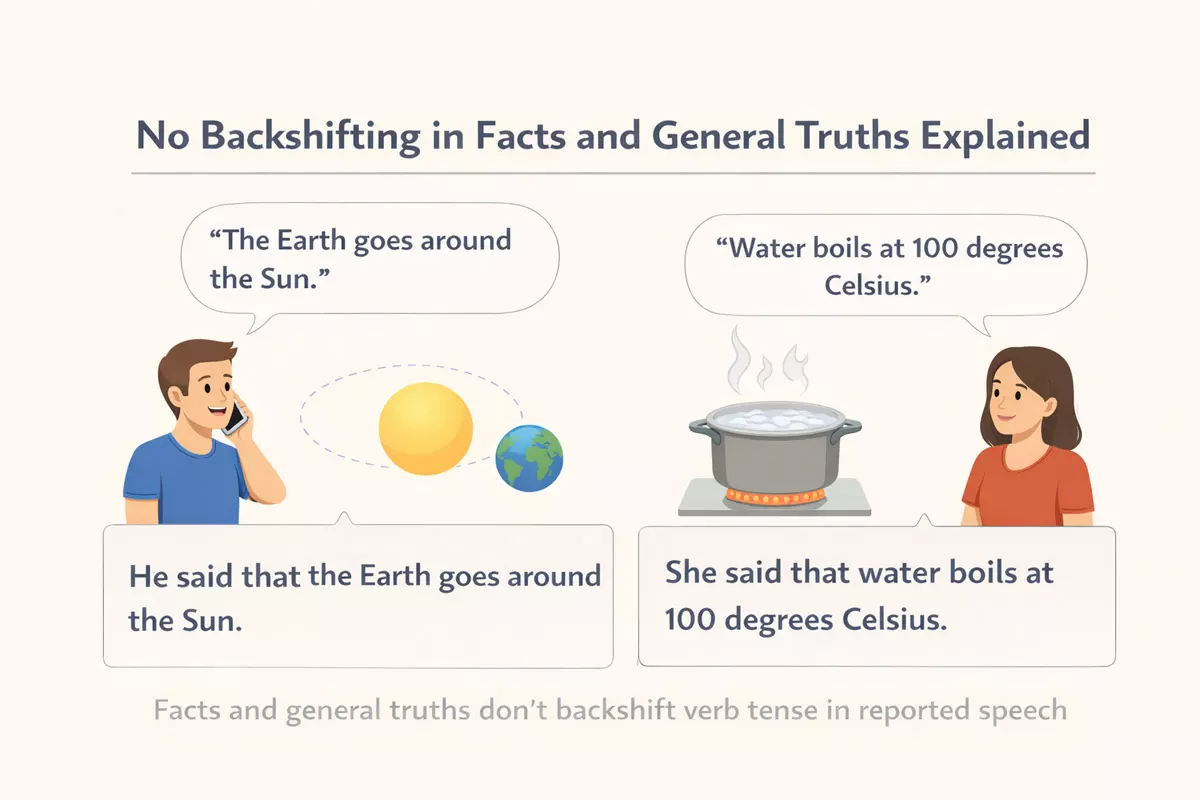 The article explains why facts and general truths use the present tense, how to distinguish facts from opinions, and when context affects tense choice. It also covers scientific statements and frequent mistakes learners make with tenses.
Many English learners are often curious about why statements expressing universal truths or established facts do not change tense when reported indirectly. This exception to the general rule of tense shifting in reported speech exists because the truth of such statements is considered permanent and unchanging, regardless of when or by whom they are mentioned. Recognizing and applying this rule can greatly improve your understanding of reported speech and help you communicate ideas more accurately and effectively in English.
Definition of facts and general truths
In English grammar, sentences that express facts or general truths refer to statements that are always valid, universally accepted, or scientifically proven. These are not tied to a specific time or event but remain constant regardless of context. For example, the statement "Water boils at 100°C" is considered a scientific fact, while "The sun rises in the east" describes a general truth about the natural world.
What makes a statement a fact or general truth?
A fact is any statement that can be proven true, either by direct observation or evidence. General truths, on the other hand, are broader statements about the world, nature, or human behavior that are consistently accurate. They are not limited by time and do not change depending on the situation. These statements typically use the simple present tense, as this form signals timelessness and reliability.
- The earth orbits the sun.
- Water freezes at 0°C.
- Cats have four legs.
- Light travels faster than sound.
- People need oxygen to survive.
- Birds lay eggs.
- Triangles have three sides.
- Ice melts in heat.
- Plants need sunlight for photosynthesis.
- Gravity pulls objects toward the earth.
- Fish live in water.
- Honey is made by bees.
- Rain falls from clouds.
- Fire is hot.
- Dogs bark.
- Humans use language to communicate.
Why is backshifting not used with facts and general truths?
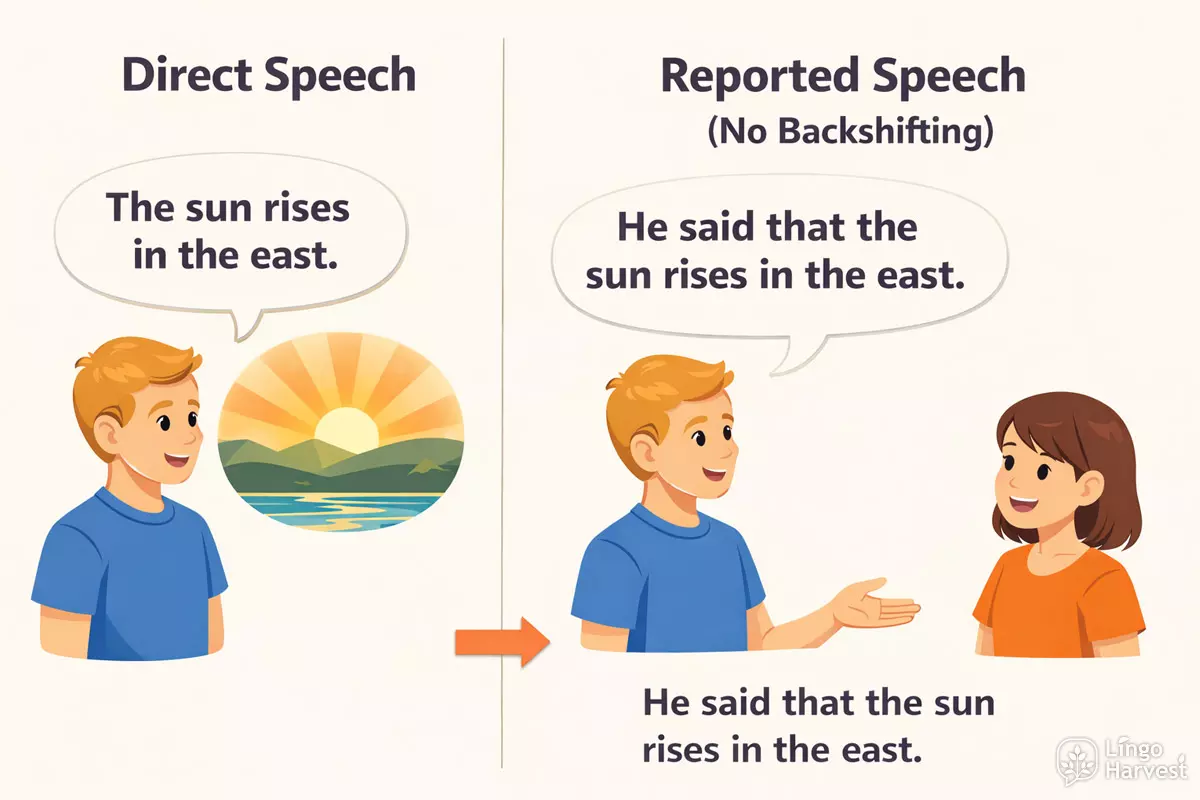
When reporting statements about universal truths or established facts, English does not typically change the verb tense (a process known as "backshifting") in indirect speech. This is because the truth of the statement is independent of when it is reported. For example, if someone says, "Water boils at 100°C," and you report it later, you still say, "She said that water boils at 100°C," not "boiled."
| Direct Speech | Reported Speech (No Backshifting) |
|---|---|
| The sun rises in the east. | He said that the sun rises in the east. |
| Humans need water to live. | She explained that humans need water to live. |
| Ice melts at 0°C. | They mentioned that ice melts at 0°C. |
| Birds fly. | We learned that birds fly. |
To summarize, statements about facts and general truths are not affected by time and remain in the present tense when reported. This principle helps maintain clarity, especially when sharing scientific knowledge, common sense, or universally accepted information.
Why tense change is unnecessary
When reporting facts or universal truths, the original tense is usually kept because the information remains accurate regardless of when it is reported. For example, scientific laws, general facts, and commonly accepted knowledge do not change over time, so shifting the tense would create confusion or even inaccuracy. This approach helps preserve the reliability and clarity of what is being communicated, especially in indirect speech or reported statements.
Stability of Facts and Universal Truths
Universal truths and factual statements stay the same over time. If you say, “The sun rises in the east,” this remains correct whether you report it today, tomorrow, or next year. Changing the tense to the past can make the statement sound as if it is no longer true, which is not the case for these types of information.
- Water boils at 100°C.
- Earth orbits the sun.
- Light travels faster than sound.
- Two plus two equals four.
- Mount Everest is the highest mountain on Earth.
- The Atlantic Ocean separates America and Europe.
- Humans need oxygen to survive.
- Dogs are mammals.
- Gravity pulls objects toward the Earth.
- Penguins cannot fly.
Reported Speech: Facts vs. Opinions
In English, backshifting (changing the tense back in reported speech) is common with statements about the past or personal experiences. However, when relaying facts or general truths, maintaining the present tense signals that the information is still valid. This distinction helps listeners or readers understand whether something is a permanent reality or a one-time event.
| Direct Speech | Reported Speech (No Tense Change) |
|---|---|
| "Water freezes at 0°C." | She said that water freezes at 0°C. |
| "The Earth is round." | He explained that the Earth is round. |
| "Birds lay eggs." | They mentioned that birds lay eggs. |
| "The heart pumps blood." | We learned that the heart pumps blood. |
Clarity and Accuracy
Maintaining the original tense for established facts avoids misleading the audience. For instance, saying “She said that the Earth was round” could suggest that it is no longer true, which is not the intended meaning. Leaving the tense unchanged preserves the timelessness and accuracy of the statement.
In summary, keeping the tense unchanged for facts and general truths supports clear, accurate communication and helps distinguish between unchanging realities and events tied to a specific time.
Scientific and universal statements
When reporting facts, general truths, or established scientific principles, English grammar has a clear preference: we do not backshift the tense, even in reported speech. This means that the verb remains in the present simple (or present perfect) to show that the statement is always true, regardless of who says it or when it is said. This rule helps avoid confusion and maintains the accuracy of information that is universally recognized.
Why no backshifting for general truths?
Backshifting—changing the tense to the past in indirect speech—serves to show that something was said in the past and may no longer be true. However, facts and universal statements, like “Water boils at 100°C,” don’t change over time. Keeping them in the present tense signals that they remain valid regardless of context or reporting.
Examples of statements that stay in the present tense
- The sun rises in the east.
- Plants need sunlight to grow.
- Two plus two equals four.
- Ice melts at 0°C.
- Human beings require oxygen to survive.
- Light travels faster than sound.
- Water consists of hydrogen and oxygen.
- Gravity pulls objects toward the Earth.
- Diamonds are harder than iron.
- Spiders have eight legs.
- Electricity flows through conductors.
- Fish live in water.
- The Earth orbits the sun.
- Milk comes from mammals.
- Sound cannot travel through a vacuum.
Comparing backshifting with factual reporting
| Reported Speech | Backshifting? | Correct Example |
|---|---|---|
| She said, "The Earth is round." | ❌ (Not used) | She said that the Earth is round. |
| He explained, "Water boils at 100°C." | ❌ (Not used) | He explained that water boils at 100°C. |
| They told us, "Spiders have eight legs." | ❌ (Not used) | They told us that spiders have eight legs. |
| She said, "The meeting starts at 9 AM." | ✅ (Backshifting possible) | She said that the meeting started at 9 AM. |
Key takeaways
- Universal truths and scientific facts stay in the present tense when reported.
- Backshifting is reserved for statements that are time-specific or potentially untrue now.
- Using the correct tense helps readers and listeners recognize whether information is permanent or context-dependent.
Remember, preserving the present tense in these statements ensures clarity and accuracy, especially in educational and scientific contexts.
Difference between fact and opinion
Understanding the distinction between statements that reflect reality and those that express personal beliefs is crucial, especially when discussing backshifting in reported speech. In English grammar, facts are pieces of information that are universally accepted and verifiable, while opinions are based on individual perspectives, feelings, or interpretations. This distinction directly affects how we handle tense changes in indirect speech, particularly with facts and general truths, where backshifting often does not occur.
What makes something a fact?
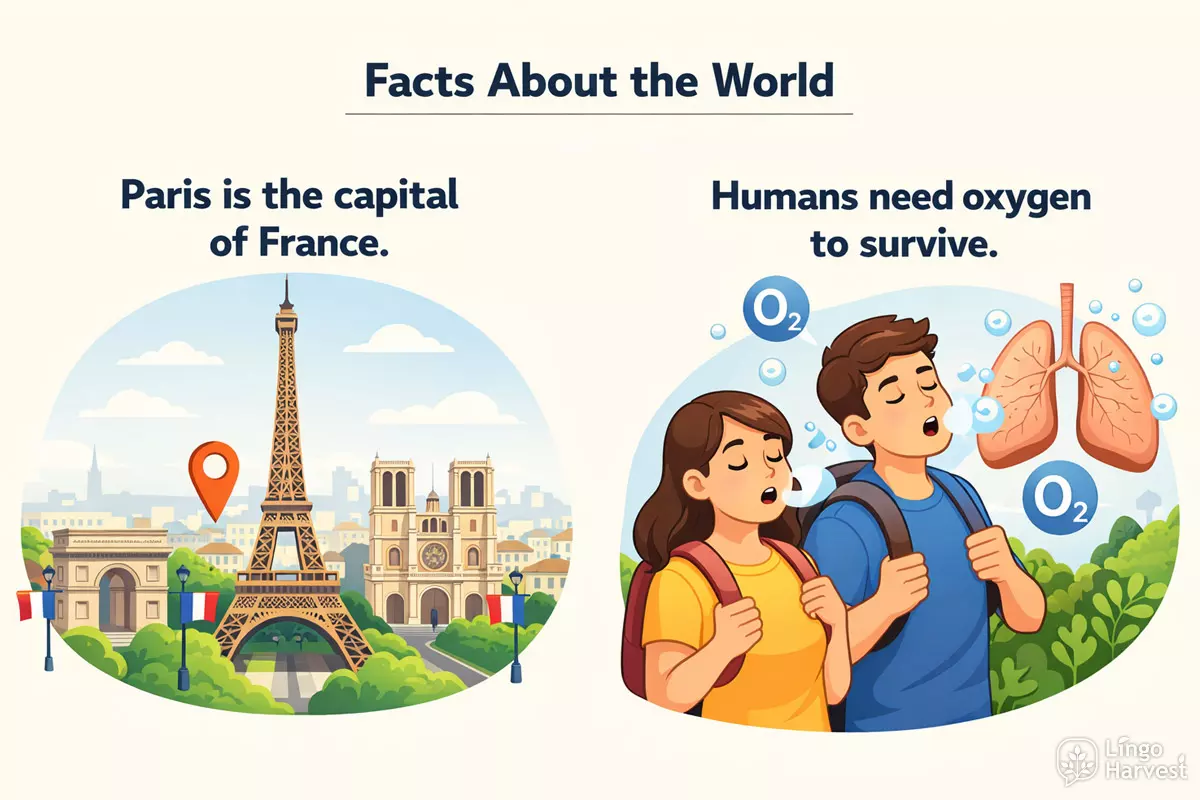
A fact is a statement that can be proven true or false using objective evidence. These are typically stable over time and do not change based on who is speaking or their point of view. For example, scientific laws, historical dates, and universal truths fall into this category.
- The Earth orbits the Sun.
- Water boils at 100°C at sea level.
- Paris is the capital of France.
- Humans need oxygen to survive.
- Ice melts at temperatures above 0°C.
- There are seven continents on Earth.
- Triangles have three sides.
- The Pacific Ocean is the largest ocean.
- Light travels faster than sound.
- The Amazon is the largest rainforest.
What defines an opinion?
Opinions, on the other hand, are subjective statements that reflect someone's beliefs, preferences, or judgments. They can vary greatly from person to person and are not universally verifiable. When reporting opinions, tense often shifts in indirect speech to match the reporting verb.
- Chocolate ice cream is the best flavor.
- Winter is more enjoyable than summer.
- This movie is boring.
- He is a talented musician.
- Online learning is better than classroom learning.
- Running is the most effective exercise.
- Cats are friendlier than dogs.
- This book is too long.
- City life is more exciting than country life.
- She is a great leader.
Key differences summarized
| Facts | Opinions |
|---|---|
| Can be proven true or false | Cannot be proven; based on beliefs |
| Remain constant regardless of who states them | May change from person to person |
| Often use present tense in reported speech (no backshifting) | Usually shift tense in reported speech |
| Example: "The sun rises in the east." | Example: "Sunrises are beautiful." |
Recognizing whether a statement is a fact or an opinion helps determine if backshifting is necessary in reported speech. When in doubt, ask yourself if the statement can be objectively verified or if it reflects someone's personal viewpoint.
Context-based tense choice
Selecting the right tense when reporting speech or writing about facts depends heavily on the nature of the information. When dealing with universal truths or facts that remain unchanged, English typically avoids backshifting—the process of moving a verb one step back in time, as is common in reported speech. Instead, the present tense is preserved to reflect the ongoing validity of the statement.
When not to backshift: facts and general truths
General truths and established facts do not change over time, so their tense remains in the present even when reported indirectly. This approach helps readers or listeners understand that the information is still relevant and accurate. Here are common cases where backshifting does not occur:
- Scientific facts: “The teacher said that water boils at 100°C.”
- Universal truths: “She mentioned that the sun rises in the east.”
- Permanent states: “He told me that Paris is the capital of France.”
- Mathematical rules: “The professor explained that two plus two equals four.”
- Proverbs: “My grandmother always said that honesty is the best policy.”
- General abilities: “She noted that birds can fly.”
- Definitions: “He clarified that a triangle has three sides.”
- Physical laws: “They taught us that objects fall due to gravity.”
- Historical dates (if still true): “He said that World War II ended in 1945.”
- Biological facts: “The scientist explained that humans need oxygen to survive.”
- Habitual actions (if unchanged): “She pointed out that bees make honey.”
Comparing tense choices in different contexts
To clarify how tense selection works in practice, compare how English handles information that is still true versus statements that are time-bound or subjective. The table below shows a range of examples highlighting this distinction.
| Original Statement | Reported Speech | Backshifting? |
|---|---|---|
| “The Earth orbits the sun.” | He said that the Earth orbits the sun. | ❌ (No backshifting) |
| “I am tired.” | She said that she was tired. | ✅ (Backshifting) |
| “Water freezes at 0°C.” | They explained that water freezes at 0°C. | ❌ (No backshifting) |
| “I will call you tomorrow.” | He promised he would call me the next day. | ✅ (Backshifting) |
| “Cats have whiskers.” | She said that cats have whiskers. | ❌ (No backshifting) |
Notice that factual, timeless statements keep the present tense, while personal, time-specific, or situational comments typically shift to the past in indirect speech. This distinction helps maintain clarity and accuracy in communication.
Summary tips
- Keep the present tense for facts, definitions, and general truths.
- Use backshifting for statements about feelings, actions, or intentions that are not universally or permanently true.
- If in doubt, ask whether the information is still valid now—if yes, no shift is needed.
Frequent learner mistakes
Learners often get confused about how to report statements that are facts or general truths, especially when dealing with reported speech. The main issue is applying backshifting (changing the tense back) where it is not actually needed. This leads to sentences that sound unnatural or even incorrect in English.
Common misunderstandings
Many students automatically backshift every verb in reported speech, forgetting that facts and general truths do not change. For example, they might report "The sun rises in the east" as "He said the sun rose in the east," which is misleading—since the sun still rises in the east!
Typical errors when reporting facts and universal truths
- Backshifting present simple to past simple for facts (e.g., "Water boils at 100°C" → "He said water boiled at 100°C.")
- Changing scientific laws or definitions to the past (e.g., "Triangles have three sides" → "She said triangles had three sides.")
- Confusing habitual actions with facts (e.g., reporting "She always gets up at 6" as "He said she always got up at 6," even though it’s still her habit)
- Misreporting general truths about geography, history, or language (e.g., "Paris is the capital of France" → "He said Paris was the capital of France.")
- Over-applying rules to modal verbs in truths (e.g., "You can see the mountains from here" → "She said you could see the mountains from here.")
- Neglecting context—sometimes backshifting is correct if the fact is no longer true, but many learners miss this nuance
- Not recognizing the difference between a permanent truth and a temporary situation
Comparing correct and incorrect reported speech
Below is a structured comparison of common mistakes and their correct forms when reporting facts or general truths:
| Incorrect (Backshifted) | Correct (No Backshift) |
|---|---|
| She said the Earth revolved around the Sun. | She said the Earth revolves around the Sun. |
| He said light traveled faster than sound. | He said light travels faster than sound. |
| They said humans needed oxygen to survive. | They said humans need oxygen to survive. |
| She said metal expanded when heated. | She said metal expands when heated. |
| He said the heart pumped blood through the body. | He said the heart pumps blood through the body. |
| They said gravity pulled objects toward the ground. | They said gravity pulls objects toward the ground. |
| She said time passed more slowly at high speed. | She said time passes more slowly at high speed. |
| He said plants produced oxygen. | He said plants produce oxygen. |
| They said diamonds formed under high pressure. | They said diamonds form under high pressure. |
| She said sound moved in waves. | She said sound moves in waves. |
How to avoid these pitfalls
- Ask yourself if the statement is still true now. If yes, do not backshift.
- Remember: scientific facts, general knowledge, and universal truths keep their tense in reported speech.
- Practice recognizing which statements are universal and which are temporary.
- Read and listen to authentic English to notice how reported speech is handled by native speakers.
Learners who pay attention to these patterns will find it easier to report facts and general truths accurately, making their English clearer and more natural.
Homework
Exercise 1: Decide — backshift or not?
Rewrite each sentence in reported speech. Decide whether the tense should change or stay the same. Make all necessary pronoun and time-reference changes.
- "Water boils at 100°C," the teacher said.
- "I am very tired," she said.
- "The Earth is round," he explained.
- "We will finish the project tomorrow," they said.
- "Birds lay eggs," the guide told us.
- "I live in Berlin," Anna said.
- "Two plus two equals four," the professor said.
- "I have lost my keys," he said.
- "Dogs are mammals," she explained.
- "We are late," they said.
Show answers
- The teacher said that water boils at 100°C.
- She said that she was very tired.
- He explained that the Earth is round.
- They said that they would finish the project the next day.
- The guide told us that birds lay eggs.
- Anna said that she lived in Berlin.
- The professor said that two plus two equals four.
- He said that he had lost his keys.
- She explained that dogs are mammals.
- They said that they were late.
Exercise 2: Fact or opinion?
For each sentence, decide whether it is a fact or an opinion. Then rewrite it in reported speech using the correct tense.
- "The sun rises in the east."
- "This city is very boring."
- "Water freezes at 0°C."
- "I like this restaurant."
- "Paris is the capital of France."
- "This exam is too difficult."
- "Plants need sunlight to grow."
- "He is the best teacher here."
- "Cats have whiskers."
- "I feel nervous today."
Show answers
- Fact → He said that the sun rises in the east.
- Opinion → She said that the city was very boring.
- Fact → He explained that water freezes at 0°C.
- Opinion → She said that she liked the restaurant.
- Fact → He said that Paris is the capital of France.
- Opinion → She said that the exam was too difficult.
- Fact → He explained that plants need sunlight to grow.
- Opinion → She said that he was the best teacher there.
- Fact → He said that cats have whiskers.
- Opinion → She said that she felt nervous that day.