Reported Speech vs Reported Thought in English Grammar

 The article compares reported speech and reported thought, highlights common verbs used for reported thought, explains grammar and tense patterns, discusses stylistic differences, and clarifies common areas where learners get confused.
Effectively communicating what someone has said or thought requires the use of various techniques in English, each governed by specific rules and subtle differences. Mastering the process of converting direct statements and internal reflections into indirect or reported speech is crucial for achieving clarity and precision in both spoken and written communication. This skill not only helps in accurately conveying messages but also ensures that the intended meaning is preserved and understood by the audience.
Reported speech vs reported thought
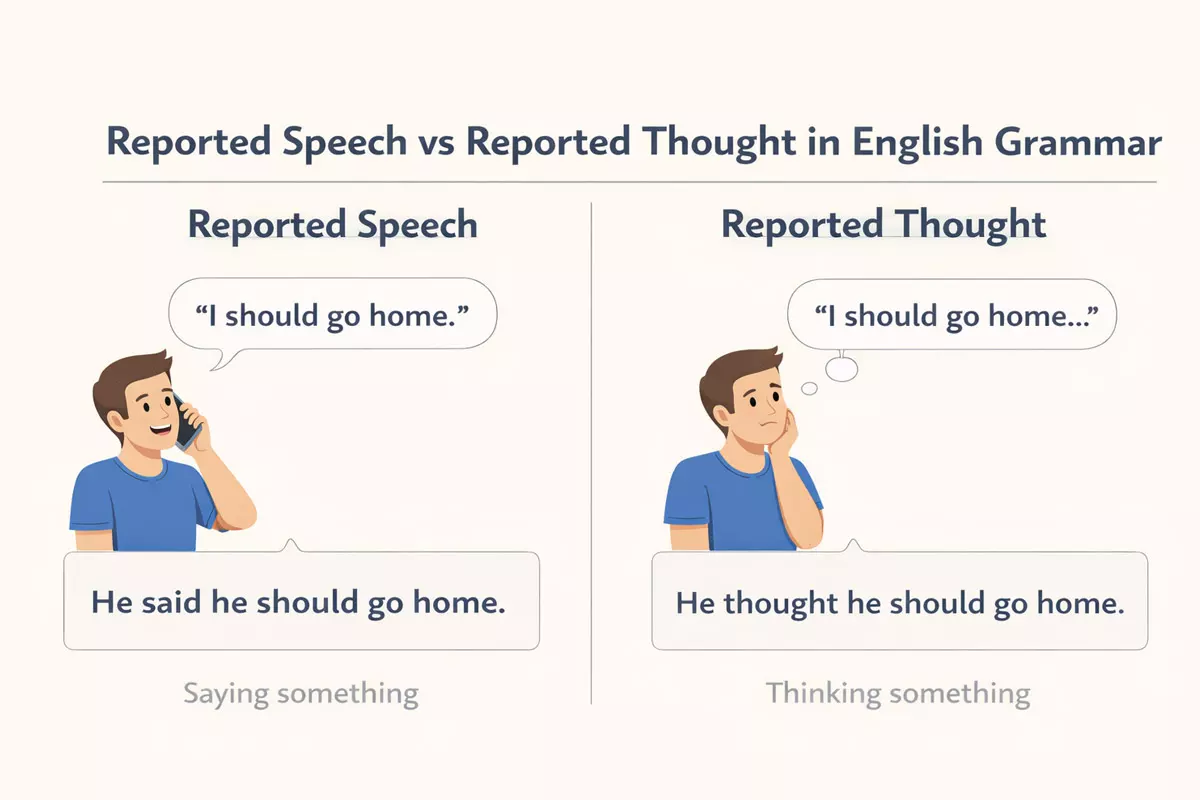
Understanding how to convey what someone else has said or thought is crucial in English grammar. While both processes involve expressing information secondhand, there are key differences in structure, usage, and style between relaying spoken words and internal thoughts. Recognizing these distinctions helps writers and speakers present information more clearly and accurately.
What is reported speech?
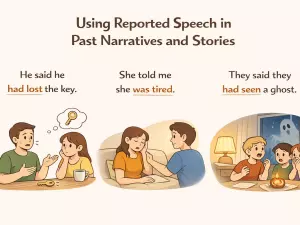
Reported speech, often called indirect speech, is used to communicate what another person said without quoting their exact words. Typically, this involves a reporting verb (like said, told, or asked) and changes in pronouns, verb tense, and time expressions. For example: She said that she was tired.
What is reported thought?
Reported thought, sometimes called indirect thought, shares some similarities with reported speech but focuses on what someone was thinking rather than speaking aloud. It often appears in narrative writing and uses verbs such as thought, wondered, realized, or remembered. For instance: He wondered if he had locked the door.
Key differences and similarities
Both forms require changes to tense, pronouns, and references to time. However, reported thought typically reflects internal dialogue, while reported speech refers to spoken communication. The reporting verbs and the context help distinguish which is being used.
| Feature | Reported Speech | Reported Thought |
|---|---|---|
| Typical Reporting Verbs | said, told, asked, replied | thought, wondered, hoped, realized |
| Original Source | Spoken words | Internal thoughts |
| Use of Quotation Marks | Not used for indirect speech | Not used for indirect thought |
| Common in | Conversation, reporting dialogue | Narrative writing, character perspective |
| Typical Example | She said (that) she was leaving. | She wondered if she had time. |
Common reporting verbs
- said → “I am tired.” → He said (that) he was tired.
- told → “I will help you.” → She told me (that) she would help me.
- asked → “Where do you live?” → He asked where I lived.
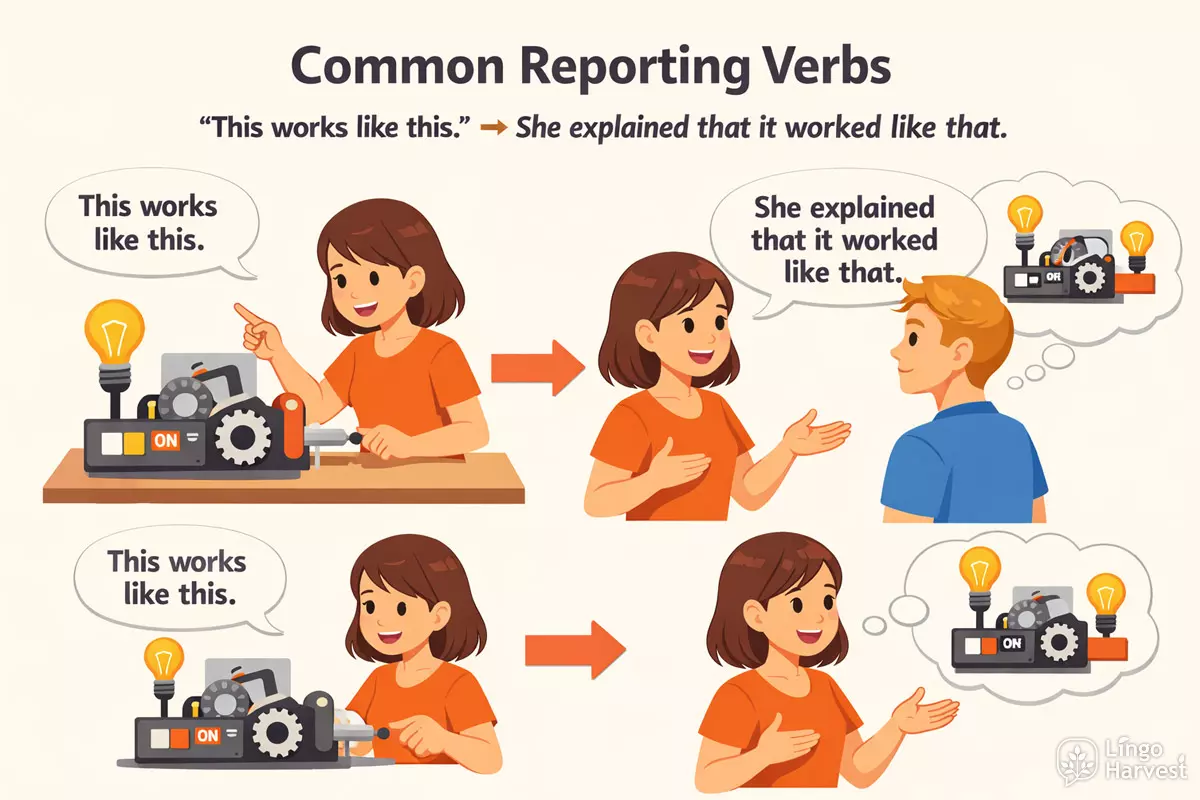
- explained → “This works like this.” → She explained that it worked like that.
- thought → “This is a mistake.” → He thought that it was a mistake.
- wondered → “Will she come?” → He wondered if she would come.
- realized → “I am late.” → She realized that she was late.
- remembered → “I met him before.” → He remembered that he had met him before.
- considered → “This might be risky.” → She considered that it might be risky.
- decided → “I will leave.” → He decided that he would leave.
- admitted → “I was wrong.” → She admitted that she had been wrong.
- denied → “I took the money.” → He denied that he had taken the money.
- promised → “I will call you.” → She promised that she would call me.
- hoped → “Everything will be fine.” → He hoped that everything would be fine.
- feared → “Something bad will happen.” → She feared that something bad would happen.
- suspected → “He is lying.” → They suspected that he was lying.
- noticed → “She looks upset.” → He noticed that she looked upset.
- believed → “This is true.” → She believed that it was true.
Example transformations
- Direct speech: "I am leaving now." → Indirect: He said (that) he was leaving then.
- Direct thought: "Will I finish on time?" → Indirect: She wondered if she would finish on time.
- Direct speech: "Where are you?" → Indirect: She asked where he was.
- Direct thought: "This can’t be real." → Indirect: He thought that it couldn’t be real.
In summary, both forms serve to relay information one step removed from the original source, but the intent and context differ. Mastering when and how to use each helps convey both spoken messages and internal reflections with clarity.
Common verbs for reported thought
When expressing someone’s inner reflections or mental processes in English, certain verbs are commonly used to introduce reported thought. These verbs help convey what a person was thinking, believing, or wondering, rather than what they explicitly said. While reporting speech often uses verbs like “say” or “tell,” describing thoughts typically involves a different set of verbs that highlight mental activity or internal dialogue.
Key verbs used to report thoughts
Writers and speakers use a range of verbs to shift from direct to indirect thought. These verbs indicate the nature of the cognitive activity, such as forming an opinion, having a suspicion, or making a decision. Here are some of the most frequent verbs used to report internal thoughts or beliefs:
- think → “I am right.” → He thought (that) he was right.
- believe → “This is true.” → She believed that it was true.
- suppose → “He knows the answer.” → She supposed that he knew the answer.
- imagine → “They are waiting for me.” → He imagined that they were waiting for him.
- assume → “Everything will be fine.” → She assumed that everything would be fine.
- wonder → “Will she call me?” → He wondered if she would call him.
- consider → “This is too risky.” → She considered that it was too risky.
- suspect → “He is hiding something.” → They suspected that he was hiding something.
- remember → “I locked the door.” → He remembered that he had locked the door.
- forget → “I promised her.” → She forgot that she had promised her.
- hope → “He will forgive me.” → She hoped that he would forgive her.
- wish → “I were taller.” → He wished that he were taller.
- expect → “She will arrive soon.” → They expected that she would arrive soon.
- realize → “I made a mistake.” → He realized that he had made a mistake.
- know → “She is telling the truth.” → He knew that she was telling the truth.
- doubt → “They will agree.” → She doubted that they would agree.
- guess → “He is at home.” → She guessed that he was at home.
- decide → “I will leave early.” → He decided that he would leave early.
Each of these verbs can change the nuance of the reported thought. For example, “wonder” suggests uncertainty, while “know” expresses certainty. “Suppose” and “assume” imply that the thought might not be based on solid evidence.
Patterns for reporting thought
Reporting someone’s thoughts often involves either a “that”-clause or a question format (especially with verbs like “wonder” or “ask oneself”). For example:
- She thought that he was late.
- He wondered whether he had locked the door.
- I assumed she would call me back.
Comparing reporting speech and thought
The verbs used for reporting thought differ from those used for quoting what someone says aloud. Here’s a structured comparison of commonly used reporting verbs:
| Typical Speech Reporting Verbs | Typical Thought Reporting Verbs |
|---|---|
| say | think |
| tell | believe |
| ask | wonder |
| reply | suppose |
| claim | imagine |
| suggest | assume |
| explain | realize |
| admit | know |
| deny | doubt |
| promise | hope |
| warn | fear |
| complain | suspect |
| announce | expect |
| argue | guess |
| insist | decide |
| whisper | remember |
| shout | forget |
| confess | wish |
Choosing the right verb for reporting someone’s mental state adds clarity and precision to writing. The selection depends on the context and the intended meaning, so understanding these subtle differences is essential for accurate and natural English.
Structural differences in grammar
When expressing someone else’s words or thoughts, English uses distinct grammatical patterns for reported speech and reported thought. These differences show up in the choice of reporting verbs, pronoun shifts, verb tense changes, and the overall structure of the clause. Understanding these patterns can help learners accurately convey what was said versus what was thought.
Reporting verbs and introductory phrases
The verbs used to introduce reported speech and thought are usually different. For speech, common verbs include say, tell, ask, and reply. For thought, verbs such as think, believe, wonder, and imagine are more typical.
- He said that he was tired. (speech)
- She thought that it would rain. (thought)
- They asked if I could help. (speech)
- I wondered where she had gone. (thought)
- He told me to wait. (speech, command)
- She believed he was honest. (thought)
- He replied that he was busy. (speech)
- She imagined living by the sea. (thought)
Tense and pronoun changes
Both forms often require shifting verb tenses and pronouns, but the intent differs. In reported speech, the changes reflect the original utterance, while in reported thought, the adjustments show internal perspective.
| Direct Form | Reported Speech | Reported Thought |
|---|---|---|
| "I am tired," he said. | He said that he was tired. | He thought that he was tired. |
| "Will you come?" she asked. | She asked if I would come. | She wondered if I would come. |
| "This is difficult," they said. | They said that it was difficult. | They believed that it was difficult. |
| "I have finished," John said. | John said that he had finished. | John thought that he had finished. |
Sentence structure and conjunctions
Reported speech often uses that to introduce the clause, but it can be omitted in informal English. Reported thought also uses that, but in some cases, the reporting verb can be followed directly by a clause or a verb in the -ing form, particularly with verbs like imagine or remember.
- He said (that) he was late. → speech
- She thought (that) it was strange. → thought
- He remembered leaving the door open. (thought)
- She told me to sit down. (speech, imperative)
Summary of key differences
- Choice of reporting verb is crucial: say/tell for speech, think/believe for thought.
- Pronoun and tense shifts occur in both, but reflect different perspectives.
- Reported speech may include direct questions and commands; reported thought rarely does.
- Some verbs allow for -ing clauses in reported thought, but not usually in reported speech.
- Conjunction that is common, but sometimes optional.
These contrasts shape how English speakers report what was said versus what was thought, and mastering them helps clarify meaning and intention in communication.
Tense use in reported thinking
When transforming someone's thoughts into indirect speech, English speakers often face choices about verb tenses. Unlike reporting spoken words, rendering thoughts indirectly can be more flexible, but certain patterns and conventions still apply. The choice of tense typically depends on the timing of the original thought and its relation to the reporting verb.
General patterns for tense shifts
Reported thoughts often follow the same sequence of tenses as reported speech. If the reporting verb is in the past, the verb in the reported thought usually shifts back:
- Present simple becomes past simple: She thought, "I am tired." → She thought she was tired.
- Present continuous becomes past continuous: I am leaving now. → He thought he was leaving then.
- Present perfect becomes past perfect: I have finished. → She thought she had finished.
- Past simple becomes past perfect: I saw him yesterday. → He thought he had seen him the day before.
Exceptions and variations
Sometimes, especially when the thought is still true or relevant at the time of reporting, English allows for less shifting. This is common with general truths or ongoing states:
- She thought the Earth is round. (general truth; no shift)
- He thought he lives in Paris. (if still true at reporting time)
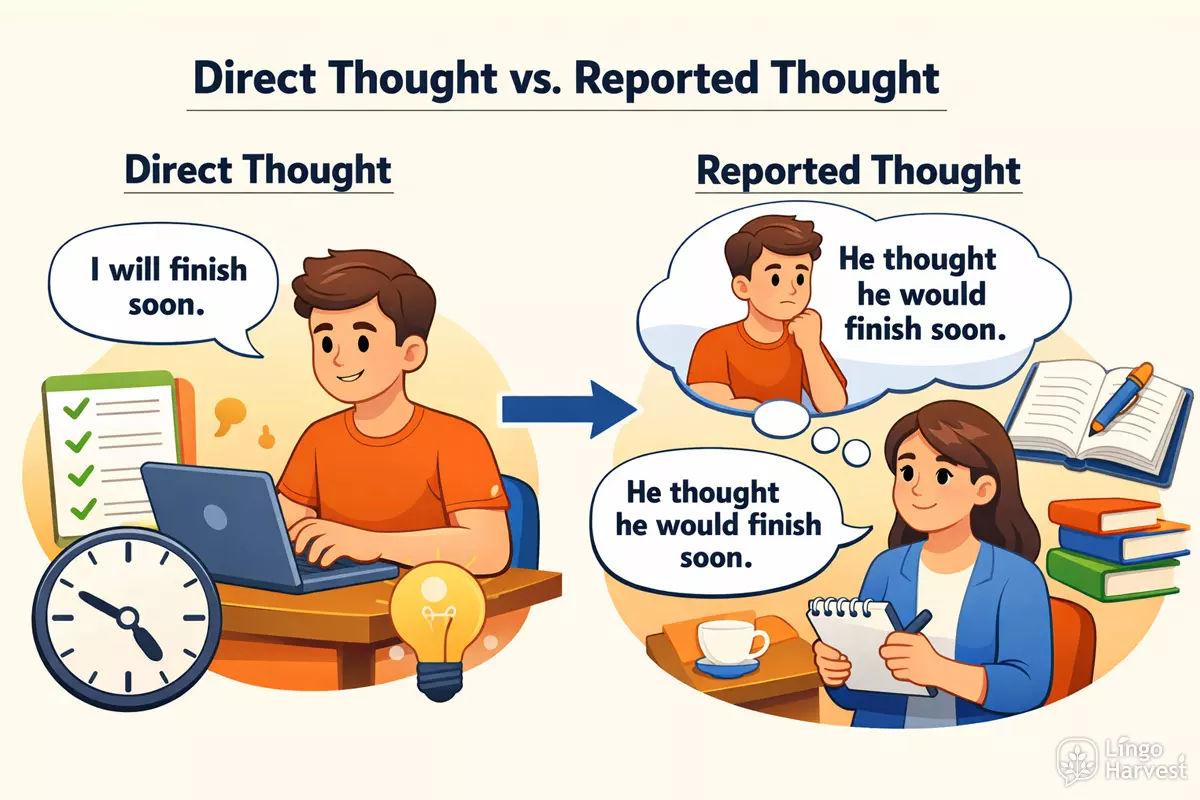
Table: Tense changes in reported thought
| Direct Thought | Reported Thought |
|---|---|
| I am hungry. | She thought she was hungry. |
| I will finish soon. | He thought he would finish soon. |
| I have lost my keys. | She thought she had lost her keys. |
| I saw her at the station. | He thought he had seen her at the station. |
| I can do it. | She thought she could do it. |
| I must call him. | He thought he had to call him. |
| I am going to win. | She thought she was going to win. |
| I like this place. | He thought he liked that place. |
| It is raining. | She thought it was raining. |
| I don't understand. | He thought he didn't understand. |
Modal verbs and other notes
Modal verbs such as can, may, and will also undergo backshifting in reported thought: can becomes could, will becomes would, and so on. Some modal verbs, like should and might, remain unchanged. It's also common to see changes in time expressions, for example, now becomes then, and today becomes that day.
- can → could → “I can swim.” → He said (that) he could swim.
- will → would → “I will call you.” → She said (that) she would call me.
- may → might → “It may rain.” → He said (that) it might rain.
- must → had to → “I must leave now.” → She said (that) she had to leave.
- shall → would → “I shall help you.” → He said (that) he would help me.
- need to → needed to → “I need to finish this.” → She said (that) she needed to finish it.
- have to → had to → “I have to work late.” → He said (that) he had to work late.
- should → should → “You should rest.” → She said (that) I should rest.
- might → might → “He might be late.” → She said (that) he might be late.
- would → would → “I would go if I could.” → He said (that) he would go if he could.
- could → could → “I could help you.” → She said (that) she could help me.
- ought to → ought to → “You ought to listen.” → He said (that) I ought to listen.
Being aware of these tense patterns helps ensure clarity and accuracy when expressing what someone was thinking, especially in written English.
Stylistic differences in writing
Writers make deliberate choices between reporting thoughts and reporting speech, and these choices can shape the feel and flow of a text. While both forms convey information from a character or source, the way they are used can affect the reader’s sense of immediacy, intimacy, and objectivity.
Directness and distance
Using reported speech often creates a sense of formality or objectivity. It tends to present information as something said aloud, distancing the narrator from the character’s inner world. In contrast, reported thought brings the reader closer to a character’s private reflections, allowing for more introspection and subtlety.
- Reported speech: “She said that she was tired.”
- Reported thought: “She thought that she was tired.”
- Reported speech is common in news, academic writing, and formal narratives.
- Reported thought is used more in fiction, biographies, and character-driven essays.
Formality and tone
Choosing between these forms can also influence the tone of a passage. Indirect speech tends to sound neutral or detached, while indirect thought may feel more subjective or emotional. The verbs used—such as “said,” “asked,” “wondered,” or “realized”—signal to the reader whether the information is external or internal.
| Usage Context | Typical Effect |
|---|---|
| Reported speech | Creates distance; emphasizes what was communicated aloud |
| Reported thought | Offers intimacy; reveals unspoken feelings or opinions |
| Mixing both forms | Provides balance between narrative authority and character insight |
| Switching perspectives | Enriches storytelling; varies reader engagement |
Common verbs and patterns
Certain reporting verbs and structures are typical for each form. Here are some frequently used choices:
- said, told, asked, replied (speech)
- thought, wondered, realized, remembered (thought)
- explained, mentioned, insisted (speech)
- believed, hoped, suspected, considered (thought)
- admitted, confessed, suggested (speech or thought, depending on context)
- noticed, imagined, doubted, decided (thought)
Ultimately, the selection between reporting speech and thought is a stylistic decision that shapes narrative voice, reader connection, and the overall mood of the writing. Skilled authors often blend both to create richer, more engaging texts.
Typical learner confusion
Learners often mix up the ways English handles quoting thoughts versus reporting what someone said. At first glance, both forms seem similar, but their rules and nuances can trip up even advanced students. One major stumbling block is deciding when to use reporting verbs like say, tell, or think, and how these choices affect verb tense and pronoun changes in indirect statements.
Common mistakes with reporting speech and thought
- Confusing which verbs introduce reported speech (say, tell) and which verbs introduce reported thought (think, know, wonder).
- Failing to shift tenses correctly when moving from direct to indirect forms, especially with reported thought.
- Using “that” unnecessarily or omitting it where it’s needed for clarity.
- Mixing up pronoun references, particularly when the speaker and thinker are not the same person.
- Forgetting to change time expressions (e.g., today → that day) in indirect statements.
- Assuming reported thought always allows for “free” tense use, when grammar rules still apply.
- Overusing quotation marks in reported thought, or leaving them out when direct quotation is intended.
- Misapplying question word order in indirect questions after verbs of saying or thinking.
- Believing that reported speech and thought always use the same grammatical structures.
- Using “ask” in places where “wonder” or “think” would be more natural for internal thoughts.
Direct vs. indirect: Spotting the difference
Another area that frequently causes uncertainty is how to transform direct speech or thought into its indirect counterpart. The following table compares typical patterns and highlights what learners often confuse.
| Direct Form | Indirect (Reported) Form |
|---|---|
| He said, "I am tired." | He said that he was tired. |
| She thought, "It will rain." | She thought that it would rain. |
| They said, "We have finished." | They said they had finished. |
| I wondered, "Where is my book?" | I wondered where my book was. |
| He told me, "You can leave." | He told me that I could leave. |
| She said, "I am working on the project." | She said that she was working on the project. |
| He said, "I have never seen this before." | He said that he had never seen that before. |
| They explained, "We were waiting for you." | They explained that they had been waiting for me. |
| She said, "I will have finished by Friday." | She said that she would have finished by Friday. |
| He said, "I might be late tonight." | He said that he might be late that night. |
| She admitted, "I made a mistake." | She admitted that she had made a mistake. |
| They said, "We are going to move abroad." | They said that they were going to move abroad. |
| He said, "I was being followed." | He said that he had been being followed. |
| She said, "I would help if I had time." | She said that she would help if she had time. |
| They said, "We have been working all day." | They said that they had been working all day. |
| He warned, "You must be careful." | He warned that I had to be careful. |
| She said, "I can't remember his name." | She said that she couldn't remember his name. |
| They said, "We may arrive later than expected." | They said that they might arrive later than expected. |
| He said, "I would have called if I had known." | He said that he would have called if he had known. |
Words and expressions learners often confuse
- say vs. tell
- think vs. say
- wonder vs. ask
- Use of that after reporting verbs
- Shifting pronouns (I → he/she, you → I/he/she, etc.)
- Time expressions: now, today, tomorrow, yesterday
- Reporting questions: word order and auxiliary use
- Verb tense changes (present → past, will → would, etc.)
- Quotation marks: when to use them and when not to
- Ambiguity about whose thought or speech is being reported
To overcome these challenges, it helps to practice transforming both speech and thought, paying close attention to reporting verbs, pronoun shifts, and tense changes. Recognizing patterns in context goes a long way toward mastering the distinctions between reporting what someone said and what someone thought.
Homework
Exercise 1: Speech or thought? Choose the correct reporting verb
Rewrite each sentence twice: (1) as reported speech, (2) as reported thought. Use a natural reporting verb for each version and make any needed pronoun, tense, and time-reference changes.
- "I can’t do this today."
- "Will she answer my message?"
- "We are meeting here at 6."
- "I have already sent the file."
- "You should not tell anyone."
- "Where did they go?"
- "This must be a mistake."
- "I will call you tomorrow."
Show answers
- Speech: He said he couldn’t do it that day. Thought: He thought he couldn’t do it that day.
- Speech: He asked if she would answer his message. Thought: He wondered if she would answer his message.
- Speech: They said they were meeting there at 6. Thought: They expected they were meeting there at 6.
- Speech: She said she had already sent the file. Thought: She believed she had already sent the file.
- Speech: He warned me not to tell anyone. Thought: He thought I shouldn’t tell anyone.
- Speech: She asked where they had gone. Thought: She wondered where they had gone.
- Speech: He said it had to be a mistake. Thought: He realized it had to be a mistake.
- Speech: She said she would call me the next day. Thought: She intended to call me the next day.
Exercise 2: Transform direct speech and direct thought into indirect forms
Convert each item into one indirect sentence. Follow the label: Speech — use a speech reporting verb; Thought — use a thought reporting verb. Make tense, pronoun, and time/place changes where needed.
- Speech: "I am leaving now."
- Thought: "Will I finish on time?"
- Speech: "Where are you?"
- Thought: "This can’t be real."
- Speech: "We have finished."
- Thought: "I left my phone at home."
- Speech: "Don’t open the window."
- Thought: "I must remember her name."
- Speech: "Can you help me?"
- Thought: "She knows the truth."
Show answers
- He said (that) he was leaving then.
- She wondered if she would finish on time.
- She asked where I was.
- He thought that it couldn’t be real.
- They said (that) they had finished.
- He realized he had left his phone at home.
- He told me not to open the window.
- She reminded herself to remember her name.
- She asked if I could help her.
- He believed that she knew the truth.