Verb + Preposition + Gerund: Common Structures Explained

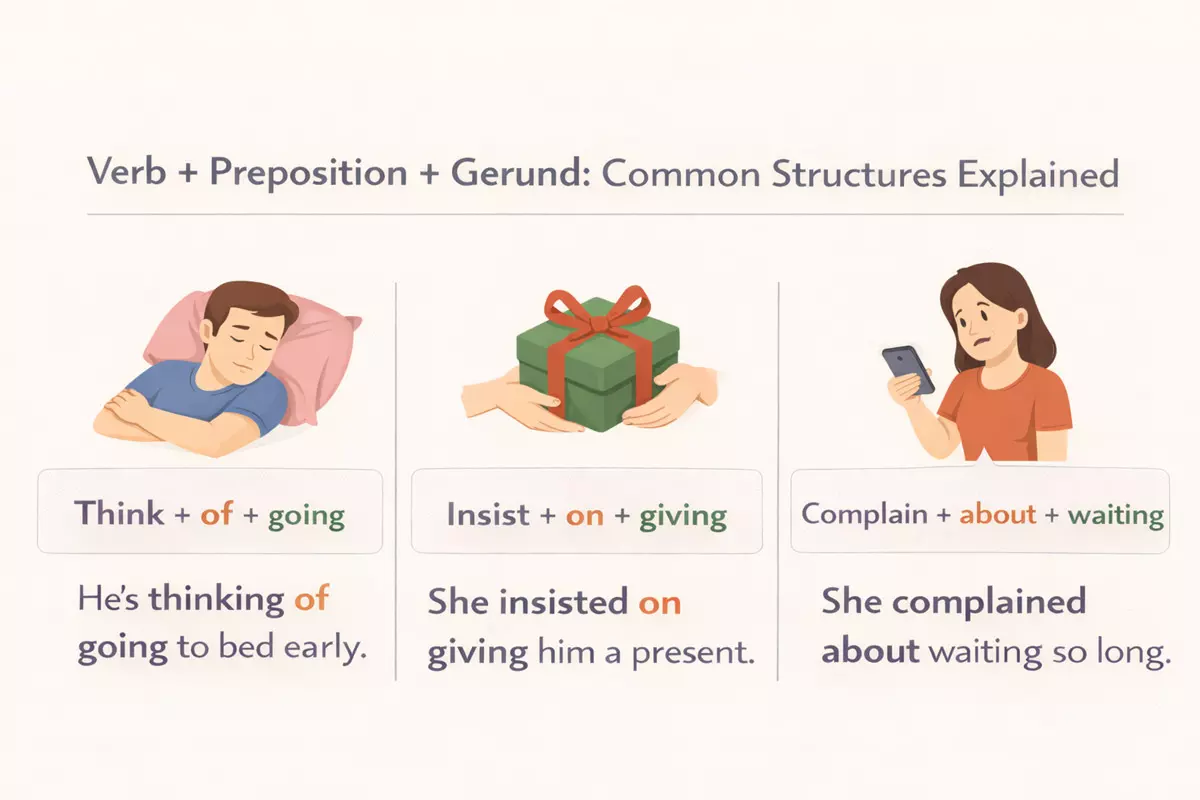 Here we what verb plus preposition plus gerund means, lists common combinations, explains how to form and use them, compares them to infinitive patterns, points out typical errors, and provides practice exercises and fixed phrases to remember.
Learning how action verbs combine with prepositions and –ing forms is a subtle but important skill that can make your English sound more natural and fluent. Many learners find these combinations confusing, but with practice, you can become more comfortable using them correctly. Paying attention to which verbs are followed by certain prepositions or –ing forms will help you avoid common mistakes and express yourself more clearly. Over time, mastering these patterns will increase your confidence and help you communicate your ideas with greater accuracy.
What verb + preposition + gerund means
This structure describes a common English pattern where a verb is directly followed by a preposition, which is then followed by a gerund (the -ing form of a verb). When you see phrases like "look forward to meeting" or "apologize for being late," you're seeing this pattern in action. The gerund acts as the object of the preposition, turning the verb into an activity or action that is being referenced.
How the pattern works
Certain verbs naturally pair with specific prepositions, and when you want to refer to an action after these, you use the gerund form. This is not just a stylistic choice—it's a grammatical rule. Using the infinitive ("to meet" instead of "to meeting") is incorrect after these verb + preposition combinations.
- He insisted on paying the bill. (not "to pay")
- They apologized for being late.
- We believe in helping others.
- She is interested in learning Spanish.
- He succeeded in passing the test.
- They talked about moving abroad.
- She’s worried about getting sick.
- I’m tired of waiting.
- He’s responsible for organizing the event.
- We look forward to seeing you.
- She’s thinking about changing jobs.
- He’s afraid of flying.
- They’re committed to improving the process.
- We’re used to working late hours.
- He’s accused of cheating.
- She’s interested in joining the club.
- They’re excited about traveling together.
- I’m good at drawing.
- He’s capable of solving complex problems.
- We succeeded in finding a solution.
Why use this structure?
Using the correct verb + preposition + gerund combination makes your English sound more natural and fluent. It’s not just about memorizing lists—understanding which verbs are followed by which prepositions, and then using the -ing form, helps you communicate ideas about actions, plans, feelings, and experiences smoothly.
Common mistakes to avoid
- ❌ He insisted on to pay the bill. → ✅ He insisted on paying the bill.
- ❌ They apologized for to be late. → ✅ They apologized for being late.
- ❌ She complained about to work too much. → ✅ She complained about working too much.
- ❌ He succeeded in to solve the problem. → ✅ He succeeded in solving the problem.
- ❌ We are interested in to learn more. → ✅ We are interested in learning more.
- ❌ They blamed him for to lose the documents. → ✅ They blamed him for losing the documents.
Quick reference: Typical verbs and prepositions that require a gerund

| Verb + Preposition | Example with Gerund |
|---|---|
| insist on | He insisted on paying. |
| apologize for | She apologized for being late. |
| believe in | We believe in helping others. |
| look forward to | I look forward to meeting you. |
| succeed in | He succeeded in passing the test. |
| be afraid of | She is afraid of flying. |
| be used to | They are used to working late. |
| be excited about | We’re excited about traveling. |
In summary, mastering verb + preposition + gerund patterns helps you express actions and attitudes in a way that fits naturally into everyday English.
Common verbs and prepositions used
Understanding how certain verbs naturally pair with specific prepositions—and then connect to a gerund—can make your English sound much more natural. These combinations are not random; they often follow patterns that native speakers use every day. Let's explore which verbs frequently appear in these constructions and which prepositions tend to follow them.
Frequent verb-preposition pairings before gerunds
Some verbs almost always need a particular preposition before a gerund. Here are some of the most common combinations, along with example gerunds:
- look forward to (meeting)
- be interested in (learning)
- worry about (failing)
- insist on (trying)
- apologize for (being late)
- think about (moving)
- complain about (waiting)
- succeed in (finding)
- feel like (going)
- be capable of (solving)
- be tired of (explaining)
- be responsible for (organizing)
- be afraid of (failing)
- be good at (drawing)
- approve of (taking)
- believe in (helping)
- prevent (someone) from (entering)
- thank (someone) for (helping)
Typical prepositions in these structures
A handful of prepositions appear most often after verbs when followed by a gerund. These include:
- in → She is interested in learning new languages.
- on → He insisted on paying the bill.
- for → They apologized for being late.
- about → We talked about moving abroad.
- of → She is afraid of making mistakes.
- to → He is used to working at night.
- at → She smiled at seeing her old friend.
- from → He stopped her from leaving early.
- with → She helped me with preparing the report.
Notice that "to" in these cases is a preposition, not the "to" of the infinitive. For example: "She is committed to improving."
Examples in context
To make things clearer, here are some full-sentence examples using these patterns:
- He apologized for forgetting her birthday.
- She succeeded in passing the exam.
- They are interested in traveling abroad.
- I look forward to meeting you.
- We prevented him from leaving early.
- She insisted on handling the matter herself.
- He is capable of solving complex problems.
- They complained about being treated unfairly.
- I am responsible for managing the entire project.
- She objected to being interrupted during the presentation.
- He was accused of manipulating the results.
- They were praised for demonstrating exceptional skill.
Quick reference: Verb + Preposition + Gerund patterns
| Verb + Preposition | Example with Gerund |
|---|---|
| be interested in | She is interested in learning Spanish. |
| apologize for | He apologized for being late. |
| insist on | They insisted on paying for dinner. |
| look forward to | I look forward to hearing from you. |
| be tired of | We are tired of waiting. |
Learning these common patterns can help you use verb + preposition + gerund structures naturally and confidently in both speech and writing.
Forming correct gerund structures
Understanding how to use gerunds after verb + preposition combinations is essential for building natural English sentences. A gerund is simply the –ing form of a verb used as a noun. When certain verbs are followed by specific prepositions, the next verb in the sequence must appear as a gerund, not as an infinitive or base form.
How gerunds follow verb + preposition patterns
After a verb and its required preposition, the action that follows is usually expressed in the –ing form. For example, in “look forward to meeting,” “meeting” is the gerund that follows “look forward to.” This structure is fixed; using an infinitive instead (e.g., “to meet”) would be incorrect here.
| Verb + Preposition | Correct Gerund Example |
|---|---|
| be interested in | She is interested in learning Spanish. |
| apologize for | He apologized for being late. |
| worry about | They worry about missing the bus. |
| insist on | I insist on paying for dinner. |
| think about | We’re thinking about moving abroad. |
| look forward to | I look forward to meeting you. |
| accuse (someone) of | She accused him of cheating. |
| complain about | He complained about working late. |
| dream of | They dream of traveling the world. |
| succeed in | She succeeded in passing the exam. |
Key tips for constructing these patterns
- Always use the –ing form after the verb + preposition combination, not the infinitive.
- If the preposition is required by the verb (e.g., “insist on”), do not omit it.
- For phrasal verbs with prepositions, check a dictionary if you’re unsure whether a gerund is needed.
- Remember that some verbs take a direct gerund (without a preposition), while others need the preposition first.
Common mistakes to avoid
- ❌ Incorrect: She is interested in to learn Spanish.
✅ Correct: She is interested in learning Spanish. - ❌ Incorrect: I look forward to meet you.
✅ Correct: I look forward to meeting you. - ❌ Incorrect: He apologized to be late.
✅ Correct: He apologized for being late.
Mastering these patterns helps you write and speak more fluently, making your English sound both accurate and natural. Practice by identifying verbs that require specific prepositions and always double-check that you’re using the gerund form after them.
Meaning and usage in context
Understanding how verbs, prepositions, and gerunds interact is essential for natural-sounding English. This structure—verb + preposition + gerund—appears in everyday conversation, formal writing, and professional communication. It helps to express actions, intentions, preferences, and ongoing processes with clarity.
How the structure works
Certain verbs are commonly followed by specific prepositions, and when these are paired with gerunds (the -ing form of verbs), the meaning often changes or becomes more precise. For example, "look forward to" is always followed by a gerund, not an infinitive: "I look forward to meeting you." This pattern signals anticipation of an activity, not just a direct object.
Common purposes and nuances
- Expressing ongoing or habitual actions: "She is interested in learning Spanish."
- Describing attitudes or emotions: "He apologized for being late."
- Clarifying reasons or causes: "They succeeded in solving the problem."
- Showing focus or intent: "She insisted on paying the bill."
Frequent patterns and examples
Here are some widely used verb + preposition + gerund combinations. Each pair has a unique meaning that can’t be substituted by another without changing the sense:
- Accuse (someone) of doing
- Apologize for being
- Approve of going
- Believe in making
- Complain about waiting
- Concentrate on finding
- Depend on getting
- Feel like eating
- Insist on trying
- Look forward to meeting
- Object to working
- Prevent (someone) from leaving
- Result in losing
- Succeed in passing
- Think about moving
- Warn (someone) against driving
Comparing structures: direct objects vs. gerunds
Some verbs can be followed by either a noun or a gerund, but the preposition often dictates the use of the -ing form. When a preposition is present, it almost always requires a gerund, not an infinitive or base verb.
| Verb + Preposition | Example with Gerund |
|---|---|
| Insist on | She insists on helping. |
| Apologize for | He apologized for forgetting. |
| Look forward to | We look forward to seeing you. |
| Prevent (someone) from | The rain prevented us from playing. |
| Think about | She’s thinking about moving. |
| Object to | They object to working late. |
Practical tips
- Always check which preposition follows a verb—usage is rarely intuitive.
- After the preposition, use the gerund (-ing form): not the infinitive.
- Memorize common pairs to avoid awkward mistakes.
- Practice with real examples to build fluency.
Mastering these combinations will help you sound more fluent and avoid common errors, especially in writing and formal speech.
Differences from infinitive patterns
Understanding how verb + preposition + gerund structures differ from verb + infinitive constructions can help you avoid common mistakes. While both patterns follow verbs, they are not interchangeable, and the choice affects meaning and grammar.
Key Distinctions
The main difference lies in which verbs are followed by a preposition and a gerund, and which take the infinitive form. Some verbs require a specific preposition before a gerund, while others connect directly to an infinitive without any preposition.
- Gerund after prepositions: If a verb is followed by a preposition, the next verb is almost always in the -ing form (gerund).
- Infinitive after verbs: Certain verbs are directly followed by the infinitive (to + base form) without a preposition.
- Meaning shift: Using a gerund or an infinitive can sometimes change the meaning or emphasis of the sentence.
- Fixed patterns: The correct structure often depends on established usage, not logic or translation from another language.
Common Examples Compared
Below is a comparison of typical verbs that take a preposition + gerund versus those that use the infinitive form:
| Verb + Preposition + Gerund | Verb + Infinitive |
|---|---|
| insist on doing | decide to do |
| worry about failing | hope to win |
| apologize for being | offer to help |
| think about moving | plan to travel |
| look forward to meeting | agree to join |
| believe in working | fail to notice |
| dream of becoming | promise to return |
| complain about waiting | want to learn |
| concentrate on studying | need to finish |
| apologize for interrupting | refuse to pay |
Usage Tips
- When you see a preposition (such as on, of, about, for, in), the next verb should be in the gerund form.
- If there is no preposition and the verb allows an infinitive, use "to" plus the base verb.
- Memorize common patterns; there is no universal rule that applies to all verbs.
- Some verbs can be followed by either structure with a change in meaning (e.g., "stop to talk" vs. "stop talking").
Being aware of these distinctions will make your English more accurate and natural, especially in writing and formal contexts.
Typical errors and corrections
Learners often struggle with using the correct preposition after certain verbs, especially when a gerund should follow. These mistakes usually happen because the choice of preposition is not always logical or consistent across languages. It’s easy to confuse which verbs require “to,” “for,” “about,” or another preposition, and whether to use the base form or gerund afterwards.
Frequent mistakes with verb-preposition-gerund patterns

One of the most common issues is omitting the preposition entirely, or swapping it for the wrong one. Another is using the infinitive (“to + verb”) instead of the gerund (-ing form) after certain structures. To help clarify, here are several patterns where errors frequently occur:
- Incorrect: She insisted to come. ❌
Correct: She insisted on coming. ✅ - Incorrect: He apologized about being late. ❌
Correct: He apologized for being late. ✅ - Incorrect: They succeeded to finish the task. ❌
Correct: They succeeded in finishing the task. ✅ - Incorrect: I'm interested to learn French. ❌
Correct: I'm interested in learning French. ✅ - Incorrect: She is afraid from flying. ❌
Correct: She is afraid of flying. ✅ - Incorrect: He accused me for stealing. ❌
Correct: He accused me of stealing. ✅ - Incorrect: We talked for going out. ❌
Correct: We talked about going out. ✅ - Incorrect: They are thinking to move abroad. ❌
Correct: They are thinking of moving abroad. ✅ - Incorrect: He is good in singing. ❌
Correct: He is good at singing. ✅ - Incorrect: She looks forward to meet you. ❌
Correct: She looks forward to meeting you. ✅
Comparing similar structures
Selecting the right preposition is challenging because some verbs use different prepositions with different meanings. Below is a table that contrasts some commonly confused patterns, showing the correct preposition and gerund form for each case.
| Verb + Preposition | Correct Gerund Example |
|---|---|
| believe in | She believes in working hard. |
| approve of | They don’t approve of smoking inside. |
| worry about | He worries about making mistakes. |
| participate in | He participated in organizing the event. |
| apologize for | I apologize for interrupting. |
| insist on | She insisted on paying for dinner. |
| think of/about | We’re thinking of/about moving house. |
| accuse of | He was accused of lying. |
Tips for avoiding mistakes
- Memorize common verb + preposition + gerund structures as set phrases.
- Double-check whether the verb is usually followed by a preposition before a gerund.
- Consult a reliable grammar source when unsure about the correct form.
- Notice patterns in reading and listening; pay special attention to how native speakers use these structures.
Mastering these patterns takes practice and attention to detail, but learning the most frequent combinations will help you avoid the most common pitfalls.
Fixed combinations to remember
Some verb patterns in English are so established that they’re best learned as set phrases. These structures often combine a verb, a preposition, and a gerund, and native speakers rarely substitute other prepositions or forms. Recognizing these “locked-in” combinations makes your English sound more natural and helps avoid common errors.
Below is a list of common pairings where the verb and preposition are almost always followed by a gerund. Internalizing these will help you build sentences confidently and understand native usage:
- Look forward to hearing from you.
- Be interested in learning new things.
- Insist on paying for dinner.
- Apologize for being late.
- Think about moving abroad.
- Dream of traveling the world.
- Complain about waiting too long.
- Feel like going out tonight.
- Be capable of solving the problem.
- Worry about missing the bus.
- Be used to working late.
- Be good at singing.
- Prevent (someone) from making mistakes.
- Accuse (someone) of cheating.
- Be responsible for organizing the event.
- Forgive (someone) for forgetting a birthday.
- Succeed in passing the exam.
- Be afraid of flying.
- Talk about starting a new project.
- Be tired of doing chores.
Patterns and exceptions
Most combinations above never change their preposition or the use of the gerund. For example, “look forward to” is always followed by an -ing form, not an infinitive. However, a few verbs can take different prepositions with different meanings. Below is a table comparing such cases:
| Verb + Preposition | Example with Gerund |
|---|---|
| Think about | She is thinking about changing jobs. |
| Think of | He never thought of asking for help. |
| Dream of | They dream of becoming famous. |
| Dream about | I dream about winning the lottery. |
While both “think about” and “think of” can be used with gerunds, their nuance differs: “think about” often means to consider, while “think of” can mean to imagine or remember. The same subtlety appears with “dream of” (aspiration) and “dream about” (fantasy or actual dreams).
Why memorize these structures?
Mastering these set phrases helps you avoid mistakes like using the infinitive after “interested in” (❌ interested in to learn) instead of the correct gerund (✅ interested in learning). When in doubt, consult lists or reliable sources, and practice these patterns in context for fluency and accuracy.
Practice exercises on verb + preposition + gerund
Understanding how verbs, prepositions, and gerunds work together can be tricky. The following exercises provide a variety of ways to practice common combinations and help you spot patterns. Try to read each example carefully and think about why the gerund is used after the preposition.
Identify the correct verb + preposition + gerund combinations
Choose the correct combination to complete each sentence.
- She apologized _________ (be) late to the meeting.
- They succeeded _________ (finish) the project on time.
- He’s interested _________ (learn) new languages.
- We’re looking forward _________ (meet) you soon.
- Are you afraid _________ (fly)?
- She complained _________ (work) too much.
- He insisted _________ (pay) for dinner.
- They are responsible _________ (organize) the event.
- I’m tired _________ (wait) so long.
- She succeeded _________ (solve) the problem alone.
Show answers
- for being
- in finishing
- in learning
- to meeting
- of flying
- about working
- on paying
- for organizing
- of waiting
- in solving
Match the verb + preposition with a suitable gerund
Match each verb + preposition with a gerund that makes sense.
- Dream of
- Insist on
- Complain about
- Apologize for
- Worry about
- Think about
- Succeed in
- Be tired of
- Look forward to
- Be responsible for
- traveling the world
- being noisy
- losing keys
- being late
- making mistakes
- changing careers
- passing the exam
- working overtime
- meeting new people
- preparing the report
Show answers
- Dream of traveling the world
- Insist on being noisy
- Complain about losing keys
- Apologize for being late
- Worry about making mistakes
- Think about changing careers
- Succeed in passing the exam
- Be tired of working overtime
- Look forward to meeting new people
- Be responsible for preparing the report
Complete the sentences
Fill in each blank with the correct gerund form of the verb in parentheses.
- He is responsible for _________ (organize) the event.
- She is thinking about _________ (change) jobs.
- We prevented them from _________ (enter) the building.
- They are used to _________ (work) under pressure.
- She apologized for _________ (forget) your birthday.
- He insisted on _________ (pay) the bill.
- They succeeded in _________ (solve) the issue.
- I’m looking forward to _________ (meet) you.
- She complained about _________ (wait) so long.
- He is afraid of _________ (make) mistakes.
Show answers
- organizing
- changing
- entering
- working
- forgetting
- paying
- solving
- meeting
- waiting
- making
Quick reference table: Verb + Preposition + Gerund
| Verb + Preposition | Example with Gerund |
|---|---|
| insist on | She insists on paying for dinner. |
| look forward to | We look forward to hearing from you. |
| apologize for | He apologized for being late. |
| worry about | I worry about making mistakes. |
| succeed in | They succeeded in finding a solution. |
| be interested in | She is interested in learning Spanish. |
Practicing with real-life examples and varied tasks helps you internalize these structures, making them easier to use naturally in your own writing and speech.