Ergative Verbs: Break, Open, Change Explained

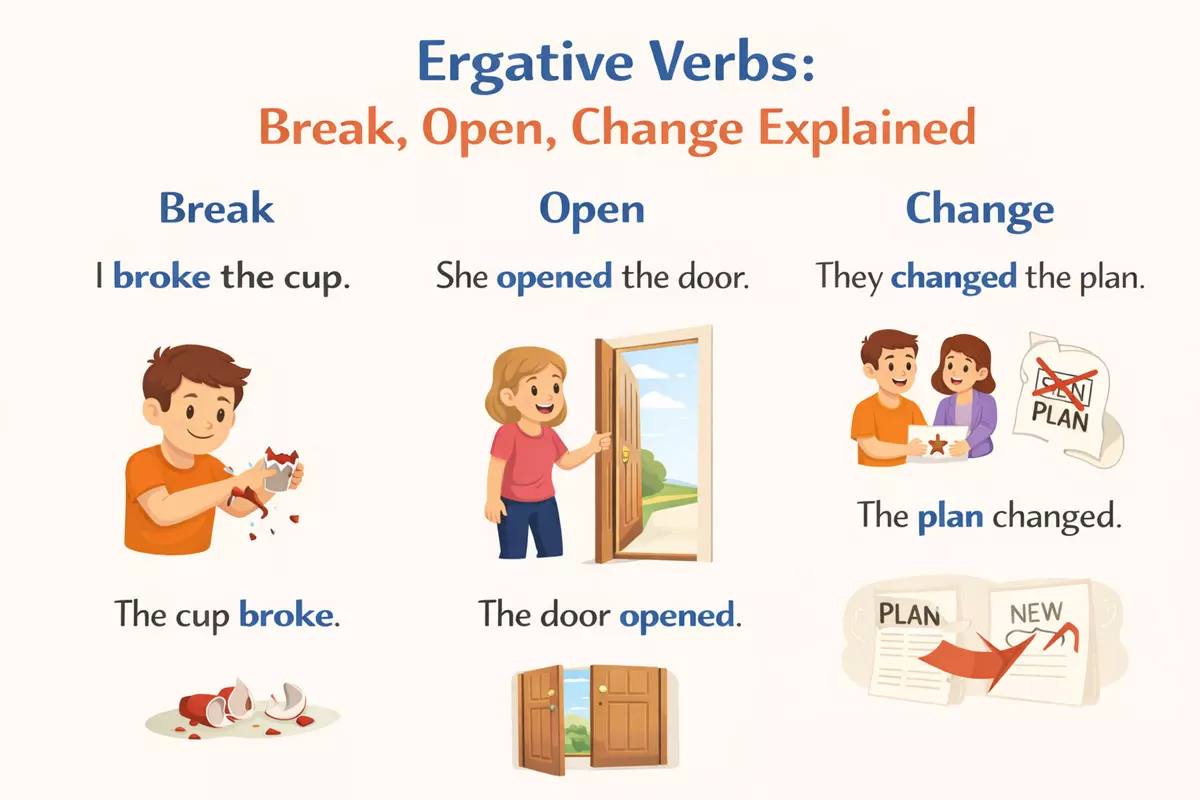 The article defines ergative verbs, shows how they work with or without agents, and gives common examples. It also explains their active and passive-like meanings, differences from regular transitive verbs, typical mistakes, and provides practice exercises.
Certain English verbs display unique behavior, enabling the subject to either perform or experience an action without altering the verb’s form. For example, verbs like break, open, and change can be used both transitively and intransitively, as in "She broke the glass" and "The glass broke." Recognizing how these verbs function in different contexts helps reveal interesting patterns in English and can improve both comprehension and expression for language learners.
What ergative verbs are
Certain English verbs can be used in two different ways: with a direct object (transitive) or without one (intransitive), while still referring to the same event. These are known as ergative verbs. The action described by the verb can happen to the subject, or the subject can cause the action to happen to something else. This property makes ergative verbs especially flexible, and they often appear in everyday conversation.
For example, consider the verb "break." You can say, "I broke the glass" (where "I" causes the action), or "The glass broke" (where the glass undergoes the action itself). In both sentences, the event is the same, but the focus shifts depending on whether the subject is the agent (the one doing the action) or the patient (the one experiencing it).
Key characteristics of ergative verbs
- They permit both transitive and intransitive uses with a similar meaning.
- The object of the transitive form becomes the subject in the intransitive form.
- They often describe changes of state or events happening to things.
- Not all verbs in English have this property; it’s a specific subset.
Common examples of ergative verbs
- Break: The window broke. / She broke the window.
- Open: The door opened. / He opened the door.
- Change: The weather changed. / The storm changed the weather.
- Close: The shop closed. / They closed the shop.
- Boil: The water boiled. / I boiled the water.
- Burn: The toast burned. / He burned the toast.
- Start: The car started. / She started the car.
- Increase: Prices increased. / They increased prices.
- Sink: The ship sank. / The iceberg sank the ship.
- Melt: The ice melted. / The sun melted the ice.
- Drop: Sales dropped. / They dropped sales.
- Grow: The plant grew. / She grew the plant.
- Spread: The rumor spread. / Someone spread the rumor.
- Roll: The ball rolled. / John rolled the ball.
- Move: The chair moved. / He moved the chair.
- Shut: The door shut. / She shut the door.
- Turn: The page turned. / He turned the page.
- Fade: The colors faded. / The sun faded the colors.
- Split: The log split. / He split the log.
How ergative verbs work
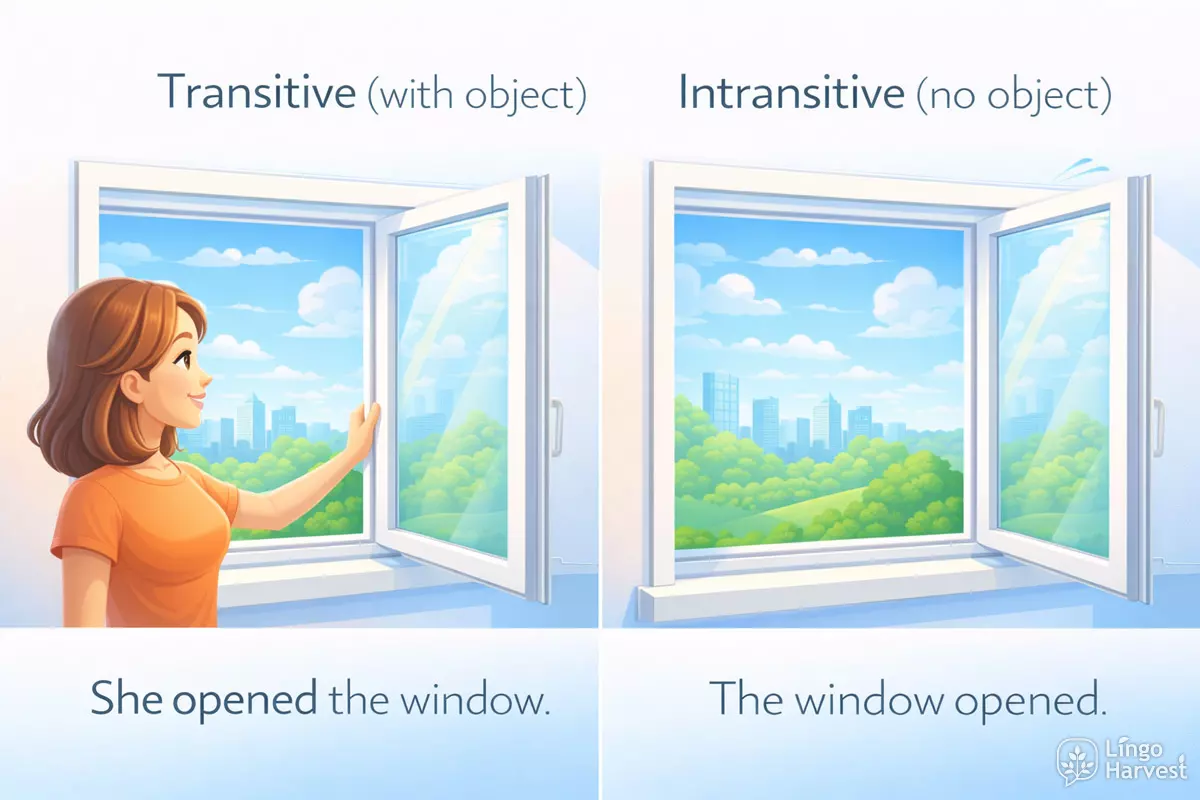
To see how these verbs function, it helps to compare their transitive and intransitive forms side by side:
| Transitive (with object) | Intransitive / Ergative | Meaning focus (process vs cause) |
|---|---|---|
| She opened the window. | The window opened. | Cause vs result: who did it vs what happened. |
| He broke the vase. | The vase broke. | Cause vs result; agent omitted in ergative. |
| The chef boiled the eggs. | The eggs boiled. | Intentional action vs natural process. |
| They started the meeting. | The meeting started. | Human decision vs event beginning. |
| We closed the shop. | The shop closed. | Action by people vs state change. |
| The company increased salaries. | Salaries increased significantly. | Deliberate policy vs observable outcome. |
| The storm sank several boats. | Several boats sank during the storm. | External cause vs resulting event. |
| The technician restarted the system. | The system restarted automatically. | Human intervention vs self-initiated process. |
| The reforms stabilized the economy. | The economy stabilized after the reforms. | Cause highlighted vs gradual process. |
| The delay frustrated the passengers. | The passengers became frustrated. | Direct cause vs resulting emotional state. |
Notice in each pair how the object of the transitive sentence appears as the subject in the intransitive version. This pattern is a hallmark of ergative verbs and distinguishes them from verbs that do not allow this alternation.
How ergative verbs work without agents
Ergative verbs let actions happen without clearly stating who or what caused them. In English, these verbs can show that something changes or happens by itself, without an obvious agent or doer. For example, when we say, “The window broke,” there’s no need to mention who or what broke it—the verb structure does not require it. This is different from most transitive verbs, which usually need a subject or agent to perform the action.
Common patterns for agentless ergative verbs
Many ergative verbs describe changes of state, appearance, or condition. The focus is on the result, not the cause. Here are some situations where these verbs are used without mentioning an agent:
- Describing sudden changes: “The ice melted.”
- Reporting unexpected events: “The door opened.”
- Talking about natural processes: “The leaves changed.”
- Noting accidental results: “The vase broke.”
- Observing automatic reactions: “The alarm sounded.”
- Reporting passive changes: “The cake burned.”
- Describing self-initiated actions: “The flower bloomed.”
- Indicating spontaneous movement: “The ball rolled.”
- Noting mechanical changes: “The machine stopped.”
- Describing gradual transformation: “The paint faded.”
- Reporting shifts in state: “The sky darkened.”
- Observing physical alterations: “The metal bent.”
- Describing involuntary occurrences: “The light flickered.”
- Noting environmental effects: “The river froze.”
- Reporting unplanned events: “The tire deflated.”
Agentless ergative vs. passive voice
At advanced levels, the difference between ergative and passive constructions is not just grammatical but semantic. Ergative structures focus on the result or process itself, while passive forms often imply an external cause, even when the agent is not stated.
| Ergative Construction | Passive Construction | Meaning Difference |
|---|---|---|
| The system rebooted unexpectedly. | The system was rebooted unexpectedly. | Ergative suggests an internal or automatic process; passive implies outside intervention. |
| Prices dropped overnight. | Prices were dropped overnight. | Ergative sounds natural for market movement; passive suggests deliberate action. |
| The negotiations collapsed. | The negotiations were collapsed. | Only ergative is idiomatic; passive sounds unnatural. |
| The schedule shifted slightly. | The schedule was shifted slightly. | Ergative focuses on outcome; passive highlights human decision. |
| The software updated overnight. | The software was updated overnight. | Ergative implies automation; passive implies someone performed the update. |
| The agreement expired last month. | The agreement was expired last month. | Passive is incorrect here; expiration is not an action performed by an agent. |
| The economy stabilized after the reforms. | The economy was stabilized after the reforms. | Ergative stresses gradual change; passive highlights government action. |
| The connection dropped during the call. | The connection was dropped during the call. | Ergative suggests technical failure; passive implies intentional disconnection. |
| The situation escalated quickly. | The situation was escalated quickly. | Ergative is natural; passive implies someone caused escalation. |
| The issue resolved itself. | The issue was resolved. | Ergative emphasizes self-resolution; passive leaves cause unspecified. |
Notice that ergative verbs naturally allow for agentless statements, making them useful when the agent is unknown, irrelevant, or simply not the focus. This aspect helps keep sentences concise and highlights the change or result itself.
Common ergative verb examples
Many English verbs can be used in both transitive and intransitive ways, which is what makes them ergative. This means the verb can describe an action happening to something by itself, or the same action being done to it by someone. Understanding which verbs work this way helps with clearer, more natural expression.
Frequent ergative verbs in English
Some verbs are especially common in this category. Here’s a list of verbs that frequently appear in both forms:
- Break (The window broke. / I broke the window.)
- Open (The door opened. / She opened the door.)
- Change (The weather changed. / We changed the plan.)
- Close (The shop closed. / They closed the shop.)
- Start (The show started. / He started the show.)
- Stop (The car stopped. / She stopped the car.)
- Grow (The flowers grew. / She grew flowers.)
- Increase (Prices increased. / They increased the prices.)
- Boil (The water boiled. / He boiled the water.)
- Sink (The boat sank. / They sank the boat.)
- Spread (The rumor spread. / Someone spread the rumor.)
- Roll (The ball rolled. / He rolled the ball.)
- Rotate (The wheel rotated. / She rotated the wheel.)
- Move (The chair moved. / He moved the chair.)
- Turn (The page turned. / She turned the page.)
- Drop (The glass dropped. / He dropped the glass.)
- Dry (The clothes dried. / She dried the clothes.)
- Melt (The ice melted. / The sun melted the ice.)
- Finish (The meal finished. / We finished the meal.)
Comparing ergative and non-ergative use
These verbs allow for a shift in focus between the subject and object. Notice how the meaning stays connected, but the agent (person doing the action) can be stated or left out.
| Intransitive (No Agent) | Transitive (With Agent) |
|---|---|
| The window broke. | He broke the window. |
| The door opened. | She opened the door. |
| The milk boiled. | I boiled the milk. |
| The flowers grew. | They grew flowers. |
| The boat sank. | Someone sank the boat. |
These patterns are especially useful for describing situations where the cause is unknown or unimportant, or when you want to emphasize the result rather than the action itself. Recognizing this flexibility can improve both your understanding and your use of English verbs.
Active and passive-like meanings
Ergative verbs such as break, open, and change are interesting because they can express both an action someone does and a result that simply happens. In English, this means a single verb can be used in two different structures: one that emphasizes who or what causes the action (active), and one that focuses on the state or result (passive-like), without needing a separate passive construction.
How ergative verbs shift between meanings
With ergative verbs, you can often use the same verb in either a transitive way (with a clear subject doing the action) or an intransitive way (where the thing affected is the subject and the cause is unknown or unimportant). This gives the effect of a passive voice, but grammatically, it’s not the same as the standard passive form.
| Transitive (Agent does it) | Intransitive (Result happens) |
|---|---|
| She broke the vase. | The vase broke. |
| They opened the door. | The door opened. |
| He changed the schedule. | The schedule changed. |
| Someone melted the ice. | The ice melted. |
| The chef boiled the water. | The water boiled. |
| We sank the boat. | The boat sank. |
| The wind shook the tree. | The tree shook. |
| She dropped the glass. | The glass dropped. |
| They split the log. | The log split. |
| He rolled the ball. | The ball rolled. |
Summary of usage
The examples above show how ergative verbs allow you to shift focus. If you want to mention who or what caused the action, you use the “agent” in a standard subject position. If you want to highlight just the event or result, you can use the intransitive form, sounding much like a passive. This makes sentences more flexible and efficient, especially when the cause is unknown or irrelevant.
- Transitive: Emphasizes the actor (agent) and the thing affected.
- Intransitive: Emphasizes the event or result, omitting the agent.
- This pattern is common with verbs describing change, movement, or transformation.
Not all verbs in English behave this way, but with ergative verbs, this active/result structure is a core feature. Recognizing and using these patterns can make your English sound more natural and concise.
Differences from regular transitive verbs
Ergative verbs have a unique property in English: they can be used both transitively and intransitively, with the object of the transitive use becoming the subject of the intransitive use. This sets them apart from standard transitive verbs, which always require a direct object and do not work without one. The meaning of the action often shifts subtly depending on how the verb is used.
How ergative verbs behave
With ergative verbs, the same event can be described from two perspectives—one that highlights the agent (the person or thing causing the action) and another that focuses on the experience or result. Take the verb "break": you can say "She broke the glass" (transitive: someone does the breaking) and "The glass broke" (intransitive: the glass undergoes the action, no agent mentioned). Regular transitive verbs do not allow this flexibility.
Typical patterns with ergative verbs
- The object in the transitive pattern becomes the subject in the intransitive pattern.
- The meaning remains closely related, but the focus shifts from the doer to the affected item.
- No passive construction is needed to express the intransitive meaning.
- Not all verbs can be used this way—many common action verbs are strictly transitive or intransitive.
Comparison: Ergative vs. Regular Transitive Verbs
| Verb Type | Active (with agent) | Intransitive Result | Explanation |
|---|---|---|---|
| Ergative | She opened the door. | The door opened. | The object can become the subject without a passive form. |
| Ergative | They changed the schedule. | The schedule changed. | The action affects the object, which can act as subject. |
| Ergative | He broke the vase. | The vase broke. | No agent is required in the intransitive version. |
| Ergative | We melted the butter. | The butter melted. | The process can happen without mentioning who caused it. |
| Regular transitive | She kicked the ball. | — | The verb requires an agent; the object cannot become the subject. |
| Regular transitive | He built a house. | — | The action cannot happen without a doer. |
| Regular transitive | She read the book. | — | No natural intransitive counterpart exists. |
| Regular transitive | They painted the wall. | — | Only passive voice is possible, not a middle or ergative form. |
Common ergative verbs in English (with usage notes)

- break → The glass broke. (sounds natural)
- open → The window opened slowly. (sounds natural)
- change → The schedule changed unexpectedly. (sounds natural)
- melt → The butter melted quickly. (sounds natural)
- close → The door closed behind him. (sounds natural)
- start → The engine started immediately. (sounds natural)
- stop → The car stopped suddenly. (sounds natural)
- grow → The flowers grew fast. (sounds natural)
- increase → Prices increased overnight. (sounds natural)
- decrease → The temperature decreased rapidly. (sounds natural)
- split → The wood split easily. (sounds natural)
- sink → The ship sank during the storm. (sounds natural)
- boil → The water boiled after a few minutes. (sounds natural)
- dry → The clothes dried in the sun. (sounds natural)
- turn → The handle turned smoothly. (sounds natural)
- shut → The gate shut automatically. (sounds natural)
- freeze → The lake froze overnight. (sounds natural)
- move → The table moved easily. (sounds natural)
- drop → The phone dropped on the floor. (sounds odd – usually “fell”)
- finish → The project finished yesterday. (sounds slightly odd – passive preferred)
In summary, ergative verbs allow more flexibility in sentence construction, making it possible to express the same event from different viewpoints without changing the verb itself. Regular transitive verbs, in contrast, require an object and cannot naturally switch to an intransitive use. This distinction is central to understanding how verbs like "break," "open," and "change" function in English.
Practice: Ergative or Not?
Decide whether each sentence sounds natural. If it sounds odd, rewrite it in a more natural way.
- The glass broke during the night.
- The report finished at noon.
- The door opened suddenly.
- The phone dropped out of his pocket.
- The soup boiled for ten minutes.
- The meeting started late.
- The table moved when I pushed it.
- The book opened on the wrong page.
Show answers
- Natural.
- Sounds odd → The report was finished at noon.
- Natural.
- Sounds odd → The phone fell out of his pocket.
- Natural.
- Natural.
- Natural.
- Natural.
Typical confusion and mistakes
Learners often stumble when using verbs like "break," "open," and "change" because these words can function both transitively and intransitively without any change in form. This flexibility creates uncertainty about when an object is needed, and sometimes leads to sentences that sound odd or are simply incorrect.
Common misunderstandings with ergative verbs
- Forgetting the subject/object swap: Many confuse who or what is performing the action when the verb shifts from transitive to intransitive.
- Adding unnecessary objects: Some try to force an object when the verb doesn’t require one in its intransitive use.
- Assuming passive is needed: Learners sometimes create awkward passive structures instead of using the simple intransitive form.
- Overusing reflexive pronouns: It’s common to see "The door opened itself" instead of the more natural "The door opened."
- Mixing up agent and patient roles: The cause of the action (agent) and the receiver (patient) are sometimes reversed by mistake.
- Incorrect tense matching: Using the wrong tense or aspect can make the meaning unclear, especially in sequences of actions with ergative verbs.
- Confusing ergative verbs with strictly transitive or intransitive verbs: Not all verbs can be used both ways, but some learners generalize the pattern too broadly.
- Word order errors: Especially in questions or negative sentences, the placement of the verb and its arguments can go wrong.
- Translation interference: Directly translating from a first language may result in unnatural or incorrect English structures.
- Unnecessary prepositions: Adding "by" or "with" where the ergative structure is already clear can muddle the sentence.
Transitive vs. Intransitive uses: a comparison
| Transitive (someone causes the action) | Intransitive (the change happens) |
|---|---|
| The company increased salaries last year. | Salaries increased significantly last year. |
| The storm sank several fishing boats. | Several fishing boats sank during the storm. |
| The technician restarted the system. | The system restarted automatically. |
| They expanded the business overseas. | The business expanded rapidly overseas. |
| The heat dried the paint too quickly. | The paint dried unevenly. |
| The manager postponed the meeting. | The meeting postponed until next week. |
| The chef thickened the sauce with flour. | The sauce thickened as it cooled. |
| The accident delayed the train. | The train delayed for over an hour. |
| The government stabilized the economy. | The economy stabilized after the reforms. |
| The sudden noise awakened the child. | The child awakened suddenly. |
Tips to avoid mix-ups
- Ask yourself: Does the verb need an object? If not, it’s likely intransitive here.
- Practice switching between forms to get comfortable with both patterns.
- Listen for natural examples in context—native speakers rarely use reflexive forms with these verbs.
- Check if the sentence still makes sense when you remove the agent.
By being aware of these common issues and reviewing real examples, you can become much more confident using verbs like "break," "open," or "change" smoothly and naturally in both forms.
Using ergative verbs in context
Understanding how to apply ergative verbs like "break," "open," and "change" in actual sentences is key for clear communication. These verbs are unique because they can be used both transitively (with a direct object) and intransitively (without one), often with a shift in focus from the agent to the object itself. Let’s look at how this works in real-world situations.
Common Patterns with Ergative Verbs
Ergative verbs adapt to different sentence structures. Here are some patterns you’ll often see:
- Transitive: Someone performs the action on something.
Example: She broke the glass. - Intransitive: The object undergoes the action, often on its own.
Example: The glass broke. - Passive voice: The focus is on the object, and the agent may be omitted.
Example: The door was opened.
Examples of Ergative Verbs in Everyday Use
These verbs are common in English. Here are some examples showing both forms:
- The door opened slowly. (intransitive)
- She opened the door. (transitive)
- The window broke during the storm. (intransitive)
- He broke the window. (transitive)
- The lights changed to green. (intransitive)
- The officer changed the lights. (transitive)
- The book sold well. (intransitive)
- They sold the book online. (transitive)
- The cake burned. (intransitive)
- She burned the cake. (transitive)
- The meeting started late. (intransitive)
- We started the meeting. (transitive)
- The engine stopped. (intransitive)
- He stopped the engine. (transitive)
- The soup boiled quickly. (intransitive)
- She boiled the soup. (transitive)
- The picture fell. (intransitive)
- He fell the tree. (rare, but possible in some dialects)
Comparing Ergative and Non-Ergative Verbs
Some verbs can’t be used in both ways. Here’s a table comparing flexible ergative verbs with those that are not ergative:
| Ergative Verb | Non-Ergative Verb |
|---|---|
| break The vase broke. She broke the vase. |
eat The cake was eaten. (No: "The cake ate.") |
| open The shop opened. They opened the shop. |
kick The ball was kicked. (No: "The ball kicked.") |
| change The rules changed. We changed the rules. |
build The house was built. (No: "The house built.") |
| start The movie started. He started the movie. |
drive The car was driven. (No: "The car drove.") |
Tips for Natural Usage
- When you want to focus on the event or result, use the intransitive form: "The window broke suddenly."
- If you need to show who caused the action, use the transitive form: "The child broke the window."
- Check if the verb can be used ergatively—some verbs don’t allow this flexibility.
- Pay attention to context: formal writing may prefer passive or intransitive forms for objectivity.
Mastering these patterns will make your English more flexible and precise, whether you’re describing events or actions done by someone.
Practice exercises on ergative verbs
Understanding how ergative verbs work can be much easier with hands-on practice. Below, you'll find a range of exercises and activities to help you recognize and use verbs like "break," "open," and "change" correctly in both transitive and intransitive forms. These tasks are designed to reinforce the patterns and logic behind ergative usage in English.
Identify the verb pattern
Read each sentence and decide whether the verb is used transitively (with a direct object) or intransitively (the subject undergoes the action). Write "T" for transitive and "I" for intransitive.
- The window broke during the storm.
- She broke the vase accidentally.
- The door opened slowly.
- He opened the box carefully.
- The weather changed suddenly.
- They changed the rules last year.
- The engine started without warning.
- The technician started the engine.
- Prices increased overnight.
- The company increased prices overnight.
Show answers
- Intransitive
- Transitive
- Intransitive
- Transitive
- Intransitive
- Transitive
- Intransitive
- Transitive
- Intransitive
- Transitive
Transform the sentences
Rewrite each sentence so that the subject and object switch roles where possible, changing from transitive to intransitive or vice versa. Make sure the sentence still makes sense and is grammatically correct.
- Someone opened the window.
- The glass broke.
- They changed the schedule.
- The lock opened easily.
- The manager delayed the meeting.
- The system restarted automatically.
- Someone melted the ice.
- The door shut suddenly.
- The company expanded the business.
- The ship sank during the storm.
Show answers
- The window opened.
- Someone broke the glass.
- The schedule changed.
- Someone opened the lock easily.
- The meeting delayed.
- Someone restarted the system.
- The ice melted.
- Someone shut the door suddenly.
- The business expanded.
- The storm sank the ship.
Common ergative verbs: quick reference
Here is a table showing several ergative verbs with examples in both transitive and intransitive uses. Notice how the subject and object can switch places depending on the structure.
| Verb | Transitive Example | Intransitive Example |
|---|---|---|
| break | She broke the pencil. | The pencil broke. |
| open | He opened the gate. | The gate opened. |
| change | They changed the time. | The time changed. |
| melt | The sun melted the ice. | The ice melted. |
| shrink | She shrank the sweater. | The sweater shrank. |
| sink | The storm sank the boat. | The boat sank. |
| increase | The company increased prices. | Prices increased. |
| grow | They grew tomatoes. | Tomatoes grew. |
| boil | She boiled the water. | The water boiled. |
| freeze | The cold froze the lake. | The lake froze. |
Fill in the blanks
Choose the correct form of the verb (transitive or intransitive) to complete each sentence.
- The ice ________ (melt) quickly in the sun.
- He ________ (melt) the chocolate for the cake.
- The prices ________ (increase) last week.
- The manager ________ (increase) the salary for everyone.
- The shirt ________ (shrink) in the wash.
- She ________ (shrink) her favorite sweater by accident.
- The door ________ (close) suddenly because of the wind.
- He ________ (close) the shop earlier than usual.
- The engine ________ (start) on its own.
- The mechanic ________ (start) the engine after the repair.
Show answers
- melted
- melted
- increased
- increased
- shrank
- shrank
- closed
- closed
- started
- started
By practicing these patterns and recognizing when verbs can be used in an ergative way, you’ll gain confidence and flexibility in your English usage. Keep experimenting with new sentences using the verbs from the table above to deepen your understanding.