Middle Voice Constructions in Modern English

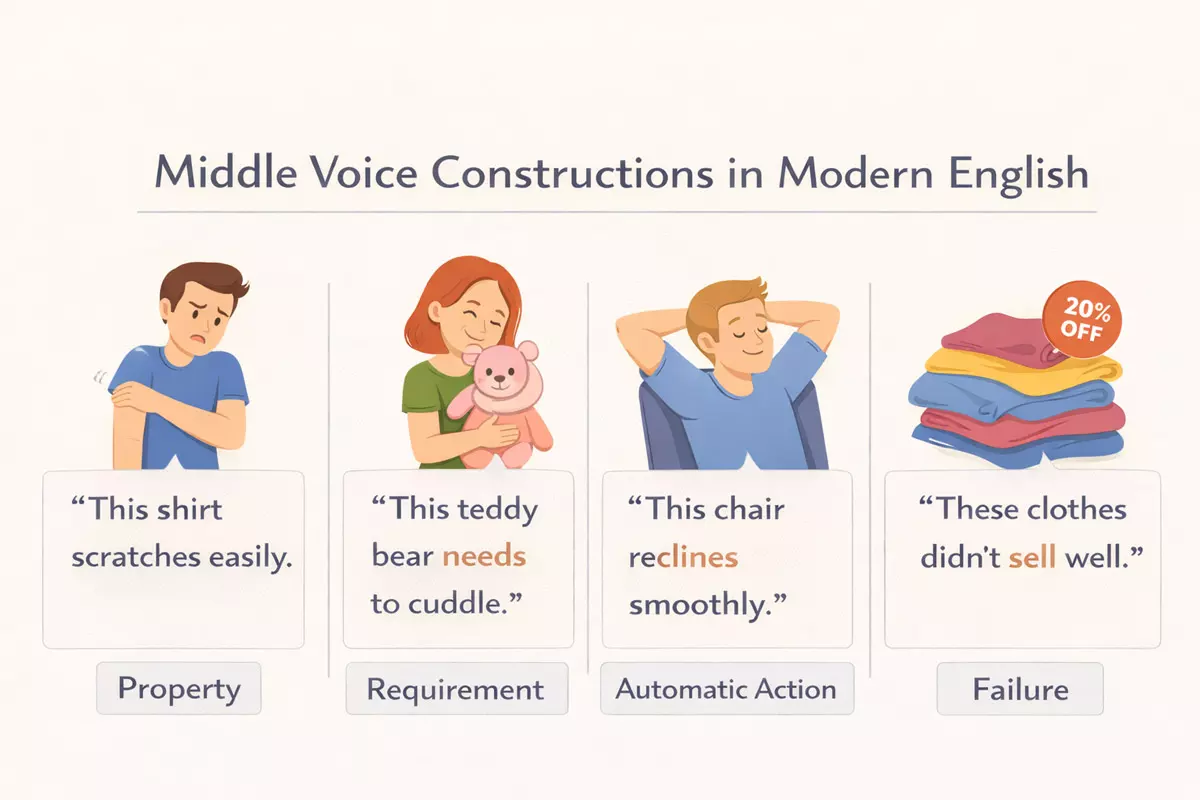 Here we what the middle voice is in English, how to form middle constructions, and which verbs are commonly used.
While English typically emphasizes clear active or passive constructions, there are instances where actions seem to occur without specifying who is responsible. These subtle sentence forms allow speakers to describe events that appear to happen by themselves, such as when objects break or situations change unexpectedly. By using structures like the middle voice or certain passive forms, English speakers can express occurrences in a way that focuses on the action or result rather than on the agent, adding nuance and flexibility to the language.
What middle voice means in English
The concept of "middle voice" describes sentences where the subject is both acting and receiving the action, or where the action happens to the subject in a way that blurs the line between active and passive. Unlike the clear-cut active (She broke the vase) or passive (The vase was broken by her) forms, the middle voice often appears when the subject experiences an action that seems to happen by itself, or where the agent is not important or omitted.
How the Middle Voice Appears in Modern English
Although English doesn't have a dedicated middle voice verb form like some other languages, it expresses this meaning through certain constructions. These usually involve verbs that can be used transitively (with an object) and intransitively (without an object), but with a subtle shift in meaning. For example, in This book sells well, nobody explicitly does the selling; the book’s ability to be sold is emphasized, not the seller.
- Wash: This shirt washes easily.
- Break: Glass breaks quickly.
- Read: The novel reads smoothly.
- Cook: Rice cooks fast.
- Drive: This car drives well.
- Open: The door opens quietly.
- Close: The window closes tightly.
- Peel: Oranges peel easily.
- Freeze: Ice cream freezes solid.
- Fold: This paper folds neatly.
- Write: The pen writes smoothly.
- Blend: Soup blends nicely.
- Lock: The door locks automatically.
- Cut: The cake cuts easily.
- Melt: Chocolate melts quickly.
- Start: The engine starts instantly.
- End: The story ends happily.
Comparing Voice Types in English
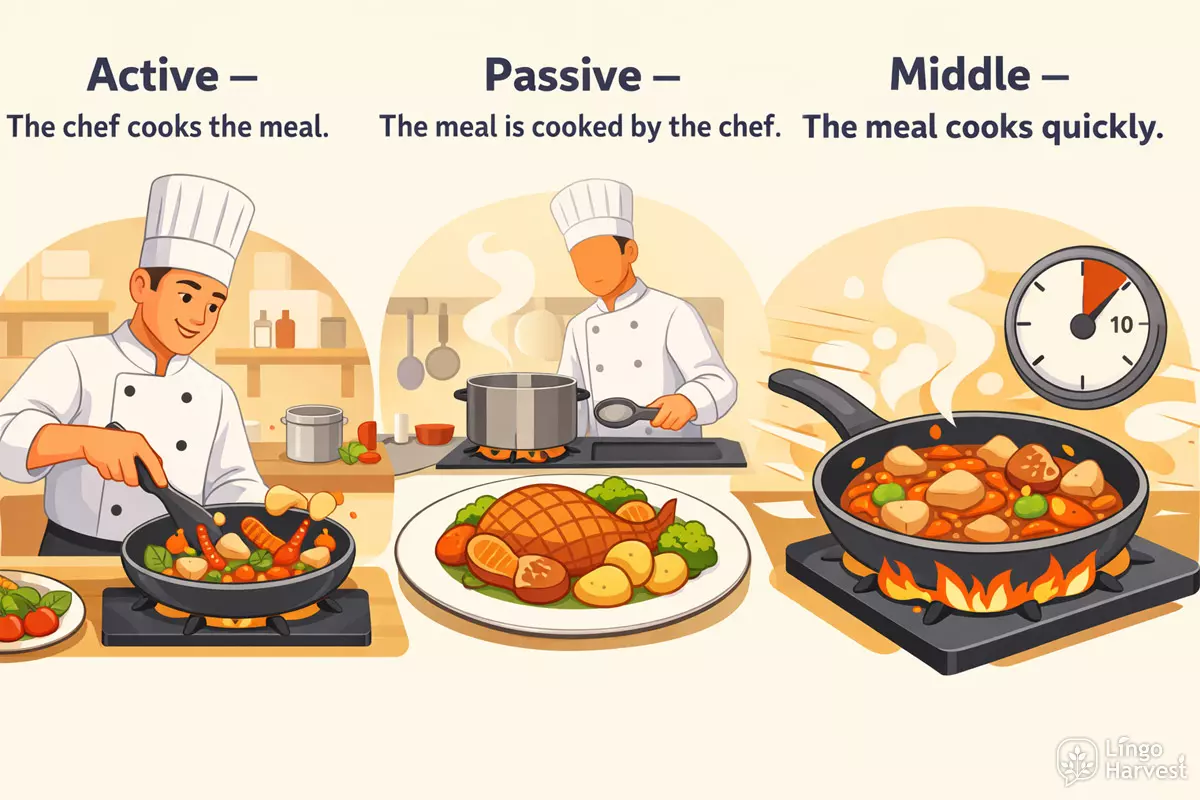
Understanding the difference between active, passive, and middle voice helps clarify how English organizes agency and focus in sentences. The table below highlights the distinctions using example sentences:
| Voice Type | Example | Agent Mentioned? |
|---|---|---|
| Active | The chef cooks the meal. | Yes (explicit subject) |
| She opened the window. | ||
| They repaired the road. | ||
| Passive | The meal is cooked by the chef. | Optional (by-phrase) |
| The window was opened. | No (agent omitted) | |
| The road is being repaired. | ||
| The letter has been sent. | ||
| Middle | The meal cooks quickly. | No (no agent possible) |
| This book reads easily. | ||
| The door closes smoothly. | ||
| The shirt washes well. |
In summary, middle voice constructions in English highlight situations where actions seem to happen to the subject naturally or effortlessly, without specifying who is responsible. This pattern is especially common with verbs relating to qualities, usability, or inherent properties of objects.
How middle constructions are formed
Middle voice sentences in English typically involve a transitive verb and a subject that is both the “logical object” (the thing affected) and the grammatical subject. The process for building these structures often relies on careful verb selection, appropriate use of adverbs, and sometimes passive-like syntax—but without using the passive voice. Instead, the focus is on the subject’s capacity or tendency to undergo an action, rather than on who performs the action.
Typical patterns and requirements
Not every verb can appear naturally in a middle construction. The verb must allow for a reading where the subject is understood as the entity being affected, and the sentence should make sense without specifying an agent (the doer). In many cases, adverbs or modal verbs (like “easily,” “well,” or “can”) are added to make the construction sound natural and grammatical.
- Transitive verb is required (e.g., “cut,” “break,” “sell,” “read”).
- The subject refers to the entity affected by the action, not the doer.
- An explicit agent (the person who acts) is omitted.
- Adverbs such as “easily,” “quickly,” or “well” often help the sentence sound natural.
- Sentences usually describe general properties, habits, or tendencies.
- The verb is typically in the simple present tense.
- Objects that are concrete or familiar work best as subjects.
- Some verbs resist this construction due to semantics or idiomatic usage.
- Middle constructions rarely work with stative verbs (like “know” or “love”).
- Negative forms are possible, but less common (e.g., “This book doesn’t read easily”).
- Modal verbs can be used to express possibility or ability (e.g., “can be washed”).
- Pronouns as subjects are possible but less frequent (“It washes well”).
- Plural and singular subjects are both used.
- Sometimes, context or world knowledge is needed to interpret the meaning.
Examples of middle voice patterns
Here are some common examples that illustrate how this structure works in practice:
- This shirt washes easily.
- The book reads quickly.
- That car drives smoothly.
- These apples peel well.
- Glass breaks easily.
- Cake cuts neatly.
- This sofa folds out.
- Cheap pens leak frequently.
- Plastic melts at high temperatures.
- Her handwriting copies poorly.
- This suitcase carries comfortably.
- Some fabrics iron badly.
- That software installs quickly.
- Frozen bread slices unevenly.
- The door locks automatically.
Comparing active, middle, and passive forms
To highlight the structure, here’s a comparison of similar meanings expressed in active, middle, and passive forms:
| Active | Middle | Passive |
|---|---|---|
| Someone washes this shirt easily. | This shirt washes easily. | This shirt is easily washed (by someone). |
| She reads the book quickly. | The book reads quickly. | The book is read quickly (by her). |
| The chef cuts the cake neatly. | Cake cuts neatly. | The cake is cut neatly (by the chef). |
| They drive the car smoothly. | The car drives smoothly. | The car is driven smoothly (by them). |
| People peel these apples easily. | These apples peel well. | These apples are easily peeled (by people). |
In summary, constructing the middle voice in English hinges on verb choice, subject selection, and often the presence of adverbs to achieve a sentence that sounds idiomatic and natural. While not all verbs or objects allow for this pattern, when used appropriately, middle constructions offer a concise way to describe general characteristics or tendencies without mentioning the agent.
Common verbs used in middle voice
In modern English, certain verbs are particularly well-suited to middle voice constructions, where the subject appears both as the agent and the experiencer or patient of the action. These verbs often describe actions that happen to the subject without direct external agency, or where the distinction between active and passive is blurred. The result is a sentence that feels neutral or self-affected, such as “This book reads easily” or “The shirt irons well.”
Typical verbs in middle constructions
Verbs that express change of state, inherent properties, or habitual actions are the most frequent candidates for this usage. Here’s a list of verbs commonly found in these patterns:
- sell (“These cars sell quickly.”)
- read (“The novel reads smoothly.”)
- cook (“Rice cooks fast.”)
- open (“The door opens easily.”)
- close (“The window closes quietly.”)
- wash (“This fabric washes well.”)
- iron (“The shirt irons easily.”)
- break (“Glass breaks easily.”)
- drive (“This truck drives smoothly.”)
- write (“The pen writes nicely.”)
- translate (“The text translates poorly.”)
- photograph (“She photographs beautifully.”)
- fold (“The paper folds neatly.”)
- tear (“The paper tears easily.”)
- blend (“The colors blend well.”)
- store (“The fruit stores well.”)
- peel (“Oranges peel easily.”)
- freeze (“Berries freeze quickly.”)
- assemble (“The furniture assembles easily.”)
Patterns and nuances
Middle voice use often requires the verb to be intransitive in context, and the subject typically refers to an object or substance rather than a person. Adverbs such as “easily,” “well,” or “quickly” frequently accompany these verbs, highlighting the manner or quality of the process. Not all verbs accept this construction, and some may sound odd or ungrammatical if forced into it.
| Verb | Example in Middle Construction | Typical Context |
|---|---|---|
| sell | This model sells well. | Products, goods |
| read | The story reads quickly. | Books, articles |
| wash | The dress washes easily. | Clothing, materials |
| break | Thin glass breaks easily. | Fragile items |
| open | The box opens smoothly. | Containers, doors |
| photograph | This landscape photographs beautifully. | People, scenery |
While many verbs resist this structure, those that do allow it provide a concise way to express how something behaves or is experienced, often highlighting qualities important in everyday situations or product descriptions.
Meaning and interpretation of middle forms
Middle voice constructions in contemporary English express situations where the subject appears to undergo an action, yet the agent is either unspecified or irrelevant. These forms often blur the distinction between active and passive usage, highlighting the subject's role as both affected and, in some sense, involved in the action. Rather than focusing on who performs the action, these structures emphasize how easily or typically an action happens to the subject.
One of the most recognizable patterns for this usage is the construction “verb + easily,” as in “This book reads easily.” Here, the sentence does not specify who is doing the reading; instead, it comments on the inherent quality of the book itself. Middle constructions are especially common with verbs relating to experience, usability, or qualities of objects, and they frequently occur in generic or habitual contexts.
Core characteristics
- The subject is typically inanimate or generic (e.g., “The door opens easily”).
- The agent performing the action is not mentioned or is unimportant.
- Sentences often include adverbs like “easily,” “well,” or “quickly.”
- The construction usually conveys a general property or tendency.
- Verbs that describe processes or changes of state are commonly used.
- These forms do not allow agent phrases (unlike passives: “by…”).
- The meaning is often close to “can be V-ed” (e.g., “This shirt washes well” ≈ “This shirt can be washed well”).
- The subject is interpreted as both affected by and somehow involved in the event.
- Middle constructions resist modification by progressive aspect (“*This book is reading easily”).
- They are more natural with some verbs than others, depending on verb meaning and context.
Typical verbs in middle constructions
- read → This book reads easily.
- sell → The tickets sell quickly.
- break → Glass breaks easily.
- wash → This fabric washes well.
- open → The door opens smoothly.
- close → The window closes quietly.
- drive → This car drives comfortably.
- write → This pen writes smoothly.
- cook → Rice cooks quickly in this pot.
- carry → This bag carries easily.
- fold → The table folds neatly.
- lock → The gate locks automatically.
- transport → This material transports easily.
- assemble → The furniture assembles quickly.
- store → These boxes store neatly.
- clean → The surface cleans easily.
- move → The chair moves smoothly.
- repair → The engine repairs easily.
Interpretive nuances
Middle constructions often convey more than just the possibility of an action; they also suggest something about the subject’s qualities or suitability. For instance, “This suitcase carries easily” implies not just that it can be carried, but that it is especially convenient or well-designed for carrying. These forms are rarely used with animate subjects, and when they are, the effect can be humorous or marked. The interpretation depends on both the verb and the broader context, so not every verb can form a natural-sounding middle construction.
Understanding these patterns helps clarify subtle distinctions in meaning and highlights how English speakers use grammar to express agency, affectedness, and qualities of things in everyday communication.
Differences from active and passive
Middle voice constructions occupy a unique position in English grammar, standing apart from both the active and passive forms. While the active voice typically highlights the subject as the doer of the action ("The chef cooked the meal"), and the passive voice emphasizes the recipient or result ("The meal was cooked by the chef"), middle constructions often blur the lines between agent and patient. In these cases, the subject may both perform and undergo the action, or the action may seem to happen "by itself," without a clear external agent.
Key Characteristics of Middle Voice
- The subject usually refers to something affected by the action, but also appears as if it initiates the action.
- Middle constructions often imply general truths or habitual actions, rather than specific events.
- Typical markers include verbs like "cuts," "breaks," "sells," or "reads" in sentences such as "This book reads easily."
- Agent phrases (like "by someone") are generally not used or sound awkward.
- The construction often involves adverbs (e.g., "easily," "quickly") to clarify the middle sense.
- Middle voice is more common with inanimate subjects.
- There is no distinct morphological marker for the middle in English; the form matches the active.
Comparison with Active and Passive Constructions
| Active Voice | Passive Voice | Middle Construction |
|---|---|---|
| The chef slices the bread. | The bread is sliced (by the chef). | This bread slices easily. |
| People speak English worldwide. | English is spoken worldwide. | English speaks well in many settings. |
| She washes the shirt quickly. | The shirt is washed quickly (by her). | This shirt washes quickly. |
| They sell these cars every year. | These cars are sold every year. | These cars sell well. |
Common Verbs in Middle Voice Usage
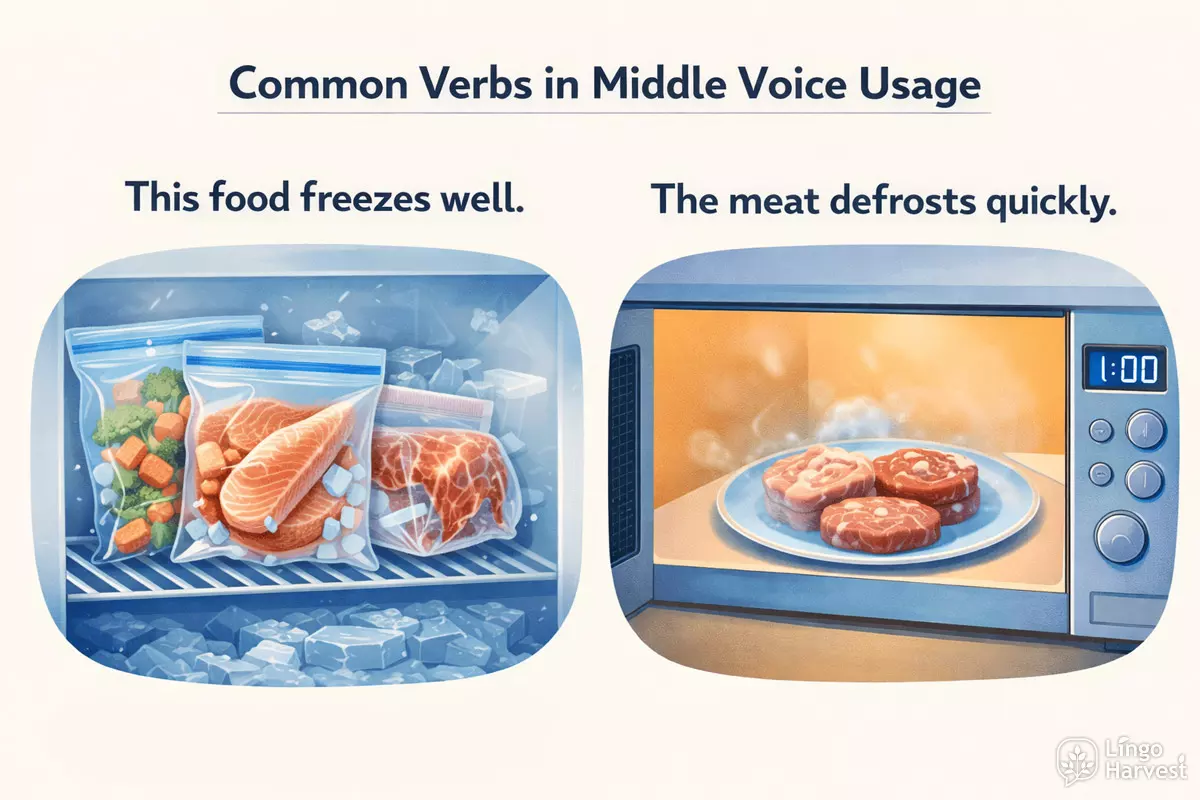
- print → This document prints clearly.
- freeze → This food freezes well.
- defrost → The meat defrosts quickly.
- iron → This shirt irons easily.
- charge → The battery charges fast.
- heat → The soup heats evenly.
- cool → The room cools quickly.
- stretch → This fabric stretches easily.
- shrink → Wool shrinks easily.
- tear → This paper tears easily.
- bend → The wire bends smoothly.
- slide → The drawer slides quietly.
- rotate → The wheel rotates freely.
- balance → The bike balances well.
- grip → The handle grips firmly.
- seal → The lid seals tightly.
- connect → The cable connects easily.
- detach → The cover detaches easily.
Summary of Distinctive Features
Middle forms are best recognized by their blend of active structure with a sense of the subject being both participant and recipient. Unlike the passive, which almost always allows for agent specification, middles rarely do. Unlike the active, the agent is backgrounded or generic, and the construction often describes properties or tendencies rather than specific acts. This makes them especially useful for describing product features, general truths, and habitual actions in English.
Typical learner problems
Understanding how English middle constructions work can be challenging for students, especially for those whose native languages lack an equivalent structure. Learners often confuse middles with passives or actives, both in meaning and in form. This confusion is made worse by the fact that middle constructions use the active voice but have a passive-like sense, which can lead to both comprehension and production errors.
Common areas of confusion
- Identifying when a verb allows for a middle construction (e.g., This book reads easily ✅ vs. This chair sits comfortably ✅ but This soup eats well ❌).
- Mixing up passive and middle forms, especially since English middles often omit the agent and use simple present tense.
- Overusing or underusing adverbs, which are typically required in middle constructions (e.g., This shirt washes quickly ✅ vs. This shirt washes ❌).
- Assuming all transitive verbs can be used in the middle voice, leading to unnatural sentences.
- Translating directly from their first language, resulting in ungrammatical or awkward phrasing.
- Misinterpreting the meaning—mistaking the subject as the agent instead of the patient or theme.
- Forgetting that the subject in a middle construction must be generic, non-specific, or inanimate.
- Forming questions incorrectly (e.g., Does this book read easily? is correct, but learners sometimes attempt, Is this book easily read? in a context where the middle is preferred).
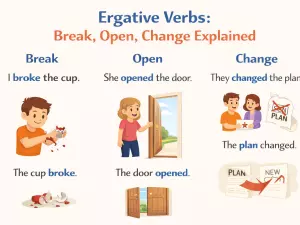
- Confusing middle constructions with ergative or inchoative uses (e.g., The glass breaks easily vs. The glass broke).
- Not recognizing that certain verbs sound odd or are ungrammatical in the middle, even if they’re transitive (e.g., This cake bakes quickly ✅ but This dog walks easily ❌ for the intended meaning).
Comparison of similar structures
| Structure | Example | Typical Use |
|---|---|---|
| Middle construction | This shirt irons easily. | Focus on the subject's property; agentless. |
| Passive voice | This shirt is easily ironed (by anyone). | Emphasizes the action done to the subject; agent is optional. |
| Active voice | People iron this shirt easily. | Agent is explicit; focus on who does the action. |
| Inchoative | The shirt dries quickly. | Describes a change of state, not a performed action. |
Typical error patterns
Mistakes often relate to verb choice, missing adverbs, or incorrect word order. Some learners also overgeneralize the pattern, attempting to use it with verbs that do not naturally allow for middle constructions. Awareness of these pitfalls can help instructors anticipate and address common stumbling blocks.
Middle voice in modern usage
Contemporary English rarely marks the middle voice explicitly, but the concept still shapes how we express actions where the subject is both the agent and the experiencer. Instead of distinct verb forms, speakers rely on certain verb patterns, reflexive constructions, and contextual cues to convey these meanings.
Common patterns expressing middle semantics
While English lacks dedicated middle voice inflections, several common strategies fill this gap. For instance, some verbs naturally describe situations where the subject acts upon itself or is affected by its own action. Here are notable examples:
- Break: The vase breaks easily. (The vase undergoes the action, but no external agent is mentioned.)
- Open: The door opens smoothly.
- Close: This window closes automatically.
- Read: The book reads well.
- Sell: These cars sell quickly.
- Wash: This shirt washes nicely.
- Cook: The rice cooks in twenty minutes.
- Drive: The car drives like a dream.
- Blend: The colors blend beautifully.
- Fold: The table folds flat.
- Assemble: The furniture assembles easily.
- Stretch: The fabric stretches well.
- Peel: The fruit peels easily.
- Change: The policy changes frequently.
- Absorb: The material absorbs water quickly.
Reflexive and pseudo-reflexive constructions
Another way English handles these meanings is through reflexive pronouns, especially when the subject and object are the same. For example:
- She dressed herself.
- He introduced himself.
- The cat cleaned itself.
However, not all reflexive forms are true middles—some simply emphasize agency or deliberate action.
Comparison with active and passive constructions
To clarify how these patterns differ from other voices, consider the following table comparing active, passive, and middle-like uses for select verbs:
| Active | Passive | Middle-like |
|---|---|---|
| She breaks the vase. | The vase is broken (by her). | The vase breaks easily. |
| They open the door. | The door is opened (by them). | The door opens smoothly. |
| We sell the car. | The car is sold (by us). | The car sells quickly. |
| You wash the shirt. | The shirt is washed (by you). | The shirt washes nicely. |
Current trends and stylistic considerations
Writers and speakers often choose middle-like patterns for stylistic reasons—these forms emphasize properties of the subject, rather than the agent. They are especially common in product descriptions ("This phone charges fast"), instructions, and informal conversation. While not all English verbs allow this usage, those that do often describe physical processes, qualities, or habitual actions.
In summary, even though English does not have a dedicated grammatical category for the middle voice, its functions are alive and well through a mix of lexical choices, construction types, and contextual interpretation.
Practice exercises on middle voice constructions
Understanding how the middle voice works in English can help you recognize subtle meanings and improve your writing style. The following activities will help you identify, analyze, and create sentences using this construction. Focus on how the subject and object relate, and pay attention to verbs that typically allow a middle reading.
1. Spot the middle voice
Read each sentence and decide if it uses a middle construction. If yes, identify the verb and explain why.
- The book sells well in the summer.
- She paints the wall every year.
- This shirt washes easily.
- The cake was eaten by the children.
- These shoes wear out quickly.
- This camera handles well in low light.
- They repaired the car yesterday.
- This fabric dries quickly.
- The letter was written by the manager.
- This door opens smoothly.
Show answers
- Yes – "sells"; the book is the subject and undergoes the action.
- No – standard active voice; "she" is the agent.
- Yes – "washes"; the shirt is affected without naming the agent.
- No – passive voice with explicit agent.
- Yes – "wear out"; shoes undergo an implied action.
- Yes – "handles"; the camera behaves in a certain way.
- No – standard active voice; "they" are the agents.
- Yes – "dries"; the fabric undergoes the process naturally.
- No – passive voice with agent mentioned.
- Yes – "opens"; the door undergoes the action without an agent.
2. Rewrite into middle constructions
Rephrase each active sentence so that it uses a middle voice structure, where possible.
- People read this novel every year.
- Someone can break this glass easily.
- People often use this app for editing photos.
- Somebody lost the keys.
- They closed the shop at 6 PM.
- People wash this fabric by hand.
- Someone cleans this surface every day.
- They drive this car very smoothly.
- People store these boxes in the basement.
- Someone opens this window with difficulty.
Show answers
- This novel reads easily every year.
- This glass breaks easily.
- This app does not form a natural middle construction.
- The keys do not lend themselves to a middle construction.
- The shop does not naturally form a middle construction here.
- This fabric washes well by hand.
- This surface cleans easily.
- This car drives smoothly.
- These boxes store easily in the basement.
- This window opens with difficulty.
3. Create your own sentences
Try forming four original middle voice sentences using verbs from the list above. Be sure the subject is the entity affected, not the agent.
Show answers
- This sweater folds neatly.
- The soup cooks quickly.
- That suitcase carries easily.
- The story reads like a fairy tale.
Practicing these patterns will help you recognize and use middle voice forms naturally in your writing and speech. Remember, not all verbs can be used this way—focus on those that describe properties or affordances of the subject.