Subjunctive in Modern English: Forms and Common Uses

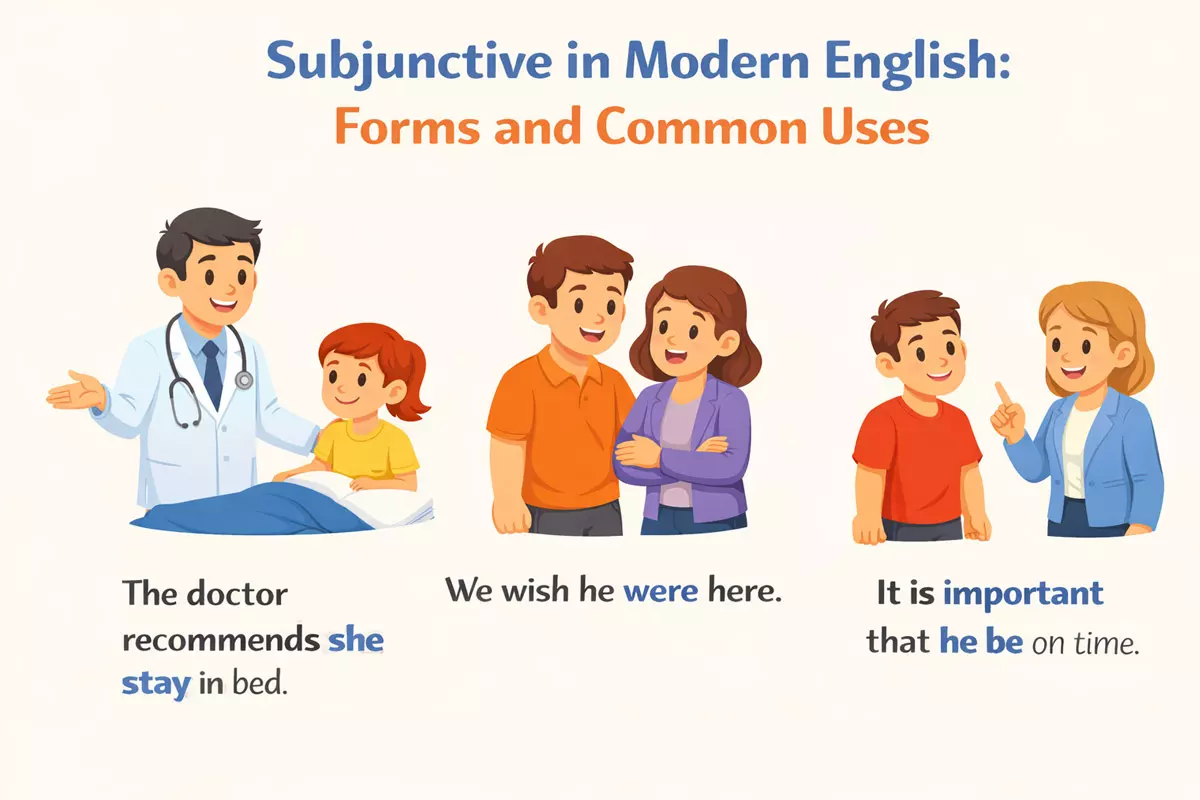 The article details how the subjunctive mood is used in modern English, outlining its presence after certain verbs and in fixed phrases. It also covers how to choose between subjunctive and indicative, typical learner errors, and includes practice tasks.
- What the subjunctive mood means today
- Where the subjunctive is still used
- Mandative subjunctive after key verbs
- Common patterns: suggest, insist, recommend
- Fixed subjunctive phrases in modern English
- Subjunctive vs indicative: choosing the right form
- Typical learner mistakes and corrections
- Homework: subjunctive practice tasks
Expressing wishes, possibilities, or hypothetical situations in English can sometimes be challenging, particularly when it comes to choosing the correct verb forms. Mastering these structures, such as using the past simple after wish to express regrets about the present, or would and could to talk about unreal situations, enables you to communicate more precisely. By understanding how to use these special constructions, you can add subtlety and clarity to your conversations and writing, making your English sound more natural and nuanced.
What the subjunctive mood means today
In contemporary English, the subjunctive form is less common than in earlier stages of the language, but it still plays a key role in expressing wishes, suggestions, hypothetical situations, and formal demands. Most often, it surfaces in certain set phrases or after specific verbs and expressions, giving nuance to statements that are not grounded in actual events but rather in possibility, necessity, or desire.
Contexts Where the Subjunctive Appears
Modern usage of the subjunctive is mostly restricted to a few recognizable scenarios. Here are some of the most frequent:
- After verbs like suggest, recommend, demand, insist, and ask
- In clauses beginning with if to describe unreal or hypothetical conditions (especially with were)
- To express wishes or hopes, often using wish
- Fixed expressions such as God save the King or Be that as it may
- Formal statements requiring necessity or urgency
Recognizing Subjunctive Forms
The subjunctive in modern English often stands out because verbs appear in their base form, regardless of subject. The most noticeable case is with the verb be, which uses be for all subjects in present subjunctive and were for all subjects in unreal past conditions. This can seem odd compared to standard verb agreement.
| Subjunctive Scenario | Example Sentence |
|---|---|
| After suggestions/requests | I suggest that he be on time. |
| Wishes about the present | I wish I were taller. |
| Fixed expressions | Long live the Queen! |
| Hypothetical statements | If she were here, we could start. |
| Formal demands | The judge ordered that he leave the courtroom. |
Common Subjunctive Triggers

- Suggest: "They suggested that she arrive early."
- Insist: "He insisted that the report be finished."
- Demand: "The teacher demanded that he apologize."
- Recommend: "We recommend that she take the test."
- Wish: "I wish it were sunny."
- If clauses (unreal): "If I were you, I’d wait."
- Ask (formally): "They ask that he be notified."
- Order: "She ordered that he go immediately."
- Propose: "He proposed that we start now."
- Fixed phrases: "Be it ever so humble…"
How Native Speakers Use (or Avoid) the Subjunctive
While the subjunctive is still considered correct in formal writing and speech, many speakers use alternative forms in casual conversation. For example, instead of "If I were you," some might say "If I was you," even though this is less traditional. The presence of the subjunctive often marks a sentence as more formal or precise. Still, understanding these patterns helps both learners and native speakers recognize subtle shades of meaning in English communication.
Where the subjunctive is still used
Although the use of the subjunctive mood has declined in everyday English, it remains present in certain formal, fixed, or traditional expressions. Speakers encounter it most often in specific contexts, especially in written or more formal registers. Understanding these situations can help learners and writers use the subjunctive accurately and appropriately.
Common contexts for the subjunctive
The subjunctive typically appears in subordinate clauses that express wishes, demands, suggestions, or hypothetical situations. In these settings, the verb form is often bare (without -s in the third person singular) and does not change for tense.
- After verbs expressing a demand, suggestion, or recommendation (e.g., "insist," "suggest," "recommend")
- In clauses following adjectives that convey necessity or importance (e.g., "essential," "important," "vital")
- With certain set phrases and idiomatic expressions (e.g., "God save the King")
- In hypothetical or contrary-to-fact "if" clauses, though more rarely in modern usage
- After "lest" to express a negative purpose or fear (e.g., "lest he be late")
- In some legal, formal, or archaic language (e.g., "be it resolved")
Typical verbs and adjectives triggering the subjunctive
Many verbs and adjectives naturally lead into clauses that require subjunctive verb forms. Here are some of the most frequent:
- Verbs: ask, demand, insist, propose, recommend, request, suggest, urge
- Adjectives: advisable, crucial, desirable, essential, imperative, important, necessary, obligatory, urgent, vital
Examples of the subjunctive in modern English
| Trigger phrase | Subjunctive example |
|---|---|
| I suggest that | he go to the doctor. |
| It is vital that | she be present. |
| They demanded that | the report be finished by noon. |
| If I were you | I would apologize. |
| Lest | he forget, remind him again. |
| God save | the Queen. |
Fixed expressions and set phrases
Some expressions have preserved the subjunctive due to tradition or formality, even as its use elsewhere has faded. These phrases are common in formal, literary, or fixed idiomatic contexts.
- Long live the king! → Long live the king and his reign.
- God bless you. → God bless you and keep you safe.
- Heaven forbid. → Heaven forbid anything should happen to her.
- Be that as it may. → Be that as it may, we must continue.
- Come what may. → I will stand by you, come what may.
- Suffice it to say. → Suffice it to say, the meeting did not go well.
- So be it. → If that is your final answer, so be it.
- Far be it from me. → Far be it from me to judge your decision.
- If need be. → We can delay the launch, if need be.
- Perish the thought. → Perish the thought that we might fail.
- Truth be told. → Truth be told, I expected a different outcome.
- As it were. → He became, as it were, the voice of reason.
- Peace be with you. → Peace be with you in difficult times.
- God save the King. → God save the King and the nation.
- Be it known. → Be it known that this rule applies to all.
- Be it resolved. → Be it resolved that the proposal is accepted.
- If it please the court. → If it please the court, I will proceed.
- God rest his soul. → God rest his soul; he was deeply respected.
While most native speakers use these constructions without thinking about the underlying mood, recognizing them helps in understanding formal texts and crafting precise, idiomatic English.
Mandative subjunctive after key verbs
One of the most noticeable uses of the subjunctive mood in contemporary English appears after certain verbs that express demands, suggestions, recommendations, or requirements. In these structures, the verb in the that-clause takes the base form, regardless of subject or tense. This construction is often found in formal writing, especially in legal, academic, and official contexts.
Typical verbs introducing the subjunctive
Some verbs frequently followed by a that-clause in the subjunctive include:
- suggest → She suggested that he leave early.
- recommend → The doctor recommended that she take a break.
- insist → He insisted that everyone be present.
- require → The law requires that the form be signed.
- propose → They proposed that the meeting be postponed.
- ask → She asked that he be informed immediately.
- demand → The workers demanded that conditions improve.
- request → He requested that the documents be reviewed.
- urge → The committee urged that action be taken.
- advise → The guide advised that visitors wear comfortable shoes.
- order → The judge ordered that the witness remain silent.
- command → The officer commanded that the troops withdraw.
- stipulate → The contract stipulates that payment be made in advance.
- decree → The king decreed that taxes be lowered.
- move (in meetings) → She moved that the proposal be accepted.
- prefer → I prefer that he stay with us.
- desire → They desired that peace be restored.
- mandate → The policy mandates that all data be protected.
- vote (formal) → The board voted that the plan be approved.
Examples of usage
Mandative constructions usually follow the pattern: verb + that + subject + base form of verb. Here are some common illustrations:
- They insisted that he leave immediately. (not "leaves")
- The committee recommended that the report be revised.
- She suggested that he apply for the position.
- The law requires that every applicant submit proof of identity.
- We ask that you be patient.
- I demand that this stop now.
- He urged that she see a doctor.
- The school stipulates that uniforms be worn by all students.
- The manager proposed that the meeting begin at 9 a.m.
- The judge ordered that the prisoner be released.
Form: Subjunctive vs. Indicative
The table below shows how the base-form subjunctive differs from the regular indicative form after these verbs.
| Subjunctive (base form) | Indicative (normal agreement) |
|---|---|
| The doctor recommended that he go home. | The doctor said that he goes home. |
| They insist that she be present. | They say that she is present. |
| We ask that you not smoke here. | We know that you do not smoke here. |
| The law requires that everyone submit an application. | The law states that everyone submits an application. |
Notice how the base form stays the same for all subjects in the mandative structure, while the indicative form shows agreement (e.g., "he goes," "she is"). This feature is one of the most distinctive signs of the subjunctive in modern usage.
Negation and passive forms
Negatives and passive constructions follow the same pattern, with "not" placed before the verb and "be" used for passives:
- They insisted that she not attend the event. ❌ (not "does not attend")
- The proposal requires that the document be signed by both parties.
While this use is more common in American English, it is also found in formal British English. In everyday conversation, alternatives like "should + base form" are often used for the same meaning ("I suggest that he should go").
Common patterns: suggest, insist, recommend
In modern English, certain verbs frequently introduce clauses that use the subjunctive mood. Among these, verbs expressing advice, necessity, or strong requests—such as suggest, insist, and recommend—are especially common. These verbs are often followed by a that-clause in which the base form of the verb is used, regardless of subject. This structure helps convey urgency, importance, or hypothetical situations.
How the structure works
The typical structure is: [verb] + that + subject + base form of verb. This pattern is used in both positive and negative sentences. The base form remains unchanged even for third-person singular subjects. For example:
- They recommended that he go home early.
- She insists that the manager be present.
- I suggest that you read this report.
- The committee demanded that the results be published immediately.
- We request that she attend the meeting.
- He proposed that the deadline be extended.
- They insisted that no one leave the building.
- She urged that the team try a new approach.
- The judge ordered that the prisoner be released.
- I recommend that he not drive tonight.
Subjunctive vs. indicative
It can be helpful to compare the subjunctive structure with the more common indicative form, especially for learners who are unsure when to use each. The subjunctive is used for necessity, suggestion, or demand, while the indicative simply states facts.
| Subjunctive | Indicative |
|---|---|
| We suggest that she be on time. | We suggest that she is on time. |
| The teacher insists that he do his homework. | The teacher insists that he does his homework. |
| They recommend that you not eat too late. | They recommend that you don't eat too late. |
| She requested that the report be sent today. | She requested that the report is sent today. |
Negative and passive forms
To make the clause negative, simply add not before the base verb: The doctor recommended that he not eat sugar. For passive voice, use be + past participle: They insisted that the rules be followed. This flexibility allows speakers to use the subjunctive in a range of formal and semi-formal contexts.
Fixed subjunctive phrases in modern English
Set expressions using the subjunctive mood have survived in contemporary English, especially in formal and semi-formal contexts. These fixed phrases often appear unchanged and serve specific functions, such as expressing wishes, commands, or hypothetical situations. While the subjunctive is less common in daily conversation, these idiomatic phrases remain widely recognized and used in both speech and writing.
Common set phrases with the subjunctive

Many traditional expressions persist in legal, academic, or polite language. Some of the most familiar examples include wishes or formulas for expressing hope, as well as certain imperative-like statements. Here are several well-known examples:
- God save the King → God save the King in these difficult times.
- Long live the king → Long live the king and his reign.
- Be that as it may → Be that as it may, we must continue.
- Come what may → I will support you, come what may.
- So be it → If that is your decision, so be it.
- If need be → We can postpone the meeting, if need be.
- Far be it from me → Far be it from me to criticize your work.
- Heaven forbid → Heaven forbid something should go wrong.
- Suffice it to say → Suffice it to say, everyone was surprised.
- Perish the thought → Perish the thought that we might fail.
- Truth be told → Truth be told, I didn’t expect this result.
- God bless you → God bless you and your family.
- Peace be with you → Peace be with you during this time.
- As it were → He became, as it were, a symbol of hope.
- If it please the court → If it please the court, I will begin my statement.
- Be it resolved → Be it resolved that the proposal is accepted.
- Come rain or shine → I’ll be there, come rain or shine.
- God rest his soul → God rest his soul; he was a kind man.
Formal and ceremonial uses
These expressions are especially common in ceremonial, religious, and legal language. For instance, phrases like God save the King are used in national anthems, while If it please the court is typical in legal proceedings. Such usage highlights the subjunctive's role in conveying formality, respect, or tradition.
Patterns and functions
Fixed subjunctive phrases often use the base form of the verb, regardless of the subject. This pattern distinguishes them from normal indicative statements. The following table shows how these expressions differ from their indicative counterparts:
| Subjunctive Phrase | Indicative Equivalent |
|---|---|
| Long live the king | The king lives a long time. |
| God bless you | God blesses you. |
| So be it | It is so. |
| Heaven forbid | Heaven forbids it. |
| Suffice it to say | It is sufficient to say. |
These set forms persist because they serve specific rhetorical or cultural functions. While not productive for new phrases, they stand as reminders of the subjunctive's historic place in English and remain a subtle marker of formality and tradition in modern usage.
Subjunctive vs indicative: choosing the right form
Understanding when to use the subjunctive mood and when to rely on the indicative is essential for expressing meaning accurately in English. While the indicative is the default for stating facts, describing reality, and making straightforward statements, the subjunctive appears in more specific contexts—especially when dealing with wishes, demands, suggestions, or hypothetical scenarios.
How the indicative differs from the subjunctive
The indicative mood is used for actual events, facts, and statements that reflect reality. In contrast, the subjunctive is reserved for situations that are uncertain, desired, recommended, or contrary to fact. Recognizing the triggers for each mood helps you choose the most natural and precise form.
| Context | Example (Indicative) | Example (Subjunctive) |
|---|---|---|
| Fact / Reality | She is here. | — |
| Wish / Hypothetical | — | I wish she were here. |
| Recommendation | He eats healthy food. | I suggest he eat healthy food. |
| Requirement / Demand | She leaves at noon. | They demanded that she leave at noon. |
| Possibility / Doubt | He is the winner. | If he were the winner... |
Typical signals for each mood
Look for certain verbs and phrases that often require the subjunctive. The indicative, on the other hand, is used in most sentences, so it is not marked by special triggers. Here are some common indicators for the subjunctive:
- Wishes: I wish, If only
- Suggestions: I suggest that, It is recommended that
- Demands: They insist that, He demanded that
- Necessity: It is essential that, It is important that
- Hypothetical conditions: If I were, Suppose he were
- Formal requests: We ask that, She requested that
- Unreal situations: If this were true
- Fixed expressions: God save the Queen, Be that as it may
- After certain adjectives: It is vital that, It is crucial that
- Legal or official language: The court orders that
Common pitfalls and tips
Writers and speakers sometimes default to the indicative out of habit, especially since modern English uses the subjunctive less frequently than in the past. To avoid mistakes:
- Double-check verbs after “that” in recommendations or demands.
- Remember that “were” is used for all subjects in unreal conditional clauses (e.g., “If I were…” not “If I was…”).
- Be cautious with verbs like suggest, insist, recommend, which often require the subjunctive.
- Don’t overuse the subjunctive; use it only when the context calls for it.
Choosing between indicative and subjunctive forms depends on whether you are stating a fact or expressing something less certain, desired, or hypothetical. Mastery comes from practice and attention to the phrases that signal each mood.
Typical learner mistakes and corrections
Understanding how the subjunctive works in modern English can be tricky, especially since its forms often look identical to regular verb forms. Mistakes usually come from confusion about when to use the subjunctive, incorrect verb forms, or overusing it where it's not needed. Here’s a closer look at frequent pitfalls and how to address them.
Common errors with form and usage
Learners often struggle with the correct construction of the subjunctive, particularly in formal recommendations, wishes, and hypothetical statements. Here are some of the most frequent mistakes:
- Using "was" instead of "were" after "if" or "wish" (e.g., If I was you ❌ instead of If I were you ✅).
- Adding "-s" or "-ed" endings to verbs in the subjunctive (e.g., I suggest he goes ❌ vs. I suggest he go ✅).
- Forgetting to use the base verb after verbs like "demand," "insist," or "recommend."
- Misplacing modal verbs (e.g., I wish he will come ❌ instead of I wish he would come ✅).
- Using the indicative where the subjunctive is needed in formal written English.
- Incorrect word order in clauses requiring the subjunctive.
- Overusing the subjunctive in everyday conversation where it’s not natural.
- Confusing the subjunctive with conditional or past simple forms.
- Omitting the subject in subjunctive clauses, especially after verbs like "require" or "suggest."
- Substituting "should" + base form when the pure subjunctive is preferred (e.g., He suggested that she should go instead of He suggested that she go in American English).
Subjunctive forms compared with common mistakes
To help clarify, here’s a quick reference showing standard subjunctive forms alongside typical errors:
| Incorrect Example | Correct Subjunctive Form |
|---|---|
| If I was you, I would apologize. | If I were you, I would apologize. |
| I suggest he goes to the doctor. | I suggest he go to the doctor. |
| It is essential that she attends the meeting. | It is essential that she attend the meeting. |
| I wish I was taller. | I wish I were taller. |
| He insisted that she leaves early. | He insisted that she leave early. |
Tips for avoiding mistakes
Paying attention to certain cues can help avoid errors with the subjunctive mood:
- After verbs like "demand," "insist," "recommend," and "suggest," use the base form of the verb.
- For hypothetical or unreal situations, especially after "if" or "wish," use "were" for all subjects.
- Remember that the subjunctive doesn’t use "-s" for third person singular.
- In formal writing, check for sentences that express necessity, importance, or unreality—these often need the subjunctive.
By being mindful of these patterns and reviewing examples, learners can avoid the most frequent errors and use the subjunctive naturally and correctly in modern English.
Homework: subjunctive practice tasks
To help you internalize the forms and uses of the subjunctive in contemporary English, try the following exercises. You’ll see a range of contexts, including formal writing, everyday speech, and set phrases where the subjunctive is most common. These activities are designed to reinforce recognition and accurate usage, particularly in complex or ambiguous situations.
Task 1: Identify the Subjunctive
Read each sentence and decide whether the verb in bold is in the subjunctive mood. If so, note what the intended meaning is (wish, suggestion, necessity, etc.).
- I suggest that he be on time tomorrow.
- If she were taller, she could reach the shelf.
- He was late to the meeting yesterday.
- It is vital that everyone arrive early.
- She wishes she were more confident.
- The manager demanded that the report be finished today.
- If I were in your position, I’d accept the offer.
- It’s important that he not forget the deadline.
- She spoke as though she were the expert.
- The law requires that every applicant submit the form.
Show answers
- Yes (subjunctive; suggestion)
- Yes (subjunctive; hypothetical/unreal)
- No (past simple, not subjunctive)
- Yes (subjunctive; necessity)
- Yes (subjunctive; wish/unreal)
- Yes (subjunctive; demand)
- Yes (subjunctive; hypothetical)
- Yes (subjunctive; requirement)
- Yes (subjunctive; unreal comparison)
- Yes (subjunctive; formal requirement)
Task 2: Complete with the Correct Subjunctive Form
Fill in the blanks with the appropriate verb form. Use the subjunctive when required.
- The teacher insisted that John _________ (apologize) for his behavior.
- If I _________ (be) you, I would reconsider the offer.
- They requested that the meeting _________ (not/start) before 10 a.m.
- It’s essential that she _________ (be) present.
- He acts as if he _________ (know) everything.
- The doctor recommended that she _________ (rest) for a few days.
- If he _________ (be) more careful, this wouldn’t have happened.
- They demanded that the decision _________ (reverse).
- She wishes she _________ (have) more time.
- It’s crucial that everyone _________ (follow) the rules.
Show answers
- apologize
- were
- not start
- be
- knew
- rest
- were
- be reversed
- had
- follow
Task 3: Recognizing Fixed Expressions
Some expressions in English always use the subjunctive. Match the phrase to its meaning:
- God save the Queen
- So be it
- Come what may
- If need be
- Let it happen, whatever the consequences
- If it is necessary
- May God protect the monarch
- Let it be that way
Show answers
- God save the Queen → May God protect the monarch
- So be it → Let it be that way
- Come what may → Let it happen, whatever the consequences
- If need be → If it is necessary
Task 5: Rewrite Sentences Using the Subjunctive
Rewrite each sentence so that it uses the subjunctive mood appropriately.
- The doctor recommends that she is resting more. (correct the verb)
- It is important that he comes to the meeting. (correct the verb)
- If I was rich, I would travel the world. (correct the verb)
- The teacher insists that the students are quiet. (correct the verb)
- It is essential that everyone follows the instructions. (correct the verb)
- If she was more confident, she would speak up. (correct the verb)
- The manager demands that the report is finished today. (correct the verb)
- It is vital that she attends the interview. (correct the verb)
- If he was in my position, he would agree. (correct the verb)
- The law requires that all applicants submit the form correctly. (correct the verb)
Show answers
- The doctor recommends that she rest more.
- It is important that he come to the meeting.
- If I were rich, I would travel the world.
- The teacher insists that the students be quiet.
- It is essential that everyone follow the instructions.
- If she were more confident, she would speak up.
- The manager demands that the report be finished today.
- It is vital that she attend the interview.
- If he were in my position, he would agree.
- The law requires that all applicants submit the form correctly.
By practicing with these scenarios and examples, you’ll build a stronger sense of when and how to use the subjunctive mood in both written and spoken English.