Metaphorical Uses of Common English Verbs

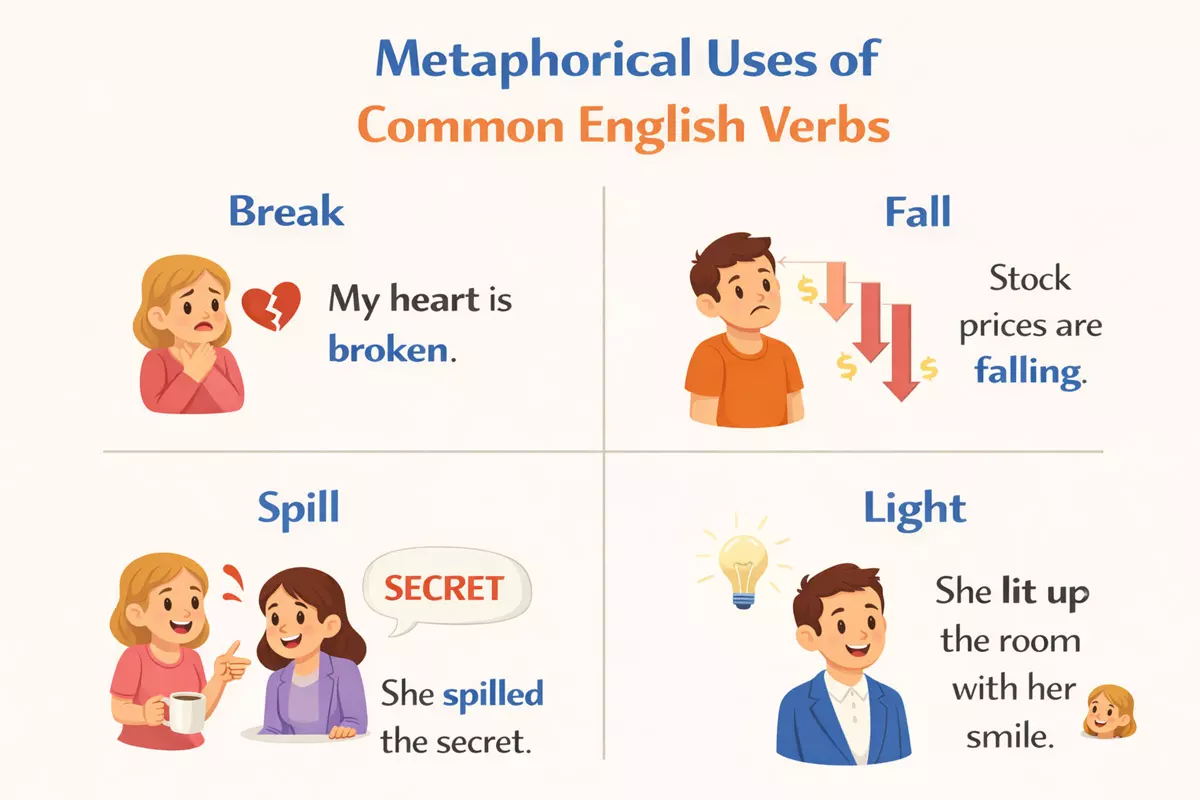 Here we what metaphorical verb use is, how literal meanings become metaphorical, common metaphor patterns, their roles in learning, thinking, work, and emotions, how context signals metaphorical meaning, frequent learner mistakes, and practice tasks.
- What metaphorical verb use means
- How literal meanings extend metaphorically
- Common metaphor patterns with everyday verbs
- Metaphors in learning, thinking, and emotions
- Metaphors in work, progress, and problems
- How context signals metaphorical meaning
- Common learner mistakes with metaphorical verbs
- Homework: metaphorical verb practice tasks
Everyday English verbs such as run, break, and catch often have meanings that extend well beyond their basic definitions. When used figuratively, these common action words help us communicate complex thoughts and emotions in creative and relatable ways. For example, we might say we "run into trouble," "break the news," or "catch someone's attention," each phrase conveying ideas that aren't tied to the physical actions themselves. Understanding these figurative uses enriches both our language skills and our appreciation for how flexible English can be.
What metaphorical verb use means
Metaphorical verbs transform everyday actions into ways of expressing abstract ideas or complex emotions. Instead of referencing a literal action, these verbs borrow the sense of movement, force, or change to describe things that don’t involve physical motion. For instance, when someone says “grasp an idea,” they are not physically grabbing anything, but using the action of grasping to describe understanding.
This kind of figurative language is essential for vivid communication. It lets speakers relate unfamiliar or intangible concepts to familiar experiences, making abstract thoughts more accessible. In English, many simple verbs—such as run, break, hit, or lift—are commonly used in non-literal ways. These metaphorical uses often become so familiar that we hardly notice them as metaphors.
How metaphors shape verb meanings
Using verbs metaphorically allows us to talk about emotions, ideas, and social situations by tapping into our shared understanding of physical actions. For example, “run into a problem” compares encountering a difficulty to physically bumping into something. This imaginative transfer is not just decorative—it can clarify meaning and add subtlety to expression.
Common patterns in metaphorical verb use
- Movement: “move forward with a plan,” “turn away from temptation”
- Collision or impact: “hit a snag,” “crash the meeting”
- Possession or acquisition: “grasp the concept,” “seize an opportunity”
- Growth or increase: “grow an audience,” “inflate expectations”
- Change or transformation: “shift perspective,” “flip the script”
- Support or opposition: “back an idea,” “stand against injustice”
- Transfer or sharing: “pass the message,” “spread the word”
- Restriction or limitation: “box in creativity,” “cap spending”
- Initiation or triggering: “spark interest,” “kick off the event”
- Destruction or failure: “break the silence,” “fall apart”
Literal vs. metaphorical: sample comparisons

Many common verbs extend from a physical (literal) meaning to an abstract (metaphorical) one. The metaphorical meaning is often more frequent in formal writing and idiomatic speech.
| Literal Use (physical) | Metaphorical Use (abstract) | Meaning shift |
|---|---|---|
| She broke the vase. | He broke the news. | Physical damage → delivering difficult information. |
| They hit the ball. | We hit a deadline. | Physical contact → reaching a target point in time. |
| She ran to the store. | The engine ran smoothly. | Movement → functioning/operating. |
| He caught the ball. | She caught his attention. | Grabbing → attracting/obtaining focus. |
| He held the door open. | They held a meeting. | Keeping in hand → organizing/conducting. |
| She built a house. | They built trust over time. | Constructing → developing gradually. |
| He cut the paper. | They cut costs by 10%. | Separating physically → reducing an amount. |
| She carried the suitcase. | He carries responsibility for the team. | Transporting → bearing/accepting a burden. |
In sum, metaphorical verb usage enriches English by connecting concrete experiences to abstract or nuanced ideas. Recognizing these patterns can help learners and speakers understand both everyday phrases and more creative uses of language.
How literal meanings extend metaphorically
Many everyday English verbs start with a physical or concrete sense, but over time, these verbs are used to describe abstract situations. This process allows speakers to express complex ideas by drawing on familiar actions from daily life. For example, we "grasp" an idea, "run" a program, or "break" the news—each usage begins with a tangible action and shifts to a metaphorical one.
Patterns of metaphorical extension
Verbs often follow certain patterns when their meanings broaden. These patterns include using physical movement to indicate progress, applying force to show influence, or transferring spatial relations to social or emotional contexts. Recognizing these patterns helps in understanding new figurative uses when you encounter them.
- Movement as progress: "move forward" in a project
- Physical contact as understanding: "grasp" a concept
- Breaking as revealing: "break the news"
- Running as operating: "run a company"
- Holding as maintaining: "hold a belief"
- Cutting as reducing: "cut costs"
- Turning as changing: "turn the situation around"
- Reaching as achieving: "reach a goal"
- Falling as declining: "fall into debt"
- Building as developing: "build relationships"
- Opening as starting: "open a discussion"
- Standing as enduring: "stand the test of time"
- Carrying as continuing: "carry on a tradition"
- Lifting as improving: "lift restrictions"
- Drawing as attracting: "draw attention"
- Stepping as taking action: "step up efforts"
- Pulling as removing: "pull the plug"
- Driving as motivating: "drive innovation"
Literal and metaphorical senses compared
Comparing literal and metaphorical uses of verbs shows how concrete physical actions develop abstract meanings. In most cases, the original core idea is preserved, but applied to mental, social, or conceptual domains.
| Literal Use (physical) | Metaphorical Use (abstract) | Core meaning shift |
|---|---|---|
| She grasped the rope tightly. | He grasped the main idea quickly. | Physical holding → mental understanding. |
| They ran across the field. | She ran the meeting efficiently. | Movement → managing/controlling a process. |
| Please hold this box for me. | He holds strong opinions. | Keeping physically → maintaining a position or belief. |
| The glass broke on the floor. | She broke the silence. | Physical separation → disruption of a state. |
| We built a sandcastle. | They built trust over time. | Construction → gradual development. |
| He carried the luggage upstairs. | She carries responsibility for the project. | Transporting weight → bearing obligation. |
| The knife cut the fabric cleanly. | The company cut expenses dramatically. | Physical division → reduction. |
| The door opened slowly. | New opportunities opened after graduation. | Physical access → becoming available. |
| The river flooded the valley. | Complaints flooded the support desk. | Physical overflow → overwhelming quantity. |
| She lifted the box with effort. | The speech lifted their spirits. | Raising physically → improving emotional state. |
Understanding these metaphorical extensions allows learners and speakers to interpret and use verbs flexibly, enriching both spoken and written communication.
Common metaphor patterns with everyday verbs
Many basic English verbs take on metaphorical meanings that go far beyond their original, literal definitions. These metaphorical uses help speakers express complex ideas, emotions, and relationships using familiar action words. By recognizing these patterns, learners can better understand native speakers and use verbs more flexibly in their own communication.
Metaphorical extensions of action verbs
Some of the most common verbs—such as run, break, hold, and catch—are frequently used in figurative expressions. These verbs can describe not just physical actions, but also abstract processes, feelings, and social situations. Here are several patterns and examples:
- Run: “run a business,” “run into trouble,” “run out of time”
- Break: “break the news,” “break a habit,” “break the ice”
- Hold: “hold a meeting,” “hold someone’s attention,” “hold a grudge”
- Catch: “catch a cold,” “catch someone’s eye,” “catch up with work”
- Carry: “carry weight,” “carry out a plan,” “carry a tune”
- Drop: “drop the subject,” “drop a hint,” “drop out of school”
- Take: “take a chance,” “take control,” “take a break”
- Make: “make a decision,” “make sense,” “make an effort”
- Go: “go for a goal,” “go too far,” “go with the flow”
- Turn: “turn a profit,” “turn the page,” “turn down an offer”
- Get: “get the point,” “get ahead,” “get over something”
- Put: “put off a meeting,” “put an idea forward,” “put someone down”
- Set: “set a record,” “set the stage,” “set someone free”
- Pull: “pull strings,” “pull through,” “pull someone’s leg”
- Drop: “drop the ball,” “drop a line,” “drop by”
- Drive: “drive a point home,” “drive someone crazy,” “drive change”
- Fall: “fall into place,” “fall for a trick,” “fall behind”
- Lift: “lift someone’s spirits,” “lift a ban,” “lift the mood”
Comparing literal and metaphorical meanings
Ordinary verbs often extend from concrete physical actions to abstract, metaphorical meanings. In most cases, the core idea of the action remains, but it is applied to mental, social, or organizational contexts.
| Literal Use (physical) | Metaphorical Use (abstract) | Meaning shift |
|---|---|---|
| She runs in the park every morning. | He runs a successful restaurant. | Physical movement → managing/operating. |
| He broke the glass by accident. | She broke the news gently. | Physical damage → delivering sensitive information. |
| They caught the ball during the game. | I caught a cold last week. | Grabbing → acquiring unintentionally. |
| We held the baby for the first time. | The speaker held our attention for hours. | Keeping physically → maintaining focus. |
| She grasped the rope tightly. | He grasped the concept immediately. | Holding firmly → understanding mentally. |
| The workers built a bridge. | The team built strong relationships. | Construction → gradual development. |
| He cut the rope with a knife. | The company cut spending drastically. | Physical separation → reduction. |
| The wind pushed the door open. | Public pressure pushed the government to act. | Physical force → social or political influence. |
Recognizing and using metaphorical verb patterns
Familiarity with these recurring figurative patterns can help learners sound more natural and understand idiomatic expressions. Practice by noting how verbs are used in different contexts and experimenting with them in your own speaking or writing. Over time, these patterns will become a natural part of your English vocabulary.
Metaphors in learning, thinking, and emotions
Everyday English is full of verbs that are used metaphorically to talk about mental processes, understanding, and feelings. These figurative expressions help people describe abstract experiences using more tangible actions or images. By borrowing from the language of movement, manipulation, or physical change, we make sense of internal states and cognitive activities.
Common Verbs as Mental Metaphors
Many familiar verbs shift from their literal meanings to represent mental and emotional activities. For example, we might say we are “grasping” a concept or “wrestling” with a problem. These expressions turn invisible processes into something we can picture and talk about more easily.
- Grasp (understand): “Did you grasp the main idea?”
- Digest (process): “I need time to digest this news.”
- Wrestle (struggle): “She’s wrestling with a tough decision.”
- Soak up (absorb): “He soaks up information quickly.”
- Illuminate (clarify): “Her example illuminated the point.”
- Weigh (consider): “He’s weighing his options.”
- Unlock (reveal): “This book unlocked new ideas for me.”
- Trigger (initiate): “That memory triggered an emotion.”
- Bounce (discuss): “Let’s bounce ideas around.”
- Sink in (become understood): “It took a while to sink in.”
- Carry (maintain): “She carries a lot of worry.”
- Channel (direct): “He channels his energy into work.”
- Fuel (motivate): “Success fuels her ambition.”
- Mirror (reflect): “His mood mirrored mine.”
- Navigate (manage): “They navigated a difficult conversation.”
- Anchor (stabilize): “Family anchors her in tough times.”
- Lift (improve): “That compliment lifted my spirits.”
- Cloud (confuse): “Doubt clouded his thinking.”
- Shape (influence): “Past events shape our beliefs.”
- Bottle up (suppress): “He bottles up his emotions.”
Comparing Literal and Figurative Uses
The metaphorical use of verbs often parallels a physical action, making abstract concepts easier to relate to. Here’s a comparison of literal and figurative meanings for a few core verbs:
| Literal Verb Use | Metaphorical Meaning |
|---|---|
| Grasp (hold physically) | Grasp (understand an idea) |
| Digest (process food) | Digest (absorb information) |
| Weigh (measure weight) | Weigh (consider options) |
| Illuminate (light up a room) | Illuminate (clarify a topic) |
| Anchor (secure a boat) | Anchor (stabilize emotions) |
| Navigate (steer a ship) | Navigate (manage a complex situation) |
| Fuel (provide energy for a machine) | Fuel (intensify anger, conflict, or debate) |
| Drift (float and move slowly) | Drift (lose focus or move away from a goal) |
| Freeze (turn into ice) | Freeze (stop suddenly, become unable to act) |
| Filter (remove unwanted particles) | Filter (screen information or messages) |
| Channel (direct water through a path) | Channel (direct energy, effort, or emotions) |
| Shield (protect from physical impact) | Shield (protect from criticism or blame) |
| Trigger (cause a mechanism to activate) | Trigger (cause a reaction or memory) |
| Map (draw a map of a place) | Map (plan or outline a process or strategy) |
| Frame (put in a physical frame) | Frame (present an argument in a particular way) |
Emotional States and Actions
When describing feelings, English speakers often use action verbs to express inner experiences more vividly. This can make conversations about emotions more relatable and dynamic. For instance, saying “anxiety crept in” or “hope lifted me” paints a much clearer picture than more clinical language.
These metaphorical verb uses enrich everyday speech, making complex thoughts and emotions easier to communicate and understand. By recognizing these patterns, learners and speakers become more attuned to the subtle ways English brings the inner world to life.
Metaphors in work, progress, and problems
Everyday English is full of verbs that describe tasks, forward movement, or difficulties using vivid imagery. These expressions often borrow from physical actions to capture abstract ideas about effort, achievement, or setbacks in professional and personal contexts. Understanding these metaphorical uses not only enriches communication but also clarifies subtle attitudes or expectations.
Common Verbs Used Metaphorically in Professional Contexts
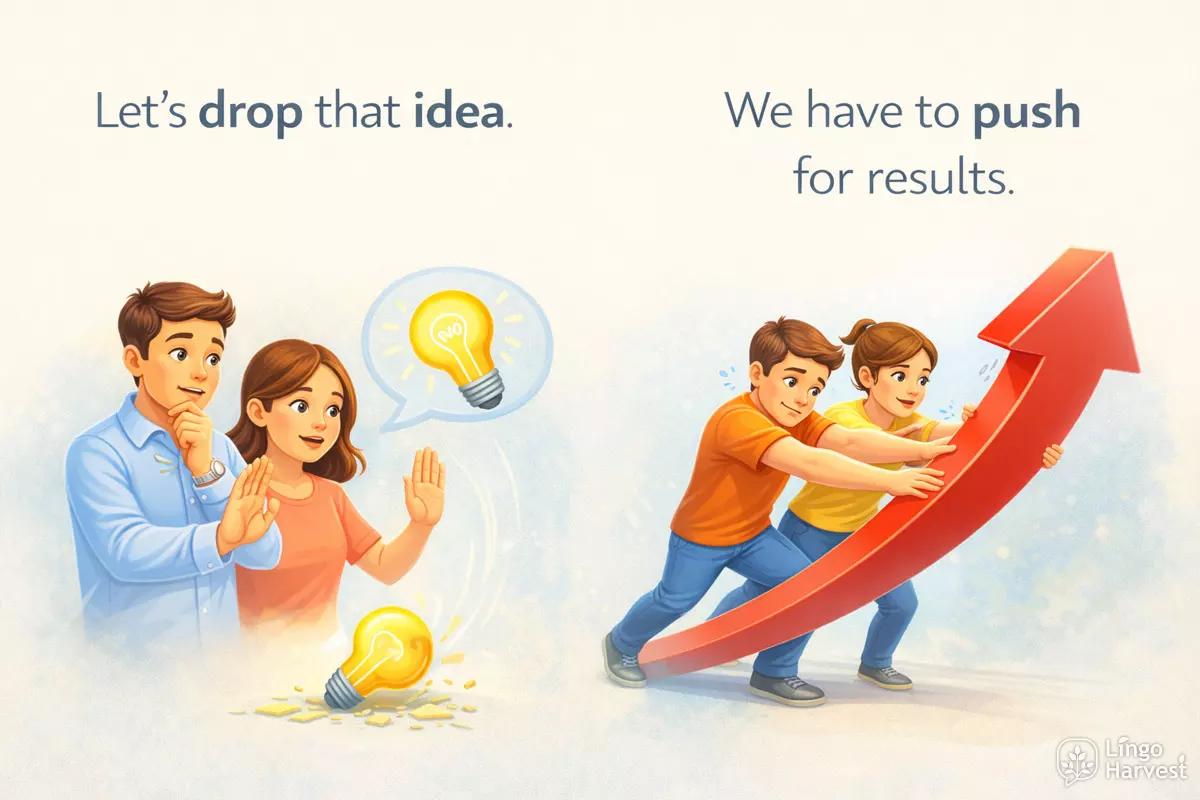
Many verbs, originally tied to physical movement or manipulation, now describe abstract processes at work or in life. Here are some frequent examples with their metaphorical meanings:
- Handle – to manage a situation or responsibility (“Can you handle this project?”)
- Tackle – to address a challenge directly (“We need to tackle these issues.”)
- Drop – to stop working on something or abandon it (“Let’s drop that idea.”)
- Push – to encourage progress or effort (“We have to push for results.”)
- Carry – to support or sustain an effort (“She carried the team through the crisis.”)
- Hit – to reach a milestone or encounter a problem (“We hit our targets.” / “We hit a snag.”)
- Break – to interrupt or overcome a barrier (“Let’s break the cycle.”)
- Bridge – to connect gaps or differences (“We need to bridge the communication gap.”)
- Juggle – to manage multiple tasks at once (“He’s juggling three projects.”)
- Navigate – to find a path through complex situations (“We must navigate these regulations.”)
- Stumble – to make a mistake or encounter a minor problem (“We stumbled during the rollout.”)
- Lift – to boost morale or improve a situation (“That news lifted everyone’s spirits.”)
- Pull – to obtain or attract (“She pulled in new clients.”)
- Fall – to fail or decrease (“Profits fell last quarter.”)
- Climb – to increase or improve (“Sales are climbing steadily.”)
- Plug – to fill a gap or fix a problem (“We need to plug the budget hole.”)
- Fire – to dismiss someone from a job (“He was fired last week.”)
- Step up – to take initiative or increase effort (“It’s time to step up.”)
- Catch up – to reach the same level as others (“We need to catch up with our competitors.”)
- Move forward – to make progress (“Let’s move forward with the plan.”)
Comparing Progress and Setbacks: Key Verb Contrasts
Some verbs are frequently paired as opposites when discussing progress, success, or difficulty. These contrasts are especially common in metaphorical, academic, and business contexts.
| Verb of Progress | Verb of Obstacle / Problem | Example in context |
|---|---|---|
| Advance | Stumble | The project advanced steadily, despite a few early stumbles. |
| Climb | Fall | Sales climbed throughout the year before suddenly falling in December. |
| Break through | Hit a snag | The team broke through initial resistance but later hit a snag. |
| Push ahead | Hold back | They pushed ahead with the plan, while budget concerns held them back. |
| Carry forward | Drop | Several ideas were carried forward, but others were dropped. |
| Gain momentum | Lose momentum | The campaign gained momentum at first, then lost momentum. |
| Move forward | Run into problems | We tried to move forward, but ran into unexpected problems. |
| Build up | Break down | Trust built up slowly, but broke down after the scandal. |
| Overcome | Face / encounter | She overcame several obstacles she encountered early on. |
| Take off | Fizzle out | The startup took off quickly, but the hype soon fizzled out. |
How Metaphorical Verbs Shape Workplace Communication
Using these verbs can quickly convey the emotional tone or urgency of a situation. For instance, saying “We’re juggling deadlines” suggests stress and complexity, while “Let’s bridge our differences” signals collaboration. The choice of metaphor can subtly motivate, warn, or encourage, depending on context. Recognizing these patterns helps in both understanding and crafting effective English in professional settings.
How context signals metaphorical meaning
The intended meaning of a verb often depends on the words and situations surrounding it. In English, common verbs like “run,” “break,” or “grasp” can shift from literal to metaphorical based on their context. Readers and listeners pick up on these cues to interpret whether a verb is being used in its everyday sense or to describe something more abstract.
Clues that suggest a metaphorical use
Several signals help us identify when a verb is being used metaphorically rather than literally. These clues often appear in the sentence structure, the objects involved, or the broader topic of conversation. Some frequent indicators include:
- Unusual objects: When a verb takes an object it cannot physically affect (e.g., “break the silence”), it’s likely metaphorical.
- Abstract subjects: If the subject is not a physical agent (e.g., “time flies”), the verb’s meaning is probably non-literal.
- Idiomatic combinations: Certain word pairings are conventional metaphors (e.g., “grasp an idea”).
- Contextual cues: The surrounding sentences may discuss emotions, concepts, or processes, not physical actions.
- Collocations: Some verbs regularly pair with certain nouns in figurative senses (e.g., “run a business”).
- Contrast with literal usage: If a passage begins literally and then shifts, the change often signals metaphor.
- Unlikely actions: If the verb describes something impossible in reality (e.g., “walls have ears”), metaphor is indicated.
- Comparative language: Words like “as if,” “like,” or “as though” sometimes introduce metaphorical uses.
- Emphasis or exaggeration: Overstated verbs often serve a figurative function (e.g., “explode with laughter”).
- Context of discussion: Abstract topics (e.g., politics, feelings, ideas) often feature non-literal verbs.
Examples: Literal vs. metaphorical uses
Comparing literal and figurative uses side by side helps clarify how context shapes interpretation. Notice how the verb’s meaning shifts depending on the surrounding words:
| Literal Use | Metaphorical Use |
|---|---|
| She ran down the street. | She ran the meeting efficiently. |
| Please break this stick in half. | Let’s break the cycle of bad habits. |
| He grasped the rope tightly. | He grasped the main idea quickly. |
| I caught the ball. | I caught her meaning instantly. |
| The glass shattered on the floor. | Her confidence shattered after the criticism. |
| The sun rose at six o’clock. | Interest rates rose last year. |
| He built a house. | She built a strong reputation. |
| They opened the door. | The news opened his eyes. |
| She carried the box upstairs. | He carried a heavy burden of responsibility. |
| The water flows quickly. | Ideas flow during brainstorming. |
Summary: Why context is essential
Ultimately, it’s the surrounding information that cues readers and listeners to switch from a literal to a figurative interpretation. By paying attention to the subject, object, and the broader discussion, we naturally adjust our understanding of verbs and appreciate the richness of metaphorical language in everyday English.
Common learner mistakes with metaphorical verbs
Understanding how everyday verbs take on figurative meanings can be challenging for English learners. Many people struggle to recognize when a verb is used metaphorically, which can lead to confusion or awkward phrasing. Some verbs have both literal and non-literal uses, and knowing the difference is essential for clear communication.
Confusing Literal and Figurative Meanings
A frequent difficulty is mistaking a metaphorical use for a literal one, or vice versa. For example, the verb “run” can mean to physically move quickly, but also to manage (“run a business”) or function (“the engine runs well”). Context is crucial for choosing the right interpretation.
- “Break the ice” (not about literal ice)
- “Catch someone’s eye” (not physically catching)
- “Hold your tongue” (not holding a tongue in your hand)
- “Drop the subject” (not dropping an object)
- “Hit the books” (not striking books)
- “Take a stand” (not standing up physically)
- “Shoot down an idea” (not with a weapon)
- “Grasp the concept” (not grabbing something)
- “Bounce ideas off someone” (not a ball)
- “Face the problem” (not turning your face)
- “Swallow your pride” (not eating pride)
- “Cut corners” (not cutting objects)
- “Lift someone’s spirits” (not physically lifting)
- “Steer the conversation” (not driving)
- “Touch base” (not physically touching)
- “Fall through the cracks” (not literally falling)
- “Jump to conclusions” (not jumping physically)
- “Open up” (not opening a box)
Incorrect Verb Choices
Learners sometimes use a verb’s literal meaning in a context that requires a metaphorical one, or vice versa. This can produce sentences that sound odd or are misunderstood. For example, saying “I broke the conversation” instead of “I broke the ice” is incorrect.
Mixing Metaphors
Another common issue is combining two different metaphors in one phrase, which can confuse listeners. For instance, “Let’s hit the ground running and then touch base” is acceptable, but “Let’s hit the ground and touch the base” mixes sports metaphors in an unnatural way.
Overusing Direct Translations
Translating metaphorical verbs directly from a learner’s native language often leads to unnatural or incorrect phrases in English. Idiomatic expressions rarely translate word-for-word, so memorizing common metaphors and their proper context is important.
Tips for Mastery
- Pay attention to context clues in conversation and writing.
- Learn common metaphorical phrases as fixed expressions.
- Practice distinguishing between literal and figurative uses in reading and listening.
- Ask native speakers for clarification when in doubt.
With time and exposure, understanding figurative uses of verbs becomes easier, helping learners communicate more naturally and effectively.
Homework: metaphorical verb practice tasks
Working with metaphorical meanings of verbs helps expand your ability to interpret and use English creatively. Below are practice activities designed to encourage you to recognize, analyze, and produce figurative uses of common action words in context.
Task 1: Identify the Metaphor
Read each sentence below. Underline the verb used metaphorically, and briefly describe its literal meaning versus the figurative sense in the sentence.
- She grasped the concept quickly.
- The project fell apart after the funding was cut.
- Let's tackle the hardest problem first.
- He pushed himself to finish the marathon.
- We need to bridge the gap between theory and practice.
- The discussion sparked new ideas.
- The plan collapsed under pressure.
- She navigated the crisis carefully.
- The argument gained strength over time.
- They laid the foundation for future growth.
Show answers
- grasped — Literal: physically hold; Figurative: understand an idea.
- fell apart — Literal: break into pieces; Figurative: fail or collapse.
- tackle — Literal: physically stop someone; Figurative: address a challenge.
- pushed — Literal: move by applying force; Figurative: motivate oneself.
- bridge — Literal: connect with a structure; Figurative: link abstract ideas.
- sparked — Literal: produce a spark; Figurative: trigger ideas or interest.
- collapsed — Literal: fall down physically; Figurative: fail completely.
- navigated — Literal: steer a vehicle; Figurative: manage a difficult situation.
- gained — Literal: acquire something physically; Figurative: increase in intensity or support.
- laid — Literal: place something down; Figurative: establish a basis for something.
Task 2: Match Literal and Metaphorical Uses
Below is a table pairing literal and metaphorical examples for common verbs. Match each verb's literal use with its metaphorical use.
| Literal Use | Metaphorical Use |
|---|---|
| She lifted the box. | He lifted the team's spirits. |
| The river runs through the valley. | This theme runs throughout the novel. |
| He broke the vase. | She broke the news gently. |
| They built a house. | They built a strong friendship. |
| The sun rises at 6 a.m. | She rose to the challenge. |
Show answers
- Lifted the box → lifted the team's spirits
- River runs → theme runs throughout
- Broke the vase → broke the news
- Built a house → built a friendship
- Sun rises → rose to the challenge
Task 3: Create Your Own Metaphors
Choose five verbs from the list below. Write a sentence for each, using the verb in a metaphorical way. Be creative!
- navigate
- plant
- spark
- sink
- fuel
- crash
- stretch
- anchor
- climb
- unfold
- dig
- weather
- melt
- snap
- shine
Show answers
- navigate: She had to navigate a difficult conversation at work.
- plant: He planted the idea in their minds.
- spark: The news sparked a heated debate.
- sink: His hopes sank when he heard the result.
- fuel: Her curiosity fueled her research.
- crash: He crashed after a long day (became exhausted).
- stretch: She stretched her skills on the new project.
- anchor: His family anchored him during tough times.
- climb: She climbed the corporate ladder quickly.
- unfold: The story unfolded over several weeks.
- dig: He dug into the problem until he found a solution.
- weather: They weathered the storm together (faced difficulties).
- melt: Her anger melted away.
- snap: He snapped under pressure (lost self-control).
- shine: She shone during the interview (performed well).
Task 4: Spot and Explain
Find three metaphorical verb uses in your favorite book, article, or a news story. Copy the sentences and explain the metaphorical meaning of each verb.
Show answers
- Answers will vary depending on the chosen source. Look for verbs used in a non-literal, figurative way and be sure to explain both the literal and intended metaphorical meaning.