Verb Simplification in Modern English Usage

 Here we how verbs are simplified in modern English, highlighting common patterns, tense and aspect changes, and simpler alternatives to complex forms. It also covers spoken English’s influence on writing, acceptability, and practical tips for learners.
- What verb simplification means in modern English
- Common simplifications in everyday speech
- Tense and aspect simplification patterns
- Simpler structures replacing complex ones
- Influence of spoken English on writing
- What is acceptable vs what sounds incorrect
- How learners can simplify without errors
- Homework: simplify sentences while keeping meaning
Over the last few years, English has been quietly doing what it does best — trimming the fat. And verbs are right at the center of that. Instead of loading sentences with extra forms, fussy phrasing, or heavy “formal” constructions, people more and more choose clean, direct action words that get the point across fast. You can hear it in everyday talk, but you can also see it in work emails, reports, and even academic writing, where clarity is basically the new status symbol. The overall vibe is simple: say what happened, who did it, and why it matters — without making the reader fight through the sentence.
What verb simplification means in modern English
So what does “verb simplification” actually look like in real modern English? It’s not that verbs are disappearing or becoming “lazy.” It’s more like the language is choosing the most efficient route: fewer tricky variations, fewer rarely used forms, and more reliance on structures that feel natural and easy to process. Modern English already has a relatively light verb system compared to many languages, and the trend keeps moving in that direction — smoothing out edges so the same patterns work across more situations. The result is a kind of streamlined toolkit that both native speakers and learners can use quickly, confidently, and without constantly second-guessing which form is “the right one.”
Key Features of Simplified Verbs
- Fewer verb endings (e.g., most verbs use -ed for past tense)
- Minimal subject-verb agreement (usually only changes for third person singular present)
- Less distinction between regular and irregular forms over time
- Preference for auxiliary verbs (like do, have, will) in questions and negatives
- Use of modal verbs instead of complex inflections to express mood or possibility
- Increasing use of phrasal verbs in place of single-word verbs
- Reduction or loss of verb endings that mark person or number
- Regularization of irregular verbs in everyday speech
- Reliance on word order and context, rather than verb endings, to clarify meaning
- Contraction and omission in casual speech (e.g., “I’m,” “don’t”)
Examples: Past and Present Verb Forms
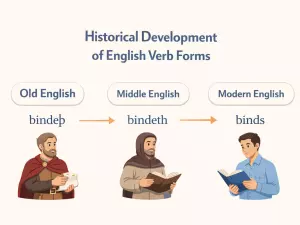
To illustrate how simplification appears in usage, here is a comparison of older versus modern English verb forms. The examples highlight changes in pronouns, agreement endings, and auxiliary verbs.
| Old/Middle / Early Modern English | Modern English | What changed |
|---|---|---|
| Thou hast | You have | Second-person singular pronoun lost; agreement simplified. |
| Thou art | You are | Older second-person verb form replaced by uniform “you”. |
| Thou dost | You do | Loss of -st ending in second person singular. |
| Thou goest | You go | Loss of -est ending; present tense leveled. |
| He runneth | He runs | -eth replaced by -s in third person singular. |
| She speaketh | She speaks | -eth replaced by -s; modern agreement pattern. |
| It seemeth | It seems | -eth replaced by -s; spelling standardized. |
| We are | We are | Form preserved; minimal change in this paradigm cell. |
| Ye are | You are | Ye replaced by you; pronoun system simplified. |
| Ye be | Older “be” forms reduced; modern “are” generalized. | |
| They doth | They do | Plural agreement leveled; “doth” restricted then lost. |
| They have | They have | Form preserved; modernization is mainly spelling and usage norms. |
| I am | I am | Stable form; survives with minor orthographic standardization. |
| I know not | I do not know | Negation shifted toward “do-support” as the default strategy. |
| Saw’st thou? | Did you see? | Second-person ending lost; do-support generalized in questions. |
| He hath spoken | He has spoken | Auxiliary “hath” replaced by “has”; standardization. |
| Thou hadst | You had | Loss of -st ending; pronoun replacement (“thou” → “you”). |
| Wherefore art thou? | Why are you? | Pronoun + verb form replaced; lexical shift (“wherefore” → “why”). |
| We go | We go | Modern plural has no agreement ending; already relatively simple. |
| We goeth | Non-standard overgeneralization; modern standard eliminates -eth in plurals. |
Why Does This Matter?
All of this matters because verb simplification makes English easier to live with. It lowers the entry barrier for new learners and gives the language a kind of built-in flexibility that works well in global communication. People can adapt faster, explain ideas quicker, and focus more on meaning than on form. Of course, simpler structures can sometimes blur the message a bit, but that’s where context, tone, and extra wording step in to do the heavy lifting. Taken as a whole, this shift shows how English keeps nudging itself toward efficiency in everyday use.
Common simplifications in everyday speech
If you listen closely to real conversations, you’ll notice that speakers naturally reach for shorter, cleaner verb forms. They help ideas move along without friction and keep the rhythm of speech smooth. In casual talk especially, no one wants to slow down just to juggle complex forms that don’t add much meaning. What’s interesting is how universal this is — you hear the same patterns across different countries, generations, and social groups, which shows that simplification isn’t a trend limited to one corner of English, but a shared instinct of the language itself.
Frequent patterns in spoken English
- Dropping auxiliary verbs: “You coming?” instead of “Are you coming?”
- Omitting “do” in questions: “You know him?” for “Do you know him?”
- Contracting negatives: “didn’t,” “wasn’t,” and “couldn’t” are nearly always used instead of their full forms
- Reducing “have” in the present perfect: “I seen it” rather than “I have seen it” (especially in some dialects)
- Using “gonna,” “wanna,” or “gotta” in place of “going to,” “want to,” and “got to”
- Shortening modal constructions: “Should’ve,” “would’ve,” “could’ve”
- Combining subject and verb: “She’s” for “She is” or “She has”
- Leaving out “that” in reported speech: “He said he was tired” (instead of “He said that he was tired”)
- Using the base verb in place of the past participle: “I done it” instead of “I have done it”
- Preferring the simple past: “I just ate” rather than “I have just eaten”
- Using “ain’t” as a universal negative
- Short responses: “Couldn’t,” “Won’t,” “Didn’t” as complete answers
- Omitting “will” in the future: “I see you tomorrow”
- Substituting “be” with “get” or “have got”: “I got a car” instead of “I have a car”
- Informal irregular forms: “brung” for “brought,” “snuck” for “sneaked”
Comparing standard and simplified verb forms
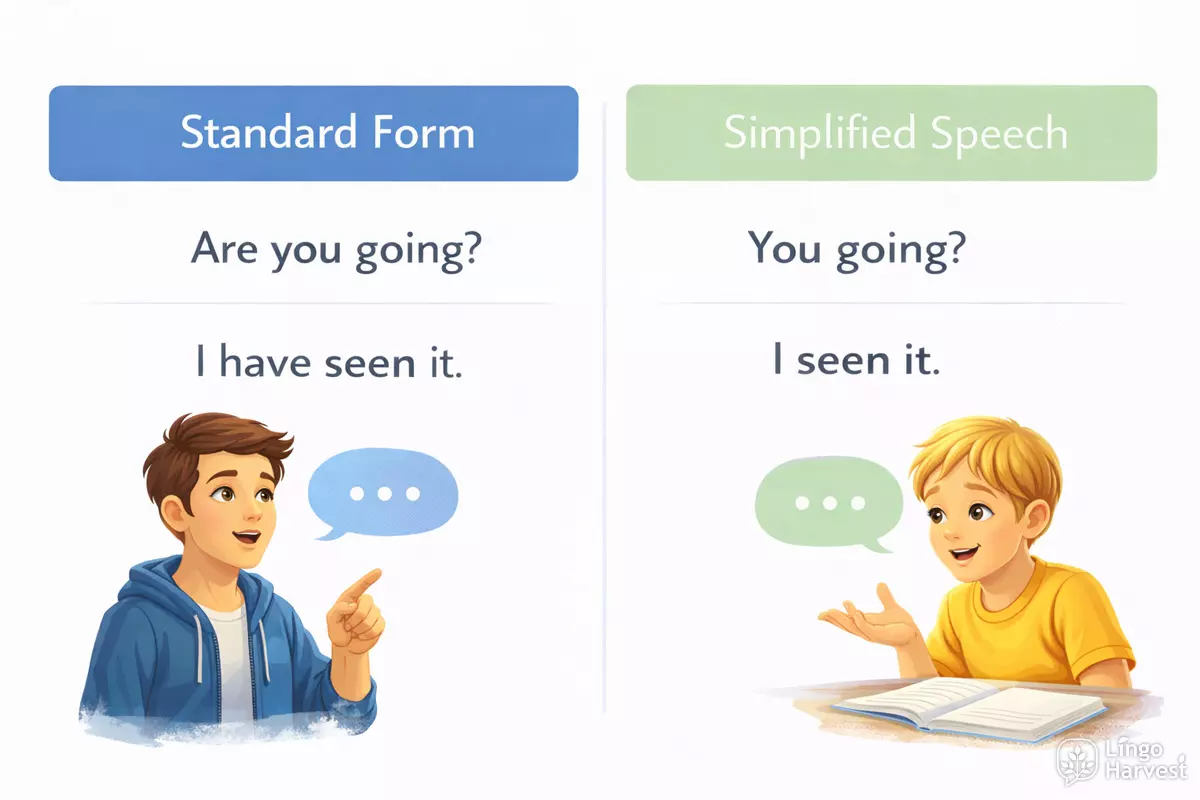
| Standard Form | Simplified Speech | What’s Happening & When It’s Used |
|---|---|---|
| Are you going? | You going? | Auxiliary verb dropped; very common in casual spoken questions. |
| I have seen it. | I seen it. | Perfect auxiliary omitted; frequent in informal speech, non-standard in writing. |
| I am going to leave. | I’m gonna leave. | “Going to” reduced to “gonna”; spoken, informal future reference. |
| Did you eat? | You eat? | Do-support dropped; acceptable in conversation, not in formal English. |
| I have got to go. | Gotta go. | Both subject and auxiliary omitted; expresses urgency in speech. |
| He does not know. | He don’t know. | Non-standard agreement; common in informal varieties and spoken registers. |
| I have not done it. | I ain’t done it. | “Ain’t” replaces multiple negatives; highly informal and non-standard. |
| I will see you tomorrow. | See you tomorrow. | Ellipsis of subject and auxiliary; typical in informal farewells. |
| What are you doing? | What you doing? | Auxiliary dropped; very common in fast, casual speech. |
| I would have told you. | I’d’ve told you. | Double contraction; natural in speech but avoided in formal writing. |
| You have to try harder. | You gotta try harder. | “Have to” reduced to “gotta”; expresses obligation informally. |
| Let me know later. | Lemme know later. | Sound reduction (“let me” → “lemme”); spoken only. |
Why do these shortcuts appear?
The short answer is simple: people want communication to move faster and feel easier. In real conversation, no one is consciously trying to be grammatically elegant — they’re trying to be understood with minimal effort. Shortening verb structures, dropping auxiliaries, and leaning on contractions all help messages land more directly. This is especially true in quick, informal exchanges, where shared context does most of the work that grammar used to handle. Over time, some of these spoken habits naturally spill into writing too, particularly in texts, chats, and dialogue. While a few forms stay firmly informal, others slowly gain acceptance in wider, even semi-formal, settings. All of it fits into the same bigger picture: English constantly reshaping itself to make communication smoother and more efficient.
Tense and aspect simplification patterns
When it comes to tense and aspect, modern English clearly leans toward simplicity. Instead of carefully separating every possible time frame or nuance of an action, speakers often choose forms that get the timing across well enough without extra complexity. Over the years, this has led to a preference for straightforward ways of talking about past, present, and future events, with heavier verb constructions gradually giving way to cleaner, more direct options.
Common trends in tense reduction
One of the clearest signs of this shift is how often people rely on the simple present and simple past. Forms that used to sound more “correct” or precise now often feel unnecessary in everyday use. Rather than saying something like “I have been reading,” many speakers will go with “I read” or “I was reading,” letting context fill in the missing details. This pattern shows up constantly in casual speech and informal writing, where ease and flow matter more than perfectly labeling every aspect of time.
- Using "I did" instead of "I have done" in casual speech.
- Favoring "will" over "shall" for future references.
- Replacing "was going to" with "would" for future-in-the-past scenarios.
- Frequent omission of the perfect aspect in American English (e.g., "Did you eat yet?" vs. "Have you eaten yet?").
- Dropping continuous forms: "I watch TV" instead of "I am watching TV" for habitual actions.
- Using "going to" (gonna) for future plans instead of "will."
- Preferring "used to" for past habits instead of the past continuous.
- Employing present simple with future meaning: "The train leaves at six."
- Opting for simple past in narratives, even when sequence or duration would allow for more nuanced aspects.
- Favoring "get" passives ("It got broken") over "be" passives ("It was broken").
- Replacing "was to have done" forms with simpler alternatives: "was supposed to do."
- Using modal verbs to indicate future or possibility rather than complex aspectual constructions.
- Eliminating unnecessary auxiliaries in questions: "You coming?" instead of "Are you coming?"
- Reducing use of "do" support in negative and interrogative sentences in some dialects ("I not know").
- Relying on context to indicate time, rather than explicit verb forms.
Aspect simplification: perfect and progressive
The distinction between perfect and progressive aspects is often blurred in modern speech. Many speakers replace the present perfect ("I have finished") with the simple past ("I finished"), and the present continuous ("I am working") with the simple present ("I work") when context makes the meaning clear.
| Traditional Form | Common Simplified Form |
|---|---|
| I have eaten | I ate |
| I was going to call | I would call |
| I am reading | I read |
| The train will have left | The train leaves |
| I had been working | I worked |
| He is to arrive | He will arrive |
Implications and ongoing changes
These patterns reflect a broader movement toward efficiency in spoken and written English. While formal writing retains many traditional forms, day-to-day usage increasingly favors directness and clarity. As language evolves, such simplifications may further influence educational materials and international English usage.
Simpler structures replacing complex ones
Modern English increasingly favors straightforward verb forms and sentence constructions. Where older or more formal styles once relied on compound tenses, passive voice, or elaborate subordinate clauses, today’s writers and speakers often opt for directness and clarity. This trend can be seen across both spoken and written English, driven by the desire for efficiency and accessibility.
Common ways verbs are simplified
- Preference for simple present and past over perfect or progressive forms
- Active voice replacing passive constructions
- Reduced use of modal verbs in favor of direct statements
- Substitution of phrasal verbs for single, often Latinate verbs
- Omission of auxiliary verbs when context allows
- Shorter verb phrases in everyday speech and informal writing
- Elimination of unnecessary tense shifts within a sentence
- Favoring regular verb forms over irregular ones, especially in new coinages
- Use of contractions to streamline verb phrases
- Replacement of archaic or formal verb forms with modern equivalents
- Collapsing conditional structures (“If I were…” becomes “If I was…”)
- Dropping “do” support in questions and negatives in some dialects
- Choosing straightforward infinitives over complex subjunctive forms
- Reducing double negatives to single negatives in standard usage
- Simplifying reported speech (“He said he is coming” vs. “He said that he would be coming”)
Comparing traditional and modern verb usage
The contrast between older and newer forms is particularly noticeable in everyday communication. To illustrate, here are several examples where streamlined verb choices have become the norm:
| Traditional/Complex Form | Modern/Simplified Form |
|---|---|
| I have been considering your offer. | I'm thinking about your offer. |
| The meeting will be held at noon. | We'll meet at noon. |
| If I were to accept, I would let you know. | If I accept, I'll let you know. |
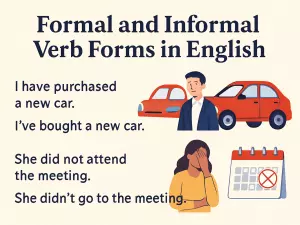
| He has not finished his work yet. | He hasn't finished yet. |
| Should you need assistance, please contact us. | If you need help, contact us. |
| The proposal was rejected by the committee. | The committee rejected the proposal. |
| She does not know the answer. | She doesn't know. |
| He proceeded to explain the process. | He explained the process. |
| They are unable to attend. | They can't come. |
| It is necessary that he be present. | He needs to be there. |
These shifts reflect a broader movement toward more accessible and concise language. While some nuance may be lost, the overall effect is a more approachable and user-friendly English, especially in everyday interactions.
Influence of spoken English on writing
The way people speak often shapes how they write, especially when it comes to simplifying verbs. Everyday conversation tends to favor shorter, more direct forms. As a result, many written texts reflect these choices, especially in informal contexts like emails, text messages, and social media posts.
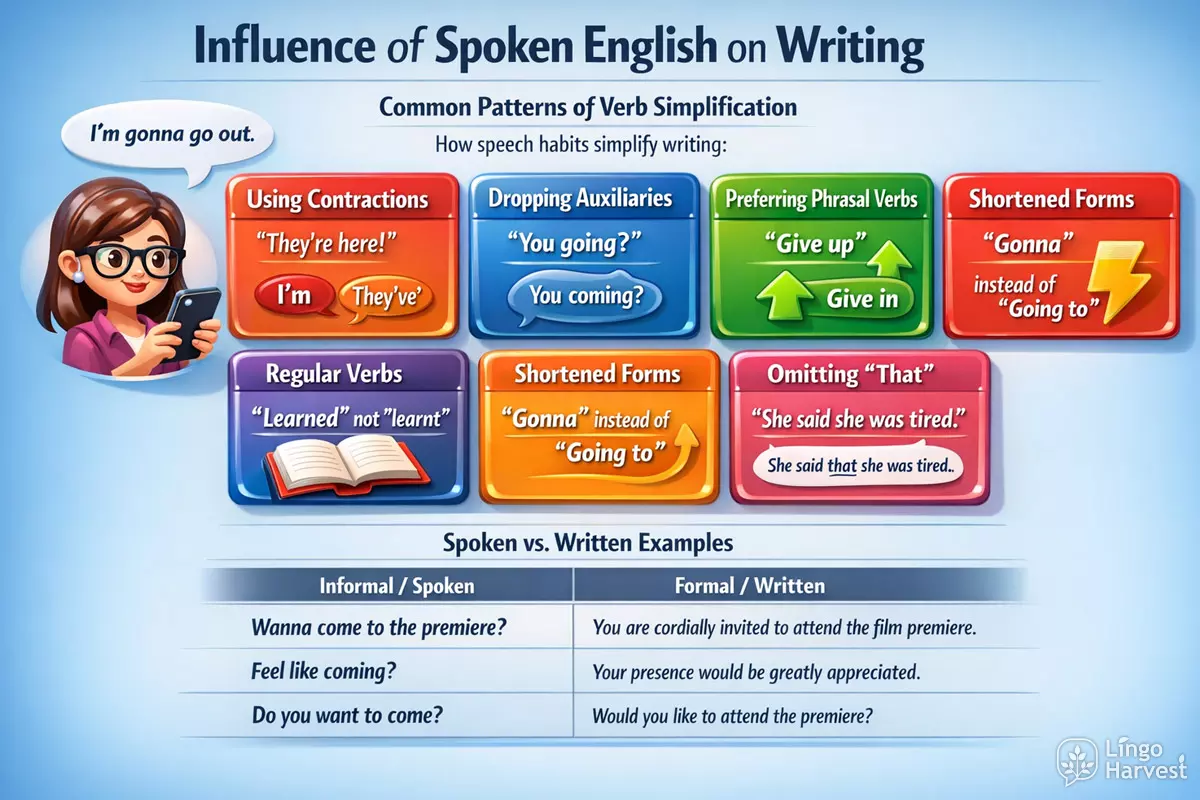
Common Patterns of Verb Simplification
Writers frequently adopt patterns from speech, leading to changes in verb usage and structure. Here are some ways this happens:
- Using contractions: "I'm" instead of "I am", "they've" for "they have"
- Dropping auxiliary verbs: "You coming?" in place of "Are you coming?"
- Preferring regular verbs: "learned" over "learnt"
- Favoring phrasal verbs: "give up" instead of "surrender"
- Shortening verb phrases: "gonna" for "going to"
- Omitting "that" in reported speech: "She said she was tired" rather than "She said that she was tired"
- Using the base form after modal verbs: "can go" rather than "can goes"
- Replacing formal verbs with simpler ones: "get" for "obtain"
- Using present tense forms for habitual actions: "I walk to work" instead of "I am walking to work every day"
- Favoring active over passive constructions: "They finished the project" instead of "The project was finished by them"
- Reducing verb chains: "I might go" instead of "I might be going to go"
- Utilizing simple past for narratives: "He told me" not "He has told me"
- Omitting subject pronouns in informal notes: "See you soon" versus "I will see you soon"
- Using "got" as a universal past: "I got home" rather than "I arrived home"
- Short forms for questions: "You okay?" instead of "Are you okay?"
Comparison: Spoken vs. Written Verb Forms
Patterns from everyday language often transfer directly into writing. The table below highlights some typical simplifications that originate in speech and appear in writing:
| Situation | Informal / Spoken Invitation | Formal / Academic Invitation |
|---|---|---|
| Inviting a friend to a movie premiere | Wanna come to the premiere? | You are cordially invited to attend the film premiere. |
| Inviting a colleague | Do you wanna join us for the premiere? | We would be pleased if you could join us for the premiere. |
| Official written invitation | — | You are formally invited to the premiere screening on Friday evening. |
| Academic or professional context | Feel like coming? | Your presence at the premiere would be greatly appreciated. |
| Polite semi-formal invitation | Do you want to come? | Would you like to attend the premiere? |
| Very formal / ceremonial | — | We hereby invite you to attend the official premiere of the production. |
| Written RSVP-style invitation | — | You are kindly requested to confirm your attendance at the premiere. |
| Institutional invitation | — | The organizing committee invites you to the premiere presentation. |
Effects on Clarity and Formality
Simplified verbs can make writing more accessible and engaging, especially when the audience is familiar with conversational English. However, these forms may reduce clarity or seem too informal in academic or professional contexts. Writers should consider the expectations of their readers and the purpose of their text before adopting speech-driven verb patterns. Balancing ease of understanding with appropriate formality is key when transferring spoken habits to written language.
What is acceptable vs what sounds incorrect
In modern English, the trend toward verb simplification raises questions about which forms are now widely accepted and which still sound awkward or even wrong to native speakers. While language evolves, not every streamlined verb pattern gains approval, and some may still trigger an instinctive "that sounds off" reaction. Understanding this subtle line can help writers and speakers avoid common pitfalls, especially in formal contexts.
Common Simplified Forms That Work
Some streamlined verb forms have become standard in everyday language. Here are examples where simplified verbs are generally accepted:
- Using "learned" instead of "learnt"
- Preferring "dreamed" over "dreamt"
- Saying "dived" rather than "dove" (in UK English)
- Choosing "spelled" instead of "spelt"
- "Burned" instead of "burnt"
- "Spoiled" rather than "spoilt"
- "Leaped" instead of "leapt"
- "Fit" as both past and present (US English: "The shirt fit yesterday")
- "Wet" for past and participle (as in "He wet the bed")
- Regularizing irregular verbs in casual speech ("snuck" for "sneaked" now widely accepted)
Patterns That Often Sound Wrong
On the other hand, some oversimplified forms still strike most listeners as incorrect, even if they're logical extensions of existing patterns. These usually haven't gained traction in standard usage:
- Using "catched" instead of "caught"
- Choosing "goed" as the past of "go"
- Saying "bringed" for "brought"
- "Buyed" instead of "bought"
- "Teached" for "taught"
- "Falled" for "fell"
- "Breaked" for "broke"
- "Thinked" instead of "thought"
- "Runned" for "ran"
- "Drinked" for "drank" or "drunk"
Comparison: Accepted vs. Unaccepted Simplifications
| Commonly Accepted | Sounds Incorrect |
|---|---|
| learned (vs. learnt) | catched (for caught) |
| dreamed (vs. dreamt) | goed (for went) |
| spelled (vs. spelt) | bringed (for brought) |
| snuck (for sneaked) | buyed (for bought) |
| fit (past of fit, US English) | teached (for taught) |
Why Some Forms Gain Acceptance
Regularization often succeeds when it aligns with existing, familiar verb patterns or is reinforced through frequent use in media and conversation. Conversely, forms that break with entrenched irregular verbs or sound jarring to the ear are less likely to be adopted, even if they follow logical rules.
In summary, while English continues to simplify many verbs, not every possible form is equally embraced. Awareness of what’s currently accepted versus what still seems off can help users sound natural and avoid common mistakes.
How learners can simplify without errors
Making English verbs easier to use doesn't mean making mistakes. To use simplified verb forms correctly, learners need to understand common patterns and know when a shorter option is acceptable. For instance, it's often possible to use the base form or the simple present, but not always. Looking at how native speakers simplify verbs in everyday communication is helpful, but rules and exceptions matter too.
Focus on Patterns with Regular and Irregular Verbs
Most regular verbs follow predictable endings, but irregular verbs can trip up even advanced students. Recognizing which verbs allow for safe simplification—and which don't—minimizes errors. Irregular verbs often keep unique forms, so memorizing those is a key step.
| Verb Type | Safe Simplification | Common Pitfall |
|---|---|---|
| Regular | Add -ed for past and past participle (e.g., "walk" → "walked") | Forgetting to add -ed ("He walk yesterday" ❌) |
| Irregular | Use correct simple forms ("go" → "went", "gone") | Using the base form for all tenses ("He go yesterday" ❌) |
| Modal + Base | Use base after modal ("can go", "should eat") | Adding -s or -ed after modal ("can goes" ❌) |
| Continuous | Use "be" + verb-ing ("is walking") | Dropping "be" ("He walking" ❌) |
Practical Tips for Avoiding Mistakes
- Check if the verb is irregular before simplifying tense.
- Use modal verbs (can, should, must) with the base form only.
- When in doubt, review the sentence for missing auxiliary verbs like "be" or "have".
- Practice forming questions and negatives, as these often use simplified verb forms (e.g., "Do you like...?").
- Listen to native speech to notice where simplification is natural and where it sounds wrong.
Examples of Clear, Simple Verb Choices
- He works every day. ✅
- She didn’t go. ✅
- We are learning. ✅
- I have seen that movie. ✅
- They can swim. ✅
- He walk to school. ❌ (Should be "walks" or "walked")
- She going home. ❌ (Should be "is going")
- I seen him. ❌ (Should be "have seen")
- We goes shopping. ❌ (Should be "go")
- He can swims. ❌ (Should be "can swim")
To summarize, simplifying verbs is about making smart choices, not just dropping endings or auxiliaries. By paying attention to verb type, using reliable patterns, and learning from common errors, learners can achieve clearer, more accurate English without falling into traps.
Homework: simplify sentences while keeping meaning
Simplifying verbs and sentence structure is a practical skill in modern English. This exercise helps you express ideas clearly without losing important details. When you revise your writing, focus on identifying unnecessary words or complicated verb forms that can be replaced with simpler alternatives.
Why Simplify Sentences?
Making sentences easier to read benefits both the writer and the reader. It reduces confusion, speeds up communication, and often makes your arguments stronger. Complex verb phrases can make sentences harder to understand, while straightforward verbs create clarity.
Common Ways to Simplify Verb Usage
- Replace phrasal verbs with single-word verbs where possible.
- Use the active voice instead of passive for directness.
- Eliminate redundant modal verbs or unnecessary helping verbs.
- Cut out filler phrases like "in order to" when "to" is enough.
- Choose present tense for ongoing actions unless past or future is required.
Examples: Before and After Simplification
Below are examples showing how to simplify sentences by focusing on the verb and overall structure. Notice how meaning is preserved while the result becomes easier to read.
| Original Sentence | Simplified Sentence |
|---|---|
| She is able to complete the assignment by tomorrow. | She can finish the assignment by tomorrow. |
| The meeting will be conducted by the manager. | The manager will lead the meeting. |
| They made a decision to postpone the event. | They decided to postpone the event. |
| In order to improve results, changes must be made. | To improve results, we must make changes. |
| The report was written by the team last week. | The team wrote the report last week. |
| There is a need for us to review the policy. | We need to review the policy. |
| He has the ability to solve complex problems. | He can solve complex problems. |
| Steps were taken in order to ensure safety. | We took steps to ensure safety. |
| The project is going to be completed soon. | The project will be completed soon. |
| It is necessary for us to finish on time. | We must finish on time. |
Tips for Practice
- Read your sentences aloud—if they sound complicated, try shortening them.
- Swap out long verb phrases with shorter equivalents.
- Check whether the subject can perform the action directly.
- Remove words that do not add meaning.
- After simplifying, confirm that the main idea remains unchanged.
By practicing these strategies, you’ll develop a habit of clear, concise communication. Remember: simplicity improves understanding without sacrificing meaning.
Homework 1
Simplify the sentences by choosing a clearer and more natural verb form. Keep the original meaning.
- She is able to understand the instructions.
- The report was completed by the researchers.
- He has the intention to apply for the position.
- The team made a decision to delay the launch.
- There is a need to revise the proposal.
- The experiment is going to be repeated.
- They have the ability to solve the problem.
- The presentation will be given by the manager.
- It is necessary for students to submit the form.
- Measures were taken in order to reduce costs.
Answers
- She can understand the instructions.
- The researchers completed the report.
- He intends to apply for the position.
- The team decided to delay the launch.
- We need to revise the proposal.
- The experiment will be repeated.
- They can solve the problem.
- The manager will give the presentation.
- Students must submit the form.
- We took measures to reduce costs.
Homework 2
Rewrite the sentences using an appropriate written standard. Avoid spoken shortcuts and non-standard verb forms.
- You gonna attend the conference?
- I seen the final version yesterday.
- We gotta finish this by Monday.
- He don’t understand the procedure.
- They wanna improve the results.
- The data was analyzed by us.
- I ain’t received any feedback.
- The team gonna present tomorrow.
- You coming to the meeting?
- We didn’t did enough research.
Answers
- Are you going to attend the conference?
- I saw the final version yesterday.
- We have to finish this by Monday.
- He does not understand the procedure.
- They want to improve the results.
- We analyzed the data.
- I have not received any feedback.
- The team is going to present tomorrow.
- Are you coming to the meeting?
- We did not do enough research.