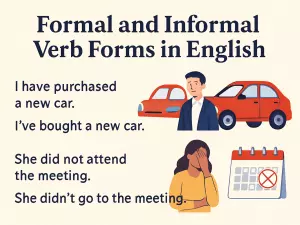
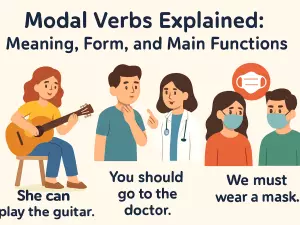
How Native Speakers Choose Verb Forms in Real Speech

 This article explains how verb choices in real conversations are shaped by context, time words, and storytelling. It covers shortcuts in speech, the impact of modality and register, common learner issues, and offers listening-based practice tasks.
- What influences verb choice in real conversation
- Tense choice vs time words and context
- Aspect choices in storytelling and updates
- Common simplifications and shortcuts in speech
- How modality changes tone and intent
- Register differences: casual vs formal speech
- Typical learner issues with natural choices
- Homework: listening-based verb choice tasks
Have you ever wondered how people naturally choose the correct tense or sentence structure while speaking? In daily conversations, fluent speakers seem to know instinctively which form to use, smoothly adjusting verbs and phrases based on the situation. This intuitive process is shaped by context, experience, and subtle social signals, allowing communication to flow without conscious effort. Over time, habitual use and exposure to language patterns help speakers develop this skill, making their speech feel effortless and effective.
What influences verb choice in real conversation
Native speakers don’t consciously analyze grammar rules in the middle of a chat. Instead, their selection of verbs is shaped by a mix of factors—context, intent, social cues, and even habit. Let’s look at the main elements that steer these spontaneous decisions.
Context and Timing
What’s happening in the moment plays a big role. Speakers naturally pick verb tenses and forms that reflect whether they’re talking about the past, present, or future. For instance, recounting a story calls for past tense, while making plans uses future or modal verbs.
Speaker Intent
The purpose behind an utterance influences which verbs are chosen. Whether someone is making a request, giving instructions, expressing an opinion, or telling a story, the verb form adapts accordingly. Politeness or directness can also affect the choice—think of the difference between “Could you help?” versus “Help me.”
Social Factors
Who you’re speaking with matters. Verb usage shifts subtly depending on formality, familiarity, and cultural expectations. In casual conversation among friends, contractions and simpler forms are common. In professional or formal settings, speakers may opt for more precise or complete structures.
Frequency and Habit
Certain verbs and constructions come up so often that they become automatic. Native speakers rely on these patterns, which are reinforced by years of exposure. This helps them communicate quickly and smoothly without overthinking each choice.
Discourse Patterns and Collocations
Some verbs naturally pair with specific nouns or expressions—these are called collocations. For example, we say “make a decision,” not “do a decision.” Familiarity with these patterns guides fluent speech.
| Situation | Typical Verb Choices | Example Sentence |
|---|---|---|
| Retelling an event | Past tense (went, saw, told) | The researcher presented the findings at the conference last year. |
| Making a suggestion | Modals (should, could, might) | The committee should consider revising the current guidelines. |
| Expressing an ongoing action | Progressive aspect (is working, are developing) | The team is currently analyzing the collected data. |
| Stating a general fact | Simple present (know, believe, indicate) | Previous studies indicate a strong correlation between stress and sleep quality. |
| Giving instructions | Imperative (take, follow, complete) | Refer to Appendix A for a detailed description of the methodology. |
| Describing completed research | Present perfect (has examined, have identified) | Several studies have examined the long-term effects of the policy. |
| Describing trends or changes | Past simple / present perfect (increased, has declined) | Enrollment rates have declined significantly over the past decade. |
| Expressing caution or uncertainty | Modal + infinitive (may suggest, might indicate) | The results may suggest a need for further investigation. |
| Formulating hypotheses | Conditional forms (would, could) | Greater transparency would improve public trust in the system. |
| Evaluating limitations | Unreal past / hedging structures (were, might have) | If the sample were larger, the conclusions might be more robust. |
Common Patterns and Examples
- “I’ll let you know” (future intent)
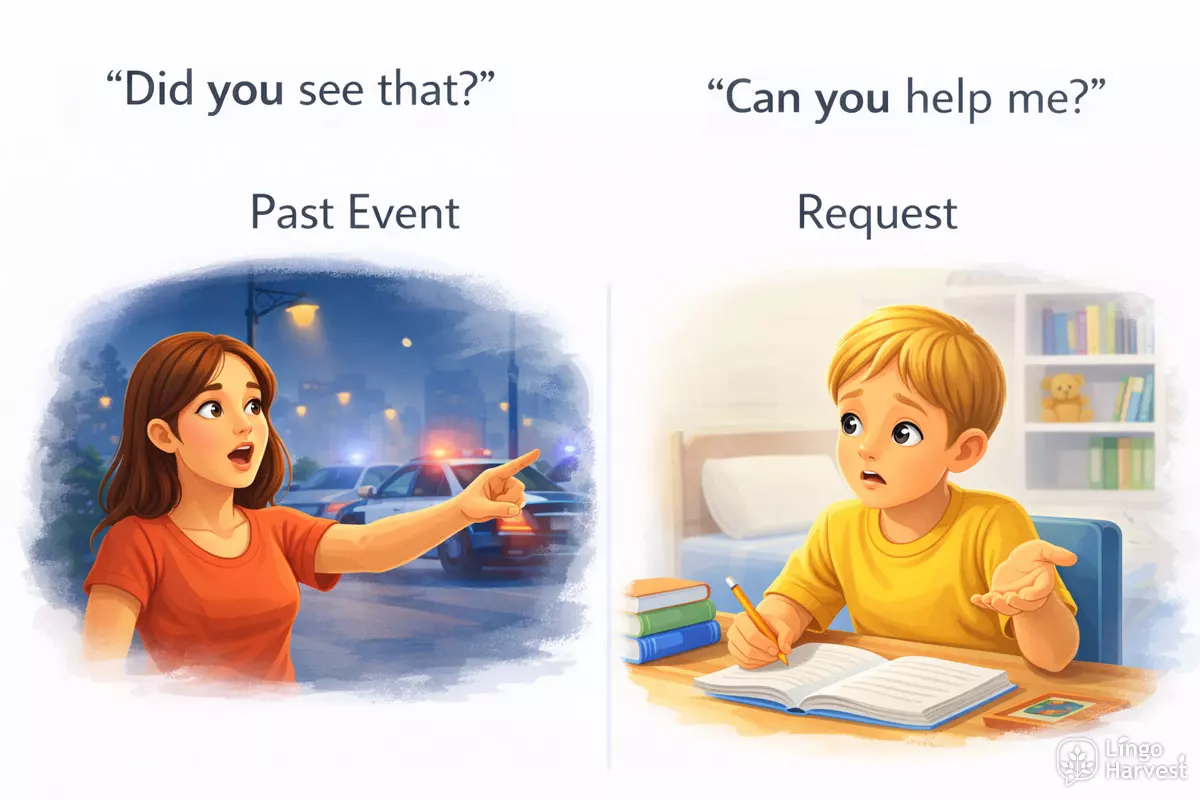
- “Did you see that?” (past event)
- “Can you help me?” (request)
- “It looks great” (present observation)
- “We’re meeting at 5” (scheduled action)
- “I’ve heard about it” (recent experience)
- “You should try this” (suggestion)
- “Please pass the salt” (instruction)
- “He always forgets” (habitual action)
- “If you need anything, call me” (conditional offer)
- “I was just thinking...” (background information)
- “Let’s get started” (group encouragement)
- “She might come later” (possibility)
- “Don’t worry” (reassurance)
- “I’d rather not say” (preference)
Ultimately, the way people pick verbs in real speech is a blend of immediate needs, social awareness, and ingrained language patterns. This natural process allows for flexible, efficient, and expressive communication.
Tense choice vs time words and context
Native speakers rarely stop to think about grammar rules when choosing verb forms. Instead, they rely on cues from time expressions, conversational context, and shared knowledge with their listeners. For example, a phrase like “yesterday” instantly triggers the past tense, while “right now” calls for the present continuous. But it’s not just about spotting time words—real-life speech often leaves those clues out, and speakers rely on context and expectations to fill the gap.
How time expressions influence tense
Words and phrases such as last week, in a minute, or already serve as signals for certain verb forms. These markers help listeners and speakers quickly agree on the time frame of an action without lengthy explanations. However, native speakers can often omit these words if the timing is clear from context.
- “Tomorrow” → will + base verb (“I’ll call you tomorrow.”)
- “Two days ago” → past simple (“She left two days ago.”)
- “Now” → present continuous (“I’m working now.”)
- “Since” + point in time → present perfect (“I’ve lived here since 2020.”)
- “Always” (habit) → present simple (“He always forgets his keys.”)
- “Just” (recent event) → present perfect (“We’ve just finished.”)
- “When I was…” → past simple or past continuous (“When I was a child, I played outside.”)
- “By the time…” → past perfect (“By the time I arrived, she had left.”)
- “If…” (real/general) → present simple (“If it rains, we stay inside.”)
- “If…” (unreal/past) → past simple or past perfect (“If I knew, I would tell you.”)
Context over explicit time words
Often, the surrounding conversation makes the timing obvious, so speakers don’t bother with time markers. For example, if two people are discussing plans for the weekend, they might simply say, “I’m leaving early,” and both understand it means the upcoming weekend. Shared background knowledge and the flow of dialogue help listeners interpret the correct tense even when explicit cues are missing.
Comparing tense triggers: time words vs. context
| Time Expression | Contextual Cue | Likely Verb Form |
|---|---|---|
| “Yesterday” | Direct question: “What did you do?” | Past simple |
| (none) | Ongoing activity: “Can you talk?” “I’m driving.” | Present continuous |
| “Already” | Progress update: “Have you finished?” | Present perfect |
| (none) | Future arrangement in context: “See you at 7.” “I’m bringing dessert.” | Present continuous (future meaning) |
| “Tomorrow” | Making plans: “We’ll leave at 9.” | Will + base verb |
Key takeaways
- Time words help, but native speakers often rely on shared context to choose tenses.
- Verb forms can signal timing even when explicit time expressions are missing.
- Conversation flow and background knowledge do much of the work in real speech.
Aspect choices in storytelling and updates
When native speakers narrate stories or provide updates, they naturally select verb aspects based on context and intent. The choice between perfective, imperfective, or progressive forms isn’t random—it reflects whether an event is seen as completed, ongoing, habitual, or background information. Speakers intuitively switch aspects to guide listeners through sequences, highlight changes, or set the scene.
How aspect guides narrative structure
In storytelling, aspect helps organize information. The imperfective (or progressive) is often used to describe background actions or ongoing states, while the perfective signals completed events or key plot points. For example, in English, “was walking” sets the background, while “found” marks a significant action. This contrast shapes how listeners interpret time and focus.
- Setting the scene: “She was reading by the window.”
- Marking events: “Suddenly, the phone rang.”
- Describing habits: “Every summer, we went to the lake.”
- Indicating interruptions: “I was cooking when he arrived.”
- Showing progress: “They have been building the house for months.”
- Expressing completion: “He has finished his homework.”
- Ongoing states: “She lived there for years.”
- Instantaneous actions: “He opened the door.”
- Background activities: “Children were playing outside.”
- Outcomes: “By noon, they had left.”
Aspect in real-time updates
When giving news or progress reports, aspect highlights what’s finished, what’s underway, and what’s habitual. For instance, in a work update, “I have completed the report” (perfective) contrasts with “I am working on the presentation” (progressive). This distinction helps listeners track developments and understand the current state.
| Aspect | Core Meaning | Typical Use | Time Focus | Example |
|---|---|---|---|---|
| Perfective | Action seen as complete | Finished events, achieved results | End point | “She called already.” |
| Imperfective | Action seen as ongoing or repeated | Habitual actions, background events | Duration or repetition | “They were eating when I arrived.” |
| Progressive | Action in progress at a specific moment | Temporary situations, actions happening now | Specific moment | “I am reading now.” |
| Perfect | Past action with present relevance | Experience, recent changes, results | Connection to present | “He has left.” |
| Perfect Progressive | Duration up to a reference point | Ongoing actions with visible results | Duration + result | “She has been working all day.” |
Subtlety and flexibility in aspect use
Native speakers often blend aspects for nuance. For example, backgrounding with the progressive and foregrounding with the perfective in the same narrative creates a sense of movement and emphasis. Context and discourse goals drive these choices, making aspect a dynamic part of real speech rather than a fixed grammatical rule. Through these patterns, speakers efficiently manage listener expectations, clarify timelines, and shape the emotional tone of stories and updates.
Common simplifications and shortcuts in speech
In everyday conversation, native speakers often use streamlined or abbreviated forms of verbs and verb phrases. This tendency arises from the desire for speed, ease, and efficiency in spoken communication. Instead of following textbook grammar, people frequently adapt their language to the context, their audience, and the level of formality. As a result, many sentences in natural speech sound quite different from carefully written language.
Typical Patterns of Verb Form Reduction
- Contracting auxiliary verbs (e.g., "I am" → "I'm", "he will" → "he'll")
- Dropping auxiliary verbs in questions or negatives ("You coming?" instead of "Are you coming?")
- Omitting subject pronouns in casual speech ("Gotta go" for "I have got to go")
- Shortening verb phrases ("Want a coffee?" instead of "Do you want a coffee?")
- Using the base form after "gonna" or "wanna" ("gonna go", "wanna eat")
- Reducing "have" in the present perfect ("I've seen it" → "Seen it")
- Substituting "be" with "’s" or "’re" ("Where’s she?" instead of "Where is she?")
- Using "ain't" for various negatives ("ain't got", "ain't coming")
- Ellipsis of verbs when context is clear ("Need help?" for "Do you need help?")
- Regularizing irregular verbs in fast speech ("dived" instead of "dove")
- Double contractions ("I'd've" for "I would have")
- Reducing modals ("shoulda", "coulda", "woulda")
- Negation contractions ("don't", "can't", "won't")
- Using "gonna" for "going to", "wanna" for "want to", "gotta" for "got to"
- Switching to simpler past forms ("run" instead of "ran" in some dialects)
- Dropping "to be" in passive or progressive ("Needs fixed" for "needs to be fixed")
- Replacing "will" with "’ll" ("She'll call you later")
- Blending verb and pronoun ("let’s", "what’s")
Comparison: Formal vs. Spoken Forms
| Formal Written Form | Typical Spoken Shortcut | Notes & Usage |
|---|---|---|
| Are you going to eat? | You gonna eat? | “Going to” → “gonna”; very common in casual speech, avoided in formal writing. |
| I have not seen him. | Haven’t seen him. | Subject omission in spoken replies; acceptable only in informal conversation. |
| Do you want to come? | Wanna come? | “Want to” → “wanna”; phonetic reduction, never used in formal writing. |
| She would have helped. | She’d’ve helped. | Multiple contraction (’d = would, ’ve = have); typical in fast speech. |
| He is not coming. | He isn’t coming / He’s not coming. | Standard contractions; acceptable in neutral writing but not in academic prose. |
| They have got to leave. | They gotta leave. | “Have got to” → “gotta”; expresses obligation in informal speech. |
| I am going to go now. | I’m gonna go now. | Redundant “go” is common in speech; avoided in formal style. |
| What are you doing? | Whatcha doing? | Sound blending (what + you); highly informal, spoken only. |
| Let me know when you arrive. | Lemme know when you get there. | “Let me” → “lemme”; casual requests. |
| I am not sure what you mean. | Dunno what you mean. | “Don’t know” → “dunno”; very informal, conversational. |
Why Do Speakers Use These Shortcuts?
Efficiency is the main reason for these reductions. In quick exchanges, clarity often comes from context, so full grammatical forms are felt to be unnecessary. Additionally, such shortcuts can signal informality or friendliness. However, overusing them in formal situations may be perceived as too casual or even incorrect.
Recognizing these patterns helps learners understand native speakers better and can even improve their own fluency when appropriate. Still, it’s important to be aware of when these shortcuts are natural and when a more standard form is expected.
How modality changes tone and intent
Modality is a key tool native speakers use to shape the feel and purpose of their statements. By choosing different modal verbs or expressions, speakers can make a sentence sound more polite, tentative, confident, or even urgent. This subtle control over mood and intention is a big reason why the same basic idea can take on many different flavors in real conversation.
Modals and their impact in conversation
Choosing between modal verbs like can, should, might, and must lets speakers express anything from possibility to obligation. For example, "You can leave" is permissive, while "You must leave" is a command. The difference isn’t just grammatical—it’s social and emotional, too. Native speakers instinctively weigh the context and relationship with their listener before settling on a form. This awareness helps them avoid sounding too direct or, conversely, too vague.
Common modal verbs and their typical tones
- Can — ability, informal permission
- Could — polite request, softer possibility
- May — formal permission or likelihood
- Might — tentative suggestion or weak possibility
- Should — advice, mild obligation
- Would — polite offer or request, hypothetical
- Will — certainty or strong intention
- Must — necessity, strong obligation
- Shall — formal suggestion or offer (rare in American English)
- Need to — necessity, often less forceful than must
- Ought to — recommendation, moral advice
Comparing modal choices in real use
| Expression | Implied Tone / Intent | Typical Context / Nuance |
|---|---|---|
| Could you help me? | Polite, tentative request | Used when speaking to strangers, colleagues, or superiors. |
| Will you help me? | Direct request, expectation of help | Neutral tone; common among peers or when help is assumed. |
| Can you help me? | Informal request | Casual spoken English; less polite than “could”. |
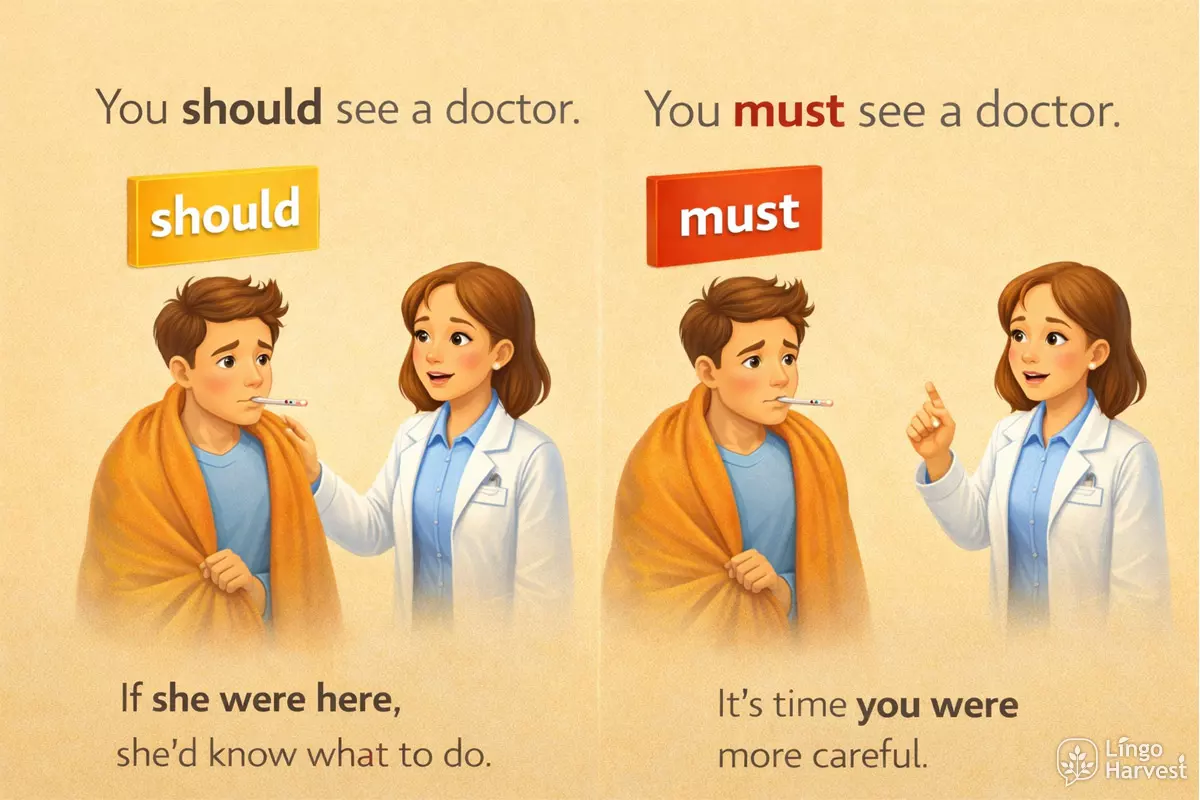
| You should see a doctor. | Advice, gentle recommendation | Speaker suggests a course of action without authority. |
| You ought to see a doctor. | Moral advice, expectation | Slightly stronger than “should”, often implies responsibility. |
| You must see a doctor. | Strong recommendation or command | Urgency or authority; speaker sees no alternative. |
| She might be home. | Weak possibility | Speaker lacks evidence; high uncertainty. |
| She may be home. | Formal possibility | Common in academic or written English. |
| She could be home. | Speculative possibility | One option among several; exploratory tone. |
| She is probably home. | High likelihood | Inference based on indirect evidence. |
| She must be home. | Logical certainty | Deduction, not obligation; strong confidence. |
| She is home. | Certainty, factual statement | Speaker presents the information as a fact. |
The table above shows how changing just one word can shift the emotional weight or social meaning of a sentence. Native speakers often rely on such shifts to avoid misunderstandings or to fit the situation—whether softening a demand, expressing doubt, or showing respect. Mastery of these subtleties is a hallmark of fluent, natural speech.
Register differences: casual vs formal speech
Native speakers instinctively adjust their verb forms depending on the situation, audience, and context. In informal conversations—among friends, family, or peers—people often simplify grammar, use contractions, and favor shorter words. In contrast, more formal contexts—such as meetings, presentations, or written correspondence—call for standard forms, complete structures, and sometimes more complex tenses.
Key ways verb forms shift between informal and formal contexts
- Contractions: Common in relaxed speech (“I’m”, “they’ll”) but less frequent in formal language.
- Omission: Auxiliary verbs and pronouns are sometimes dropped in casual talk (“Gonna go?” instead of “Are you going to go?”).
- Nonstandard forms: Slang or regional forms (“ain’t”, “gotta”) appear in everyday exchanges but are avoided in official settings.
- Verb tense selection: The simple present and present continuous often replace more precise forms in speech (“I go” vs. “I am going”).
- Progressive over perfect: “I’ve been working” may become “I’m working” in quick conversation, even if the meaning shifts slightly.
- Passive voice: More common in formal or academic language (“The results were analyzed…”), while active voice dominates in casual speech (“We checked the results…”).
- Modality: Polite modal verbs like “would,” “could,” and “might” are preferred in formal requests, whereas “can” and “will” are frequent in relaxed exchanges.
- Tag questions: Informal speech often uses short tags (“You’re coming, right?”), while formal contexts use full questions (“Are you coming?”).
- Expanded forms: Full sentences and explicit subjects are expected in official writing or speech, but dropped subjects (“Got it”) are common among friends.
- Verb shortening: Reductions like “wanna,” “gonna,” and “gotta” are typical in speech but avoided in writing.
Examples: Comparing casual and formal verb use
| Casual Speech | Formal Speech |
|---|---|
| She’s gonna leave soon. | She is going to leave soon. |
| Did you get it? | Did you understand the instructions? |
| We’re done, right? | Are we finished? |
| He’s been working here a while. | He has been employed here for some time. |
| You gotta see this! | You should see this. |
| I can’t make it. | I am unable to attend. |
| They’ll let us know. | They will inform us. |
| What’d you do? | What did you do? |
| He ain’t coming. | He is not coming. |
| We gotta go. | We have to leave. |
Ultimately, the choice between relaxed and formal verb forms depends on social expectations, familiarity, and the purpose of communication. Native speakers often switch registers seamlessly, reflecting both their relationship with listeners and the norms of the context. Recognizing these differences can help learners sound more natural and appropriate in a range of real-life situations.
Typical learner issues with natural choices
Learners often find it difficult to select the most natural verb forms when speaking, even after mastering grammar rules. This challenge usually stems from differences between textbook patterns and the flexible, context-driven choices native speakers make in real conversations. Understanding why non-native speakers struggle can help pinpoint areas for focused practice.
Common struggles in verb form selection
- Overusing simple present when a continuous form sounds more natural
- Applying past simple for actions with present relevance, instead of present perfect
- Missing the subtle uses of modal verbs for politeness or nuance
- Confusing stative and dynamic verbs (e.g., “I am knowing” instead of “I know”)
- Translating directly from their native language, leading to awkward verb tense choices
- Misplacing auxiliary verbs in questions and negatives
- Choosing the wrong tense for storytelling or narration
- Forgetting to use contractions, making speech sound robotic
- Sticking to regular forms and avoiding irregular verbs due to uncertainty
- Omitting phrasal verbs, which are common in spontaneous speech
- Using future forms (“will”) instead of “going to” for planned events
- Failing to shift tenses naturally in dialogues or when reporting speech
- Overusing progressive forms where simple forms are more idiomatic
- Neglecting aspect (simple, continuous, perfect) distinctions that signal subtle meaning
- Relying on “do” support incorrectly in statements
- Not matching subject-verb agreement in spontaneous speech
- Forgetting to reduce or omit auxiliary verbs in casual questions (“You coming?”)
Comparison: Textbook patterns vs. authentic usage
| Textbook Example | Natural Spoken Version |
|---|---|
| I do not know. | Dunno. |
| She will arrive soon. | She’s gonna be here soon. |
| Did you eat? | You eat yet? |
| I am going to sleep now. | I’m off to bed. |
| I have finished my work. | All done with work. |
Why do these issues persist?
Much of the difficulty comes from the dynamic, context-sensitive way verbs are used in natural speech. Unlike written language, conversations often feature contractions, omissions, and informal verb choices. Learners may also hesitate to use these forms out of fear of making mistakes or sounding too casual. Exposure to real conversations, active listening, and targeted practice with authentic audio can help bridge the gap between classroom knowledge and fluent, natural expression.
Homework: listening-based verb choice tasks
Listening exercises are a practical way to observe how native speakers select verb forms in authentic contexts. By focusing on real dialogues or recordings, learners can attune their ear to subtle cues that influence tense, aspect, and mood. This section provides structured activities to help you practice recognizing and choosing appropriate verbs as they occur in spoken language.
Task 1: Listen and Choose
Play a short audio clip of natural conversation (for example, a podcast or interview). As you listen, pause after each sentence and decide which verb form fits best. This helps sharpen your awareness of native-like choices based on context, intent, and surrounding words.
- After listening, note down the verbs you hear.
- For each verb, consider why that specific tense or aspect was chosen (e.g., simple past, present perfect).
- If possible, replay the segment and check your answers.
Common Patterns: What to Listen For
- Switches between past and present when telling stories
- Use of progressive forms to describe ongoing actions
- Modal verbs for speculation, requests, or advice
- Present perfect for experiences or recent events
- Simple present for routines or general truths
- Future forms (will, going to) for plans or predictions
- Conditional forms to express hypotheticals
- Imperatives for instructions
- Passive voice when the agent is unknown or unimportant
- Infinitives after certain verbs (want to go, need to see)
- Gerund forms after verbs like enjoy, finish, avoid
- Ellipsis: omitting repeated verbs in rapid speech
- Shortened forms (I’d, he’s, we’re) in casual dialogue
- Changing verb forms for emphasis or contrast
- Question forms: inversion and auxiliary use
Practice Table: Verb Forms in Context
| Audio Excerpt | Verb Form Used | Reason/Context |
|---|---|---|
| "I was running when I saw her." | Past continuous | Ongoing action interrupted by another event |
| "She has finished her homework." | Present perfect | Action completed with relevance to the present |
| "Will you help me?" | Modal + base form | Request or offer |
| "If I had known, I would have called." | Past perfect | Hypothetical/unreal past condition |
| "People say it’s a nice place." | Simple present | General truth or repeated action |
Quiz: Choose the Correct Verb
Listen to the following sentences and decide which verb form fits best in each blank. Write your answers before checking.
- While I ____ (walk) home, it started to rain.
- They ____ (finish) the project already.
- If you ____ (call) earlier, I would have answered.
- She ____ (go) to the gym every morning.
- Will you ____ (join) us for dinner?
- By the time we arrived, the meeting ____ (start).
- He usually ____ (work) late on weekdays.
- I ____ (never / see) such a response before.
- When she was a student, she ____ (live) abroad.
- If he ____ (know) the truth, he would act differently.
Show answers
- was walking
- have finished
- had called
- goes
- join
- had started
- works
- have never seen
- lived
- knew
Tips for Effective Listening Practice
- Use transcripts to confirm your choices after listening.
- Note any differences between written and spoken verb forms.
- Focus on intonation and stress, which often signal verb choices.
- Replay unclear segments and slow down playback if needed.
- Try shadowing: repeat sentences aloud to reinforce patterns.
By regularly practicing with real speech, you’ll become more comfortable identifying and using the range of verb forms that native speakers rely on in everyday communication.