Verbs of Change and Result: Become, Grow, Turn, Remain

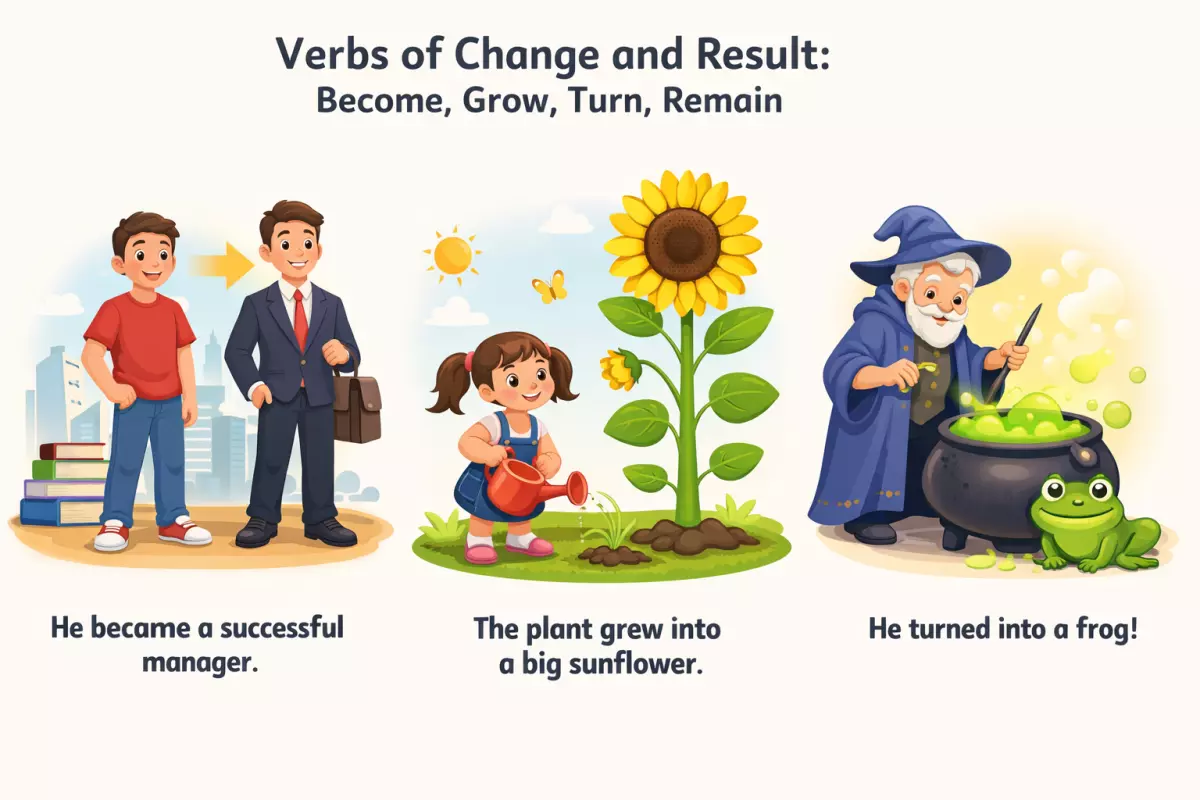 Explains what change and result verbs mean, then shows patterns for become, and how grow, turn, and go describe shifts. Covers remain, stay, and keep for no change, plus verb + adjective/noun patterns, common mistakes, style tips, and homework practice tasks.
In everyday English, we describe how people and things change or stay the same with verbs like become, grow, turn, and remain. You hear them in real life: a child grows confident, milk turns sour, a plan becomes successful, or a room remains quiet. Knowing the differences helps you sound natural and pick the verb that best matches the result you mean.
What change and result verbs express
These verbs describe how a subject moves into a new state or stays in the same state. They commonly link the subject to an adjective or noun phrase that names the final condition, identity, or status (rather than an action).
Core meanings you can express
- Entering a new state: the subject changes and ends up different. (Typical with become, grow, turn.)
- Gradual development: the change happens over time, often step by step. (Often with grow.)
- Noticeable shift: the change is seen as a clear switch into another condition, sometimes sudden. (Often with turn.)
- Staying the same: no change; the subject continues in an existing condition. (With remain.)
- Result focus: the grammar highlights the end state more than the process (common with all four verbs).
Common patterns (what usually comes after the verb)
- Verb + adjective: to describe a state or quality.
- ✅ The room became quiet.
- ✅ He grew confident.
- ✅ The sky turned dark.
- ✅ The situation remained unclear.
- Verb + noun phrase: to describe identity, role, or category (especially with become and remain).
- ✅ She became a manager.
- ✅ It remained a mystery.
- Verb + comparative adjective: to show movement along a scale.
- ✅ The days are growing shorter.
- ✅ The problem became more serious.
- Verb + “to be” + complement: to explain or define the resulting state more fully.
- ✅ It turned out to be a mistake.
- ✅ The plan proved to be unrealistic. (Similar result meaning, different verb.)
Typical uses and example meanings
- become: neutral, general change into a new state or identity.
- ✅ The noise became unbearable.
- ✅ After training, he became a pilot.
- grow: gradual change, often natural or progressive.
- ✅ She grew tired during the long meeting.
- ✅ Trust grows stronger with time.
- turn: clear shift, frequently used for colors, weather, mood, or conditions.
- ✅ The leaves turned red.
- ✅ The conversation turned awkward.
- remain: continuing state; emphasizes stability or lack of change.
- ✅ The door remained closed.
- ✅ Prices remained high.
What these verbs usually do not express
- Deliberate actions by the subject; they act as linking verbs, not action verbs.
- ❌ She became the report. → (Use an action verb: She wrote/finished the report.)
- Direct objects in the typical “verb + object” sense; the complement describes the subject.
- ✅ The milk turned sour. (sour describes milk)
- ❌ The milk turned sourness. (unnatural structure)
Become and its common patterns
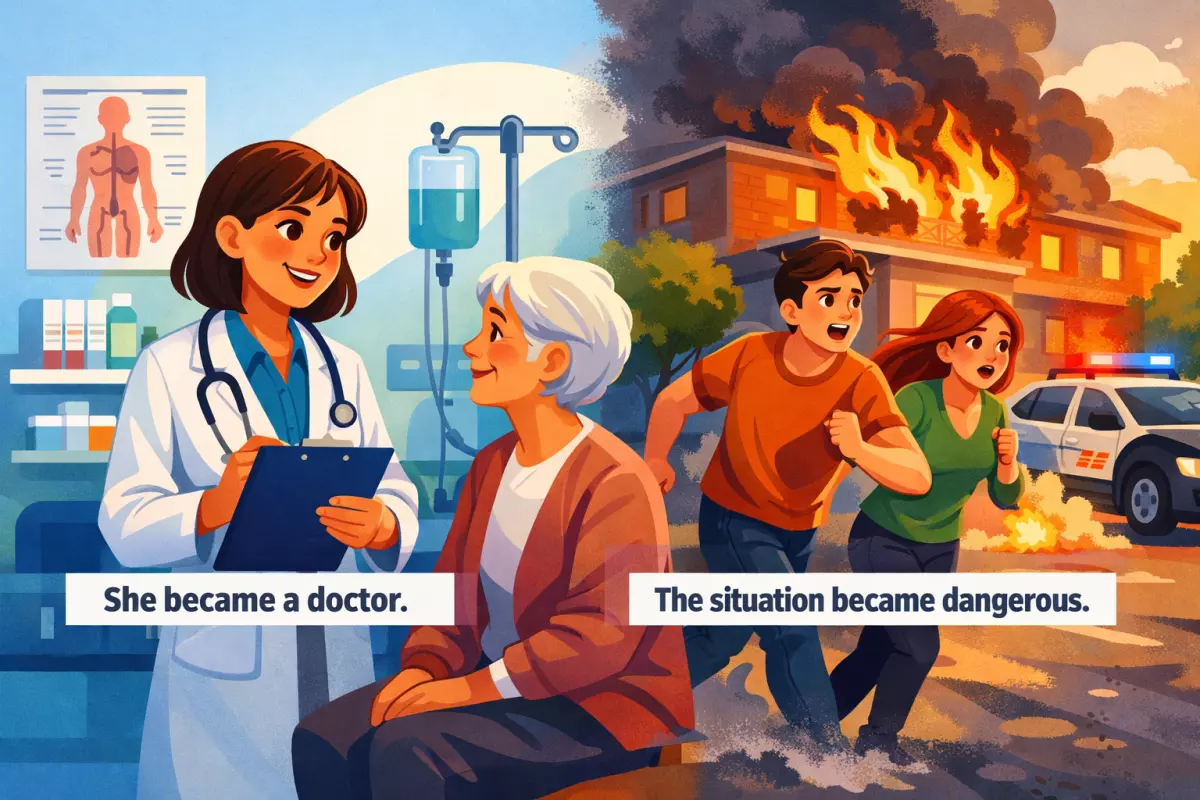
Use become to show a change into a new state, identity, or role. It focuses on the result (what someone or something is after the change), not on the process. It works well for clear outcomes like jobs, statuses, labels, and conditions.
Core grammar patterns
- become + noun (new identity/role): “She became a doctor.”
- become + adjective (new state/condition): “The situation became dangerous.”
- become + noun phrase with modifier: “He became the team leader.”
- become + comparative adjective (change over time): “It became more difficult to park.”
- become + adjective phrase: “The room became too noisy to work.”
- become + past participle used as adjective: “The plan became complicated.”
- become + prepositional phrase (common with “of” in formal style): “It became of interest to researchers.”
Common tense choices and what they imply
- Past simple for a completed change: “After the merger, the company became profitable.”
- Present simple for general truths or repeated patterns: “Small problems become serious if ignored.”
- Present perfect to connect past change to now: “The neighborhood has become quieter.”
- Future for expected results: “If demand rises, prices will become higher.”
- Progressive is possible but less common; it highlights an ongoing shift: “It’s becoming harder to concentrate.”
High-value example patterns (expanded)
- become + job/title: “She became a manager.”
- become + nationality/status label: “He became a citizen.”
- become + age-related state: “They became adults.”
- become + relationship status: “They became friends.”
- become + adjective of quality: “The water became clear.”
- become + adjective of emotion: “I became anxious.”
- become + adjective of difficulty: “The task became impossible.”
- become + adjective of availability: “Tickets became scarce.”
- become + comparative: “The days became shorter.”
- become + “more/less” + adjective: “It became more efficient.”
- become + “too” + adjective: “It became too risky.”
- become + “adj + enough” + to-infinitive: “It became easy enough to use.”
- become + “a/an + adjective + noun”: “It became an urgent matter.”
- become + “the + superlative + noun” (resulting status): “She became the youngest winner.”
- become + “a symbol of …”: “The bridge became a symbol of the city.”
- become + “part of …”: “The phrase became part of everyday speech.”
Frequent learner issues (and fixes)
- Using “become” where a process verb is better: “He became better at chess” is possible, but “He got better at chess” is more natural for gradual improvement.
- Confusing “become” with “be”: ❌ “He became tired every day.” ✅ “He was tired every day.” (Use “be” for a repeated state, not a change each time.)
- Overusing passive-style forms: prefer direct results when possible (e.g., “It became clear” rather than longer alternatives).
- Register mismatch: “become” often sounds neutral-to-formal; in casual speech, “get” is often chosen (“It got cold”).
Grow, turn, and go for changes
These verbs often describe a shift in state, appearance, or situation. They are especially common when the change feels gradual (grow), noticeable or surprising (turn), or like a move into a new phase (go). Each verb prefers certain complements and sounds natural in particular contexts.
Grow: gradual development or increasing intensity
Grow is used for changes that happen over time: feelings deepen, problems increase, and people or things develop. It commonly appears with adjectives, and with the pattern grow + comparative.
- grow + adjective: “The nights grew colder.” / “She grew anxious.”
- grow + comparative: “It’s growing harder to concentrate.” / “He grew more confident.”
- grow + to + verb (more formal): “I grew to appreciate the routine.”
- grow + noun (meaning “become” in fixed uses): “They grew friends over the years.” (less common; often replaced by “became friends”)
- Typical subjects: people, relationships, doubts, tension, interest, distance, problems.
- Natural time markers: “over time,” “gradually,” “as the months passed.”
- Common collocations: “grow tired,” “grow impatient,” “grow stronger,” “grow quieter,” “grow worse.”
- Contrast: use get for more neutral everyday change; use grow when the slow build matters.
Turn: a noticeable shift, often in color, mood, or condition
Turn often suggests a clear change from one state to another, sometimes sudden. It is frequent with colors and with reactions that show on the face or in behavior.
- turn + adjective: “The sky turned dark.” / “He turned silent.”
- turn + color: “Her face turned red.” / “The leaves turn yellow in autumn.”
- turn + noun (role/status, sometimes informal): “He turned professional at 18.” / “The discussion turned an argument.” (more natural as “turned into an argument”)
- turn + into + noun: “The small issue turned into a major complaint.”
- turn + out + (to be) + complement (result/discovery): “It turned out to be a misunderstanding.”
- Typical triggers: weather changes, emotional reactions, situations changing direction.
- Common collocations: “turn pale,” “turn nasty,” “turn sour,” “turn serious,” “turn ugly.”
- Meaning difference: “turn quiet” often implies a shift you can observe; “become quiet” can sound more neutral or descriptive.
Go: moving into a different state, often negative or “not working”
Go is widely used for changes to an undesirable condition, for food and materials becoming bad, and for systems failing. It also appears in fixed phrases about changing missing or unavailable.
- go + adjective (often negative): “The milk went sour.” / “The plan went wrong.”
- go + bad/off (food): “The fish has gone off.” / “The fruit went bad.”
- go + missing: “Several files went missing.”
- go + silent/quiet: “The line went dead.” / “The room went quiet.”
- go + bankrupt: “The company went bankrupt.”
- go + crazy/mad (informal): “He went crazy when he heard.”
- go + wrong (fixed): “Something went wrong during the update.”
- Typical subjects: food, machines, plans, lights, phones, businesses, situations.
- Register note: many go change phrases are idiomatic; they sound natural because they are conventional combinations (go wrong, go quiet, go missing).
Choosing between them in practice
- Use grow when the change builds gradually: “The pressure grew intense.”
- Use turn when the shift is clear or visible: “His expression turned cold.”
- Use go for failure, spoilage, or a move into a bad state: “The computer went slow after the update.”
- For neutral everyday change, get is often the simplest option; these three add extra meaning about how the change happens.
- Check complement patterns: colors strongly prefer turn; “wrong/off/missing” strongly prefer go; comparatives strongly prefer grow.
Remain, stay, keep for no change
Use these verbs when the subject does not change state. They often describe stability in condition, position, opinion, or level, and they commonly appear with adjectives, prepositional phrases, or (with remain) a noun phrase.
Core patterns
- remain + adjective: “remain calm/quiet/closed/uncertain.”
- remain + noun phrase (more formal): “remain a mystery/a problem/the best option.”
- remain + past participle: “remain unchanged/unanswered/unresolved.”
- remain + prepositional phrase: “remain in place/in control/under pressure.”
- stay + adjective (everyday): “stay warm/awake/positive.”
- stay + prepositional phrase: “stay at home/in bed/on the path.”
- keep + adjective (often with an object implied or stated): “keep quiet,” “keep the door closed.”
- keep + object + adjective: “keep the room tidy,” “keep your hands clean.”
- keep + object + prepositional phrase: “keep it in the fridge,” “keep the files on the server.”
- keep + -ing (continuing an action): “keep working,” “keep trying.”
Meaning and usage differences
- Remain is neutral to formal and focuses on a state continuing: “The cause remains unclear.”
- Stay is common in speech and often suggests “not leaving” or “not changing”: “Stay seated.”
- Keep often adds the idea of maintaining something actively (sometimes by effort): “Keep the children quiet.”
- Remain works well in reports and academic writing; stay fits instructions and everyday situations; keep is frequent in rules, advice, and management of conditions.
Common example sentences (stable state)
- The situation remains serious.
- Prices remained stable throughout the year.
- Several questions remain unanswered.
- The building remained closed after the inspection.
- Please stay calm and follow the instructions.
- It’s cold outside, so stay warm.
- We decided to stay at home tonight.
- Stay on the main road until you reach the bridge.
- Keep the window closed during the storm.
- Keep your voice low in the library.
- Keep the documents in a safe place.
- Keep the meeting short and focused.
- Even under pressure, she kept her composure.
- They kept working until the job was finished.
Typical errors to avoid
- ❌ “The problem remains to solve.” → ✅ “The problem remains unsolved.” / “The problem still needs to be solved.”
- ❌ “Stay the door closed.” → ✅ “Keep the door closed.”
- ❌ “Keep at home today.” → ✅ “Stay at home today.”
- ❌ “Remain happy!” (sounds unnatural as an instruction) → ✅ “Stay happy!” / “Keep a positive attitude.”
- ❌ “The answer stayed unclear.” (possible but less natural in formal writing) → ✅ “The answer remained unclear.”
Verb + adjective and verb + noun patterns

With become, grow, turn, and remain, the most common complement is an adjective (to describe a new or continuing state) or a noun phrase (to identify a new or continuing role, identity, or category). Choosing adjective vs. noun depends on what you want to express: a quality (adjective) or a label/position (noun).
1) Verb + adjective: describing a state or quality
Use this structure when the complement answers “What is it like?” or “In what condition/state?” These verbs behave like linking verbs here: they connect the subject to a description rather than to an action.
- become + adjective: focuses on a change into a new state.
- The sky became dark.
- His explanation became clearer after the example.
- The situation became complicated quickly.
- grow + adjective: often gradual change; common with comparatives.
- She grew tired during the long meeting.
- Prices are growing higher each month.
- He grew more confident over time.
- turn + adjective: noticeable shift, often sudden; very common with colors and “bad” outcomes.
- The leaves turned yellow in autumn.
- The milk has turned sour.
- The conversation turned awkward.
- remain + adjective: no change; the state continues.
- Please remain silent during the test.
- The door remained closed all day.
- Her reasons remain unclear.
- Comparatives and intensifiers fit naturally with these verbs.
- It became even worse after the delay.
- They grew increasingly anxious as time passed.
- He remained completely calm.
- Correct vs incorrect form: after these linking verbs, use an adjective (not an adverb) to describe the subject.
- ✅ She became angry. ❌ She became angrily.
- ✅ He remained quiet. ❌ He remained quietly.
2) Verb + noun (noun phrase): identifying a role, category, or status
Use this structure when the complement answers “What did it become?” or “What is it (now)?” The complement is usually a noun phrase (often with an article) or a plural noun for categories.
- become + noun phrase: common for jobs, titles, and identities.
- She became a doctor.
- That small idea became a global project.
- He became the team leader in 2024.
- grow + noun phrase: less common than adjective complements; used for development into a role, especially with “grow into.”
- He grew into a confident speaker.
- The startup grew into a major competitor.
- She grew into the role after a few weeks.
- turn + noun: used for changes of type/status, often with “turn into” for transformation.
- The discussion turned into an argument.
- The caterpillar turned into a butterfly.
- The day turned into a disaster after the storm.
- remain + noun phrase: continuing identity/status; often formal.
- She remained a close friend despite the move.
- He remains the best candidate.
- These questions remain a problem for the team.
- Articles and determiners matter: singular countable nouns usually need a/an or the.
- ✅ He became a manager. ❌ He became manager.
- ✅ She remained the owner of the company.
- ✅ They became friends. (plural, no article needed)
3) Choosing the pattern: what meaning do you want?
- Use an adjective to highlight a quality or condition: became quiet, grew stronger, turned red, remained open.
- Use a noun phrase to label a role or category: became a citizen, grew into a leader, turned into a trend, remained the priority.
- If both are possible, the meaning changes slightly:
- He became famous. (quality/status)
- He became a celebrity. (category/identity)
Common mistakes and corrections
These verbs follow specific patterns for grammar and meaning. Many errors come from mixing structures (adjective vs. noun), choosing the wrong verb for the type of change, or using an unnecessary preposition.
- Using “become” with the wrong complement
❌ She became to a doctor. → ✅ She became a doctor.
Use become + noun/adjective (no preposition): become a teacher, become famous. - Confusing “become” and “become to”
❌ It became to be difficult. → ✅ It became difficult.
If you want an infinitive, use a different structure: ✅ It started to be difficult / It became difficult. - Overusing “become” when the change is gradual
❌ The weather became colder and colder every day. → ✅ The weather grew colder every day.
Grow often fits slow, natural development (age, confidence, temperature, interest). - Using “grow” for sudden or deliberate change
❌ He grew angry when he saw the message. → ✅ He became angry / He turned angry.
For quick reactions, become or turn is usually more natural than grow. - Mixing up “turn” (change) and “turn” (rotate)
❌ She turned a doctor. → ✅ She became a doctor.
Use turn for changes of state, especially visible or noticeable ones (turn red, turn cold), not for professions. - Wrong preposition after “turn” for topics
❌ The discussion turned to an argument. → ✅ The discussion turned into an argument.
Use turn into for transformation; use turn to for direction/attention: ✅ She turned to her friend for help. - Confusing “turn into” and “become” with people
❌ He turned into a manager last year. → ✅ He became a manager last year.
Turn into is common for dramatic transformations (often physical or surprising), less common for job changes. - Using “remain” to express change
❌ He remained tired after the nap (meaning he got tired). → ✅ He became tired after the nap.
Remain means “stay the same,” not “change.” - Forgetting that “remain” often needs a complement
❌ Despite the noise, she remained. → ✅ Despite the noise, she remained calm.
Common patterns: remain + adjective, remain + noun, remain + in/on/at. - Using “remain to” incorrectly
❌ The problem remains to unsolved. → ✅ The problem remains unsolved.
Use remain + past participle/adjective: remain closed, remain unknown, remain unresolved. - Confusing “remain” and “stay” in formal vs. informal tone
❌ Please remain here for a second (very casual context). → ✅ Please stay here for a second.
Both can work, but remain is more formal and common in writing or official instructions. - Choosing the wrong adjective pattern
❌ She became success. → ✅ She became successful.
Use a noun after become (a success) or an adjective (successful), but don’t mix them. - Using “grow” with a noun where an adjective is expected
❌ He grew a leader. → ✅ He grew into a leader / He became a leader.
Grow into + noun is the natural pattern for developing into a role. - Missing “into” after “grow” for roles and identities
❌ She grew a confident speaker. → ✅ She grew into a confident speaker.
Use grow into when someone gradually fits a new role or situation. - Using “turn” with age in the wrong structure
❌ He turned to 30 last week. → ✅ He turned 30 last week.
Age uses turn + number (no preposition): turn 18, turn 40. - Confusing “turn” and “become” with colors and physical states
❌ The leaves became yellow (possible, but less vivid). → ✅ The leaves turned yellow.
For visible changes (color, facial expression), turn + adjective is often the best choice. - Wrong tense choice for a completed change vs. a continuing state
❌ He has become here since Monday. → ✅ He has been here since Monday / He has remained here since Monday.
Use become for the change itself; use be/remain for the continuing situation. - Using a change verb when you need a result verb
❌ The plan became to be a failure. → ✅ The plan turned out to be a failure.
When you mean “the result was,” consider turn out (to be) rather than a change-of-state verb.
Quick pattern reminders
- become + noun/adjective: become a parent; become clearer
- grow + adjective (gradual): grow stronger; grow impatient
- grow into + noun: grow into a role; grow into a leader
- turn + adjective (often visible/sudden): turn red; turn silent
- turn into + noun (transformation): turn into a problem; turn into a habit
- remain + adjective/noun/past participle: remain calm; remain a mystery; remain closed
Style tips for clear descriptions
Make change-and-result verbs easy to follow by showing (1) what changes, (2) what it changes into, and (3) whether the change is a process or a final state. Small choices—tense, adjective vs. noun, and the presence of an explicit cause—often determine whether a sentence sounds natural.
1) Match the verb to the type of change
- Use become for a clear shift into a new state, especially with roles or identities: “She became a manager.”
- Use grow for gradual development over time: “The days grew shorter.”
- Use turn for a noticeable change that can feel sudden, surprising, or visual: “The sky turned gray.”
- Use remain when emphasizing no change despite expectations: “The schedule remained the same.”
2) Choose the right complement (adjective vs. noun)
- Adjectives are common after all four verbs: “become quieter,” “grow impatient,” “turn cold,” “remain calm.”
- Nouns are especially natural after become: “become a doctor,” “become an issue,” “become the priority.”
- Turn + noun is more limited and often fixed or idiomatic: “turn traitor,” “turn professional.”
- Remain + noun works when the noun is a role/status: “remain president,” “remain a member,” but adjectives are usually smoother for general descriptions.
3) Make time and progression explicit when needed
- Use time markers with grow to support the “process” meaning: “Over the years, he grew more confident.”
- Use become when the endpoint matters more than the journey: “After the merger, the company became profitable.”
- Use turn with “suddenly,” “quickly,” or a triggering moment for a crisp shift: “The conversation turned tense after the question.”
- Use remain with contrast cues to highlight stability: “Despite the delay, the plan remained unchanged.”
4) Control formality and tone
- Become tends to sound neutral to formal in writing: “The risk became apparent.”
- Grow can sound reflective or narrative: “She grew tired of the routine.”
- Turn often feels vivid and conversational: “It turned weird fast.”
- Remain is common in formal reporting: “The cause remains unknown.”
5) Avoid common pattern mistakes
- ✅ “He became angry.” ❌ “He became angrily.” (Use an adjective, not an adverb.)
- ✅ “The milk turned sour.” ❌ “The milk turned sourly.”
- ✅ “She grew more patient.” ❌ “She grew patienter.” (Use “more + adjective” for most longer adjectives.)
- ✅ “It remained quiet.” ❌ “It remained to be quiet.” (Do not add an infinitive here.)
- ✅ “They remained friends.” ❌ “They remained as friends.” (Usually no “as” after “remain.”)
6) Use concise, reusable patterns
- become + adjective: “become available,” “become obvious,” “become difficult.”
- become + noun: “become a habit,” “become a problem,” “become the standard.”
- grow + comparative: “grow older,” “grow faster,” “grow stronger.”
- grow + more/less + adjective: “grow more cautious,” “grow less interested.”
- turn + color/condition adjective: “turn red,” “turn pale,” “turn silent,” “turn bitter.”
- turn + negative/awkward shift: “turn hostile,” “turn messy,” “turn complicated.”
- remain + adjective: “remain open,” “remain stable,” “remain unclear.”
- remain + past participle: “remain unchanged,” “remain closed,” “remain unnoticed.”
7) Add (or omit) the cause strategically
- To keep focus on the result, place the cause after the change: “The room grew quiet when the lights went out.”
- To emphasize the trigger, lead with it: “After the announcement, the mood turned tense.”
- When the reason is unknown or irrelevant, remain is useful: “The error remains unexplained.”
Homework: change verb practice tasks
Focus on choosing the most natural verb for a change or end state, and on building correct patterns (adjective vs. noun complement, time expressions, and “remain” for no change). Complete the tasks in order; they move from controlled practice to freer writing.
1) Choose the best verb (become / grow / turn / remain)
- After the merger, the company ______ more competitive.
- As the years passed, their friendship ______ stronger.
- When she heard the news, her face ______ pale.
- Despite the budget cuts, the service ______ reliable.
- The water in the kettle ______ hot in a few minutes.
- He trained every day and ______ faster each month.
- The sky ______ dark before the storm arrived.
- Even after the apology, he ______ angry.
- With practice, the task ______ easier.
- During the discussion, the room ______ silent.
- Over time, the neighborhood ______ safer.
- After the lights went out, everything ______ black.
Show answers
- became
- grew
- turned
- remained
- becomes
- grew
- turned
- remained
- became
- turned
- grew
- turned
2) Fix the pattern (rewrite each sentence)
- She became to a doctor after university.
- The weather grew coldly by evening.
- He turned a manager last year.
- The milk became sourly in the fridge.
- They remained to be calm during the emergency.
- His voice grew more quietly when the teacher entered.
- The leaves turned to yellow in October.
- The plan became success after the changes.
Show answers
- She became a doctor after university.
- The weather grew cold by evening.
- He became a manager last year.
- The milk became sour in the fridge.
- They remained calm during the emergency.
- His voice grew quieter when the teacher entered.
- The leaves turned yellow in October.
- The plan became a success after the changes.
3) Match the meaning to the verb (write the verb only)
- Slow, gradual change over time: ______
- Sudden/noticeable change in color or condition: ______
- Change into a new role/identity or a new state (often more general): ______
- No change; stay the same: ______
- Typical with “older/taller/stronger”: ______
- Typical with colors (red/pale/green): ______
Show answers
- grow
- turn
- become
- remain
- grow
- turn
4) Expand with a complement (adjective or noun)
Add a natural complement after the verb. Keep each sentence realistic and grammatically complete.
- After the move, I became ______.
- With daily practice, her pronunciation grew ______.
- When the alarm sounded, the hallway turned ______.
- Even under pressure, he remained ______.
- Over the semester, the lectures became ______.
- As the deadline approached, the team grew ______.
- In autumn, the hills turn ______.
- After the investigation, the rumor remained ______.
5) Short writing task (use all four verbs)
Write 8–10 sentences about a project, a relationship, a place, or a personal habit. Requirements:
- Use become at least twice (one with a noun: “became a …”).
- Use grow at least twice (with a comparative: “grew more … / grew …-er”).
- Use turn at least twice (one with a color or physical condition).
- Use remain at least twice (show something that did not change).
- Include at least two time markers (e.g., “over time,” “within a week,” “by the end”).
6) Error spotting (choose the incorrect sentence numbers)
Read the sentences and list the numbers that are not natural or not correct. Do not rewrite yet.
- He became tired after the flight.
- The soup turned delicious after I added salt.
- She grew more confident each week.
- The screen turned black suddenly.
- They remained to be friends for years.
- My brother became an engineer.
- The situation grew worse overnight.
- The room remained quiet during the test.
Show answers
- 2
- 5