Present Continuous with Action and State Verbs

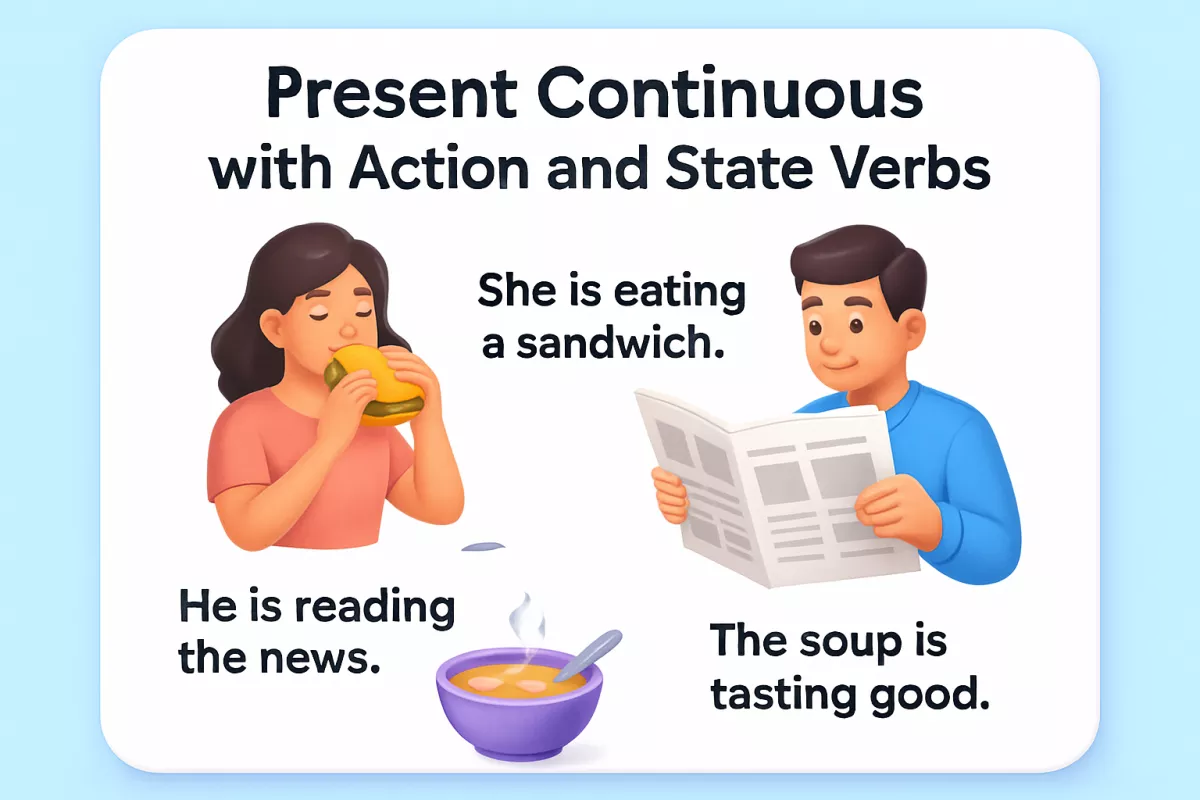 Here we the uses of the present continuous tense, its formation with am, is, or are plus -ing, differences between action and state verbs, temporary situations versus routines, future plans, spelling rules, and typical mistakes, with practice exercises.
Have you ever wondered why we say "I'm eating dinner" but not "I'm knowing the answer"? The reason lies in how English uses the "-ing" form, known as the present continuous. This form focuses on actions that are happening now or around the present moment. However, some verbs describe states rather than actions, which makes the "-ing" form sound unnatural with them. Understanding this difference helps learners choose the correct tense and sound more natural in everyday English.
What present continuous expresses
The present continuous tense is used to describe actions and situations connected to the present moment. It highlights activity, change, or arrangement rather than permanent facts. Below are the main contexts where this tense is typically used.
Describing actions happening at the moment
The most common use of the present continuous is to show that an action is in progress right now, at the time of speaking.
- She is eating lunch → the action is happening at this exact moment.
- They are watching a movie → the activity is currently in progress.
- I am writing an email → the task has started but is not finished.
- We are learning English now → the activity is ongoing at present.
- It is raining outside → the situation is true at the moment of speaking.
- The baby is sleeping → the action is temporary and happening now.
In all these examples, the focus is on actions that are unfinished and actively happening.
Talking about temporary or changing situations
The present continuous is also used for situations that are temporary or developing, even if they are not happening at the exact second of speaking.
- He is staying with his parents this week → the situation is temporary.
- Prices are rising these days → this describes a current trend.
- I am working from home lately → the arrangement is not permanent.
- People are becoming more aware of climate change → this shows gradual change.
- She is taking an online course this month → the situation has a limited duration.
Here, the tense emphasizes change, contrast with the usual situation, or limited time.
Expressing future plans or arrangements
The present continuous can describe future events when they are already planned or arranged, often involving a specific time or other people.
- We are meeting Sarah at 6 pm → the meeting is scheduled.
- I am flying to Berlin next Monday → travel plans are already set.
- They are starting a new project soon → the decision has been made.
- She is seeing the doctor tomorrow → the appointment is arranged.
- We are having dinner with clients tonight → the plan is fixed.
This use shows certainty and preparation, not a spontaneous decision.
Common learner questions: Action vs. state verbs
A frequent learner question is whether all verbs can be used in the present continuous form. The answer is no. Some verbs describe actions that can be seen or measured, while others describe states, feelings, thoughts, or possession. Verbs that describe states, often called state verbs (or stative verbs), are usually not used in continuous forms. Common examples include know, like, believe, own.
| Type | Example in Present Continuous | Is it correct? |
|---|---|---|
| Action verb | She is running. | ✅ Yes — physical action in progress |
| State verb | I am knowing the answer. | ❌ No — use “I know the answer.” |
| Action verb | They are making dinner. | ✅ Yes — temporary activity |
| State verb | He is liking pizza. | ❌ No — preference is a state |
| Action verb | We are talking. | ✅ Yes — action happening now |
| State verb | She is owning a car. | ❌ No — ownership is not an action |
| Mixed-use verb | He is thinking about the problem. | ✅ Yes — “think” as a mental process |
| Mixed-use verb | He thinks the answer is correct. | ✅ Yes — simple present for opinions |
Summary of practical uses
The present continuous is most commonly used in the following situations:
- Describe actions happening now or around now → She is reading an email.
- Talk about temporary or changing situations → He is working late this week.
- Discuss fixed or arranged future plans → They are meeting the client tomorrow.
- Avoid state verbs in this form → use simple present instead (I know, not I am knowing)
Focusing on whether a verb describes an action or a state makes it easier to choose the correct tense and avoid typical learner errors.
Form: am/is/are + -ing
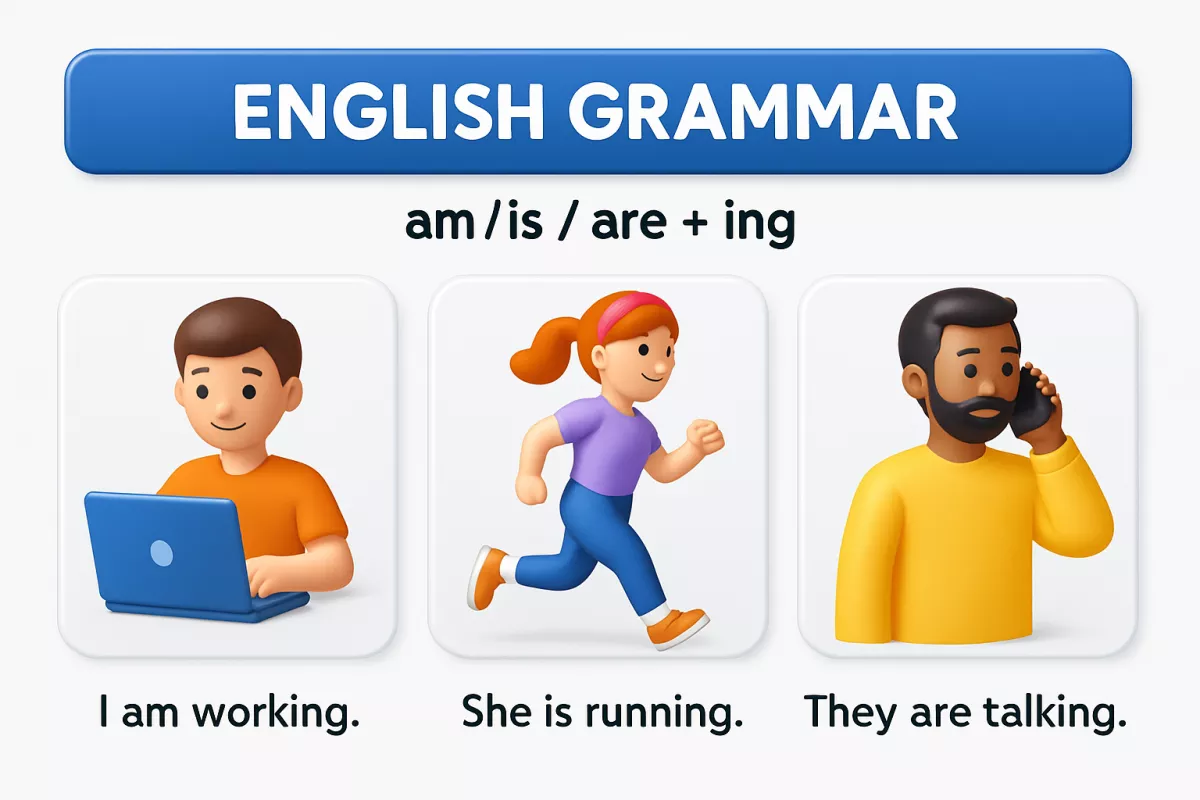
The present continuous form is built using the correct form of the verb be followed by the main verb ending in -ing. This structure highlights actions that are in progress, temporary situations, or planned future events.
Step 1: Choose the Correct Form of "Be"
Select the appropriate form of be based on the subject of the sentence:
- am – use with I → I am studying.
- is – use with he, she, it, or singular nouns → She is working.
- are – use with you, we, they, or plural nouns → They are waiting.
Step 2: Add the Base Verb + -ing
Add -ing to the base form of the main verb. In many cases, this simply means attaching the ending without other changes.
- walk → walking → He is walking to work.
- eat → eating → She is eating lunch.
- study → studying → They are studying English.
- run → running → The dog is running fast.
- swim → swimming → She is swimming in the pool.
- write → writing → He is writing a report.
- watch → watching → We are watching the news.
- make → making → They are making a plan.
- read → reading → I am reading an article.
- play → playing → The children are playing outside.
- cook → cooking → She is cooking dinner.
- listen → listening → He is listening carefully.
- drive → driving → They are driving home.
- shop → shopping → I am shopping online.
- talk → talking → We are talking about work.
- sing → singing → She is singing quietly.
- sleep → sleeping → The baby is sleeping.
- paint → painting → He is painting the wall.
- dance → dancing → They are dancing together.
Common Questions
- What about spelling changes? Verbs ending in -e drop the -e before adding -ing → make → making, write → writing. Verbs ending in a single vowel + consonant usually double the consonant → run → running, sit → sitting.
- Can I use this with all verbs? No. Some verbs describe states rather than actions and are rarely used in continuous forms → know, want, believe, own.
- How do I make negatives? Add not after am / is / are → She is not listening.
- How do I ask questions? Place am / is / are before the subject → Are you coming?
Full Structure in Sentences
The table below shows how affirmative, negative, and question forms are built in the present continuous.
| Sentence Type | Structure Example |
|---|---|
| Affirmative | She is reading a book. |
| Negative | They are not watching TV. |
| Question | Are you listening? |
| Short Answer | Yes, I am. / No, I’m not. |
| Wh-question | What are you doing? |
When to Use This Form
The present continuous is used for actions happening now, temporary situations, and current trends → I am studying for my exam right now. It is not normally used with state verbs, which describe feelings, thoughts, or possession rather than actions. When deciding whether this form is correct, check whether the verb describes something active and temporary.
Action verbs vs state verbs in -ing form
Whether a verb can be used in the -ing form depends on its meaning. Some verbs describe actions that can start and stop, while others describe states that are generally stable and do not show visible activity.
What are action verbs?
Action verbs describe activities or processes that involve movement, change, or deliberate action. These verbs are commonly used in the present continuous.
- run → She is running in the park.
- swim → They are swimming in the pool.
- read → He is reading an article.
- drive → She is driving to work.
- make → They are making dinner.
- sing → The child is singing loudly.
- play → The kids are playing outside.
- cook → He is cooking pasta.
- draw → She is drawing a sketch.
- dance → They are dancing together.
- watch → We are watching the match.
- listen → He is listening to music.
- study → She is studying for exams.
- travel → They are traveling across Europe.
- paint → He is painting the wall.
- build → The workers are building a house.
- type → She is typing an email.
- jump → The dog is jumping happily.
Because these verbs describe visible or measurable actions, they naturally fit the present continuous form.
What are state verbs?
State verbs (or stative verbs) describe conditions, feelings, thoughts, senses, or possession. These meanings are usually stable rather than “in progress,” so state verbs are not commonly used in continuous forms. Typical state verbs include:
- know → I know the answer.
- believe → They believe him.
- like → She likes jazz.
- love → He loves cooking.
- hate → I hate cold weather.
- want → We want a break.
- prefer → She prefers tea to coffee.
- understand → I understand the rule.
- need → They need help.
- belong → This book belongs to me.
- own → He owns a car.
- seem → It seems easy.
- remember → I remember your name.
- mean → What does this word mean?
- recognize → I recognize that face.
- promise → She promises to call.
- suppose → I suppose you’re right.
- sound → That sounds great.
You usually do not say: I am knowing the answer. ❌
Instead, say: I know the answer. ✅
Comparison: Action vs. State Verbs in Present Continuous
The table below shows which verbs typically work with “am/is/are + -ing” and which usually do not.
| Verb | Can use -ing form in present continuous? | Example |
|---|---|---|
| run | Yes | ✅ I am running to catch the bus. |
| eat | Yes | ✅ She is eating lunch right now. |
| work | Yes | ✅ They are working late this week. |
| know | No | ❌ He is knowing the answer. ✅ He knows the answer. |
| want | No | ❌ I am wanting coffee. ✅ I want coffee. |
| own | No | ❌ She is owning a house. ✅ She owns a house. |
| think* | Sometimes | ✅ He is thinking about his future. (process) ✅ He thinks it’s a good idea. (opinion) |
| have* | Sometimes | ✅ I am having lunch. (eat) ❌ I am having a car. (own) |
| see* | Sometimes | ✅ I am seeing the doctor tomorrow. (meeting) ✅ I see the mountains from here. (vision) |
Special cases: Verbs with both meanings
Some verbs can be action or state verbs depending on meaning. When the meaning is an activity or a process, the continuous form is often possible. When the meaning is a state, the simple form is preferred.
- Think: I am thinking about the answer (considering) → I think it’s correct (opinion)
- Have: I’m having a shower (activity) → I have a shower every morning (routine) / I have a car (possession)
- See: I’m seeing the doctor (appointment) → I see the mountains (vision)
Key tips for learners
- If the verb describes an action in progress, the -ing form is often correct → She is cooking right now.
- If the verb describes a stable state (thought, feeling, possession), use simple present → He owns a bike.
- If a verb can have two meanings, choose the tense based on meaning → She is having lunch (activity) vs. She has a car (possession).
To choose the correct form quickly, ask whether the verb describes an activity happening or developing, or a state that is simply true.
Temporary situations vs routines
Choosing between present continuous and present simple often depends on time: is something temporary and happening “around now,” or is it a routine that repeats regularly?
Present Continuous for Temporary Actions
Use the present continuous (am/is/are + -ing) for actions and situations that are temporary, changing, or limited in time.
- She is working in Paris this month → the situation is temporary.
- I am reading a new book these days → a current, short-term activity.
- They are staying with friends while their house is being repaired → temporary living arrangement.
- We are using Dad’s car today → not the usual situation.
- He is learning Spanish at the moment → a current project.
- I am not eating sugar this week → a temporary change in routine.
- My brother is living in Berlin for the summer → limited duration.
- The company is hiring new staff right now → ongoing process.
- Our neighbors are renovating their kitchen this month → temporary activity.
- She is visiting her grandmother this weekend → short, planned event.
- He is taking extra classes this term → temporary schedule.
Typical time expressions for temporary situations include: now, at the moment, this week, these days, for a while, this month.
Present Simple for Regular Habits
Use the present simple for routines, habits, facts, and repeated actions.
- I read every night before bed → a regular habit.
- She works in Paris → a stable situation.
- They usually stay at home on Sundays → repeated routine.
- We use public transport to get to work → typical behavior.
- He learns languages quickly → general ability.
- I do not eat sugar → a general rule, not just this week.
- My brother lives in Berlin → his usual home.
- The company hires new staff every year → repeated pattern.
- Our neighbors renovate their house every summer → recurring activity.
- She visits her grandmother every weekend → regular schedule.
- He takes the train to work every day → daily routine.
Common time expressions for habits include: always, usually, often, every day, on Sundays, never, once a week.
Common Learner Questions
- Can present continuous describe something that happens every day? Usually no → for regular habits, use present simple (I go to the gym every day).
- What about a short-term “new habit”? Present continuous can work if it is temporary or unusual → I’m going to the gym a lot these days.
- How to show something is unusual? Use present continuous to highlight a change from the normal routine → She’s eating out a lot lately.
Comparing Temporary Activities and Habits
| Temporary (Present Continuous) | Habitual (Present Simple) |
|---|---|
| I am working from home this week. | I work from home every Monday. |
| She is studying French at the moment. | She studies French every semester. |
| They are taking the bus today. | They take the bus to school. |
| We are eating out more than usual these days. | We eat out once a week. |
| He is living with his parents for now. | He lives with his parents. |
| She is taking extra classes this term. | She takes extra classes every autumn. |
When choosing between these tenses, focus on time and repetition: temporary situations use present continuous, while routines and general facts use present simple.
Present continuous for future plans
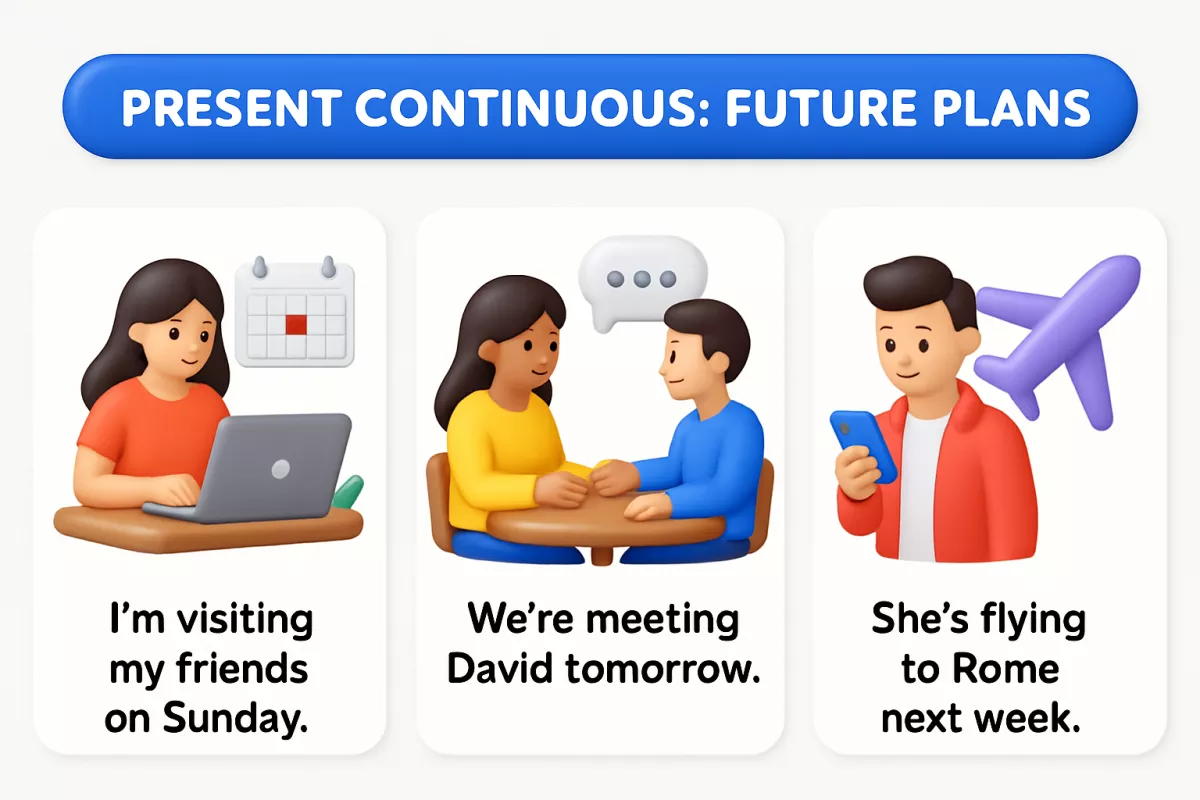
The present continuous can be used to talk about future events when the plan is already arranged. This use is common for meetings, appointments, travel, and social plans that are fixed or clearly scheduled.
How it works
The structure remains am / is / are + verb-ing. Although the form looks the same as for actions happening now, the meaning refers to the future when a specific time or arrangement is mentioned. This usage highlights certainty and preparation rather than prediction.
Examples of future arrangements
- I’m meeting my friend after work → the meeting is already planned.
- She’s flying to Paris next Thursday → travel arrangements are fixed.
- We’re having dinner with the boss tomorrow → the plan is scheduled.
- They’re visiting their grandparents this weekend → the visit is arranged.
- My parents are coming over at 6 pm → the time is agreed in advance.
- He’s starting his new job on Monday → the start date is set.
- The team is playing at home next week → the match is on the schedule.
- I’m seeing the dentist at 3 o’clock → the appointment is booked.
- We’re moving house next month → the move is already organized.
- We’re not working this Saturday → the plan is confirmed in advance.
- She’s taking her driving test on Friday → the date is fixed.
Common learner questions
- Can this form be used for all future events? → No. It is used for arranged plans, not for predictions or decisions made at the moment of speaking.
- Can it be used with state verbs? → Usually not. State verbs like know or believe are not normally used in this structure.
- What is the difference from “going to”? → Going to often expresses intention, while present continuous focuses on a fixed arrangement.
- Is it limited to the near future? → It is most common for the near future, but it can describe any future time if the plan is definite.
Comparing present continuous and other future forms
| Form | Example & Usage |
|---|---|
| Present continuous | We’re meeting at 7 pm. → A definite plan that is already arranged. |
| Going to | I’m going to meet her later. → An intention, not necessarily arranged. |
| Will | I’ll meet her later. → A decision made at the moment of speaking or a promise. |
| Simple present | The train leaves at 8 am. → A timetable or fixed schedule. |
Tips for using present continuous for future events
- Include a clear time reference → tonight, tomorrow, next week, at 6 pm.
- Use only with action verbs → avoid state verbs in this structure.
- This form often answers questions like → What are you doing tomorrow?
When a future plan is fixed and arranged, the present continuous provides a clear and natural way to describe it.
Spelling rules for -ing forms
Forming the -ing form (present participle / gerund) is often straightforward, but spelling can change depending on the verb ending. The rules below cover the most common patterns and the mistakes learners typically make.
1. Basic addition: Just add -ing
For most verbs, add -ing to the base form without changes.
- work → working → She is working today.
- read → reading → He is reading the news.
- open → opening → I am opening the window.
- visit → visiting → They are visiting friends.
- help → helping → We are helping with the project.
2. Drop the silent “e”
If a verb ends in a silent -e, drop the -e before adding -ing.
- make → making → She is making dinner.
- write → writing → He is writing an email.
- drive → driving → They are driving home.
- take → taking → I am taking notes.
- dance → dancing → We are dancing tonight.
Exception: Keep the final -e in verbs ending in -ee (and do not drop it) → see → seeing, agree → agreeing. Verbs ending in -ie follow a different rule (see Rule 5).
- see → seeing → I am seeing the result now.
- agree → agreeing → They are agreeing on a plan.
3. Double the final consonant
With one-syllable verbs ending in a single vowel + single consonant, double the final consonant before adding -ing.
- run → running → He is running fast.
- swim → swimming → She is swimming now.
- hop → hopping → The rabbit is hopping.
- sit → sitting → They are sitting outside.
- plan → planning → We are planning a trip.
This rule can also apply to some two-syllable verbs when the stress is on the last syllable.
- begin → beginning → It is beginning to rain.
- admit → admitting → He is admitting his mistake.
4. Don’t double for “w,” “x,” or “y” endings
Do not double the last letter if the verb ends in w, x, or y, even after a single vowel.
- snow → snowing → It is snowing again.
- fix → fixing → He is fixing the door.
- play → playing → The kids are playing outside.
- enjoy → enjoying → She is enjoying the lesson.
5. Change “ie” to “y”
When a verb ends in -ie, change -ie to -y before adding -ing.
- die → dying → The battery is dying.
- lie → lying → He is lying on the sofa.
- tie → tying → She is tying her shoes.
| Verb Base | Present Participle (-ing form) |
|---|---|
| run | running |
| write | writing |
| swim | swimming |
| make | making |
| die | dying |
| fix | fixing |
| see | seeing |
| begin | beginning |
| plan | planning |
| tie | tying |
| travel | travel(l)ing |
| work | working |
| read | reading |
| open | opening |
| visit | visiting |
| dance | dancing |
| drive | driving |
| take | taking |
| sit | sitting |
| hop | hopping |
| admit | admitting |
| stop | stopping |
| shop | shopping |
| study | studying |
| try | trying |
| agree | agreeing |
| panic | panicking |
| lie | lying |
| snow | snowing |
| play | playing |
| enjoy | enjoying |
Common questions from learners
- What if the verb ends in “c”? Add k before -ing → panic → panicking → She is panicking right now.
- What about verbs with double vowels? Do not double the final consonant → need → needing → He is needing help ❌ (verb choice issue), but spelling is correct; read → reading → She is reading now.
- Is the rule different for British and American English? Sometimes → travel → travelling (UK) / traveling (US); the spelling rules above still apply.
To avoid spelling mistakes, check the verb ending first and apply the matching rule. Regular exposure to real examples helps these patterns become automatic.
Common mistakes with state verbs
Learners often struggle with using the present continuous together with verbs that describe states rather than actions. State verbs typically refer to thoughts, feelings, possession, senses, or stable situations that do not involve visible change. Knowing which verbs do not normally appear in the present continuous is essential for sounding natural and accurate in English.
Why state verbs are different
State verbs describe conditions that are generally static, not actions that unfold over time. Verbs such as know, believe, and own usually describe something that is simply true, rather than something that is happening. Because of this, they are normally used in the simple present, not in continuous forms.
Common state verbs you should not use in the present continuous
- like → She likes spicy food.
- love → He loves classical music.
- hate → I hate loud noise.
- prefer → They prefer online classes.
- know → We know the answer.
- understand → She understands the rule.
- remember → I remember his name.
- believe → They believe the story.
- forget → He often forgets passwords.
- mean → What does this word mean?
- belong → This bag belongs to her.
- own → She owns a small business.
- need → We need more time.
- want → I want a break.
- seem → It seems easy.
- hear → I hear strange noises.
- see → I see the mountains.
- appear → He appears confident.
- contain → This box contains tools.
- consist → The course consists of five modules.
Typical learner errors
These mistakes are common, especially when learners apply patterns from their native language:
- Using the present continuous with a state verb → “I am knowing the answer.” ❌
- Assuming all verbs work in continuous forms → “She is liking chocolate.” ❌
- Using continuous forms in questions where simple present is needed → “Are you understanding?” ❌ instead of “Do you understand?”
Correct vs. incorrect usage
| Incorrect (Present Continuous) | Correct (Simple Present) |
|---|---|
| She is knowing the answer. | She knows the answer. |
| I am wanting a coffee. | I want a coffee. |
| They are believing you. | They believe you. |
| We are understanding the rules. | We understand the rules. |
| This cake is containing nuts. | This cake contains nuts. |
| You are seeming tired. | You seem tired. |
| He is owning two cars. | He owns two cars. |
Exceptions and special cases
Some verbs can function as either state or action verbs depending on meaning. For example, think can express an opinion (I think it’s a good idea.) or a mental process (I am thinking about my plans.). Always choose the tense based on what the verb means in context.
As a general rule, use the simple present for states and the present continuous only for actions that are actively happening or developing.
Homework: present continuous exercises
Using the present continuous correctly depends on recognizing whether a verb describes an action or a state. The exercises below focus on this distinction and help reinforce correct tense choice in practical contexts.
Step 1: Recognizing Action vs. State Verbs
Action verbs describe activities that can be seen or performed. State verbs describe thoughts, feelings, possession, or senses and are usually not used in continuous forms.
| Action Verbs (usually OK in continuous) | State Verbs (usually NOT in continuous) |
|---|---|
| eat → She is eating lunch. | believe → I believe you. |
| play → They are playing outside. | know → We know the answer. |
| study → He is studying now. | love → She loves music. |
| run → The dog is running. | belong → This bag belongs to me. |
| read → I am reading a book. | understand → I understand the rule. |
| write → She is writing an email. | hate → He hates loud noise. |
| drive → They are driving home. | prefer → She prefers tea. |
| swim → He is swimming. | remember → I remember his name. |
| talk → We are talking quietly. | hear → I hear a noise. |
| cook → She is cooking dinner. | seem → It seems easy. |
Step 2: Using the Present Continuous Form
The present continuous is formed with am / is / are + verb-ing. It is used for actions happening now or for temporary situations.
- She is eating lunch → action happening now.
- They are studying for exams this week → temporary situation.
State verbs are usually not used in the continuous form → I know the answer, not I am knowing the answer.
Step 3: Practice Exercises
Complete the tasks below. Decide whether the verb should be in the present simple or present continuous.
- Write the correct form (present simple or present continuous):
- Right now, she (read) a book.
- I (not / believe) your story.
- My parents (travel) in Italy at the moment.
- We (not / understand) this rule.
- He (cook) dinner now.
- I (love) chocolate.
- Listen! The birds (sing).
- She (have) a shower.
- He (think) about changing his job.
- They (need) some help.
- Spot the mistake and correct the sentence:
- I am knowing the answer.
- She is liking this movie a lot.
- We are understanding the question now.
- He is having three cats.
- Make sentences in the present continuous using these prompts:
- they / play / football
- I / not / watch / TV
- she / talk / on the phone
- it / rain
- we / study / English
Show answers
- Exercise 1:
- is reading
- do not (don’t) believe
- are traveling
- do not (don’t) understand
- is cooking
- love
- are singing
- is having
- is thinking
- need
- Exercise 2:
- I know the answer.
- She likes this movie a lot.
- We understand the question now.
- He has three cats.
- Exercise 3 (sample answers):
- They are playing football.
- I am not watching TV.
- She is talking on the phone.
- It is raining.
- We are studying English.
Troubleshooting: Common Questions
- Can state verbs ever appear in the continuous? Sometimes, when the meaning changes → She is having lunch (activity, not possession).
- Why is “I am knowing” incorrect? Know describes a state, so the simple present is used → I know.
- How does “think” work? Use simple present for opinions (I think it’s true) and present continuous for processes (I am thinking about it).
Regular practice and attention to verb meaning help prevent common errors and improve accuracy with the present continuous.