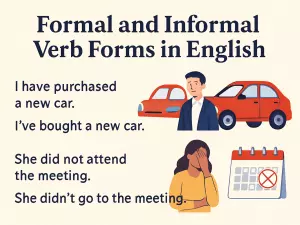
Past Simple Verbs: Forms, Pronunciation, and Spelling Rules

 The article explains how to use the past simple tense, focusing on regular and irregular verbs, -ed spelling and pronunciation, negatives and questions with did, and common time expressions. It also includes practice exercises for mastering these points.
Learning to talk about completed actions is important for telling stories or explaining what you did during your day, and choosing the correct verb forms is key to clear communication. By practicing the use, pronunciation, and spelling of past tense verbs, you can describe previous events more accurately and confidently. Paying attention to common patterns and irregular verbs will help you avoid mistakes and make your speech or writing sound more natural. With regular practice, you’ll find it easier to share your experiences and connect with others through language.
What past simple expresses
The past simple tense is used to describe actions, events, or situations that happened and finished at a specific time in the past. This form is essential for narrating stories, reporting completed activities, or giving historical facts. The event being described is always viewed as finished, with no connection to the present.
Common uses of the past simple
- Completed actions at a definite past time: She visited Paris last year.
- Sequences of actions in the past: He entered the room, turned on the light, and sat down.
- Events that happened once or repeatedly: They played football every Saturday.
- Situations or states that were true for a period in the past: I lived in London when I was a child.
- Stories or narratives: Once upon a time, there was a king who ruled wisely.
- Facts or general truths about the past: The dinosaurs disappeared millions of years ago.
- Habits in the past (now finished): He always walked to school.
- Polite or indirect speech in certain contexts: I wondered if you needed any help.
- Describing past abilities or opportunities: She could swim when she was five.
- Reporting something said or asked: He said he finished the project.
Time expressions often used with past simple
Certain time markers signal that the action is finished and belongs to the past. These expressions help clarify when the activity happened.
- yesterday
- last night/week/month/year
- in 2010 (or any specific year)
- ago (e.g., two days ago)
- when I was a child
- this morning (when the morning is finished)
- at 5 o’clock (if in the past)
- the other day
- once / twice
- earlier today (if the time is over)
Affirmative, negative, and question forms
The simple past changes its structure depending on whether you are making a statement, asking a question, or forming a negative. Regular and irregular verbs follow different patterns. Below is a summary of how the form changes:
| Type | Example |
|---|---|
| Affirmative | She walked to school. |
| Negative | She did not walk to school. |
| Question | Did she walk to school? |
| Affirmative | They played football yesterday. |
| Negative | They did not play football yesterday. |
| Question | Did they play football yesterday? |
| Affirmative | He went home early. |
| Negative | He did not go home early. |
| Question | Did he go home early? |
| Affirmative | We saw a movie last night. |
| Negative | We did not see a movie last night. |
| Question | Did we see a movie last night? |
Understanding when and how to use the past simple helps speakers clearly communicate about events that are finished and disconnected from the present. This tense is fundamental for recounting experiences, describing past habits, and stating facts that are no longer true.
Regular verbs: -ed spelling rules
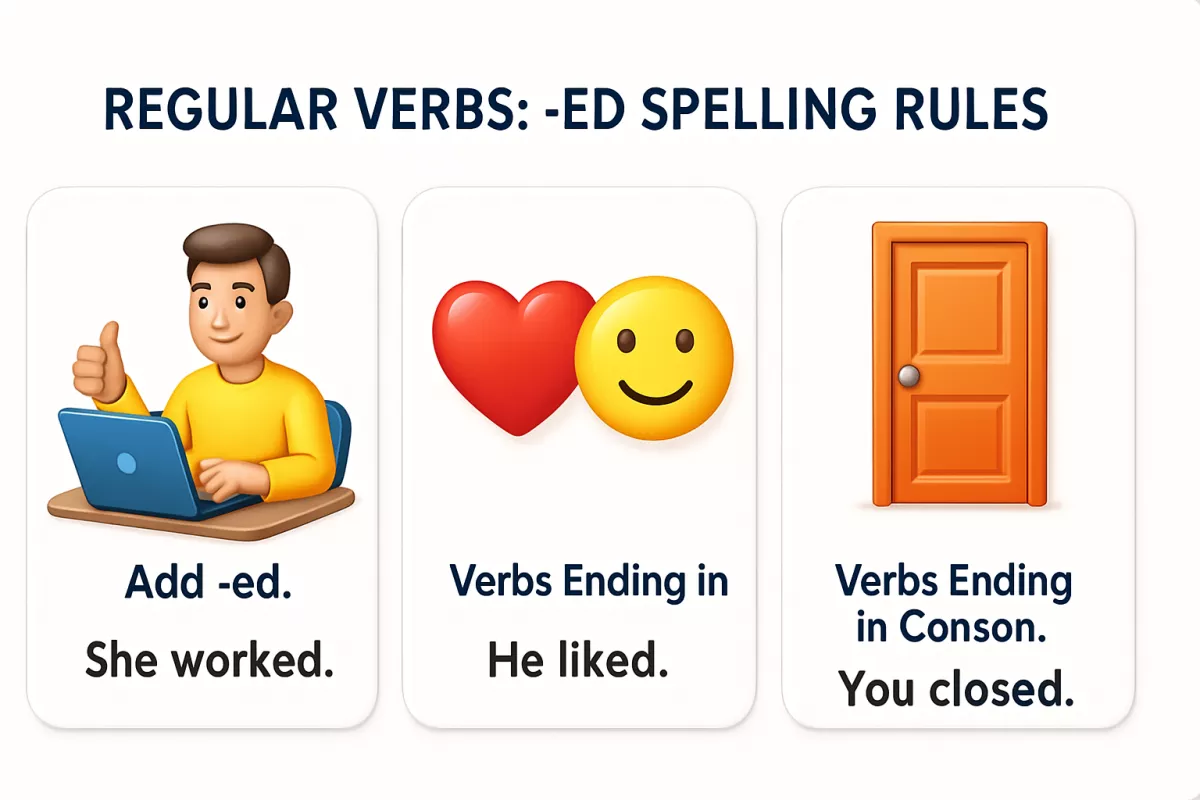
When forming the past simple of regular verbs, most simply add -ed to the base form. However, certain spelling patterns must be followed to form the correct past tense endings. Understanding these rules helps avoid common mistakes and ensures accurate usage.
Basic Rule: Add -ed
For most verbs, just add -ed to create the past form:
- work → worked
- play → played
- open → opened
Verbs Ending in e
If the verb already ends in e, only add -d:
- like → liked
- live → lived
- close → closed
Verbs Ending in Consonant + y
Change the y to i and add -ed:
- study → studied
- carry → carried
- hurry → hurried
If the verb ends in a vowel + y, just add -ed:
- enjoy → enjoyed
- play → played
Verbs Ending in a Single Vowel + Single Consonant
If the verb ends with a single vowel followed by a single consonant (except w, x, and y), double the final consonant before adding -ed. This rule usually applies to one-syllable verbs or stressed final syllables:
- stop → stopped
- plan → planned
- admit → admitted
- prefer → preferred
No doubling is needed if the last syllable is not stressed or if the verb ends in w, x, or y:
- fix → fixed
- snow → snowed
- visit → visited
Summary Table: Common -ed Spelling Changes
| Verb Ending | Past Simple Form |
|---|---|
| Base + -ed | work → worked, open → opened |
| Ends with "e" | like → liked, live → lived |
| Consonant + "y" | study → studied, carry → carried |
| Vowel + Consonant (double consonant) | stop → stopped, plan → planned |
Quick Reference: Common Regular Past Forms
- call → called
- want → wanted
- visit → visited
- move → moved
- decide → decided
- try → tried
- stop → stopped
- plan → planned
- study → studied
- enjoy → enjoyed
- fix → fixed
- snow → snowed
Applying these spelling patterns will help you form the past simple of regular verbs accurately and confidently.
Irregular verbs: common patterns to learn
Unlike regular verbs, which form the past simple by simply adding -ed, irregular verbs follow unique patterns and sometimes change completely. Recognizing these patterns helps learners remember and use them more accurately in conversation and writing.
Common change patterns
Irregular verbs do not all follow the same rule, but many share similar transformations. Here are several frequent patterns found among them:
- No change: Some verbs have the same base and past form (e.g., put → put, cut → cut).
- Vowel change: Many verbs change their internal vowel (e.g., begin → began, drink → drank).
- End in -t: Some verbs switch the ending from -d to -t (e.g., send → sent, build → built).
- Full change: A few verbs change entirely, with no clear pattern (e.g., go → went, be → was/were).
Examples of irregular verb forms
Below is a table showing several common irregular verbs and their past simple forms. These examples highlight the patterns described above, making it easier to spot similarities and differences.
| Base Form | Past Simple | Pattern |
|---|---|---|
| begin | began | vowel change |
| drink | drank | |
| sing | sang | |
| swim | swam | |
| take | took | |
| write | wrote | |
| build | built | end in -t |
| send | sent | |
| spend | spent | |
| buy | bought | |
| bring | brought | |
| cut | cut | no change |
| put | put | |
| hit | hit | |
| let | let | |
| read | read (pronounced /red/) | no change in spelling |
| go | went | full change |
| be | was / were | |
| do | did | |
| have | had | consonant change |
| make | made | |
| say | said | |
| tell | told | |
| meet | met | vowel shortening |
| feel | felt | |
| keep | kept | |
| leave | left | vowel + ending change |
| sleep | slept |
Tips for learning irregular verbs
- Group similar verbs together (e.g., build–built, send–sent).
- Practice with common verbs first, as these appear most often in everyday English.
- Use flashcards or quizzes to reinforce memory.
- Pay attention to pronunciation, since some verbs change sound but not spelling (e.g., read).
By focusing on these typical transformations and practicing high-frequency examples, learners can more easily master the unique forms of English's most important irregular verbs.
-ed pronunciation: /t/ /d/ /ɪd/
In the past simple, regular verbs ending in -ed are pronounced in three different ways: /t/, /d/, or /ɪd/. The correct pronunciation depends on the final sound of the base verb, not on its spelling.
How to choose the correct -ed sound
- /t/ — after voiceless sounds (except /t/): k, p, s, sh, ch, f
walked (/wɔːkt/), laughed (/læft/), kissed (/kɪst/) - /d/ — after voiced sounds (except /d/), including vowels and consonants like b, g, l, m, n, v, z
played (/pleɪd/), lived (/lɪvd/), cleaned (/kliːnd/) - /ɪd/ — after verbs ending in /t/ or /d/
wanted (/ˈwɒntɪd/), needed (/ˈniːdɪd/)
Common examples
| Base Verb | Past Form & Pronunciation |
|---|---|
| ask | asked /t/ |
| fix | fixed /t/ |
| play | played /d/ |
| call | called /d/ |
| want | wanted /ɪd/ |
| need | needed /ɪd/ |
| touch | touched /t/ |
| love | loved /d/ |
Key rule: the pronunciation of -ed depends on the final sound of the verb, not on its spelling.
Negatives with did not
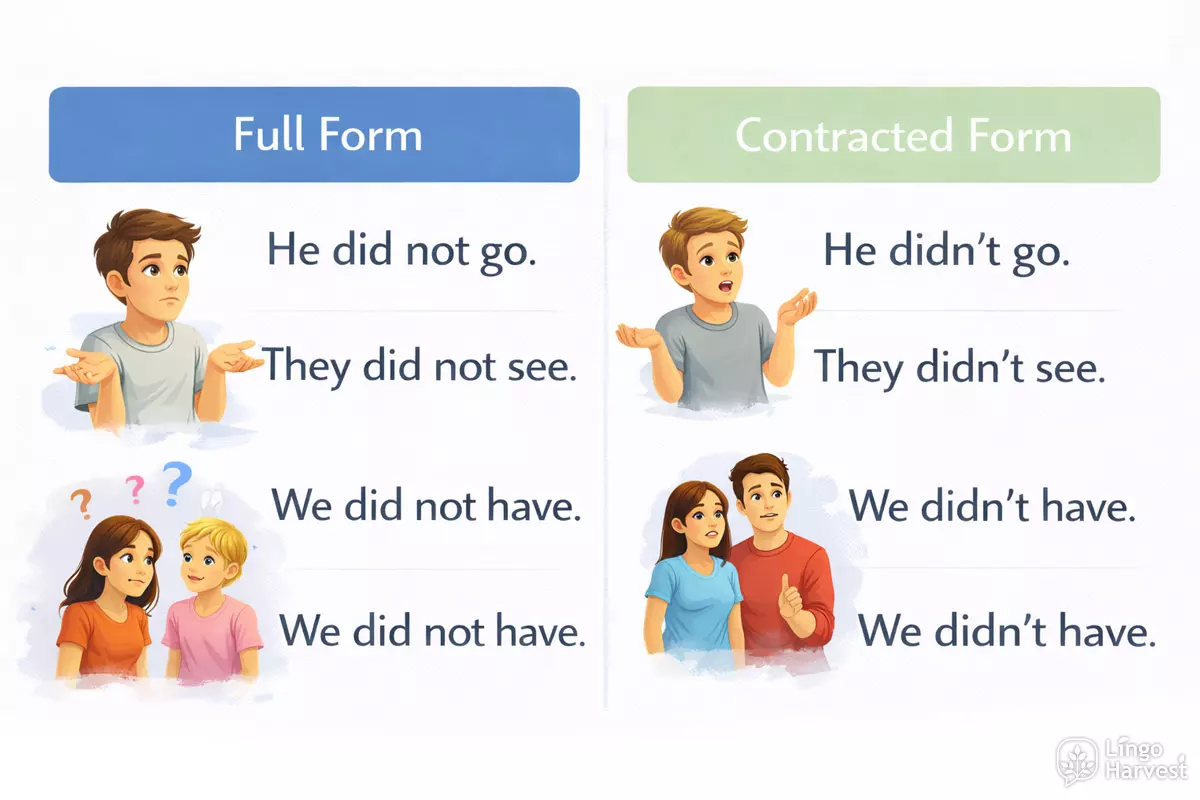
To form negative statements in the past simple tense, English uses the auxiliary verb did followed by not and the base form of the main verb. This structure is the same for all subjects, which makes it straightforward to apply. The contracted form didn't is commonly used in spoken and informal written English.
Structure and Usage
The pattern is: Subject + did not (didn't) + base verb. The main verb does not change, even for irregular verbs or the verb "be" (where special rules apply). This negative form is used to state that something did not happen in the past.
- I did not (didn't) see the movie.
- She did not (didn't) finish her homework.
- They did not (didn't) call you yesterday.
- We did not (didn't) understand the lesson.
- He did not (didn't) eat breakfast.
- You did not (didn't) arrive on time.
- The team did not (didn't) win the match.
- It did not (didn't) rain last night.
- The students did not (didn't) ask questions.
- My brother did not (didn't) drive to work.
Key Points to Remember
- The verb after did not always stays in its base (infinitive) form—never in the past form.
- Contractions (didn't) are frequent in everyday conversation and informal writing.
- This pattern applies to both regular and irregular verbs.
- For the verb be, use was not or were not instead of did not be.
Examples: Correct and Incorrect Forms
| Correct ✅ | Incorrect ❌ |
|---|---|
| He did not go. | He did not went. |
| They didn't see. | They didn't saw. |
| We did not have time. | We did not had time. |
| I didn't eat breakfast. | I didn't ate breakfast. |
| She did not call me. | She did not called me. |
| We didn't finish the test. | We didn't finished the test. |
| He did not buy anything. | He did not bought anything. |
| They didn't understand the question. | They didn't understood the question. |
| I did not write to her. | I did not wrote to her. |
| She didn't take the bus. | She didn't took the bus. |
| We did not meet yesterday. | We did not met yesterday. |
| He didn't make dinner. | He didn't made dinner. |
Common Mistakes
- Using the past tense form of the verb after did not (e.g., did not went) is incorrect. Always use the base form (did not go).
- Confusing did not with was not/were not for the verb "be".
- Forgetting to use did in negatives with other verbs (e.g., She not finish instead of She did not finish).
Mastering this negative structure helps ensure clarity and accuracy when talking about actions or events that did not happen in the past. Always check that the main verb is in its base form after did not or didn't for correct usage.
Questions with did
Forming questions in the past simple tense often involves the auxiliary verb "did." This structure helps signal that the action occurred in the past and makes it easy to ask about completed events or experiences. The main verb in the question always remains in its base form, regardless of the subject or the verb's regularity.
Basic Structure and Word Order
To create a question about a past action, place "did" at the beginning of the sentence, followed by the subject and then the base form of the verb. This pattern is consistent for all subjects (I, you, he, she, it, we, they).
- Did you see the movie?
- Did she finish her homework?
- Did they travel last summer?
- Did he call you?
For questions with question words (who, what, where, when, why, how), the question word comes first, then "did," the subject, and the base verb.
- Where did you go?
- Why did he leave early?
- When did they arrive?
- How did she learn English?
Key Patterns and Examples
Notice that "did" is always used in the past simple for questions, and the main verb never takes an -ed ending or irregular past form in this structure. This rule applies to both regular and irregular verbs.
| Statement (Past Simple) | Question (with "did") |
|---|---|
| She watched TV. | Did she watch TV? |
| They ate breakfast. | Did they eat breakfast? |
| He studied for the test. | Did he study for the test? |
| You visited Paris. | Did you visit Paris? |
| We ran in the park. | Did we run in the park? |
Common Mistakes to Avoid
Learners sometimes use the past form of the verb after "did," which is incorrect. Always use the base verb after "did" in questions.
- ❌ Did you went to the store?
- ✅ Did you go to the store?
Useful Practice Questions
Here are more examples for practice and reference:
- Did it rain yesterday?
- Did your friends enjoy the party?
- Did the teacher explain the lesson?
- Did you find your keys?
- Did Mark drive to work?
- Did the dog bark last night?
- Did Anna cook dinner?
- Did we miss the train?
- Did they understand the instructions?
- Did you meet anyone new?
Time expressions for past simple
When describing completed actions or events that happened before now, English speakers often use specific words and phrases to show when something took place. These expressions help clarify the timing and make it clear that the action is finished. Typically, these time markers refer to a definite point or period in the past.
Common words and phrases indicating past actions
Some of the most frequent expressions used with the past simple tense include references to days, dates, and periods that have already finished. They provide context and answer the question "When did it happen?" Here are some typical examples:
- yesterday
- last night
- last week / last month / last year
- an hour ago
- two days ago
- in 2010
- on Monday
- when I was a child
- the day before yesterday
- a long time ago
- this morning (if it is now afternoon or evening)
- at 5 o’clock (if the time is now past)
- in the 18th century
- once
- just now
- the other day
- in my childhood
- when I lived in Paris
- in the past
Patterns and placement in sentences
These markers can appear at the beginning or end of a sentence, depending on emphasis. For example: "I met her yesterday." or "Yesterday, I met her." Both are correct, but the focus changes slightly.
Some time phrases use "ago" to indicate how much time has passed since the action. The word "ago" always follows the time reference: "He left two hours ago." Other expressions, such as "last year" or "in 1999," specify a particular period or point in the past when the event occurred.
Comparison of time markers
Below is a summary of several common expressions, showing how they indicate different types of past reference:
| Time Expression | Example Sentence |
|---|---|
| yesterday | She called me yesterday. |
| two weeks ago | We finished the project two weeks ago. |
| last Friday | He traveled to London last Friday. |
| in 2005 | They moved here in 2005. |
| when I was a student | I learned French when I was a student. |
| the day before yesterday | We met the day before yesterday. |
| at 9 o’clock | The train left at 9 o’clock. |
| the other day | I saw your brother the other day. |
Using these expressions correctly helps clarify when an action took place and ensures your sentences are precise and natural. Choosing the right time marker depends on how specific you want to be and the context of your statement.
Homework: past simple verb practice
Understanding and using the past simple tense correctly is important for talking about finished actions and events. This section provides practical exercises to help you build confidence with regular and irregular verb forms, pronunciation patterns, and common spelling changes.
Task 1: Complete the sentences with the correct past simple form
Fill in each blank with the right past form of the verb in parentheses.
- Yesterday, I ______ (walk) to the library.
- She ______ (not/like) the movie we watched last night.
- We ______ (study) English for two hours.
- He ______ (go) to bed early.
- They ______ (have) lunch at 1 pm.
- My brother ______ (try) to fix the computer.
- It ______ (rain) all day on Sunday.
- Our teacher ______ (give) us homework.
- I ______ (see) a shooting star.
- The cat ______ (catch) a mouse.
Show answers
1. walked2. did not like
3. studied
4. went
5. had
6. tried
7. rained
8. gave
9. saw
10. caught
Task 2: Identify regular and irregular verbs
Read the list of verbs below. Decide which are regular and which are irregular in their past simple form.
- play
- buy
- jump
- eat
- open
- swim
- call
- drive
- answer
- take
- watch
- find
- arrive
- make
- finish
- run
- climb
- sing
- visit
- leave
Show answers
Regular verbs: play, jump, open, call, answer, watch, arrive, finish, climb, visitIrregular verbs: buy, eat, swim, drive, take, find, make, run, sing, leave
Task 3: Past simple spelling patterns for regular verbs
Write the correct past simple form for each verb below.
- stop
- study
- live
- plan
- cry
- clean
- try
- open
- travel
- fix
Show answers
stopped, studied, lived, planned, cried, cleaned, tried, opened, travelled/traveled, fixedTask 4: Past simple pronunciation patterns
Sort the verbs into the correct pronunciation group: /t/, /d/, or /ɪd/.
- watched
- cleaned
- needed
- liked
- played
- visited
- walked
- called
- wanted
- fixed
- laughed
- ended
Show answers
/t/: watched, liked, walked, fixed, laughed/d/: cleaned, played, called
/ɪd/: needed, visited, wanted, ended