Future Forms with Verbs: Will, Going To, Present Continuous

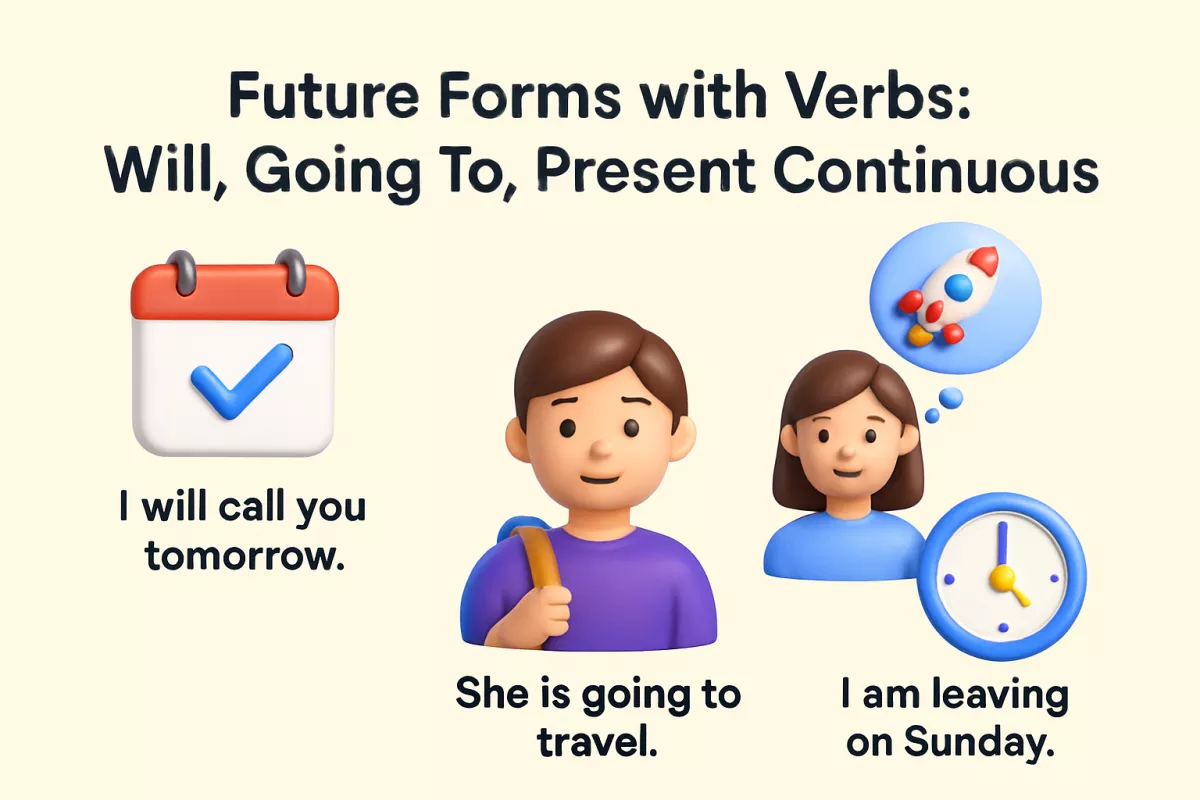 This article explains when to use will, be going to, and the present continuous for future situations. It covers future time markers, forming questions and negatives, common mistakes, and includes practice on choosing the right future form.
English offers several ways to talk about the future, such as using will, be going to, or the present continuous, and choosing the right form can sometimes be confusing. Will is often used for spontaneous decisions or promises, be going to is typically used for plans or predictions based on current evidence, and the present continuous works well for arrangements that are already scheduled. By learning the differences and practicing their uses, you can communicate your intentions and expectations more clearly in everyday conversations.
When to use will
The modal verb "will" is commonly used to express the simple future in English. Its main function is to indicate decisions, predictions, promises, offers, and spontaneous actions related to the future. Understanding the various situations where "will" is appropriate helps learners choose the right future form for each context.
Typical situations for using "will"
- Decisions made at the moment of speaking: Choose "will" when you decide to do something as you speak, not before.
Example: "I'm thirsty." – "I will get you a glass of water." - Predictions based on opinion or experience: Use "will" for predictions that are not based on present evidence but on what you think or believe.
Example: "I think it will rain tomorrow." - Promises and offers: "Will" is standard for making promises or offering to do something for someone.
Examples: "I will help you with your homework." / "Don't worry, I will call you." - Requests and suggestions: Use "will" to make polite requests or suggestions.
Examples: "Will you open the window, please?" / "Will we meet at six?" - Refusals or willingness: To express that someone is (or is not) willing to do something.
Examples: "He won't eat his vegetables." / "I will do it if you want." - Facts about the future: For statements that are certain or generally true about the future.
Example: "The sun will rise at 6:00 tomorrow." - Formal announcements or instructions: Often used in official or formal contexts.
Example: "The meeting will begin at 9 a.m." - Conditional sentences (first conditional): In the "if" clause, "will" is used to show the result.
Example: "If it rains, we will stay indoors." - Threats and warnings: To caution or warn about possible future actions.
Example: "If you touch that, you will get hurt." - Habits in the future: Sometimes used for repeated actions expected in the future.
Example: "He will often forget his keys."
Common patterns with "will"
The basic structure for using "will" is straightforward. The subject is followed by "will" and the base form of the verb:
| Affirmative | Negative | Question | Short Answer |
|---|---|---|---|
| She will call you. | She will not (won't) call you. | Will she call you? | Yes, she will. / No, she won't. |
| They will arrive soon. | They will not (won't) arrive soon. | Will they arrive soon? | Yes, they will. / No, they won't. |
| I will help. | I will not (won't) help. | Will you help? | Yes, I will. / No, I won't. |
| We will see. | We will not (won't) see. | Will we see? | Yes, we will. / No, we won't. |
| He will finish the report. | He will not (won't) finish the report. | Will he finish the report? | Yes, he will. / No, he won't. |
| You will understand. | You will not (won't) understand. | Will you understand? | Yes, I will. / No, I won't. |
| It will rain later. | It will not (won't) rain later. | Will it rain later? | Yes, it will. / No, it won't. |
| We will meet tomorrow. | We will not (won't) meet tomorrow. | Will we meet tomorrow? | Yes, we will. / No, we won't. |
| They will remember this. | They will not (won't) remember this. | Will they remember this? | Yes, they will. / No, they won't. |
| She will be ready. | She will not (won't) be ready. | Will she be ready? | Yes, she will. / No, she won't. |
Remember, "will" is not usually used for plans or intentions that have already been made before the moment of speaking. For those, other future forms such as "going to" or the present continuous are more natural.
When to use be going to
The construction “be going to” is commonly used in English to talk about plans, intentions, or predictions based on present evidence. Understanding when to select this form helps express future meaning more accurately and naturally. This section explains the main contexts and patterns for using “be going to” in future expressions.
Expressing Intentions and Plans
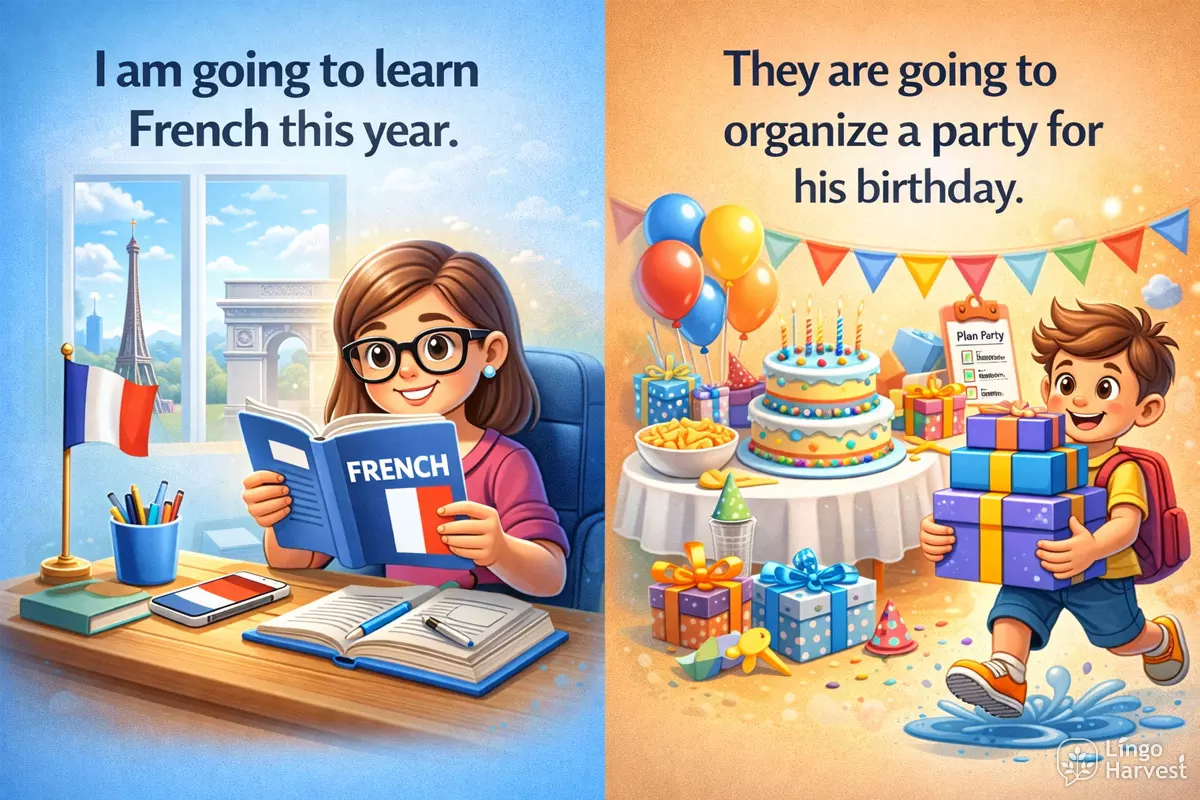
Use “be going to” for decisions or intentions that have already been made before the moment of speaking. It signals that the speaker has a definite plan or aim, as opposed to making a spontaneous decision.
- She is going to start a new job next week.
- We are going to visit our grandparents this weekend.
- I am going to learn French this year.
- They are going to organize a party for his birthday.
Making Predictions Based on Evidence
Choose “be going to” when predicting a future event because there is something in the present that suggests the outcome. This is different from predictions based solely on opinions or beliefs.
- Look at those clouds! It is going to rain soon.
- Watch out! You are going to drop that glass.
- She is going to be late; the traffic is terrible.
- This bag is going to break if you put more books in it.
Typical Patterns and Structure
The grammatical structure for “be going to” combines the verb “be” (am/are/is), the word “going,” and “to” plus the base form of the main verb. Negative and question forms follow regular patterns.
| Affirmative | Negative | Question |
|---|---|---|
| I am going to travel next month. | I am not going to travel next month. | Am I going to travel next month? |
| You are going to win this match. | You are not going to win this match. | Are you going to win this match? |
| She is going to call you after work. | She is not going to call you after work. | Is she going to call you after work? |
| We are going to eat at 7 pm. | We are not going to eat at 7 pm. | Are we going to eat at 7 pm? |
| He is going to start a new job soon. | He is not going to start a new job soon. | Is he going to start a new job soon? |
| They are going to visit their grandparents this weekend. | They are not going to visit their grandparents this weekend. | Are they going to visit their grandparents this weekend? |
| It is going to rain later today. | It is not going to rain later today. | Is it going to rain later today? |
| I am going to study tonight. | I am not going to study tonight. | Am I going to study tonight? |
| You are going to meet her at the station. | You are not going to meet her at the station. | Are you going to meet her at the station? |
| We are going to watch a movie tomorrow. | We are not going to watch a movie tomorrow. | Are we going to watch a movie tomorrow? |
Common Mistakes to Avoid
- Do not use “be going to” for spontaneous decisions (use “will” instead).
- Check that the verb “be” agrees with the subject: I am, you/we/they are, he/she/it is.
- Use only the base form of the main verb after “to” (not the -ing or past form).
Examples in Everyday Contexts
- He is going to buy a new laptop.
- They are going to move to a new city.
- I am going to make dinner tonight.
- We are going to watch a movie later.
- The team is going to win if they keep playing well.
- It is going to be a great day.
- My friends are going to join us at the park.
- She is going to study medicine.
- We are going to be late if we don’t leave now.
- You are going to love this book.
To summarize, use “be going to” for future plans already decided and for predictions with present evidence. Mastery of this form helps convey intentions and expectations clearly in English.
Present continuous for future arrangements
The present continuous tense is commonly used to describe personal plans or arrangements that are scheduled in the near future. This form emphasizes that a decision has been made and some preparation has already begun. The pattern is am/is/are + verb-ing, and it is typically used with time expressions that specify when the activity will happen.
Usage and key characteristics
Use the present continuous when talking about fixed appointments, meetings, or events that are already arranged, especially when another person is involved or the event is on someone’s calendar. This tense suggests a higher level of certainty compared to predictions or general intentions.
- We’re meeting the new manager at 3 p.m. tomorrow.
- She’s flying to Berlin next Friday.
- They’re having dinner with clients tonight.
- I’m seeing the dentist on Monday morning.
- My parents are coming over for lunch this weekend.
- He is starting his new job next week.
- The team is presenting the project results this afternoon.
- Are you joining us for the movie later?
- We’re leaving for the airport at 6 a.m.
- Lisa is meeting her study group after class.
- Our company is launching a new product next month.
- She’s having her car serviced on Saturday.
- I’m picking up the tickets tomorrow morning.
- They’re moving into their new apartment next weekend.
- We’re having a video call with the client at noon.
Form and structure
The structure of the present continuous for scheduled plans follows a clear pattern. The subject is followed by the correct form of be (am, is, are) and the verb in its -ing form. Negative and question forms are also typical in planning conversations.
| Affirmative | Negative | Question | Short Answer |
|---|---|---|---|
| I am meeting Sam at 8. | I am not meeting Sam at 8. | Am I meeting Sam at 8? | Yes, you are. / No, you aren’t. |
| She is flying to Rome. | She isn’t flying to Rome. | Is she flying to Rome? | Yes, she is. / No, she isn’t. |
| We are having lunch soon. | We aren’t having lunch soon. | Are we having lunch soon? | Yes, we are. / No, we aren’t. |
| They are moving house. | They aren’t moving house. | Are they moving house? | Yes, they are. / No, they aren’t. |
Common time expressions
Time expressions frequently used with this tense include: tonight, tomorrow, this weekend, next week, at 7 p.m., on Monday, and similar phrases that specify future timing.
In summary, when there is a definite plan or arrangement for the near future, the present continuous is the preferred form to communicate certainty and preparation.
Future time markers and context clues
Choosing the correct future form in English often depends on time markers and contextual signals rather than grammar rules alone. Certain words, phrases, and situations clearly point to future meaning and help determine whether will, going to, or the present continuous is the most natural choice.
Common time markers that signal future reference
These words and expressions usually indicate that the action happens after the moment of speaking:
- tomorrow, the day after tomorrow
- next week / next month / next year
- in an hour / in two days / in five years
- later, soon, shortly, eventually
- this evening / this afternoon (if still in the future)
- by Monday / by 8 o’clock / by the end of the month
- after work / after class / after lunch
- on Saturday / on New Year’s Day
- when he arrives / when you finish
- as soon as possible / as soon as you can
Context clues that influence future form choice
Time words alone are not always enough. The speaker’s intention and the situation often provide stronger clues than the sentence itself.
| Context clue | Typical form | Example |
|---|---|---|
| Decision made at the moment of speaking | Will | I’ll answer the phone. |
| Personal opinion or uncertainty | Will | I think it will rain later. |
| Plan decided before now | Going to | I’m going to start a new course next month. |
| Clear evidence in the present | Going to | Look at those clouds — it’s going to rain. |
| Fixed arrangement with time and people | Present continuous | I’m meeting Sarah at 6 pm. |
| Official schedules and timetables | Present simple | The train leaves at 7:30. |
Same time marker, different meaning
The same future time expression can appear with different verb forms depending on context:
- Tomorrow + will: I’ll call you tomorrow. → decision made now
- Tomorrow + going to: I’m going to call you tomorrow. → prior intention
- Tomorrow + present continuous: I’m calling you tomorrow at 10. → arranged plan
Practical tip for choosing the right form
Instead of focusing only on the time word, ask one key question: Is this a decision, an intention, or an arrangement? The answer usually points to the correct future structure more reliably than memorizing rules.
Questions and negatives in future forms
Understanding how to form questions and negatives with future tenses is essential for clear communication about plans, predictions, and intentions. Each future form—will, going to, and present continuous—follows its own specific word order and auxiliary usage. Recognizing these patterns helps avoid common errors and improves fluency.
Forming questions in future structures
To ask about future actions or plans, the structure changes depending on the verb form:
- Will: Use “will” before the subject, then the base verb.
Example: Will you come to the meeting? - Going to: Start with the correct form of “be,” followed by the subject, “going to,” and the base verb.
Example: Are they going to travel next week? - Present continuous: Begin with the correct form of “be,” then the subject and the –ing verb.
Example: Is she meeting us later?
Making negatives in future forms
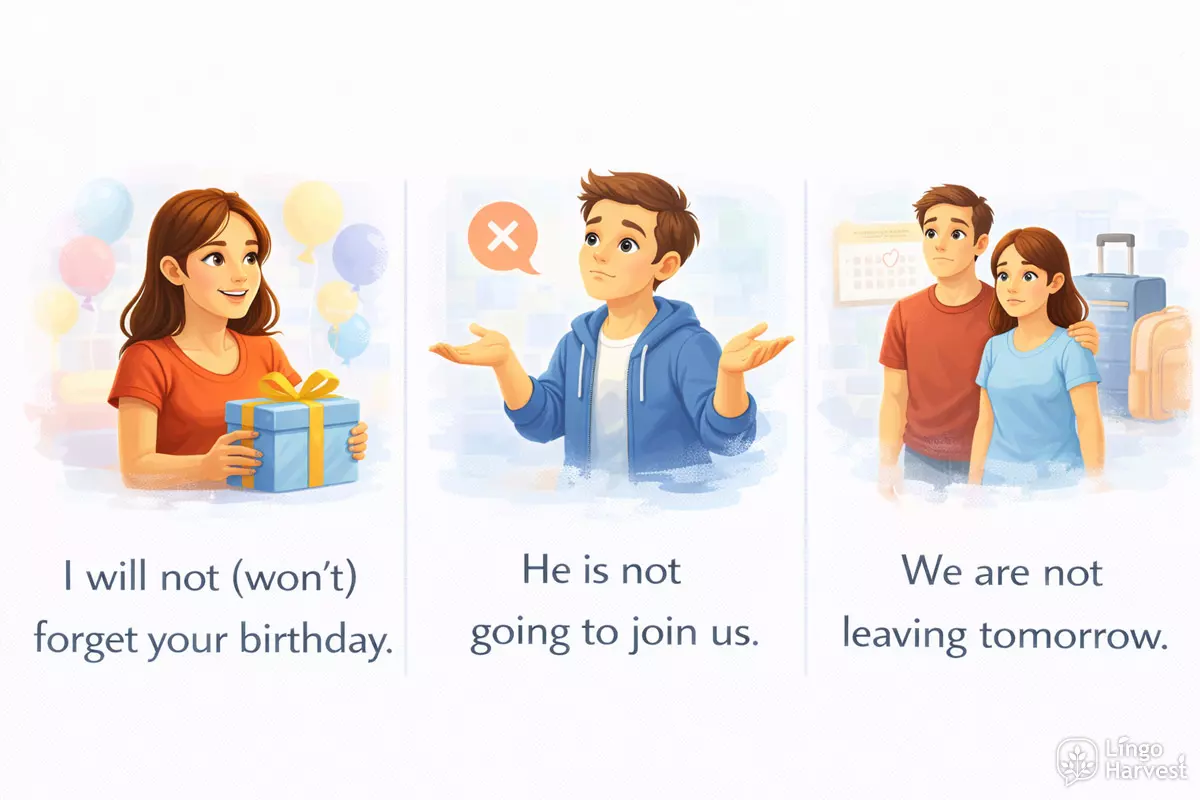
Negating future statements also depends on the chosen construction:
- Will: Add “not” after “will.”
Example: I will not (won’t) forget your birthday. - Going to: Place “not” after the correct form of “be.”
Example: He is not going to join us. - Present continuous: Insert “not” after “be.”
Example: We are not leaving tomorrow.
Common patterns and examples
The table below compares how different future forms behave in questions, negatives, and short answers. Focus on the auxiliary verb and word order rather than memorizing entire sentences.
| Form | Affirmative | Question | Negative | Short Answer |
|---|---|---|---|---|
| Will | He will call you. | Will he call you? | He will not (won’t) call you. | Yes, he will. / No, he won’t. |
| Will | They will arrive soon. | Will they arrive soon? | They will not arrive soon. | Yes, they will. / No, they won’t. |
| Going to | You are going to eat now. | Are you going to eat now? | You are not going to eat now. | Yes, I am. / No, I’m not. |
| Going to | He is going to help us. | Is he going to help us? | He is not going to help us. | Yes, he is. / No, he isn’t. |
| Present continuous | She is working late. | Is she working late? | She is not working late. | Yes, she is. / No, she isn’t. |
| Present continuous | We are meeting at six. | Are we meeting at six? | We are not meeting at six. | Yes, we are. / No, we aren’t. |
| Present simple (schedule) | The train leaves at 8. | Does the train leave at 8? | The train does not leave at 8. | Yes, it does. / No, it doesn’t. |
Key tips for usage
- In questions, the auxiliary verb always comes first (will, am/is/are, does).
- In negatives, not follows the auxiliary verb.
- Do not use do/does with will, going to, or the present continuous.
- Short answers repeat only the auxiliary verb, not the main verb.
- Use contractions in spoken and informal English (won’t, isn’t, aren’t).
- Choose the form based on meaning: decisions (will), intentions (going to), arrangements (present continuous).
Common confusion: predictions vs plans
Learners often mix up when to use "will," "going to," and the present continuous because these forms can all refer to the future, but they serve different purposes. The main source of confusion is distinguishing between talking about a prediction (what you think will happen) and talking about a plan or intention (what you have decided or arranged to do).
Key uses: predictions and plans
"Will" is most often used for predictions—statements about the future based on opinions, guesses, or things we cannot control. In contrast, "going to" and the present continuous usually describe plans or intentions, especially when there is some evidence or arrangement.
| Form | Typical Use | Example | Clue Words/Context |
|---|---|---|---|
| "Will" | Prediction (opinion or guess) | It will rain tomorrow. | think, hope, believe, probably |
| "Going to" | Planned intention (decision made before speaking) | I am going to visit my aunt. | already decided, intention, evidence now |
| Present continuous | Arranged future plan (with fixed time or place) | We are meeting at 7 pm. | definite arrangement, time/place given |
| "Will" | Instant decision (decided at the moment of speaking) | I’ll answer the phone! | spontaneous, at the moment |
Patterns and signal words
Recognizing certain patterns and signal words can help you choose the correct future form. Here are some common clues:
- Predictions: "I think," "probably," "I guess," "maybe," "I don’t think," "I’m sure," "believe," "expect."
- Intentions: "I’m going to," "We’re going to," "They are going to," often with verbs like "start," "try," "buy," "visit."
- Arrangements: Present continuous with a future time: "I’m seeing," "We’re meeting," "She’s flying," "They’re having," plus a specific time or place.
- Evidence now: "Look!" "Watch out!" "Be careful!"—used with "going to" for predictions based on current evidence: "Look at those clouds—it’s going to rain."
- Spontaneous decisions: "I’ll help," "I’ll get it," "I’ll call you," usually decided at the moment of speaking.
Common mistakes
Mistakes often happen when learners use "will" for plans or "going to" for predictions without evidence. To avoid errors, match the form to your meaning:
- Use "will" for things you decide right now or for general predictions.
- Use "going to" for plans or predictions based on what you see or know now.
- Use the present continuous for arrangements with a specific time or place.
Summary
Understanding the difference between predicting and planning is key to choosing the correct future form. Pay attention to context, signal words, and the nature of the action—whether it’s simply what you think will happen, what you have already decided, or what you have arranged with others.
Typical learner mistakes and corrections
Learners often confuse the use of "will," "going to," and the present continuous when talking about the future. These forms have overlapping meanings but specific usage patterns that can lead to mistakes if not understood clearly. The following points highlight frequent issues and provide guidance for accurate usage.
Confusing Future Forms: Choosing the Wrong Structure
Using the wrong verb form for the intended meaning is a common problem. Each future form has its own context:
- "Will" is generally used for spontaneous decisions, promises, offers, or predictions not based on present evidence.
- "Going to" is used for plans or intentions made before the moment of speaking, or predictions based on current evidence.
- Present continuous is used for fixed arrangements, especially with other people, often with a specific time mentioned.
Typical Errors and Correct Usage
| Incorrect Sentence | Correction & Explanation |
|---|---|
| I'm going to open the window. (said at the moment of decision) | I will open the window. Use "will" for decisions made at the moment of speaking. |
| We will meet Tom at 6 pm. (already arranged) | We are meeting Tom at 6 pm. Present continuous is used for fixed arrangements. |
| Look at those dark clouds! It will rain. | Look at those dark clouds! It is going to rain. Use "going to" when there is evidence now. |
| I am going to visit grandma on Sunday. (said after arranging with her) | I am visiting grandma on Sunday. Present continuous is better for definite arrangements. |
| I think I'm going to help you with your bags. (decision at the moment) | I think I'll help you with your bags. "Will" fits spontaneous offers. |
| Are you going to coming to the party? | Are you coming to the party? Use present continuous for arranged events. |
| I'm meeting with Jane tonight. (no arrangement yet) | I'm going to meet Jane tonight. Use "going to" if it's just an intention, not a fixed plan. |
| He will buy a new car next year. (already decided, planned) | He is going to buy a new car next year. Use "going to" for planned intentions. |
| We are going to have lunch at 1 pm. (restaurant booked, fixed plan) | We are having lunch at 1 pm. Present continuous is used for definite arrangements. |
| She will travel to Italy next week. (tickets bought, arranged trip) | She is traveling to Italy next week. Present continuous signals a fixed future arrangement. |
Forming Questions and Negatives
Mistakes also happen with questions and negatives, especially with word order and auxiliary verbs:
- Incorrect: "You will go to the meeting?"
- Correct: "Will you go to the meeting?"
- Incorrect: "He not going to study tonight."
- Correct: "He is not going to study tonight."
- Incorrect: "Are you meet Jane tonight?"
- Correct: "Are you meeting Jane tonight?"
Summary of Key Patterns
Pay attention to the intended meaning—spontaneous decision, planned intention, or fixed arrangement. Use "will" for unplanned decisions and predictions, "going to" for intentions and evidence-based predictions, and present continuous for set plans. Being clear on these patterns helps avoid common errors and makes future statements more natural and accurate.
Homework: choose the correct future form
Understanding when to use will, going to, or the present continuous for future meaning is essential for clear communication. Each form follows certain patterns and is used in specific situations. Practice helps you recognize the right structure for different contexts, such as predictions, plans, and scheduled events.
When to Use Each Future Form
- Will is often used for decisions made at the moment of speaking, promises, offers, or predictions not based on present evidence.
- Going to is used for plans or intentions decided before the moment of speaking and for predictions based on current evidence.
- Present Continuous (am/is/are + -ing) is used for fixed arrangements, especially when the time and place are already decided.
Practice: Identify the Correct Future Form
Below are sentences where you need to select the most appropriate structure. Pay attention to clues in each sentence, such as evidence, intention, or arrangement.
- Look at those clouds! It (will / is going to / is) rain soon.
- I (will / am going to / am) visit my grandparents next weekend. The train tickets are already booked.
- Wait a minute, I (will / am going to / am) help you with those bags.
- She (will / is going to / is) start a new job next month. She accepted the offer last week.
- We (will / are going to / are) meet at 7:00 pm at the restaurant. The reservation is confirmed.
- I think they (will / are going to / are) win the match. They're playing very well today.
- He (will / is going to / is) be a doctor when he grows up.
- The phone is ringing. I (will / am going to / am) answer it.
- They (will / are going to / are) move to Canada next year. They've already started looking for apartments.
- We (will / are going to / are) have a meeting at 10 a.m. tomorrow. It's on the calendar.
- My parents (will / are going to / are) travel to Spain this summer. They bought their tickets yesterday.
- Watch out! You (will / are going to / are) spill your coffee.
- I (will / am going to / am) call you when I arrive.
- She (will / is going to / is) meet her friend after work. They've arranged it already.
- I'm sure you (will / are going to / are) enjoy this movie.
Summary Table: Common Patterns and Usage
| Future Form | Typical Usage / Pattern |
|---|---|
| will | Spontaneous decisions, offers, promises, predictions without present evidence Pattern: will + base verb |
| going to | Intentions, plans made before speaking, predictions with evidence Pattern: am/is/are + going to + base verb |
| present continuous | Fixed arrangements, scheduled events (with time/place) Pattern: am/is/are + verb-ing |
Review the examples and patterns above. Practicing with real sentences helps you master the differences between these future forms and use them naturally in conversation and writing.