Verb Agreement: Subject–Verb Concord Made Simple

 Here we the basics of subject–verb agreement, including rules for singular, plural, compound, and collective subjects, tricky words like each and none, agreement with there is/there are, common mistakes, and provides practice exercises.
Have you ever noticed that we say "She runs" but "They run"? This difference happens because the verb must match the subject in number and person, a rule called subject-verb agreement. Using the correct verb form helps your speech and writing sound natural and clear. For example, with singular subjects like "he" or "she," we add an "s" to the verb, as in "He eats breakfast." With plural subjects like "they," the verb stays in its base form, as in "They eat breakfast." Paying attention to this rule will improve your English communication.
What subject–verb agreement means
Subject–verb agreement is the grammatical rule that a verb must match its subject in number and person. This means that singular subjects require singular verbs, while plural subjects need plural verbs. The connection ensures a sentence is clear and grammatically correct. In English, this pattern is especially noticeable in the present tense, where verbs change form to agree with their subjects.
Basic patterns of subject–verb concord
Most sentences follow straightforward agreement rules. Here are some common patterns:
- He runs ✅ (He is singular, so runs is singular)
- They run ✅ (They is plural, so run is plural)
- The cat sleeps ✅
- The cats sleep ✅
- I am ✅
- We are ✅
- She has ✅
- They have ✅
- It goes ✅
- Dogs bark ✅
Common agreement challenges
Some sentence structures make matching subjects and verbs less obvious. Watch for these cases:
- Subjects separated from verbs by phrases or clauses (The bouquet of roses smells lovely).
- Indefinite pronouns as subjects (Everyone is ready).
- Compound subjects joined by and are usually plural (My brother and sister are here).
- Subjects joined by or or nor agree with the closer noun (Neither the teacher nor the students are available).
- Collective nouns may take singular or plural verbs depending on meaning (The team is winning, but The team are arguing among themselves).
Overview: Standard agreement forms
| Subject | Verb Form (Present Simple) | Example |
|---|---|---|
| I | base form | I walk |
| You | base form | You walk |
| He/She/It | base + s | She walks |
| We/They | base form | They walk |
Mastering these agreement patterns helps writers and speakers avoid common errors and makes communication more precise. Always identify the true subject and ensure the verb matches in both number and person for clear, correct sentences.
Singular vs plural subjects
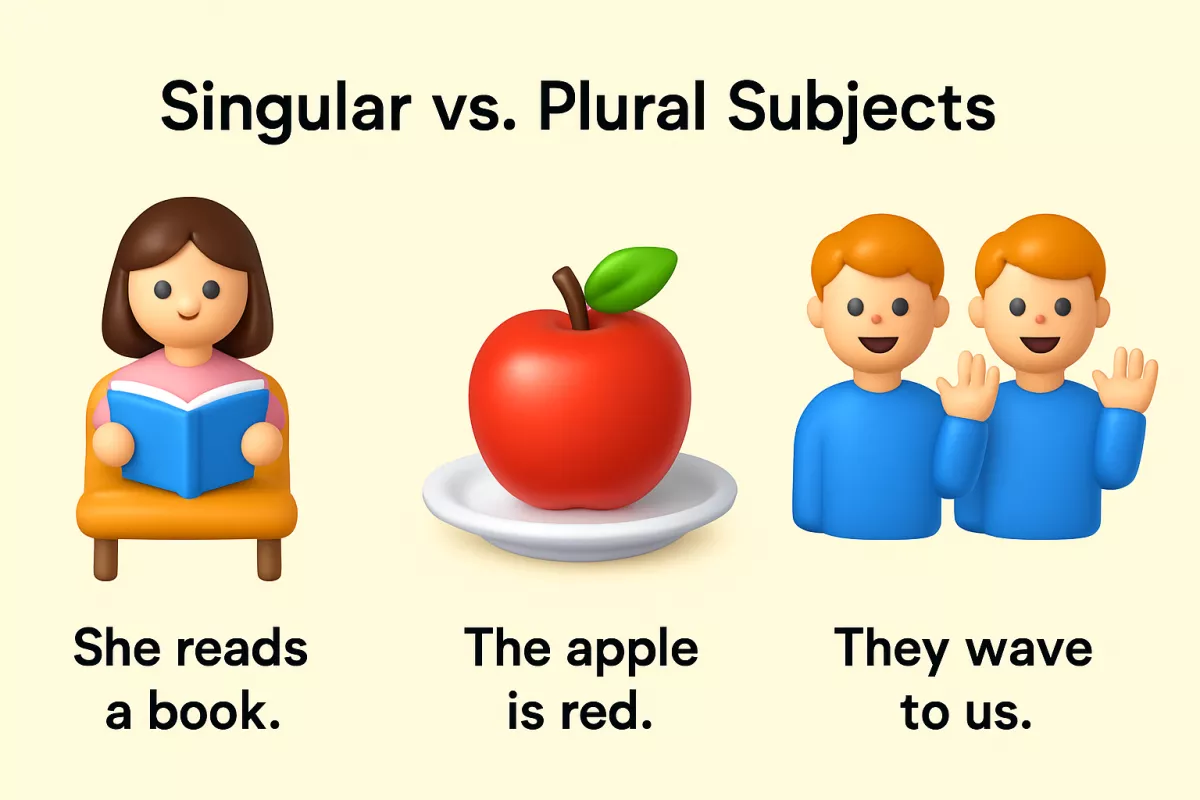
Understanding how subjects affect verb forms is key to mastering subject–verb concord. In English, the verb form changes depending on whether the subject is singular or plural. This distinction is most noticeable in the present simple tense, especially with regular verbs and the verb "to be."
How verb forms change
When a singular subject is used, most verbs in the present tense add an -s or -es ending. With plural subjects, the base form of the verb is used. The verb "to be" has unique forms for each subject type.
| Subject Type | Verb Example | Sample Sentence |
|---|---|---|
| Singular | walks | The cat walks quietly. |
| Plural | walk | The cats walk quietly. |
| Singular ("to be") | is | She is happy. |
| Plural ("to be") | are | They are happy. |
| Singular (irregular verb) | has | He has a book. |
| Plural (irregular verb) | have | They have books. |
Common patterns and examples
- She runs. ✅ (singular subject, verb + s)
- They run. ✅ (plural subject, base verb)
- The child plays.
- The children play.
- My friend likes pizza.
- My friends like pizza.
- It rains often.
- Clouds gather quickly.
- A dog barks.
- Dogs bark.
- This apple tastes sweet.
- These apples taste sweet.
- The teacher explains the lesson.
- The teachers explain the lesson.
Key points to remember
- Singular subjects take verbs with -s or -es endings in the present simple (except for "I" and "you").
- Plural subjects use the base form of the verb.
- Pronouns "he," "she," and "it" are always singular.
- Some nouns look plural but are singular in meaning (e.g., "news," "mathematics") and use singular verbs.
- Collective nouns (e.g., "team," "group") can take singular or plural verbs depending on whether the group acts as a unit or as individuals.
Accurately matching the verb to the subject in number ensures clarity and grammatical correctness in writing and speech. Practicing with various subject types helps build confidence in applying these patterns.
Agreement with compound subjects
When a sentence has more than one subject joined by words like "and," "or," or "nor," the verb must match the combined subject. Understanding how to choose the right verb form depends on both the joining word and the meaning of the subjects together.
Subjects joined by "and"
Compound subjects connected by "and" are usually considered plural. This means the verb that follows should also be plural, even if each subject is singular on its own. For example:
- The cat and the dog are sleeping.
- My brother and his friend have arrived.
- Sarah and her colleagues work late.
If the two items joined by "and" refer to a single entity or idea, a singular verb is used:
- Bread and butter is my favorite breakfast.
- Macaroni and cheese was served.
Subjects joined by "or" or "nor"
When subjects are connected by "or" or "nor," the verb agrees with the subject closest to it (the one right before the verb). This is sometimes called the "proximity rule."
- Neither the teacher nor the students are ready.
- Either the books or the pen is on the table.
- Either the manager or the assistants have the key.
- Neither the players nor the coach was present.
- Either the cake or the cookies taste delicious.
- Neither the twins nor their friend likes broccoli.
Special patterns and exceptions
Some compound subjects can be tricky, especially when they involve collective ideas, pairs, or are modified by words like "each" or "every." Here are some key patterns:
- Each boy and girl has a ticket. (treated as singular)
- Every student and teacher was invited. (singular verb)
- Bacon and eggs is a classic breakfast. (seen as one dish)
- Fish and chips is popular in the UK.
Quick reference: Compound subject agreement patterns
| Type of Compound Subject | Correct Verb Form |
|---|---|
| Singular + singular with "and" | Plural verb (The dog and the cat are…) |
| Singular + singular with "or/nor" | Verb agrees with nearest subject (Neither the teacher nor the students are…) |
| Compound subject as one unit | Singular verb (Peanut butter and jelly is…) |
| Each/every before subjects | Singular verb (Each boy and girl has…) |
Mastering verb forms with combined subjects helps sentences sound natural and clear. Pay attention to the structure of the subject, and let the meaning guide your verb choice.
Agreement with collective nouns
When a noun refers to a group—such as team, family, committee, or jury—the choice between a singular or plural verb depends on how the group is being considered in the sentence. If the group acts as a single unit, use a singular verb. If the members are acting as individuals, a plural verb is often used, especially in British English. This section will help clarify the usage patterns and provide practical examples.
Singular vs. plural verb forms
In American English, collective nouns usually take singular verbs unless the emphasis is on the individuals within the group. In British English, plural verbs are more common when the group is seen as a collection of individuals. Here are some common collective nouns and their verb agreements:
- The team is winning the match. (The team as a single unit)
- The team are arguing among themselves. (The team members as individuals, more common in British English)
- The committee has reached a decision. (The committee as a whole)
- The committee have disagreed on the proposal. (The committee members individually)
- The family is going on holiday. (The family as one group)
- The family are packing their suitcases. (Each member is acting)
- The audience was silent. (All together)
- The audience were clapping wildly. (Individuals acting)
- The jury delivers its verdict. (The jury as a unit)
- The jury are divided in their opinions. (Jurors as individuals)
- The band is playing tonight. (One group)
- The band are tuning their instruments. (Members acting separately)
Patterns and tips
- When the group acts together, use a singular verb: The class enjoys the field trip.
- When members act separately, use a plural verb: The class are handing in their assignments.
- Phrases like members of or individuals in make the subject clearly plural: The members of the team are practicing.
- Some collective nouns are almost always singular (e.g., furniture, equipment) and take singular verbs.
Common collective nouns and their agreement
| Collective Noun | Singular Verb Example | Plural Verb Example |
|---|---|---|
| Team | The team wins every game. | The team are wearing their new uniforms. |
| Committee | The committee has approved the plan. | The committee are divided in their opinions. |
| Family | My family is large. | My family are living in different cities. |
| Government | The government is proposing new laws. | The government are debating among themselves. |
| Audience | The audience was impressed. | The audience are taking their seats. |
| Staff | The staff is dedicated. | The staff are preparing for the event. |
Remember, consistency is important. In formal writing, choose one style and apply it throughout your text. Always consider whether the group acts as a single entity or as individuals to select the appropriate verb form.
Tricky subjects: each, every, none
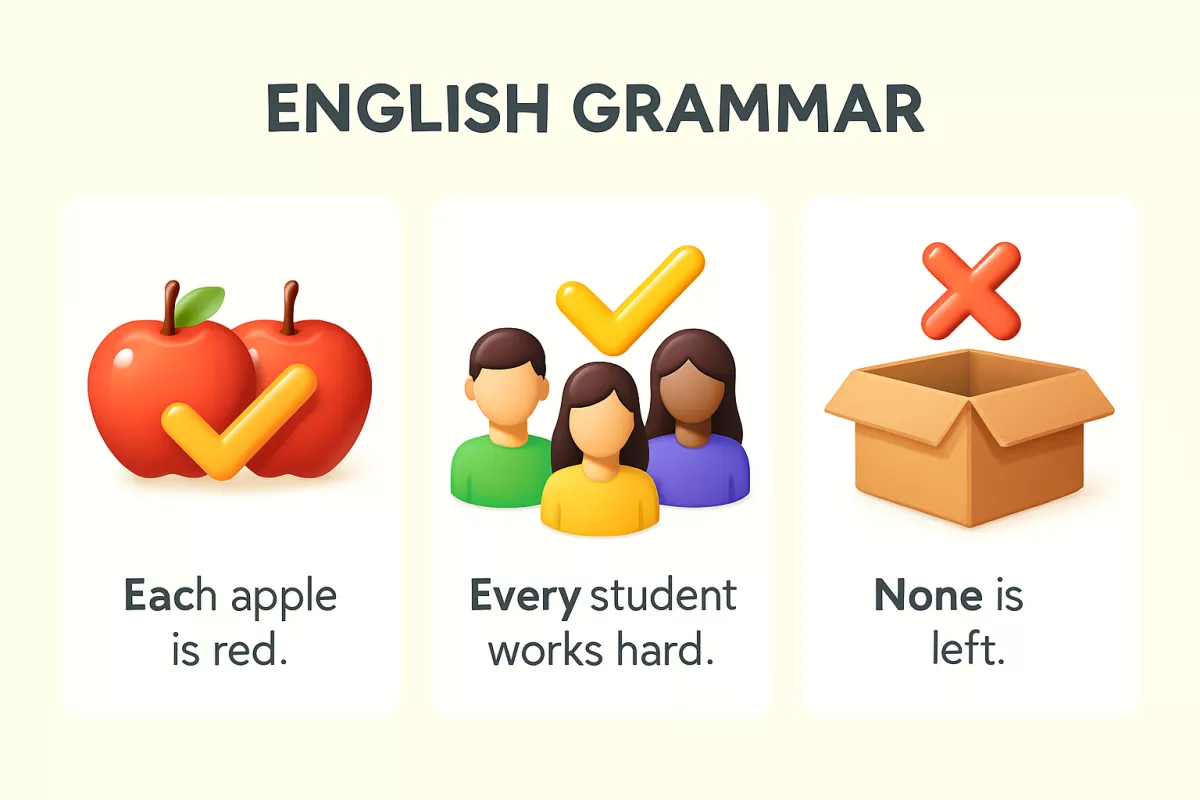
Some pronouns and determiners can make subject–verb agreement confusing, especially when they seem to refer to more than one thing. Words like “each,” “every,” and “none” often trip up writers because they look plural or refer to groups, but their verb agreement rules are specific and important to understand.
Agreement with “each” and “every”
“Each” and “every” are always followed by a singular noun and take a singular verb. Even when they refer to many items or people, the verb stays singular because these words emphasize individuals within the group, not the group as a whole.
- Each student has a locker.
- Every book is on the shelf.
- Each of the cookies was eaten.
- Every child likes ice cream.
- Each answer is correct.
- Every one of the cars was parked outside.
- Each participant receives a certificate.
How “none” behaves
“None” can be singular or plural, depending on the context. If it means “not one” or refers to something uncountable, use a singular verb. When it means “not any” with a plural noun, a plural verb is generally accepted, especially in casual English.
| Pattern | Example |
|---|---|
| None + singular/uncountable noun | None of the information is correct. |
| None + plural noun (formal/written) | None of the students is late. |
| None + plural noun (everyday use) | None of the students are late. |
| None as subject alone | None was available. |
Common pitfalls and quick checks
Writers sometimes use a plural verb after “each” or “every” because the sentence mentions multiple people or things. Always check if the subject is grammatically singular. For “none,” decide if the word is closer to “not one” (singular) or “not any” (plural). Both can be correct, but keep your audience and formality in mind.
- ✅ Correct: Each of the players runs fast.
- ❌ Incorrect: Each of the players run fast.
- ✅ Correct: None of the water was spilled.
- ✅ Acceptable: None of the cookies are left. (Informal)
- ✅ Also correct: None of the cookies is left. (Formal)
Mastering these patterns helps avoid common errors and makes your subject–verb agreement more precise and natural.
There is / There are agreement
Understanding how to use “there is” and “there are” correctly depends on recognizing whether the noun that follows is singular or plural. These introductory phrases help point out the existence or presence of something, so matching the verb to the noun’s number is essential. “There is” is used before singular nouns and uncountable nouns, while “there are” comes before plural nouns.
Basic Patterns
- There is a book on the table. ✅ (singular)
- There is some water in the glass. ✅ (uncountable)
- There are three chairs in the room. ✅ (plural)
- There are many options available. ✅ (plural)
Common Mistakes
- There is two dogs in the yard. ❌ (should be “There are”)
- There are a cat on the sofa. ❌ (should be “There is”)
Special Cases and Spoken English
In informal speech, you may sometimes hear “there’s” used with plural nouns, as in “There’s two people waiting.” While common in conversation, this usage is generally considered incorrect in formal writing. Always match the verb form to the noun’s number in formal contexts.
Agreement with Compound Subjects
When more than one item follows, agreement is based on the first noun after “there.” If the first noun is singular, use “there is”; if plural, use “there are.” However, for clarity, it is best to use “there are” if any noun in the list is plural.
| Structure | Example |
|---|---|
| Singular noun | There is a pen on the desk. |
| Plural noun | There are pens on the desk. |
| Uncountable noun | There is milk in the fridge. |
| Compound (plural first) | There are books and a notebook on the shelf. |
| Compound (singular first, but plural follows) | There are a notebook and some books on the shelf. |
Quick Reference: When to Use Each Form
- Use there is for singular or uncountable nouns: “There is a problem.” / “There is information.”
- Use there are for plural nouns: “There are many questions.”
- For lists: if any noun is plural, prefer “there are.”
- In questions, invert: “Is there a message?” / “Are there any messages?”
- In negatives: “There isn’t a solution.” / “There aren’t any solutions.”
Correct agreement with “there is” and “there are” ensures that your sentences are clear and grammatically accurate, especially in both speech and writing. Always check the noun that follows to choose the right form.
Common errors in real writing
Missteps with subject–verb agreement frequently appear in everyday texts, emails, and even published materials. These mistakes often stem from confusion over what the actual subject is, irregular patterns, or exceptions in English grammar. By recognizing recurring patterns, writers can avoid many of the pitfalls that cause sentences to sound awkward or incorrect.
Typical subject–verb agreement slip-ups
Writers tend to make similar errors, especially when dealing with tricky subjects or less common structures. The following list highlights some of the most frequent issues:
- Using a plural verb with a singular collective noun (e.g., The team are winning instead of The team is winning in American English)
- Confusing agreement when the subject is separated from the verb by phrases or clauses (e.g., The bouquet of flowers smell lovely instead of smells)
- Matching the verb to a noun close to it, rather than the true subject (e.g., Each of the students have finished instead of has)
- Overcorrecting after "either/or" or "neither/nor" structures (e.g., Neither the teacher nor the students was ready instead of were)
- Forgetting irregular verb forms with "be" (e.g., There is many reasons instead of are)
- Using a singular verb with plural indefinite pronouns (e.g., Many is interested instead of are)
- Getting tripped up by titles, company names, or band names that look plural but take a singular verb (e.g., The United States are instead of is)
- Incorrect agreement after quantities and amounts (e.g., Ten dollars are enough instead of is—when considered a single sum)
- Uncertainty with "none" (e.g., None of the cake are left instead of is)
- Pluralizing verbs with singular subjects ending in -s (e.g., Mathematics are hard instead of is)
- Omitting agreement after relative clauses (e.g., She is one of those people who enjoys art instead of enjoy)
- Inconsistent agreement in sentences with mixed subjects (e.g., The manager, as well as the team, are attending instead of is)
Examples: Incorrect vs. Correct Agreement
| Incorrect | Correct |
|---|---|
| The list of items are on the desk. | The list of items is on the desk. |
| Neither of the answers are correct. | Neither of the answers is correct. |
| There is many reasons for this. | There are many reasons for this. |
| My favorite band are playing tonight. | My favorite band is playing tonight. |
| Ten dollars are enough. | Ten dollars is enough. |
Patterns that often cause confusion
Writers are most likely to make mistakes when:
- The subject is followed by a prepositional phrase (e.g., The group of students)
- Sentences contain inverted word order (e.g., There is/are...)
- Compound subjects joined by "and" (almost always plural), but exceptions exist for phrases like "peanut butter and jelly"
- Subjects with "or"/"nor"—the verb agrees with the closest noun
- Indefinite pronouns (everyone, someone, none) that can be singular or plural depending on context
Understanding these recurring issues can help writers develop a keener sense for correct subject–verb pairing, resulting in clearer, more professional communication.
Homework: subject–verb agreement exercises
Mastering subject–verb concord is essential for clear and accurate English. These activities focus on identifying correct verb forms, understanding common patterns, and practicing agreement in various sentence structures. Review the examples, then try the exercises to reinforce your understanding.
Common Patterns in Subject–Verb Agreement
English verbs must match their subjects in both number and person. Remember these frequent patterns:
- Singular subjects take singular verbs: The cat runs.
- Plural subjects take plural verbs: The cats run.
- When using "there is/are," the verb agrees with the noun that follows: There is a problem. / There are problems.
- With collective nouns, choose the verb based on whether the group acts as a unit (singular) or individuals (plural): The team wins. / The team are arguing.
- Indefinite pronouns such as everyone, each, and nobody are singular: Everyone enjoys the show.
- Compound subjects joined by "and" usually take plural verbs: Tom and Jerry are friends.
- Subjects joined by "or" or "nor" agree with the nearer subject: Neither the teacher nor the students are ready.
- Titles of books, movies, or organizations are treated as singular: The United Nations is meeting today.
- Amounts of time, money, or distance are usually singular: Ten dollars is enough.
- When phrases come between the subject and verb, ignore them for agreement: The basket of apples is full.
Practice: Choose the Correct Verb Form
Select the correct verb to complete each sentence.
- The list of items (is/are) on the desk.
- Neither the manager nor the employees (was/were) present.
- Mathematics (is/are) his favorite subject.
- My friends and I (enjoy/enjoys) hiking every weekend.
- Everyone in the class (has/have) finished the assignment.
- Ten kilometers (seems/seem) like a long distance to walk.
- There (is/are) many reasons to celebrate.
- The news (is/are) encouraging today.
- Each of the students (was/were) given a certificate.
- The team (wins/win) most of its games.
Show answers
- is
- were
- is
- enjoy
- has
- seems
- are
- is
- was
- wins
Identifying Agreement Errors
Each sentence below contains a subject–verb agreement error. Rewrite the sentence to correct the mistake.
- One of the dogs bark loudly every morning.
- The books on the shelf needs to be dusted.
- Neither of my parents are coming to the meeting.
- The committee have made its decision.
- There is several students waiting outside.
Show answers
- One of the dogs barks loudly every morning.
- The books on the shelf need to be dusted.
- Neither of my parents is coming to the meeting.
- The committee has made its decision.
- There are several students waiting outside.
Subject–Verb Agreement Examples
Review the following table for typical subject–verb pairs and their correct forms:
| Subject | Correct Verb Form |
|---|---|
| She | runs |
| They | run |
| Everyone | enjoys |
| The children | play |
| My family | is |
| My friends | are |
| The news | is |
| Ten dollars | is |