Third Person -s: Rules, Pronunciation, and Frequent Errors

 Here we when to use the third person -s, spelling and pronunciation rules for -s, -es, and -ies, using does in negatives and questions, common learner mistakes, time expressions for habits, quick checks, and practice tasks.
Many English learners struggle with using the correct verb endings when referring to third-person subjects such as he, she, or it, particularly in the present tense. This common challenge can make sentences sound awkward or unclear. Paying attention to these small changes, like adding an s or es to the verb, is important for clear and natural communication. By practicing and becoming comfortable with these endings, learners can significantly improve both their speaking and writing, making their English sound more fluent and accurate in everyday situations.
When third person -s is required
In English, the simple present tense for verbs uses a special ending, -s, when the subject is a third person singular noun or pronoun (he, she, it, or any single person, animal, thing, or name). This rule helps clarify who is doing the action and is a distinctive feature of standard present tense verb forms.
Subjects that trigger the -s ending
The -s ending is used when the subject is:
- He (He walks to work.)
- She (She reads every morning.)
- It (It rains often in spring.)
- A singular noun (The dog barks at strangers.)
- A singular name (Maria studies French.)
- Indefinite pronouns (Someone calls every day.)
- Anything considered as one unit (The team wins the match.)
- Titles or organizations (The government decides new laws.)
- Uncountable nouns when used as a subject (Sugar dissolves in water.)
- Gerunds as subjects (Swimming helps relaxation.)
Verbs that take the -s ending
Most main verbs in the simple present add -s for third person singular. However, the way the ending is added can change depending on the verb’s spelling.
- Play → plays (She plays piano.)
- Work → works (He works late.)
- Go → goes (It goes well.)
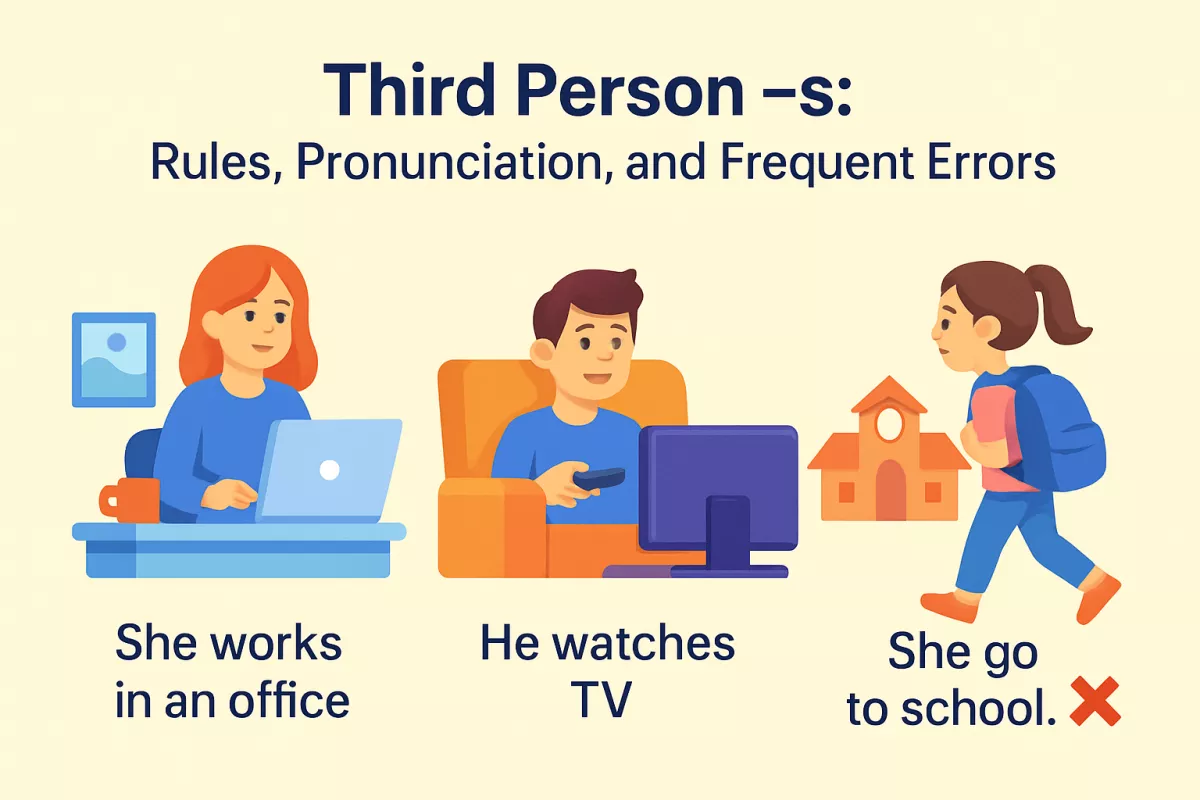
- Watch → watches (He watches TV.)
- Fix → fixes (She fixes cars.)
- Carry → carries (He carries groceries.)
- Study → studies (She studies biology.)
- Teach → teaches (He teaches math.)
- Wash → washes (It washes easily.)
- Mix → mixes (He mixes ingredients.)
- Pass → passes (She passes the test.)
- Catch → catches (He catches the train.)
Special cases: irregular verbs and key patterns
Some verbs follow special rules in the third person singular and often cause mistakes. These forms must be memorized, as they do not follow the regular -s pattern.
- Be → is (He is ready.)
- Have → has (She has a meeting today.)
- Do → does (It does not work properly.)
- Go → goes (He goes to work by train.)
- Say → says (She says it is important.)
Summary of subject-verb agreement in the simple present
| Situation | Correct Verb Form | Example |
|---|---|---|
| I / You / We / They | Base form | They work from home. |
| He / She / It / Singular noun | Base form + -s / -es | She works in marketing. |
| Verb be (third person) | is | It is expensive. |
| Verb have (third person) | has | He has two brothers. |
| Verb do (third person) | does | She does not agree. |
| Negative statements | does not + base form | He does not like coffee. |
| Questions | Does + subject + base form | Does she work here? |
| After modal verbs | Base form only | He can work remotely. |
| Common learner mistake | ❌ base + -s after does | ❌ Does she works? → ✅ Does she work? |
Keep in mind that the -s ending appears only in affirmative statements of the simple present. In questions, negatives, and after modal verbs, English always uses the base form. Mastering this contrast is essential for accurate and natural everyday communication.
Spelling rules: -s, -es, -ies
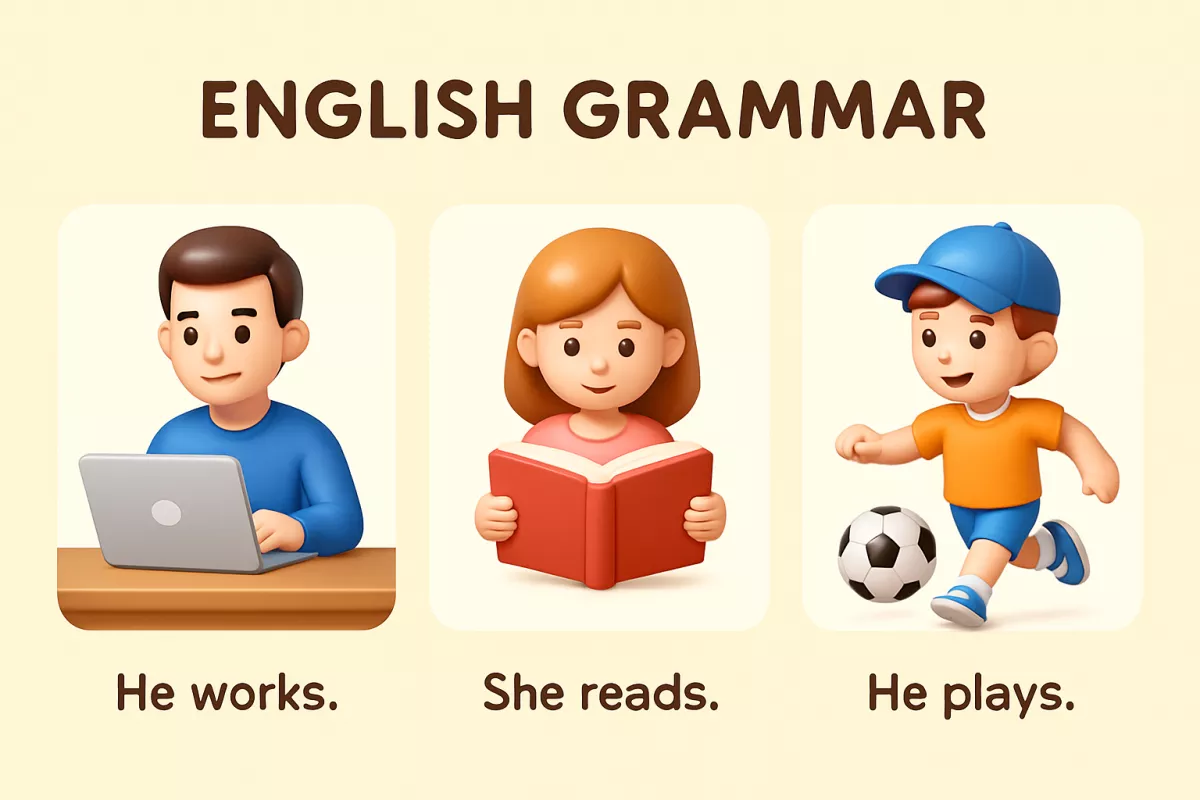
When forming the third person singular form of present simple verbs, English uses three main endings: -s, -es, and -ies. Which ending is correct depends on the final letter or sound of the base verb. Recognizing these patterns helps avoid common mistakes in writing and speaking.
Basic -s ending
Most verbs add simply -s to create the third person form. This is the default for verbs ending in most consonants or vowels except those requiring special treatment.
- work → works (He works remotely.)
- read → reads (She reads every evening.)
- play → plays (He plays tennis on weekends.)
- eat → eats (She eats breakfast at home.)
- drink → drinks (He drinks a lot of water.)
- call → calls (She calls her parents daily.)
- need → needs (He needs more time.)
- find → finds (She finds the job challenging.)
- open → opens (The store opens at nine.)
- wait → waits (He waits patiently.)
- help → helps (She helps her colleagues.)
- work out → works out (He works out every morning.)
Adding -es for sibilant and certain endings
Verbs ending in -s, -ss, -sh, -ch, -x, -z, or -o take -es in the third person singular. This adds an extra syllable, which makes pronunciation smoother and more natural.
| Verb ending | Base verb | Third person form | Example sentence |
|---|---|---|---|
| -ss | miss | misses | She misses her family. |
| -sh | wash | washes | He washes his car on Sundays. |
| -ch | teach | teaches | She teaches English online. |
| -x | fix | fixes | He fixes technical issues. |
| -z | buzz | buzzes | The phone buzzes constantly. |
| -o | go | goes | She goes to work by train. |
| -o | do | does | He does his homework after dinner. |
| -s | kiss | kisses | She kisses her child goodnight. |
Changing -y to -ies
If a verb ends in a consonant + -y, the -y changes to -ies. If -y follows a vowel, the verb simply takes -s.
- study → studies (He studies linguistics.)
- carry → carries (She carries a heavy bag.)
- try → tries (He tries to improve.)
- cry → cries (The baby cries at night.)
- fly → flies (The plane flies at dawn.)
- hurry → hurries (She hurries to work.)
- reply → replies (He replies quickly.)
- enjoy → enjoys (vowel + y, just add -s)
- play → plays (vowel + y)
- stay → stays (vowel + y)
Tip: If you can clearly hear an extra syllable at the end (like -iz), you probably need -es or -ies. If not, a simple -s is usually enough.
Summary of spelling patterns
To summarize, use -s for most verbs, -es for sibilant and certain endings, and -ies after a consonant plus -y. Regular practice and attention to the verb ending will help avoid common errors like studys ❌ or goes spelled as gos ❌.
Pronunciation: /s/ /z/ /ɪz/
Understanding how to pronounce the third person singular ending in English verbs is essential for clear and accurate communication. The -s ending can sound different depending on the final sound of the verb. These variations follow predictable phonetic patterns that help speakers determine the correct pronunciation.
Three Main Sounds
The -s ending in the third person singular present tense is pronounced in three distinct ways:
- /s/ — a voiceless "s" sound
- /z/ — a voiced "z" sound
- /ɪz/ — an extra syllable, sounding like "iz"
How to Choose the Correct Ending
The pronunciation depends on the final sound (not the final letter) of the base verb:
- /s/ is used after voiceless sounds (except /s/, /ʃ/, /tʃ/): He stops, She laughs.
- /z/ follows voiced sounds (except /z/, /ʒ/, /dʒ/): She plays, He calls.
- /ɪz/ is added after sibilant sounds: /s/, /z/, /ʃ/, /ʒ/, /tʃ/, /dʒ/: He watches, She passes, It judges.
Common Patterns and Examples
| Verb Ending Sound | Example (Third Person) | Pronunciation |
|---|---|---|
| Voiceless (/p/, /t/, /k/, /f/, /θ/) | stops, hits, walks, laughs, bathes | /s/ |
| Voiced (/b/, /d/, /g/, /v/, vowels, /m/, /n/, /ŋ/, /l/, /r/) | grabs, needs, begs, loves, sees, runs, sings, calls, hears | /z/ |
| Sibilants (/s/, /z/, /ʃ/, /ʒ/, /tʃ/, /dʒ/) | misses, buzzes, washes, judges, watches | /ɪz/ |
Expanded Example List
- He works (/s/)
- She eats (/s/)
- It fits (/s/)
- He reads (/z/)
- She loves (/z/)
- It runs (/z/)
- She dances (/ɪz/)
- He fixes (/ɪz/)
- It pushes (/ɪz/)
- He teaches (/ɪz/)
- She washes (/ɪz/)
- He passes (/ɪz/)
- It buzzes (/ɪz/)
- She judges (/ɪz/)
- He calls (/z/)
- She sings (/z/)
- It jumps (/s/)
- He laughs (/s/)
- She helps (/s/)
- It grabs (/z/)
Key Points to Remember
- The pronunciation is determined by the sound, not the spelling, at the end of the verb base.
- Adding -es creates an extra syllable only after sibilant sounds.
- Incorrect pronunciation can lead to confusion or misunderstandings in speech.
Recognizing the patterns for the third person singular ending will help prevent common mistakes and improve both listening and speaking accuracy.
Negatives and questions with does
When talking about third person singular subjects (he, she, it, or singular nouns), the verb usually takes an -s ending in the present simple. However, this changes in negative sentences and questions. Instead of adding -s to the main verb, English uses the auxiliary verb does for these forms. The main verb returns to its base form, without -s.
Forming negative sentences
To make a negative statement, use does not (or doesn't) followed by the base form of the verb. The subject comes first, then doesn't, and finally the base verb.
- She doesn't like coffee.
- He does not play football.
- The dog doesn't bark at night.
- It doesn't rain much here.
- My brother doesn't eat meat.
- Anna doesn't drive to work.
- The machine does not work properly.
- Our teacher doesn't give homework on Fridays.
- His car doesn't start in cold weather.
- The baby doesn't sleep well.
Making questions
In questions, does comes before the subject, and the main verb stays in its base form. This structure is used for yes/no questions and for questions with words like where, when, and why.
- Does she live nearby?
- Does he know the answer?
- Does it work?
- Does your friend speak French?
- Does the train stop here?
- Does Anna have a cat?
- Does the movie start at 8?
- Does the teacher check homework every day?
- Does your phone ring in silent mode?
- Does the dog like water?
Common patterns and errors
A very common mistake is adding -s to the main verb in negatives or questions. In the present simple, only the auxiliary does shows the third person singular. The main verb must always stay in the base form.
- ❌ She doesn't likes apples → ✅ She doesn't like apples.
- ❌ Does he drives to work? → ✅ Does he drive to work?
- ❌ She doesn't works on Mondays → ✅ She doesn't work on Mondays.
- ❌ Does it costs much? → ✅ Does it cost much?
- ❌ He don't like coffee → ✅ He doesn't like coffee.
Quick rule to remember: If you see does or doesn't, the main verb is always bare — no -s, no -es, no -ies.
Summary of third person singular forms
| Sentence Type | Correct Structure | Example (he / she / it) | Common Mistake |
|---|---|---|---|
| Affirmative | Subject + verb + -s | She drinks tea. | She drink tea ❌ |
| Negative | Subject + does not + base verb | She doesn't drink tea. | She doesn't drinks ❌ |
| Yes/No Question | Does + subject + base verb? | Does she drink tea? | Does she drinks? ❌ |
| Short Answer | Yes/No + subject + does | Yes, she does. | Yes, she drinks ❌ |
| Wh-question | Wh-word + does + subject + base verb | Where does he work? | Where does he works? ❌ |
Final takeaway: Use -s only in affirmative sentences. The moment you add does or doesn't, the verb drops back to its base form. This single rule eliminates most third-person errors instantly.
Common learner mistakes and why they happen
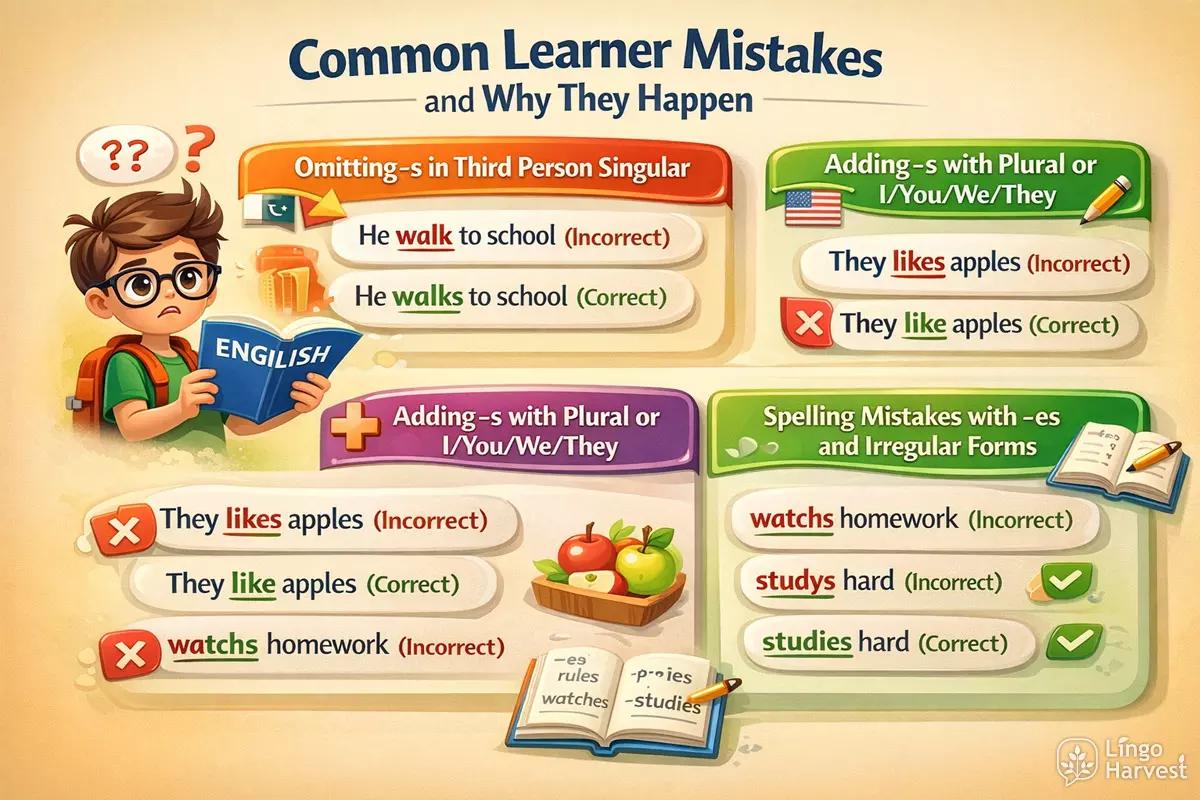
Misunderstandings with third person -s are frequent among English learners, especially when it comes to forming present simple verbs. These errors usually occur due to differences between learners’ native languages and English grammar, as well as confusion with verb forms, spelling, and pronunciation patterns.
Omitting -s in third person singular
Many learners forget to add -s or -es to verbs with he, she, or it. This often happens because the present tense in some languages does not mark verbs for person or number, or the marker is placed elsewhere in the sentence. As a result, sentences like "She walk to school" or "It rain every day" are common.
Adding -s with plural or first/second person subjects
Learners sometimes overgeneralize the rule and attach -s to verbs with I, you, we, or they (e.g., "They likes apples" or "We goes home"). This confusion usually comes from memorizing the -s rule without fully understanding subject-verb agreement.
Spelling mistakes with -es and irregular forms
Spelling errors often appear with verbs ending in -ch, -sh, -x, -o, or -y. Learners may write "watchs" instead of "watches" or "studys" instead of "studies." This happens because the spelling rules for adding -es or changing -y to -ies are not always intuitive.
Pronunciation errors: -s endings
The pronunciation of the third person -s varies: /s/, /z/, or /ɪz/. Learners may use only one sound, making their speech less natural or harder to understand. For example, "watches" pronounced as /wɒtʃs/ instead of /wɒtʃɪz/, or "runs" as /rʌnz/ pronounced /rʌns/.
| Verb Ending | Correct -s Pronunciation | Example |
|---|---|---|
| Voiceless consonant (e.g., p, k, f) | /s/ | talks /tɔːks/ |
| Voiced consonant or vowel (e.g., b, g, n, l, vowels) | /z/ | runs /rʌnz/ |
| s, z, sh, ch, x | /ɪz/ | washes /ˈwɒʃɪz/ |
Confusing verb forms with auxiliaries
Sometimes learners add -s to modal verbs or auxiliaries, creating forms like "He cans swim" or "She does likes music." This mistake occurs because learners may not distinguish between main verbs and helping verbs, or because their first language uses similar patterns.
Common error patterns
- She go to work every day. ❌ → She goes to work every day. ✅
- He don’t like coffee. ❌ → He doesn’t like coffee. ✅
- It make noise at night. ❌ → It makes noise at night. ✅
- You likes pizza. ❌ → You like pizza. ✅
- She study hard. ❌ → She studies hard. ✅
- He watch TV. ❌ → He watches TV. ✅
- They eats lunch. ❌ → They eat lunch. ✅
- My brother play football. ❌ → My brother plays football. ✅
- She cans cook. ❌ → She can cook. ✅
- The dog barks loudly. ✅ (correct usage)
Why these mistakes persist
Such errors are persistent because learners may not hear the final -s clearly in spoken English, or they may not receive enough feedback when writing. In addition, memorizing patterns without understanding the reasons for them makes it harder to apply the rule consistently. Regular practice with both written and spoken examples helps develop a more accurate sense of when and how to use the third person -s.
Time expressions and present simple habits
Understanding when to use the third person -s in the present simple tense often depends on recognizing specific time markers and habitual actions. These key words and phrases indicate regularity, routine, or facts that do not change, making them essential for correct verb form usage.
Common time expressions for routines
Certain time expressions strongly signal that a sentence describes a habit, routine, or repeated action. These markers are a reliable clue that the present simple (with third person -s) is required.
- Frequency adverbs: always, usually, often, sometimes, rarely, never, regularly
- Daily routines: every day, every morning, every evening, after school, before breakfast
- Specific days: on Mondays, on weekends, on holidays
- Fixed intervals: once a week, twice a month, every year
- General repetition: all the time
Tip: If a sentence answers the question “How often?” or “When regularly?”, the present simple is usually the correct choice.
Typical sentence patterns
When describing habits or routines, English follows a stable structure. In the third person singular (he, she, it), the verb takes an -s ending.
- She walks to school every morning.
- He checks his email before work.
- It rains a lot in April.
- The train leaves at 8 o’clock.
- My brother works late on Fridays.
Notice: Even when the subject is not a pronoun (e.g. the train, my brother), the same third person rule applies.
Comparing third person -s and base form
The table below contrasts habitual sentences with and without the third person -s, using the same time expressions for clarity.
| Subject Type | Correct Example | Why This Form Is Used |
|---|---|---|
| I / You / We / They | They eat lunch at noon every day. | No -s is added with plural subjects. |
| He / She / It | She eats lunch at noon every day. | Third person singular requires -s. |
| I / You / We / They | We go to the gym twice a week. | Base form follows non-third person subjects. |
| He / She / It | He goes to the gym twice a week. | -es is added for pronunciation. |
| Singular noun | The teacher starts class at 9 a.m. | Singular nouns behave like he/she/it. |
Key points to remember
- Use the present simple for habits, routines, schedules, and general facts.
- Add -s or -es only when the subject is he, she, it, or a singular noun.
- Time expressions are strong signals for this tense.
- The most common mistake is forgetting -s with third person subjects.
- If the sentence sounds like a regular pattern, the present simple is usually correct.
By recognizing routine-related time expressions and matching them with the correct verb form, learners can consistently produce accurate and natural present simple sentences.
Quick accuracy checks for third person -s
When using simple present tense verbs with he, she, or it, adding -s or -es is a key marker of subject-verb agreement. Mistakes with this pattern are common, but there are simple ways to check accuracy and reinforce correct usage.
Identify the subject
First, ask: is the subject third person singular? This includes nouns like “the dog,” “my friend,” or pronouns such as “he,” “she,” or “it.” Only these require the special verb ending in present tense.
- He runs.
- It rains.
- The cat sleeps.
- My sister watches.
- A student studies.
How to check third person singular forms (without overthinking)
When proofreading present simple sentences, focus on two things only: who performs the action and how the verb is spelled. If the subject is third person singular (he, she, it, or a singular noun), the verb usually changes — but not always in the same way.
| Sentence Context | Correct Form | Why This Form Is Used |
|---|---|---|
| A routine with a singular person | The manager approves requests every Friday. | Singular subject → base verb + -s. |
| A fact about a thing or system | This device requires regular updates. | Objects count as it → third person singular. |
| Verb ending in a sibilant sound | The policy addresses several risks. | -es added for pronunciation (-ss / -sh / -ch). |
| Verb ending in consonant + y | She relies on expert advice. | -y → -ies after a consonant. |
| Verb ending in vowel + y | He plays a minor role in the process. | Vowel + y → just add -s. |
| Verb ending in -o | The system goes offline at night. | -o verbs usually take -es. |
| Irregular verb: have | The company has strict guidelines. | Have changes completely → has. |
| Irregular verb: do | The software does the job automatically. | Do → does in third person. |
| Negative sentence | She does not follow outdated rules. | Auxiliary does takes the -s, main verb stays base. |
| Question form | Does the author argue this point? | No -s on the main verb after does. |
High-frequency mistakes to eliminate
- Double marking: She does explains ❌ → She does explain ✅
- Missing -s: The report describe ❌ → The report describes ✅
- Wrong subject logic: Statistics shows ❌ → Statistics show ✅ (plural noun)
- Modal confusion: He can manages ❌ → He can manage ✅
Fast self-check before submitting or speaking
- Is the subject one person, one thing, or one concept?
- If yes → does the verb show -s / -es?
- If there is does / doesn’t, is the main verb in base form?
- Is the verb irregular (have / do / be)?
Bottom line: third person singular is not about memorizing rules — it’s about recognizing patterns. Once the subject is clear, the correct verb form usually becomes obvious.
Homework: third person -s practice tasks
Mastering the third person singular -s in present simple is essential for clear English communication. The following practice activities focus on recognizing, forming, and using the correct verb endings with he, she, and it. Pay attention to spelling changes, pronunciation, and patterns to avoid common mistakes.
Recognizing correct forms
Select the correct present simple form for each verb in the sentences below. Remember, verbs take -s with third person singular subjects.
- He (work/works) in a hospital.
- She (play/plays) tennis every weekend.
- It (rain/rains) a lot in autumn.
- My brother (study/studies) French.
- The cat (chase/chases) the mouse.
- The professor (teach/teaches) linguistics at the university.
- This app (track/tracks) your daily activity.
- Her father (watch/watches) the news every evening.
- The machine (fix/fixes) minor errors automatically.
- Anna (try/tries) to arrive early on Mondays.
Show answers
- works
- plays
- rains
- studies
- chases
- teaches
- tracks
- watches
- fixes
- tries
Common error correction
Read each sentence and decide if it is correct or incorrect. If incorrect, rewrite the sentence with the right form.
- She walk to school every day.
- He eats breakfast at 7 o'clock.
- It make a loud noise.
- My father drives a bus.
- The baby cry at night.
- Her manager approve the request.
- The device work without batteries.
- His sister live abroad.
- The software update automatically.
- The train arrive at noon.
Show answers
- Incorrect. She walks to school every day.
- Correct.
- Incorrect. It makes a loud noise.
- Correct.
- Incorrect. The baby cries at night.
- Incorrect. Her manager approves the request.
- Incorrect. The device works without batteries.
- Incorrect. His sister lives abroad.
- Incorrect. The software updates automatically.
- Incorrect. The train arrives at noon.
Pronunciation practice
Listen for the pronunciation of the -s ending. Sort the verbs into the three groups based on their final sound.
- likes
- needs
- teaches
- runs
- watches
- speaks
- opens
- fixes
- calls
- catches
Show answers
- /s/: likes, speaks
- /z/: needs, runs, opens, calls
- /ɪz/: teaches, watches, fixes, catches
Short writing task
Write five sentences about a friend or family member, using third person singular verbs about their daily routine. Check your verbs for the correct -s endings. Example: "My sister wakes up at 6 a.m."
Show answers
- My brother plays football after school.
- He eats dinner with our family.
- He goes to bed at nine o'clock.
- He watches TV in the evening.
- He brushes his teeth before sleeping.