Verb Spelling Rules: Doubling, Dropping -e, Adding Endings

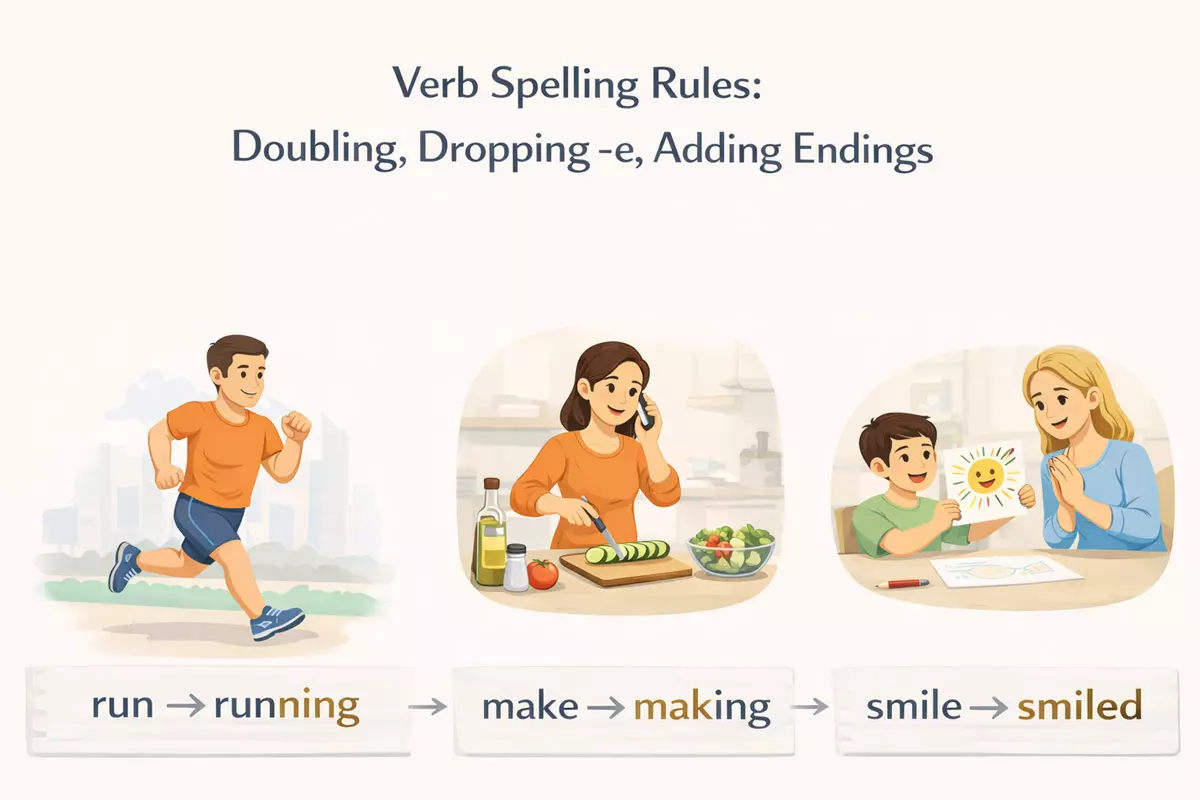 The article explains why English verbs change spelling with different endings. It covers key rules for doubling consonants, dropping final -e, handling y and ie endings, common learner mistakes, and includes quick tips and practice tasks.
Understanding how verbs change when adding -ing or -ed is essential for clear and confident English writing. By learning rules such as when to double the final consonant, drop a silent “e,” or just add the ending, you can avoid frequent errors and express your ideas more effectively. This knowledge not only improves your grammar but also helps you communicate smoothly in both casual conversations and more formal situations, making your English sound more natural and polished.
Why verb spelling changes with endings
When English verbs take endings like -ing, -ed, or -s, the spelling sometimes changes — not randomly, but to protect pronunciation and readability. These adjustments developed so that written forms stay close to how words are actually spoken. Once you see the logic behind them, the rules stop feeling mechanical and start feeling predictable.
Instead of memorizing the same examples again and again, it’s more useful to understand what triggers a change and what does not. The table below brings all major spelling adjustments together without repeating the same verbs across lists.
Core spelling-change triggers when adding verb endings
| Trigger | What happens | Why it happens | Representative examples |
|---|---|---|---|
| Short vowel + single consonant (stressed syllable) |
Final consonant is doubled | Keeps the vowel short | plan → planning, admit → admitted, occur → occurring |
| Silent -e at the end | Silent -e is dropped | Avoids double vowels | move → moving, decide → decided, write → writing |
| Consonant + y | y changes to i (before -ed / -es) | Maintains standard spelling patterns | apply → applied, deny → denies, copy → copied |
| Vowel + y | No spelling change | Pronunciation already clear | play → played, enjoy → enjoying |
| Ending in s, z, sh, ch, x, o | -es added instead of -s | Prevents hard-to-pronounce clusters | pass → passes, fix → fixes, go → goes |
| Unstressed final syllable | No consonant doubling | Stress rule not met | open → opened, travel → traveling (US) |
What learners often misunderstand
- Doubling is about stress, not word length.
- The silent -e disappears only before vowel-starting endings (-ing, -ed).
- -y changes only after consonants, not vowels.
- Not all verbs ending in a consonant double it — stress matters.
- British and American spelling may differ (travelled vs traveled).
Seen as a system rather than a list of rules, verb spelling changes become far more manageable. Instead of asking “Which rule do I use?”, learners start asking the better question: “What sound and stress does this verb have?” That shift alone prevents most spelling mistakes.
Doubling final consonants: rules and examples
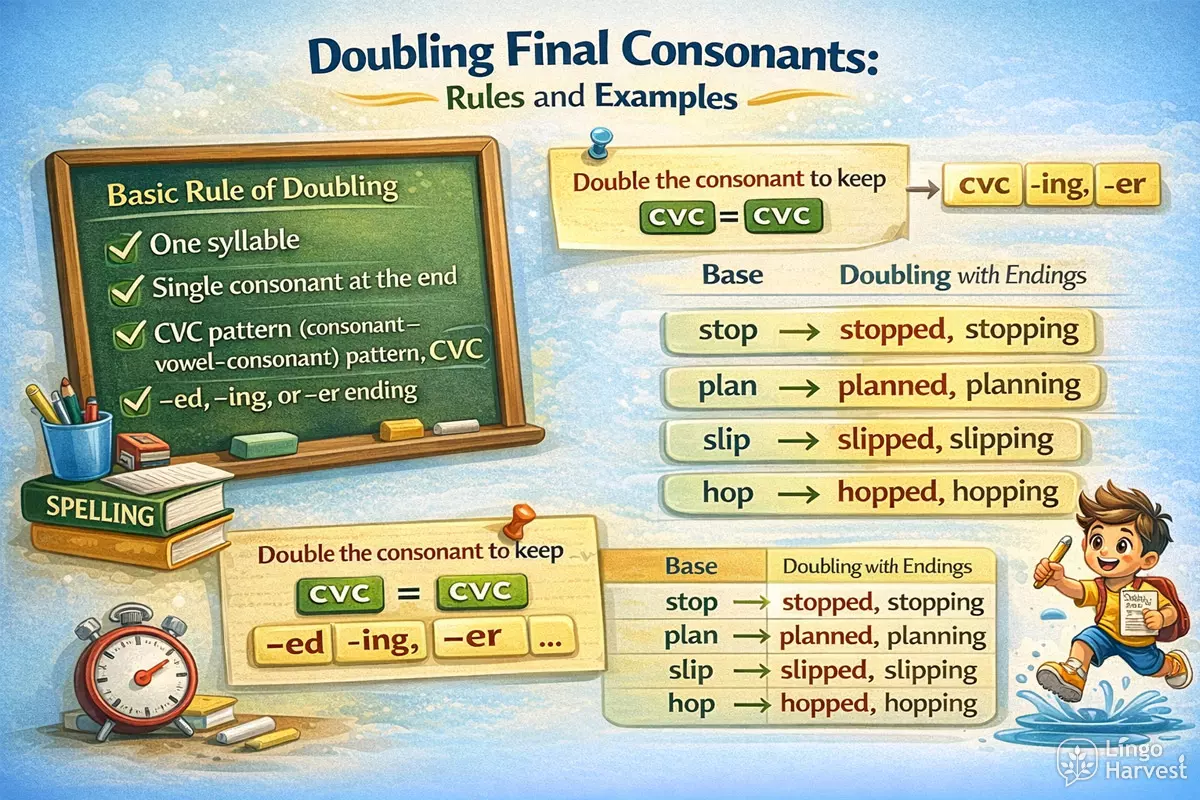
When adding endings like -ed, -ing, or -er to certain verbs, a common spelling adjustment is to double the last consonant. This pattern helps preserve the original vowel sound and follows clear rules based on the structure of the word.
Basic rule for doubling
Verbs typically double the final consonant when all of these conditions are met:
- The verb is one syllable (or the stress is on the last syllable for longer verbs).
- The word ends in a single consonant (not w, x, or y).
- There is a single vowel before the final consonant (consonant-vowel-consonant pattern, or CVC).
- An ending such as -ed, -ing, or -er is added.
Examples of verbs with doubled final consonants
Many familiar words follow this pattern. Compare the base form and the form with an ending:
- stop → stopped, stopping
- plan → planned, planning
- slip → slipped, slipping
- hop → hopped, hopping
- beg → begged, begging
- drum → drummed, drumming
- fit → fitted, fitting
- grab → grabbed, grabbing
- rub → rubbed, rubbing
- nod → nodded, nodding
- chat → chatted, chatting
- drop → dropped, dropping
- pat → patted, patting
- rob → robbed, robbing
- slap → slapped, slapping
- tap → tapped, tapping
- tan → tanned, tanning
- trap → trapped, trapping
- grin → grinned, grinning
When not to double the consonant
There are important exceptions to be aware of:
- If the verb ends in two consonants (e.g., help), do not double: helped, helping.
- If the last letter is w, x, or y, do not double: fix → fixed, fixing.
- If the vowel before the final consonant is not a single vowel (e.g., heap), no doubling: heaped, heaping.
- For verbs with two or more syllables, only double when the stress is on the final syllable (e.g., admit → admitted, admitting but visit → visited, visiting).
Comparison: Double vs. no double
| Base Form | With Ending (Doubling) | With Ending (No Doubling) |
|---|---|---|
| stop | stopped, stopping | — |
| plan | planned, planning | — |
| open | — | opened, opening |
| visit | — | visited, visiting |
| fix | — | fixed, fixing |
Summary
Doubling the final consonant is a predictable spelling adjustment for many verbs when adding common endings. Paying attention to the word’s structure—especially the CVC pattern and syllable stress—ensures correct spelling in both regular and exception cases.
Dropping final -e before adding endings
One of the most common spelling adjustments in English happens when a verb ends in a silent -e. In many cases, this final letter disappears as soon as an ending is added. This isn’t a random change — it exists to keep spelling readable and pronunciation clear. Once learners understand when the -e drops and when it stays, this rule becomes highly reliable.
The real rule (simplified)
The key question is not the verb itself, but the first letter of the ending. If the ending begins with a vowel sound, the silent -e usually disappears. If the ending begins with a consonant, the -e usually stays.
How the rule works in practice
| Ending type | What happens to final -e | Why | Clear examples |
|---|---|---|---|
| Vowel-initial endings (-ing, -ed, -er, -able) |
-e is dropped | Avoids double vowels and awkward spelling | make → making, hope → hoped, drive → driver |
| Consonant-initial endings (-ful, -less, -ment) |
-e is kept | No spelling conflict | hope → hopeful, care → careless, move → movement |
| Double-vowel endings (-ee, -oe, -ye) |
-e is kept | Dropping it would distort pronunciation | agree → agreeing, canoe → canoeing |
| Meaning-sensitive forms | -e is kept | Prevents ambiguity | dye → dyeing (not dying) |
Common traps learners fall into
- Dropping -e before consonant endings (hopeful, not hopful).
- Keeping -e before -ing (makeing ❌).
- Forgetting special cases like dye → dyeing.
- Overthinking verbs where no change is required.
One-sentence takeaway
If the ending starts with a vowel, the silent -e usually disappears; if it starts with a consonant or protects meaning, the -e stays.
Seen this way, the rule stops being a memorization task and becomes a simple spelling check you can apply instantly while writing.
Adding -ing and -ed correctly
Forming -ing and -ed endings looks simple on the surface, but spelling changes appear as soon as pronunciation or stress would otherwise become unclear. The goal of these rules is not grammar complexity — it is readability and sound consistency. Once you focus on why the spelling changes, the patterns become much easier to apply.
When no spelling change is needed
Many verbs accept -ing and -ed directly, with no adjustments at all. These are typically verbs that do not end in a silent -e and do not meet the stress conditions for consonant doubling.
- listen → listening, listened
- answer → answering, answered
- travel → traveling, traveled
- follow → following, followed
Doubling the final consonant (stress-based rule)
The final consonant is doubled only when the verb ends in a single vowel + single consonant and the final syllable is stressed. This preserves the short vowel sound.
- admit → admitting, admitted
- occur → occurring, occurred
- refer → referring, referred
- permit → permitting, permitted
When the stress is not on the final syllable, doubling does not happen:
- open → opening, opened
- visit → visiting, visited
- offer → offering, offered
Dropping the silent -e
If a verb ends in a silent -e, that letter is removed before adding -ing, but usually kept for -ed. This avoids awkward letter combinations and keeps pronunciation clear.
- prepare → preparing, prepared
- arrive → arriving, arrived
- improve → improving, improved
- escape → escaping, escaped
Verbs ending in -y
Verbs ending in -y behave differently depending on what comes before the y.
- Consonant + y: modify → modifying, modified
- Consonant + y: reply → replying, replied
- Vowel + y: delay → delaying, delayed
- Vowel + y: employ → employing, employed
Special spelling shifts learners often miss
A small number of verbs follow unique spelling logic that does not fit neatly into the main rules.
- lie → lying (not lieing)
- die → dying
- tie → tying
- panic → panicking, panicked
One-table overview (no repetition)
| Spelling trigger | What changes | Clear examples |
|---|---|---|
| No conflict | Add ending directly | follow → followed, answer → answering |
| Final stress + vowel + consonant | Double consonant | admit → admitted, occur → occurring |
| Silent -e | Drop -e before -ing | arrive → arriving, escape → escaping |
| Consonant + y | y → i before -ed | reply → replied, modify → modified |
| Irregular spelling logic | Unique transformation | lie → lying, panic → panicking |
Instead of memorizing dozens of isolated examples, focus on the trigger: stress, sound, or letter combination. Once you identify what causes the change, spelling -ing and -ed forms becomes a fast, reliable process rather than guesswork.
Special cases with -y and -ie endings
Verb endings with -y and -ie cause spelling changes not because English wants to be difficult, but because it tries to keep words readable and pronunciation predictable. Once you separate these verbs by what comes before the final letter, the rules become consistent and logical.
Consonant + y: spelling shifts before -ed and -es

If a verb ends in a consonant followed by -y, the y changes to i before adding -ed or -es. This prevents awkward letter combinations and keeps the word visually clear.
- reply → replied, replies → She replied immediately.
- apply → applied, applies → He applies for the job every year.
- identify → identified, identifies → The system identified the error.
- justify → justified, justifies → She justified her decision.
- classify → classified, classifies → The data is classified by type.
Important: this change does not happen before -ing.
- reply → replying
- apply → applying
- identify → identifying
Vowel + y: no spelling change
When a vowel comes before -y, the verb keeps the y for all endings. These verbs are visually stable and do not trigger spelling shifts.
- delay → delayed, delaying, delays → The flight was delayed again.
- enjoy → enjoyed, enjoying, enjoys → She enjoys working remotely.
- employ → employed, employing, employs → The company employs over 200 people.
- convey → conveyed, conveying, conveys → The message was clearly conveyed.
-ie endings: change to -y before -ing
Verbs ending in -ie follow a unique rule. Before adding -ing, the -ie changes to -y. This avoids awkward spellings like dieing or lieing, which English does not allow.
| Base verb | -ing form | Example in context |
|---|---|---|
| die | dying | Many species are dying out. |
| lie | lying | He was lying about the incident. |
| tie | tying | She is tying her shoes. |
| vie | vying | Several teams are vying for first place. |
For -ed and -s forms, these verbs behave normally:
- die → died
- lie → lies
- tie → tied
- vie → vies
One-glance rule overview
- Consonant + y → change y to i before -ed and -es
- Vowel + y → keep y for all endings
- -ie → change to -y before -ing only
Instead of memorizing long verb lists, focus on the letter immediately before -y or -ie. That single detail determines the entire spelling behavior.
Common spelling mistakes by learners
Spelling errors with verb endings usually don’t come from carelessness — they come from applying the wrong rule at the right time, or the right rule in the wrong place. Instead of memorizing isolated examples, it’s more useful to recognize the decision points where learners typically go wrong.
Where mistakes actually come from
Most spelling errors fall into a few predictable categories. Understanding why they happen makes them much easier to avoid.
- Over-doubling — doubling a consonant when stress or syllable structure does not require it
- Under-doubling — failing to double when a short stressed vowel demands it
- Silent -e confusion — dropping or keeping -e in the wrong context
- Stress blindness — ignoring which syllable carries the stress
- Regional spelling mix-ups — mixing British and American conventions
High-frequency learner errors (with explanations)
| Incorrect form | Correct form | Why the mistake happens |
|---|---|---|
| admiting | admitting | Final syllable is stressed → consonant must be doubled |
| developped | developed | Stress is not on the final syllable → no doubling |
| useing | using | Silent -e must be dropped before -ing |
| travelling (US context) | traveling | British spelling applied in American English |
| comming | coming | Long vowel sound → no consonant doubling |
| prefering | preferring | Final syllable stress triggers doubling |
| argueing | arguing | Silent -e dropped, not retained |
| occuring | occurring | Short vowel + stress → double consonant |
| openning | opening | Unstressed final syllable → no doubling |
| planed (past of plan) | planned | Short vowel requires doubling before -ed |
Why these mistakes persist
Learners often rely on surface rules like “short verbs double” or “verbs ending in consonants double,” which are incomplete. English spelling reacts to a combination of:
- syllable count
- stress placement
- vowel length
- regional spelling standards
Ignoring even one of these factors leads to predictable errors.
Practical self-check before adding an ending
- Is the final syllable stressed?
- Is the vowel before the final consonant short or long?
- Does the verb end in silent -e?
- Am I writing for American or British English?
Asking these questions takes seconds — and prevents most spelling mistakes before they happen.
Quick rules to remember
Understanding the main patterns for changing verb endings helps with spelling accuracy when adding "-ing", "-ed", or "-es". These general principles can save time and prevent common errors, especially with irregular or tricky verbs.
Doubling the final consonant
When a verb ends with a single vowel followed by a single consonant (except w, x, or y), double the final consonant before adding an ending that starts with a vowel, such as "-ing" or "-ed". This rule applies most often when the stress falls on the last syllable.
- run → running, ran → running
- stop → stopped, stopping
- admit → admitted, admitting
- begin → beginning
- prefer → preferred, preferring
- permit → permitted, permitting
- forget → forgetting
- occur → occurred, occurring
- plan → planned, planning
- fit → fitted, fitting
Dropping the final -e
For verbs ending with a silent "e", drop the "e" before adding endings that begin with a vowel, such as "-ing" or "-ed". However, keep the "e" before endings that start with a consonant, like "-ment".
- make → making, made
- hope → hoping, hoped
- use → using, used
- write → writing, written
- move → moving, moved
- live → living, lived
- drive → driving, driven
- arrange → arranging, arranged
- advise → advising, advised
- change → changing, changed
Adding -es to verbs ending in -y, -s, -sh, -ch, -x, or -z
For present simple third-person singular, add "-es" to verbs ending with these sounds or letters. If the verb ends in a consonant + "y", change "y" to "i" and add "-es".
| Verb Base | 3rd Person Singular |
|---|---|
| study | studies |
| watch | watches |
| fix | fixes |
| go | goes |
| miss | misses |
| carry | carries |
| push | pushes |
| buzz | buzzes |
Special notes
- Do not double the final consonant if the stress is not on the last syllable (e.g., "open" → "opening").
- Never double w, x, or y at the end of a word.
- For verbs ending in a vowel + "y", simply add the ending (e.g., "play" → "playing").
- Some irregular verbs do not follow these patterns and must be memorized individually.
Applying these spelling patterns consistently will help prevent mistakes with verb forms and endings.
Homework: verb spelling practice tasks
Understanding how to correctly spell verbs when adding endings is essential for accurate writing. English verbs follow predictable patterns when endings such as -ing, -ed, or -er are added. Common patterns include doubling the final consonant, dropping the final -e, or simply adding the ending. Practicing these patterns helps reinforce correct usage and builds spelling confidence.
Task 1: Doubling the Final Consonant
Some verbs double the final consonant before adding -ing or -ed. This usually happens when the verb ends in a single vowel + single consonant and the final syllable is stressed.
Write the -ing and -ed forms for each verb.
- stop
- plan
- shop
- begin
- prefer
- admit
- occur
- fit
- permit
- refer
Show answers
- stop → stopping, stopped
- plan → planning, planned
- shop → shopping, shopped
- begin → beginning, began
- prefer → preferring, preferred
- admit → admitting, admitted
- occur → occurring, occurred
- fit → fitting, fitted
- permit → permitting, permitted
- refer → referring, referred
Task 2: Dropping the Final -e
If a verb ends in a silent -e, drop it before adding endings that begin with a vowel (most commonly -ing). The -e is usually kept when adding -ed.
Change each verb into its -ing and -ed forms.
- make
- hope
- use
- live
- move
- bake
- smile
- invite
- arrive
- close
Show answers
- make → making, made
- hope → hoping, hoped
- use → using, used
- live → living, lived
- move → moving, moved
- bake → baking, baked
- smile → smiling, smiled
- invite → inviting, invited
- arrive → arriving, arrived
- close → closing, closed
Task 3: No Change Needed
Some verbs do not require any spelling changes before adding -ing or -ed. This usually happens when the verb ends in a vowel, a consonant cluster, or the letters w, x, y. In these cases, you simply add the ending.
Form the -ing and -ed versions of each verb.
- talk
- open
- mix
- enjoy
- snow
- fix
- read
- visit
- push
- help
Show answers
- talk → talking, talked
- open → opening, opened
- mix → mixing, mixed
- enjoy → enjoying, enjoyed
- snow → snowing, snowed
- fix → fixing, fixed
- read → reading, read
- visit → visiting, visited
- push → pushing, pushed
- help → helping, helped
Application Challenge
Rewrite each sentence by changing the verb in brackets to the correct -ing or -ed form. Apply the appropriate spelling rule.
- I am (run) late for work.
- She has (bake) cookies for the class.
- They were (plan) a long vacation.
- He is (fix) his bike in the garage.
- We have (move) into a smaller apartment.
- The dog was (stop) at the door.
- I have (agree) to the new schedule.
- She is (enjoy) the quiet evening.
- They had (shop) for hours.
- He was (carry) a heavy backpack.
Show answers
- I am running late for work.
- She has baked cookies for the class.
- They were planning a long vacation.
- He is fixing his bike in the garage.
- We have moved into a smaller apartment.
- The dog was stopping at the door.
- I have agreed to the new schedule.
- She is enjoying the quiet evening.
- They had shopped for hours.
- He was carrying a heavy backpack.