Gerunds in English: How Verb + -ing Works as a Noun

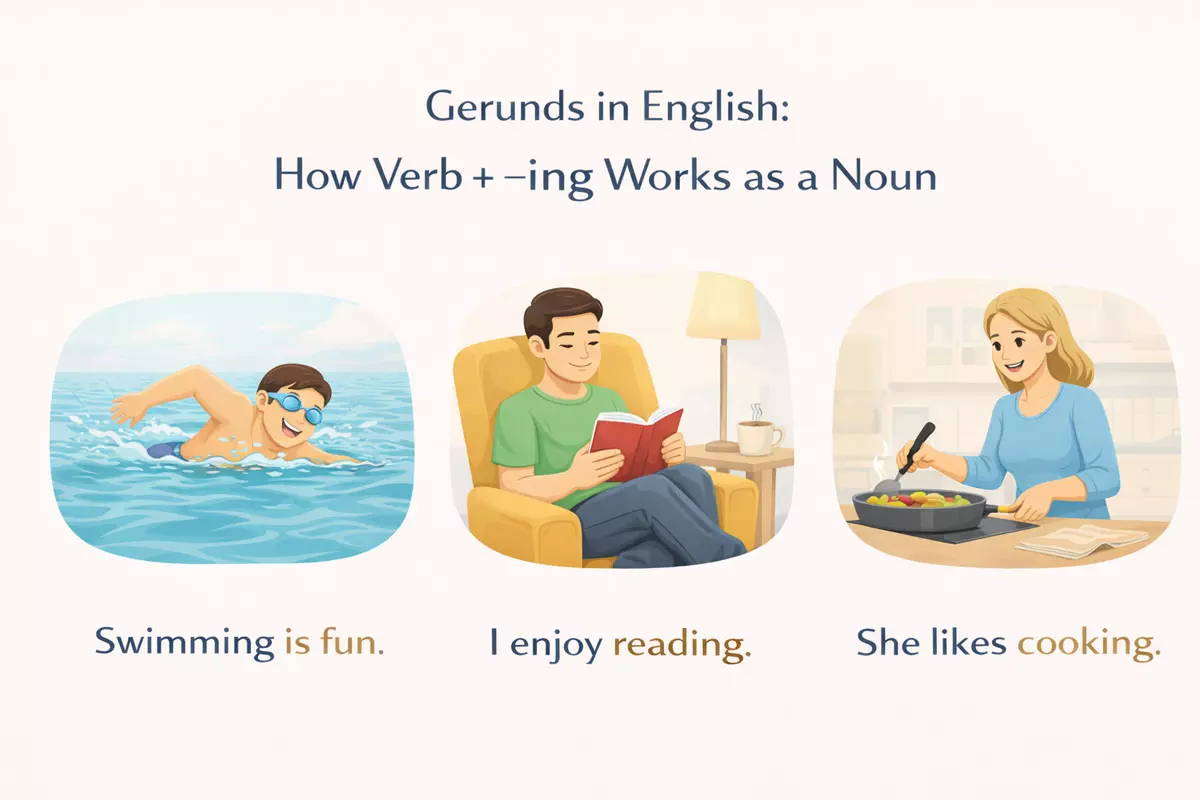 This article explains what gerunds are, how they work as subjects and objects, which verbs and prepositions take them, and how to tell them apart from present participles and infinitives. It also fixes common mistakes and includes homework practice.
Turning an action word into something you can talk about is simple: add -ing and use the verb as a noun. You hear this in everyday English, from I enjoy cooking to Running helps me relax. It can make sentences smoother and more natural, and it works after many verbs like enjoy, avoid, and consider, as well as after prepositions, such as in She left without saying goodbye.
What a gerund is in English
A gerund is the -ing form of a verb used as a noun. It keeps the meaning of an action (like a verb), but it behaves grammatically like a noun: it can be the subject of a sentence, the object of a verb, or the object of a preposition.
How to recognize it
The form looks the same as the present participle (both end in -ing), so the key is the job in the sentence. If the -ing word functions as a noun (thing/activity), it is a gerund.
- Subject: Reading helps me relax.
- Object of a verb: She enjoys cooking.
- Object of a preposition: They left without saying goodbye.
- Complement after “be”: His hobby is collecting stamps.
Common patterns where it appears
Gerunds are especially common after certain verbs, after prepositions, and in set expressions. In these positions, English typically treats the activity as a “thing” you can talk about.
- After verbs of preference: like, love, hate, enjoy, prefer → I prefer walking.
- After “avoid / consider / suggest / recommend”: We considered moving.
- After “stop / finish / quit / keep”: He stopped smoking.
- After prepositions: good at, interested in, tired of, before, after, without → She’s good at explaining.
- After “go” for activities: go shopping, go swimming, go hiking → Let’s go swimming.
- Fixed phrases: It’s no use arguing. / There’s no point waiting.
Gerund vs. present participle (same form, different function)
Use meaning and position to tell them apart. A participle usually describes a noun or forms a verb tense, while a gerund names the activity.
| -ing form used as… | How it functions | Example |
|---|---|---|
| Noun (gerund) | Names an activity; can be subject/object | Swimming is fun. |
| Adjective/descriptor (participle) | Modifies a noun | The swimming child waved. |
| Part of a verb tense (participle) | Forms the continuous aspect with “be” | She is swimming now. |
| Reduced clause/extra information (participle) | Adds background action | Swimming across the lake, he got tired. |
Typical noun-like features
Because it acts like a noun, a gerund can take modifiers and complements in predictable ways.
- It can have an object: I enjoy reading novels.
- It can be modified by an adverb (not an adjective): Quickly answering emails saves time.
- It can be part of a longer noun phrase: Her carefully planning the trip impressed everyone.
- It often answers “What activity?”: Their main goal is improving communication.
Gerunds as subjects and objects
A gerund (verb + -ing) can function like a noun in a sentence. Two of the most common positions are the subject (what the sentence is about) and the object (what receives the action or completes the meaning of a verb or preposition).
Gerunds as the subject

When an -ing form is the subject, it usually refers to an activity in general, not a specific event. This pattern is common for habits, skills, and general truths.
- Swimming relaxes me after work.
- Reading improves vocabulary over time.
- Cooking at home saves money.
- Traveling broadens your perspective.
- Listening carefully prevents mistakes.
- Learning a language takes patience.
- Working late affects my sleep.
- Driving in heavy rain requires focus.
- Practicing daily builds confidence.
- Being on time shows respect.
- Helping others can be rewarding.
- Overthinking makes decisions harder.
Gerunds as objects
Gerunds also appear after certain verbs and after prepositions. In these positions, the -ing form behaves like a noun phrase that completes the meaning of what comes before it.
- After some verbs: I enjoy running in the morning.
- After some verbs: She avoids driving at night.
- After some verbs: We finished cleaning the kitchen.
- After some verbs: They suggested taking a break.
- After some verbs: He considered changing jobs.
- After some verbs: I miss seeing my friends regularly.
- After some verbs: She keeps checking her phone.
- After some verbs: We discussed moving closer to work.
- After a preposition: I’m interested in learning design.
- After a preposition: They left without saying goodbye.
- After a preposition: He apologized for being late.
- After a preposition: She’s good at explaining complex ideas.
- After a preposition: We talked about starting earlier.
- After a preposition: I’m tired of waiting.
- After a preposition: There’s no point in arguing.
- After a preposition: She succeeded by practicing consistently.
Common usage notes
Choose the gerund when you want to name an activity, especially after prepositions and after verbs that typically take an -ing complement. If you are unsure, check what comes right before the -ing form:
- ✅ If the word before it is a preposition (in, of, for, about, by, without), use a gerund: “good at speaking,” “interested in joining.”
- ✅ If the -ing phrase is doing the job of a noun (subject or object), a gerund is a natural choice: “Studying helps,” “I enjoy studying.”
- ❌ Do not treat a present participle as a gerund when it is only describing a noun: “the running water” (adjective use, not a noun role).
Common verbs followed by gerunds
Many English verbs are typically followed by an -ing form when the next idea functions like a noun (a gerund). This pattern is especially common after verbs that express preferences, avoidance, completion, and reactions. Using the gerund here sounds natural and is often required for correct usage.
High-frequency verbs that take a gerund
- enjoy → I enjoy reading before bed.
- avoid → She avoids driving at night.
- finish → They finished cleaning the kitchen.
- stop → He stopped smoking last year.
- quit → I quit eating sugar for a month.
- consider → We’re considering moving closer to work.
- suggest → She suggested taking a break.
- recommend → The doctor recommended resting more.
- keep → They keep asking the same question.
- mind → Do you mind waiting a few minutes?
- miss → I miss talking with my old classmates.
- practice → He practices speaking every day.
- admit → She admitted making a mistake.
- deny → He denied taking the files.
- risk → You risk losing your progress if you skip backups.
- postpone / put off → We postponed meeting until Friday.
- discuss → They discussed changing the schedule.
- imagine → Imagine living by the sea.
- can’t stand → I can’t stand waiting in long lines.
- can’t help → She can’t help laughing at that scene.
Useful usage notes and common pitfalls
- Verb + gerund often follows verbs about likes/dislikes and habits: “enjoy reading,” “avoid driving,” “keep asking.”
- Discuss is followed by a noun or gerund, not an infinitive: ✅ “discuss changing the plan” ❌ “discuss to change the plan.”
- Suggest and recommend commonly use a gerund for the action: “suggest taking,” “recommend resting.” (You can also use “suggest that + clause.”)
- Stop + gerund means ending an activity: “stopped smoking.” (This is different from “stopped to smoke,” which means paused in order to do something.)
- Mind + gerund is typical in polite questions and requests: “Do you mind closing the window?”
Gerunds after prepositions
When a verb comes right after a preposition, English normally uses the -ing form (a gerund), not an infinitive. This pattern appears after single-word prepositions (like in, on, at) and after multi-word prepositions (like because of, instead of).
Core pattern
Use this structure:
- preposition + gerund: She’s interested in learning Japanese.
- preposition + noun/pronoun + gerund: They complained about him arriving late.
Common prepositions that take an -ing form
- about: We talked about moving abroad.
- after: After finishing work, I went home.
- before: Wash your hands before eating.
- by (method): You can improve by practicing daily.
- for: Thank you for helping.
- from: Stop him from touching the wires.
- in: She succeeded in solving the problem.
- of: He’s capable of running a team.
- on: They insisted on paying now.
- to (as a preposition): I’m looking forward to seeing you.
- with: He helped me with carrying the boxes.
- without: She left without saying goodbye.
- instead of: Instead of driving, we took the train.
- because of: Because of missing the bus, he was late.
- in spite of: In spite of feeling tired, she kept working.
Especially common combinations
- interested in + -ing: She’s interested in designing apps.
- good/bad at + -ing: He’s good at explaining ideas.
- afraid of + -ing: They’re afraid of losing money.
- tired of + -ing: I’m tired of waiting.
- responsible for + -ing: She’s responsible for training new staff.
- used to + -ing (accustomed): I’m used to getting up early.
- look forward to + -ing: We look forward to meeting your team.
- have trouble/difficulty + -ing: He had trouble finding the address.
Common mistake: “to” as a preposition vs. “to” as an infinitive marker
- ✅ I’m committed to improving my writing. (to = preposition)
- ❌ I’m committed to improve my writing.
- ✅ I want to improve my writing. (to introduces an infinitive after want)
Possessive vs. object before a gerund
When a person comes before the -ing form, both patterns are possible. The meaning is usually similar, but the focus can shift slightly.
- possessive + gerund (more formal; focuses on the action): I disliked his interrupting.
- object pronoun + gerund (common in speech; focuses on the person): I disliked him interrupting.
Gerunds vs present participles
Forms ending in -ing can behave like nouns or like parts of verb phrases. The spelling looks the same, so the reliable way to tell them apart is to check the job in the sentence: noun-like roles point to a gerund, while verb/adjective roles point to a present participle.
How to identify each form by function

| Function in the sentence | -ing form type | Common pattern | Examples |
|---|---|---|---|
| Subject (acts as the “thing” doing the sentence topic) | Gerund (noun role) | -ing + singular verb | Swimming relaxes me. / Working late isn’t ideal. |
| Object of a verb | Gerund (noun role) | verb + -ing | She enjoys reading. / They avoided talking about it. |
| Object of a preposition | Gerund (noun role) | prep + -ing | He left without saying goodbye. / I’m interested in learning more. |
| Subject complement (after be, naming what something is) | Gerund (noun role) | be + -ing (as a noun phrase) | Her hobby is painting. / The best part was meeting everyone. |
| Part of a continuous/progressive tense | Present participle (verb role) | be + present participle | I am waiting. / They were driving home. |
| Adjective-like modifier of a noun | Present participle (adjective role) | present participle + noun | A shocking result. / The running water woke me. |
| Reduced clause / participle clause (adds background information) | Present participle (clause role) | present participle phrase, often set off by commas | Walking to work, she listened to podcasts. / He sat there, staring at the screen. |
| After verbs of perception (what someone sees/hears) | Present participle (event in progress) | see/hear/watch + object + present participle | I saw him crossing the street. / We heard them arguing. |
Common “look-alike” cases to watch
Some sentences contain an -ing phrase that looks noun-like, but it is actually describing an action in progress or adding extra information. Use these checks:
- Replace it with “it” or “this activity.” If the sentence still makes sense, it is probably functioning as a noun (a gerund). If not, it is likely a participle phrase.
- Check what comes right before it. After a preposition, the -ing form is almost always a gerund (for example, after leaving, by working, without asking).
- Look for a form of be. If you have am/is/are/was/were + -ing, you are looking at a present participle in a continuous tense (for example, is running, were talking).
Meaning differences: noun activity vs ongoing action
When the same verb can appear as either form, the meaning can shift:
- Noun-like activity (gerund): Running is good for your health. (the activity in general)
- Ongoing action (present participle): She is running right now. (action happening now)
- Modifier (present participle): The running engine sounded rough. (engine that is running)
Quick diagnostic questions
Use these questions to classify an -ing form quickly:
- Does it name an activity, idea, or “thing” in the sentence (subject/object/complement)? → gerund.
- Does it help build a verb tense, describe a noun, or introduce a background clause? → present participle.
Gerund vs infinitive overview
English often offers two noun-like verb forms after another verb: the gerund (verb + -ing) and the infinitive (to + base verb). Choosing between them is usually not about “grammar correctness” in general, but about which verbs and patterns you are using and what meaning you want to express.
A practical way to decide is to look at three common situations: (1) verbs that strongly prefer -ing, (2) verbs that strongly prefer to + verb, and (3) verbs that allow both but change meaning (or emphasis). The comparison below groups these patterns and gives typical examples.
| Pattern | Common verbs | Meaning / usage note | Example |
|---|---|---|---|
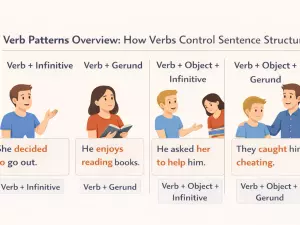
| Verb + gerund | avoid, consider, enjoy, finish, keep, mind, miss, postpone, practice, quit, recommend, risk, suggest | Often describes an activity as a “thing” you do; common after verbs of preference, completion, and delay. | I enjoy reading before bed. |
| Verb + infinitive | agree, decide, hope, learn, need, offer, plan, promise, refuse, seem, want | Often points to a goal, intention, or future action; common after decisions and plans. | We decided to leave early. |
| Verb + gerund or infinitive (little change) | begin, start, continue, like, love, hate, prefer | Both forms are widely used; the difference is usually small. In many contexts, -ing can feel more “activity-focused,” while to + verb can feel more “choice/plan-focused.” | She started working / to work at 9. |
| Verb + gerund or infinitive (meaning changes) | remember, forget, stop, try, regret, mean | The form signals a different time relationship or intention (before vs after, purpose vs result). | I stopped smoking. / I stopped to smoke. |
| Verb + object + infinitive | advise, allow, ask, expect, help, invite, need, order, remind, teach, tell, want, warn | Common when one person influences another person’s action; the object is the “doer” of the infinitive. | They told him to call back. |
| Verb + object + gerund (less common) | catch, find, hear, see, watch (with perception), keep (someone) | Often highlights an action in progress that you observe or discover. | I caught him copying my answers. |
Meaning shifts to watch for
Some verbs are especially important because the choice changes what the sentence means. These are frequent in everyday writing and speaking:
- stop: “stop doing” = quit an activity; “stop to do” = pause another activity in order to do something.
- remember / forget: “remember doing” = recall a past action; “remember to do” = not forget a duty.
- try: “try doing” = experiment with a method; “try to do” = attempt a difficult action.
- regret: “regret doing” = feel sorry about the past; “regret to do/say” = formal, used for bad news.
Quick guidance for choosing the form
When you are unsure, focus on the verb before the noun-like form and the time/intent you want to express. Many errors come from using the right idea with the wrong verb pattern.
Typical learner mistakes and corrections
Errors with verb + -ing forms usually come from mixing up noun uses (gerunds) with verb uses (infinitives, base verbs, or participles). The fixes are mostly pattern-based: learn which structures require an -ing noun, which require to + base verb, and where either is possible with a meaning change.
Common patterns that cause trouble
- Using an infinitive after a preposition
❌ I’m interested in to learn English. → ✅ I’m interested in learning English. - Forgetting that “be used to” is followed by an -ing noun
❌ I’m used to wake up early. → ✅ I’m used to waking up early. - Confusing “used to” (past habit) with “be used to” (familiarity)
❌ I used to waking up early. → ✅ I used to wake up early. / ✅ I’m used to waking up early. - Choosing the wrong form after common verbs
❌ I enjoy to cook. → ✅ I enjoy cooking. - Mixing “stop” meanings
❌ I stopped to smoke (meaning: I quit). → ✅ I stopped smoking (quit).
✅ I stopped to smoke (paused another activity in order to smoke). - Mixing “remember/forget” meanings
❌ I forgot locking the door (when you mean you didn’t do it). → ✅ I forgot to lock the door.
✅ I forgot locking the door (you did it, but don’t remember it now). - Using “suggest” with an infinitive
❌ She suggested to go by train. → ✅ She suggested going by train. - Using “avoid” with an infinitive
❌ Try to avoid to make mistakes. → ✅ Try to avoid making mistakes. - Misusing “it’s no use / it’s worth”
❌ It’s worth to try. → ✅ It’s worth trying.
❌ It’s no use to argue. → ✅ It’s no use arguing. - Leaving out the gerund as the subject
❌ To swim is good exercise (possible, but less natural in many contexts). → ✅ Swimming is good exercise. - Using an -ing form after “make/let/help” without the correct structure
❌ He made me going. → ✅ He made me go.
❌ She let him studying. → ✅ She let him study. - Confusing the -ing noun with the present participle
❌ I saw him to run. → ✅ I saw him running. (participle after a perception verb)
✅ I saw him run. (complete action) - Wrong word order with “go” + activity
❌ Let’s go to shopping. → ✅ Let’s go shopping. - Overusing -ing after adjectives without a preposition
❌ I’m happy seeing you (when you mean “to see you”). → ✅ I’m happy to see you.
✅ I’m happy about seeing you again. (with a preposition + -ing noun) - Using “to” as a preposition vs. “to” as part of an infinitive
❌ I look forward to meet you. → ✅ I look forward to meeting you. (to here is a preposition) - Incorrect negative placement
❌ He admitted to not take the money. → ✅ He admitted not taking the money.
Quick correction checklist
- If a verb comes after a preposition (in, on, at, about, for, to, etc.), use an -ing noun.
- After verbs like enjoy, avoid, suggest, consider, finish, mind, choose verb + -ing.
- After verbs like decide, hope, plan, want, agree, choose to + base verb.
- With stop, remember, forget, try, check meaning first; the form changes the message.
- When the -ing form is the subject of the sentence, it usually sounds most natural as a gerund: Reading helps me relax.
Homework: gerund usage practice tasks
Practice using verb + -ing forms as nouns by focusing on the patterns that trigger them: verbs that take an -ing object, prepositions, fixed expressions, and “it” as a preparatory subject. Complete the tasks below and check your work in the answer key.
Task 1: Choose the correct form (gerund or infinitive)
Select the best option to complete each sentence.
- I can’t stand (to wait / waiting) in long lines.
- She decided (to take / taking) the early train.
- They suggested (to meet / meeting) after work.
- He promised (to call / calling) me later.
- We finished (to clean / cleaning) the kitchen.
- Do you mind (to open / opening) the window?
- I hope (to see / seeing) you again soon.
- He avoided (to answer / answering) the question.
- She offered (to help / helping) with the project.
- They admitted (to make / making) a mistake.
- He refused (to pay / paying) the fee.
- I miss (to live / living) near the sea.
Show answers
- waiting
- to take
- meeting
- to call
- cleaning
- opening
- to see
- answering
- to help
- making
- to pay
- living
Task 2: Complete with a gerund after a preposition
Fill each blank with the correct -ing form of the verb in parentheses.
- Thanks for __________ (help) me with the report.
- She’s interested in __________ (learn) Korean.
- They left without __________ (say) goodbye.
- He apologized for __________ (be) late.
- I’m tired of __________ (hear) the same excuse.
- We talked about __________ (move) to a new apartment.
- She’s good at __________ (solve) puzzles.
- Before __________ (sign) the contract, read it carefully.
- He insisted on __________ (pay) for dinner.
- They succeeded in __________ (find) a cheaper flight.
Show answers
- helping
- learning
- saying
- being
- hearing
- moving
- solving
- signing
- paying
- finding
Task 3: Rewrite using a gerund as the subject
Rewrite each sentence so that the action becomes the subject. Keep the meaning as close as possible.
- It is fun to swim in the ocean.
- It makes me nervous to speak in public.
- It is important to recycle plastic.
- It feels good to help others.
- It takes patience to learn a new instrument.
- It was a mistake to ignore the warning signs.
Show answers
- Swimming in the ocean is fun.
- Speaking in public makes me nervous.
- Recycling plastic is important.
- Helping others feels good.
- Learning a new instrument takes patience.
- Ignoring the warning signs was a mistake.
Task 4: Gerund vs. noun: choose the natural option
Choose the more natural completion. In some cases, both are possible, but pick the best fit for everyday usage.
- His __________ (singing / song) surprised everyone.
- The __________ (building / build) is over 100 years old.
- I enjoyed her __________ (cooking / cuisine) last night.
- That __________ (painting / paint) looks expensive.
- Their __________ (planning / plan) was very detailed.
- We watched the __________ (dancing / dance) for an hour.
- Her __________ (writing / letter) is hard to read.
- The __________ (meeting / meet) starts at 9 a.m.
Show answers
- singing
- building
- cooking
- painting
- planning
- dancing
- writing
- meeting
Task 5: Error correction (focus on common patterns)
Each sentence contains one mistake related to verb patterns or prepositions. Rewrite it correctly.
- She suggested to go earlier.
- He is good in play chess.
- They avoided to talk about money.
- I’m looking forward to see you.
- We discussed to change the schedule.
- He insisted to pay for everything.
- Thanks for to call me back.
- She finished to write the email.
- He admitted to break the rule.
- Before to leave, turn off the lights.
Show answers
- She suggested going earlier.
- He is good at playing chess.
- They avoided talking about money.
- I’m looking forward to seeing you.
- We discussed changing the schedule.
- He insisted on paying for everything.
- Thanks for calling me back.
- She finished writing the email.
- He admitted breaking the rule.
- Before leaving, turn off the lights.
Optional extension: Build your own sentences (no answer key)
Write one original sentence for each pattern below. Aim for natural, everyday contexts.
- Verb + gerund: enjoy, avoid, consider, finish, miss
- Preposition + gerund: good at, interested in, tired of, before, without
- Gerund as subject: “__________ is hard/easy/important.”
- Possessive + gerund: “I appreciate your __________.”
- Fixed expression: “It’s no use __________.”
- Fixed expression: “There’s no point in __________.”
- Fixed expression: “I can’t help __________.”
- Contrast pair: “I stopped __________” (quit the activity) vs. “I stopped to __________” (pause to do something else)
- Like/love/hate + gerund: a general preference or habit
- Remember/forget + gerund: memory of a past action