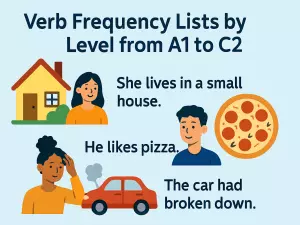
Verb + Two Objects: Give, Send, Show, Teach Patterns

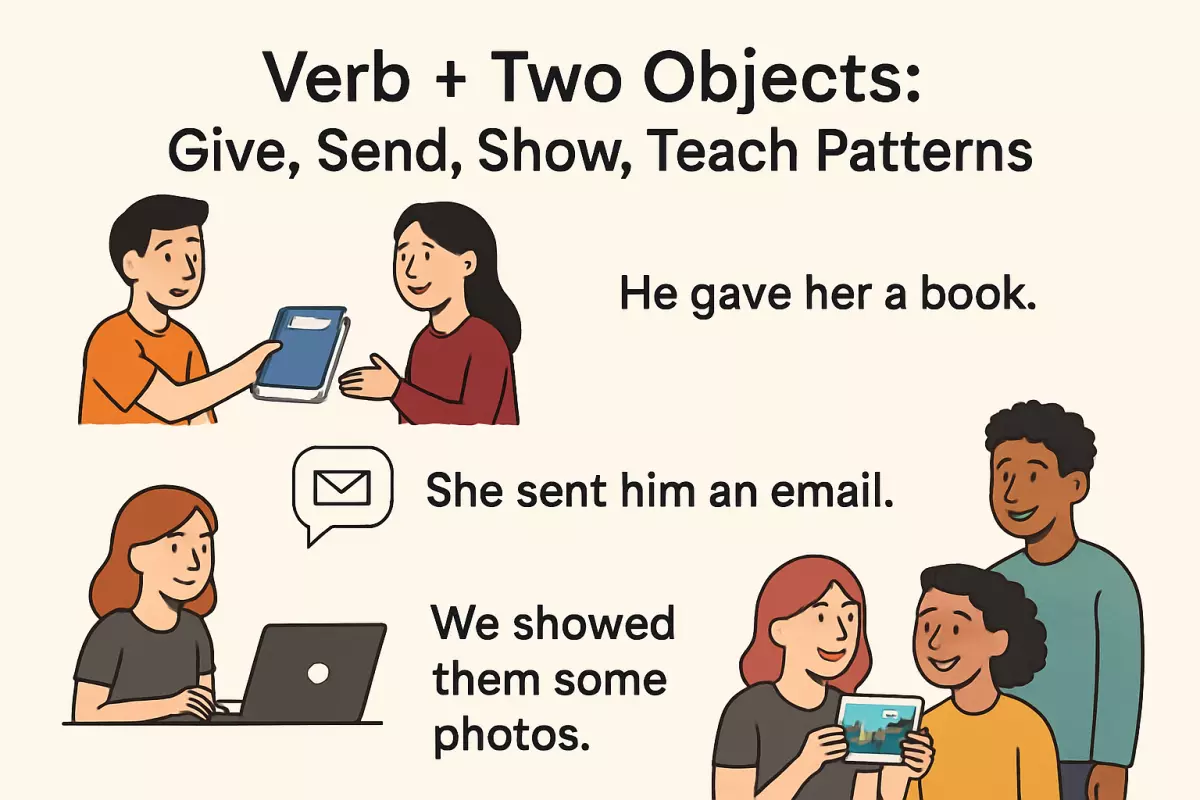 Learn what two-object verbs are, how direct and indirect objects work, and when to use double-object vs prepositional forms. Covers common verbs, word order and pronouns, typical mistakes, plus homework practice tasks.
Some verbs can take two objects to show that something is transferred to someone, such as give, send, show, and teach. This lesson explains how to choose the best word order so your meaning stays clear and natural in everyday communication, whether you are writing an email, sharing information, doing a favor, or teaching a skill.
What two-object verbs are
Some English verbs can take two objects in the same clause: one person (or recipient) and one thing (or message). This structure is common with verbs of giving, sending, showing, and teaching, because the action naturally involves a transfer from one party to another.
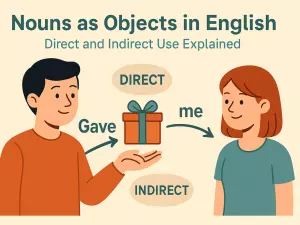
Direct object vs. indirect object
In a sentence with two objects, the direct object is usually the thing being given, sent, shown, or taught. The indirect object is the person (or group) who receives it. English often places the indirect object first when there is no preposition.
- Indirect object (recipient) → who gets it: me, you, her, the students, my boss
- Direct object (thing) → what is transferred: a book, an email, the answer, a lesson, some advice
Two common patterns
These verbs typically appear in one of two patterns. The meaning is usually the same, but the form changes depending on emphasis, length, and pronoun use.
| Pattern | Form | Example | Typical use |
|---|---|---|---|
| Double-object | Verb + Indirect Object + Direct Object | She gave him the keys. | Very common when the recipient is short (often a pronoun). |
| Prepositional | Verb + Direct Object + to/for + Indirect Object | She gave the keys to him. | Useful when the recipient is long or needs emphasis. |
| “For” group | Verb + Indirect Object + Direct Object / Verb + Direct Object + for + Indirect Object | He bought her a ticket / He bought a ticket for her. | Often expresses doing something for someone (benefit), not transferring to them. |
| “To” group | Verb + Indirect Object + Direct Object / Verb + Direct Object + to + Indirect Object | They sent us the details / They sent the details to us. | Often expresses transfer or communication toward a recipient. |
Which verbs commonly allow two objects?
Many transfer and communication verbs can use the double-object pattern. Here are common choices you will see in everyday writing and speech:
- give: give someone a chance, give her the report
- send: send me the link, send them an invoice
- show: show us the menu, show him the photo
- teach: teach the kids a song, teach me the basics
- tell: tell her the truth, tell us your plan
- offer: offer him a seat, offer them help
- lend: lend me your notes, lend her some money
- promise: promise me an update, promise them results
- bring: bring us some water, bring her a jacket
- buy: buy him a coffee, buy the team lunch
- make: make me a sandwich, make her a cup of tea
- get: get me a taxi, get them a replacement
- write: write me a message, write her an email
- read: read the children a story, read me the instructions
- pay: pay the driver a tip, pay her the fee
- hand: hand me the form, hand the client a receipt
Key usage notes
- In the double-object pattern, the recipient usually comes first: show me the answer.
- If the direct object is long, the to/for pattern often sounds clearer: show the steps for resetting the account to the new users.
- Not every verb that can take an object can take two; when in doubt, the to/for structure is often the safer choice if it is grammatical for that verb.
- Meaning can shift slightly with for verbs (benefit) versus to verbs (transfer/communication): buy a gift for her versus send a file to her.
Direct and indirect objects explained
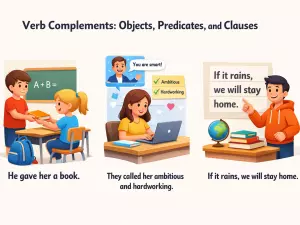
Some verbs can take two complements: a recipient (who gets something) and a thing (what is given, sent, shown, taught, etc.). Understanding which noun plays which role helps you choose the right word order and decide when you need to or for.
What each object means
- Direct object (DO) → the thing, information, or result affected by the verb: a book, the answer, the rules.
- Indirect object (IO) → the recipient/beneficiary: me, the students, her manager.
- In many “two-object” verbs, the IO is typically a person, and the DO is typically a thing or message.
- A quick test: if you can rephrase with to or for, the person after to/for is the recipient/beneficiary (the IO role).
Two common patterns you’ll see
- Pattern A: Verb + IO + DO (double-object order) → She sent him an email.
- Pattern B: Verb + DO + to/for + IO (prepositional order) → She sent an email to him.
- Both patterns often mean the same thing, but writers choose based on clarity, emphasis, and pronoun use.
- When the recipient is long or detailed, the to/for version is usually easier to read: She sent the updated schedule to everyone in the afternoon workshop.
How to identify the roles in real sentences
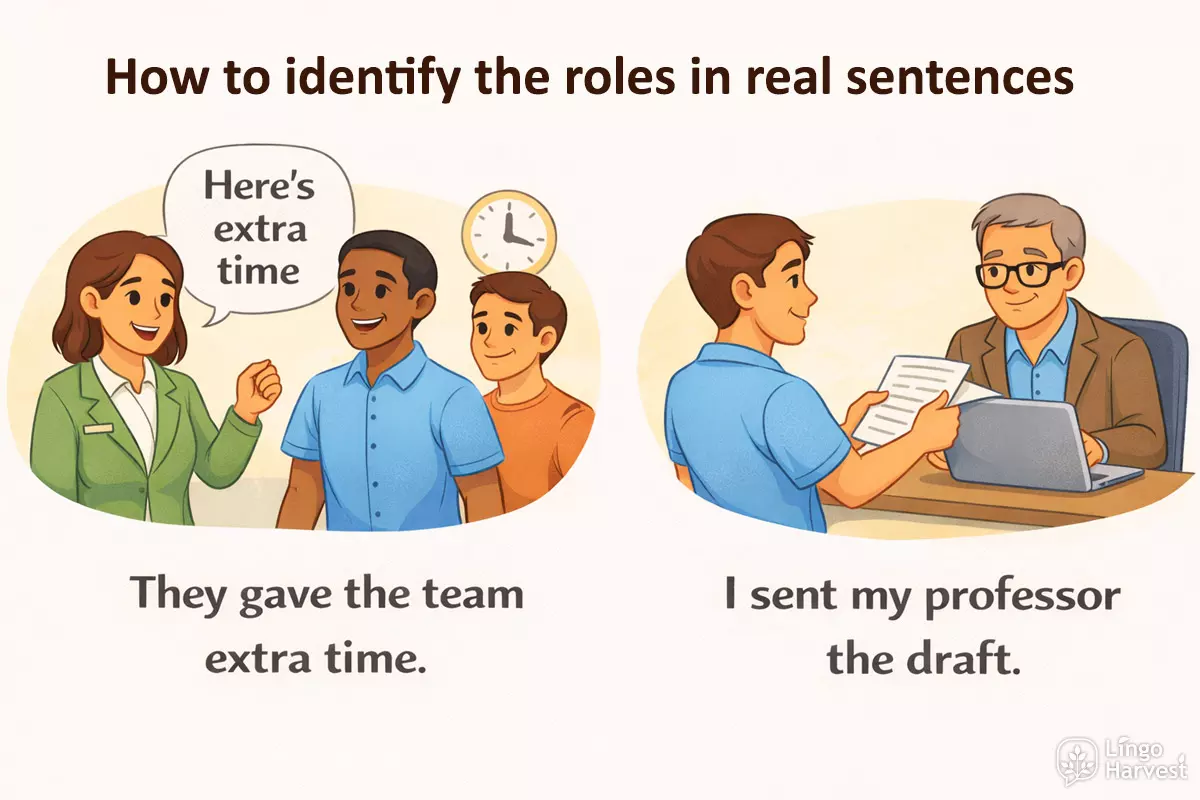
- Give: They gave the team extra time. (team = recipient; extra time = thing)
- Send: I sent my professor the draft.
- Show: Can you show me your notes?
- Teach: She taught the class basic coding.
- Offer: He offered us a ride.
- Promise: They promised her support.
- Lend: Could you lend me your charger?
- Bring: Bring me the file.
- Read: He read his son a story.
- Write: She wrote them a message.
- Buy: I bought my sister a scarf.
- Make: We made our guests tea.
- Get: He got his friend a ticket.
- Pass: Please pass me the salt.
- Hand: She handed the receptionist her ID.
- Tell: Tell me the truth.
Word order choices that affect correctness
- With the double-object order, the recipient usually comes first: ✅ Show me the report. ❌ Show the report me.
- When the “thing” is a pronoun, the to/for pattern is often preferred: Show it to me (more natural than Show me it).
- When both objects are pronouns, to/for is typically the clearest: Send it to her, Give them to us.
- Use to for transfer of something (give, send, show, teach, tell) and for for doing something for someone (buy, make, get): buy a gift for her, make dinner for them.
Double object vs prepositional structure
Many verbs can express “transfer” or “communication” with two participants: a recipient (who gets something) and a thing (what is given, sent, shown, taught). English commonly offers two word orders: (1) two objects next to the verb, or (2) one object plus a prepositional phrase (usually to or for). Choosing between them depends on meaning, clarity, and what you want to emphasize.
Core patterns
Use these as your default templates:
- Two-object order: Verb + recipient + thing → Give him the keys.
- Prepositional order: Verb + thing + to/for + recipient → Give the keys to him.
- Meaning check: to often signals “transfer to a person”; for often signals “done for someone’s benefit.”
When each form sounds more natural
- Use the two-object form when the recipient is short and familiar information: Send me the file.
- Use the prepositional form when the recipient is long or needs emphasis: Send the file to the new project manager in Berlin.
- Use the prepositional form to avoid two pronouns together (often awkward): ❌ Send him it. ✅ Send it to him.
- Use the two-object form to highlight the recipient as the main focus: Show us your draft.
- Use the prepositional form to highlight the thing being transferred: Show your draft to us.
- Prefer the prepositional form when the “thing” is a clause or very long phrase: Explain the reasons for the delay to the client.
Verbs that commonly alternate (with examples)
- give: Give her the receipt. / Give the receipt to her.
- send: Send them an update. / Send an update to them.
- show: Show me the photo. / Show the photo to me.
- teach: Teach the kids phonics. / Teach phonics to the kids.
- tell: Tell him the truth. / Tell the truth to him.
- offer: Offer them a discount. / Offer a discount to them.
- lend: Lend me your charger. / Lend your charger to me.
- promise: Promise me a call. / Promise a call to me.
- bring: Bring us some water. / Bring some water to us.
- hand: Hand him the form. / Hand the form to him.
- mail: Mail her the contract. / Mail the contract to her.
- read: Read the children a story. / Read a story to the children.
Common restrictions and “watch-outs”
- Some verbs do not take the two-object order and usually require a preposition: ✅ Explain the problem to me. ❌ Explain me the problem.
- Pronoun placement: when the thing is a pronoun (it, them), the to-phrase is often clearer: Show it to me.
- Passive voice changes focus: He was given a refund. (recipient-focused) vs A refund was given to him. (thing-focused)
- For vs to: Buy me a coffee. / Buy a coffee for me. (benefit) versus Send the invoice to me. (destination/recipient)
Common verbs used with two objects
Many English verbs can take an indirect object (the receiver) and a direct object (the thing). These verbs often appear in two patterns: verb + person + thing (double-object) or verb + thing + to/for + person (prepositional). Choosing between them depends on meaning, length, and what you want to emphasize.
High-frequency verbs that work well in double-object patterns
- give: Give me your number. → Give your number to me.
- send: Send her the file. → Send the file to her.
- show: Show us the plan. → Show the plan to us.
- tell: Tell him the truth. → Tell the truth to him.
- teach: Teach them English. → Teach English to them.
- offer: Offer me a seat. → Offer a seat to me.
- lend: Lend her your notes. → Lend your notes to her.
- pay: Pay the driver the fare. → Pay the fare to the driver.
- promise: Promise me a call. → Promise a call to me.
- bring: Bring us some water. → Bring some water to us.
- hand: Hand him the keys. → Hand the keys to him.
- pass: Pass me the salt. → Pass the salt to me.
- read: Read the kids a story. → Read a story to the kids.
- write: Write me an email. → Write an email to me.
- sell: Sell them your old laptop. → Sell your old laptop to them.
- buy: Buy her a coffee. → Buy a coffee for her.
- make (meaning “create for someone”): Make us dinner. → Make dinner for us.
- get (meaning “obtain for someone”): Get me a towel. → Get a towel for me.
Useful usage notes and limits
- To vs. for: Use to when the idea is “transfer/communication” (give, send, show, tell). Use for when the idea is “benefit/service” (buy, make, get, find).
- Pronouns often prefer the double-object form: “Send me the link” is usually more natural than “Send the link to me,” unless you need emphasis.
- Long direct objects often shift to the prepositional pattern: “Send the updated report with the final figures to the manager” can feel clearer than placing the long phrase at the end.
- Some verbs do not take two objects directly: ❌ “Explain me the problem.” ✅ “Explain the problem to me.” (Explain uses the prepositional pattern.)
- Meaning can change with the verb: “Teach me English” (instruction) vs. “Teach English to me” (possible but less common and more formal).
Word order rules and variations
With verbs like give, send, show, teach, English commonly allows two object positions: a person (indirect object) and a thing (direct object). The meaning stays similar, but the structure changes depending on whether you use the double-object pattern or a prepositional phrase.
Core patterns (and what they signal)
| Pattern | Typical use and examples |
|---|---|
| Verb + person + thing (double object) |
Common when the recipient is a short noun or pronoun; sounds direct and fluent. ✅ She gave him the keys. ✅ They sent me an email. ✅ I showed her the photo. ✅ He taught us the basics. |
| Verb + thing + to + person (prepositional) |
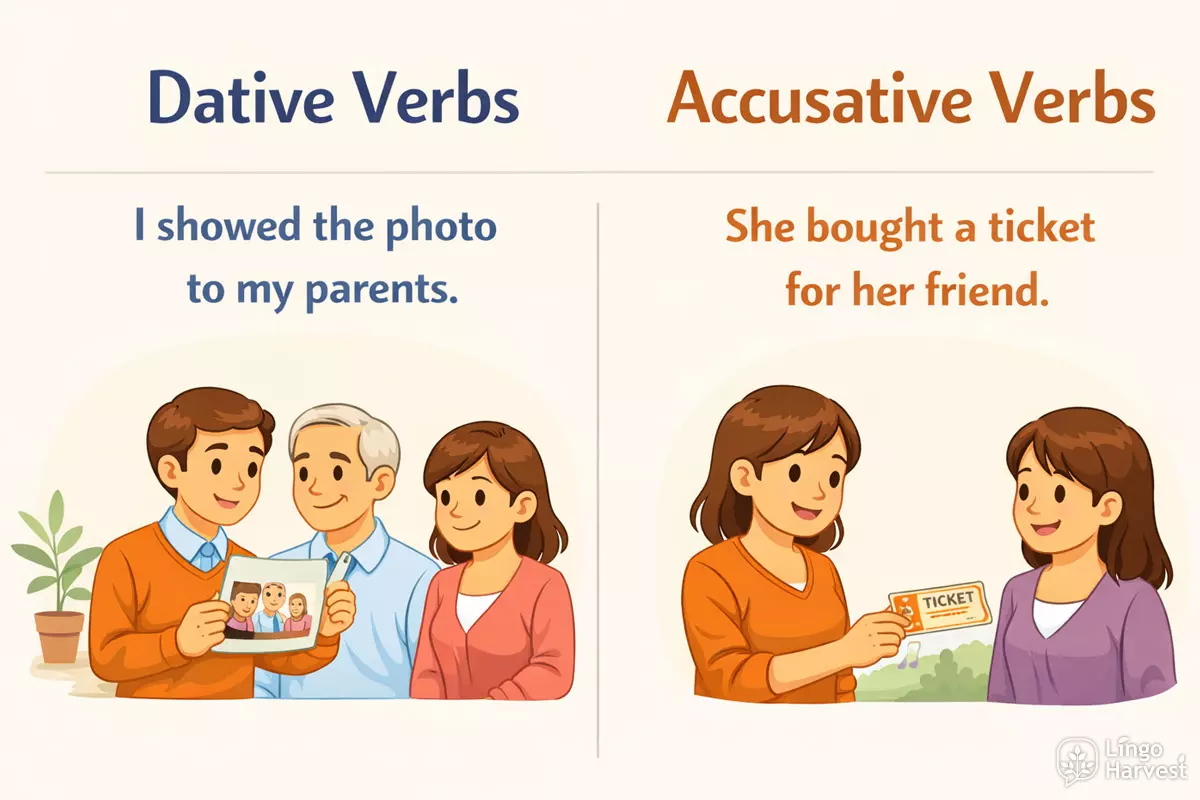
Common when the recipient is long, needs emphasis, or is new information. ✅ She gave the keys to her neighbor. ✅ They sent an email to everyone in the department. ✅ I showed the photo to my parents. ✅ He taught the basics to new hires. |
| Verb + thing + for + person (prepositional) |
Used when the meaning is “do/get something for someone” rather than “transfer to someone.” ✅ She bought a ticket for her friend. ✅ He cooked dinner for his family. Note: give and send usually take to for the recipient, not for, unless the meaning changes. |
| Pronoun placement (smoothness rule) |
Recipient pronouns often sound best right after the verb in the double-object form. ✅ Give me that. ✅ Show us your notes. ❌ Give that to me (possible, but often used for emphasis or contrast). ✅ Give that to me, not to him. |
Common variations and constraints
Choose the structure that fits information flow. If the recipient is long or includes extra detail, the to-phrase often reads more naturally because it keeps the “heavy” part later in the sentence.
✅ She sent the documents to the client we met last week.
✅ She sent him the documents. (short recipient, very natural)
Some forms are grammatical but feel awkward in everyday usage. A frequent cause is putting a long direct object after a short recipient without a pause.
→ Prefer: I showed the updated schedule for next month to the team.
→ Less natural: I showed the team the updated schedule for next month.
When the direct object is a pronoun like it or this, both patterns are possible, but the double-object form is often the quickest and most idiomatic in speech.
✅ Send me it when you can.
✅ Send it to me when you can. (often chosen for contrast or clarity)
In passive voice, either object can sometimes become the subject, but the recipient-as-subject passive is especially common with these verbs.
✅ He was given a warning.
✅ A warning was given to him. (more formal, more distant)
Finally, keep the roles clear: the person is the receiver/learner/viewer, and the thing is what is transferred or communicated. If a sentence sounds confusing, switching to the to-phrase usually makes the relationship easier to read.
Pronouns in two-object sentences
When one or both objects are pronouns, word order becomes more fixed. English usually places the indirect object (the receiver) before the direct object (the thing) in the double-object pattern, but pronouns often sound clearer in the to/for pattern.
Common patterns with object pronouns
- Double-object: Verb + (person) + (thing) → Give me the keys.
- Prepositional: Verb + (thing) + to/for + (person) → Give the keys to me.
- Both objects as pronouns: usually prefer the prepositional pattern for clarity → Give it to me. (more natural than Give me it.)
Which order sounds natural?
- Pronoun receiver + noun thing is very common: Send her the details. / Show us your ticket.
- Noun receiver + pronoun thing often shifts to to/for: Send it to Maria. (more natural than Send Maria it.)
- Two pronouns usually use to/for: Teach it to them. / Show it to him.
- Emphasis on the receiver can also trigger to: Give it to me, not to him.
Examples you can copy
- Give me a minute.
- Give it to me.
- Send her the link.
- Send it to her.
- Show us the menu.
- Show it to us.
- Teach him English.
- Teach it to him.
- Tell them the truth.
- Tell it to them.
- Offer me a seat.
- Offer it to me.
- Lend me your pen.
- Lend it to me.
- Bring us some water.
- Bring it to us.
Common mistakes to avoid
- ❌ Give to me it. → ✅ Give it to me.
- ❌ Send Maria it. → ✅ Send it to Maria.
- ❌ Explain me it. → ✅ Explain it to me. (some verbs require to and do not take the double-object pattern)
As a practical rule, if the thing is a pronoun (it, them), the to/for version is usually the safest choice. If the receiver is a pronoun (me, him, us) and the thing is a noun phrase, the double-object version is often the most natural.
Typical learner mistakes
Errors with verbs that take two objects often come from mixing the double-object pattern (give someone something) with the to/for pattern (give something to someone). The meaning is usually still understandable, but the sentence can sound unnatural or become grammatically wrong.
1) Mixing up word order in the double-object pattern
- ❌ Give to me it. → ✅ Give it to me.
- ❌ Send to her the file. → ✅ Send her the file. / Send the file to her.
- ❌ Show me to it. → ✅ Show it to me.
- ❌ Teach to us grammar. → ✅ Teach us grammar. / Teach grammar to us.
- ❌ Give the teacher it. (possible but awkward) → ✅ Give it to the teacher.
2) Misplacing pronouns (it, them, me, him)
- When the thing is a pronoun, the to/for pattern is usually safer and more natural: ✅ Send it to him (more natural than Send him it).
- ❌ Give him them. (often sounds heavy) → ✅ Give them to him.
- ❌ Show them me. → ✅ Show me them (rare) / Show them to me (best).
- ❌ Teach it us. → ✅ Teach it to us.
3) Using the wrong preposition: to vs for
- Use to for transfer/communication: give, send, show, teach → to someone.
- Use for for doing something as a benefit: buy, make, cook, get → for someone.
- ❌ Teach English for me. (wrong meaning) → ✅ Teach English to me.
- ❌ Send it for me. (unless “on my behalf”) → ✅ Send it to me.
- ❌ Show the photo for me. → ✅ Show the photo to me.
4) Assuming every verb allows two objects
- Some verbs do not normally take the double-object structure, even if the meaning is similar.
- ❌ Explain me the problem. → ✅ Explain the problem to me.
- ❌ Describe us your plan. → ✅ Describe your plan to us.
- ❌ Say me the answer. → ✅ Say the answer to me. / Tell me the answer.
- ❌ Mention me his name. → ✅ Mention his name to me.
5) Confusing “teach” with “learn” and “study”
- Teach = give instruction to someone: teach someone something / teach something to someone.
- Learn = receive knowledge: ❌ He learned me English. → ✅ He taught me English. / I learned English from him.
- Study = spend time learning: ❌ She studied me math. → ✅ She studied math. / She taught me math.
6) Leaving out the indirect object or making it unclear
- If the listener/receiver is important, include it clearly: Send the form to HR (not just Send the form).
- Avoid ambiguous “him/her” when several people are mentioned: repeat the noun if needed: Send the report to Maria.
- With show, the receiver is often necessary: ✅ Show me is fine, but Show the document may sound incomplete without context.
7) Overusing the double-object form in formal writing
- In more formal contexts, the to pattern can sound clearer, especially with long noun phrases: ✅ Send the updated contract to the legal department (often better than Send the legal department the updated contract).
- When the “thing” is long, place it after the verb and keep the receiver in a to phrase: Show the results to the committee.
Homework: two-object verb practice tasks
Use these tasks to practice verbs that can take an indirect object (the person) and a direct object (the thing). Focus on choosing the correct pattern: verb + person + thing or verb + thing + to/for + person, and on pronoun placement (for example, give him it is usually avoided in favor of give it to him).
Task 1: Choose the best structure (A or B)
Select the more natural option in each pair. Pay attention to pronouns and the verb’s usual preposition.
- A) She gave her colleague the document. B) She gave the document her colleague.
- A) I sent my parents it. B) I sent it to my parents.
- A) He showed me his notes. B) He showed his notes to me.
- A) They taught the new staff the procedure. B) They taught the procedure to the new staff.
- A) Can you lend me your charger? B) Can you lend your charger to me?
- A) We offered them a ride. B) We offered a ride to them.
- A) Please read me the instructions. B) Please read the instructions to me.
- A) She bought her friend a ticket. B) She bought a ticket to her friend.
- A) He made his kids dinner. B) He made dinner to his kids.
- A) I told him the truth. B) I told the truth him.
Show answers
- A
- B
- A (B is possible but less common here)
- A (B is also acceptable)
- A (B is possible but less natural)
- A (B is possible but less natural)
- B (A is possible but can sound informal or old-fashioned)
- A (B is incorrect; use for)
- A (B is incorrect; use for)
- A
Task 2: Rewrite using the other pattern
Rewrite each sentence so it uses the alternative structure. Keep the meaning the same.
- She gave the keys to her sister.
- We sent an email to the client.
- He showed the photo to his classmates.
- I lent my notes to Maria.
- They offered help to the neighbors.
- Can you teach the rules to the children?
- She bought a snack for her son.
- He made tea for the guests.
- I told the story to my team.
- Please read the message to me.
Show answers
- She gave her sister the keys.
- We sent the client an email.
- He showed his classmates the photo.
- I lent Maria my notes.
- They offered the neighbors help.
- Can you teach the children the rules?
- She bought her son a snack.
- He made the guests tea.
- I told my team the story.
- Please read me the message.
Task 3: Fix the error (word order or preposition)
Each sentence has one problem. Rewrite it correctly.
- She explained me the problem.
- He said me the answer.
- I described her the place.
- They donated the hospital money.
- Can you suggest me a restaurant?
- She bought a gift to her friend.
- He gave to me it yesterday.
- We sent them to it by mistake.
- He made to his daughter a sandwich.
- I told the truth to him it was complicated.
Show answers
- She explained the problem to me.
- He told me the answer.
- I described the place to her.
- They donated money to the hospital.
- Can you recommend a restaurant to me? (or: Can you suggest a restaurant to me?)
- She bought a gift for her friend.
- He gave it to me yesterday.
- We sent it to them by mistake.
- He made his daughter a sandwich. (or: He made a sandwich for his daughter.)
- I told him the truth: it was complicated.
Task 4: Build sentences from prompts
Write one correct sentence for each prompt. Use either pattern, but keep the roles clear (who receives what).
- (give / I / my neighbor / a spare key)
- (send / they / us / the schedule)
- (show / you / your manager / the report)
- (teach / she / her brother / basic French)
- (offer / we / our guests / some water)
- (lend / he / his friend / $20)
- (read / please / me / the first paragraph)
- (buy / I / my niece / a book)
- (make / Dad / the kids / pancakes)
- (tell / she / me / the good news)
Task 5: Quick self-check rules to apply while writing
- Prefer verb + person + thing when both objects are nouns: She gave her sister the keys.
- Prefer verb + thing + to/for + person when the recipient is a pronoun: She gave the keys to her.
- Use to for transfer/communication verbs: give, send, show, lend, offer, tell, read.
- Use for for actions done for someone’s benefit: buy, make, cook, get.
- Remember common exceptions: explain/describe usually need to + person, not the double-object form.