Verbs of Emotion and Attitude: Meaning and Usage

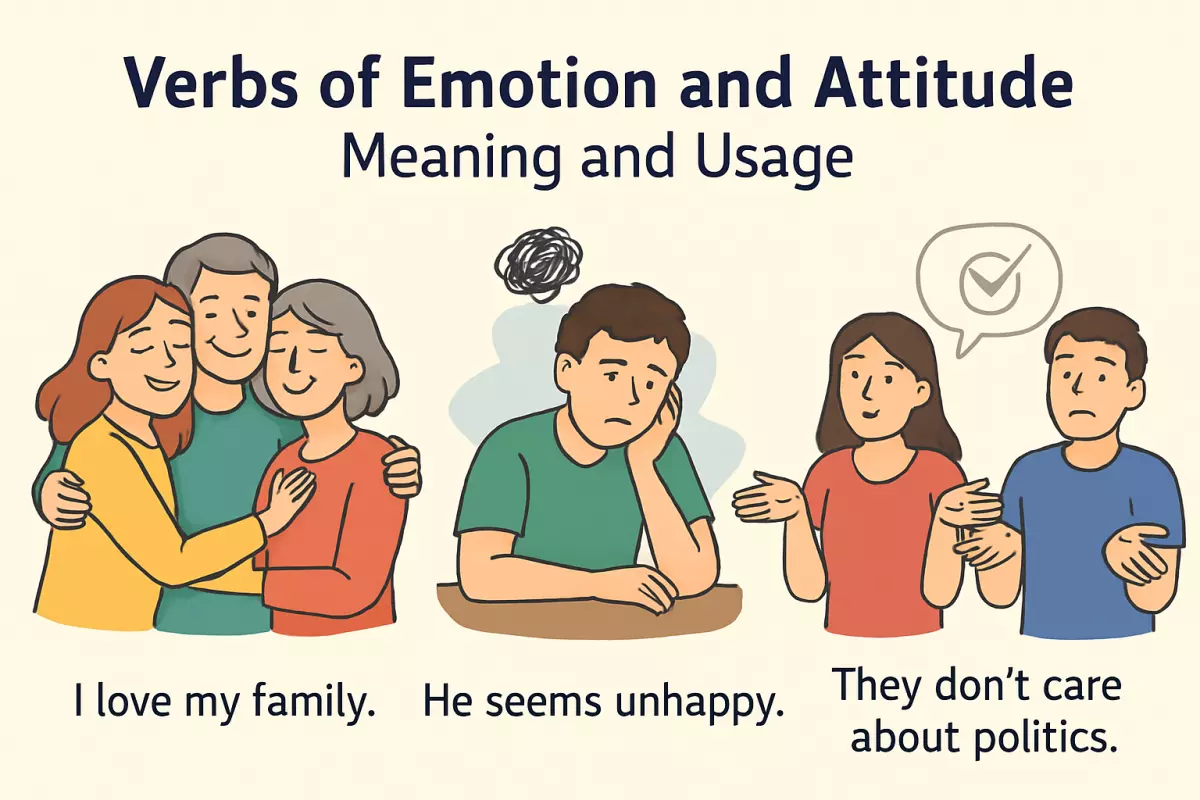 This article explains what emotion and attitude verbs express and lists common verbs for feelings and opinions. It shows object and clause patterns, gerunds vs infinitives, tone and strength, common learner mistakes, spoken usage, and homework practice tasks.
Emotion and attitude verbs help us express feelings and opinions about people, ideas, and events. In everyday English, selecting the right verb makes your meaning clearer and your tone more polite, whether you are stating a preference, showing concern, agreeing or disagreeing, or describing how something affects you. Using them well can also make conversations smoother by reducing confusion and sounding more considerate.
What emotion and attitude verbs express
These verbs describe how someone feels, evaluates, or reacts toward a person, thing, idea, or situation. They often show an internal state (emotion) or a stance (attitude) rather than a physical action, and they commonly shape sentence patterns such as verb + noun, verb + -ing, or verb + that-clause.
1) Core meanings: feelings vs. stances
- Emotions (felt responses): love, hate, fear, envy, miss, regret.
- Attitudes (opinions, preferences, judgments): prefer, value, respect, approve, doubt, trust.
- Intensity and direction: some verbs imply strong feeling (adore, detest), while others are milder (like, dislike).
- Temporary vs. stable: be annoyed suggests a current state; resent often suggests a longer-lasting attitude.
2) Typical targets (what the feeling is “about”)
- People: “She admires her mentor.”
- Things and activities: “They enjoy live music.” / “He avoids driving at night.”
- Ideas and claims: “I doubt his explanation.” / “We accept your proposal.”
- Events and situations: “She regrets the decision.” / “He fears losing his job.”
3) Common grammar patterns they trigger
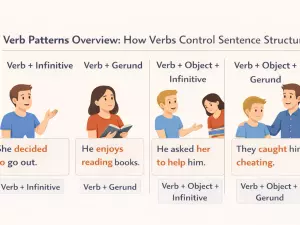
- Verb + object (noun/pronoun): “I appreciate your help.” “She trusts him.”
- Verb + -ing form (reaction to an activity): “He enjoys cooking.” “They avoid talking about it.”
- Verb + to-infinitive (often preference/choice): “I prefer to walk.” “She hates to wait.”
- Verb + that-clause (belief/judgment): “I hope that you understand.” “She regrets that she spoke.”
- Verb + wh-clause: “I wonder why he left.” “She remembers what happened.”
- Verb + preposition + object: “They care about results.” “He apologised for the delay.”
4) Meaning differences created by pattern choice
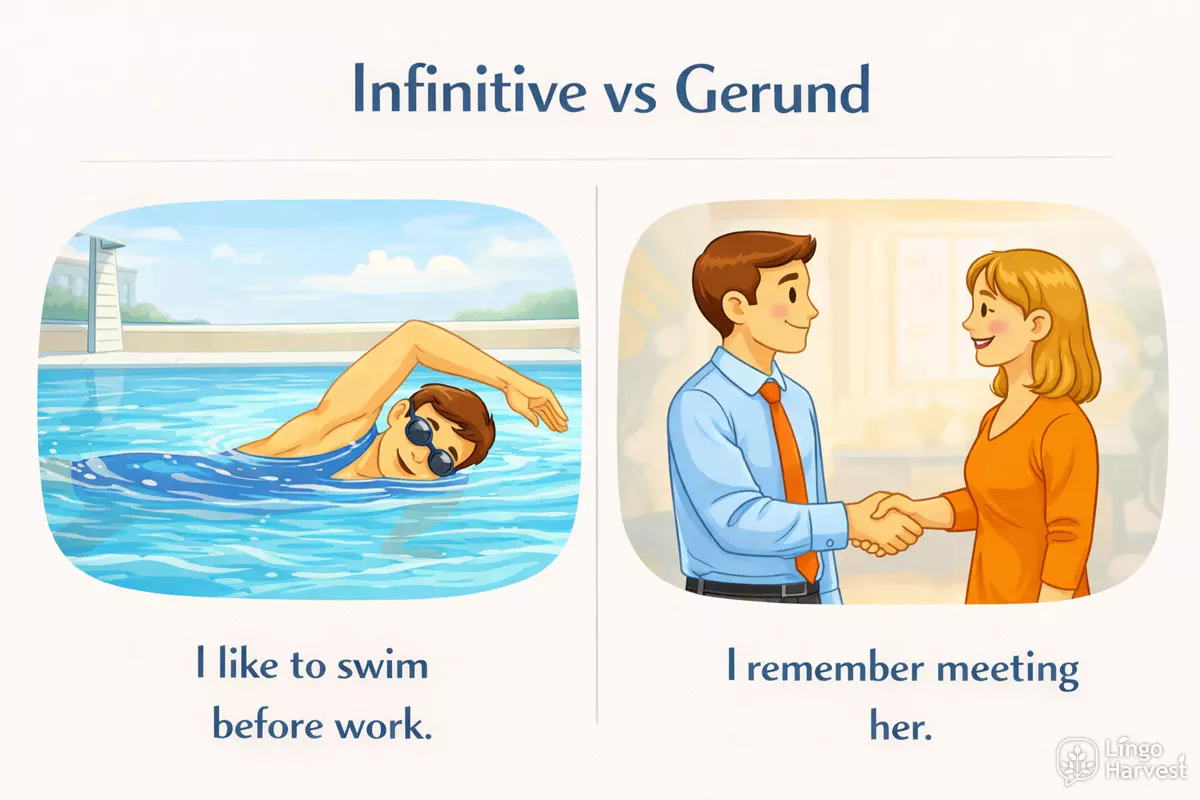
- Like + -ing often means enjoyment: “I like swimming.”
- Like + to-infinitive often means preference or habit: “I like to swim before work.”
- Remember/forget + -ing refers to memory of a past action: “I remember meeting her.”
- Remember/forget + to-infinitive refers to not missing a duty: “Remember to lock the door.”
- Regret + -ing focuses on an action already done: “He regrets lying.”
- Regret + to-infinitive is common in formal announcements: “We regret to inform you…”
5) Useful verb set (with typical complements)
- adore + noun/-ing: “She adores her kids.” / “He adores travelling.”
- detest + noun/-ing: “They detest cruelty.” / “I detest waiting.”
- miss + noun/-ing: “I miss my friends.” / “She misses working outdoors.”
- fear + noun/that-clause: “He fears failure.” / “She fears that it’s too late.”
- envy + noun/-ing: “I envy her confidence.” / “He envies being able to travel.”
- prefer + noun/to-infinitive: “We prefer tea.” / “I prefer to stay in.”
- appreciate + noun/-ing/that-clause: “I appreciate your honesty.” / “I appreciate being included.”
- respect + noun/for + noun: “They respect her.” / “I respect him for his patience.”
- approve + of + noun/-ing: “She approves of the plan.” / “He doesn’t approve of skipping class.”
- doubt + noun/that-clause: “I doubt the figures.” / “I doubt that he’ll come.”
- trust + noun/to-infinitive: “Do you trust her?” / “I trust him to handle it.”
- blame + noun for + noun/-ing: “They blamed him for the mistake.”
- forgive + noun for + noun/-ing: “She forgave him for shouting.”
- apologise + for + noun/-ing: “He apologised for interrupting.”
- resent + noun/-ing: “She resents the criticism.” / “He resents being ignored.”
In practice, choosing the right complement (noun, -ing, to-infinitive, or clause) helps you show whether the speaker is reacting to a fact, an activity, a future intention, or a general preference.
Common verbs for feelings and opinions
These verbs help you describe what someone feels, believes, prefers, or reacts to. They often follow predictable patterns: many take a direct object (I love coffee), some prefer a clause (I think (that) it’s true), and others commonly use an -ing form or an infinitive (enjoy doing, hope to do). Paying attention to the complement (noun, -ing, infinitive, or clause) makes your sentences sound natural.
Frequent verbs and the patterns they use
- like + noun / like + -ing: She likes jazz. / She likes listening to jazz.
- love + noun / love + -ing: They love the city. / They love walking at night.
- hate + noun / hate + -ing: I hate loud music. / I hate waiting.
- enjoy + -ing (more common than an infinitive): He enjoys cooking.
- prefer + noun / prefer + to-infinitive: I prefer tea. / I prefer to stay home.
- mind + -ing (often in questions/negatives): Do you mind opening the window? / I don’t mind waiting.
- miss + noun / miss + -ing: She misses her friends. / She misses traveling.
- fear + noun / fear + (that) clause (more formal): They fear a delay. / I fear (that) we’re late.
- hope + to-infinitive / hope + (that) clause: We hope to finish soon. / I hope (that) you understand.
- wish + (that) clause (often unreal/contrary to fact): I wish (that) I knew.
- regret + noun / regret + -ing: He regrets his decision. / He regrets saying that.
- appreciate + noun / appreciate + -ing: I appreciate your help. / I appreciate you taking the time.
- adore + noun (strong affection): She adores her niece.
- value + noun (importance/respect): We value honesty.
- believe + (that) clause: I believe (that) it will work.
- think + (that) clause: They think (that) it’s too expensive.
- feel + (that) clause (opinion) / feel + adjective (emotion): I feel (that) this is unfair. / I feel nervous.
- suppose + (that) clause (tentative): I suppose (that) you’re right.
- doubt + (that) clause (often with negatives for “believe”): I doubt (that) they’ll agree. / I don’t doubt (that) she tried.
- agree + with + noun/pronoun / agree + (that) clause: I agree with you. / I agree (that) it’s important.
Useful usage notes (common pitfalls)
- Enjoy normally takes an -ing form: ✅ I enjoy reading. ❌ I enjoy to read.
- Mind also prefers -ing: ✅ Would you mind helping? ❌ Would you mind to help?
- Hope is for realistic possibilities; wish often signals something unreal or unlikely: I hope she arrives on time. / I wish she were here.
- Think is a neutral opinion verb; believe is usually stronger (closer to “accept as true”): I think it’s a bad idea. / I believe it’s true.
- Feel can express emotion (feel anxious) or viewpoint (feel that the plan is risky); the grammar changes with the meaning.
Object and clause patterns after emotion verbs
Emotion and attitude verbs often allow more than one complement type, and the choice affects meaning, formality, and what information is in focus. Some verbs prefer a direct object, others prefer a clause, and many allow both with small shifts in emphasis.
1) Direct object patterns (noun phrase objects)
Use a noun phrase when the feeling is directed at a person, thing, or situation treated as a “thing” rather than a full proposition.
- Verb + object: “I love this song.” / “She hates loud music.”
- Verb + object (person): “They admire her.” / “He envies his colleague.”
- Verb + object + for + noun (common with evaluative feelings): “I respect him for his honesty.”
- Verb + object + about + noun (topic-focused): “She’s worried about the exam.”
- Verb + object + at/by + noun (trigger/cause): “He was amazed by the result.” / “She’s angry at the delay.”
- Verb + object + with + noun (satisfaction/dissatisfaction): “We’re pleased with the outcome.”
2) Clause patterns with that and zero that
Use a finite clause when the emotion is about a complete idea (a proposition). The conjunction that is optional in many cases, especially in speech.
- Verb + (that) clause: “I regret (that) I said it.”
- Verb + (that) clause (attitude/judgment): “She fears (that) it’s too late.”
- Verb + (that) clause (reaction): “They were surprised (that) he left early.”
- More formal with that: “We appreciate that you took the time to respond.”
- Reporting-style: “I resent (that) you keep interrupting.”
3) Non-finite clause patterns: -ing and to-infinitive
Many emotion verbs take a non-finite clause. The form often signals whether the speaker evaluates an action as a general fact (-ing) or as a specific event/choice (to-infinitive), though individual verbs have strong preferences.
- Verb + -ing (general experience): “I enjoy working here.”
- Verb + -ing (negative feeling): “She can’t stand waiting.”
- Verb + -ing (admit/feel sorry): “He regrets saying that.”
- Verb + to-infinitive (reaction to a specific fact): “I was surprised to hear the news.”
- Verb + to-infinitive (polite stance): “We’d love to help.”
- Verb + to-infinitive (unhappy necessity/reluctant acceptance): “I hate to admit it, but you’re right.”
- Verb + object + to-infinitive (emotion about someone’s action): “I’d prefer you to stay.” / “They’d like him to apologize.”
4) Wh-clauses: focusing on unknown information
Wh-clauses are useful when the content of the feeling involves an open question or unclear detail.
- Verb + wh-clause: “I hate what he did.”
- Verb + wh-clause: “She’s anxious about how it will look.”
- Verb + wh-clause: “They were surprised at how quickly it ended.”
- Verb + wh-clause (uncertainty): “I worry what people will think.”
5) Extraposition with it: keeping heavy clauses at the end
When the clause is long, English often uses a “dummy” it and moves the real clause to the end. This is especially common with adjective-like emotion expressions.
- It + be + emotion adjective + (that) clause: “It’s annoying (that) the app keeps crashing.”
- It + be + emotion adjective + to-infinitive: “It was nice to see you.”
- It + be + emotion adjective + wh-clause: “It’s frustrating how slow the process is.”
6) Patterns with prepositions: what the feeling is “about”
Prepositions help specify the target (who/what) and the cause (why). The preposition is often fixed for a given verb or adjective, so it is worth learning as a chunk.
- angry at/with: “She’s angry at the driver.” / “He’s angry with me.”
- upset about/by: “They’re upset about the decision.” / “She was upset by the comment.”
- ashamed of: “He’s ashamed of his behavior.”
- proud of: “I’m proud of you.”
- jealous of: “She’s jealous of his success.”
- excited about: “We’re excited about the trip.”
- afraid of / afraid that: “I’m afraid of flying.” / “I’m afraid that we’re late.”
7) Common learner issues (quick contrasts)
- ✅ “I’m happy about the result.” ❌ “I’m happy for the result.” (Use happy for mainly with people: “happy for you.”)
- ✅ “I regret saying that.” / “I regret that I said that.” → both possible; the -ing form is very common for past actions.
- ✅ “I was surprised to hear…” → typical for immediate reaction; “surprised that…” is also fine when stating the fact more explicitly.
- ✅ “I’d prefer you to…” → many speakers avoid “prefer that you…” in casual style; the to-infinitive pattern is often smoother.
Gerund and infinitive after emotion verbs
After verbs that express feelings and attitudes, English often uses a non-finite verb form to name the action that causes the emotion. The choice between -ing and to + base verb depends on meaning: whether you are reacting to a real event, talking about a plan, or describing a general preference.
-ing forms: reaction to a real action, experience, or general idea
Use the gerund when the emotion is connected to something experienced, remembered, or treated as a fact (often something that happened or is happening). This is common with regret, enjoyment, dislike, and fear of an activity.
- enjoy + -ing: “She enjoys working with children.”
- hate / dislike + -ing (general): “I dislike waiting in long lines.”
- love + -ing (habit): “They love traveling by train.”
- can’t stand + -ing: “He can’t stand being interrupted.”
- don’t mind + -ing: “We don’t mind sharing the space.”
- regret + -ing (looking back): “I regret saying that.”
- be ashamed of + -ing: “She’s ashamed of lying to them.”
- be proud of + -ing: “He’s proud of finishing the project early.”
- be tired of + -ing: “I’m tired of arguing about it.”
- be interested in + -ing: “They’re interested in learning Japanese.”
- be excited about + -ing: “She’s excited about starting her new job.”
- be worried about + -ing: “I’m worried about missing the deadline.”
- be afraid of + -ing (fear of the activity): “He’s afraid of driving at night.”
- be good at / bad at + -ing (often with attitude): “I’m bad at remembering names.”
to-infinitives: intention, choice, willingness, or a specific future action
Use the to-infinitive when the emotion relates to a decision, a willingness to act, or something viewed as a potential or future event. This pattern is common when the speaker is evaluating an upcoming action or responding to a request.
- hope + to: “We hope to meet again soon.”
- want + to: “I want to help.”
- would like + to: “She’d like to speak with you.”
- prefer + to (choice now): “I prefer to walk today.”
- be willing + to: “He’s willing to apologize.”
- be reluctant + to: “They’re reluctant to change the plan.”
- be eager + to: “She’s eager to learn.”
- be happy / glad + to (often about a specific act): “I’m glad to hear you’re safe.”
- be sorry + to (apology or bad news): “I’m sorry to say the tickets are sold out.”
- be surprised + to: “He was surprised to see them there.”
- be disappointed + to: “I’m disappointed to hear that.”
- be afraid + to (fear of doing it): “I’m afraid to ask.”
Verbs where meaning changes with -ing vs to
Some emotion-related verbs allow both forms, but the meaning shifts. The most important are regret, remember, and forget (often used to report feelings about actions).
- regret + -ing → remorse about a past action: “She regrets leaving early.”
- regret + to → formal/polite announcement of bad news: “We regret to inform you that your application was unsuccessful.”
- remember + -ing → memory of a past experience: “I remember meeting him before.”
- remember + to → not forgetting a duty: “Remember to lock the door.”
- forget + -ing → forgetting a past event happened: “I’ll never forget seeing that view.”
- forget + to → failing to do something: “I forgot to reply.”
Common learner pitfalls
- Don’t use to after prepositions: ❌ “interested in to learn” → ✅ “interested in learning.”
- Don’t confuse “afraid of -ing” (fear of the activity) with “afraid to” (fear to take the step): “afraid of flying” vs “afraid to fly today.”
- With like/love/hate, -ing often describes a general habit, while to can sound more like a choice in a particular situation: “I like swimming” vs “I like to swim in the morning.”
Tone and strength of attitude verbs
Attitude verbs often carry an implied level of intensity and social tone. Choosing between near-synonyms (for example, like vs. love, or disagree vs. reject) helps you sound appropriately neutral, polite, firm, or confrontational. Many of these verbs also signal how open you are to discussion: some invite negotiation, while others close it down.
Common attitude verbs grouped by intensity and tone
- Neutral / descriptive stance (low emotional charge; good for reports and careful discussion): think, believe, assume, suppose, expect, consider, prefer, agree, disagree.
- Warm approval (positive evaluation; friendly and personal): like, enjoy, appreciate, admire, value, support, approve of.
- Strong approval / commitment (high intensity; can sound emphatic or absolute): love, adore, recommend, endorse, stand by, insist.
- Mild disapproval (negative evaluation but still measured): don’t like, mind, object to, doubt, question, disapprove of, be concerned about.
- Strong disapproval / rejection (high intensity; can sound confrontational): hate, despise, reject, refuse, condemn, resent, oppose.
Patterns that soften or strengthen your stance
- Hedging to sound less forceful: use verbs like think, tend to believe, suspect, or seem to present a view as provisional.
- ✅ I think this approach works better. → suggests openness to alternatives.
- ❌ This approach works better. → can sound like a final judgment in discussion.
- Upgrading intensity: move from like to love, or from disagree to reject, when you want to signal stronger commitment.
- I like the idea. → positive, moderate.
- I love the idea. → enthusiastic, personal.
- I reject the idea. → firm, closing the door.
- Polite disagreement: verbs such as question, doubt, and have reservations about challenge without directly attacking.
- I question whether the data supports that conclusion.
- I have reservations about the timeline.
- Direct confrontation: verbs like condemn and despise express moral judgment and usually escalate conflict; they fit only when strong evaluation is intended.
- They condemned the decision. → public, severe criticism.
- He despises the policy. → intense negative emotion.
Usage notes: what these verbs typically take
- Verb + noun phrase: support the plan, oppose the proposal, appreciate your help, reject the claim.
- Verb + gerund (-ing) (common for likes/dislikes): enjoy working, hate waiting, don’t mind sharing, object to paying.
- Verb + that-clause (common for beliefs/judgments): believe that it’s true, insist that we leave, regret that I can’t attend.
- Verb + preposition (fixed combinations that affect tone): approve of (formal), disapprove of (formal), object to (often polite but firm), care about (warm, personal).
When revising, check whether your chosen verb matches the relationship and context: neutral verbs keep discussion open, warmer verbs build rapport, and stronger rejection verbs signal finality. Small shifts in wording can change how your attitude is heard more than the factual content does.
Common learner mistakes
Errors with emotion and attitude verbs often come from mixing up verb patterns (infinitive vs. -ing vs. that-clause), confusing who experiences the feeling, and choosing the wrong preposition. The fixes are usually simple once you learn which structure each verb “likes.”
1) Mixing up -ing and infinitive patterns
- ❌ I enjoy to read. → ✅ I enjoy reading. (enjoy + -ing)
- ❌ She suggested to go earlier. → ✅ She suggested going earlier. (suggest + -ing)
- ❌ They avoided to talk about it. → ✅ They avoided talking about it. (avoid + -ing)
- ❌ I hope going tomorrow. → ✅ I hope to go tomorrow. (hope + to-infinitive)
- ❌ We decided going by train. → ✅ We decided to go by train. (decide + to-infinitive)
- ❌ He refused helping. → ✅ He refused to help. (refuse + to-infinitive)
2) Confusing “feeling” verbs and “causing” adjectives
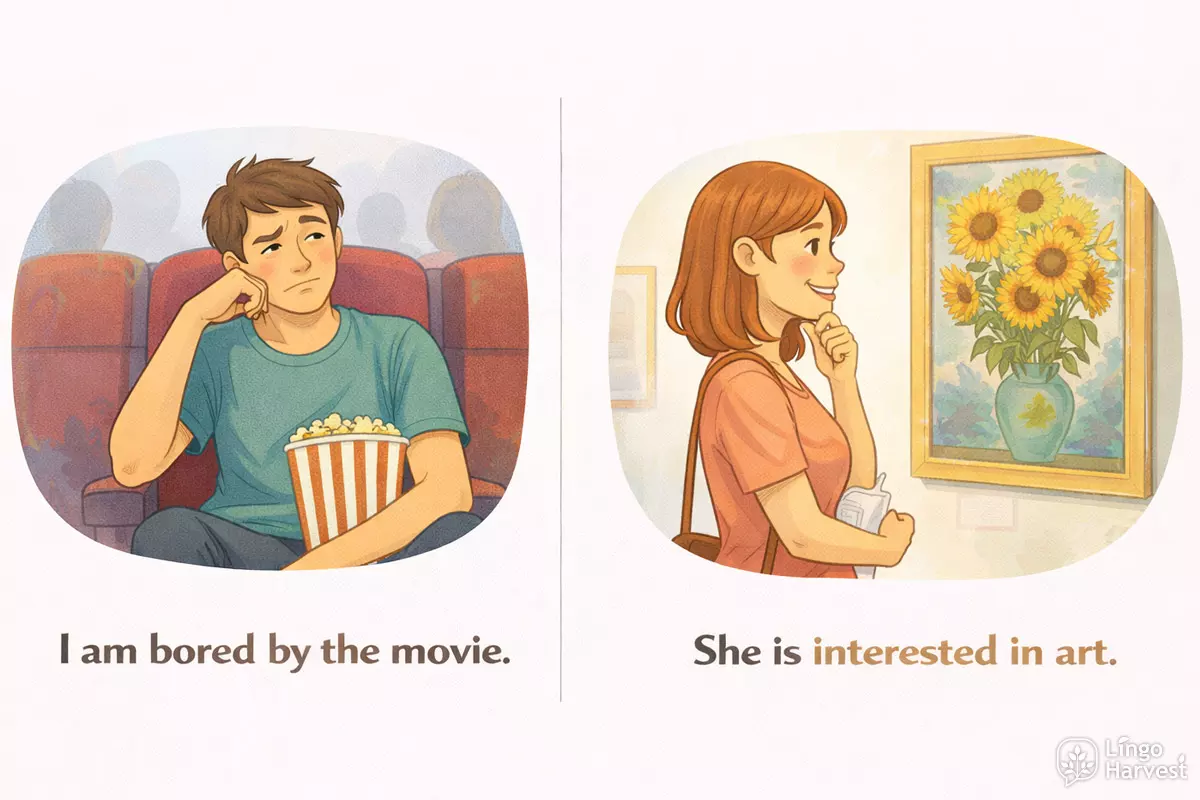
- ❌ I am bored movie. → ✅ I am bored by the movie. / The movie is boring. (bored = how you feel; boring = what causes it)
- ❌ She is interesting in art. → ✅ She is interested in art. (interested in)
- ❌ The news was shocked. → ✅ The news was shocking. / I was shocked by the news.
- ❌ I’m exciting about the trip. → ✅ I’m excited about the trip. / The trip is exciting.
3) Using the wrong preposition after attitude verbs/adjectives
- ❌ She is afraid from spiders. → ✅ She is afraid of spiders.
- ❌ I’m angry to him. → ✅ I’m angry with him. (angry with a person)
- ❌ He’s angry with the delay. → ✅ He’s angry about the delay. (angry about a thing/situation)
- ❌ They’re interested on politics. → ✅ They’re interested in politics.
- ❌ I’m proud for my results. → ✅ I’m proud of my results.
- ❌ She’s good in math. → ✅ She’s good at math.
- ❌ I’m sorry about to be late. → ✅ I’m sorry to be late. (sorry + to-infinitive for what you do/say)
4) Choosing the wrong complement: that-clause vs. object + infinitive
- ❌ I think him to be honest. → ✅ I think (that) he is honest. (that-clause is more natural here)
- ❌ I suggest that to go now. → ✅ I suggest going now. / I suggest that we go now.
- ❌ She wants that I help. → ✅ She wants me to help. (want + object + to-infinitive)
- ❌ We expect that him to arrive early. → ✅ We expect him to arrive early. / We expect that he’ll arrive early.
5) Misplacing the experiencer (who feels what)
- ❌ It annoys to me. → ✅ It annoys me. / It’s annoying to me. (verb takes a direct object; adjective can take “to”)
- ❌ This pleases to her. → ✅ This pleases her. / This is pleasing to her.
- ❌ I fear to lose my job. → ✅ I fear losing my job. / I’m afraid of losing my job. (fear + noun/-ing is common)
6) Overusing “very” instead of choosing the right verb
- Instead of “I’m very angry,” consider: I’m furious, I’m upset, I’m annoyed.
- Instead of “I very like it,” consider: I love it, I really enjoy it, I’m fond of it.
- Instead of “I’m very scared,” consider: I’m terrified, I’m nervous, I’m anxious.
When you learn a new verb of feeling or evaluation, store it with its pattern (for example: “object + to-infinitive,” “verb + -ing,” or “adjective + preposition”). This prevents most structure errors before they happen.
Emotion verbs in spoken English
In everyday conversation, verbs that express feelings and attitudes tend to be short, flexible, and closely tied to common patterns like verb + it, verb + to-infinitive, and verb + that-clause. Speakers also rely on intensifiers (really, so, kind of) and quick follow-up reasons (because…, when…, that’s why…) to show stance without sounding formal.
Common spoken patterns
- Verb + it + adjective (evaluating a situation): “I love it when it’s quiet.” / “I hate it when people interrupt.”
- Verb + -ing (reacting to an activity or experience): “I enjoy meeting new people.” / “I can’t stand waiting.”
- Verb + to-infinitive (preference, intention, reluctance): “I’d prefer to stay in.” / “I hate to say this, but…”
- Verb + that-clause (belief + feeling/attitude): “I hope that it works out.” / “I regret that I missed it.”
- Verb + object + to-infinitive (feelings about someone’s action): “I’d love you to come.” / “I hate you to see me like this.”
- Verb + wh-clause (uncertainty, concern, curiosity): “I wonder what he meant.” / “I worry where she’s gone.”
High-frequency verbs and ready-to-use frames
- love: “I love that.” / “I love how you did that.” / “I’d love to.”
- like: “I like it.” / “I like that idea.” / “I like how it sounds.”
- enjoy: “I enjoy working from home.” / “Did you enjoy it?”
- hate: “I hate this.” / “I hate it when…” / “I hate to admit it, but…”
- can’t stand: “I can’t stand the noise.” / “I can’t stand being late.”
- mind (often in questions/negatives): “Do you mind if I…?” / “I don’t mind waiting.”
- care: “I don’t care.” / “I don’t care what they think.”
- hope: “I hope so.” / “I hope you’re okay.” / “Hope it helps.”
- wish: “I wish I knew.” / “Wish me luck.”
- worry: “Don’t worry.” / “I worry about him.” / “I’m worried that…”
- miss: “I miss you.” / “I miss having time.”
- regret: “I regret saying that.” / “I regret that I didn’t call.”
- appreciate (polite, common in service/work talk): “I appreciate it.” / “I’d really appreciate it if you could…”
- prefer: “I prefer tea.” / “I’d prefer to leave early.”
- feel (stance marker): “I feel like we should go.” / “I feel that it’s unfair.”
Spoken grammar choices that sound natural
- Use “feel like” for soft opinions: “I feel like it’s getting late.” (less direct than “I think…”)
- Use “hope” for friendly closings and checks: “Hope you got home okay.” / “I hope that makes sense.”
- Use “mind” to manage requests politely: ✅ “Do you mind if I sit here?” ❌ “Do you mind I sit here?”
- Choose -ing vs. to-infinitive based on meaning: “I like swimming” (general enjoyment) vs. “I like to swim in the morning” (habit/preference).
- Keep “regret” patterns distinct: “I regret saying it” (past action) vs. “I regret to say…” (formal announcement; less common in casual talk).
- Use intensifiers and softeners for tone: “I really love it.” / “I kind of hate crowds.” / “I’m a bit worried about tomorrow.”
Quick corrections that matter in conversation
- ✅ “I’m excited about the trip.” → prefer about for the topic; “excited for” is common when focusing on a person’s benefit.
- ✅ “I’m interested in photography.” ❌ “interested on”
- ✅ “I’m afraid of heights.” / “I’m afraid to ask.” (noun vs. action)
- ✅ “I’m angry with him” / “angry about the delay.” (person vs. issue)
- ✅ “I’m happy with it” / “happy to help.” (result vs. willingness)
Homework: emotion verb practice tasks
These tasks focus on common patterns with emotion and attitude verbs: who feels what, which prepositions are typical, and when an infinitive or gerund is required. Work through the activities in order; later items recycle earlier structures so you can notice the patterns.
Task set A: Choose the correct structure (gerund vs. infinitive)
- I can’t stand (to wait / waiting) in long lines.
- She refused (to apologize / apologizing) for the comment.
- They enjoy (to hike / hiking) in the mountains.
- He agreed (to meet / meeting) us after work.
- Do you mind (to open / opening) the window?
- We hope (to hear / hearing) from you soon.
- I regret (to say / saying) that the event is canceled.
- She avoids (to talk / talking) about politics at dinner.
- They decided (to postpone / postponing) the trip.
- He misses (to work / working) with his old team.
Show answers
- waiting
- to apologize
- hiking
- to meet
- opening
- to hear
- to say
- talking
- to postpone
- working
Task set B: Fix the pattern (object, preposition, or form)
Rewrite each sentence so it sounds natural. Keep the meaning the same.
- ❌ I’m interested to learn more about the role.
- ❌ She apologized me for being late.
- ❌ He blamed on me the mistake.
- ❌ We insisted to pay for dinner.
- ❌ They accused him for cheating.
- ❌ I’m afraid from flying.
- ❌ She’s proud for her progress.
- ❌ He’s disappointed to the result.
- ❌ I complained him about the noise.
- ❌ She thanked to me for the help.
Show answers
- ✅ I’m interested in learning more about the role.
- ✅ She apologized to me for being late.
- ✅ He blamed me for the mistake.
- ✅ We insisted on paying for dinner.
- ✅ They accused him of cheating.
- ✅ I’m afraid of flying.
- ✅ She’s proud of her progress.
- ✅ He’s disappointed with the result.
- ✅ I complained to him about the noise.
- ✅ She thanked me for the help.
Task set C: Identify the “feeler” and the “trigger”
For each sentence, label the roles: (A) who experiences the emotion/attitude and (B) what causes it (a person, thing, action, or idea). Then rewrite using the other common pattern if possible (for example, switch between “X annoys Y” and “Y is annoyed by X”).
- The noise irritated Lena.
- Marco is worried about the deadline.
- Her honesty impressed the interviewer.
- They’re excited about moving.
- The comment offended several students.
- I’m grateful to you for the advice.
- The results disappointed the team.
- Sam envies her confidence.
Show answers
- A: Lena; B: the noise. Rewrite: Lena was irritated by the noise.
- A: Marco; B: the deadline. Rewrite: The deadline worries Marco.
- A: the interviewer; B: her honesty. Rewrite: The interviewer was impressed by her honesty.
- A: they; B: moving. Rewrite: Moving excites them.
- A: several students; B: the comment. Rewrite: Several students were offended by the comment.
- A: I; B: your advice (and you as the source). Rewrite: Your advice helped me a lot; I really appreciate it. (No exact passive swap is natural here.)
- A: the team; B: the results. Rewrite: The team was disappointed with/by the results.
- A: Sam; B: her confidence. Rewrite: Sam is envious of her confidence.
Task set D: Build sentences with target patterns
Write one original sentence for each prompt. Aim for natural collocations and correct complements.
- be + ashamed of + noun/gerund
- be + annoyed with + person
- be + annoyed by + thing/situation
- apologize + to + person + for + noun/gerund
- complain + to + person + about + noun
- complain + of + symptom/problem (more formal)
- insist + on + gerund
- accuse + object + of + gerund/noun
- forgive + person + for + noun/gerund
- admire + person + for + noun/gerund
- regret + to say (for announcements)
- regret + gerund (for past actions)
Task set E: Mini-editing checklist (self-correction)
- Check whether the verb takes an object: admire someone, envy someone, blame someone.
- Check the preposition: proud of, interested in, accuse of, apologize to someone for something.
- Check the complement type: enjoy + gerund, refuse + infinitive, mind + gerund, hope + infinitive.
- Check role direction: if the subject is the cause, use a causative pattern (The news shocked me); if the subject is the experiencer, use an adjective/participle pattern (I was shocked by the news).