Habitual Actions and Repeated Events in English

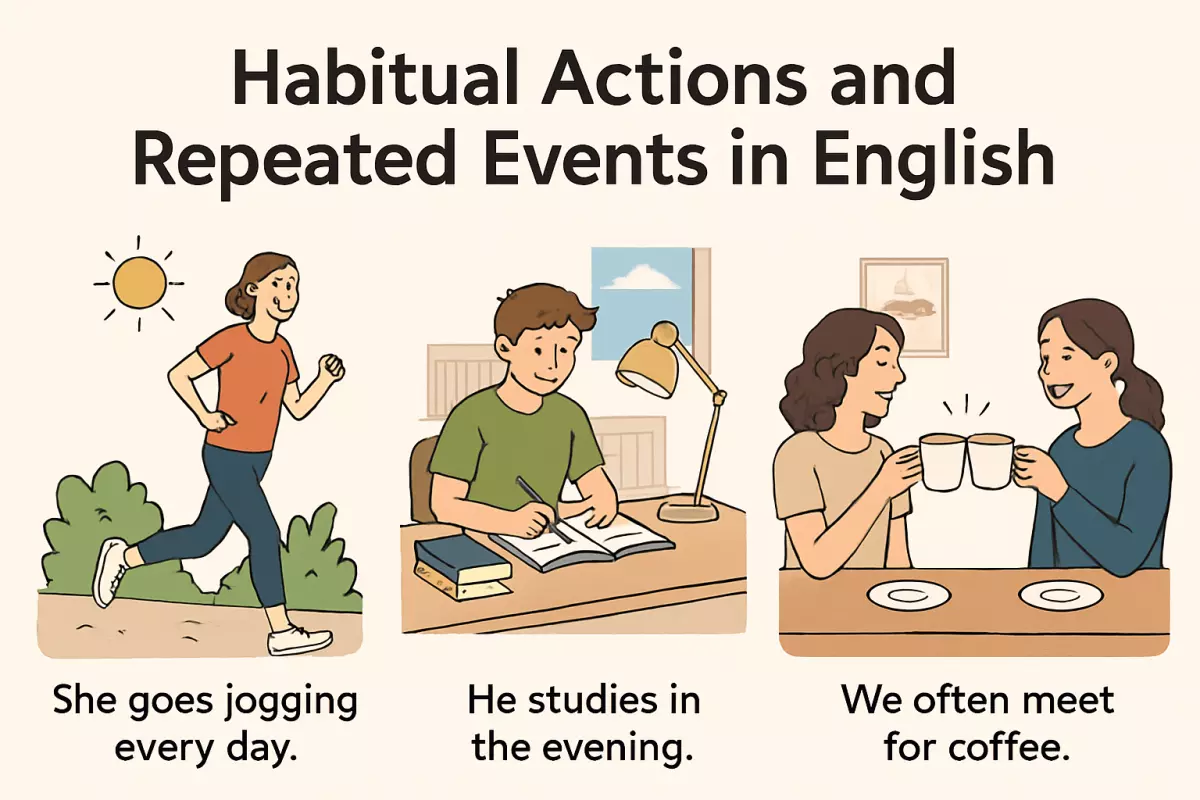 Learn what habitual actions are and how to talk about them using the present simple, used to, and would. It also covers adverbs of frequency, habits vs temporary actions, common mistakes, natural routine talk, and homework practice tasks.
To talk about routines and recurring moments in English, go beyond memorized rules and imagine real days. Practice choosing verb forms that show what you do regularly, what happens again and again, and what feels like a habit. You will learn to describe daily schedules, repeated events, and typical behaviors clearly and naturally, so listeners can understand when something is a routine rather than a one-time action.
What habitual actions mean
In grammar, a habitual action is something that happens regularly enough to be treated as a pattern rather than a single event. It can describe routines (daily, weekly), repeated behavior over a period of time, or typical tendencies that are true “in general,” even if there are exceptions.
Core idea: pattern, not one-time action
Use habitual meaning when the listener should understand “this is what usually happens.” The focus is on repetition or typicality, not on the exact time of any one instance.
- Routines: actions tied to schedules or repeated time frames (every day, on Fridays, in the summer).
- Repeated events: the same type of event occurring again and again (meetings, calls, deliveries).
- General truths about behavior: tendencies that describe someone’s usual conduct (how a person typically reacts or acts).
- Customs and practices: what people normally do in a place, group, or culture.
How English signals habitual meaning
English often marks repeated behavior through verb choices and time expressions. Some forms sound neutral and factual, while others add attitude (for example, annoyance or emphasis).
- Simple present for routines and general patterns: “She walks to work.”
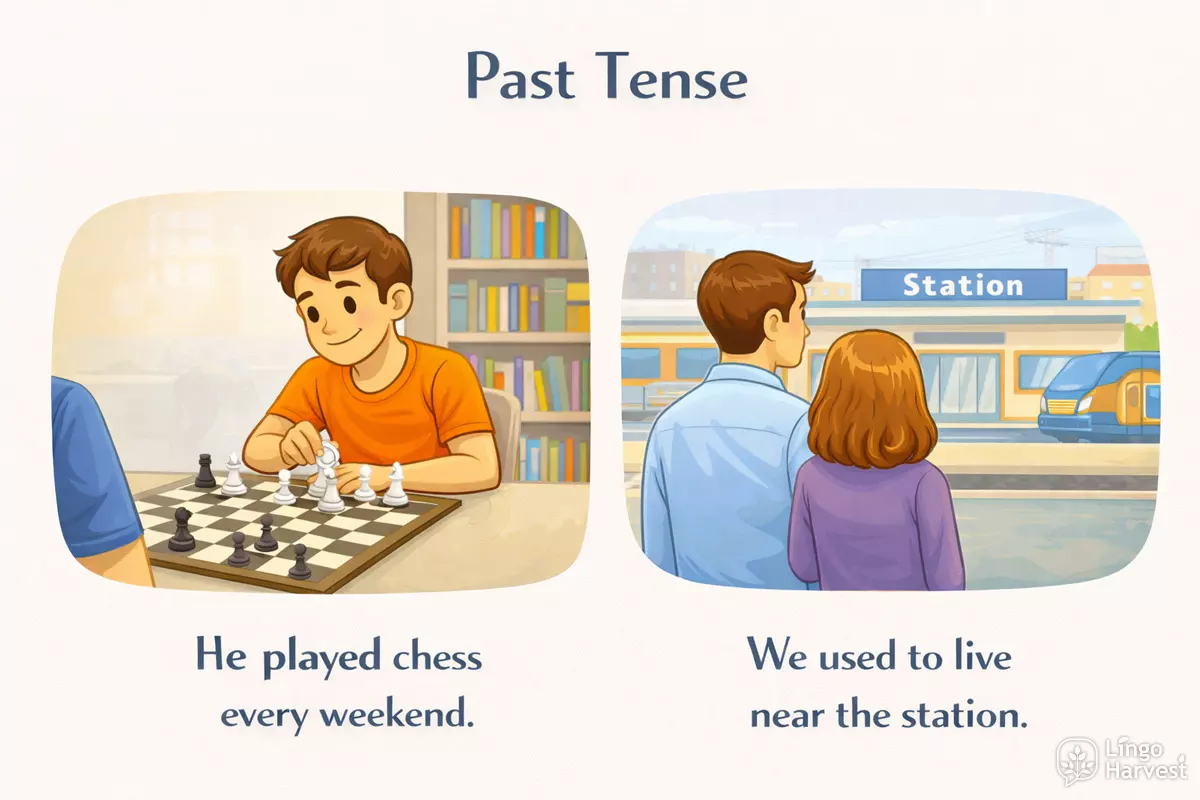
- Simple past for past routines in a finished time period: “He played chess every weekend.”
- Used to + base verb for past habits that are no longer true: “We used to live near the station.”
- Would + base verb for repeated past behavior in a narrative (often with a clear past time frame): “On winter nights, we would sit by the fire.”
- Present continuous can describe temporary repeated behavior around “now” (a current trend): “She’s taking the bus a lot these days.”
- Adverbs of frequency make the pattern explicit: always, usually, often, sometimes, rarely, never.
- Time phrases anchor repetition: every morning, once a week, on Mondays, whenever, from time to time.
Common meanings learners confuse
Repeated behavior is different from an action happening right now, and it is also different from a permanent fact. The same tense can shift meaning depending on context words like “usually” or “these days.”
- Habit vs. action in progress: “He reads after dinner” (routine) vs. “He is reading” (now).
- Habit vs. single past event: “I visited my aunt every summer” (repeated) vs. “I visited my aunt last summer” (one time).
- General tendency vs. strict rule: “They usually start at nine” allows exceptions; it is not a guarantee.
Example patterns you can reuse
- “I usually + verb …”
- “She + verb + every (day/week/month) …”
- “We + verb + on (Mondays/weekends) …”
- “They + verb + whenever + clause …”
- “In the past, I used to + verb …”
- “Back then, we would + verb … (repeatedly)”
- “These days, he’s + verb-ing + a lot …”
- “She rarely + verb …”
- “I never + verb …”
- “From time to time, we + verb …”
- “Once in a while, they + verb …”
- “Every so often, I + verb …”
Present simple for habits
Use the present simple to talk about routines and repeated behavior that you see as normal, typical, or generally true over time. It describes what happens regularly, not what is happening right now.
When to choose this tense
- Daily routines: actions that happen as part of a schedule. I leave home at 7:30.
- Regular frequency: repeated events with words like often or usually. She often takes the bus.
- Long-term patterns: habits that have become typical. We eat out on Fridays.
- Timetables and fixed schedules: especially for transport and classes. The train arrives at 9:05.
- Instructions and directions: steps that are generally followed. You press this button to start.
- General truths: facts that stay the same. Water boils at 100°C.
Form and common patterns
- Affirmative: Subject + base verb (I/you/we/they) or Subject + verb + -s/-es (he/she/it). They walk to work. He walks to work.
- Negative: Subject + do not (don’t) / does not (doesn’t) + base verb. I don’t snack at night. She doesn’t drink coffee.
- Questions: Do/Does + subject + base verb? Do you exercise? Does he cook?
- Short answers: Yes, I do. / No, she doesn’t.
- -s/-es spelling: add -es after -ch, -sh, -s, -x, -z, -o (watches, finishes, goes); change y to ies after a consonant (studies).
Time expressions that signal habits
- always, usually, often, sometimes, rarely, never
- every day, every morning, every weekend, every summer
- once a week, twice a month, three times a year
- on Mondays, at weekends, in the evenings
- in general, most days, from time to time
Example sentences (habit-focused)
- I check my messages after breakfast.
- They play tennis on Saturdays.
- She reads before she goes to sleep.
- We usually take a short walk at lunchtime.
- He doesn’t eat meat, but he eats fish.
- Do you ever work late on Fridays?
- My parents visit us once a month.
- The shop opens at 10 and closes at 6.
- I rarely watch TV during the week.
- Does your brother call you every day?
- Our team trains twice a week.
- She always carries a notebook.
- We don’t drive to the city center; we take the метро.
- When I feel stressed, I listen to music.
- He studies English in the evenings.
- Do they normally eat at home or at work?
Common mistakes to avoid
- ❌ He don’t go to the gym. → ✅ He doesn’t go to the gym.
- ❌ Does she goes to work by car? → ✅ Does she go to work by car?
- ❌ I am going to work every day. (if you mean a routine) → ✅ I go to work every day.
- ❌ He go to bed early. → ✅ He goes to bed early.
Used to and would for past habits
To describe repeated behavior or familiar routines in the past, English commonly uses used to and would. Both can point to habits, but they follow different patterns and have different limits, especially with states (like be, know, have).
Core meaning and typical use
- used to + base verb highlights that something was true or happened regularly in the past, often implying it is not true now.
- Examples: I used to cycle to work. / She used to live near the river.
- would + base verb describes repeated actions in the past, often in storytelling, and usually needs a clear past-time context.
- Examples: On summer nights, we would sit outside and talk.
When each form works (and when it does not)
- Actions vs. states
- used to can describe actions and states: He used to be shy. / We used to have a small car.
- would is mainly for repeated actions, not states: ❌ He would be shy. (sounds like a conditional or a prediction, not a past habit)
- Need for time framing
- would typically follows a past setting already established: When I was a child, we would visit my grandparents every Sunday.
- used to can introduce the past habit by itself: We used to visit my grandparents every Sunday.
- Single events
- Neither form is for a one-time past event: ❌ I used to meet her yesterday. → ✅ I met her yesterday.
Form and common patterns
- Affirmative: used to + verb / would + verb
- I used to drink coffee every morning.
- After dinner, my dad would wash the dishes.
- Negative with used to (two common forms)
- ✅ I didn’t use to like olives. (very common in modern usage)
- ✅ I used not to like olives. (more formal/less common)
- Questions with used to
- ✅ Did you use to play an instrument?
- ✅ What did you use to do after school?
- Negative with would
- He would never apologise. (repeated refusal as a habit)
- On cold mornings, the car wouldn’t start. (repeated past problem; “wouldn’t” shows typical failure)
Example bank (habitual past)
- We used to go camping every April.
- She used to be afraid of dogs.
- There used to be a bakery on this corner.
- I didn’t use to eat breakfast.
- Did you use to live in the city?
- When we lived by the sea, we would walk along the pier after dinner.
- Every Friday, my friends would meet at the same café.
- On long trips, my brother would count tunnels.
- In winter, the river would freeze for weeks.
- Whenever the phone rang, she would rush to answer it.
- He would always leave his keys in the same drawer.
- Back then, I used to know everyone in the neighbourhood.
- We used to have a dog named Pepper.
- During exams, I would stay up late and regret it the next day.
- My grandparents used to write letters instead of texting.
- As a teenager, she would play the same song on repeat.
Choosing between them
- Use used to when you want to include past states or when you want the sentence to carry the “not anymore” implication clearly: I used to live here.
- Use would when you are narrating a past routine in context, especially a sequence of repeated actions: After school, we would drop our bags and head outside.
- If the meaning is “past habit” but the sentence is missing a time frame, add one for would: When I worked nights, I would sleep until noon.
Adverbs of frequency and time expressions
To describe habits and repeated events clearly, English often combines frequency words (how often) with time phrases (when, how long, or over what period). The key is choosing the right position in the sentence and matching the expression to the tense and meaning.
Common frequency adverbs and where they go
Most single-word frequency adverbs fit into a predictable word order. They usually appear before the main verb but after the verb be. With auxiliaries (have, will, can, etc.), they typically go after the first auxiliary.
- Before the main verb: “I often drink tea in the afternoon.”
- After be: “She is always on time.”
- After the first auxiliary: “They have never missed a class.” / “He can usually finish early.”
- With negative meaning: “I hardly ever eat fast food.” (more natural than placing it at the end)
- For emphasis (less neutral): “Sometimes I work late.” (front position highlights the contrast or change)
Frequency expressions that behave like time phrases
Many multi-word expressions act more like time adverbials and often appear at the end of the clause, especially in neutral statements. They answer “how often?” in a measurable way.
- Regular intervals: “every day,” “every weekend,” “every other week,” “once a month,” “twice a year”
- Rates: “three times a week,” “four days a month,” “once every two weeks”
- Typical end position: “We meet once a month.” / “She calls her parents every Sunday.”
- Front position for contrast: “Every Friday, they watch a film.”
Time expressions that support habitual meaning
Time phrases can signal routines even without a frequency adverb. These often pair naturally with the present simple, “used to,” or “would” (for past routines), depending on whether the habit is current or past.
- Daily schedule points: “in the morning,” “at night,” “after lunch,” “before work,” “on Mondays”
- Periods and seasons: “in summer,” “during the semester,” “at the weekend” (BrE), “on the weekend” (AmE)
- General time windows: “these days,” “nowadays,” “at the moment” (often with present continuous for temporary patterns)
- Habit + time window: “I run in the mornings.” / “She studied a lot during the semester.”
Combining frequency and time: natural patterns
When both types appear together, place the frequency element where it sounds least crowded. A common pattern is frequency adverb near the verb and the time phrase later. Avoid stacking too many modifiers in one clause; split the sentence if needed.
- Balanced combination: “I usually go to the gym after work.”
- With auxiliaries: “She has often worked late on Thursdays.”
- Measurable frequency + time: “They practice twice a week in the evening.”
- Avoid awkward piling: ❌ “I usually every day go after work.” → ✅ “I usually go after work.” / “I go every day after work.”
Quick reference: high-to-low frequency choices
- 100%: always
- very often: usually, normally, generally
- often: often, frequently
- sometimes: sometimes, occasionally
- rarely: rarely, seldom, hardly ever
- 0%: never
Habits vs temporary actions
English often signals the difference between a regular pattern and a short-lived situation through tense choice, time expressions, and a few common constructions. The key is to ask: is this something that repeats as a routine, or is it only true around “now” (this week, these days, for a while)?
Common patterns for routines
For repeated behavior, English typically uses the present simple, sometimes with adverbs of frequency. For past routines, it often uses used to or would (in the right context).
- Present simple for regularity: “I walk to work.” / “She doesn’t eat meat.”
- Frequency adverbs: “He usually arrives early.” / “They rarely complain.”
- Time phrases that suggest repetition: “on Mondays,” “every summer,” “once a week,” “at weekends.”
- Used to for past habits/states: “We used to live near the station.”
- Would for repeated past actions (not states): “After dinner, my grandfather would tell stories.”
- Habit markers with tend to: “I tend to forget names.”
- Habit markers with always (often emotional): “You’re always losing your keys.”
Common patterns for short-term situations
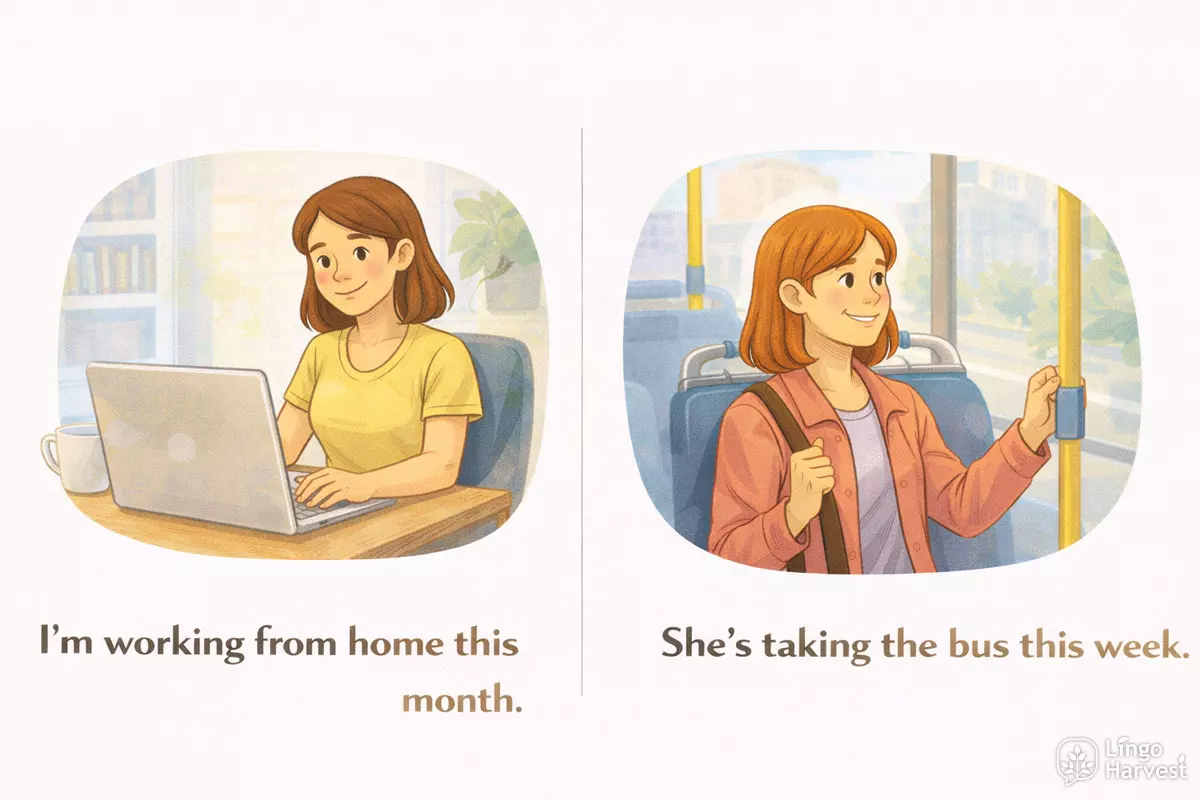
For something limited in time or in progress around the present, English commonly uses the present continuous (or past continuous for a temporary period in the past). These forms pair naturally with “these days” and similar expressions.
- Present continuous for a temporary trend: “I’m working from home this month.”
- Temporary change from the usual: “She’s taking the bus this week.”
- Time phrases that suggest “for now”: “these days,” “this week,” “at the moment,” “for the time being.”
- Short-term repeated events (still temporary): “He’s going to the gym a lot lately.”
- Temporary irritation with always: “He’s always borrowing my charger.” (complaint, not a neutral routine)
Side-by-side contrasts (meaning changes with tense)
| Routine / repeated pattern | Temporary / limited-time situation |
|---|---|
| I drink coffee in the morning. (normal routine) | I’m drinking coffee this week. (unusual period or current phase) |
| She teaches English. (job / regular activity) | She’s teaching English this semester. (short contract or current assignment) |
| They play tennis on Saturdays. (scheduled habit) | They’re playing tennis a lot these days. (current trend, may stop later) |
| He doesn’t eat sugar. (general rule) | He’s not eating sugar right now. (temporary restriction) |
Quick checks to choose the right form
- If the sentence answers “How often?” → prefer present simple: “I go every Friday.”
- If it answers “What’s happening around now?” → prefer present continuous: “I’m going a lot lately.”
- If you can add “these days/this week” naturally, it often points to a limited-time meaning.
- If you can add “every day/on Mondays/usually” naturally, it often points to a routine meaning.
- With stative verbs (know, believe, like, belong), routines are usually expressed with simple forms: ✅ “I know him.” ❌ “I’m knowing him.”
- For past repetition, use used to for actions and states; use would mainly for repeated actions in a narrative sequence.
Common learner mistakes
Learners often mix up verb forms and time expressions when talking about routines, habits, and events that happen again and again. The result is usually a tense that sounds “too temporary,” a frequency word in the wrong place, or an overuse of one structure (often will) where English prefers another.
1) Using the present continuous for regular routines
The present continuous usually describes something happening around now, not a stable routine. Use the present simple for habits unless you mean a temporary arrangement.
- ❌ I’m going to the gym every day. → ✅ I go to the gym every day.
- ❌ She’s taking the bus to work. (habit) → ✅ She takes the bus to work.
- ✅ I’m going to the gym every day this week. (temporary change)
2) Overusing will for repeated behavior
Will can describe typical behavior, but it often sounds like a comment on someone’s tendencies (sometimes with mild annoyance) rather than a neutral routine. For everyday habits, the present simple is usually the default.
- ❌ He will drink coffee every morning. (neutral routine) → ✅ He drinks coffee every morning.
- ✅ He will leave his socks on the floor. (typical, “that’s what he does”)
- ✅ The door won’t lock sometimes. (typical behavior of a thing)
3) Confusing used to with the present simple
Used to is for past habits or states that are no longer true now. If the habit still happens, use the present simple.
- ❌ I used to work from home now. → ✅ I work from home now.
- ❌ She uses to play tennis. → ✅ She used to play tennis.
- ✅ I used to live in Madrid, but now I live in Valencia.
4) Mixing up used to and be used to
Used to + verb describes a past habit. Be used to + noun/gerund means “accustomed to.” The forms and meanings are different.
- ❌ I’m used to get up early. → ✅ I’m used to getting up early.
- ❌ I used to getting up early. → ✅ I used to get up early.
- ✅ She’s used to the noise. / She’s used to working nights.
5) Wrong word order with frequency adverbs
Words like always, usually, often, sometimes, rarely, never typically go before the main verb, but after be. With auxiliaries, they usually go after the auxiliary.
- ❌ I go always to bed late. → ✅ I always go to bed late.
- ❌ She is often late? → ✅ She is often late.
- ❌ They have finished always early. → ✅ They have always finished early.
- ❌ Do you go usually on Fridays? → ✅ Do you usually go on Fridays?
6) Using every with the wrong form or meaning
Every needs a singular countable noun (every day, every week) and it expresses regularity. For approximate frequency, use usually or most days.
- ❌ Every days I study. → ✅ Every day I study. / I study every day.
- ❌ I see her every times. → ✅ I see her every time.
- ❌ I go there every. → ✅ I go there every week. / I go there regularly.
7) Confusing present simple with present perfect for life experience vs routine
The present simple is for repeated actions and schedules. The present perfect often focuses on experience or results up to now, not a routine with a clear frequency.
- ❌ I have gone to the gym every day. (routine) → ✅ I go to the gym every day.
- ✅ I’ve gone to the gym three times this week. (up to now, counted)
- ✅ I’ve never tried yoga. (life experience)
8) Treating schedules like “future plans” only
Timetables and fixed schedules commonly use the present simple, even though they refer to the future. Learners often force will or the present continuous.
- ❌ The train will leave at 6:10. (schedule) → ✅ The train leaves at 6:10.
- ❌ My class is starting at 9 every Monday. (regular schedule) → ✅ My class starts at 9 every Monday.
- ✅ I’m meeting the doctor on Tuesday. (arranged appointment)
9) Using when where English prefers if for repeated conditions
When suggests something is expected to happen; if suggests it may or may not happen. In repeated situations, the choice changes the meaning.
- ✅ When I get home, I usually make tea. (it happens regularly)
- ✅ If I get home early, I make tea. (only on the days it happens)
- ❌ When I have time, I’ll call you. (not sure) → ✅ If I have time, I’ll call you.
10) Leaving out the auxiliary in questions about routines
Questions in the present simple need do/does unless the main verb is be.
- ❌ How often you go there? → ✅ How often do you go there?
- ❌ What time she starts work? → ✅ What time does she start work?
- ❌ Where you are usually on Sundays? → ✅ Where are you usually on Sundays?
Talking about routines naturally
Use the present simple as the default tense for regular habits, schedules, and repeated behaviors. It states what is generally true, not what is happening right now. Add time expressions to show frequency and make the pattern sound natural in context.
Core patterns for repeated actions
- Affirmative: I/You/We/They work from home on Fridays. He/She/It works from home on Fridays.
- Negative: I don’t drink coffee in the afternoon. She doesn’t drink coffee in the afternoon.
- Questions: Do you take the train? Does he take the train?
- Be: I am usually early. They are often busy on Mondays. He is rarely late.
- Short answers: Yes, I do. / No, I don’t. Yes, she does. / No, she doesn’t.
Frequency words: where they go
- Before most verbs: I usually eat breakfast at home. They often meet after work.
- After “be”: She is always polite. We are sometimes late.
- With auxiliaries: I don’t usually stay up late. Do you often travel for work?
- At the end for emphasis: I go there every week. We order takeout once a month.
Useful time expressions for habits
- every day / every morning / every weekend
- on Mondays / at weekends (BrE) / on the weekend (AmE)
- in the evenings / at night
- once a week / twice a month / three times a year
- from time to time / now and then
- most days / most weeks
- at least once a day / about once a week
- in summer / during the school year
Common sentence frames that sound natural
- I tend to + verb: I tend to check email first thing.
- I usually + verb: I usually leave around six.
- I’m not big on + noun/-ing: I’m not big on eating late.
- As a rule, + clause: As a rule, we keep meetings short.
- Most of the time, + clause: Most of the time, he walks to work.
- Whenever + clause, + clause: Whenever it rains, they take the bus.
- If I can, I + verb: If I can, I cook at home.
- It’s normal for me to + verb: It’s normal for me to start early.
- On weekdays, I + verb: On weekdays, I go to bed before eleven.
- In the mornings, we + verb: In the mornings, we keep things quiet.
Typical mistakes and clean fixes
- ❌ She go to the gym on Tuesdays. → ✅ She goes to the gym on Tuesdays.
- ❌ He don’t eat breakfast. → ✅ He doesn’t eat breakfast.
- ❌ Does she goes there often? → ✅ Does she go there often?
- ❌ I am going to work by bus every day. → ✅ I go to work by bus every day.
- ❌ I always am tired on Mondays. → ✅ I am always tired on Mondays.
Choose the present continuous only when the repeated action is temporary or part of a changing situation: “I’m taking the bus this week” (not a permanent pattern). For stable habits, the present simple remains the most natural choice.
Homework: habitual action practice tasks
Use these tasks to practice how English expresses routines, repeated events, and typical behavior. Focus on choosing the right tense and time expression, and on building sentences that sound natural in context.
Task 1: Choose the best form (present simple, present continuous, used to, would)
Complete each sentence with the most natural option. Some items may allow more than one answer, but choose the best fit for the context given.
- My sister ________ (take) the bus to work every day.
- Listen! The neighbors ________ (argue) again.
- When we were kids, we ________ (play) in the street until it got dark.
- He ________ (not / eat) meat, but now he does.
- On Fridays, our team usually ________ (meet) at 4 p.m.
- These days I ________ (drink) less coffee than before.
- Back then, my grandfather ________ (tell) us stories after dinner.
- She ________ (always / lose) her keys. It’s a habit at this point.
- I can’t talk right now; I ________ (drive).
- In my first job, I ________ (start) at 6 a.m. and finish at 2 p.m.
- We ________ (go) to that café every weekend, but it closed.
- He ________ (work) from home this month, so his routine is different.
Show answers
- takes
- are arguing
- would play / used to play
- didn’t use to eat
- meet
- am drinking
- would tell / used to tell
- is always losing
- am driving
- used to start
- used to go
- is working
Task 2: Add a time marker that signals a routine or repeated event
Rewrite each sentence by adding a suitable time expression (for example: every, once a week, usually, from time to time, whenever). Keep the meaning natural.
- I check my email before breakfast.
- We go for a walk after dinner.
- She visits her grandparents.
- They argue about money.
- He takes the train to the city.
- I forget my password.
- The shop closes early.
- My phone battery dies.
- Our teacher gives a short quiz.
- It rains in this region.
Show answers
- I check my email before breakfast every day.
- We usually go for a walk after dinner.
- She visits her grandparents once a week.
- They argue about money from time to time.
- He takes the train to the city every morning.
- I sometimes forget my password.
- The shop closes early on Sundays.
- My phone battery dies every few days.
- Our teacher gives a short quiz every Friday.
- It often rains in this region in summer.
Task 3: Fix the mistake (habit vs. happening now)
Each sentence has one problem with tense or meaning. Rewrite it so it clearly expresses either a regular pattern or something happening around now.
- I am going to the gym every day.
- She goes to bed right now.
- He is usually driving to work.
- We would meet every Monday last year, and we still do.
- I use to work here.
- They are always arrive late.
- When I was a child, I am playing outside after school.
- These days, she studies French every Saturday (meaning: temporary change).
Show answers
- ✅ I go to the gym every day. / ✅ I’m going to the gym a lot these days. (temporary trend)
- ✅ She’s going to bed right now.
- ✅ He usually drives to work. / ✅ He’s usually driving to work when I call. (specific repeated situation)
- ✅ We met every Monday last year, and we still do. / ✅ We used to meet every Monday, but we don’t anymore. (if it stopped)
- ✅ I used to work here.
- ✅ They are always arriving late. / ✅ They always arrive late. (neutral)
- ✅ When I was a child, I played outside after school. / ✅ …I used to play…
- ✅ These days, she’s studying French. (temporary) / ✅ She studies French every Saturday. (routine)
Task 4: Build sentences from prompts (make the pattern clear)
Write one complete sentence for each prompt. Choose a structure that clearly signals a habitual action, a repeated event, or a past routine.
- (you / normally / do / after lunch)
- (your friend / always / complain / about)
- (in your town / people / often / do / on weekends)
- (when you were younger / you / used to / be / like)
- (a temporary change this month / you / work / different hours)
- (a repeated annoyance / your neighbor / constantly / play music)
- (a rule at home / you / not allowed to / do)
- (a seasonal pattern / it / tend to / get dark early)
- (a repeated event with “whenever”)
- (a past repeated action with “would” plus a clear past time frame)
Show answers
- I normally go for a short walk after lunch.
- My friend always complains about the traffic.
- In my town, people often go to the market on weekends.
- When I was younger, I used to be very shy.
- This month, I am working different hours.
- My neighbor constantly plays loud music at night.
- At home, I am not allowed to eat in my room.
- In winter, it tends to get dark early.
- Whenever I feel stressed, I listen to music.
- When I was in college, I would study at the library every evening.
Task 5: Short paragraph (mix two time frames)
Write 80–120 words about a routine now and a routine in the past. Include:
- at least three present simple verbs for regular habits
- one present continuous sentence for a temporary trend
- two past-habit forms (choose from used to, would, or past simple with a repeated-time phrase)
- at least four time markers (for example: usually, every, these days, back then, once a week)