British vs American Verb Usage Compared

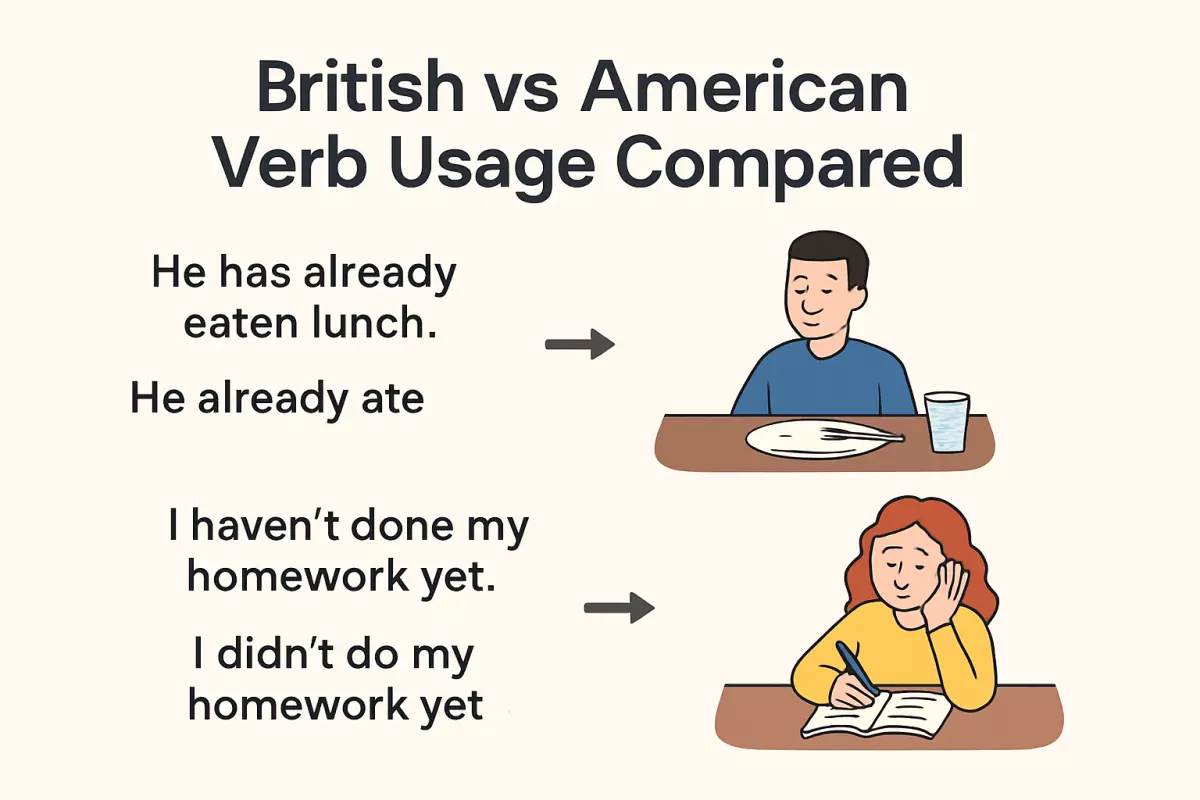 This article compares British and American English verb forms, including past simple vs present perfect, auxiliary choices, spelling and form differences, and common verbs used differently.
British and American English often use different verbs for the same everyday action, which can cause confusion in real conversations. This guide shows which choices sound natural in the UK versus the US, explains common situations where the wording changes, and points out cases where both options are widely accepted so you can speak and write with confidence.
Main differences in verb forms
British and American English often share the same core grammar, but they can diverge in which verb forms feel “standard” in everyday writing and speech. The biggest differences show up in past participles, choices between regular and irregular past tense forms, and a few fixed verb patterns that have become conventional on each side of the Atlantic.
| Verb / pattern | British English (common) | American English (common) | Example (BrE / AmE) |
|---|---|---|---|
| get (past participle) | got | gotten | BrE: He has got better. / AmE: He has gotten better. |
| learn (past / participle) | learnt (also learned) | learned | BrE: She learnt quickly. / AmE: She learned quickly. |
| dream (past / participle) | dreamt (also dreamed) | dreamed | BrE: I dreamt about it. / AmE: I dreamed about it. |
| spell (past / participle) | spelt (also spelled) | spelled | BrE: It’s spelt wrong. / AmE: It’s spelled wrong. |
| smell (past / participle) | smelt (also smelled) | smelled | BrE: It smelt odd. / AmE: It smelled odd. |
| burn (past / participle) | burnt (also burned) | burned | BrE: The toast burnt. / AmE: The toast burned. |
| spill (past / participle) | spilt (also spilled) | spilled | BrE: I spilt coffee. / AmE: I spilled coffee. |
| fit (past tense) | fitted (often), fit (also used) | fit | BrE: The suit fitted well. / AmE: The suit fit well. |
| prove (past participle) | proved (also proven) | proven (also proved) | BrE: It has been proved. / AmE: It has been proven. |
| dive (past tense) | dived | dived (also dove) | BrE: He dived in. / AmE: He dove in (common in speech). |
| plead (past / participle) | pleaded | pleaded (also pled) | BrE: She pleaded guilty. / AmE: He pled guilty. |
| forecast / broadcast (past) | forecast / broadcast | forecast / broadcast | Both: They broadcast it live. |
How to spot the pattern
- BrE often keeps -t endings where AmE prefers -ed: burnt/burned, dreamt/dreamed, learnt/learned, spelt/spelled.
- AmE preserves some older participles in common use: gotten is the clearest example.
- Some verbs allow both forms in both varieties, but one option may sound more natural depending on region and register (formal writing vs casual speech).
- Meaning can influence the choice: in AmE, proven is especially common as an adjective (“a proven method”), while proved can sound more like a straightforward verb form.
Quick usage notes for learners
- If you write for a UK audience, prefer learnt, dreamt, spelt, smelt, burnt, spilt in neutral prose; use -ed forms if you want a more international tone.
- If you write for a US audience, default to learned, dreamed, spelled, smelled, burned, spilled, and use gotten as the usual past participle of get.
- With fit, AmE commonly uses fit for the past (“It fit yesterday”), while BrE often prefers fitted in the same meaning.
- In edited writing, keep the choice consistent within the same document: mixing burnt and spelled can look accidental unless you are quoting.
Past simple vs present perfect usage
British and American English follow the same core rule: use the past simple for finished actions at a finished time, and use the present perfect for past events that connect to “now” (results, relevance, or an unfinished time period). The difference is mainly about preference in certain everyday contexts, especially with words like already, just, and yet.
Typical preference patterns
| Context | More typical in British English | More typical in American English |
|---|---|---|
| Recent news with just | I’ve just eaten. | I just ate. |
| Completion with already | She’s already left. | She already left. |
| Questions/negatives with yet | Have you finished yet? / I haven’t finished yet. | Did you finish yet? / I didn’t finish yet. |
| Life experience without a stated time | I’ve been to Paris. | I’ve been to Paris. (also common) |
| Finished time words (e.g., yesterday, in 2019) | I saw him yesterday. ✅ / I’ve seen him yesterday. ❌ | I saw him yesterday. ✅ / I’ve seen him yesterday. ❌ |
| Unfinished time periods (e.g., today, this week) | I’ve spoken to her today. (if “today” is still continuing) | I spoke to her today. (often acceptable; present perfect also used) |
How to choose the tense in practice
- Use past simple when the time is finished or clearly implied as finished: last night, two minutes ago, in 2020, when I was a child.
- Use present perfect when the time period is still open or the result matters now: today (so far), this week, recently, so far, ever, never.
- With just/already/yet, British English often keeps the “connection to now” framing with present perfect; American English often treats the event as simply completed and uses past simple.
- If you add a finished-time marker, both varieties strongly prefer past simple: “I’ve just eaten” is fine, but “I’ve just eaten at 7 p.m.” usually becomes “I ate at 7 p.m.”
- In American English, “Did you… yet?” and “I didn’t… yet” are widely heard, but in more formal writing, present perfect with yet is still common.
Example sets you can model
- BrE: “Have you already sent it?” → AmE often: “Did you already send it?”
- BrE: “I’ve just seen your message.” → AmE often: “I just saw your message.”
- BrE: “We haven’t decided yet.” → AmE also common: “We didn’t decide yet.”
- Both: “I’ve never tried sushi.” (no finished time stated)
- Both: “I tried sushi last year.” (finished time)
- BrE: “Have you met her before?” → AmE also common: “Did you meet her before?” (especially if a specific occasion is implied)
- Both: “He’s gone home.” (focus on current result: he isn’t here)
- Both: “He went home.” (focus on the past event; time may be understood from context)
- BrE: “I’ve lived here for ten years.” (still true now) → AmE: same
- Both: “I lived there for ten years.” (finished period; no longer true)
- BrE: “She’s worked here since May.” → AmE: same
- Both: “She worked here from May to October.” (finished span)
- BrE: “Have you eaten yet?” → AmE often: “Did you eat yet?”
- Both: “Did you eat already?” (possible in both, but tends to sound more natural in AmE than BrE)
Different auxiliary preferences
British and American English often choose different helper verbs to build questions, negatives, short answers, and certain fixed expressions. The meaning usually stays the same, but the preferred auxiliary can change the level of formality, the rhythm of the sentence, or what sounds “native” in each variety.
| Pattern | British English tendency | American English tendency |
|---|---|---|
| Possession with have | Often uses have got: “I’ve got a car.” | Often uses simple have: “I have a car.” |
| Questions/negatives with have (possession) | May use have as an auxiliary: “Have you any cash?” “I haven’t any.” | Usually uses do-support: “Do you have any cash?” “I don’t have any.” |
| Short answers with possession | “Have you got a pen?” → “Yes, I have.” / “Yes, I’ve got one.” | “Do you have a pen?” → “Yes, I do.” / “Yes, I have one.” |
| Do-support with lexical have | Less consistent; both types occur depending on register | Strong preference for do: “Did you have time?” “I didn’t have time.” |
| Shall vs will for offers/suggestions | Shall is common in questions: “Shall I open the window?” | Will is more common: “Should I open the window?” or “Do you want me to open the window?” |
| Tag questions and auxiliary choice | Tags are frequent and varied: “You’re coming, aren’t you?” | Tags are used too, but often replaced by other checks: “You’re coming, right?” |
How to choose the auxiliary in practice
- For possession, expect have got to sound natural in many UK contexts, while plain have is the default in the US.
- For questions and negatives, American usage strongly favors do-support with possession: “Do you have…?” “I don’t have…”. In British usage, “Have you…?” and “I haven’t…” are possible, especially in more formal or traditional styles.
- Keep the auxiliary consistent in short answers: “Do you have…?” → “Yes, I do.”; “Have you got…?” → “Yes, I have.”
- Use shall carefully: it remains a normal choice for suggestions in British English (“Shall we start?”), but can sound formal, old-fashioned, or overly marked in everyday American English.
- Watch fixed patterns: some combinations are idiomatic in one variety and merely acceptable in the other, so matching the local auxiliary often improves fluency.
Common example pairs (same meaning, different helper verb)
- UK: “I’ve got a meeting tomorrow.” → US: “I have a meeting tomorrow.”
- UK: “Have you any ID?” → US: “Do you have any ID?”
- UK: “I haven’t any change.” → US: “I don’t have any change.”
- UK: “Have you got time?” → US: “Do you have time?”
- UK: “I’ve got to go.” → US: “I have to go.”
- UK: “Shall we take a break?” → US: “Should we take a break?”
- UK: “Shall I call you later?” → US: “Do you want me to call you later?”
- UK: “You’ve got a pen, haven’t you?” → US: “You have a pen, don’t you?”
- UK: “Have you got any questions?” → US: “Do you have any questions?”
- UK: “I haven’t got a clue.” → US: “I don’t have a clue.”
- UK: “He’s got a cold.” → US: “He has a cold.”
- UK: “Have you a minute?” → US: “Do you have a minute?”
Spelling and form differences
Many UK–US verb contrasts come from how the same verb is formed: different endings, different past-tense shapes, and occasional shifts between a verb and a related noun-based form. These patterns are consistent enough that you can often predict the preferred form once you know the verb family.
-ise/-ize and related verb families
One common difference is the productive ending used to build verbs from nouns and adjectives. Both varieties understand both spellings in many cases, but house style and regional preference can differ.
- -ize is widely used in American English: organize, realize, prioritize, legalize.
- -ise is common in British English publishing: organise, realise, prioritise, legalise.
- Some verbs are typically written with -ise in British English even when a publisher allows -ize elsewhere (e.g., advertise, surprise, exercise), because the ending is not the same productive -ize suffix historically.
- When you add other endings, the base spelling usually stays consistent within a variety: organize → organized/organizing vs organise → organised/organising.
-l- doubling in inflected forms
For verbs ending in a vowel + l, British English often doubles the l before -ed and -ing, while American English often keeps a single l. This is a form rule tied to stress patterns and spelling conventions, not meaning.
| Base verb | British English forms | American English forms |
|---|---|---|
| travel | travelled, travelling | traveled, traveling |
| cancel | cancelled, cancelling | canceled, canceling |
| label | labelled, labelling | labeled, labeling |
| model | modelled, modelling | modeled, modeling |
| fuel | fuelled, fuelling | fueled, fueling |
| dial | dialled, dialling | dialed, dialing |
| marvel | marvelled, marvelling | marveled, marveling |
| quarrel | quarrelled, quarrelling | quarreled, quarreling |
Past tense and past participle form choices
A few high-frequency verbs show different preferred past forms. In most cases, both forms are understood on both sides of the Atlantic, but one will sound more natural in local usage.
- learn: BrE often learnt; AmE usually learned.
- dream: BrE often dreamt; AmE usually dreamed.
- spell: BrE often spelt; AmE usually spelled.
- smell: BrE often smelt; AmE usually smelled.
- burn: BrE often burnt; AmE usually burned (though burnt appears as an adjective in both).
- get (past participle): BrE typically got; AmE commonly gotten for “obtained/received” (e.g., has gotten better), while got remains common in set phrases.
- prove (past participle): BrE often accepts proved and proven; AmE strongly favors proven in many contexts.
Verb vs noun-based spellings that affect the verb form
Some contrasts look like “verb differences” because the spelling cue pushes writers toward different related forms.
- practice/practise: In British English, practise is the verb and practice is the noun; in American English, practice is used for both.
- license/licence: In British English, license is commonly the verb and licence the noun; American English uses license for both.
- advice/advise: Both varieties keep the noun/verb split, but learners often miss it because the pronunciation changes; ✅ advise (verb) ❌ advice (verb).
When editing, the safest approach is consistency: choose the regional pattern (or a publisher’s house style) and apply it across inflections and derived forms, especially with -ise/-ize families and -l- doubling.
Common verbs used differently
Some everyday verbs follow different patterns in British and American English, especially around past forms, prepositions, and whether a verb is treated as transitive (taking an object) or intransitive (not taking an object). Learning the typical pairings makes writing and editing much easier, because the “right” choice often depends on the variety you’re aiming for.
| Verb / pattern | British English (BrE) | American English (AmE) | Typical example |
|---|---|---|---|
| get (past participle) | got | gotten (also got) | BrE: “He has got better.” / AmE: “He has gotten better.” |
| learn (past / participle) | learnt (also learned) | learned | “She learnt/learned to drive last year.” |
| dream (past / participle) | dreamt (also dreamed) | dreamed | “I dreamt/dreamed about work.” |
| spell (past / participle) | spelt (also spelled) | spelled | “He spelt/spelled my name wrong.” |
| burn (past / participle) | burnt (also burned) | burned | “The toast burnt/burned.” |
| smell (past / participle) | smelt (also smelled) | smelled | “The room smelt/smelled of paint.” |
| prove (past participle) | proved (also proven) | proven (also proved) | “It has been proved/proven effective.” |
| fit (past / participle) | fitted (also fit) | fit | “The lid fit/fitted perfectly.” |
| quit (past / participle) | quit (also quitted, rare) | quit | “He quit his job.” |
| write (past participle in fixed phrases) | written | written | Same form, but usage differs more in set expressions than grammar. |
| appeal (preposition) | appeal against a decision | appeal a decision / appeal to a court | BrE: “They appealed against the ruling.” / AmE: “They appealed the ruling.” |
| protest (object vs preposition) | protest against something | protest something / protest against something | AmE often allows: “They protested the policy.” |
| meet (with) | meet (someone) | meet with (someone) common in business contexts | AmE: “I’ll meet with the team at 3.” |
| write (to) | write to someone | write someone | BrE: “Write to me soon.” / AmE: “Write me soon.” |
| phone / call | phone someone / ring someone | call someone | BrE: “I’ll ring you.” / AmE: “I’ll call you.” |
| visit (with) | visit someone | visit with someone (meaning “chat”) also used | AmE: “We visited with our neighbors.” |
| fill in / fill out | fill in a form | fill out a form (also fill in) | “Please fill in/out this form.” |
| check (up) on | check something | check up on something more common | AmE: “I’ll check up on that.” |
| take (a decision) | take a decision | make a decision | BrE formal: “They took a decision quickly.” |
How to choose the right form
- Past participles vary most in BrE vs AmE: verbs like learn, dream, spell, and burn often take -t forms in BrE, while AmE usually prefers -ed.
- Prepositions signal variety: BrE often keeps a preposition where AmE may drop it (for example, write to someone vs write someone).
- Formality matters: some BrE patterns (such as take a decision) are more common in formal writing, while AmE tends to favor the everyday alternative (make a decision).
- Keep consistency within a document: mixing gotten with other strongly BrE choices (like learnt) can sound uneven unless you’re intentionally blending styles.
Formal and informal contrasts
Verb choices often shift with register: formal writing tends to prefer more explicit, Latinate, or fully spelled-out verb phrases, while casual speech leans on shorter verbs, contractions, and everyday phrasal verbs. British and American English share most of these tendencies, but they differ in which verbs sound “neutral” versus “stiff” in each variety.
Register patterns that commonly differ
- Have got as possession: BrE informal “I’ve got a meeting” is very common; AmE uses it too, but formal AmE often prefers “I have a meeting” or “I have a meeting scheduled.”
- Needn’t vs don’t need to: BrE formal and informal can use “needn’t”; AmE generally prefers “don’t need to,” especially in everyday use.
- Shall: BrE keeps “shall” in more formal offers and legal/policy wording (“The tenant shall…”). AmE uses it mainly in legal style; in conversation it can sound marked or old-fashioned.
- Must for obligation: both varieties use it, but in speech it can sound forceful. Softer alternatives are common: “have to,” “need to,” “should,” or “be required to” (more formal).
- May vs can for permission: formal writing still favors “may” (“You may request…”). Informal speech in both varieties usually uses “can.”
- Request vs ask for: “request” reads more official; “ask for” is the everyday option in both BrE and AmE.
- Assist vs help: “assist” is more formal; “help” is neutral and conversational in both.
- Purchase vs buy: “purchase” is formal/administrative; “buy” is the default in speech.
- Commence vs start/begin: “commence” is formal; “start” is the most informal; “begin” sits comfortably in neutral prose.
- Terminate vs end/stop: “terminate” is formal/legal; “end” is neutral; “stop” is more conversational and direct.
- Inform vs tell: “inform” suits notices and reports; “tell” is the everyday verb in both varieties.
- Require vs need: “require” is formal and impersonal; “need” is more personal and common in conversation.
- Ensure vs make sure: “ensure” is more formal; “make sure” is the natural spoken choice.
- Obtain vs get: “obtain” is formal; “get” is informal and extremely frequent in both BrE and AmE (and often avoided in very formal writing).
- Submit vs send in/hand in: “submit” is standard in official contexts; “hand in” is common in BrE school/work talk, while AmE often uses “turn in.”
Verb forms that signal formality
- Contractions: more common in informal writing and speech (“we’ve,” “they’ll”). Formal documents often avoid them (“we have,” “they will”).
- Passive voice: used to sound impersonal or procedural (“The form is completed and submitted…”). In casual contexts, active voice is usually preferred (“Complete the form and send it…”).
- Modal verbs as politeness tools: “could/would” often sound more tactful than “can/will.” This is similar in BrE and AmE, though BrE may use “would you mind…?” patterns slightly more often in service interactions.
- Verb + preposition choices can mark register: “discuss” is more formal than “talk about,” “investigate” more formal than “look into.”
- Single-word verbs vs phrasal verbs: formal prose often prefers “continue” over “carry on,” “discover” over “find out,” “postpone” over “put off.” In speech, the phrasal verb is frequently the natural option.
Common “too formal” or “too casual” mismatches to watch
- ✅ “Please send the file by Friday.” → neutral
❌ “Please submit the file by Friday.” (can sound overly official in a friendly email) - ✅ “We need to fix this.” → neutral speech
❌ “We are required to fix this.” (sounds bureaucratic unless it really is a requirement) - ✅ “Could you help me with this?” → polite and natural
❌ “Could you assist me with this?” (can sound stiff in everyday conversation) - ✅ “The meeting starts at 10.” → natural
❌ “The meeting commences at 10.” (formal tone; fine for notices, odd in casual talk) - ✅ “I’ll get back to you.” → common in both varieties
❌ “I will revert to you.” (often seen in some business English, but can sound unnatural in standard BrE/AmE usage)
Choosing the right variety
Pick the verb patterns that match your audience and context, then keep them consistent. In most cases, either British or American usage will be understood, but mixing systems can make tense, agreement, and formality feel uneven.
Practical factors to decide your default
- Audience location and expectations: UK-based readers often expect British past participles and collective-noun agreement; US-based readers usually expect American forms.
- Publication style guide: Many workplaces and journals specify one variety; follow it even if your personal habit differs.
- Formality level: Some choices (for example, got vs gotten) can signal register or region, which may matter in academic or legal writing.
- Quoted speech: Preserve the speaker’s variety inside quotations, but keep the surrounding narration in your chosen standard.
- International readers: When writing for mixed audiences, prefer forms with the least chance of being flagged as “wrong” by either group, and avoid region-heavy idioms.
- Editing and proofreading: Choose the variety your editors and tools are set up to check; automated grammar settings can otherwise “correct” valid regional forms.
High-impact verb differences to standardise early
| Usage area | British pattern | American pattern | Notes for consistency |
|---|---|---|---|
| Past participle of get | have got | have gotten | Both are correct regionally; avoid switching within the same document. |
| Past participle of learn | learnt | learned | Either can appear in both varieties, but one will look more “native” depending on region. |
| Past participle of dream | dreamt | dreamed | Choose one set of -t or -ed forms across similar verbs. |
| Past participle of burn | burnt | burned | In US English, burnt can sound adjectival; decide whether you treat it as a verb form. |
| Past participle of spill | spilt | spilled | Keep parallel structure in lists: “spilled, spoiled, filled” vs “spilt, spoilt, filled”. |
| Past participle of spell | spelt | spelled | Especially noticeable in instructions and education writing. |
| Past participle of smell | smelt | smelled | Be careful with ambiguity: smelt can also be a noun/verb meaning “to smelt metal”. |
| Past participle of prove | proved | proven | In US English, proven is common as a participle; in UK English it is often more adjectival. |
| Past participle of fit | fitted | fit | Technical contexts vary; pick one and apply it to similar constructions (e.g., “was fit/fitted”). |
| Collective nouns + verb agreement | the team are winning | the team is winning | British usage often follows meaning (plural individuals); American usage usually follows the grammatical singular. |
| Simple past vs present perfect with recent time | I’ve just eaten | I just ate | Both are understandable; choose one approach for “just/already/yet” in narrative and reporting. |
| Mandative subjunctive after demands | They insisted that he should resign | They insisted that he resign | Either works; keep the same structure across similar verbs: insist, recommend, request, demand. |
Quick consistency checks while drafting
- Scan for mixed participles: if you use learnt, check nearby verbs for matching -t choices (e.g., dreamt, spelt) rather than alternating with -ed forms.
- Standardise “recent past” phrasing: decide whether you prefer present perfect (common in British usage) or simple past (common in American usage) with just, already, and yet.
- Choose a collective-noun rule: treat groups as singular or plural, then apply it to government, company, team, staff, and committee.
- Keep demands and recommendations aligned: don’t alternate between “that he resign” and “that he should resign” in the same document unless you are reflecting different speakers.
- Use error marking carefully: a form that looks unfamiliar may be regional rather than incorrect; only flag it as wrong if it breaks the chosen standard (e.g., ✅ “have gotten” in American usage; ❌ “have gotten” in a document otherwise written in British style).
Homework: British vs American practice tasks
Use these exercises to build a reliable habit: first identify the variety (BrE or AmE), then choose the verb form that fits its usual pattern. Focus on agreement (collective nouns), past forms (regular vs irregular), and prepositions that commonly follow certain verbs.
Task 1: Choose the form that matches the variety
Select the best option for the target variety shown in brackets.
- (BrE) The government is / are expected to respond today.
- (AmE) The team is / are playing its first home game.
- (BrE) I’ve got / gotten a meeting at three.
- (AmE) She has got / gotten much better at presenting.
- (BrE) He learnt / learned to drive last year.
- (AmE) He learnt / learned to drive last year.
- (BrE) The shop fit / fitted the kitchen yesterday.
- (AmE) The shop fit / fitted the kitchen yesterday.
- (BrE) Have you filled in / filled out the form?
- (AmE) Have you filled in / filled out the form?
- (BrE) I’ll ring / call you after lunch.
- (AmE) I’ll ring / call you after lunch.
Show answers
- are
- is
- got
- gotten
- learnt
- learned
- fitted
- fit
- filled in
- filled out
- ring
- call
Task 2: Rewrite for the other variety (verb-focused)
Rewrite each sentence in the other variety by changing only what is needed (typically the verb form, verb choice, or verb-preposition pattern). Keep meaning and tense the same.
- I’ve just got a new phone. (rewrite in AmE)
- She has gotten really interested in gardening. (rewrite in BrE)
- The committee are meeting at noon. (rewrite in AmE)
- The band is touring in June. (rewrite in BrE, if you choose a plural collective)
- He learned the news yesterday. (rewrite in BrE)
- He dreamt about the exam. (rewrite in AmE)
- Could you fill out this form? (rewrite in BrE)
- I’ll call you on Monday. (rewrite in BrE)
- The tailor fit me for a suit. (rewrite in BrE)
- The installer fitted the shelves last week. (rewrite in AmE)
Show answers
- I’ve just gotten a new phone. (Alternative: “I just got a new phone.”)
- She has got really interested in gardening.
- The committee is meeting at noon.
- The band are touring in June. (If treating the band as individuals.)
- He learnt the news yesterday.
- He dreamed about the exam.
- Could you fill in this form?
- I’ll ring you on Monday.
- The tailor fitted me for a suit.
- The installer fit the shelves last week.
Task 3: Spot and correct the variety mismatch
Each sentence mixes patterns from both varieties. Rewrite each one so it is consistent in either BrE or AmE (choose one and make it uniform).
- I’ll ring you later, and I already filled out the form.
- The team are winning, and they’ve gotten a new coach.
- He learnt a lot, but he just got promoted yesterday.
- The installer fit the kitchen, but the company are sending another worker.
- Have you got any questions? I can call you after.
- The committee is divided; they’ve learnt the details already.
- She’s gotten better, so I’ll ring her with the news.
- We filled in the application, and the band is rehearsing now.
Show answers
- BrE: I’ll ring you later, and I already filled in the form.
AmE: I’ll call you later, and I already filled out the form. - BrE: The team are winning, and they’ve got a new coach.
AmE: The team is winning, and they’ve gotten a new coach. - BrE: He learnt a lot, but he just got promoted yesterday.
AmE: He learned a lot, but he just got promoted yesterday. - BrE: The installer fitted the kitchen, but the company are sending another worker.
AmE: The installer fit the kitchen, but the company is sending another worker. - BrE: Have you got any questions? I can ring you after.
AmE: Do you have any questions? I can call you after. - BrE: The committee are divided; they’ve learnt the details already.
AmE: The committee is divided; they’ve learned the details already. - BrE: She’s got better, so I’ll ring her with the news.
AmE: She’s gotten better, so I’ll call her with the news. - BrE: We filled in the application, and the band are rehearsing now.
AmE: We filled out the application, and the band is rehearsing now.
Checklist for self-correction
- Collective noun agreement: in BrE, plural agreement is often acceptable when the group is seen as individuals; in AmE, singular agreement is the default.
- Got vs gotten: BrE typically uses got; AmE commonly uses gotten for change or acquisition.
- Past forms that vary: BrE often prefers learnt, dreamt, spoilt, smelt; AmE often prefers learned, dreamed, spoiled, smelled.
- Verb choice differences: BrE often uses ring where AmE prefers call.
- Form verbs: BrE commonly uses fill in a form; AmE commonly uses fill out a form.