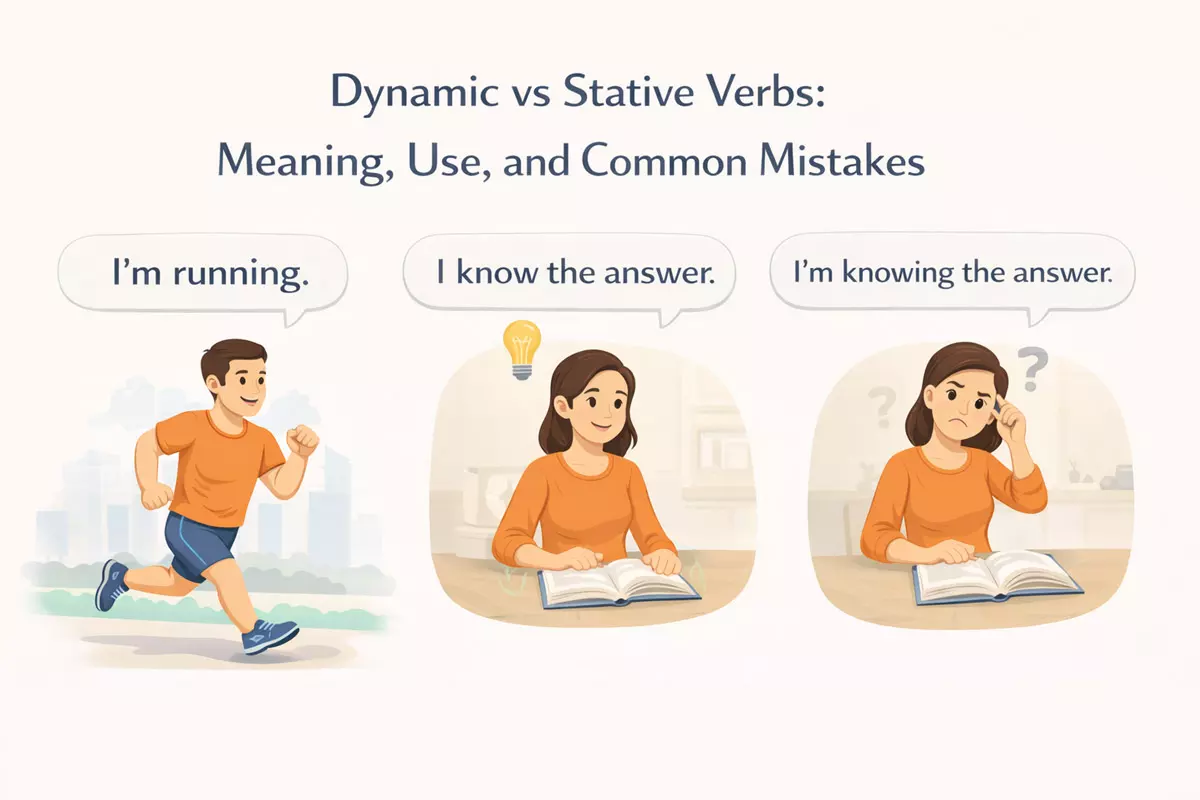
Dynamic vs Stative Verbs: Meaning, Use, and Common Mistakes

 Explains the core difference between dynamic and stative verbs, why many statives don’t use the continuous, and the main stative categories.
- Dynamic vs stative verbs: core meaning difference
- Stative verbs and limits of the continuous form
- Major categories of stative verbs
- Verbs that shift between stative and dynamic use
- Meaning change when stative verbs take -ing
- Choosing the correct form in real sentences
- Frequent learner errors with corrections
- Practice: dynamic vs stative verb exercises
Action verbs and state verbs may seem alike, but they work differently in everyday speech. This guide explains when to choose simple or continuous forms, how the meaning can shift with each choice, and the common mistakes learners make in real conversations, so you can speak more naturally and avoid confusing or incorrect verb forms.
Dynamic vs stative verbs: core meaning difference
The key distinction is whether the verb describes an action that unfolds or a state that simply exists. Dynamic verbs point to events, activities, or changes over time. Stative verbs describe conditions such as thoughts, feelings, possession, senses, and relationships, which are usually viewed as stable rather than “happening.”
| Type | Core meaning | Typical time behavior | Common grammar pattern |
|---|---|---|---|
| Dynamic (action) verbs | Doing, happening, changing | Has a start/finish or develops over time | Often works naturally in continuous forms (be + -ing) |
| Stative (state) verbs | Being, having, feeling, thinking (as a condition) | Viewed as stable at a moment in time | Usually used in simple forms; continuous is often unusual or changes meaning |
| “Mixed” verbs (both types) | Meaning depends on context (state vs activity) | Either stable or developing, depending on the intended meaning | Simple vs continuous often signals the intended meaning difference |
| Result-focused dynamic verbs | Action aimed at an outcome (finish, build, decide) | Progresses toward completion | Continuous emphasizes the process; simple can emphasize completion |
How to identify the type in real sentences
Instead of memorizing labels, check what the verb is doing in context. Ask whether the meaning is an activity you can “watch” happening, or a condition that is simply true.
- Can it be “in progress” right now? If yes, it is likely dynamic: She is running.
- Does it describe a condition rather than an event? If yes, it is likely stative: She knows the answer.
- Does the verb imply change or movement from one situation to another? That points to an action meaning: The weather is getting colder.
- Does it describe possession, preference, belief, or perception as a fact? That points to a state meaning: I own this book. I prefer tea.
Common verb groups and what they usually express
- Dynamic activities: run, walk, write, cook, build, swim, study, negotiate, repair, paint, practice, drive
- Dynamic changes: grow, improve, increase, decrease, melt, freeze, widen, shrink, develop, recover
- Stative mental states: know, believe, understand, remember, imagine, suppose, doubt, mean (intend), agree (as an opinion)
- Stative emotions/preferences: love, hate, like, dislike, prefer, want, need, fear, enjoy (often treated as stative in many contexts)
- Stative possession/relationship: have (own), own, belong, contain, include, consist (of), depend (on), matter
- Stative senses (as perception): see, hear, smell, taste, feel (when describing what is perceived, not the action)
Why the distinction matters for meaning
Choosing simple vs continuous often communicates whether you mean a stable condition or a temporary, developing situation. With many state verbs, the continuous form is either uncommon or signals a different meaning (often “behavior,” “temporary attitude,” or “process”).
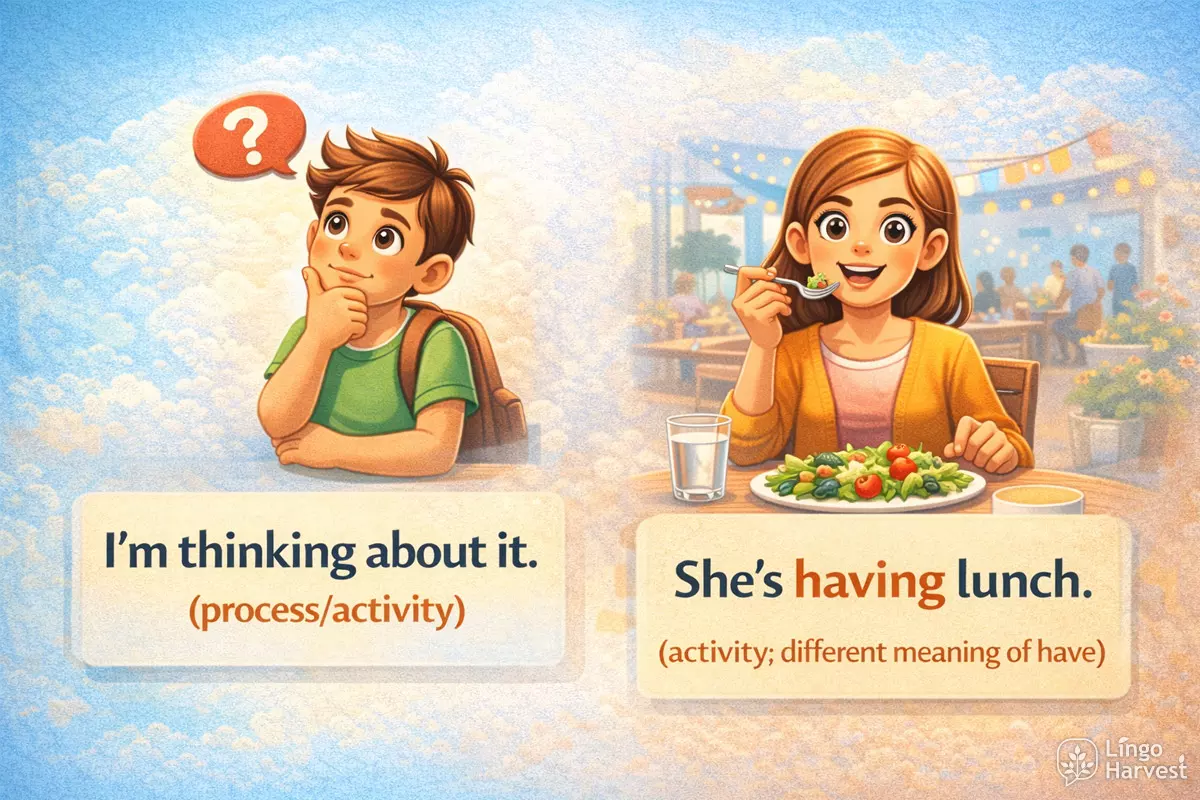
- ✅ I think it’s a good idea. (opinion/state) → ✅ I’m thinking about it. (process/activity)
- ✅ She has a car. (possession/state) → ✅ She’s having lunch. (activity; different meaning of have)
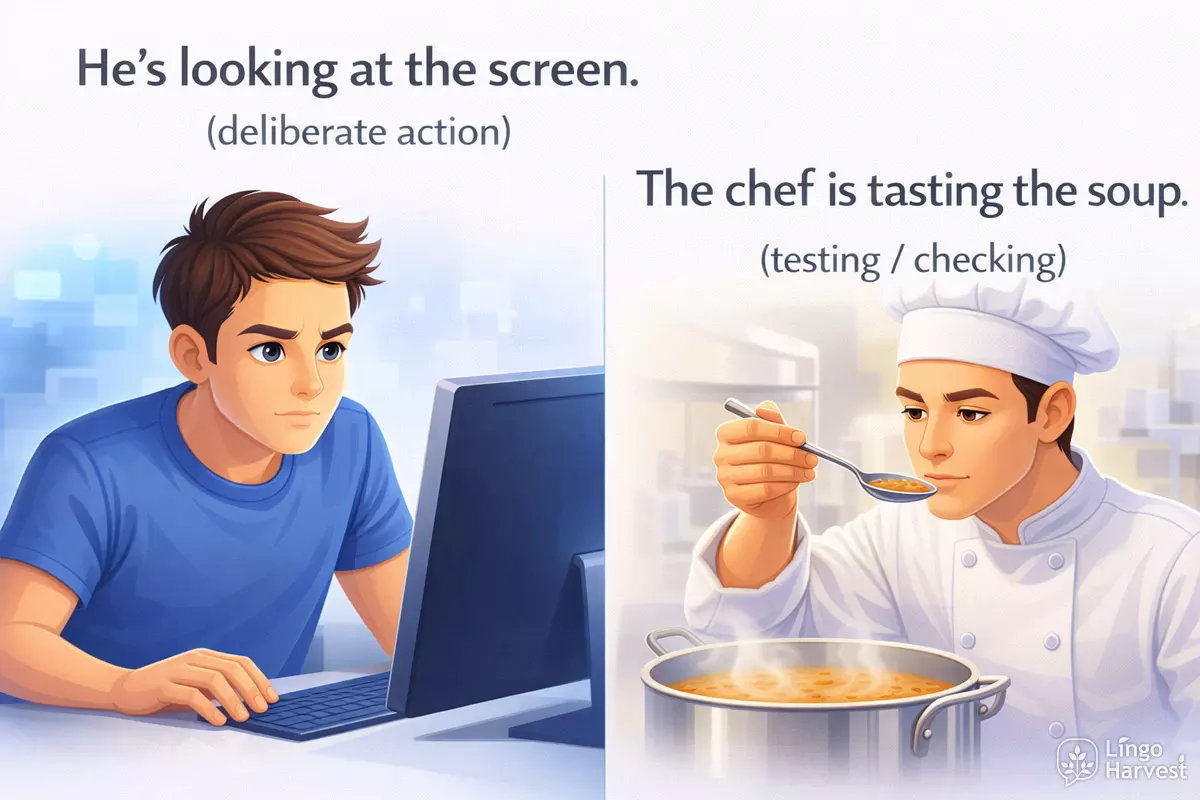
- ✅ This soup tastes salty. (perception/state) → ✅ The chef is tasting the soup. (action)
- ✅ I see the problem. (understand/state) → ✅ I’m seeing the doctor tomorrow. (meeting/arrangement; action meaning)
Stative verbs and limits of the continuous form
Many English verbs describe a condition, perception, or relationship rather than an action. These “state” meanings usually do not take the continuous form because there is no activity in progress to picture. As a result, learners often produce sentences that sound unnatural (or change the meaning) when they use be + -ing with these verbs.
Core pattern: simple tenses for states
When a verb expresses a stable situation (thoughts, feelings, possession, senses, identity), the simple present/past is the default choice.
- ❌ I’m knowing the answer. → ✅ I know the answer.
- ❌ She’s owning two cars. → ✅ She owns two cars.
- ❌ We’re believing him. → ✅ We believe him.
- ❌ They’re seeming tired. → ✅ They seem tired.
- ❌ I’m liking this song. → ✅ I like this song.
Common stative verb groups (and typical examples)
Grouping helps you predict which verbs resist the progressive. The examples below show the stative meaning that normally stays in simple tenses.
- Opinions and mental states: believe, think (opinion), know, understand, remember, forget, agree, doubt, suppose, mean.
- Emotions and preferences: love, like, dislike, prefer, want, need, hate, fear, mind, care (about).
- Possession and relationships: have (possession), own, belong (to), possess, contain, include, consist (of), depend (on).
- Senses (involuntary perception): see, hear, smell, taste, feel (when it means “sense”).
- Appearance and qualities: seem, appear, look (appearance), sound (impression), resemble, fit, matter.
When the continuous form is possible: meaning shifts
Some verbs can be stative or dynamic depending on meaning. In the progressive, they often switch to an “activity” sense (temporary, deliberate, developing, or repeated behavior).
- think: ✅ I think it’s true. (opinion) / ✅ I’m thinking about my options. (mental activity)
- have: ✅ She has a brother. (possession) / ✅ She’s having lunch. (activity) / ✅ They’re having a problem. (often acceptable as a temporary situation)
- see: ✅ I see the mountains. (perception) / ✅ I’m seeing a doctor tomorrow. (arrangement) / ✅ He’s seeing someone. (dating)
- feel: ✅ I feel cold. (state) / ✅ I’m feeling better today. (temporary change; common in speech)
- look: ✅ It looks expensive. (appearance) / ✅ She’s looking at the price tag. (action)
- taste: ✅ It tastes salty. (state) / ✅ The chef is tasting the soup. (action)
- smell: ✅ The room smells fresh. (state) / ✅ He’s smelling the flowers. (action)
- weigh: ✅ The bag weighs 10 kilos. (fact) / ✅ They’re weighing the luggage. (action)
- be: ✅ He is polite. (character) / ✅ He’s being polite. (behavior right now; possibly temporary or deliberate)
Practical limits and common learner mistakes
Use the progressive only when you can reasonably answer “What is happening right now (or around now)?” If the verb describes a fact, possession, or internal state that is simply true, the continuous form usually sounds wrong.
- Overusing -ing for “now”: “I’m knowing” and “I’m understanding” are typically incorrect; use I know, I understand.
- Confusing perception vs. action: I smell smoke (I detect it) vs. I’m smelling the milk (I’m checking it).
- Mixing up appearance vs. intentional behavior: He is rude (general) vs. He’s being rude (right now).
- Assuming all feeling verbs are stative: I’m feeling nervous is widely used for a temporary condition, especially in conversation.
- Forgetting that context controls the form: the same verb can be non-progressive in one sentence and progressive in another, depending on whether it describes a state or an activity.
Major categories of stative verbs
Stative verbs usually describe a condition that is true for a period of time rather than an action in progress. They often resist the present continuous, especially when the meaning is about a stable state (not a temporary behavior or deliberate action).
1) Perception and senses (non-deliberate)
These verbs report what the senses register, not what someone is actively doing. They commonly appear in simple tenses.
- see: “I see the problem.” ❌ “I’m seeing the problem.” (unless meaning “meeting”)
- hear: “I hear music.” ❌ “I’m hearing music.” (unless meaning “receiving news/being interviewed” in some contexts)
- smell (state): “The soup smells good.”
- taste (state): “This tastes salty.”
- feel (state): “The fabric feels soft.”
- sound: “That sounds interesting.”
- look (appearance): “You look tired.”
- seem: “It seems impossible.”
- appear (seem): “She appears calm.”
- notice: “I notice a mistake.”
2) Emotions, preferences, and attitudes
These verbs express feelings or evaluations that are typically ongoing rather than actively performed. Many learners overuse the -ing form here.
- like: “I like this song.” ❌ “I’m liking this song.” (possible in special contexts, but not the default)
- love: “They love their new home.”
- hate: “He hates waiting.”
- prefer: “I prefer tea to coffee.”
- dislike: “She dislikes crowds.”
- enjoy (often dynamic, but can be treated as a state in general statements): “I enjoy classical music.”
- need: “I need help.”
- want: “We want a refund.”
- mind: “I don’t mind the noise.”
- care: “He cares about accuracy.”
3) Thinking, believing, and knowing
These verbs describe mental states (knowledge, opinions, assumptions). In many cases, the continuous form sounds wrong unless the verb shifts to a different meaning.
- know: “I know the answer.” ❌ “I’m knowing the answer.”
- believe: “I believe you.”
- think (opinion): “I think it’s a bad idea.” (contrast with dynamic “I’m thinking about it.”)
- understand: “Do you understand the instructions?”
- remember: “I remember her name.”
- forget (state of not remembering): “I forget his address.” (often “I’ve forgotten…”)
- mean: “This word means ‘quick’.”
- suppose: “I suppose you’re right.”
- agree: “I agree with you.”
- doubt: “I doubt that’s true.”
4) Possession, ownership, and relationships
These verbs describe having, belonging, or social connections. They typically refer to a stable situation, so simple tenses are the norm.
- have (possession): “She has a car.” ❌ “She’s having a car.” (but “She’s having lunch.” is dynamic)
- own: “They own two apartments.”
- possess: “The museum possesses rare artifacts.”
- belong: “This key belongs to me.”
- contain: “The box contains documents.”
- include: “The price includes tax.”
- consist of: “The team consists of five members.”
- depend on (general relationship): “It depends on the weather.”
- fit: “This jacket fits well.”
- lack: “The report lacks evidence.”
5) Being, identity, and characteristics
These verbs describe what something is, how it is defined, or what qualities it has. They are strongly stative and rarely take the continuous without a special, temporary meaning.
- be: “He is polite.” ❌ “He is being polite.” (possible only when emphasizing temporary behavior)
- exist: “Unicorns don’t exist.”
- remain: “Prices remain high.”
- equal: “Two plus two equals four.”
- resemble: “She resembles her mother.”
- weigh (measurement): “It weighs 10 kilos.”
- measure (measurement): “The room measures 20 square meters.”
- cost: “It costs $50.”
- matter: “Details matter.”
- deserve: “You deserve a break.”
Many verbs can be stative in one meaning and dynamic in another. When you are describing a stable condition, use the simple form; when you shift to an intentional action or a temporary behavior, the continuous often becomes natural.
Verbs that shift between stative and dynamic use
Some English verbs can describe either a state (a condition, opinion, possession, perception) or an action (a deliberate, changing activity). The meaning changes with the grammar: the stative sense usually avoids the progressive, while the dynamic sense often sounds natural in the progressive because it highlights a temporary or developing situation.
Common patterns to watch
- State → action: the verb moves from “what is true” to “what someone is doing.”
- General truth → temporary behavior: the progressive often signals “for now” rather than “in general.”
- Perception → meeting/experiencing: “see/hear” can shift from sensing to attending or finding out.
- Possession/relationship → interaction: “have” can mean ownership (state) or an activity (dynamic).
- Opinion → evaluation in progress: verbs like “think” can describe a belief or an active mental process.
High-frequency verbs that switch meaning (with examples)
| Verb | Stative meaning (usually non-progressive) | Dynamic meaning (often progressive) |
|---|---|---|
| think | I think this is correct. (opinion) | I’m thinking about your offer. (considering) |
| have | She has a car. (possession) | We’re having lunch. (activity) |
| see | I see the mountains. (perception) | I’m seeing the dentist tomorrow. (appointment) |
| hear | I hear music. (perception) | I’m hearing a lot of complaints lately. (receiving reports repeatedly) |
| feel | I feel tired. (state/condition) | I’m feeling the fabric. (touching/examining) |
| taste | This soup tastes salty. (quality) | The chef is tasting the sauce. (testing) |
| smell | The room smells fresh. (quality) | She’s smelling the flowers. (sniffing deliberately) |
| look | You look happy. (appearance) | He’s looking at the report. (directing attention) |
| weigh | The package weighs two kilos. (measurement) | They’re weighing the options. (considering) |
| fit | This jacket fits well. (size/compatibility) | We’re fitting a new window. (installing) |
| appear | He appears calm. (seems) | He’s appearing in a new series. (performing/participating) |
| be | She is polite. (characteristic) | She’s being polite. (temporary behavior) |
Usage notes and typical mistakes
- Use the progressive to show “temporary behavior,” not permanent identity. ✅ She’s being quiet today. ❌ She’s being quiet. (if you mean “she is a quiet person”)
- Sense verbs often switch when there is deliberate action. ✅ I’m tasting the soup. (testing) ❌ I’m tasting salty. (quality should be stative: “It tastes salty.”)
- “See” in the progressive usually means an arrangement or relationship. ✅ I’m seeing my manager at 3. (appointment) ✅ She’s seeing someone. (dating)
- “Have” is progressive for experiences/activities, not possession. ✅ We’re having a meeting. ❌ I’m having a laptop. (possession: “I have a laptop.”)
- “Think” in the progressive signals an active process. ✅ I’m thinking about moving. (considering) ✅ I think it’s a bad idea. (opinion)
Meaning change when stative verbs take -ing
Some verbs that usually describe states (thoughts, feelings, possession, perception) can appear in the -ing form, but the meaning often shifts. The progressive typically adds the idea of temporary behavior, change in progress, or an active/intentional process rather than a stable condition.
Common meaning shifts (state → activity/temporary behavior)
- think: “I think it’s true” (opinion) → “I’m thinking about it” (mental process happening now).
- have: “She has a car” (possession) → “She’s having lunch” (activity/experience).
- see: “I see the problem” (understand) → “I’m seeing a doctor” (meeting/visiting) or “I’m seeing what you mean” (gradual understanding).
- feel: “I feel tired” (current condition) → “I’m feeling tired lately” (temporary trend, not a fixed state).
- look: “It looks good” (appearance) → “He’s looking at the screen” (deliberate action).
- taste: “It tastes salty” (resulting flavor) → “The chef is tasting the soup” (testing/checking).
- smell: “It smells strange” (odor) → “She’s smelling the flowers” (intentional action).
- weigh: “The bag weighs 10 kilos” (measurement) → “They’re weighing the bag” (measuring action).
- be: “He is polite” (character trait) → “He’s being polite” (temporary behavior, possibly unusual or strategic).
- love/like: “I love this song” (general preference) → “I’m loving this song” (strong enjoyment right now; informal).
- hate: “I hate crowds” (general dislike) → “I’m hating this noise” (strong reaction now; informal).
- want: “I want a coffee” (desire) → “I’m wanting a coffee” (dialectal/less standard; often avoided in formal English).
- hope: “I hope it works” (wish) → “I’m hoping it works” (ongoing, repeated hoping; often sounds more tentative/polite).
- remember: “I remember his name” (stored memory) → “I’m remembering his name now” (the memory is returning; less common but possible).
- understand: “I understand” (state of comprehension) → “I’m understanding it better now” (comprehension developing; can sound nonstandard to some speakers, but used to show gradual change).
Usage patterns to watch
- Progressive = temporary or developing. Use -ing when the situation is changing or limited in time: “I’m feeling better today.”
- Progressive = intentional action. With sense verbs, -ing often means “doing it on purpose”: “She’s tasting the sauce.”
- Progressive = behavior (not identity). “You’re being rude” describes current conduct, not a permanent trait.
- Informal emphasis. Some stative verbs in -ing add emotional immediacy: “I’m loving this!” In careful writing, prefer the simple form: “I love this.”
Common mistakes and cleaner alternatives
- ❌ “I’m knowing the answer.” → ✅ “I know the answer.” (knowledge is treated as a state)
- ❌ “She’s owning two apartments.” → ✅ “She owns two apartments.” (possession is usually non-progressive)
- ❌ “I’m believing you.” → ✅ “I believe you.” (belief is typically a state; progressive can sound marked or unusual)
- ❌ “He’s seeming tired.” → ✅ “He seems tired.” (appearance verbs rarely take -ing)
Choosing the correct form in real sentences
Pick the form by asking what the verb means in that moment: an activity in progress (usually the progressive) or a state/condition (usually the simple form). Many “stative” verbs can switch to a dynamic meaning when they describe behavior, change, or a temporary situation.
Quick decision checks
- Is it happening right now or around now? Use the progressive for an unfolding action: “She is reading.”
- Is it a stable fact, opinion, possession, or relationship? Use the simple form: “He owns a bike.”
- Does the verb describe a deliberate action or repeated behavior? Progressive is often possible: “You are being rude.”
- Is the verb about perception or mental states? Simple is the default, but progressive can appear with a different meaning (often “meeting/experiencing”): “I see what you mean” vs. “I am seeing a doctor.”
- Is the speaker emphasizing a temporary trend? Progressive fits: “More people are using electric cars.”
- Is it a planned near-future arrangement? Progressive can be used even with verbs that are not “actions” in the physical sense: “I am meeting him tomorrow.”
Common verb patterns and what they usually signal
- Think: ✅ “I think it’s a good idea.” (opinion) → ✅ “I am thinking about moving.” (mental process)
- Have: ✅ “She has two sisters.” (possession) → ✅ “She is having lunch.” (activity/experience)
- Be: ✅ “He is polite.” (general trait) → ✅ “He is being polite.” (temporary behavior)
- See: ✅ “I see the problem.” (understand) → ✅ “I am seeing my manager later.” (arrangement/meeting)
- Feel: ✅ “I feel nervous.” (state) → ✅ “I am feeling better today.” (temporary condition; common in conversation)
- Smell / taste: ✅ “This soup tastes salty.” (result) → ✅ “He is tasting the soup.” (action of testing)
- Look: ✅ “You look tired.” (appearance) → ✅ “She is looking at the photo.” (action)
- Weigh: ✅ “It weighs 10 kilos.” (measurement) → ✅ “The chef is weighing the flour.” (action)
- Measure: ✅ “The room measures 4 meters wide.” (fact) → ✅ “They are measuring the room.” (action)
- Fit: ✅ “This jacket fits me.” (state) ❌ “This jacket is fitting me.” (rare; usually avoided)
- Know: ✅ “I know her.” (state) ❌ “I am knowing her.” (not standard)
- Believe: ✅ “They believe it’s true.” (opinion) ❌ “They are believing it’s true.” (unusual; only in special contexts)
- Like / love / hate: ✅ “I love this song.” (preference) → ✅ “I am loving this song lately.” (informal emphasis; trend/temporary enthusiasm)
- Want / need: ✅ “I need help.” (state) ❌ “I am needing help.” (generally avoided; use simple)
- Prefer: ✅ “I prefer tea.” (preference) ❌ “I am preferring tea.” (rare)
- Remember / forget: ✅ “I remember his name.” (state) → ✅ “I am forgetting things these days.” (trend; common in speech)
High-frequency mistake patterns (and fixes)
- Using progressive for permanent meanings: ❌ “I’m owning a car.” → ✅ “I own a car.”
- Using simple form when the meaning is an activity: ❌ “She has dinner now.” → ✅ “She is having dinner now.”
- Mixing “understand” and “meet” meanings: ❌ “I’m seeing what you mean.” (usually) → ✅ “I see what you mean.”
- Forgetting the “behavior” meaning of be: ❌ “You are rude today.” (sounds like a general label) → ✅ “You are being rude today.” (temporary behavior)
- Overusing progressive with emotion verbs: ❌ “I’m hating this movie.” (can sound overly dramatic or informal) → ✅ “I hate this movie.” / ✅ “I’m really not enjoying this movie.”
- Using progressive with “know” and “believe” in neutral statements: ❌ “I’m knowing the answer.” → ✅ “I know the answer.”
When you are unsure, choose the simple form for states (opinions, possession, identity, senses as results) and switch to the progressive only when the verb clearly means an action, a temporary situation, or a developing trend.
Frequent learner errors with corrections
Many mistakes come from mixing up actions (often used in continuous forms) with states (usually used in simple forms). The patterns below show what typically goes wrong, why it sounds unnatural, and what to say instead.
1) Using the continuous with common stative verbs
- ❌ I am knowing the answer. → ✅ I know the answer. (Knowledge is a state, not an action.)
- ❌ She is believing you. → ✅ She believes you. (Belief is generally treated as a state.)
- ❌ We are needing more time. → ✅ We need more time. (Need is usually stative in everyday meaning.)
- ❌ He is owning two cars. → ✅ He owns two cars. (Possession is a state.)
- ❌ I am preferring tea. → ✅ I prefer tea. (Preferences are typically states.)
- ❌ They are seeming tired. → ✅ They seem tired. (Seem describes an impression, not an activity.)
- ❌ This is belonging to me. → ✅ This belongs to me. (Belong is stative.)
- ❌ I’m not understanding. → ✅ I don’t understand. (Use simple present for general lack of understanding.)
2) Forgetting that some verbs can be dynamic or stative (meaning changes)
Several verbs switch meaning depending on whether they describe a state (simple) or a temporary/active process (continuous). Errors happen when the form doesn’t match the intended meaning.
- ❌ I think you’re right. (when you mean “I’m considering”) → ✅ I’m thinking about your idea. (Active mental process.)
- ❌ I’m thinking you’re right. (when you mean “I believe”) → ✅ I think you’re right. (Opinion/belief.)
- ❌ She has a great time. (right now, at the party) → ✅ She’s having a great time. (Experience in progress.)
- ❌ I’m having a car. → ✅ I have a car. (Possession is stative; have continuous is for experiences/activities.)
- ❌ The soup tastes too salty. (while the chef is testing repeatedly and commenting on changes) → ✅ The soup is tasting too salty. (Less common, but possible to emphasize an ongoing testing situation.)
- ❌ He is seeing a dog in the yard. (meaning “he notices it”) → ✅ He sees a dog in the yard. (Perception as a state.)
- ❌ I see my doctor every week. (meaning “I’m meeting her this week as an arrangement”) → ✅ I’m seeing my doctor this week. (Planned meeting/temporary situation.)
3) Overusing continuous to sound “more natural”
Learners sometimes choose the -ing form because it feels more conversational. In English, the continuous signals temporary, in-progress, or changing situations, so it can sound odd with stable facts.
- ❌ I’m living in Canada. (if it’s a permanent fact you present as stable) → ✅ I live in Canada. (Use simple for a long-term situation.)
- ❌ He’s working at Google. (stated as a permanent fact in a biography-style context) → ✅ He works at Google. (Simple present for general facts/habits.)
- ❌ She’s always knowing what to say. → ✅ She always knows what to say. (Habit/ability, not an action in progress.)
4) Confusing “temporary” vs “general” meaning in present simple vs present continuous
- ❌ I’m usually going to work by bus. → ✅ I usually go to work by bus. (Routine/habit → simple present.)
- ❌ I go to work by bus this week. → ✅ I’m going to work by bus this week. (Temporary arrangement → present continuous.)
- ❌ She’s being very kind. (when you mean her personality in general) → ✅ She is very kind. (General characteristic → simple.)
- ❌ She is very kind. (when you mean “unusually kind today”) → ✅ She’s being very kind (today). (Temporary behavior → continuous.)
5) Using “feel” and “look” without matching the intended meaning
- ❌ I’m feeling you’re wrong. → ✅ I feel (that) you’re wrong. (Opinion/judgment → simple.)
- ❌ I feel sick. (if you want to emphasize the change happening now) → ✅ I’m feeling sick. (Ongoing sensation; both can work, but -ing highlights “right now.”)
- ❌ You’re looking tired lately. (if you mean a general impression about someone’s appearance) → ✅ You look tired lately. (Stative “appearance” meaning.)
- ❌ I look at the screen and I’m seeing an error. → ✅ I look at the screen and I see an error. (Perception verb as a state.)
6) Quick check: choose the form by the meaning
- If the verb describes a state (possession, belief, preference, perception), default to the simple form.
- If the verb describes an activity in progress, a temporary situation, or changing behavior, the continuous form is often the better fit.
- When a verb can be both, decide what you mean first (state vs action), then choose the tense that matches.
Practice: dynamic vs stative verb exercises
Use these activities to decide whether a verb describes an action in progress (dynamic) or a state/condition (stative), and to choose the tense that sounds natural. Pay close attention to patterns like “stative verbs usually avoid the continuous,” and to verbs that can switch meaning depending on context (for example, think, have, see).
1) Choose the best form (present simple vs present continuous)
- She (knows / is knowing) the answer.
- I (think / am thinking) you’re right.
- Look! The baby (smiles / is smiling) at you.
- They (own / are owning) three apartments in the city.
- We (have / are having) dinner right now.
- This soup (tastes / is tasting) too salty.
- He (appears / is appearing) in a new series this month.
- My phone (doesn’t work / isn’t working) again.
- She (sees / is seeing) a therapist these days.
- I (love / am loving) this song.
- The kids (are / are being) unusually quiet today.
- It (depends / is depending) on the weather.
Show answers
- knows
- think
- is smiling
- own
- are having
- tastes
- is appearing
- isn’t working
- is seeing
- love
- are being
- depends
2) Correct the mistake (one change per sentence)
- ❌ I am believing you. → ____________________
- ❌ She is having a car. → ____________________
- ❌ We are needing more time. → ____________________
- ❌ He is knowing the manager. → ____________________
- ❌ This bag is belonging to me. → ____________________
- ❌ I’m understanding the problem now. → ____________________
- ❌ They are preferring tea. → ____________________
- ❌ It is seeming expensive. → ____________________
- ❌ She is loving spicy food. → ____________________
- ❌ I’m agreeing with you. → ____________________
Show answers
- I believe you.
- She has a car.
- We need more time.
- He knows the manager.
- This bag belongs to me.
- I understand the problem now.
- They prefer tea.
- It seems expensive.
- She loves spicy food.
- I agree with you.
3) Decide the meaning: state or action?
For each sentence, label the verb as stative (state/condition) or dynamic (activity/temporary behavior). Focus on what the speaker means in that context.
- I have a sister.
- We are having a meeting at 3.
- She thinks it’s a bad idea.
- He is thinking about moving abroad.
- This fabric feels soft.
- The doctor is feeling the patient’s pulse.
- I see what you mean.
- I am seeing my friends after work.
- It looks great on you.
- She is looking for her keys.
- He is being rude today.
- She is rude.
Show answers
- stative
- dynamic
- stative
- dynamic
- stative
- dynamic
- stative
- dynamic
- stative
- dynamic
- dynamic
- stative
4) Quick pattern checklist (use before you choose a tense)
- If the verb describes a permanent or long-term condition (know, believe, belong, own), the simple form is usually the default.
- If the verb describes a temporary activity happening now (run, talk, cook, work), the continuous form is often natural.
- Some verbs change category with meaning: have (possession → stative; activity/experience → dynamic), think (opinion → stative; mental process → dynamic), see (understand → stative; meet/date → dynamic).
- With sense verbs, continuous often signals an intentional action: “I’m tasting the sauce” (testing) vs “It tastes spicy” (result).
- With be, continuous usually signals behavior, not identity: “He’s being helpful” (temporary) vs “He is helpful” (general trait).