Verb Tenses Compared: Choosing the Right Time Form

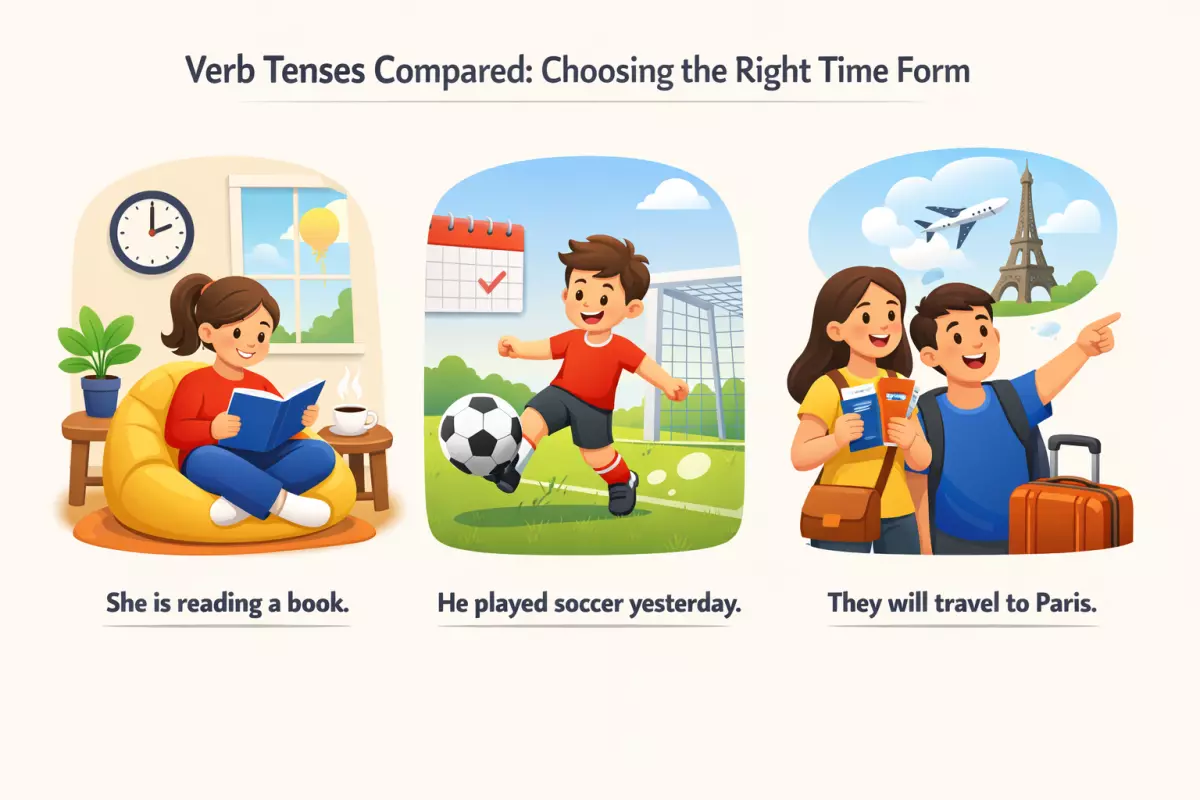 This article shows how to choose the right tense by meaning, comparing present simple vs present continuous; past simple vs present perfect and past continuous; and present perfect vs present perfect continuous. It also covers past perfect vs past simple, future forms will vs going to vs present continuous, and includes homework practice tasks.
Comparing verb tenses is about choosing the time form that matches what you mean in real life. In daily conversation, you rarely think in grammar labels; you show whether an action is finished, ongoing, repeated, or expected. This guide helps you spot those signals in context, so your sentences sound natural and people understand the timing right away.
How to choose a tense by meaning
Choose a verb tense by asking what time relationship you want to show: a finished event, a current state, an ongoing process, a repeated habit, or a result that matters now. The form is less about calendar time and more about the speaker’s viewpoint (complete vs. in progress, general vs. specific, connected to now vs. separate from now).
Start with the meaning you need
- Use a simple tense when you present an action as a whole (complete, not “zoomed in”):
“I called you yesterday.” / “She works on Fridays.” - Use a continuous/progressive tense when you focus on the activity in progress (temporary, unfolding, or background):
“I was calling when you texted.” / “She is working from home this week.” - Use a perfect tense when you connect two times (earlier action → later reference point):
“I had called before you arrived.” / “I have called three times (so far).” - Use perfect continuous when you connect two times and emphasize duration or ongoing effort:
“I have been calling all morning.” / “They had been waiting for an hour when the bus came.”
Decide what “now” is in your sentence
- Present Simple: facts, routines, schedules, stable states.
“Water boils at 100°C.” / “The train leaves at 6.” - Present Continuous: happening around now, temporary situations, changing trends.
“I am reading right now.” / “Prices are rising.” - Present Perfect: past event with present relevance, life experience, unfinished time period.
“I have lost my keys (and I still can’t find them).” / “We have met before.” - Present Perfect Continuous: activity started earlier and continues or has visible effects now.
“She has been studying; that’s why she’s tired.”
When you talk about the past, choose between “finished” and “connected”
- Past Simple: finished time, completed story events, “then” timeline.
“I moved here in 2019.” / “He opened the door and walked in.” - Past Continuous: background action, interrupted action, two actions in progress at the same time.
“I was cooking when the phone rang.” / “They were arguing while we were driving.” - Past Perfect: earlier past before another past point (the “past of the past”).
“By the time we arrived, the film had started.” - Past Perfect Continuous: earlier past with duration leading up to a past moment.
“He had been working there for years before he changed jobs.”
Use future forms to show intention, plan, prediction, or timing
- Will: predictions, spontaneous decisions, offers, promises.
“I think it will rain.” / “I will help you.” - Be going to: prior intention or evidence-based prediction.
“I’m going to call her tonight.” / “Look at those clouds—it’s going to rain.” - Present Continuous for future: arranged plans (often with time/place).
“We are meeting at 3.” - Future Continuous: action in progress at a future time; polite inquiry about plans.
“This time tomorrow, I will be flying.” / “Will you be using the car tonight?” - Future Perfect: completion before a future deadline.
“By Friday, I will have finished the report.” - Future Perfect Continuous: duration up to a future point.
“In June, they will have been living here for ten years.”
Quick meaning checks (common decision points)
- Habit vs. temporary: “I work in sales” (usual) vs. “I am working in sales this month” (temporary).
- Finished time vs. unfinished time: “I saw her yesterday” (finished) vs. “I have seen her today” (today is still open).
- Result now vs. event then: “He has broken his arm” (current result) vs. “He broke his arm last year” (past event).
- Sequence clarity in stories: “After she had left, I called” (clear order) vs. “After she left, I called” (often fine when order is obvious).
- Background vs. main event: “I was walking home when I met Sam.”
- Duration emphasis: “I have read the book” (completed) vs. “I have been reading the book” (process/duration).
- State verbs and progressive: prefer simple for states: ✅ “I know” / ❌ “I am knowing” (unless a special meaning is intended).
- Polite questions about plans: “Will you be coming to the meeting?” (less direct than “Will you come…?”).
- Deadlines: use perfect to mark “completed by”: “By 5 p.m., we will have sent the files.”
- Cause now from earlier activity: “Sorry—my hands are dirty. I have been fixing the bike.”
When two tenses both seem possible, the difference is usually focus: simple forms present events as complete units, continuous forms highlight the unfolding activity, and perfect forms show a relationship between an earlier action and a later reference point. Pick the form that matches the meaning you want the listener to notice first.
Present simple vs present continuous
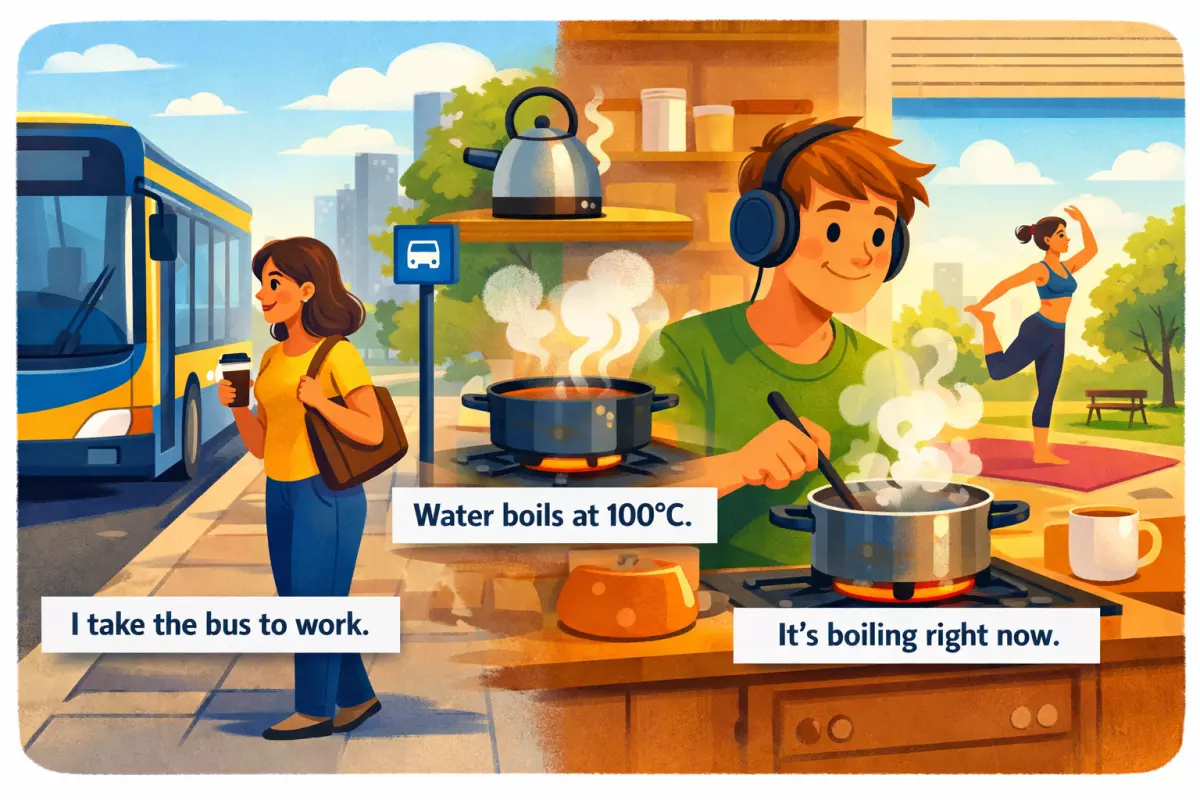
Choose between these two present forms based on whether you mean a stable fact/habit or an activity in progress around now. The simple form presents actions as regular, general, or permanent; the continuous form highlights a temporary situation, a current trend, or something happening at this moment.
| Use | Present simple | Present continuous |
|---|---|---|
| Routine / habit | I take the bus to work. | I’m taking the bus this week. |
| Facts / general truths | Water boils at 100°C. | It’s boiling (right now). |
| Now / around now | I work in marketing. (job) | I’m working on a new campaign. (current project) |
| Temporary situations | She lives in Madrid. (home base) | She’s living in Madrid this year. (temporary) |
| Trends / changes | People shop online. | More people are shopping online. |
| Annoying repeated actions (often with “always”) | He always forgets his keys. (neutral) | He’s always forgetting his keys. (complaint) |
| Scheduled future (timetables) | The train leaves at 6:10. | I’m leaving at 6:10. (personal plan/arrangement) |
Form patterns to recognize quickly
- Present simple: base verb (I/you/we/they work) and -s/-es for he/she/it (she works, he watches).
- Present continuous: am/is/are + verb-ing (I am working, they are watching).
- Negatives: don’t/doesn’t + base verb (I don’t know) vs am not/isn’t/aren’t + -ing (I’m not knowing is usually wrong).
- Questions: Do/Does + subject + base verb? (Do you play?) vs Am/Is/Are + subject + -ing? (Are you playing?).
Time expressions that often signal each tense
- Simple form often fits with: always, usually, often, sometimes, rarely, never, every day/week, on Mondays, once a month.
- Continuous form often fits with: now, right now, at the moment, today, this week, these days, currently, for the time being.
- Either can work with “today/this week” depending on meaning: “I work from home today” (schedule) vs “I’m working from home today” (temporary arrangement in progress).
Common contrasts (with quick corrections)
- States vs actions: ✅ I know the answer. ❌ I’m knowing the answer.
- Possession: ✅ She has a car. ❌ She’s having a car. (But: She’s having lunch.)
- Opinion: ✅ I think it’s useful. ✅ I’m thinking about it. (meaning changes: opinion vs mental process)
- Feeling: ✅ I feel tired. ✅ I’m feeling better today. (both possible; continuous sounds more temporary)
- Work meaning: ✅ He works at a bank. ✅ He’s working late tonight.
- Live meaning: ✅ They live near the sea. ✅ They’re living with friends until they find a place.
- Always meaning: ✅ She always arrives early. (fact) ✅ She’s always arriving late. (speaker annoyance)
- Future reference: ✅ The meeting starts at 9. (schedule) ✅ We’re starting at 9. (arrangement)
When deciding, focus on the speaker’s viewpoint: the simple form treats the situation as a regular pattern or stable fact, while the continuous form frames it as ongoing, temporary, or developing. If the verb describes a mental state, possession, or preference, the simple form is usually the default unless a special “in progress” meaning is intended.
Past simple vs present perfect
Choose the past simple when you place an action in a finished time in the past. Choose the present perfect when the time is not finished, not stated, or when the result matters now. The key difference is whether you are talking about a completed past period or a connection to the present.
| Use case | Past simple | Present perfect |
|---|---|---|
| Finished time (yesterday, last week, in 2019) | I visited Rome in 2019. | ❌ I have visited Rome in 2019. |
| Unfinished time (today, this week, so far) | ❌ I visited three clients today. (unless “today” is already over in context) | I have visited three clients today. |
| Life experience (no specific time) | ❌ I went to Japan. (sounds like a specific trip is implied) | I have been to Japan. |
| Past event with a present result | I lost my keys yesterday. (focus on when) | I have lost my keys. (focus on the result: I can’t get in) |
| Sequence of completed events in a story | She opened the door, looked inside, and left. | ❌ She has opened the door, has looked inside, and has left. (unnatural for narrative sequence) |
| Recent news/announcement (often with “just/already/yet”) | The train arrived. (neutral, factual) | The train has arrived. (news-like, relevant now) |
Time markers that strongly suggest each tense
- Past simple: yesterday; last night; last week/month/year; two days ago; in 2008; when I was a child; at 6 pm; on Monday; during the meeting; the other day.
- Present perfect: today (so far); this week/month/year; recently; lately; already; just; yet; ever; never; so far; up to now; since 2020; for three years.
Common patterns and typical mistakes
- Use the present perfect to introduce a topic, then switch to the past simple for details: “I’ve met her before. We met at a conference in Berlin.”
- Avoid pairing the present perfect with a finished-time expression: ❌ “I have finished it yesterday.” ✅ “I finished it yesterday.”
- Use “since” + starting point with the present perfect: “I’ve lived here since 2021.” (not ❌ “I lived here since 2021.”)
- Use “for” + duration with the present perfect when the situation continues: “They’ve worked here for ten years.”
- If the situation is finished, use the past simple even with “for”: “They worked here for ten years, then moved abroad.”
- With “yet” in questions/negatives, the present perfect is the usual choice: “Have you sent it yet?” / “I haven’t sent it yet.”
- With “just” for very recent actions, present perfect is common: “I’ve just emailed you.” (past simple is also possible in some varieties of English.)
- Be careful with “gone” vs “been”: “She has gone to Paris” (she’s there now) vs “She has been to Paris” (experience; she’s back).
- When the exact time matters or is asked, use the past simple: “When did you order it?” (not “When have you ordered it?”)
- For completed steps in instructions or reports tied to a finished period, prefer the past simple: “I checked the figures and updated the file.”
- For progress up to now, prefer the present perfect: “We’ve completed three milestones so far.”
- In stories and biographies, past simple is the default for a timeline: “He graduated in 1998 and started his career in finance.”
Example set: choose the tense by the meaning
- ✅ “I called you earlier.” (a finished point in time)
- ✅ “I have called you three times today.” (today is still open)
- ✅ “We didn’t see them last weekend.” (finished weekend)
- ✅ “We haven’t seen them recently.” (unspecified time window)
- ✅ “She left at noon.” (specific time)
- ✅ “She has left.” (result now: she isn’t here)
- ✅ “They won the match on Saturday.” (finished day)
- ✅ “They have won three matches this month.” (unfinished period)
- ✅ “I read that book in college.” (finished past period)
- ✅ “I have read that book.” (experience; no time given)
- ✅ “He didn’t reply yesterday.” (finished day)
- ✅ “He hasn’t replied yet.” (up to now)
- ✅ “We met in 2016.” (specific year)
- ✅ “We have known each other for years.” (relationship continuing)
Past simple vs past continuous
Use the simple past to present a completed action or event as a whole. Use the past continuous to show an action in progress at a particular time in the past, often to set the scene or show background activity.
Core meanings and typical uses
- Simple past: a finished event with a clear endpoint (known or implied). Example: “She left at 6.”
- Past continuous: an ongoing action around a past moment; the focus is on duration or progress. Example: “She was leaving when the phone rang.”
- Use the continuous for background actions and the simple for the main event that moves the story forward.
- Use the simple past for a sequence of completed actions. Example: “He opened the door, looked inside, and walked away.”
- Use the continuous to describe temporary situations in the past. Example: “They were staying with friends that week.”
- Use the simple past for habits in the past (often with “always,” “often,” “every day”). Example: “We played chess after dinner.”
- Use the continuous to show irritation with “always/constantly” in the past. Example: “He was always borrowing my charger.”
Common pattern: interruption and background
- Ongoing background + sudden event: “I was driving home when I saw the accident.”
- Ongoing action + interruption: “They were watching a film when the power went out.”
- Two actions in progress (simultaneous): “While she was cooking, he was setting the table.”
- Background description: “It was raining, and people were running for cover.”
- Completed event as a fact (no focus on progress): “It rained all night.” (the night is finished; the rain is treated as a whole)
Form and signal words
- Simple past form: verb + -ed (regular) or irregular form: “worked,” “went,” “took.”
- Past continuous form: was/were + verb-ing: “was working,” “were going.”
- Time markers that often fit the simple past: “yesterday,” “last week,” “in 2019,” “two days ago.”
- Markers that often fit the continuous: “at 8 pm,” “at that moment,” “while,” “as,” “when” (when introducing an interrupting event).
Examples to model (correct vs. common mistakes)
- ✅ “I watched TV last night.” → finished activity
❌ “I was watching TV last night.” (possible, but it suggests emphasis on the ongoing process rather than the completed fact) - ✅ “I was watching TV when you called.” → in progress + interruption
❌ “I watched TV when you called.” (sounds like the call happened after the whole TV-watching ended) - ✅ “They were talking while the teacher was explaining the task.” → two ongoing actions
- ✅ “She fell because she was running too fast.” → result (simple) + background cause (continuous)
- ✅ “We lived in Dublin for five years.” → completed period
✅ “We were living in Dublin when we met.” → situation in progress at that time - ✅ “He wrote three emails this morning.” → completed number/achievement
✅ “He was writing emails this morning.” → activity in progress (number not important) - ✅ “I noticed she was wearing a new jacket.” → noticing is a point event; wearing is ongoing
- ✅ “The kids played outside and then came in.” → sequence of finished actions
- ✅ “The kids were playing outside when it started to snow.” → background + change
- ✅ “At 10, I was still working.” → action in progress at a specific time
Quick decision guide
- Choose the simple past when the action is presented as complete, counted, or part of a finished sequence.
- Choose the past continuous when you want to highlight an action in progress, set a scene, or show what was happening when another event occurred.
- If both are possible, the difference is usually focus: completed result (simple) vs. ongoing process/background (continuous).
Present perfect vs present perfect continuous
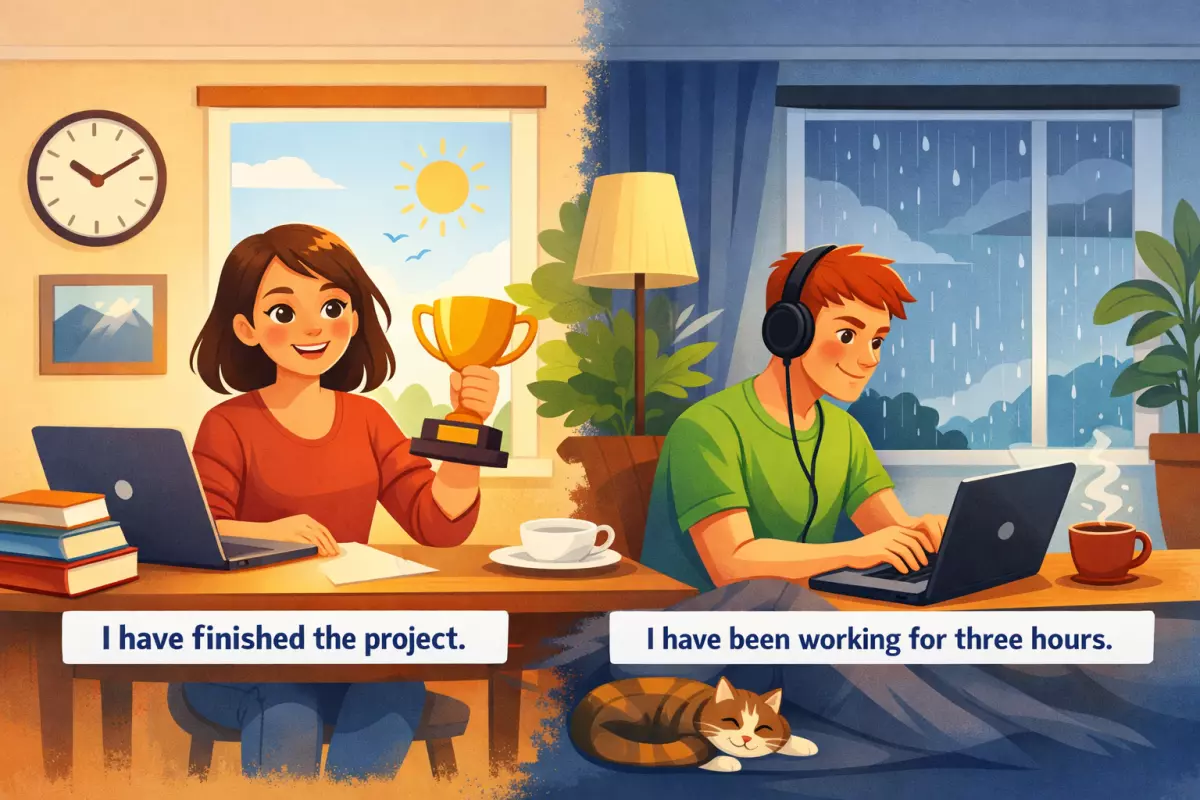
Choose between these two forms based on what you want to highlight: the result/achievement or the ongoing activity. Both connect past time to “now,” but they package the meaning differently.
| Focus | Present perfect (have/has + past participle) | Present perfect continuous (have/has been + -ing) |
|---|---|---|
| Core idea | Completed or counted events up to now; present relevance | Activity in progress recently or up to now; duration and continuity |
| What it answers | “What has happened?” “How many?” “Have you ever…?” | “What have you been doing?” “How long?” “Why (is it like this)?” |
| Typical signals | already, yet, just, ever, never, recently, so far, this week | for, since, all day, lately, recently, the whole morning |
| Common outcomes | Emphasizes a finished step or a measurable result | Emphasizes the process; often explains a visible present situation |
| Examples (same situation, different emphasis) | I have written three emails. (quantity/result) | I have been writing emails. (activity/duration) |
Practical choice rules
- Use have/has + past participle when the endpoint or result matters: a task finished, a change achieved, a number reached.
- Use have/has been + -ing when the activity itself matters: it has been continuing, repeating, or leading to a present effect.
- If you ask “How many / how much?”, the simple form is usually the better fit; if you ask “How long?”, the continuous form is usually the better fit.
- For short, just-finished actions with a present result, both can work, but the nuance changes: “I’ve cleaned the kitchen” (job done) vs “I’ve been cleaning the kitchen” (process; maybe tired or it took a while).
- With “since” and “for,” the continuous form is common for activities, while the simple form is common for states: “I’ve been studying for two hours” vs “I’ve known her for two years.”
Examples you can model
- I have finished the report. → The report is complete now.
- I have been working on the report. → The work has been in progress; it may or may not be finished.
- She has read that book twice. → Countable completed readings.
- She has been reading that book. → Ongoing activity; not necessarily finished.
- We have visited Paris. → Experience at some time up to now.
- We have been visiting clients in Paris. → A recent ongoing trip/work activity.
- He has lost his keys. → Present result: the keys are missing.
- He has been losing things lately. → Repeated pattern over a period.
- They have built a new website. → Completed project with a clear outcome.
- They have been building a new website. → Ongoing project; progress is the point.
- I have taught this course for years. → Emphasis on the fact/role over time.
- I have been teaching this course for years. → Emphasis on the repeated activity and continuity.
- How many pages have you written today? → Result/quantity.
- How long have you been writing today? → Duration/process.
Common pitfalls to avoid
- Mixing up result vs activity: ✅ “I’ve painted the room” (finished) vs ✅ “I’ve been painting the room” (in progress or recently active).
- Using the continuous form with many stative verbs (often unnatural): ❌ “I’ve been knowing him for years.” → ✅ “I’ve known him for years.”
- Forgetting that both tenses usually connect to the present; if you name a finished past time (“yesterday,” “in 2019”), you typically need past simple instead.
Past perfect vs past simple
Use these two past forms to show how events relate in time. One form typically tells the main sequence of actions in the past, while the other highlights that one action happened earlier than another past reference point.
Core difference in meaning
| Past simple | Past perfect |
|---|---|
| Shows a completed action at a finished time in the past; often advances the story. | Shows an action completed before another past moment; sets background or explains a result. |
| Typical time markers: yesterday, last week, in 2019, two days ago, then. | Typical markers: already, just, never, before, by the time, after (for clarity), earlier. |
| Common pattern: action 1 happened, then action 2 happened. | Common pattern: earlier action had happened before later past action. |
| Example: I arrived at 8. The meeting started at 8:05. | Example: I arrived at 8, but the meeting had started at 8:05. |
When the past perfect is necessary (and when it is optional)
- To prevent confusion about order: Use had + past participle when two past actions could be misread. Example: ✅ When I got there, she had left. (She left first.)
- With “by the time” and “before” for a clear earlier action: By the time we arrived, they had finished dinner.
- To explain a past result: He was tired because he had worked late.
- To show a change of plan or expectation: I had hoped to call, but I fell asleep.
- In reported speech (shifting back in time): She said she had seen the message.
- Optional when the sequence is obvious: After I finished, I went home. (Past simple is often enough because “after” already orders events.)
- Often unnecessary in simple narratives: I woke up, ate breakfast, and left. (A straightforward timeline usually stays in past simple.)
Common patterns and example pairs
- When + past simple + past perfect: When I arrived, they had already started.
- Past simple + because + past perfect: She apologized because she had forgotten.
- By the time + past simple + past perfect: By the time the train came, we had waited an hour.
- Past perfect + before + past simple: He had locked the door before he left.
- Past simple + but + past perfect (contrast with expectation): I called, but he had turned off his phone.
- Past perfect negative for “not yet” earlier: We hadn’t met before that night.
- Question form to ask about earlier events: Had you ever visited the city before you moved there?
- With “just/already/never”: I had just sat down when the phone rang.
- Two past events, same time (avoid past perfect): I saw her as I crossed the street. (Actions overlap; past simple fits.)
- Earlier vs later clarified: ✅ I realized I had left my keys at home. ❌ I realized I left my keys at home. (Possible, but less clear about “earlier.”)
- First time in a story vs later mentions: The shop had closed, so we went elsewhere. (Later you may continue in past simple once the order is established.)
- Past perfect for background, past simple for main action: She had studied for weeks, and she passed the exam.
Quick accuracy checks
- If you can add “earlier” naturally, the earlier action often needs had + past participle: She had already left (earlier), so I went home.
- If the sentence is a simple timeline of events, past simple usually works best: We arrived, checked in, and unpacked.
- If the listener might ask “Which happened first?”, consider the past perfect to make the order explicit.
Future forms: will vs going to vs present continuous
English uses several forms to talk about what comes next, and the best choice depends on the speaker’s purpose: prediction, decision timing, evidence, intention, or a fixed arrangement. The three most common options overlap, but each has typical patterns that make your meaning clearer.
| Form | Core use | Common signals | Examples |
|---|---|---|---|
| will + base verb | Instant decisions, promises, offers, predictions (often opinion-based) | “I think…”, “probably”, “maybe”, sudden choice, willingness | I’ll call you tonight. / I think it’ll rain later. |
| be going to + base verb | Plans/intentions already formed; predictions based on present evidence | prior intention, visible signs now, “look at…”, “there are signs…” | We’re going to move in July. / Look at those clouds—it’s going to rain. |
| present continuous (am/is/are + -ing) | Arrangements fixed with people/places/times (often scheduled) | specific time/date, tickets/bookings, meetings, “tomorrow/at 3” | I’m meeting Sam at 3. / They’re flying to Rome on Friday. |
| Negative & question patterns (all three) | How to form questions/negatives without changing the time meaning | auxiliary-first questions; not after auxiliary | Will you help? / I won’t forget. → Are you going to drive? / She isn’t going to drive. → Are you leaving tomorrow? / We aren’t leaving yet. |
How to choose in real situations
Use will when the decision is made at the moment of speaking or when you are expressing willingness. It also fits predictions that come from your judgment rather than clear evidence in front of you.
- Instant decision: “The phone’s ringing—I’ll get it.”
- Offer/help: “I’ll carry that for you.”
- Promise: “I’ll email the report tonight.”
- Refusal: “The car won’t start.” (it refuses to start)
- Opinion prediction: “I think prices will rise.”
- Neutral future fact (often in formal style): “The conference will begin at 9.”
Use be going to when you have a prior plan or intention, or when the prediction is based on what you can see or know right now. It often sounds more “already decided” than will.
- Intention already formed: “I’m going to apply for that job.”
- Plan with preparation: “We’re going to paint the kitchen this weekend.”
- Evidence-based prediction: “It’s going to snow—look at the forecast.”
- Warning based on the present: “Be careful! You’re going to drop it.”
- Not just a wish: “I’m going to save more this year.” (implies a decision)
Use the present continuous when the future event is arranged, especially with a specific time, place, or other people involved. It commonly appears with travel, meetings, appointments, and social plans.
- Appointment: “I’m seeing the dentist on Tuesday.”
- Meeting: “We’re meeting the client at 11.”
- Travel booking: “She’s taking the 6 a.m. train tomorrow.”
- Social arrangement: “They’re coming over for dinner tonight.”
- Work schedule: “I’m working late this Friday.”
- With time expressions: “I’m leaving in ten minutes.”
Common contrasts and typical mistakes
- Evidence vs opinion: “It’s going to rain” (dark clouds now) vs “It will rain” (your guess).
- Arrangement vs intention: “I’m meeting Alex tomorrow” (fixed plan with Alex) vs “I’m going to meet Alex tomorrow” (intention; arrangement may be less fixed).
- Instant decision vs prior plan: “I’ll cook tonight” (decided now) vs “I’m going to cook tonight” (already planned).
- Don’t use present continuous for pure predictions: ❌ “It’s raining tomorrow.” ✅ “It’s going to rain tomorrow.”
- Don’t use will for a plan you clearly prepared: “We’re going to launch in May” usually fits better than “We’ll launch in May” when the plan is set.
- Question word order: ❌ “You will come?” ✅ “Will you come?”
- Negatives: “won’t” is the normal negative of will; “will not” is more formal or emphatic.
Quick pattern reminders
- will: will + base verb (I will go / I’ll go; I won’t go; Will you go?)
- going to: am/is/are + going to + base verb (She is going to leave; She isn’t going to leave; Is she going to leave?)
- present continuous: am/is/are + verb-ing with a future time reference (They are leaving tomorrow; They aren’t leaving tomorrow; Are they leaving tomorrow?)
Homework: tense choice practice tasks
Choose the tense by matching the meaning first (time, completion, duration, habit, or “future as plan”), then confirm it fits common patterns such as time markers (already, since, by the time, when, while) and clause type (main clause vs. time clause). Complete the tasks below in order; later items recycle earlier contrasts so you can notice repeated cues.
1) Fill in the blank: choose the best tense
- By the time we arrived, the film ________ (start) already.
- I can’t talk now; I ________ (drive).
- She usually ________ (take) the bus, but today she ________ (walk).
- They ________ (live) here since 2019.
- When I was a child, we ________ (visit) my grandparents every Sunday.
- Look at those clouds— it ________ (rain) soon.
- At 8 p.m. tomorrow, I ________ (study) for the exam.
- I ________ (finish) the report, so I can send it now.
- He ________ (work) on this project for months before he finally ________ (publish) it.
- While she ________ (cook), the phone ________ (ring).
- We ________ (not/see) that film yet. Is it good?
- After you ________ (submit) the form, you ________ (receive) a confirmation email.
Show answers
- had started
- am driving
- takes; is walking
- have lived
- visited
- is going to rain
- will be studying
- have finished
- had been working; published
- was cooking; rang
- haven’t seen
- submit; will receive
2) Choose the better option (A or B)
- I (A) lived / (B) have lived in this town all my life.
- Sorry I’m late— I (A) missed / (B) have missed the bus.
- When you (A) will finish / (B) finish, call me.
- At the moment, the company (A) expands / (B) is expanding into Asia.
- He (A) worked / (B) was working when the lights went out.
- By next Friday, we (A) will complete / (B) will have completed the first phase.
- I (A) didn’t know / (B) haven’t known about the meeting yesterday.
- She (A) has been reading / (B) has read for two hours, so she needs a break.
- They (A) are leaving / (B) will leave at 6 a.m. (the tickets are booked).
- He (A) has gone / (B) has been to Paris twice.
Show answers
- B
- B
- B
- B
- B
- B
- A
- A
- A
- B
3) Error correction: fix the tense (one change each)
Rewrite each sentence with a more natural tense choice. Keep the meaning.
- I am knowing her for years.
- We have seen him yesterday at the station.
- By the time the manager arrived, the team finished the presentation.
- While I watched TV, I was falling asleep.
- I will call you when I will get home.
- She’s tired because she worked all day.
- They are living here since March.
- He has gone to Italy last summer.
Show answers
- I have known her for years.
- We saw him yesterday at the station.
- By the time the manager arrived, the team had finished the presentation.
- While I was watching TV, I fell asleep.
- I will call you when I get home.
- She’s tired because she has been working all day.
- They have been living here since March.
- He went to Italy last summer.
4) Production task: write your own sentences (check the cue)
Write one sentence for each cue. Focus on the signal words and the relationship between actions.
- A finished action with a present result (use already / just).
- An unfinished situation from the past until now (use since / for).
- A temporary action happening around now (use these days / at the moment).
- A background past action interrupted by a short event (use while + when).
- A completed action before another past time (use by the time).
- A future plan with a fixed arrangement (use tomorrow / next week).
- A future action in progress at a specific time (use this time tomorrow).
- A future deadline (use by + date/time).
Show answers
- I’ve just finished my homework, so I can relax now.
- We have lived in this apartment for five years.
- She’s working from home these days.
- While I was walking to work, I saw an old friend.
- By the time we got to the platform, the train had left.
- I’m meeting my tutor next week.
- This time tomorrow, I’ll be flying to Madrid.
- By Friday, we’ll have completed the draft.