Infinitive vs Gerund: How to Choose the Correct Form

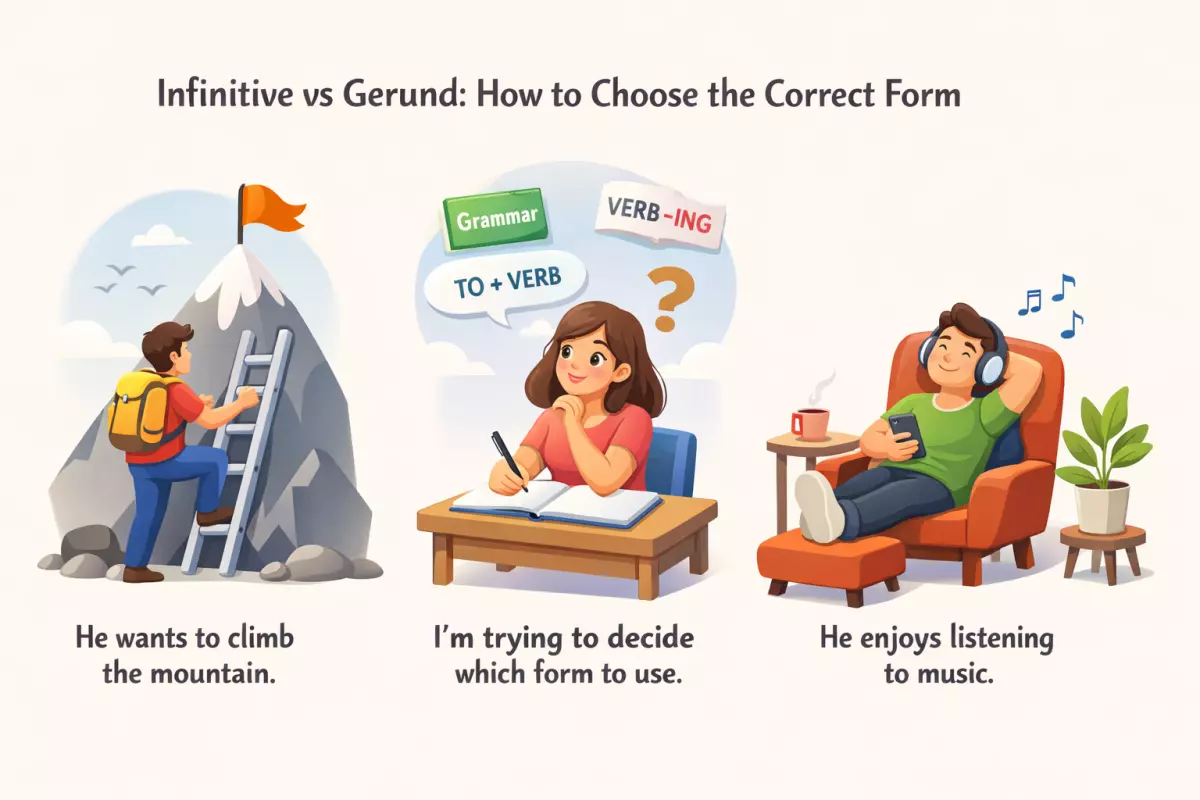 Learn the core difference between infinitives and gerunds, plus which verbs take each form. It also covers verbs that allow both with a meaning change, gerunds after prepositions, and infinitives for purpose and intention. Finish with common mistakes, quick rules, and homework practice tasks.
Choosing between the to form and the -ing form may seem minor, but it can change how your sentence sounds and sometimes what it means. In everyday speech, native speakers follow common patterns: some verbs usually take one form, others accept both with a meaning shift, and context often decides. Learn clear cues and examples to choose confidently in your own sentences.
Core difference between infinitives and gerunds
These two verb forms both let you talk about an action as a thing, but they package that action differently. An infinitive uses to + base verb (to read, to leave). A gerund uses the -ing form as a noun (reading, leaving). The choice is rarely about “time”; it is mainly about the grammar pattern your sentence needs and the verb/adjective/noun that comes before it.
How each form behaves in a sentence
- Infinitive (to + verb) often points to purpose, intention, or a potential/next action: “I went to the library to study.”
- Gerund (-ing) often treats the action as an activity or general concept: “Studying helps memory.”
- Both can function as subjects, but gerunds are more common as subjects in everyday English: “Traveling is expensive.” (More natural than “To travel is expensive.” in most contexts.)
- After a preposition, English uses a gerund, not an infinitive: “She’s interested in learning Korean.” ❌ “interested in to learn”
- After certain verbs, only one form is standard, so the “rule” is the verb pattern, not a meaning choice.
Common patterns that strongly predict the correct form
- Use a gerund after prepositions: about, after, before, by, for, from, in, of, on, without + -ing (e.g., “by working late”).
- Use an infinitive after many adjectives (especially feelings/judgments): happy, ready, likely, difficult, easy + to + verb (e.g., “ready to start”).
- Use an infinitive to express purpose: “She called to confirm the time.”
- Use a gerund after “go” for activities: go swimming, go shopping, go hiking, go sightseeing, go jogging.
- Use a gerund after certain “activity” verbs: enjoy, avoid, consider, suggest, recommend, finish, keep, miss, practice (e.g., “avoid driving in storms”).
- Use an infinitive after certain “decision/plan” verbs: decide, plan, hope, agree, refuse, promise, offer, manage (e.g., “decide to leave”).
- Object + infinitive is common after verbs like want, ask, tell, expect, allow, persuade: “They asked me to wait.”
- Possessive + gerund can be used in formal writing to highlight the “doer” of the action: “I appreciated his helping.” (Also common: “I appreciated him helping.”)
Meaning changes: when both are possible but not equal
- remember + -ing = recall a past action: “I remember locking the door.”
- remember + to + verb = don’t forget a future action: “Remember to lock the door.”
- stop + -ing = quit an activity: “He stopped smoking.”
- stop + to + verb = pause one action in order to do another: “He stopped to smoke.”
- try + -ing = experiment with a method: “Try restarting the app.”
- try + to + verb = attempt, possibly with difficulty: “I tried to restart the app, but it failed.”
- regret + -ing = feel sorry about a past action: “She regrets leaving early.”
- regret + to + verb = formal way to introduce bad news: “We regret to inform you…”
Quick accuracy checks
- If the word before the verb form is a preposition, choose -ing: “good at explaining.”
- If the sentence expresses purpose, choose to + verb: “I’m here to help.”
- If a verb is followed by an object + action, an infinitive is often the default: “They encouraged her to apply.”
- If you are naming an activity as a general idea, a gerund usually sounds natural: “Reading before bed helps.”
Verbs followed by infinitives
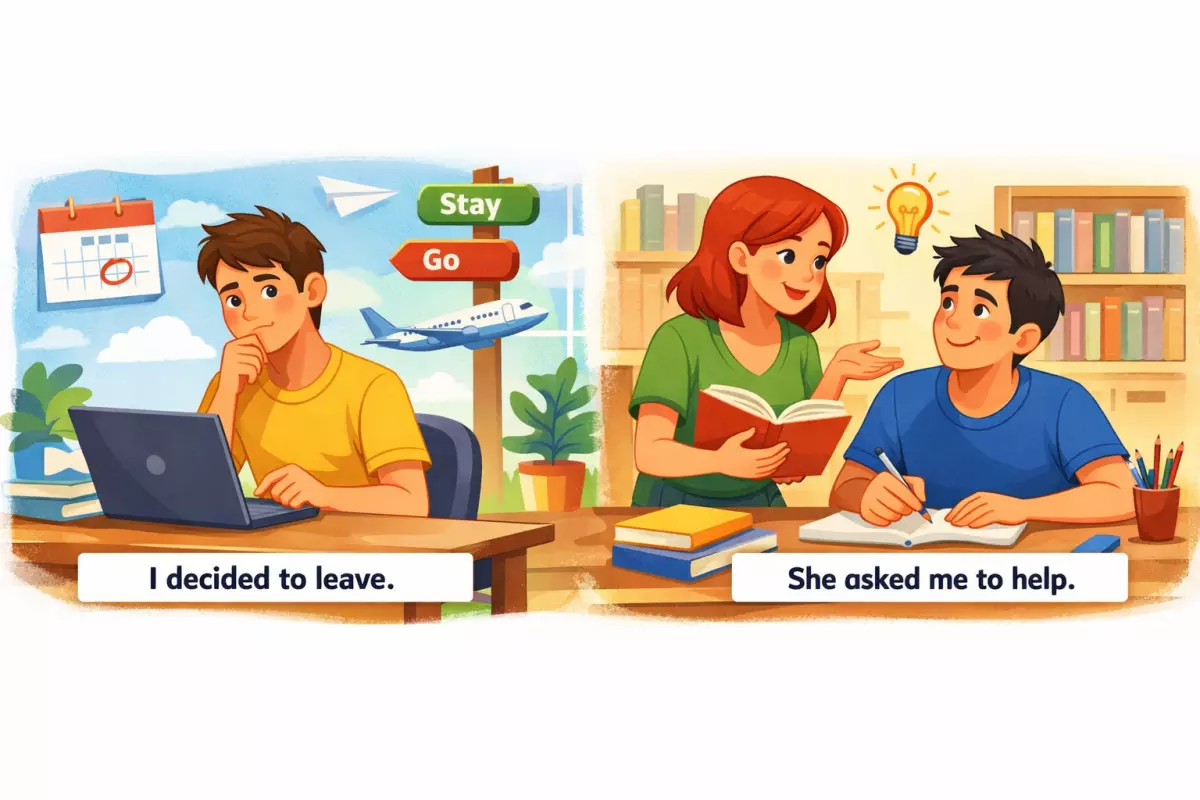
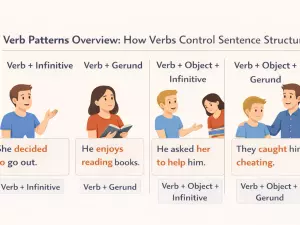
Many common verbs are typically followed by the to-infinitive (to + base verb). This pattern is especially frequent when the second verb expresses an intention, plan, decision, request, or attempt rather than an activity in progress.
Core pattern
Use this structure when one verb “points forward” to another action:
- Subject + verb + to + base verb: I decided to leave.
- Subject + verb + object + to + base verb: She asked me to help.
Common verbs that take the to-infinitive
The verbs below are frequently followed by a to-infinitive. The examples show the most typical form in everyday English.
- agree: They agreed to meet after work.
- aim: We aim to finish by Friday.
- arrange: He arranged to pick her up.
- attempt: She attempted to explain the problem.
- choose: I chose to stay home.
- decide: He decided to apply for the job.
- expect: They expect to hear back soon.
- fail: She failed to notice the sign.
- forget: Don’t forget to lock the door.
- hope: I hope to visit next year.
- learn: He learned to swim at six.
- manage: We managed to solve it.
- need: I need to call my bank.
- offer: She offered to drive.
- plan: They plan to move in June.
- promise: I promise to be on time.
- refuse: He refused to answer.
- seem: It seems to work fine.
- tend: I tend to overthink things.
- want: We want to improve our results.
Verbs that often take an object + to-infinitive
Some verbs commonly appear with a person (or thing) between the two verbs. This is useful when the subject of the infinitive is not the same as the subject of the first verb.
- ask + object + to: She asked him to wait.
- advise + object + to: The doctor advised me to rest.
- allow + object + to: They allowed us to enter.
- encourage + object + to: I encouraged her to apply.
- expect + object + to: We expect you to follow the rules.
- help + object + (to): Can you help me (to) carry this?
- invite + object + to: They invited us to join them.
- order + object + to: The officer ordered them to stop.
- persuade + object + to: He persuaded her to reconsider.
- remind + object + to: Please remind me to send it.
- teach + object + to: She taught him to read.
- tell + object + to: I told them to be careful.
- warn + object + to: They warned us to stay away.
Quick accuracy checks
- After these verbs, prefer to + base verb, not a gerund: ✅ I decided to go. ❌ I decided going.
- Watch for meaning differences with certain verbs: ✅ Remember to call (don’t forget). ✅ Remember calling (recall a past action).
- If you include an object, place it before the infinitive: ✅ She asked him to leave. ❌ She asked to leave him (different meaning).
Verbs followed by gerunds
Some verbs are typically followed by the -ing form (a gerund) when the next word is an action. In these patterns, the gerund functions like a noun, even though it still expresses an activity.
Common verbs that take an -ing form
Use a gerund after these verbs when you mean “the activity” (not “to do the activity”):
- avoid: She avoids driving at night.
- consider: We considered moving closer to work.
- enjoy: He enjoys cooking for friends.
- finish: I finished writing the report.
- keep: They keep asking the same question.
- mind: Do you mind waiting a moment?
- miss: She misses living near the ocean.
- postpone: Let’s postpone meeting until Friday.
- practice: You should practice speaking every day.
- quit: He quit smoking last year.
- recommend: I recommend taking notes.
- resist: It’s hard to resist checking your phone.
- risk: They risk losing customers.
- suggest: She suggested leaving early.
- tolerate: I can’t tolerate being interrupted.
Patterns to notice (and common mistakes)
- Verb + gerund is the default structure here: ✅ I enjoy reading. ❌ I enjoy to read.
- Mind often appears in questions and negatives: Do you mind opening the window? / I don’t mind helping.
- Suggest and recommend commonly take a gerund when the subject is general: She suggested taking a taxi.
- When you add an object after suggest/recommend, the structure usually changes to a clause: ✅ She suggested that we take a taxi. (Not: suggested us taking, in most standard usage.)
- Stop can be tricky: ✅ He stopped smoking (he quit the habit). This differs from “stopped to smoke” (he paused another activity in order to smoke).
When you learn these verbs as “gerund verbs,” you reduce errors quickly: if the first verb expresses liking, avoiding, finishing, or delaying, the next action is usually best in the -ing form.
Verbs that take both with meaning change
Some verbs can be followed by either a gerund (-ing) or an infinitive (to + base verb), but the choice changes the meaning. The key pattern is that one form often points to an action as a real experience (or something already done), while the other points to an intention, plan, or the action as an idea.
| Verb | Verb + gerund (meaning + example) | Verb + infinitive (meaning + example) |
|---|---|---|
| remember | Recall a past action: I remember locking the door. | Don’t forget to do something: Remember to lock the door. |
| forget | Fail to remember a past action: I’ll never forget meeting her. | Fail to do something: I forgot to send the email. |
| stop | Quit an activity: He stopped smoking. | Pause one action in order to do another: He stopped to smoke. |
| try | Experiment to see what happens: Try restarting your phone. | Make an effort (often difficult): I tried to restart it, but it wouldn’t turn on. |
| regret | Feel sorry about a past action: I regret telling him. | Formal: regret to inform/say/announce (bad news now): We regret to inform you that your order was canceled. |
| go on | Continue the same action: She went on talking for hours. | Move to the next action: She went on to explain the next step. |
| mean | Involve/require: This job means working weekends. | Intend: I meant to call you. |
| need | Passive meaning (common in informal BrE): The car needs washing. | Active meaning: You need to wash the car. |
Usage notes and common pitfalls
- remember/forget: Use the gerund for memories of real events; use the infinitive for duties and tasks. ✅ Remember to bring your ID. ❌ Remember bringing your ID. (unless you mean you recall that you brought it)
- stop: “Stop + -ing” ends an activity; “stop + to…” interrupts one activity to do another. Context usually makes the intended meaning clear.
- try: “Try + -ing” suggests a method to test; “try + to…” emphasizes effort and possible failure.
- regret: “Regret + -ing” looks back; “regret + to…” is often used in announcements and customer service language.
- go on: Use “go on + -ing” for continuing; use “go on + to…” for the next stage in a sequence (often in explanations, lectures, or stories).
- mean: “Mean + -ing” describes consequences; “mean + to…” describes intention. If you can replace it with “intend,” choose the infinitive.
- need: “Need + -ing” usually has a passive sense (something requires attention). If you name the person who should do it, the infinitive is often more natural: I need to fix this.
When you are unsure, check whether you are talking about (1) a completed or experienced action → gerund, or (2) a future task, purpose, or intention → infinitive. These meaning shifts are predictable once you connect the form to time and viewpoint.
Gerunds after prepositions
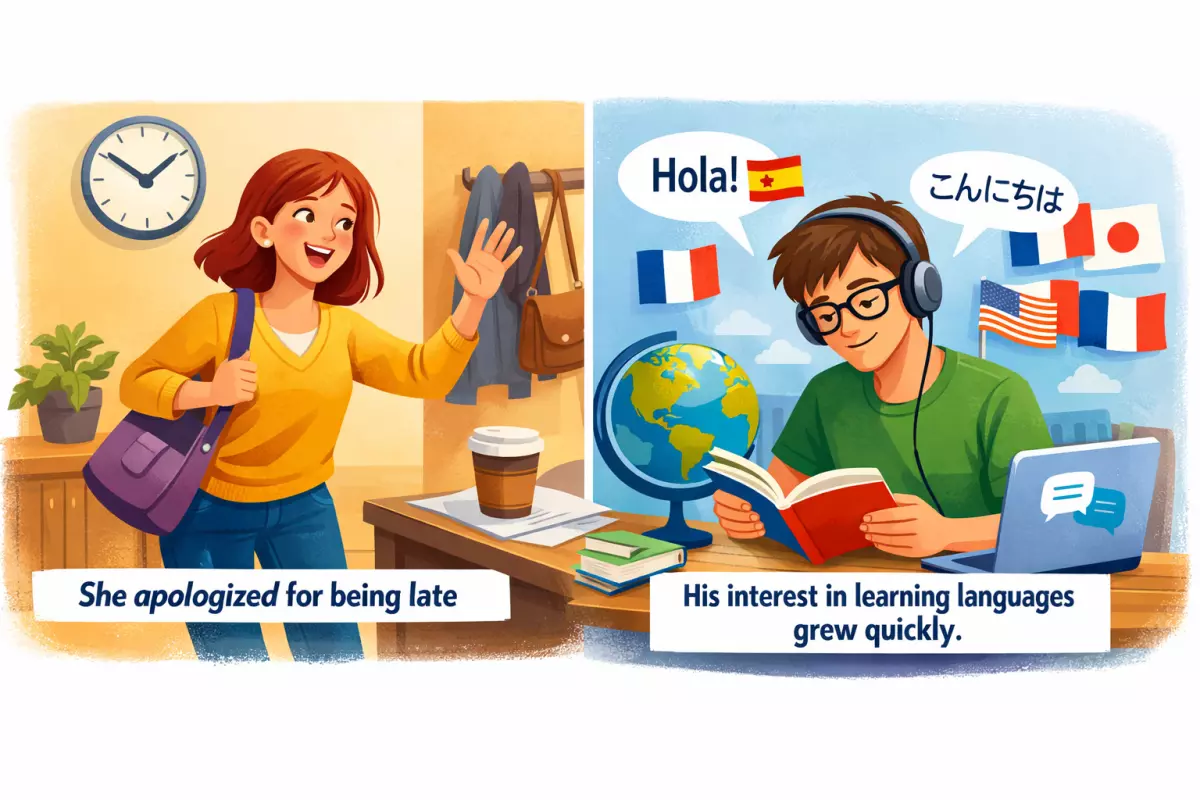
When a verb comes right after a preposition, English normally uses the -ing form (a gerund), not an infinitive. This includes common prepositions like in, on, at, for, of, about, with, without, before, after, and by. The preposition can follow a verb, an adjective, or a noun; the pattern stays the same: preposition + verb-ing.
Core pattern
- Preposition + gerund: She apologized for being late.
- Noun + preposition + gerund: His interest in learning languages grew quickly.
- Adjective + preposition + gerund: They’re afraid of losing the contract.
- Verb + preposition + gerund: We’re thinking about moving.
Common prepositions and example sentences
- about: We talked about changing the schedule.
- after: After finishing the report, she left.
- before: Wash your hands before eating.
- by: He solved it by checking the assumptions.
- for: Thank you for helping me.
- from: She stopped him from making a mistake.
- in: He’s interested in working abroad.
- instead of: Instead of complaining, suggest a fix.
- on: They insisted on paying in cash.
- of: I’m tired of waiting.
- to (as a preposition): She’s committed to improving her writing.
- with: He left without saying goodbye.
- without: You can’t do this without breaking something.
- at: She’s good at explaining complex ideas.
- over: They argued over choosing a venue.
“To” as a preposition vs. “to” as an infinitive marker
One common source of errors is the word to. Sometimes it introduces an infinitive (to + base verb), but sometimes it functions as a preposition, and then it must be followed by verb-ing.
- ✅ I want to leave early. → (to = infinitive marker)
- ✅ I’m looking forward to meeting you. → (to = preposition)
- ❌ I’m looking forward to meet you.
- ✅ She admitted to lying.
- ❌ She admitted to lie.
Useful set phrases that follow this pattern
- look forward to + -ing: I look forward to hearing from you.
- be used to + -ing: He’s used to getting up early.
- get used to + -ing: You’ll get used to driving on the left.
- be committed to + -ing: They’re committed to reducing waste.
- object to + -ing: I object to being blamed.
- be opposed to + -ing: She’s opposed to raising fees.
- be accustomed to + -ing: We’re accustomed to working remotely.
As a quick check, identify the preposition first. If the word before the verb is a preposition (including multi-word ones like instead of), the next verb is typically in the -ing form.
Infinitives for purpose and intention
Use the to + base verb form to show why someone does something or what they plan to do. This structure often answers “Why?” and it’s especially common after action verbs (go, come, stop, save, call) and after adjectives that describe readiness or willingness.
Core pattern: to-infinitive = goal or planned result
The most common purpose pattern is:
- Verb + to + verb: “I called to confirm the time.”
- Verb + object + to + verb: “She reminded me to bring my ID.”
- Adjective + to + verb: “They’re ready to leave.”
Purpose vs. activity: infinitive vs. gerund
Choose the infinitive when the second verb expresses a goal; choose a gerund when the second verb names an activity itself. Compare the meaning:
- ✅ “I went to the store to buy milk.” (goal)
- ✅ “I like buying milk there.” (general activity/preference)
- ✅ “He stopped to smoke.” (he paused in order to smoke)
- ✅ “He stopped smoking.” (he quit the habit)
Common purpose expressions that take an infinitive
These patterns are frequent in everyday writing and speaking. They keep the focus on intention rather than the action as a noun.
- to: “She stayed late to finish the report.”
- in order to: “He left early in order to catch the train.”
- so as to (more formal): “We spoke quietly so as to avoid waking the baby.”
- to + verb after movement: “Come here to look at this.”
- to + verb after “take” (time/effort): “It took hours to solve the issue.”
- to + verb after “need” (purpose/next step): “I need to update my password.”
- to + verb after “decide/plan/hope/aim”: “They plan to expand next year.”
- to + verb after “learn”: “She’s learning to drive.”
- to + verb after “try” (attempt): “Try to restart the app.”
- to + verb after “agree/refuse/offer”: “He refused to sign.”
- to + verb after “promise”: “I promised to call.”
- to + verb after “remember/forget” (future action): “Remember to lock the door.”
Negative purpose: what someone intends not to do
Place not before the infinitive to show a negative aim.
- ✅ “I turned off notifications not to get distracted.”
- ✅ “She whispered so as not to interrupt.”
- ❌ “I turned off notifications to not get distracted.” (possible, but less natural in many contexts)
Quick accuracy notes
- Use the base verb after to: ✅ “to go,” “to learn,” not “to going.”
- Don’t use for + -ing to express purpose in standard English: ❌ “I went there for buying milk.” → ✅ “I went there to buy milk.”
- Use for + noun when the purpose is a thing, not an action: “I went there for milk.”
Common mistakes and quick rules
Choose the form based on the verb pattern, not on “what sounds right.” Many errors come from mixing structures (verb + object + form), copying patterns from a different verb, or forgetting that some verbs change meaning depending on whether they take an infinitive or an -ing form.
Frequent mistakes to avoid
- Using to + -ing: ❌ to going → ✅ to go (infinitive) or ✅ going (gerund), depending on the verb.
- Using a bare infinitive after a verb that needs to: ❌ He decided go → ✅ He decided to go.
- Using to + infinitive after a preposition: ❌ interested to learn → ✅ interested in learning.
- Forgetting that many “verb + preposition” combinations require an -ing form: ❌ insist to pay → ✅ insist on paying.
- Mixing patterns with an object: ❌ She suggested me to take → ✅ She suggested that I take or ✅ She suggested taking.
- Using the wrong form after make/let/help: ❌ They made me to wait → ✅ They made me wait.
- Overusing the infinitive after common -ing verbs: ❌ He enjoys to cook → ✅ He enjoys cooking.
- Using -ing after verbs that typically take an infinitive: ❌ She agreed going → ✅ She agreed to go.
- Confusing verbs that change meaning: ❌ I stopped to smoke when you mean quitting → ✅ I stopped smoking.
- Using an infinitive after spend time/money: ❌ I spent two hours to fix it → ✅ I spent two hours fixing it.
- Using -ing after too/enough: ❌ too tired going → ✅ too tired to go.
- Using the wrong form after adjectives: many adjectives take an infinitive for purpose/reaction: ❌ happy seeing you (often possible, but different meaning) → ✅ happy to see you (reaction to the meeting).
Quick rules that solve most cases
- After a preposition, use -ing. Examples: good at cooking, before leaving, without asking, in addition to working.
- After “to” as a preposition, use -ing. Examples: look forward to meeting, be used to getting up early, object to paying.
- After “to” as part of the infinitive, use the base verb. Examples: want to leave, plan to study, need to call.
- Use the infinitive to express purpose. Examples: I went to the store to buy milk; She called to confirm the time.
- Some verbs strongly prefer -ing. Common ones: enjoy, avoid, finish, consider, mind, suggest, recommend, admit, miss, practice.
- Some verbs strongly prefer the infinitive. Common ones: decide, hope, plan, agree, refuse, promise, offer, manage, learn, fail.
- If you add an object, the pattern may change. Compare: I stopped smoking vs. I stopped to smoke; I remembered locking the door vs. Remember to lock the door.
- After reporting verbs like “tell/ask/advise/encourage,” use object + infinitive. Examples: She advised me to wait; They encouraged him to apply.
- After “suggest/recommend,” don’t use object + infinitive. Use -ing or a clause: They recommended taking a taxi / They recommended that we take a taxi.
- Use the bare infinitive after “make/let” and often after “help.” Examples: Let me explain; They made us leave; Help me (to) carry this.
High-value verb pairs that often cause errors
- stop: ✅ stop smoking (quit the activity) vs. ✅ stop to smoke (pause another activity in order to smoke).
- remember: ✅ remember locking (memory of a past action) vs. ✅ remember to lock (don’t forget a future action).
- forget: ✅ forget meeting (no memory of it) vs. ✅ forget to meet (fail to do it).
- try: ✅ try to call (attempt) vs. ✅ try calling (experiment with a method).
- regret: ✅ regret saying (feel sorry about a past action) vs. ✅ regret to say (formal: announce bad news).
- mean: ✅ mean to offend (intend) vs. ✅ mean offending (involve/require).
- need: ✅ need to clean (someone should clean it) vs. ✅ needs cleaning (passive meaning: it should be cleaned).
Homework: infinitive vs gerund practice tasks
Use these tasks to practise choosing between to + base verb and the -ing form. Focus on the verb pattern first (what the main verb “expects”), then check meaning (purpose, result, general activity, or a specific event).
Task 1: Choose the correct form
- I decided (to leave / leaving) early because of the weather.
- They suggested (to take / taking) the train instead of driving.
- She hopes (to get / getting) a reply by Friday.
- We finished (to paint / painting) the kitchen last night.
- He offered (to help / helping) with the presentation.
- Do you mind (to open / opening) the window?
- I can’t afford (to buy / buying) a new laptop right now.
- She avoids (to eat / eating) late in the evening.
- They agreed (to meet / meeting) at 8:00.
- He admitted (to break / breaking) the rule.
- We plan (to visit / visiting) our grandparents this weekend.
- He keeps (to forget / forgetting) his password.
Show answers
- to leave
- taking
- to get
- painting
- to help
- opening
- to buy
- eating
- to meet
- breaking
- to visit
- forgetting
Task 2: Verb + object pattern (add the object, then choose the form)
Rewrite each sentence by adding an object (me/him/her/us/them) after the main verb, then choose the correct form. Example: “She reminded ___ (to call/calling)” → “She reminded me to call.”
- My teacher encouraged ___ (to apply / applying) for the course.
- They warned ___ (to touch / touching) the wires.
- I persuaded ___ (to come / coming) with us.
- She invited ___ (to join / joining) the meeting.
- He reminded ___ (to lock / locking) the door.
- We asked ___ (to be / being) quiet.
- The guide advised ___ (to bring / bringing) water.
- They allowed ___ (to park / parking) here.
Show answers
- My teacher encouraged me to apply for the course.
- They warned us not to touch the wires.
- I persuaded him/her to come with us.
- She invited them to join the meeting.
- He reminded me to lock the door.
- We asked them to be quiet.
- The guide advised us to bring water.
- They allowed us to park here.
Task 3: Meaning change (gerund vs infinitive)
Choose the form that matches the meaning in brackets. Pay attention to verbs like remember, stop, try, and regret, where the choice changes the message.
- I remembered (to send / sending) the email. (I did it, and now I recall it.)
- I remembered (to send / sending) the email. (I didn’t forget to do it.)
- She stopped (to smoke / smoking). (She quit the habit.)
- She stopped (to smoke / smoking). (She paused in order to smoke.)
- He tried (to restart / restarting) the router. (He made an effort; not sure it worked.)
- He tried (to restart / restarting) the router. (He tested this method to see what happens.)
- I regret (to say / saying) that we can’t refund the ticket. (Formal announcement now.)
- I regret (to say / saying) what I said yesterday. (I feel sorry about a past action.)
Show answers
- sending
- to send
- smoking
- to smoke
- to restart
- restarting
- to say
- saying
Task 4: Error correction (find and fix the mistake)
Each sentence contains one wrong choice. Rewrite it with the natural form.
- ❌ She enjoyed to watch the documentary.
- ❌ I promised calling you after work.
- ❌ They avoided to talk about money.
- ❌ He offered helping us move house.
- ❌ We decided going by bus.
- ❌ Do you want going out tonight?
- ❌ I can’t stand to wait in long lines.
- ❌ She suggested to meet earlier.
Show answers
- ✅ She enjoyed watching the documentary.
- ✅ I promised to call you after work.
- ✅ They avoided talking about money.
- ✅ He offered to help us move house.
- ✅ We decided to go by bus.
- ✅ Do you want to go out tonight?
- ✅ I can’t stand waiting in long lines.
- ✅ She suggested meeting earlier.
Task 5: Production (write your own sentences)
Write one sentence for each prompt. Use the pattern shown and keep the meaning clear.
- Verb + infinitive: decide + (something you will do this week).
- Verb + gerund: avoid + (a habit you are trying to change).
- Verb + object + infinitive: remind + (someone) + (a task).
- Preposition + gerund: interested in + (an activity).
- Meaning change: stop + gerund (quit) OR stop + infinitive (pause to do something).
- Meaning change: remember + gerund (memory) OR remember + infinitive (don’t forget).