Verb + Infinitive Patterns: Want, Plan, Decide and More

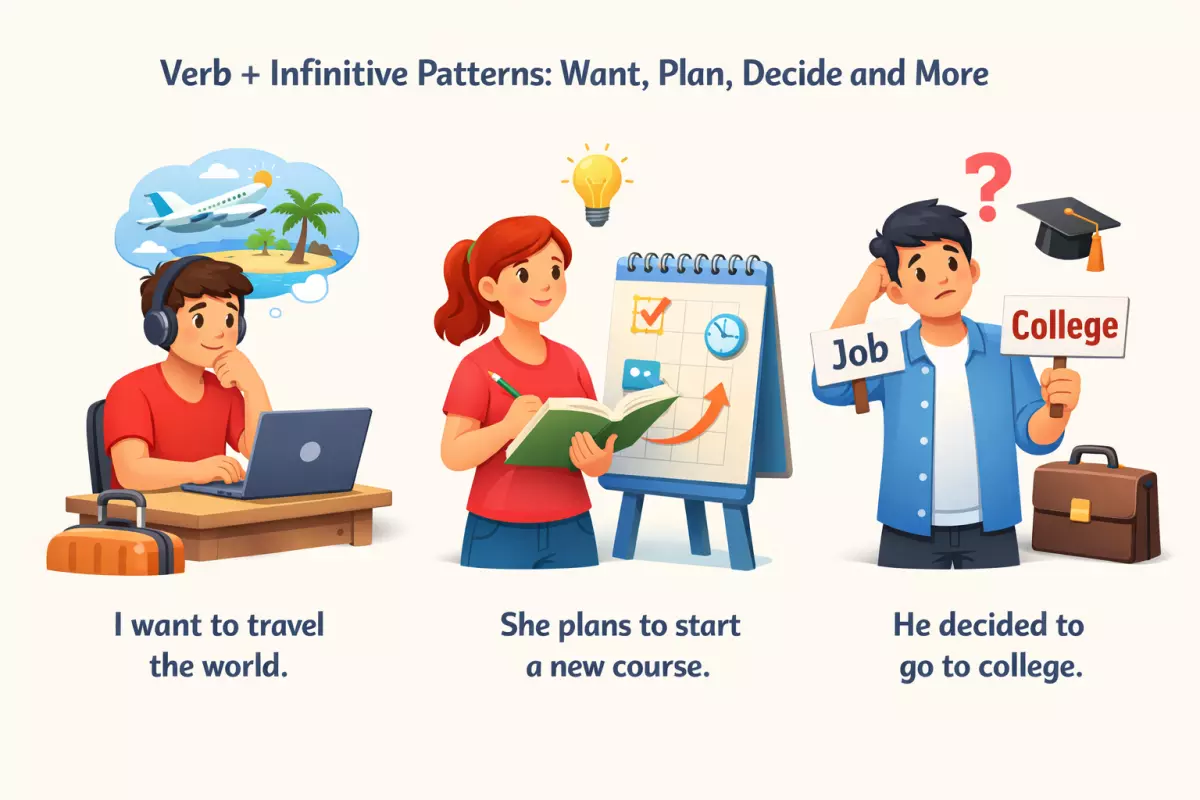 This article explains what verb + infinitive patterns are, lists common verbs that take to + verb, and shows how meaning and intention affect them. It covers negatives and questions, verb + object + infinitive, infinitives after adjectives and nouns, common mistakes and fixes, plus homework practice tasks.
- What verb + infinitive patterns are
- Common verbs followed by to-infinitive
- Meaning and intention in infinitive patterns
- Negative infinitives and questions
- Verb + object + infinitive overview
- Infinitives after adjectives and nouns
- Typical learner mistakes and fixes
- Homework: verb + infinitive practice tasks
Some English verbs are often followed by to plus another verb, and learning this pattern can make your speech smoother. You use it all the time to talk about goals, choices, and intentions: I want to leave early, we plan to meet tomorrow, she decided to change jobs. Once you notice which verbs take an infinitive, you will hesitate less and form sentences faster.
What verb + infinitive patterns are
Many English verbs are followed by to + base verb to show a goal, intention, decision, request, or plan. This structure is common after verbs that describe what someone wants to do, chooses to do, or agrees to do.
In this pattern, the infinitive (to do, to go, to learn) works like the verb’s complement: it completes the meaning by answering “what?” or “why?”
Basic form and meaning
- Form: verb + to + base verb
- Example: I decided to leave early.
- Typical meaning: the infinitive expresses a future or unreal action (something planned, intended, or possible).
Common verb + infinitive patterns
- want to: They want to travel this summer.
- plan to: We plan to meet at six.
- decide to: She decided to change jobs.
- hope to: I hope to finish tonight.
- need to: You need to show your ID.
- agree to: He agreed to help.
- refuse to: They refused to pay.
- promise to: I promise to call tomorrow.
- offer to: She offered to drive.
- choose to: We chose to stay home.
- learn to: He’s learning to swim.
- try to: I’m trying to concentrate.
- manage to: She managed to solve it.
- fail to: He failed to notice the sign.
- pretend to: The child pretended to be asleep.
- forget to: Don’t forget to lock the door.
- remember to: Remember to send the email.
- expect to: We expect to arrive by noon.
Patterns with an object (verb + noun/pronoun + infinitive)
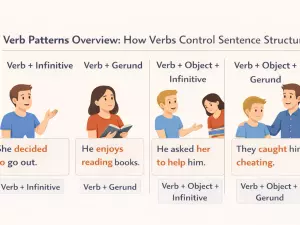
Some verbs commonly take an object before the infinitive. The object is the person who will do the action in the infinitive.
- ask + someone + to: She asked me to wait.
- tell + someone + to: He told them to sit down.
- advise + someone + to: The doctor advised her to rest.
- invite + someone + to: They invited us to join them.
- encourage + someone + to: The teacher encouraged him to speak more.
- remind + someone + to: Please remind me to bring it.
- warn + someone + to: She warned him to be careful.
- allow + someone + to: They allowed him to enter.
Common usage notes (errors to avoid)
- Use the base verb after to: ✅ She decided to go. ❌ She decided to going.
- Don’t add to after modal verbs (can, must, should): ✅ You must leave. ❌ You must to leave.
- Some verbs take different patterns (infinitive vs. -ing) with a change in meaning: ✅ Remember to lock the door (do it later) vs. remember locking the door (memory of the past).
Common verbs followed by to-infinitive
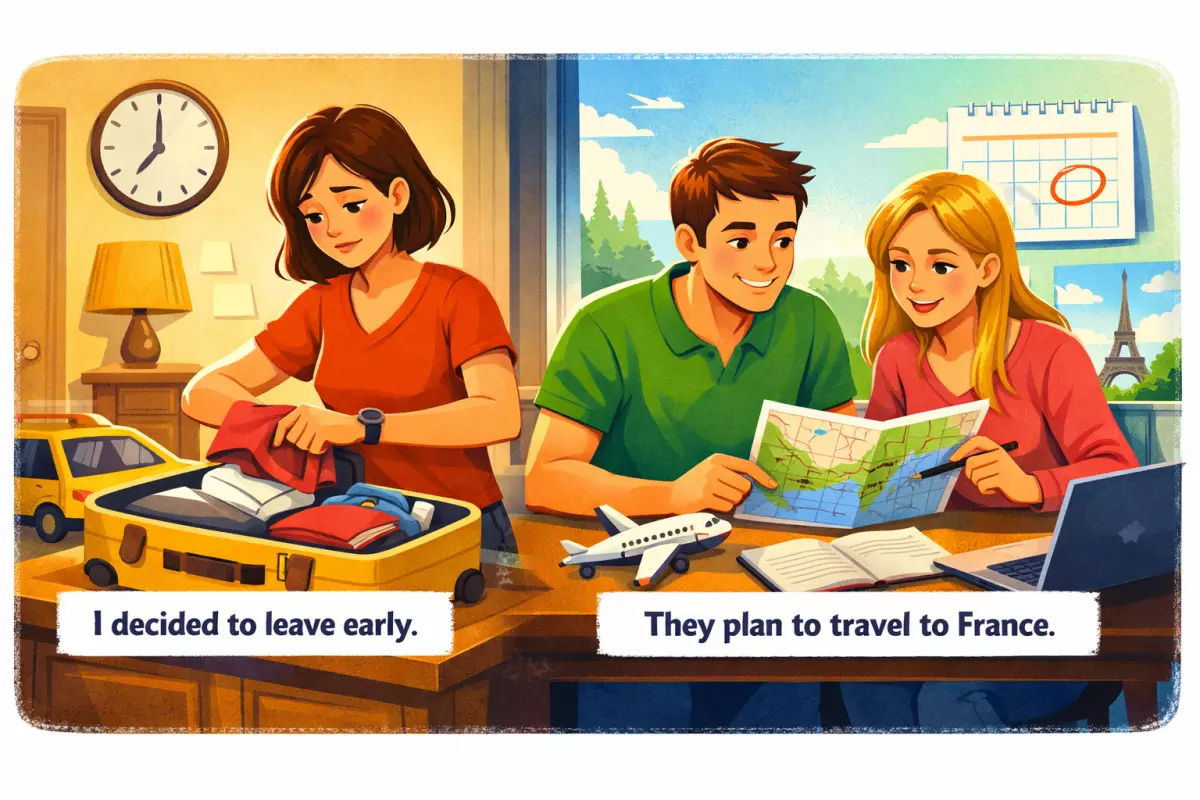
Many English verbs are typically followed by to + base verb (a to-infinitive). This pattern is especially common after verbs that express intention, decisions, plans, hopes, or willingness. The structure is straightforward: verb + to + verb.
Core pattern
- Affirmative: I decided to leave early.
- Negative: She decided not to leave early.
- Question: Did you decide to leave early?
High-frequency verbs that take a to-infinitive
- want + to-infinitive: I want to learn French.
- plan + to-infinitive: They plan to move next year.
- decide + to-infinitive: We decided to stay home.
- hope + to-infinitive: I hope to see you soon.
- expect + to-infinitive: She expects to finish today.
- need + to-infinitive: You need to wear a helmet.
- agree + to-infinitive: He agreed to help us.
- refuse + to-infinitive: They refused to answer.
- promise + to-infinitive: I promised to call.
- offer + to-infinitive: She offered to drive.
- choose + to-infinitive: He chose to wait.
- learn + to-infinitive: She learned to swim.
- manage + to-infinitive: We managed to solve it.
- fail + to-infinitive: He failed to notice the sign.
- attempt + to-infinitive: They attempted to fix the leak.
- pretend + to-infinitive: She pretended to understand.
- tend + to-infinitive: I tend to forget names.
- remember + to-infinitive: Remember to lock the door.
Two common usage notes
- Object + to-infinitive: Some verbs often include an object before the infinitive. For example: I want you to listen. / She asked me to help. (Not all verbs in the list above take an object in this way.)
- Negative position: Put not before the infinitive: ✅ He decided not to go. ❌ He decided to not go. (The incorrect version is common in speech, but the first is usually preferred in careful writing.)
Meaning and intention in infinitive patterns
Choosing a verb + infinitive structure often signals how the speaker views an action: as a goal, a decision, a plan, an attempt, or an obligation. Many of these verbs point forward in time, so the infinitive commonly refers to a future or “not-yet-real” action rather than something already completed.
Common intention types expressed with verb + to-infinitive
- Desire / preference:
✅ I want to leave early. / She would like to speak to you. / They prefer to walk. - Plans and arrangements:
✅ We plan to visit in July. / He intends to apply next week. / I hope to finish today. - Decisions and choices (often made at a particular moment):
✅ She decided to stay. / I chose to wait. / They agreed to meet at six. - Promises and commitments:
✅ I promise to call. / He swore to tell the truth. / We vowed to support the project. - Attempts and effort:
✅ I tried to open the window. / She managed to solve it. / He failed to notice the sign. - Ability and readiness (often about willingness or preparedness):
✅ I’m able to help tomorrow. / She’s ready to start. / He’s reluctant to talk about it. - Advice, obligation, and necessity (common with adjectives and reporting verbs):
✅ You need to back up your files. / We have to leave now. / I was told to wait here. - Permission and requests:
✅ She asked to leave early. / They allowed me to take photos. / He refused to answer. - Learning and discovery:
✅ I learned to drive at 18. / She found out to her surprise that the shop was closed. (More natural: She found out the shop was closed.) - Emotional reaction to an action (often with adjectives):
✅ I’m happy to help. / She was surprised to see him. / They’re sorry to hear that.
How the infinitive shapes time and “reality”
- Forward-looking meaning: Many verbs naturally point to a later action.
✅ We hope to move next year. (The move is in the future.) - Unrealized vs. completed action: Some verbs highlight whether the action happened.
✅ She managed to fix it. (It happened.)
✅ She failed to fix it. (It did not happen.) - Decision point:
✅ I decided to take the job. (A clear choice was made.) - Effort without guaranteeing success:
✅ I tried to call you. (The attempt matters; success is not certain.)
Pattern choices that change meaning
- Want/need/expect + object + to-infinitive focuses on who should do the action:
✅ I want you to listen. / We need them to arrive on time. / She expects him to apologize. - Decide/plan/hope + to-infinitive usually keeps the subject as the doer:
✅ They plan to expand. (They will expand.) - Agree/refuse/promise + to-infinitive often signals a social commitment:
✅ He agreed to help. / She refused to sign. / I promised to be there. - Common learner error: missing “to”:
❌ I want go now. → ✅ I want to go now. - Common learner error: wrong structure after “suggest”:
❌ She suggested to go home. → ✅ She suggested going home. / She suggested that we go home.
Negative infinitives and questions
With verb + infinitive structures, negation usually happens in one of two places: before the main verb (to negate the whole idea) or directly before the infinitive (to negate only the action in the infinitive). Questions follow normal question word order; the infinitive itself does not change.
Where to put not
Most of the time, place not after an auxiliary (do/does/did, will, can, etc.) to negate the main verb. Use not before to when you want the main verb to remain positive but the infinitive action to be negative.
- Negate the main verb (common):
✅ I don’t want to leave early.
✅ She didn’t decide to apply. - Negate the infinitive (more specific):
✅ I decided not to apply. (The decision is positive; the action is negative.)
✅ They agreed not to mention it. - Meaning difference:
✅ I didn’t decide to go. (No decision was made, or the decision is unclear.)
✅ I decided not to go. (A clear decision: no.) - With “want” and “plan”:
✅ We don’t want to interrupt. (We have no desire to interrupt.)
✅ We want not to interrupt. (Possible, but less natural; usually rephrase: “We want to avoid interrupting.”) - With “promise,” “agree,” “refuse”:
✅ He promised not to be late.
✅ She refused to sign. → She refused to not sign. ❌ (Unnatural; use “refused to sign” or “refused to sign anything.”) - Split infinitive note:
✅ I decided not to call. (standard)
✅ I decided to not call. (possible when emphasizing “not,” but often sounds heavier)
Common patterns and examples
- I chose not to comment during the meeting.
- They arranged not to meet at the office.
- We expected not to hear back so soon.
- She learned not to take it personally.
- He offered not to charge us for delivery.
- We decided not to renew the contract.
- I tried not to laugh.
- They managed not to wake the baby.
- She asked me not to share the news yet.
- He reminded us not to park there.
- I forgot not to mention it. (often clearer as: “I forgot to mention it.”)
- We agreed not to discuss salaries.
Questions with verb + infinitive
Form questions by changing the main clause (using auxiliaries or inversion). The infinitive stays the same: to + base verb. In questions, negation usually appears in the main clause (don’t/doesn’t/didn’t), but it can also appear as not to when the question is about choosing the negative action.
- Yes/no questions:
Do you want to sit here?
Did she decide to leave?
Are they planning to call? - Negative yes/no questions (expecting confirmation or surprise):
Don’t you want to wait?
Didn’t he agree to help? - Wh- questions:
What do you want to do next?
Why did they decide to cancel?
When do you plan to start? - Questions about choosing the negative action:
Did you decide not to go?
Why did she choose not to respond? - Indirect questions (no inversion after the question word):
Do you know what he wants to do?
I’m not sure why they decided to move. - Tag questions:
You want to leave now, don’t you?
She decided not to call, didn’t she?
Verb + object + infinitive overview
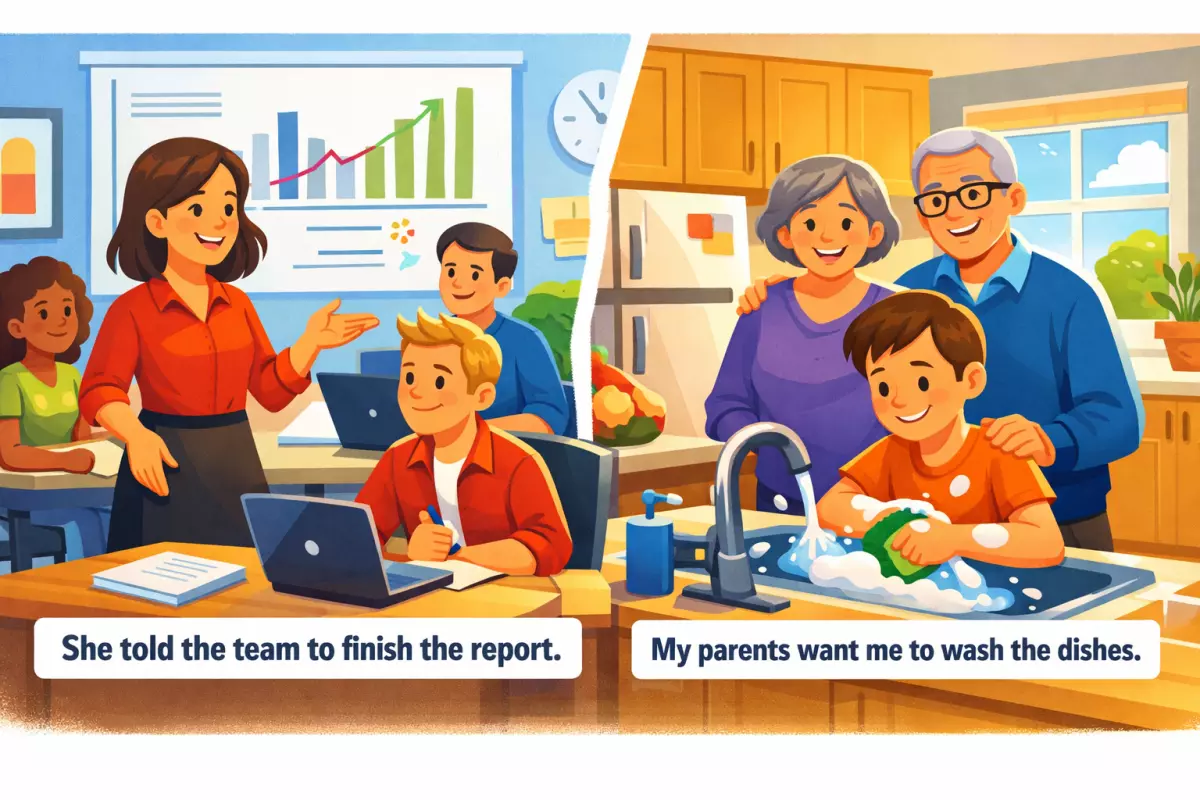
Some verbs commonly take a pattern where you name a person or thing first (the object) and then add an infinitive to show the action you want, expect, or cause. This structure is useful when the subject does not do the second action directly; instead, the subject influences another person or thing to do it.
Core pattern and meaning
- Form: Subject + verb + object + to-infinitive (most common).
- Meaning: The object is the “doer” of the infinitive action.
- Object types: a noun (the team, my parents) or an object pronoun (me, him, her, us, them).
- Typical uses: requests, advice, permission, persuasion, expectations, instructions, and arrangements.
Common verbs that use this pattern
- ask: She asked him to call later.
- tell: They told us to wait outside.
- advise: The doctor advised me to rest.
- encourage: We encouraged her to apply.
- persuade: He persuaded them to stay.
- invite: I invited my neighbors to join us.
- remind: Please remind me to email her.
- warn: They warned him not to touch it.
- order: The officer ordered everyone to leave.
- allow: The rules allow students to use calculators.
- permit: The sign permits visitors to enter.
- forbid: The policy forbids employees to share passwords. ❌ (Use “forbids employees from sharing …” in most modern usage.)
- expect: I expect you to be on time.
- need: We need you to sign here.
- want: I want you to listen carefully.
- would like: I’d like them to meet the team.
- help: She helped me (to) finish the report.
- teach: They taught us to swim.
Key usage notes (what learners often miss)
- Who does the action? In “I told him to leave,” he leaves (not “I”).
- Negative infinitives: Put not before the infinitive: They told him not to worry.
- Object pronouns: Use object forms after the verb: ✅ She asked me to help. ❌ She asked I to help.
- Help is flexible: “help + object + (to) infinitive” is common: She helped me to carry it / She helped me carry it.
- Make/let have a different pattern: “make/let + object + bare infinitive” (no to): They made him leave; She let us go.
- Passive option: Some verbs often appear in the passive with an infinitive: He was told to wait; We were advised to leave early.
Quick check: choose this pattern when…
- you are directing, requesting, or persuading another person: I asked her to explain.
- you are expressing what you expect another person to do: We expect them to arrive by noon.
- you want to show responsibility clearly: The manager told the team to update the file.
Infinitives after adjectives and nouns
English often uses to + base verb after an adjective or a noun to explain what someone should do, wants to do, is able to do, or feels. This pattern is common when the adjective describes a person’s reaction or readiness, and when the noun names a plan, decision, or opportunity.
Adjective + to-infinitive: common meanings
With adjectives, the infinitive usually adds the action that matches the feeling, ability, or situation. It answers questions like “ready to do what?” or “easy to do what?”
- Feelings/reactions: happy to help, surprised to hear, relieved to know, shocked to see
- Willingness/attitude: willing to try, reluctant to admit, eager to learn, keen to join
- Readiness/availability: ready to leave, free to talk, available to meet
- Ability/difficulty: able to swim, unable to attend, easy to use, hard to explain, difficult to prove
- Safety/appropriateness: safe to drink, dangerous to touch, okay to park, inappropriate to say
- Certainty/likelihood: likely to rain, certain to win, bound to happen
Useful adjective patterns (with examples)
- It’s important to arrive early.
- She’s happy to answer questions.
- They’re ready to start now.
- I’m sorry to hear that.
- He was surprised to see her there.
- This app is easy to install.
- That rule is hard to remember.
- It’s safe to use on glass.
- She’s unlikely to agree.
- We’re free to meet after lunch.
- It was nice to talk to you.
- He’s too tired to drive. ✅ / He’s too tired for drive. ❌
Noun + to-infinitive: what the noun is “for”
After nouns, the infinitive often explains purpose or content: what the plan/decision/need involves. This is especially common with abstract nouns related to choices, requests, and future actions.
- We made a decision to move.
- She has a plan to study abroad.
- There’s a chance to improve.
- I got permission to leave early.
- They gave us instructions to follow.
- He felt a need to explain.
- We have an opportunity to meet the team.
- She made an effort to be polite.
- They submitted a request to change the date.
- It’s your responsibility to lock the door.
- He took the time to call back.
- There’s no reason to panic.
- She has the ability to lead.
- We reached an agreement to share costs.
Common mistakes to avoid
- After adjectives, don’t use a full clause without to: ✅ I’m happy to help. / ❌ I’m happy help.
- With “easy/hard/difficult,” the infinitive often has a passive meaning: ✅ This topic is hard to explain (= hard to be explained).
- Don’t confuse noun + infinitive with noun + of + -ing in fixed phrases: ✅ the decision to leave (common) vs. ✅ the idea of leaving (also possible, different emphasis).
Typical learner mistakes and fixes
Many errors with these structures come from mixing verb patterns (infinitive vs. -ing), adding extra words like to, or choosing the wrong form after a modal or a preposition. Use the fixes below to check your sentence shape quickly.
- ❌ I want that I go. → ✅ I want to go.
Fix: After want, use to + base verb, not a full “that-clause” in most everyday sentences. - ❌ I want go. → ✅ I want to go.
Fix: Don’t drop to after verbs like want, plan, decide, hope, need, learn. - ❌ I plan going tomorrow. → ✅ I plan to go tomorrow.
Fix: plan is typically followed by an infinitive (plan to do). “Plan on + -ing” exists, but it changes the structure and is less common in careful writing. - ❌ I decided going. → ✅ I decided to go.
Fix: decide takes to + verb. - ❌ I hope going soon. → ✅ I hope to go soon.
Fix: hope usually takes the infinitive when the subject is the same person. - ❌ I want you go. → ✅ I want you to go.
Fix: With an object, use want + person + to + verb. - ❌ She decided me to leave. → ✅ She told me to leave. / ✅ She decided to leave.
Fix: decide doesn’t work like “tell/ask” with an object + infinitive. Either change the verb (tell/ask) or remove the object. - ❌ He suggested me to take a taxi. → ✅ He suggested taking a taxi. / ✅ He suggested that I take a taxi.
Fix: suggest does not take object + to + verb. - ❌ They explained me to fill the form. → ✅ They explained how to fill in the form. / ✅ They explained the process to me.
Fix: explain needs a different pattern (often how to, or a noun phrase). - ❌ I made him to apologize. → ✅ I made him apologize.
Fix: After make/let/help, many learners incorrectly add to. Use the bare infinitive (help can be either: help do / help to do). - ❌ I can to swim. → ✅ I can swim.
Fix: Modals (can, must, should, might) take the base verb without to. - ❌ I need go now. → ✅ I need to go now.
Fix: need as a main verb normally uses to + verb. - ❌ I want to that you come. → ✅ I want you to come. / ✅ I want you to come early.
Fix: Don’t combine to with “that” in this structure; choose either want + object + to or a different verb that allows a that-clause. - ❌ I’m looking forward to meet you. → ✅ I’m looking forward to meeting you.
Fix: When to is a preposition (look forward to, be used to, object to), it must be followed by -ing, not an infinitive. - ❌ I decided for leaving. → ✅ I decided to leave.
Fix: Avoid adding extra prepositions before the infinitive after verbs that already take to + verb. - ❌ We agreed go. → ✅ We agreed to go.
Fix: agree is another verb that requires to. - ❌ She promised me to call. → ✅ She promised to call me. / ✅ She promised me that she would call.
Fix: With promise, keep the infinitive attached to the person who will do the action. “Promise + to do” is most common. - ❌ I want to improve quickly my English. → ✅ I want to improve my English quickly.
Fix: Place adverbs more naturally: often after the object, or before the main verb if needed for emphasis.
Quick checks to self-correct
- If the first verb is want/plan/decide/hope/agree/learn/need, the next verb is usually to + base form.
- If you see a modal (can/should/must), the next verb is the bare infinitive (no to).
- If to belongs to a phrase like look forward to, treat it as a preposition and use -ing.
- If there is an object (me/you/him/her/them) after the first verb, check whether that verb allows object + to + verb (want/ask/tell/need) or needs a different structure (suggest/explain).
Homework: verb + infinitive practice tasks
Use these tasks to build accuracy with common patterns like verb + to + base verb (want to go, decide to study) and to avoid frequent errors (for example, adding an extra verb ending after to). Complete the activities in order; each one focuses on a different kind of choice you need to make when writing or speaking.
1) Complete the sentences (choose the correct infinitive form)
- I want ______ (learn) a second language this year.
- They decided ______ (not / drive) because the roads were icy.
- We plan ______ (meet) at 6:30 outside the station.
- She hopes ______ (get) the job after the interview.
- He promised ______ (call) me when he arrived.
- Did you manage ______ (finish) the report on time?
- I agreed ______ (help) my neighbor move the boxes.
- The team refused ______ (change) the schedule.
- My parents encouraged me ______ (apply) for the scholarship.
- He offered ______ (pay) for dinner.
- We arranged ______ (talk) after class.
- She learned ______ (swim) when she was five.
Show answers
- to learn
- not to drive
- to meet
- to get
- to call
- to finish
- to help
- to change
- to apply
- to pay
- to talk
- to swim
2) Find and correct the mistakes (focus: “to” + base verb)
- I want to going home early today.
- She decided to studies abroad next semester.
- We plan to meeting your parents on Sunday.
- He promised to called after work.
- They agreed help us with the project.
- Did you manage to finished the application?
- I hope to can visit you soon.
- She offered paying for the tickets.
Show answers
- I want to go home early today.
- She decided to study abroad next semester.
- We plan to meet your parents on Sunday.
- He promised to call after work.
- They agreed to help us with the project.
- Did you manage to finish the application?
- I hope I can visit you soon.
- She offered to pay for the tickets.
3) Choose the best verb (meaning-based choice)
Pick the verb that best matches the meaning, then add to + base verb.
- I ______ to take a break, but I kept working. (promised / planned)
- They ______ to lower the price, even after we asked. (refused / offered)
- We ______ to meet earlier, because the event starts at 7. (decided / managed)
- She ______ to help, but she didn’t have time in the end. (offered / learned)
- He ______ to finish the marathon, and he did it. (managed / hoped)
- I ______ to call you yesterday, but I forgot. (intended / agreed)
- They ______ to keep the news secret. (promised / arranged)
- Our teacher ______ us to read more in English. (encouraged / refused)
- We ______ to meet at the café at 3. (arranged / learned)
- She ______ to apply, but she’s still unsure. (hopes / plans)
Show answers
- planned to take
- refused to lower
- decided to meet
- offered to help
- managed to finish
- intended to call
- promised to keep
- encouraged us to read
- arranged to meet
- plans to apply
4) Rewrite using verb + infinitive (keep the meaning)
Rewrite each sentence using the verb given. Keep the meaning as close as possible.
- I said yes to helping. (agree)
- He said he would not change his mind. (refuse)
- We made a plan to visit them in July. (plan)
- She told me she would call later. (promise)
- They were able to solve the problem. (manage)
- I really want a new laptop. (want)
- He thinks it’s a good idea for you to apply. (encourage)
- She said, “I can pay.” (offer)
Show answers
- I agreed to help.
- He refused to change his mind.
- We plan to visit them in July.
- She promised to call later.
- They managed to solve the problem.
- I want to buy a new laptop.
- He encouraged you to apply.
- She offered to pay.
5) Production task (write your own)
Write 8–10 sentences about your next week. Use at least six different verbs that commonly take an infinitive. Include:
- One sentence with a negative infinitive (not to + base verb).
- One sentence with an object (for example, encourage someone to do something).
- One sentence showing a completed difficulty (manage to…).
- One sentence showing a decision (decide to…).
Checklist before you finish: after to, use the base form (to go, to study, to call), and place not before to (not to go).