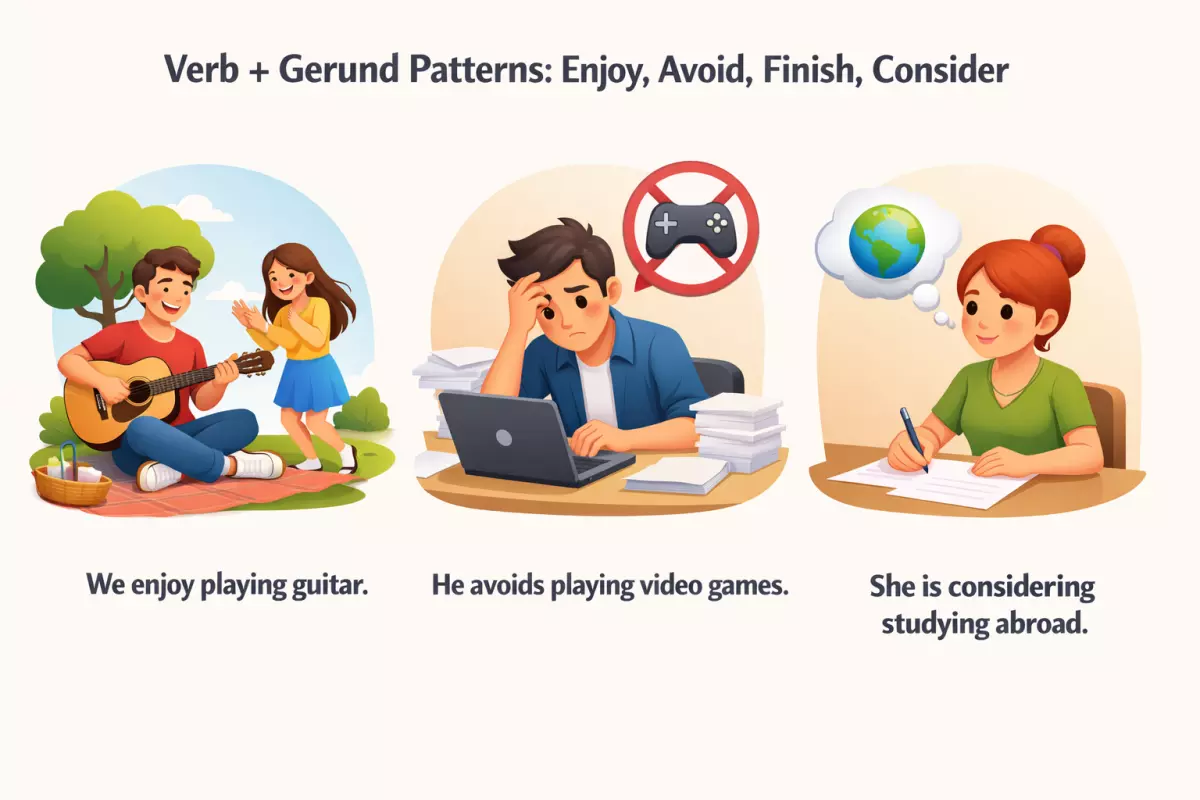
Verb + Gerund Patterns: Enjoy, Avoid, Finish, Consider

 Learn what verb + gerund patterns are, which common verbs take gerunds, and how gerunds work after prepositions. It explains meanings these patterns express, negatives and questions, a quick gerund vs infinitive comparison, typical mistakes with fixes, and homework practice tasks.
Some English verbs are commonly followed by an -ing form, and noticing this pattern can make your speech sound smoother. In daily life you might say you enjoy cooking, avoid driving in traffic, finish studying, or consider changing jobs. Rather than memorizing long rules, focus on how these verbs appear in real sentences so you can use them naturally and with confidence.
What verb + gerund patterns are
Some English verbs are typically followed by an -ing form (a gerund) when the next idea is an activity, not a thing. This creates a common structure: verb + gerund, used to talk about likes/dislikes, avoiding actions, completing actions, and thinking about actions.
Core structure
- Form: verb + verb-ing
- Meaning: the -ing form names the action as an “activity” or “event”
- Typical use: after certain verbs, the gerund is the natural choice (not an infinitive)
Verbs that commonly take a gerund (with examples)
- enjoy + -ing: I enjoy reading before bed.
- avoid + -ing: She avoids driving at night.
- finish + -ing: We finished cleaning the kitchen.
- consider + -ing: They’re considering moving closer to work.
- suggest + -ing: He suggested taking a break.
- recommend + -ing: I recommend checking the schedule.
- mind + -ing: Do you mind waiting a minute?
- miss + -ing: I miss seeing my friends.
- practice + -ing: She practices speaking every day.
- keep + -ing: He kept asking the same question.
- quit + -ing: He quit smoking.
- postpone + -ing: They postponed meeting until Friday.
- delay + -ing: Don’t delay answering the email.
- deny + -ing: She denied taking the files.
- admit + -ing: He admitted making a mistake.
- risk + -ing: You risk losing your data.
Common learner errors to avoid
- ✅ I enjoy cooking. ❌ I enjoy to cook.
- ✅ She avoided talking about it. ❌ She avoided to talk about it.
- ✅ We finished studying. ❌ We finished to study.
- ✅ He’s considering changing jobs. ❌ He’s considering to change jobs.
Where the gerund phrase fits in a sentence
- With an object after the -ing form: She enjoys watching movies.
- With a time expression: I avoid driving in heavy traffic.
- With a negative: He finished noticing the error too late.
- With a possessive (more formal): I don’t mind your asking questions.
Common verbs followed by gerunds

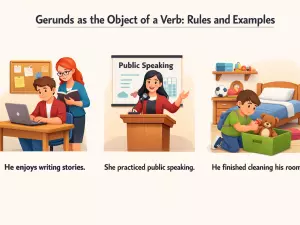
Many English verbs take an -ing form as their direct object. In these patterns, the gerund behaves like a noun: it answers “What?” after the verb and can be followed by its own object or modifiers (for example, “enjoy reading long novels”).
High-frequency verbs that typically take a gerund
- enjoy + -ing: “I enjoy cooking for friends.”
- avoid + -ing: “She avoids driving at night.”
- finish + -ing: “They finished cleaning the kitchen.”
- consider + -ing: “We’re considering moving next year.”
- suggest + -ing: “He suggested taking a break.”
- recommend + -ing: “I recommend starting early.”
- admit + -ing: “She admitted making a mistake.”
- deny + -ing: “He denied copying the answers.”
- mind + -ing (often in questions/negatives): “Do you mind waiting a moment?”
- miss + -ing: “I miss working with that team.”
- practice + -ing: “They practice speaking every day.”
- postpone + -ing: “We postponed meeting until Friday.”
- delay + -ing: “The storm delayed landing.”
- keep + -ing (continue): “She kept asking the same question.”
- quit + -ing: “He quit smoking.”
- risk + -ing: “You risk losing your data.”
- discuss + -ing: “They discussed changing the schedule.”
- appreciate + -ing: “I appreciate you helping me.”
Useful usage notes (to prevent common errors)
- Gerund as the object: If the verb needs an object, the -ing form can fill that role. ✅ “They avoided talking about it.” ❌ “They avoided to talk about it.”
- Gerund + object: The -ing form can take its own object. “She enjoys reading mystery novels.”
- After prepositions, use -ing: When a verb is followed by a preposition, the next verb is usually a gerund. “He apologized for being late.”
- Mind in polite questions: “Do you mind opening the window?” is standard; “Do you mind to open…” is not.
- Discuss is not followed by “about” in many cases: ✅ “Let’s discuss going by train.” (Also possible: “discuss the plan.”)
- Appreciate + gerund often includes an object: “I appreciate you taking the time to explain.”
These verbs are a reliable starting point for mastering verb + gerund structures. Once the pattern feels natural, you can expand it by noticing other verbs in reading and listening that treat the -ing form like a noun phrase.
Gerunds after prepositions overview
After a preposition, English normally uses the -ing form (a gerund), not an infinitive. This is true whether the preposition belongs to a verb phrase, an adjective phrase, or a fixed expression. The key idea is simple: preposition + verb is typically expressed as preposition + gerund.
Core pattern
- Preposition + gerund: ✅ I’m interested in learning more.
- Not preposition + infinitive: ❌ I’m interested in to learn more.
- When a verb is needed after a preposition, the gerund functions like a noun phrase: “in learning” = “in the process of learning.”
Common prepositions that take a gerund
- about: We talked about moving to a new place.
- after: After finishing the report, she left.
- before: Think before replying.
- by: You improve by practicing daily.
- for: He apologized for being late.
- from: She stopped him from making a mistake.
- in: He succeeded in getting the job.
- of: They’re capable of solving it.
- on: She insisted on paying.
- to (as a preposition): I’m used to waking up early.
- with: He helped me with carrying the boxes.
- without: She left without saying goodbye.
“To” as a preposition (not an infinitive marker)
- Some expressions contain to as a preposition, so they are followed by a gerund:
- ✅ I’m looking forward to seeing you.
- ✅ She’s committed to improving her writing.
- ✅ They’re used to working under pressure.
- ❌ I’m looking forward to see you.
- ❌ She’s committed to improve her writing.
Verb + preposition + gerund combinations to notice
- apologize for + gerund: He apologized for interrupting.
- insist on + gerund: She insisted on checking the details.
- succeed in + gerund: They succeeded in reducing costs.
- think about + gerund: I’m thinking about changing jobs.
- complain about + gerund: He complained about waiting too long.
- approve of + gerund: I don’t approve of cheating.
- prevent (someone) from + gerund: This prevents users from losing data.
- focus on + gerund: Focus on writing clearly.
- depend on + gerund: It depends on finding the right supplier.
- worry about + gerund: Stop worrying about making mistakes.
Quick accuracy checks
- If the word before the verb is a preposition (in, on, at, for, by, about, to, etc.), use the -ing form: “on doing,” “in doing.”
- If you can replace the phrase with “the act of …,” the gerund will usually fit: “by practicing” → “by the act of practice.”
- If you see to, confirm whether it is part of an infinitive (“to do”) or a preposition in a set phrase (“used to,” “look forward to,” “committed to”).
Meaning expressed by gerund patterns
When a verb is followed by a gerund (-ing form), the -ing clause usually names an activity as a concept (an experience, a habit, a plan, or a completed step). With verbs like enjoy, avoid, finish, and consider, the gerund commonly points to an action seen as real or possible in the speaker’s world, not a hypothetical idea.
Core meanings with common verb + -ing choices
- Enjoy + -ing: focuses on pleasure from the activity itself.
- I enjoy cooking for friends.
- She enjoys working late when it’s quiet.
- They enjoyed walking along the river.
- Avoid + -ing: focuses on preventing an action or situation from happening.
- He avoids driving at night.
- Try to avoid making the same mistake again.
- We avoided talking about politics at dinner.
- Finish + -ing: focuses on completing an activity (the endpoint matters).
- Finish writing the email before lunch.
- I finished reading the report.
- She hasn’t finished packing yet.
- Consider + -ing: focuses on thinking about an option or possibility as a potential plan.
- We’re considering moving closer to work.
- Have you considered taking a different route?
- They considered canceling the meeting.
How the gerund changes what the sentence highlights
- Activity as a “thing”: the -ing clause behaves like a noun phrase (the object of the main verb).
- She enjoys teaching beginners. (the activity is the object)
- He finished repairing the bike. (the task is the object)
- General vs. specific meaning: gerunds often sound general or habitual, but context can make them specific.
- I enjoy swimming. (general hobby)
- I enjoyed swimming in the lake yesterday. (specific event)
- Real-world action rather than abstract possibility: these verbs typically pair with -ing to refer to actions people actually do (or choose not to do).
- She avoided answering the question. (a real response she didn’t give)
- They considered postponing the launch. (a realistic option)
Common usage patterns and typical complements
- Gerund + object: enjoy/avoid/finish/consider + -ing + noun/pronoun.
- He enjoys learning new words.
- She avoided calling him.
- We finished cleaning the kitchen.
- They considered buying a used car.
- Gerund + adverbial detail: -ing clause can include time, place, or manner information.
- I enjoy reading on the train.
- Avoid speaking too quickly.
- She finished typing before the deadline.
- He considered waiting until Monday.
- Negative gerund: use not + -ing to negate the activity.
- He enjoys not checking his phone during meals.
- She considered not going to the event.
Frequent learner errors to watch for
- ✅ I enjoy cooking. ❌ I enjoy to cook.
- ✅ Avoid making noise. ❌ Avoid to make noise.
- ✅ She finished writing the summary. ❌ She finished to write the summary.
- ✅ Consider taking a break. ❌ Consider to take a break.
Negative forms and questions

With verbs like enjoy, avoid, finish, and consider, the gerund (verb + -ing) stays the same in statements, negatives, and questions. What changes is the auxiliary (do/does/did), the position of not, or the use of a negative subject (nobody, nothing).
Core patterns to remember
- Present simple negative: subject + do/does + not + verb + gerund
Example: She doesn’t enjoy working late. - Past simple negative: subject + did + not + verb + gerund
Example: They didn’t finish cleaning the kitchen. - Yes/no questions: Do/Does/Did + subject + verb + gerund?
Example: Do you avoid eating sugar? - Wh- questions: Wh-word + do/does/did + subject + verb + gerund?
Example: Why did he consider moving abroad? - Short answers: Yes, I do./No, I don’t. (or does/did)
Example: Do you enjoy running? No, I don’t.
Common negative placements (and what they mean)
- ✅ Don’t/doesn’t/didn’t + verb + -ing (most common)
She didn’t consider taking the earlier train. - ✅ Verb + not + -ing (less common; sounds more formal or emphatic)
We considered not going because of the weather. - ✅ Negative subject + verb + -ing (the verb stays positive)
Nobody enjoys waiting in long lines. - ❌ Not + verb + -ing as a sentence start for a normal statement (usually incorrect)
❌ Not enjoy working late. → ✅ I don’t enjoy working late.
Example bank: correct forms you can copy
- I don’t enjoy studying in noisy places.
- She doesn’t avoid talking to strangers when she has to.
- We didn’t finish writing the report on time.
- He didn’t consider asking for help.
- Do you enjoy cooking for other people?
- Does he avoid driving at night?
- Did they finish packing before noon?
- Did you consider changing your major?
- What do you enjoy doing after work?
- Why does she avoid meeting new clients?
- How did you finish organizing everything so quickly?
- When did he consider moving to a different city?
- I considered not buying it because it was expensive.
- They avoided not answering by changing the topic. (grammatical, but often awkward in meaning)
- Nobody enjoys paying extra fees.
- Nothing avoids causing problems if the plan is unclear. (possible, but “prevents” is often more natural than “avoids” here)
Gerund vs infinitive quick comparison
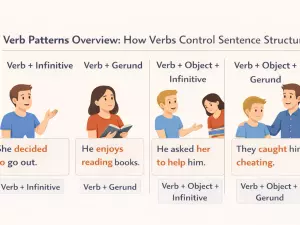
Some verbs are followed by an -ing form (a gerund), while others take to + base verb (an infinitive). A smaller group can take both, sometimes with a change in meaning. The verbs in this article (enjoy, avoid, finish, consider) belong to the “verb + gerund” group, so verb + -ing is the default pattern.
| Pattern | Typical use | Common verb examples | Example sentence |
|---|---|---|---|
| Verb + gerund (-ing) | Often describes activities, habits, or experiences as a “thing” (an activity treated like a noun). | enjoy, avoid, finish, consider, suggest, recommend, keep, mind, miss, practice | I enjoy reading before bed. |
| Verb + infinitive (to + base) | Often points to goals, decisions, plans, or future-oriented actions. | decide, plan, hope, want, need, learn, agree, refuse, promise, offer | We decided to leave early. |
| Verb + gerund / infinitive (meaning changes) | Choice affects meaning (memory, timing, or intention). | remember, forget, stop, try, regret | She stopped smoking. / She stopped to smoke. |
| Verb + gerund / infinitive (meaning similar) | Both forms may be possible with little or no meaning change (often style or emphasis). | begin, start, continue, like, love, hate | He started working. / He started to work. |
Fast checks to choose the right form
- If the verb is one of the “activity verbs” (enjoy/avoid/finish/consider), follow it with -ing: ✅ I considered moving. ❌ I considered to move.
- If the verb expresses a decision, plan, or intention, to + base is common: ✅ They plan to travel next month.
- If the verb is in the “both forms” group, check whether meaning changes (especially with stop, remember, try).
- When you need a noun-like phrase after a verb, the gerund often fits naturally: “avoid driving,” “finish writing,” “keep talking.”
Extra practice: correct completions (mixed patterns)
- I enjoy cooking at home.
- We avoided taking the highway.
- She finished answering the emails.
- They considered changing the schedule.
- He suggested meeting earlier.
- Do you mind waiting a moment?
- I miss seeing my friends regularly.
- She decided to apply for the job.
- We agreed to help with the project.
- He promised to call after work.
- I learned to swim as a child.
- They refused to answer the question.
- She stopped smoking. (quit the habit)
- She stopped to smoke. (paused in order to smoke)
- Remember to lock the door. (don’t forget the task)
- I remember locking the door. (memory of a past action)
Typical learner mistakes and fixes
These verbs are commonly followed by an -ing form, but learners often mix them with the infinitive (to + base verb) or apply the pattern inconsistently in negatives, questions, and longer sentences. Use the fixes below to make your verb choices predictable and natural.
1) Using to + verb after verbs that normally take a gerund
- ❌ I enjoy to read. → ✅ I enjoy reading.
- ❌ She avoided to talk about it. → ✅ She avoided talking about it.
- ❌ We finished to clean the kitchen. → ✅ We finished cleaning the kitchen.
- ❌ He considered to move abroad. → ✅ He considered moving abroad.
- Fix: after enjoy, avoid, finish, consider, choose verb + -ing as your default pattern.
2) Confusing “consider + -ing” with “consider + noun/that-clause”
- ✅ I considered moving to a smaller place. (activity/option)
- ✅ I considered the offer carefully. (noun object)
- ✅ We consider this plan risky. (object + adjective)
- ✅ She considered that it might be too late. (that-clause, more formal)
- Fix: use consider + -ing when you mean “think about doing an action.” Use a noun or clause when you mean “think about a thing/idea” or “judge something.”
3) Misplacing the object with “enjoy/avoid/finish + -ing”
- ❌ I enjoyed very much reading it. → ✅ I enjoyed reading it very much.
- ❌ She avoided quickly answering. → ✅ She avoided answering quickly.
- ❌ They finished the report writing. → ✅ They finished writing the report.
- Fix: put the -ing activity right after the verb, then add objects and adverbs: enjoy/avoid/finish/consider + -ing + (object) + (adverb).
4) Using “avoid” without a clear action
- ❌ I avoided. → ✅ I avoided talking to him.
- ❌ She avoided the meeting to speak. → ✅ She avoided speaking at the meeting.
- ✅ He avoided making a decision. (clear activity)
- Fix: “avoid” needs a specific thing or activity. If you mean an action, use the -ing form.
5) Overusing “finish” with a noun when you mean an activity
- ❌ I finished my homework to do. → ✅ I finished doing my homework.
- ✅ I finished my homework. (focus on the task as a completed item)
- ✅ I finished doing my homework. (focus on the action/process)
- Fix: if you want to emphasize the process, choose finish + -ing. If the noun already represents the task, the noun alone can work.
6) Errors with negatives and questions (keeping the -ing form)
- ❌ I don’t enjoy to drive at night. → ✅ I don’t enjoy driving at night.
- ❌ Did you finish to write the email? → ✅ Did you finish writing the email?
- ❌ She didn’t avoid to mention it. → ✅ She didn’t avoid mentioning it.
- Fix: negatives and questions change the auxiliary (do/does/did), not the complement pattern. The second verb stays in the -ing form.
7) Mixing gerunds with infinitives inside one sentence
- ❌ He enjoys reading and to cook. → ✅ He enjoys reading and cooking.
- ❌ She considered moving and to change jobs. → ✅ She considered moving and changing jobs.
- Fix: keep parallel structure. If the first item is -ing, the next coordinated verbs should also be -ing.
8) Forgetting that “enjoy” usually needs an object or activity
- ❌ I enjoy. → ✅ I enjoy working here.
- ✅ I enjoy it. (it = a specific thing already mentioned)
- ✅ I really enjoy meeting new people.
- Fix: “enjoy” typically introduces what you enjoy (a noun/pronoun or an -ing activity). Add that information to complete the meaning.
9) Spelling and form mistakes with the -ing ending
- ❌ enjoy swiming → ✅ enjoy swimming (double the consonant)
- ❌ avoid makeing → ✅ avoid making (drop the silent “e”)
- ❌ finish runing → ✅ finish running (double the consonant)
- ❌ consider studing → ✅ consider studying (y → ying)
- Fix: treat the -ing form as a real verb form with spelling rules, not just “add -ing.”
Homework: verb + gerund practice tasks
These exercises focus on common verbs that are typically followed by an -ing form (a gerund). Pay attention to the pattern verb + gerund after enjoy, avoid, finish, and consider, and check for natural sentence meaning.
Task 1: Complete the sentences (use the gerund form)
- I really enjoy ________ (cook) for my friends on weekends.
- She avoided ________ (talk) about the problem during the meeting.
- We finished ________ (clean) the kitchen before the guests arrived.
- They are considering ________ (move) to a smaller apartment.
- Do you enjoy ________ (work) from home?
- He avoided ________ (drive) at night because of the fog.
- After I finished ________ (read) the email, I replied immediately.
- My manager is considering ________ (hire) another assistant.
- She enjoys ________ (learn) new languages.
- We avoided ________ (make) a decision until we had more information.
- He finished ________ (write) the report at midnight.
- I’m considering ________ (take) a short course in design.
Show answers
- cooking
- talking
- cleaning
- moving
- working
- driving
- reading
- hiring
- learning
- making
- writing
- taking
Task 2: Choose the correct option
- He enjoys (to swim / swimming) in the ocean.
- We avoided (to mention / mentioning) her name.
- They finished (to paint / painting) the bedroom.
- I’m considering (to change / changing) my phone plan.
- She avoided (to answer / answering) the question directly.
- Did you enjoy (to watch / watching) the documentary?
- He finished (to fix / fixing) the bike and tested it.
- We are considering (to order / ordering) takeout tonight.
- They enjoy (to travel / traveling) by train.
- I avoided (to check / checking) my messages during class.
Show answers
- swimming
- mentioning
- painting
- changing
- answering
- watching
- fixing
- ordering
- traveling
- checking
Task 3: Fix the mistakes (rewrite each sentence correctly)
- ❌ I enjoy to read before bed.
- ❌ She avoided to talk to him after the argument.
- ❌ We finished to pack and left.
- ❌ He is considering to apply for the job.
- ❌ They enjoy to play chess online.
- ❌ I avoided to make eye contact.
- ❌ She finished to write the last paragraph.
- ❌ Are you considering to buy a new laptop?
Show answers
- ✅ I enjoy reading before bed.
- ✅ She avoided talking to him after the argument.
- ✅ We finished packing and left.
- ✅ He is considering applying for the job.
- ✅ They enjoy playing chess online.
- ✅ I avoided making eye contact.
- ✅ She finished writing the last paragraph.
- ✅ Are you considering buying a new laptop?
Task 4: Write your own sentences (focus on meaning)
Write one original sentence for each prompt. Use the -ing form after the verb, and make the sentence specific (time, place, reason, or result).
- Enjoy: Write about an activity you like (at home or outside).
- Avoid: Write about something you try not to do (and why).
- Finish: Write about completing a task (and what happened next).
- Consider: Write about a possible future plan (and one reason for it).
- Enjoy: Write about a hobby you like with friends.
- Avoid: Write about a habit you are trying to stop.
- Finish: Write about a project or assignment you completed.
- Consider: Write about a change you might make this year.
Task 5: Expand with an object or a time phrase
Add 3–6 words to each sentence to make it more complete. Keep the structure verb + gerund.
- I enjoy cooking ________.
- She avoided talking ________.
- We finished cleaning ________.
- They’re considering moving ________.
- He enjoys learning ________.
- I avoided checking ________.
- She finished writing ________.
- We’re considering hiring ________.