Phrasal Verbs with Get, Take, Put, Come, and Go

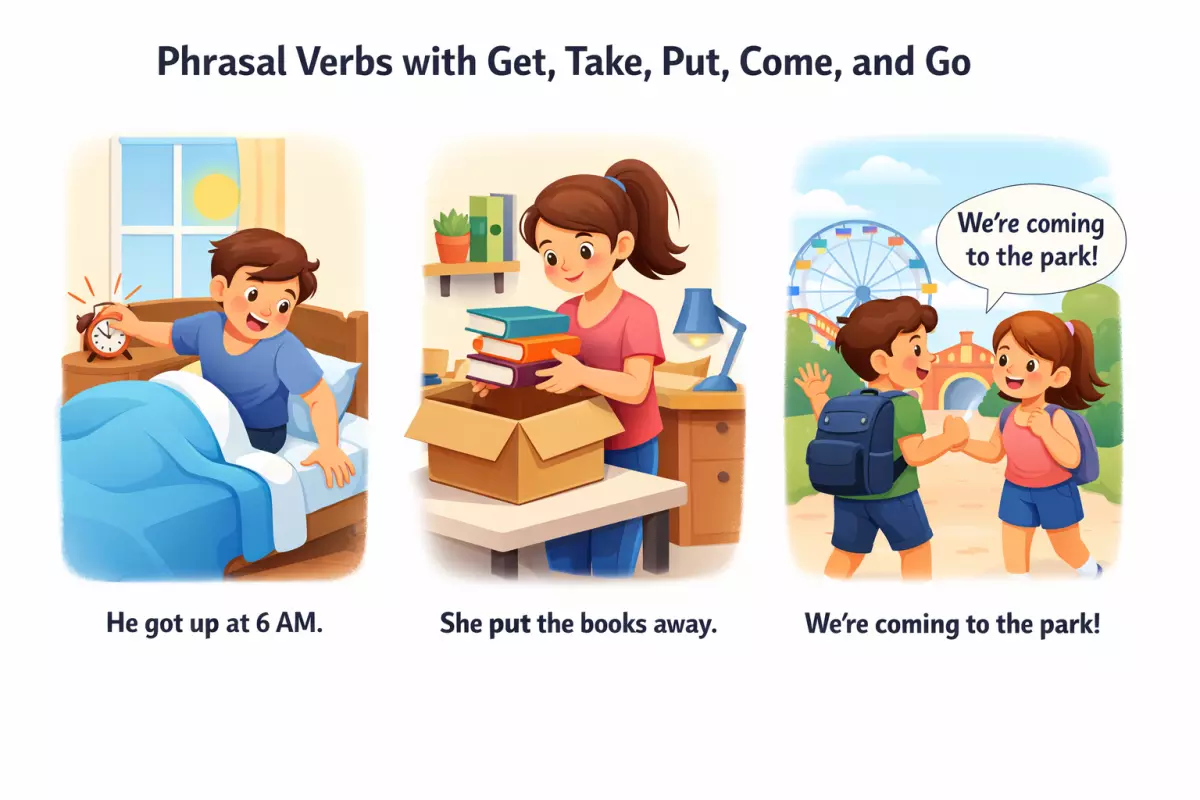 The article explains why get, take, put, come, and go form so many phrasal verbs, then lists common examples with meanings and shows how they’re used in everyday English. It also compares literal vs idiomatic uses, highlights typical learner confusion, and ends with homework practice.
Everyday English gets easier when you understand common phrasal verbs built around get, take, put, come, and go. These short verbs combine with particles to form meanings you will hear at work, in messages, and in casual conversation, often far from the original verb. This article explains what they mean in context and how to pick the right one naturally.
Why these verbs form many phrasal verbs
These five verbs are extremely common, and they stay flexible because their basic meanings are broad. When you add a short particle (like up, out, off, in, on), the combination quickly becomes more specific. Over time, frequent combinations turn into fixed, everyday expressions.
1) They have “light verb” meanings that invite particles
Get, take, put, come, and go often act as general-purpose verbs. The particle carries much of the meaning, so the verb + particle works like a compact mini-idiom.
- get = obtain/become/arrive: get + particle narrows the idea (obtain, recover, escape, communicate).
- take = remove/accept/use: particles add direction or result (remove completely, accept reluctantly, start doing).
- put = place/arrange/express: particles show where, how, or for what purpose (postpone, tolerate, deceive).
- come = move/occur: particles mark completion, appearance, or return (appear, recover, happen unexpectedly).
- go = move/change: particles show change of state, continuation, or disappearance (continue, stop working, leave).
2) Particles encode common “direction” and “result” patterns
Many particles have consistent core meanings. Learners can often guess a new combination by recognizing the particle’s usual role.
- up often signals completion or increase: clean up, use up, speed up.
- out often signals removal, disappearance, or discovery: find out, run out, figure out.
- off often signals separation or stopping: take off, cut off, go off.
- on often signals continuation or attachment: carry on, put on, go on.
- in often signals entry or inclusion: come in, take in, hand in.
- back often signals return or reversal: come back, get back, take back.
- over often signals repetition or review: go over, think over, take over.
- away often signals distance, removal, or continuous action: go away, take away, put away.
- down often signals reduction or suppression: calm down, turn down, write down.
- through often signals completion of a process: go through, get through, pull through.
3) They map well to everyday situations, so new combinations spread fast
Because these verbs cover movement, change, and handling objects, they fit daily communication. That usefulness makes certain verb + particle pairings “stick” and become standard.
- Movement and travel: come back, go out, get in, take off.
- Starting and stopping: go on, come on, put off, take up.
- Social interaction: get along, come over, go out (socially), take on (responsibility).
- Work and tasks: get through, take over, put together, go ahead.
- Problem-solving: figure out (often with out patterns), work out, sort out.
4) Some combinations become idioms, but many are still predictable
A useful learning strategy is to separate “mostly literal” combinations from strongly idiomatic ones. Literal ones follow the direction/result meaning; idioms need memorizing.
- More literal: come in, go out (leave the house), put down (place on a surface), take off (remove clothing).
- More idiomatic: get over (recover emotionally), take after (resemble), put up with (tolerate), come across (seem/encounter), go off (explode/stop liking).
5) They support many grammar patterns (object placement and extra particles)
These verbs combine easily with objects and additional particles, which creates many usable structures in real sentences.
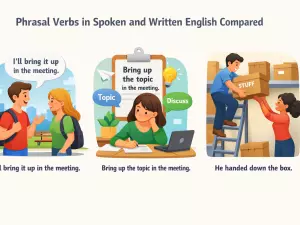
- Separable patterns with objects: ✅ put the meeting off / put off the meeting.
- Pronoun placement: ✅ put it off ❌ put off it (common rule for separable phrasal verbs).
- Two-particle combinations: get away with, put up with, come up with, go in for, take up on (less common, but the pattern exists).
- Passive-friendly forms in formal contexts: The plan was put off, The lights were turned off (many phrasal verbs allow this).
Common get phrasal verbs
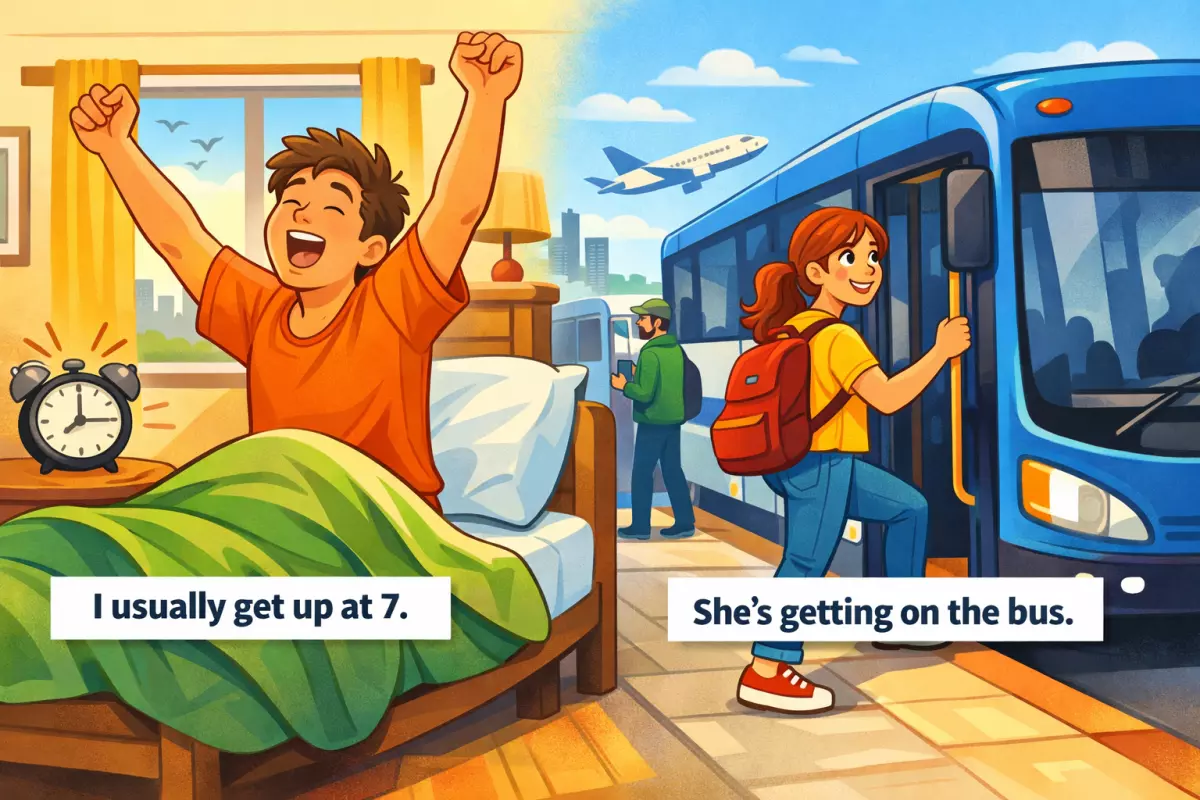
Many expressions with get focus on change (a new state), movement (arrive/leave), relationships (communicate), or managing difficulties (recover, escape). A useful pattern is that the particle often signals the direction of the change: up can suggest increase or completion, over often suggests recovery, and along/on frequently relates to progress.
Everyday meanings and how to use them
- get up = rise from bed; also stand up.
Example: I usually get up at 7. - get on = board a bus/train/plane; also continue/progress.
Example: We got on the train at Central Station. - get off = leave a bus/train; also finish work.
Example: I get off work at 6. - get in = enter (a car/building); arrive.
Example: What time did you get in last night? - get out = leave; escape; become known.
Example: The news got out quickly. - get back = return; regain something.
Example: I’ll call you when I get back. - get away = leave to take a break; escape.
Example: We’re trying to get away for the weekend. - get over = recover from an illness/upset; overcome.
Example: She got over the flu in a week. - get through = finish something difficult; survive; reach someone by phone.
Example: I finally got through to customer service. - get by = manage with limited money/time; survive.
Example: We can get by with one car. - get along (with) = have a good relationship.
Example: Do you get along with your neighbors? - get on (with) = continue doing something; make progress.
Example: Let’s get on with the meeting. - get together = meet socially; gather.
Example: We should get together sometime next week. - get into = become interested/involved; enter (a place); put on clothing (informal).
Example: He got into jazz at college. - get out of = avoid a duty; leave a place/vehicle.
Example: She got out of doing the dishes. - get rid of = remove/throw away.
Example: I need to get rid of these old files. - get back to = return to a topic; respond later.
Example: I’ll get back to you tomorrow. - get ahead = make progress, especially in work/life.
Example: He works evenings to get ahead.
Common grammar patterns to notice
- Movement: get in/out/on/off/back/away often answers “Where?” or “When?”
✅ We got off at the next stop. ❌ We got off the next stop. - Recovery/overcoming: get over + noun (an illness, a breakup, a shock).
Example: It took months to get over the accident. - Completion/connection: get through + task/call.
Example: Can you get through this report by Friday? - Relationships: get along with + person/group (not “get along someone”).
Example: She gets along with everyone. - Avoiding obligations: get out of + noun/-ing.
Example: He got out of paying the fee.
Take phrasal verbs and meanings
Many expressions with take fall into a few common patterns: “remove/collect” (take away, take off), “accept/assume” (take on, take up), “react” (take after, take to), and “use time/effort” (take up time). Some are separable (you can place the object between the verb and particle), while others are not.
Common phrasal verbs with take
- take off — remove clothing; also (for planes) leave the ground; also become suddenly successful.
- Remove: “Take off your jacket.”
- Flight: “The plane took off on time.”
- Success: “Her career took off last year.”
- take away — remove something; reduce a feeling or quality; (food) buy to eat elsewhere.
- “Please take away these empty plates.”
- “This doesn’t take away from your achievement.”
- take back — return something; admit you were wrong and retract a statement.
- “I’m going to take back the shoes.”
- “I take back what I said.”
- take in — understand; deceive; allow someone/something to stay; make clothing narrower.
- “It took me a while to take it all in.”
- “He was taken in by the scam.”
- “They took in a stray cat.”
- “The tailor can take in the waist.”
- take on — accept work/responsibility; hire; compete against; acquire a particular look or quality.
- “She took on a new project.”
- “The company is taking on two interns.”
- “Our team will take on the champions.”
- “The room took on a warmer feel.”
- take up — start a hobby/activity; use space or time; accept an offer; raise an issue for discussion.
- “He took up tennis.”
- “This desk takes up too much room.”
- “I’d like to take up your offer.”
- “She took up the problem with her manager.”
- take over — gain control of something; replace someone in a job or task.
- “A larger firm took over the business.”
- “Can you take over while I’m out?”
- take after — resemble a family member in appearance or personality. (Not separable)
- “She takes after her mother.”
- take to — start to like something; develop a habit; go to a place for safety/shelter. (Not separable)
- “I took to the new schedule quickly.”
- “He’s taken to waking up at 5 a.m.”
- “The villagers took to the hills.”
- take out — remove from a place; invite someone on a date; obtain food to eat elsewhere; destroy/disable.
- “Take out the trash.”
- “He took her out to dinner.”
- “We’ll take out pizza tonight.”
- “The storm took out the power lines.”
- take down — remove from a higher position; write notes; defeat someone.
- “Take down the posters.”
- “Let me take down your number.”
- “They finally took down the champion.”
- take apart — separate into pieces; criticize something in detail.
- “He took the engine apart.”
- “The reviewer took the argument apart.”
- take through — explain step by step; guide someone through a process. (Often separable with a pronoun)
- “Can you take me through the report?”
- take up with — become friendly with; start associating with (sometimes disapproving tone). (Not separable)
- “He’s taken up with a new group of friends.”
Usage patterns to notice
- Separable vs. inseparable:
- Separable: “take off your shoes” / “take your shoes off” ✅
- Pronoun rule: “take them off” ✅ → “take off them” ❌
- Inseparable: “take after your dad” ✅ (not “take your dad after” ❌)
- Meaning shifts with context: “take off” can mean remove clothing, depart, or become popular; the subject and situation usually make the meaning clear.
- Common objects:
- take out: trash, money, food, someone (on a date)
- take on: responsibility, work, staff, a challenge
- take in: information, a person/animal, a dress/skirt
Put phrasal verbs in everyday English
These expressions with put are common in spoken and written English because they describe actions like placing, delaying, tolerating, or suggesting. Many follow a simple pattern: put + particle (on/off/away/up/through/forward), and several are separable when they take an object.
Core meanings and when to use them
- put on = wear or add (clothes, music, an accent). “Put on your jacket.” / “She put on some jazz.”
- put off = delay or discourage. “Let’s put off the meeting.” / “The smell put me off my food.”
- put away = store, tidy, or save (money). “Put the groceries away.” / “He puts away a little each month.”
- put up = build/erect, display, or provide accommodation. “They put up a fence.” / “Put up the notice.” / “We can put you up for the night.”
- put up with = tolerate (often negative situations). “I can’t put up with the noise.”
- put down = place on a surface, criticize, or euthanize (animals). “Put the box down.” / “Don’t put him down in public.”
- put out = extinguish, publish/issue, or inconvenience. “Put out the fire.” / “The company put out a statement.” / “Sorry to put you out.”
- put in = install or submit (effort, time, an application). “They put in new windows.” / “She put in a request.”
- put through = connect (a call) or make someone complete something difficult. “Could you put me through to Sales?” / “They were put through a tough interview.”
- put back = return to a place or delay (schedule). “Put it back where it belongs.” / “The flight was put back an hour.”
- put forward = propose an idea or candidate. “He put forward a plan.”
- put up to = encourage someone to do something (often mischievous). “Who put you up to this?”
- put over = communicate successfully; sometimes “postpone” in some varieties. “She put her point over clearly.”
- put together = assemble or create. “Put together the shelf.” / “He put together a quick presentation.”
- put aside = save or ignore temporarily. “Put aside some money.” / “Let’s put that issue aside for now.”
Separable vs. inseparable patterns (the rule that prevents mistakes)
- Separable: the object can go between the verb and particle.
- ✅ “Put the coat on.” / “Put on the coat.”
- ✅ With pronouns, place the pronoun in the middle: “Put it on.” ❌ “Put on it.”
- Common separable ones: put on, put off, put away, put down, put out, put back, put together.
- Inseparable: the object must come after the whole phrasal verb.
- ✅ “Put up with the noise.” ❌ “Put the noise up with.”
- ✅ “Put me through to reception.” (object follows the full verb phrase)
- Common inseparable ones: put up with, put up to (and often put through in the “connect a call” meaning).
Quick usage notes that help you sound natural
- Put off (delay) is neutral; put off (disgust/discourage) is emotional: “The attitude put me off.”
- Put up can mean “raise/display” (“put up a sign”) or “stay somewhere” (“put you up”). Context usually makes it clear.
- Put down for criticism is common in everyday speech: “He keeps putting me down.” It’s stronger than “tease.”
- Put in often collocates with effort/time: “put in hours,” “put in the work,” “put in an application.”
- Put away is used for tidying and saving; for “hide,” speakers often choose “hide” unless the context is storage.
Come and go phrasal verb patterns
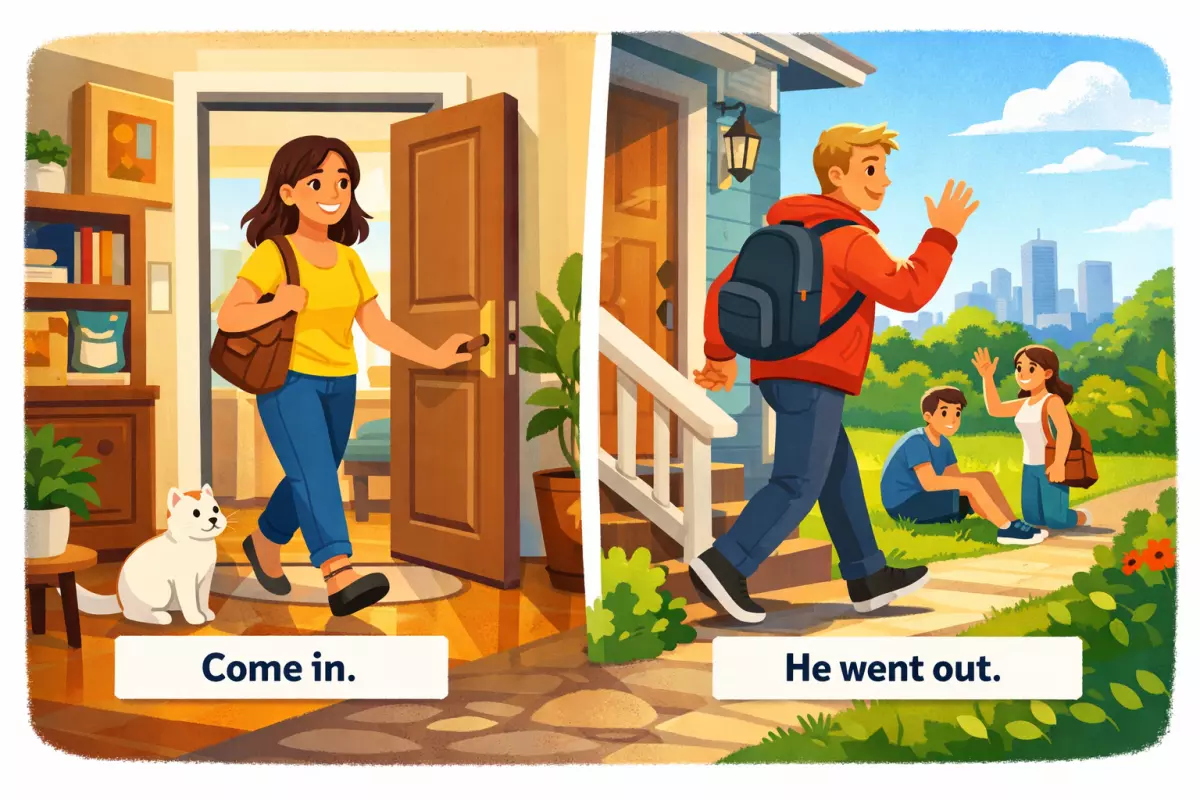
With come and go, many phrasal verbs describe movement, change, or how something starts and stops. The most useful patterns are about (1) whether the verb needs an object, (2) whether the particle can move, and (3) which preposition typically follows.
Core usage patterns to notice
- Intransitive movement (no object): many common forms don’t take a direct object.
- come in / go out: “Come in.” / “He went out.”
- come back / go back: “She came back late.” / “We’ll go back tomorrow.”
- come over / go over: “Come over after work.” / “Let’s go over again.” (also “review”)
- come along / go along: “Come along!” / “I’ll go along with you.”
- come around: “He came around eventually.” (recover/agree)
- go away: “Go away.” / “The pain went away.”
- Verb + particle + preposition: some combinations are “fixed” and are usually followed by a preposition phrase.
- come up with + noun: “She came up with a plan.”
- go through + noun: “We went through the contract.” (review) / “He went through a hard time.”
- come down with + illness: “I came down with the flu.”
- go in for + activity: “She goes in for swimming.”
- go back on + promise/word: “Don’t go back on your promise.”
- come out with + statement/product: “The company came out with a new model.”
- Transitive “process” meanings (object required): these often describe checking, reviewing, or handling information.
- go over + noun: “Let’s go over the main points.”
- go through + noun: “Go through your notes.”
- come across + noun: “I came across an old photo.” (find by chance)
- come by + noun: “Good jobs are hard to come by.” (obtain)
- Separable vs. inseparable: with come and go, most phrasal verbs are inseparable (the particle does not move).
- ✅ “I came across a mistake.” ❌ “I came a mistake across.”
- ✅ “We went through the report.” ❌ “We went the report through.”
- Because separability is rare here, learn these as fixed chunks rather than trying to “move” the particle.
- Register and context: some are neutral everyday speech, while others sound more formal or specific.
- come in / go out / come back / go away: everyday, literal movement.
- go through (review/endure) and come up with (invent): common in work and study contexts.
- come to (regain consciousness/realize): “He came to after a few minutes.” / “I came to understand.”
- Common time and place add-ons: these verbs frequently pair with short adverbials that clarify direction or timing.
- come back + later/soon/tomorrow: “Come back later.”
- go out + tonight/for dinner: “We’re going out tonight.”
- come over + to my place: “Come over to my place.”
- go in + for a minute: “I’ll go in for a minute.”
Quick meaning cues (useful for guessing)
- come + up often signals “appear/arrive” or “be mentioned”: “A problem came up.” / “That topic came up.”
- go + on often signals “continue/happen”: “Go on.” / “What’s going on?”
- come + out often signals “become public/available”: “The results came out.”
- go + down often signals “decrease” or “be received”: “Prices went down.” / “The joke went down well.”
- come + off often signals “succeed” or “detach”: “The plan came off.” / “The label came off.”
- go + off often signals “explode/ring/spoil”: “The alarm went off.” / “The milk went off.”
Literal vs idiomatic meanings
Phrasal verbs can be easier to learn when you separate the concrete, physical sense (movement, placement, direction) from the figurative sense (progress, relationships, decisions, emotions). With verbs like get, take, put, come, and go, the particle (up, out, off, on, in, over, etc.) often signals a consistent “direction” of meaning even when the whole expression becomes idiomatic.
Common patterns that signal a physical (more literal) meaning
- Location or direction: particles like in, out, up, down, away often describe where something moves.
- Get in/out: enter/leave a car or room.
- Go out: leave the house; move outside.
- Come in: enter (toward the speaker’s location).
- Placement: put + particle frequently stays concrete because “put” already means “place.”
- Put down the bag: place it on a lower surface.
- Put on a jacket: place clothing onto your body.
- Removal: off and out often involve taking something away from a surface/container.
- Take off your shoes: remove them.
- Take out the trash: remove it from inside and carry it away.
- Completion or reaching a point: get to, come to, go to can be literal (arrive) when followed by a place.
- We got to the station at 6.
- She came to the office early.
Common patterns that signal a figurative (more idiomatic) meaning
- Up = increase, improvement, completion, or creating something
- Get up to speed: reach the needed level of knowledge.
- Take up a hobby: start doing it regularly.
- Put up with noise: tolerate it. (Not physical “up.”)
- Come up with an idea: produce/think of it.
- Go up in price: increase.
- Out = become known, be discovered, be removed from a situation, or stop functioning
- Find out the truth: discover it.
- It came out that he resigned: became public.
- Put out a statement: publish/release it.
- The lights went out: stopped working (no longer lit).
- Take someone out: go on a date or bring them somewhere socially.
- On = continuation, activation, or attachment to an activity
- Go on talking: continue.
- Come on: show enthusiasm/encourage; sometimes expresses impatience.
- Put on an accent: pretend or adopt it (not literally “put”).
- Get on (with someone): have a good relationship.
- Off = separation, cancellation, reduction, or leaving a state
- Call off a meeting: cancel it.
- Get off work: finish work; leave the job for the day.
- Take off (a business): become successful quickly.
- Go off (an alarm): start ringing/sounding.
- Over = review, transfer, or “again” in a careful way
- Go over notes: review.
- Talk it over: discuss before deciding.
- Come over: visit (often informal; not always about crossing space).
- Hand over the keys: transfer control/possession.
Usage checks that help you decide which meaning is intended
- Look at the object: a physical object often supports a concrete reading (take off your coat), while an abstract noun pushes an idiomatic one (take off as a trend).
- Check if substitution works: if you can replace the phrasal verb with a single verb without changing the core meaning, it’s likely idiomatic (find out → discover; put up with → tolerate).
- Notice who/what moves: literal uses usually involve real movement or placement; figurative uses often describe change in state (go out = stop being fashionable; come around = change your opinion).
- Watch for fixed combinations: some pairings are strongly set and rarely literal in modern usage (come up with, put up with, get along).
- Pay attention to context signals: time, plans, relationships, and opinions often cue figurative meanings (get over a breakup; go on a diet; come to an agreement).
Typical learner confusion
Many mistakes with these multi-word verbs come from treating them like simple “verb + preposition” combinations, or assuming the base verb meaning stays the same. In practice, the particle (up, off, out, in, on, over, etc.) often carries the key meaning, and small changes in word order can change what sounds natural or even what is correct.
1) Mixing up similar particles (up / out / off / over)
- get up (leave bed; stand) vs get out (leave a place/vehicle) vs get off (leave a bus/train; stop touching/stop working) vs get over (recover; move past a problem).
- take off (remove clothing; plane leaves the ground; suddenly become successful) vs take out (remove; invite; buy food to eat elsewhere).
- put off (delay) vs put out (extinguish; publish; inconvenience) vs put up (build/erect; tolerate; provide accommodation).
- come over (visit informally) vs come out (become known; be released/published; appear) vs come off (succeed; detach).
- go on (continue; happen) vs go off (explode; alarm rings; food becomes bad; leave suddenly) vs go out (stop burning; socialize; stop being available).
2) Choosing the wrong verb when the meaning is “become” or “change”
- Using get for changes of state is common, but it does not replace everything: get tired, get worse, get better are natural; but many fixed expressions prefer other verbs (for example, “become available” is often better as be available or come out depending on context).
- get + past participle often focuses on the result or what happened: “He got fired.” This can sound more informal than “He was fired.”
- come and go are frequently confused because they depend on viewpoint: “Come over” (toward the speaker) vs “Go over” (away from the speaker, or to check something carefully).
3) Word order with objects (separable vs inseparable)
- With many separable forms, a noun object can go in the middle or at the end: “put the meeting off” / “put off the meeting.”
- Pronoun objects usually must go in the middle: ✅ “put it off” ❌ “put off it.”
- Some combinations are typically inseparable in everyday use: “get over a cold” (not “get a cold over”); “go into details” (not “go details into”).
- When learners memorize only the base verb (“put = place”), they may place objects incorrectly because the phrasal unit is not treated as one meaning.
4) Confusing “movement” meanings with “completion” meanings
- get in can mean enter a car/building, but it can also mean “arrive” in some contexts: “What time did you get in?”
- take in can mean physically bring inside, but also “understand” or “absorb”: “I couldn’t take in the instructions.”
- put in can mean insert physically, but also “submit” or “spend time/effort”: “She put in an application”; “He put in extra hours.”
- go through can mean pass from one side to another, but also “experience” or “examine”: “They went through a difficult year”; “Let’s go through the plan.”
5) Overusing one phrasal verb for many situations
- Learners often rely on a small set (especially get on, get off, get out) and apply them too widely, producing unclear meaning.
- Build contrast sets instead of single items. For example, separate “continue” meanings: go on (continue), carry on (continue), keep on (continue repeatedly), and use go on mainly for events, stories, or activities.
- For “tolerate,” learners may use put up alone; it is usually put up with: ✅ “I can’t put up with the noise.”
6) Common mix-ups to watch for (quick contrasts)
| Often confused | Typical meaning difference | Example (natural use) |
|---|---|---|
| get on vs get in | board public transport vs enter a car/building | “We got on the train.” / “She got in the car.” |
| take off vs get off | remove (clothes) / depart (plane) vs leave transport; stop touching/annoying | “Take off your shoes.” / “Get off the bus at the next stop.” |
| put off vs take off | delay vs remove; depart | “They put off the meeting.” / “The plane took off late.” |
| come back vs go back | return toward the speaker/starting point vs return away from the speaker | “Come back soon.” / “Go back to your seat.” |
| go out vs come out | leave home/socialize; stop burning/working vs become visible/known; be released | “We’re going out tonight.” / “The report came out yesterday.” |
7) Patterns that reduce errors
- Learn in chunks with a typical object: “put off a meeting,” “take out the trash,” “get over a cold,” “come across an article,” “go through a checklist.”
- Notice pronoun placement early: “turn it down,” “put it away,” “take it back,” “pick it up” (this habit transfers well to similar structures).
- Group by function, not by base verb: “delay” set (put off, hold off), “recover” set (get over, bounce back), “start/continue” set (go on, carry on).
- Check whether the particle is literal (movement) or figurative (completion, cancellation, discovery). If the meaning feels abstract, treat the whole phrase as one vocabulary item.
Homework: common phrasal verb practice
Use these tasks to build accuracy with phrasal verbs formed with get, take, put, come, and go. Focus on two patterns as you work: (1) meaning changes when the particle changes (up/out/off/on/over/back), and (2) some combinations are separable (object can go in the middle), while others are not.
1) Choose the best phrasal verb
Complete each sentence with the best option. Use the correct tense.
- I’m trying to ______ smoking this year.
- Can you ______ the lights when you leave?
- She ______ a new hobby during the lockdown.
- We need to ______ the meeting until next week.
- He ______ his jacket because it got warm.
- How do you usually ______ stress before exams?
- The plane ______ on time despite the rain.
- I can’t ______ how to solve this problem.
- Please ______ your shoes before entering.
- They ______ a lot of money after the company was sold.
- It took me a while to ______ the flu.
- The neighbors complained, so we had to ______ the music.
Show answers
- give up
- turn off
- took up
- put off
- took off
- deal with
- took off
- figure out
- take off
- made (a lot of money) / came into (a lot of money) (either can work depending on the lesson focus; “came into” suggests inheritance or unexpected gain)
- get over
- turn down
2) Separable or not? Place the object correctly
Rewrite each sentence in a natural way. Some items have two correct versions; keep the meaning the same.
- She put on quickly her coat.
- Could you turn down it a bit?
- He looked up the word it in the dictionary.
- They put off until Friday the decision.
- I’m going to pick up from the station my sister.
- We need to sort out today this issue.
- He ran into yesterday an old friend.
- Please take out after dinner the trash.
Show answers
- She quickly put on her coat. / She put her coat on quickly.
- Could you turn it down a bit?
- He looked the word up in the dictionary. (If using “it”: He looked it up in the dictionary.)
- They put off the decision until Friday. / They put the decision off until Friday.
- I’m going to pick my sister up from the station. / I’m going to pick up my sister from the station.
- We need to sort this issue out today. / We need to sort out this issue today.
- He ran into an old friend yesterday.
- Please take the trash out after dinner. / Please take out the trash after dinner.
3) Match the meaning to the pattern (particle clues)
Choose the best particle (up/out/off/on/over/back) to complete each idea. Then write one original example sentence for each.
- get ___ = recover from an illness or disappointment
- take ___ = remove (clothes) / leave the ground (plane)
- put ___ = postpone
- come ___ = discover/find by chance (information, an object)
- go ___ = review again; repeat to check details
- get ___ = become friendly/continue well (relationships)
- take ___ = start a new activity (hobby, habit)
- put ___ = wear (clothes) / start a device
- come ___ = return
- go ___ = stop working (a machine/system)
Show answers
- get over
- take off
- put off
- come across
- go over
- get on
- take up
- put on
- come back
- go out
4) Short writing task (controlled practice)
Write one short paragraph (70–120 words) about a busy week. Use at least eight different phrasal verbs from this set, each used once: get over, get on, take off, take up, put off, put on, come across, come back, go over, go out, turn down, figure out. Aim for natural context and correct word order with objects.
5) Self-check checklist (usage and patterns)
- Check meaning first: the same verb + different particle often creates a new idea (get over vs. get on; take off vs. take up).
- Check separability: if there is a pronoun object (it/them), place it in the middle for separable verbs (turn it down, pick them up).
- Check tense: many are regular in the past (put off → put off), but some change form (take → took; get → got).
- Check formality: many combinations are neutral and common in speech; in formal writing, you may prefer a one-word verb (postpone instead of put off) if required.