Perception Verbs: See, Hear, Watch, Feel + Object Forms

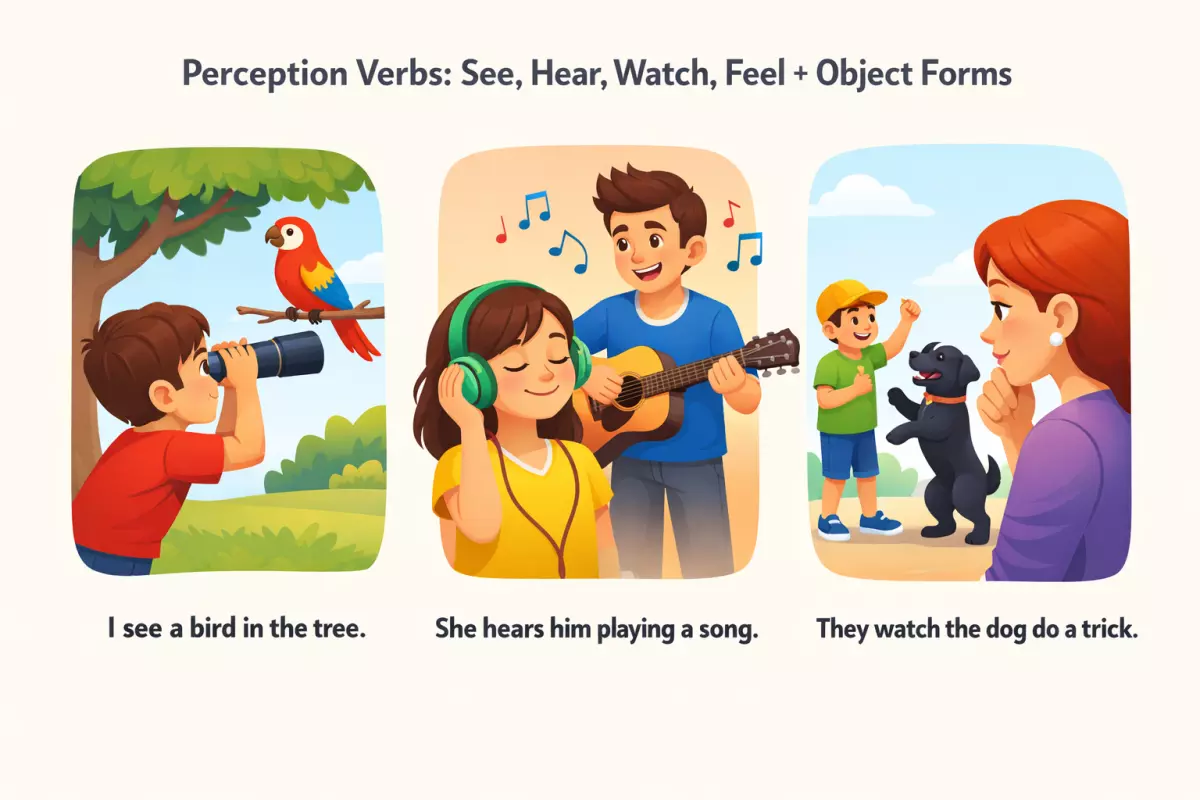 This article explains what perception verbs express, how to use verb + object with the base form or the -ing form, and what the meaning difference is. It also covers passive forms, reported speech, typical learner mistakes, and homework practice tasks.
English shifts when you describe what you observe with verbs like see, hear, watch, and feel, especially when another person or thing is involved. In everyday conversation, the object and the verb form that follows can signal whether you noticed a complete action or only caught it in progress. Learning these patterns helps you sound natural, choose the right structure quickly, and avoid common mistakes.
What perception verbs express
These verbs describe information that comes through the senses (sight, hearing, touch, smell, taste). In English, they often focus on the moment you notice something, the process you observe, or the result you perceive. The grammar choices that follow them (bare infinitive, -ing form, or adjective) help show which meaning you intend.
Main meanings they communicate
- Direct sensory input: you experience something with your senses, not through thinking or guessing.
- I heard a strange noise.
- She felt cold air on her face.
- We smelled smoke in the hallway.
- Noticing an event in progress (process): you observe part of an action as it happens (often with an -ing form).
- I saw him crossing the street.
- They watched the children playing outside.
- We heard someone talking in the next room.
- Noticing a complete event (whole action): you perceive the action from start to finish (often with a bare infinitive).
- I saw him cross the street.
- She heard the door slam.
- We watched the plane land.
- Recognizing a state or quality: you perceive a condition, appearance, or change (often with adjectives or complements).
- He looked tired.
- The soup tastes salty.
- The fabric feels soft.
- It sounded like a good idea.
- Checking or monitoring (purposeful attention): you actively pay attention, especially with watch, listen (to), look (at).
- Watch the road.
- Listen to the instructions.
- Look at this photo.
- Immediate evidence: you use what you sense as proof for a conclusion, often with “seem” meanings (common with look/sound/feel).
- It looks like it might rain.
- That sounds wrong.
- This feels safer.
Typical patterns you will see
- Verb + object (perceiving a thing): I saw a cat. / She heard music.
- Verb + object + -ing (part of an action, in progress): I saw him running. / We heard them arguing.
- Verb + object + bare infinitive (whole action, complete event): I saw him run. / She heard the baby cry.
- Linking pattern (sense verb + complement): It smells awful. / The idea sounds reasonable. / He looked angry.
- Preposition patterns for active attention: look at, listen to (common when you choose to focus).
- She looked at the screen.
- He listened to the radio.
Common contrasts in meaning
- ✅ I saw her dance. (the whole performance, or at least a complete action) → ✅ I saw her dancing. (she was in the middle of it when I noticed)
- ✅ We watched the sun set. (complete change) → ✅ We watched the sun setting. (the process)
- ✅ It sounds interesting. (my impression from what I hear/know) → ✅ I heard something interesting. (actual sound/information received)
Choosing the pattern is not just grammar; it signals whether you mean a thing, an ongoing action, a completed event, or an impression about a state. This is why the same verb can shift meaning depending on what comes after it.
Verb + object + base form

Use this pattern when you want to report what you perceived as a complete action or event. The second verb stays in the base form (the dictionary form) and does not change for tense; the perception verb (see/hear/watch/feel) carries the tense instead.
Core meaning
- Whole event: the speaker notices the action from start to finish, or as a complete unit (not just in progress).
- Focus on the action: the object is the person/thing doing the action; the base verb names what they did.
- Tense stays on the first verb: “I saw…” / “She hears…” / “We watched…”
Common examples
- I saw him leave the building.
- We heard the baby cry.
- She watched the team win the match.
- They felt the ground shake.
- I heard someone knock on the door.
- He saw the bus stop at the corner.
- We watched the cat catch a mouse.
- She heard her name called.
- I felt my phone vibrate.
- They saw the lights go out.
- We heard the glass break.
- He watched the chef slice the vegetables.
- I saw the guard open the gate.
- She felt her hands tremble.
- They heard the crowd cheer.
- We saw the plane land.
Form notes and typical mistakes
- Use an object form after the perception verb: “I saw him leave,” not “I saw he leave.”
- Keep the second verb in the base form: ✅ “I heard her sing.” ❌ “I heard her sang.”
- Don’t add “to” in active voice: ✅ “We watched them play.” ❌ “We watched them to play.”
- With “feel,” this structure is common for physical sensations and noticeable movements: “I felt the floor move,” “She felt her heart race.”
When to choose base form instead of -ing
- Choose the base verb when the perception is of the action as a complete event: “I saw him cross the street.”
- Choose -ing when the perception highlights the action in progress: “I saw him crossing the street.”
- In real-life speech, both can be possible; the difference is usually about viewpoint (complete vs. ongoing), not about grammar correctness.
Verb + object + -ing form
Use the -ing form after a perception verb and an object to show an action in progress. This pattern focuses on what you observed happening, often as an unfolding scene rather than a completed event.
Core meaning and when to choose it
- Ongoing action: highlights that the action was in progress when you noticed it. Example: “I saw her crossing the street.”
- Background activity: the action can be the setting or atmosphere. Example: “We heard people talking outside.”
- Partial observation: you may not see the whole action from start to finish. Example: “He watched them playing in the park.”
- Repeated/extended activity (context-dependent): can suggest activity continuing for a while. Example: “I felt my phone vibrating in my pocket.”
Common verbs and typical objects
- see + person/thing: “I saw the dog digging in the garden.”
- hear + person/thing/sound source: “She heard someone knocking at the door.”
- watch + person/thing: “They watched the kids building a sandcastle.”
- feel + body part/object: “He felt his hands shaking.”
- notice (often used similarly): “I noticed him looking at the clock.”
Example sentences (varied, classroom-friendly)
- I saw Maria waiting by the bus stop.
- We heard the neighbors arguing through the wall.
- He watched the chef chopping onions.
- She felt the baby kicking.
- They saw smoke rising from the hill.
- I heard a dog barking all night.
- She watched the sun setting behind the buildings.
- He felt cold air coming in under the door.
- We saw people running toward the station.
- I heard my name being called from across the room.
- She noticed him smiling at the message.
- They watched the plane descending over the sea.
- I felt the floor shaking during the storm.
- We heard music playing upstairs.
- He saw the lights flickering in the hallway.
- She watched the cat stalking a bird.
Form notes and frequent learner errors
- Object is required: “I saw him running,” not “I saw running” (unless the subject is clear in context and you rephrase).
- Use an object pronoun: “I heard her singing,” not “I heard she singing.” ✅ “I heard her singing.” ❌ “I heard she singing.”
- Passive -ing is possible: when the object receives the action. Example: “We saw the car being towed.”
- Don’t confuse with a finished action: if you mean you witnessed the whole event, the base form is often more natural (covered in the base-form section). With -ing, the emphasis stays on the action as it was happening.
Meaning differences between forms
With perception verbs (see, hear, watch, feel), the form after the object changes what you mean: a complete event, an event in progress, or a general fact/ability. The choice is mostly about what part of the experience you focus on.
| Form after the object | Typical meaning and focus | Common verbs | Example |
|---|---|---|---|
| Object + base verb (bare infinitive) | Whole action/event is perceived (often from start to finish), or the action is seen/heard as a complete unit. | see, hear, feel (less often watch) | I saw him cross the street. |
| Object + -ing (present participle) | Action in progress; you notice part of the event (ongoing scene), not necessarily the beginning or end. | see, hear, watch, feel | I saw him crossing the street. |
| Object + past participle | Focus on the result/state (often passive meaning) rather than the action itself. | see, hear, feel | I heard my name mentioned in the meeting. |
| Object + adjective / noun phrase | Perception of a state, quality, or identity (not an action). | see, feel | I saw the room empty. |
| That-clause (often after hear, sometimes see) | Information learned/understood (more “find out” than direct sensory perception). | hear, see | I heard that the flight was delayed. |
Base verb vs -ing: what changes
- Complete event: “I heard her sing the anthem.” (the performance as a whole)
- In progress: “I heard her singing in the shower.” (an ongoing sound/scene)
- Single, bounded action often prefers the base verb: “I saw the glass fall.”
- Background activity often prefers -ing: “I saw people walking along the river.”
- Start-to-finish is not always literal: the base verb can also mean you perceived the action as a whole, even if you didn’t watch every second: “I saw him leave.”
- Watch naturally fits ongoing viewing, so -ing is very common: “We watched them playing.” (Base verb is possible but often sounds more formal or “complete event” focused.)
Past participle: result or passive meaning
- Use the past participle when the object is not doing the action; it is affected by it: “She saw the window broken.”
- This form often highlights the state you notice: “I found the door closed” is similar in meaning to “I saw the door closed.”
- With hear, it commonly reports words/information as something received: “We heard the plan explained.”
- Contrast with -ing (action happening): “I heard my name being mentioned” (in progress) vs “I heard my name mentioned” (fact/result).
State complements (adjective / noun) vs action complements
- Use an adjective when you perceive a condition: “I saw the child asleep.” / “I felt my hands cold.”
- Use a noun phrase for identity/role (more common with see): “They saw him a leader.” (often closer to “consider,” depending on context)
- Choose an action form (base/-ing) when you perceive movement or activity: “I saw the child sleeping.”
Direct perception vs “learned information” (that-clauses)
- Direct sensory experience: “I heard him argue with the manager.”
- Report/knowledge: “I heard that he argued with the manager.” (you may not have heard it yourself)
- With see, a that-clause often means “understand/realize”: “I see that you’re upset.” (not literal eyesight)
Passive forms with perception verbs
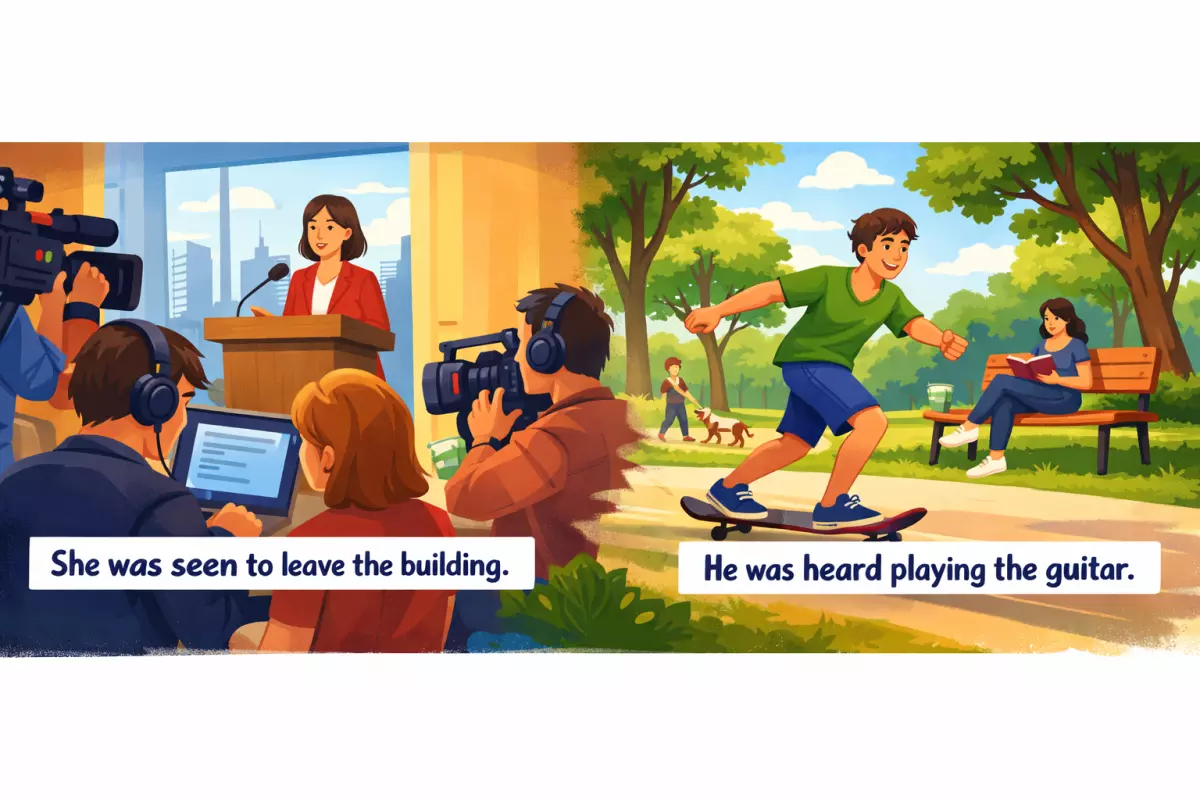
With verbs like see, hear, watch, and feel, the passive is used to shift attention from the observer to the person or thing that was perceived. The typical result is a structure like: Subject + be + past participle + to-infinitive / -ing.
Core patterns
- Passive + to-infinitive (common in reports, news, and formal writing):
Subject + be + seen/heard/felt/observed/noticed + to + base verb. - Passive + -ing (focus on an action in progress):
Subject + be + seen/heard/felt + verb-ing. - Passive reporting style: the observer is often omitted because it is unknown, unimportant, or obvious (e.g., “by the police,” “by witnesses” is optional).
To-infinitive vs. -ing in the passive
- Use to-infinitive to present the perceived event as a complete action or as a fact: “He was seen to enter the building.”
- Use -ing to highlight that the action was in progress at the time of perception: “He was seen entering the building.”
- In many contexts, both are possible but the meaning changes slightly (complete event vs. ongoing action).
Common passive forms with examples
- She was seen to leave the office at 6 p.m.
- She was seen leaving the office at 6 p.m.
- The suspect was heard to say “I’m sorry.”
- The suspect was heard saying “I’m sorry.”
- A child was heard crying in the hallway.
- The door was heard to slam upstairs.
- He was observed to cross the street against the light.
- He was observed crossing the street against the light.
- The engine was felt to vibrate under the floor.
- The ground was felt shaking during the quake.
- The announcement was barely heard over the noise.
- The footsteps were heard approaching the door.
- She was noticed to hesitate before answering.
- She was noticed hesitating before answering.
- The painting was seen hanging in the main gallery.
Form notes and frequent issues
- Object becomes subject: Active “They saw him leave” → Passive “He was seen to leave.”
- “To” often appears in the passive: ✅ “He was seen to leave.” ❌ “He was seen leave.”
- Keep the meaning of completion vs. progress: “was heard to sing” (the act as a fact) vs. “was heard singing” (in progress).
- Agent phrases are optional: “He was seen to leave (by a neighbor).” Add “by…” only when the observer matters.
- “Watch” in the passive is less common than “see/observe,” but it is possible when the watcher is not important: “They were watched entering the venue.” In formal styles, “were observed” is often preferred.
- Stative uses can appear with “seen” meaning “found/considered”: “He is seen as a leader.” (This is not a perception event; it is an opinion/interpretation meaning.)
Perception verbs in reported speech
When you report what someone saw, heard, or felt, the grammar usually shifts from a direct description of perception to an indirect report. The key choices are (1) whether you keep the original “object + verb” structure, and (2) whether you show the action as complete or in progress.
Common reporting patterns
- reporting verb + (that) + clause: Use this when you report the information, not the raw sensory experience.
- “I saw that the door was open.” → She said (that) she had seen that the door was open.
- “I heard that they were moving.” → He said (that) he had heard that they were moving.
- reporting verb + object + bare infinitive: Keeps the “witnessed the whole action” meaning.
- “I saw him leave.” → She said she had seen him leave.
- “I heard the baby cry.” → He said he had heard the baby cry.
- reporting verb + object + -ing: Keeps the “in progress / part of the action” meaning.
- “I saw him leaving.” → She said she had seen him leaving.
- “I heard them arguing.” → He said he had heard them arguing.
- reporting verb + object + past participle: Focuses on the result or state you noticed.
- “I saw the window broken.” → She said she had seen the window broken.
- “I heard my name mentioned.” → He said he had heard his name mentioned.
Tense and time shifts in indirect reporting
- If the reporting verb is in the past (said, told me), the perception is often backshifted:
- Direct: “I saw him leave.” → Reported: She said she had seen him leave.
- Direct: “I heard them arguing.” → Reported: He said he had heard them arguing.
- If the report is still true or the time is clearly “now,” speakers sometimes avoid heavy backshifting:
- She said she saw him leave (common in informal speech when the time is obvious).
- He said he can hear music from next door (still true at the time of speaking).
- Time words often change in reported speech:
- now → then
- today → that day
- yesterday → the day before
- this morning → that morning
What changes (and what stays the same)
- Pronouns shift to match the new speaker and listener:
- “I saw you take it.” → She said she had seen me take it.
- “We heard him call our names.” → They said they had heard him call their names.
- With tell, you normally need a listener; with say, you don’t:
- ✅ She told me she had seen him leave.
- ✅ She said she had seen him leave.
- ❌ She told she had seen him leave.
- Keep the perception structure if you want the “witness” meaning; switch to a clause if you want the “information” meaning:
- Witness: He said he had heard her sing (he personally heard it).
- Information: He said (that) he had heard that she could sing (he heard about it).
Example set (useful models)
- She said she had seen the car stop outside the house.
- He said he had seen someone waiting by the gate.
- They said they had heard the alarm go off.
- I was told that she had heard footsteps in the hallway.
- He said he had heard his name called.
- She said she had watched the children cross the street.
- They said they had watched the plane landing.
- He said he had felt the building shake.
- She said she had felt someone pulling her sleeve.
- He said he had noticed the lights flickering.
- She said she had seen the document signed.
- They said they had heard the door being locked.
- He said he had seen her smile and walk away.
- She said she had heard him speaking on the phone.
- They said they had felt the water getting colder.
- He said he had seen the package left at the entrance.
Typical learner mistakes
Errors with perception verbs usually come from mixing up two patterns: object + base verb (complete action) and object + -ing (action in progress). Learners also often add extra words like to
or use the wrong object form after the verb.
-
Adding
to
after the objectAfter verbs like
see
,hear
,watch
, andfeel
, the verb that follows the object is usually a base form (noto
).- ❌ I saw him to cross the street. → ✅ I saw him cross the street.
- ❌ We heard her to sing. → ✅ We heard her sing.
- ❌ They watched us to leave. → ✅ They watched us leave.
- ❌ I felt it to move. → ✅ I felt it move.
-
Choosing base verb vs. -ing without the meaning change
Base verb often suggests the whole event (from start to finish or as a complete unit). The -ing form highlights an action happening at that moment or over a period.
- ✅ I watched them play a full match. (the match as a complete event)
- ✅ I watched them playing in the park. (ongoing scene)
- ✅ She heard him knock twice. (a complete, countable action)
- ✅ She heard him knocking while she was on the phone. (repeated/continuous)
- ✅ We saw the plane land. (the landing happened)
- ✅ We saw the plane landing as we drove past. (in progress)
-
Using the wrong object form (subject vs. object pronouns)
The pronoun after the perception verb is an object:
me/him/her/us/them
, notI/he/she/we/they
.- ❌ I saw he run. → ✅ I saw him run.
- ❌ She heard they arguing. → ✅ She heard them arguing.
- ❌ We watched she dance. → ✅ We watched her dance.
- ❌ They felt we hesitate. → ✅ They felt us hesitate.
-
Confusing perception verbs with reporting verbs
Perception verbs describe direct sensory experience. If the meaning is “learn/understand from information,” learners often need a different structure.
- ❌ I heard him is sick. → ✅ I heard (that) he is sick. (information, not direct hearing)
- ❌ She saw that him leave. → ✅ She saw him leave. (direct observation)
- ❌ We heard them to be late. → ✅ We heard (that) they were late.
-
Mixing up
watch
andsee
in contexts that need intentionWatch
usually implies attention over time;see
can be accidental or simply noticing.- ❌ I watched a bird outside the window (for a second). → ✅ I saw a bird outside the window.
- ❌ We saw a movie for two hours. → ✅ We watched a movie for two hours.
- ✅ I watched him crossing the road. (I paid attention as it happened)
- ✅ I saw him cross the road. (I noticed the whole event)
-
Using an adjective where an -ing form is needed (and vice versa)
After
feel
, learners sometimes choose an adjective when the meaning is actually “perceive an action.”- ❌ I felt the ground unstable under my feet. (possible, but changes meaning to a state)
- ✅ I felt the ground shaking under my feet. (action in progress)
- ❌ She felt the baby awake. (state; may not match the intended meaning)
- ✅ She felt the baby move. / She felt the baby moving. (physical movement)
-
Awkward passive forms or missing the passive option
In passive voice, the
to
-infinitive often appears:He was seen to leave
. Learners may avoid it or form it incorrectly.- ❌ He was seen leave. → ✅ He was seen to leave.
- ❌ They were heard sing. → ✅ They were heard to sing.
- ✅ She was watched walking toward the station. (passive + -ing is also possible)
-
Forgetting that some objects are clauses, not people/things
When the “object” is a whole idea, English often uses a that-clause instead of
object + verb
.- ❌ I saw that the door close. → ✅ I saw the door close. (direct observation)
- ❌ I heard the news happen. → ✅ I heard (that) the news happened. (information)
- ❌ We felt that the situation change. → ✅ We felt the situation changing. (gradual change)
Homework: perception verb practice tasks
These tasks focus on the most common patterns with perception verbs (see, hear, watch, feel, notice, observe): object + base verb (complete action) and object + -ing (action in progress). Work through the exercises in order, and pay attention to object forms (me, him, her, us, them) after the verb.
1) Choose the correct complement: base verb or -ing
Complete each sentence with the correct form of the verb in parentheses.
- I saw her (cross) the street.
- We heard them (argue) in the hallway.
- Did you notice him (take) your seat?
- They watched the kids (play) in the yard.
- She felt the baby (kick) again.
- I heard someone (knock) twice.
- He saw the train (leave) the station.
- We watched the sun (set) behind the hills.
- I noticed my phone (vibrate) on the desk.
- She heard the door (close) softly.
- They saw him (run) across the parking lot.
- I felt my hands (shake) during the speech.
Show answers
- cross
- arguing
- take
- playing
- kick
- knock
- leave
- set
- vibrating
- close
- run
- shaking
2) Object forms after perception verbs
Rewrite each sentence using an object pronoun (me/him/her/us/them). Keep the meaning the same.
- I saw Sarah leave early. → I saw ____ leave early.
- We heard John and Mike laughing. → We heard ____ laughing.
- She watched the children run to the bus. → She watched ____ run to the bus.
- Did you notice I was shaking? → Did you notice ____ shaking?
- They felt the dog jump onto the bed. → They felt ____ jump onto the bed.
- I heard my parents talking downstairs. → I heard ____ talking downstairs.
- He saw you take the keys. → He saw ____ take the keys.
- We watched the team practicing. → We watched ____ practicing.
Show answers
- her
- them
- them
- me
- it
- them
- you
- them
3) Correct the errors (one error per sentence)
Each sentence has one mistake with the pattern (object form, verb form, or unnecessary “to”). Rewrite it correctly.
- ❌ I saw him to leave the building.
- ❌ She heard they arguing outside.
- ❌ We watched them to play basketball.
- ❌ I noticed her changed her password.
- ❌ They felt he was touch their bag.
- ❌ Did you see she cross the road?
- ❌ I heard the baby cried.
- ❌ He watched me to working late.
- ❌ We saw them went into the wrong room.
- ❌ She noticed him to texting during the meeting.
Show answers
- ✅ I saw him leave the building.
- ✅ She heard them arguing outside.
- ✅ We watched them play basketball.
- ✅ I noticed her change her password.
- ✅ They felt him touch their bag.
- ✅ Did you see her cross the road?
- ✅ I heard the baby cry.
- ✅ He watched me working late.
- ✅ We saw them go into the wrong room.
- ✅ She noticed him texting during the meeting.
4) Meaning choice: complete action vs. action in progress
Choose the option (A or B) that best matches the meaning in brackets.
- (I witnessed the whole action from start to finish.)
A) I saw him fall.
B) I saw him falling. - (The sound was happening for a while.)
A) I heard her sing in the shower.
B) I heard her singing in the shower. - (I caught the action while it was happening.)
A) We watched them practice.
B) We watched them practicing. - (I noticed the moment it happened.)
A) She felt the phone vibrate.
B) She felt the phone vibrating. - (I observed the entire event.)
A) They saw the car hit the curb.
B) They saw the car hitting the curb. - (I heard it as an ongoing background sound.)
A) He heard the neighbors talk.
B) He heard the neighbors talking.
Show answers
- A
- B
- B
- A
- A
- B
5) Production task: write your own sentences
Write 10 original sentences using the patterns below. Use at least 5 different objects (a noun or an object pronoun) and at least 4 different perception verbs.
- 3 sentences with: verb + object + base verb (complete action)
- 3 sentences with: verb + object + -ing (action in progress)
- 2 sentences with: verb + object + adjective (state/condition), e.g., “I saw him upset.”
- 2 sentences with: verb + object + past participle (result), e.g., “I found the door locked.”
After writing, check two things: (1) the object is in object form (me/him/her/us/them), and (2) you did not add “to” before the second verb.