Get-Passive and Informal Passive Forms Explained

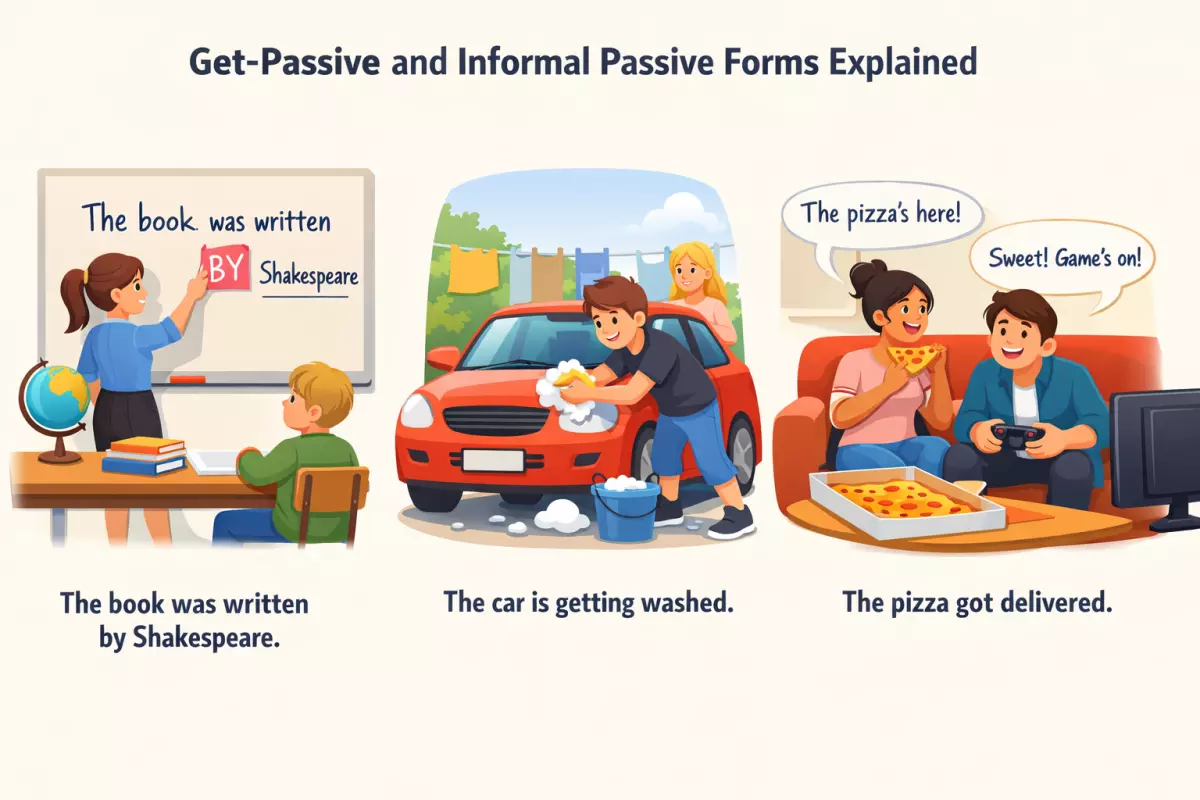 This article explains what the get-passive is and how it differs from the be-passive. It covers common uses for changes, events, and accidents, key get plus past participle patterns, when it sounds natural, learner mistakes, and how it shows up in spoken English, plus homework practice tasks.
In everyday English, people often use a casual passive with get instead of the more formal be passive, especially when something happens unexpectedly or feels personal. You will hear it in stories about accidents, mistakes, and sudden changes, like getting locked out or getting promoted. This guide explains when each form sounds natural, what it implies about responsibility, and how to use it smoothly.
What the get-passive is
This construction uses get + a past participle to describe an event where someone or something becomes affected by an action. It often highlights the change of state (the “result”) and commonly sounds more informal and more “happening-focused” than a standard passive with be.
Core pattern
- Form: get + past participle (V3)
- Tense: the tense sits on get (get/gets, got, is getting, has gotten/has got, will get)
- Meaning focus: the subject experiences the outcome of an action (often unexpectedly, suddenly, or as a concrete event)
- Agent: the “doer” is often omitted; if needed, it can be added with by (less common in casual use)
Typical uses in real sentences
- To emphasize an event rather than a general state: “He got fired last week.”
- To describe accidents or unwanted outcomes: “My phone got stolen.”
- To report changes that happen over time: “The situation is getting worse.”
- To show a result that affects the subject directly: “We got stuck in traffic.”
- To describe things that happen in everyday life (informal narration): “The package got delivered early.”
- To talk about consequences in warnings: “You’ll get caught if you do that.”
Common patterns and variations
- Simple present: “It gets updated automatically.”
- Past: “The window got broken during the storm.”
- Progressive: “The rules are getting changed again.”
- Present perfect: “I’ve gotten invited to the interview.”
- Modal + get: “You might get charged a fee.”
- Negative: “The email didn’t get sent.”
- Question: “How did it get damaged?”
- With an agent (when necessary): “He got promoted by his manager.”
Past participles that frequently appear with it
- get hurt
- get injured
- get caught
- get arrested
- get fired
- get hired
- get promoted
- get paid
- get robbed
- get stolen
- get lost
- get stuck
- get locked out
- get delayed
- get canceled
- get damaged
- get broken
- get blamed
- get invited
- get published
What it usually implies (and what it doesn’t)
- It often suggests the situation is dynamic or event-like, not just a neutral description.
- It can hint that the subject is somehow involved or affected personally, even when the agent is unknown.
- It does not automatically mean the subject caused the action; context decides that.
- It is less common in very formal writing, where be-passives are often preferred.
Get-passive vs be-passive
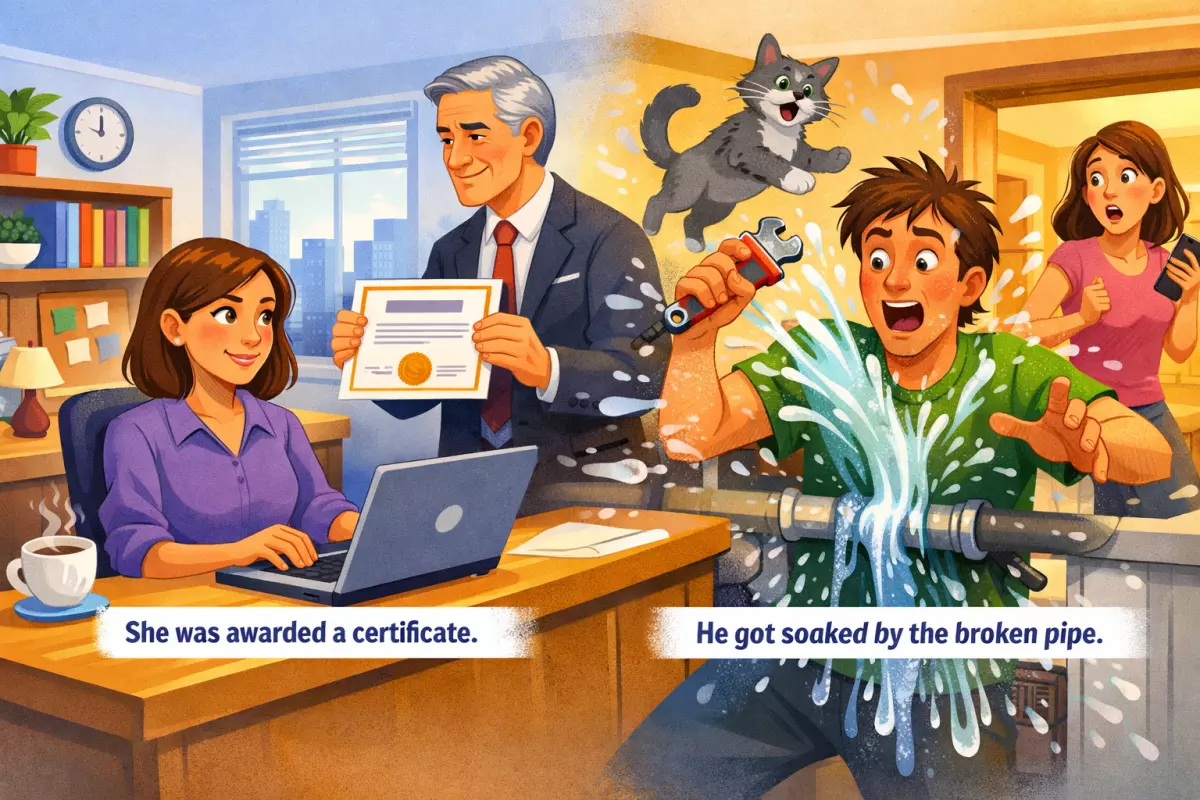
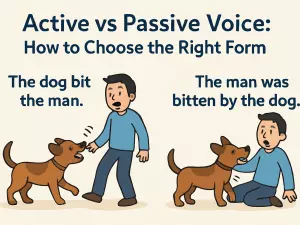
The two main passive patterns in English use either be or get before a past participle. Both shift attention from the doer to the receiver of the action, but they differ in tone, typical contexts, and what they imply about the event.
| Feature | Be + past participle | Get + past participle |
|---|---|---|
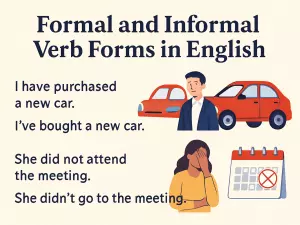
| Overall feel | Neutral, standard, common in formal writing and speech | More informal, conversational, often more vivid |
| Typical focus | State, description, or general fact | Change of state; something happening to someone |
| Implied responsibility | Usually no implication about the subject’s role | Can suggest the subject is partly involved or “ended up” in the situation |
| Common time reference | Often used for ongoing situations and general truths | Often used for specific events (especially unexpected ones) |
| Agent with “by …” | Natural and frequent: “was repaired by a mechanic” | Possible but less common: “got repaired by a mechanic” |
| Where it sounds most natural | Reports, instructions, academic and professional contexts | Everyday speech, storytelling, complaints, warnings |
Meaning patterns to watch
Be-passives often describe a condition or a routine process, while get-passives highlight the event that leads to a new condition. In many cases, both are possible, but the choice changes the emphasis.
- State vs. event: “The door was closed” (state) vs. “The door got closed” (event/result).
- Neutral vs. “it happened”: “He was fired” (neutral report) vs. “He got fired” (more personal, often implies circumstances).
- Planned vs. accidental feel: “The file was deleted” (could be planned) vs. “The file got deleted” (often sounds accidental).
- Victim/impact framing: “She was injured” (clinical/neutral) vs. “She got injured” (story-like, impact-focused).
Common verb choices and natural-sounding combinations
Some past participles are especially frequent with get because they describe mishaps, sudden changes, or outcomes. Others lean toward be because they sound like descriptions or official statements.
- More common with get: got hurt, got hit, got caught, got stuck, got lost, got fired, got arrested, got robbed, got paid, got invited, got promoted, got blocked, got delayed, got interrupted, got damaged.
- More common with be: was constructed, was manufactured, was distributed, was approved, was regulated, was monitored, was documented, was implemented, was scheduled, was required, was recommended.
Accuracy and form: what is and isn’t a passive
Not every “get + participle” is truly passive. Sometimes it behaves more like an adjective describing a change (similar to “become”). A practical test is whether an agent can be added naturally with “by …”.
- ✅ Passive-like: “He got arrested (by the police).”
- ✅ Passive-like: “The package got delivered (by a courier).”
- ❌ Mostly adjectival/change-of-state: “She got tired.” (Not a passive; no real agent.)
- ❌ Mostly adjectival/change-of-state: “They got excited.” (Not a passive; no agent.)
Choosing between them in real sentences
- Use be when you need a neutral, report-like tone: “The application was rejected due to missing documents.”
- Use get when you want a conversational, event-centered tone: “My application got rejected because I forgot a document.”
- Prefer be in formal instructions and policies: “All requests must be submitted by Friday.”
- Prefer get for warnings and everyday advice: “Don’t leave your bag there—it could get stolen.”
- If you want to include the agent clearly, be usually reads smoother: “The window was broken by vandals.”
Common uses: change, events, accidents
Use the get-passive especially when you want to present a result that happens to someone or something, often with a sense of change over time, an unexpected outcome, or a real-world incident. It is common in everyday speech and storytelling because it highlights the transition into a new state rather than the action itself.
1) Changes of state (becoming different)
These patterns focus on the moment something shifts from one condition to another. The emphasis is on the new state after the change.
- get + past participle to describe a new condition: “The soup got cold.” “My phone got scratched.”
- Often used with gradual or noticeable change: “The sky got darker.” “The room got crowded.”
- Common with adjectives that also work as participles: “get tired,” “get bored,” “get confused,” “get annoyed.”
- Works well with time markers that show progression: “It got worse overnight.” “Things got complicated after that.”
- Frequently paired with “again” to show repeated change: “The wound got infected again.”
- Typical everyday examples:
- “My shirt got stained.”
- “The window got fogged up.”
- “The password got changed.”
- “His name got misspelled.”
- “The schedule got updated.”
2) Events and situations (what happened)
When reporting what happened in a situation, get + past participle can sound more immediate and informal than a be-passive. It often appears when the speaker is describing a sequence of events.
- Use it to keep the focus on the person affected: “We got invited at the last minute.”
- Common in narratives with “then/after/when”: “We got separated, and then we got reunited later.”
- Often used when the cause is unknown, unimportant, or obvious from context: “The email got deleted.”
- Frequent verbs in this use:
- “get picked (for a team/job)”
- “get promoted / get transferred”
- “get rejected / get accepted”
- “get delayed / get canceled”
- “get interrupted / get cut off (on a call)”
- “get caught (in traffic / in the rain)”
- “get stuck (in an elevator / in mud)”
- “get locked out”
- “get sent back / get turned away”
- With “get” you can also foreground the outcome as a turning point: “He got chosen, and everything changed.”
3) Accidents, mishaps, and negative outcomes
In everyday English, this form is very common for accidents and problems because it naturally frames them as something that happened (often unexpectedly) and affected someone.
- Typical accident-related combinations:
- “get hurt”
- “get injured”
- “get burned”
- “get cut”
- “get hit”
- “get knocked over”
- “get bitten”
- “get stung”
- “get trapped”
- “get killed” (used carefully; very strong)
- Common “things go wrong” outcomes:
- “get lost”
- “get stolen”
- “get damaged”
- “get broken”
- “get ruined”
- “get flooded”
- “get hacked”
- “get scammed”
- “get blocked”
- “get fined”
- It often implies the event was not planned or not desired: “My bike got stolen” sounds more like an unfortunate incident than a neutral report.
Pattern notes that help you choose “get” naturally
- Agent is often omitted (who did it): “The files got erased.” If you add an agent, “by…” is possible but less common in casual speech.
- Responsibility can be implied: “He got fired” may suggest his actions contributed, while “He was fired” can sound more neutral. Context decides.
- State focus vs. action focus: use “get” when the result matters most (“It got damaged”), and use an active verb when the doer matters (“Someone damaged it”).
- Correct form: ✅ “She got hurt.” ❌ “She got hurted.” (use the correct past participle)
Get + past participle patterns
This structure commonly appears in informal English to describe a change of state, a result, or an event that happens to someone or something. It often feels more “dynamic” than be passives because it highlights what happens and the outcome, not just the fact.
Core form and tense patterns
- Present simple: subject + get/gets + past participle (The files get deleted after 30 days.)
- Past simple: subject + got + past participle (My phone got stolen on the train.)
- Present continuous: am/is/are getting + past participle (The roads are getting blocked by snow.)
- Past continuous: was/were getting + past participle (The area was getting flooded all night.)
- Present perfect: have/has gotten/got + past participle (The order has gotten delayed again.)
- Past perfect: had gotten/got + past participle (By noon, the tickets had gotten sold out.)
- Modal + get: can/could/might/should + get + past participle (It can get complicated.)
- Future: will get + past participle (You’ll get notified when it ships.)
- Infinitive: to get + past participle (I don’t want to get involved.)
- -ing form: getting + past participle (Getting promoted often takes time.)
Common participles in this pattern (useful chunks)
- get hurt / get injured
- get stuck / get trapped
- get caught / get arrested
- get fired / get laid off
- get paid / get refunded
- get invited / get included
- get chosen / get selected
- get lost / get found
- get broken / get damaged
- get fixed / get repaired
- get delayed / get canceled
- get blocked / get locked (out)
- get upgraded / get downgraded
- get approved / get rejected
- get published / get removed
- get recognized / get ignored
Agent phrases: when (and when not) to add “by …”
- Often, the doer is unknown or unimportant, so no agent is added: “My account got hacked.”
- If the agent matters, use by: “My account got hacked by someone using a leaked password.”
- With people as agents, this can sound blunt; many speakers prefer an active version: ✅ “Someone hacked my account.” → more direct than “My account got hacked by someone.”
Meaning patterns: result, accident, and “undesired event”
- Result/change: “The situation got complicated.” (focus on the change over time)
- Accident/misfortune: “He got hit by a car.” (common in narratives)
- Unexpected outcome: “Our plans got canceled.”
- Consequences of actions: “If you share that file, it could get leaked.”
Common errors to avoid
- ✅ “He got promoted.” ❌ “He got promote.” (use a past participle, not a base verb)
- ✅ “They got married.” ❌ “They got marry.”
- ✅ “The package got delivered.” ❌ “The package got deliver.”
- Don’t confuse it with “get + adjective”: “get tired/angry” is not passive, while “get fired/invited” is passive-like.
When get-passive sounds natural
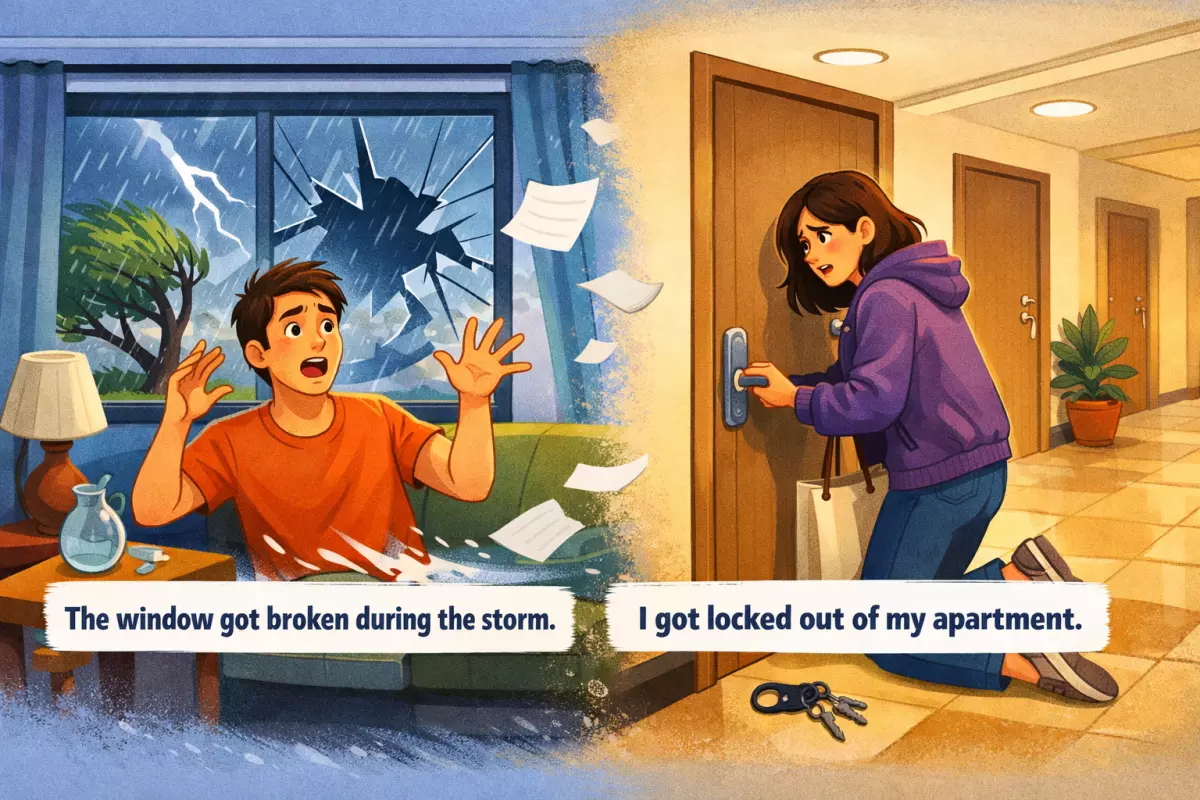
Use get + past participle when the situation feels event-like, personal, or tied to a change of state. This form is especially common in speech and informal writing, and it often suggests that something happened to the subject rather than describing a neutral state.
Common contexts where it fits well
- Sudden or noticeable changes (a shift from “not X” to “X”): “The window got broken during the storm.”
- Unplanned or accidental events: “I got locked out of my apartment.”
- Negative experiences (often with inconvenience or harm): “He got robbed on the way home.”
- Good or bad outcomes that feel like results: “She got promoted last month.”
- Everyday mishaps in conversation: “My phone got dropped in the sink.”
- Situations emphasizing the person affected rather than the doer: “They got delayed at the airport.”
- Cause-and-effect storytelling: “We took a shortcut and got stuck in traffic.”
- Warnings and advice: “Be careful you don’t get scammed.”
- Informal reports of trouble: “The files got deleted somehow.”
- When the agent is unknown, irrelevant, or obvious: “My bike got stolen.”
- When the subject’s involvement is implied (sometimes responsibility, sometimes just participation): “He got caught cheating.”
- With “get” + adjective-like participles that describe a resulting condition: “The kids got excited,” “The door got stuck.”
Usage patterns that make it sound natural
- Short, concrete verbs are common: “get hit,” “get caught,” “get fired,” “get hurt,” “get paid,” “get stuck.”
- Time markers often appear because the focus is on an event: “yesterday,” “on the way,” “all of a sudden,” “during the meeting.”
- Agentless phrasing is typical; adding “by…” can sound heavier or more formal: “He got injured (at practice)” is more natural than “He got injured by a player” in casual speech.
- Result emphasis: the sentence highlights the outcome more than the process. Compare: “The documents were signed” (neutral record) vs. “The documents got signed” (finally happened).
Example sentences you can model
- “I got pulled over for speeding.”
- “Our meeting got canceled.”
- “She got invited to the conference.”
- “My card got declined.”
- “He got blamed for the mistake.”
- “They got stuck in the elevator.”
- “The email got forwarded to the wrong person.”
- “We got told to wait outside.”
- “The package got delivered late.”
- “She got accepted into the program.”
- “My laptop got damaged in transit.”
- “He got picked for the team.”
- “The rumor got spread around fast.”
- “I got distracted and missed my stop.”
- “The plan got changed at the last minute.”
In general, this informal passive works best when you want the sentence to feel immediate and human-focused, especially in narratives about what happened and what result followed.
Typical learner mistakes
Errors with get-passives and other informal passive-like patterns often come from mixing them with the be-passive, choosing the wrong register, or using “get” where the meaning is not about a change of state. The points below focus on the most common usage traps and the patterns that fix them.
- Using “get” for neutral, formal description
❌ The report got published in 2020.
✅ The report was published in 2020.
Use be + past participle for formal, factual reporting; “get” sounds more conversational and event-focused. - Overusing get-passives in academic or technical writing
In formal prose, repeated “got + V3” can sound careless. Prefer “was/were + V3” unless you specifically want an informal tone or a sense of “something happened/changed.” - Confusing the get-passive with “have/get something done” (causative)
❌ I got my hair cut by the barber yesterday. (often intended as passive “someone cut it”)
✅ I got my hair cut yesterday. (causative: you arranged the service)
If you mean an arranged service, “get/have + object + past participle” is the normal structure. - Adding an unnecessary “by”-agent
❌ He got fired by his boss. (possible, but often clunky in casual speech)
✅ He got fired. / He was fired by his boss.
With “get,” the agent is frequently omitted; if the agent matters, “be-passive” often reads cleaner. - Choosing “get” when there is no change-of-state feeling
❌ The building got owned by the city. (ownership is a state, not an event in this framing)
✅ The building is owned by the city. / The city bought the building. (active event)
“Get” works best when the situation changes or something happens to the subject. - Mixing up “get + adjective” with a passive participle
❌ She got bored by the lecture. (awkward; “bored” is more adjective-like here)
✅ She got bored during the lecture. / She was bored by the lecture.
If you include an agent (“by the lecture”), “be” is usually smoother; without an agent, “get + adjective” is natural. - Using get-passives for long, complex passive clauses
❌ The proposal got rejected after being reviewed by three separate committees with conflicting criteria.
✅ The proposal was rejected after review by three committees with conflicting criteria.
Informal passives tend to work best in short, spoken-style sentences. - Incorrect tense or auxiliary stacking
❌ He is got promoted. → ✅ He got promoted. / He has been promoted.
Don’t combine “be” as an extra auxiliary with “got” in standard passive meaning. - Wrong participle form after “get”
❌ They got choose for the team. → ✅ They got chosen for the team.
The verb after “get” must be a past participle (V3), not the base form. - Using “get” where “be” is required for a continuing state
❌ The door gets closed all day. (sounds like repeated action, not a state)
✅ The door is closed all day.
“Gets closed” usually implies an event that happens (possibly repeatedly), not a stable condition. - Misreading responsibility or blame
“Get + V3” can imply the subject’s involvement, bad luck, or consequences.
✅ He got arrested. (often suggests a dramatic event; sometimes hints at responsibility)
If you want a neutral tone, use “was arrested.” - Using get-passives with verbs that sound unnatural in this frame
Some participles are rare with “get” in everyday English. Learners often create forms that are grammatical but odd in usage.
❌ The theory got believed by many scientists. → ✅ The theory was widely believed. - Confusing informal passive-like “get” with “become” meanings
❌ He got married with 25. → ✅ He got married at 25.
Set phrases like “get married/divorced/dressed” behave like change-of-state expressions; prepositions and collocations matter. - Overgeneralizing “get” to all passive situations in conversation
In speech, it’s common to alternate: “was” for clarity and “got” for impact. If every passive is “got,” the tone can sound repetitive or overly dramatic. - Using informal passive forms in the wrong social setting
In job applications, official emails, and formal presentations, “was/were + V3” is the safer default. Save “got + V3” for storytelling, casual updates, and spoken narratives.
Quick pattern checks
- If you can naturally add “suddenly” or “unexpectedly,” a get-passive is often a good fit: “He got blamed (suddenly).”
- If the sentence is a neutral record (date, procedure, publication), prefer be-passive: “The device was tested.”
- If you mean “arranged a service,” use the causative pattern: “I got my phone repaired.”
Get-passive in spoken English
In everyday conversation, speakers often choose get + past participle to sound more immediate and personal than the more neutral be passive. This form is especially common in narratives, complaints, warnings, and quick updates because it highlights what happened to someone or something, often as an event rather than a general state.
Core pattern and meaning
The basic structure is:
- Subject + get + past participle (e.g., “She got promoted.”)
- Subject + get + past participle + (by + agent) when the doer matters (e.g., “He got stopped by the police.”)
Compared with be passives, get often suggests one or more of these ideas: a change of situation, an unexpected event, a result that “happens to” the subject, or a slightly more informal, spoken feel.
Where this form is most natural in speech
- Sudden events and mishaps: “I got locked out.” “My phone got stolen.”
- Personal impact: “She got hurt.” “They got embarrassed.”
- Everyday workplace or school updates: “He got hired.” “I got moved to a new team.”
- Warnings and instructions: “Don’t get caught.” “Try not to get distracted.”
- Storytelling: “We got delayed, then our bags got lost.”
- When the agent is unknown or irrelevant: “The meeting got canceled.”
Tense, aspect, and common forms
- Present simple: “It gets updated automatically.” (often for repeated processes)
- Past simple: “We got stuck in traffic.”
- Present perfect: “I’ve gotten invited to the interview.” (BrE often prefers “I’ve got invited” less; many speakers switch to “I’ve been invited”)
- Past perfect: “He had gotten fired before the merger.”
- Future: “You’ll get notified soon.”
- Modal + get: “You might get charged extra.” “It could get damaged.”
- Negative: “It didn’t get fixed.” “Don’t get fooled.”
- Questions: “How did it get broken?” “Did you get paid?”
Typical verbs and collocations in conversation
- get caught, get stopped, get arrested
- get hurt, get injured, get burned, get cut
- get lost, get stuck, get locked out
- get robbed, get mugged, get scammed
- get promoted, get fired, get hired, get paid
- get invited, get picked, get chosen
- get canceled, get postponed, get rescheduled
- get fixed, get repaired, get replaced
- get damaged, get broken, get scratched
- get blocked, get banned, get muted (online contexts)
- get approved, get rejected, get denied
- get recognized, get blamed, get praised
Common learner issues to avoid
- ✅ “He got fired.” ❌ “He got fire.” (use the past participle)
- ✅ “I got invited.” ❌ “I got invite.”
- ✅ “The window got broken.” (event focus) → “The window was broken.” (state description)
- Prefer be passives in very formal writing; in casual speech, get often sounds more natural for incidents and outcomes.
- Be careful with meaning: “He got married” is a common fixed expression, but “He was married” usually describes a status.
When you want to sound natural in conversation, choose get + past participle for results, problems, and changes, and switch to be passives when you need a neutral description of a condition or a more formal tone.
Homework: get-passive practice tasks
Use these activities to build accuracy with get + past participle and related informal passive patterns. Focus on when English prefers a more “event-focused” or “unexpected” passive (get) rather than a neutral description (be). Pay attention to tense, subject choice, and whether the sentence sounds like a real-life situation.
1) Choose: get-passive or be-passive
Rewrite each sentence twice: (A) with a get-passive, (B) with a be-passive. Keep the meaning as close as possible.
- The window was broken during the storm.
- My phone was stolen on the train.
- The report was finished before lunch.
- He was promoted last month.
- The kids were punished for shouting.
- The door was locked at 9 p.m.
- She was injured in the match.
- The meeting was cancelled because of the weather.
Show answers
- (A) The window got broken during the storm. (B) The window was broken during the storm.
- (A) My phone got stolen on the train. (B) My phone was stolen on the train.
- (A) The report got finished before lunch. (B) The report was finished before lunch.
- (A) He got promoted last month. (B) He was promoted last month.
- (A) The kids got punished for shouting. (B) The kids were punished for shouting.
- (A) The door got locked at 9 p.m. (B) The door was locked at 9 p.m.
- (A) She got injured in the match. (B) She was injured in the match.
- (A) The meeting got cancelled because of the weather. (B) The meeting was cancelled because of the weather.
2) Fix the form (tense + participle)
Each sentence has a mistake with the passive form. Correct it. Use a get-passive where it sounds natural in everyday speech.
- I got steal yesterday.
- Our flight got cancel because of fog.
- She gets promoted last week.
- They got being invited to the wedding.
- My laptop got broke when I dropped it.
- He got fireded for being late.
- The tickets got sold yesterday already.
- We got stucked in traffic for two hours.
- The package got delivered tomorrow.
- My card got stolen and I got charge twice.
Show answers
- I got stolen yesterday. (More natural: I got robbed yesterday.)
- Our flight got cancelled because of fog.
- She got promoted last week.
- They got invited to the wedding.
- My laptop got broken when I dropped it.
- He got fired for being late.
- The tickets got sold already / The tickets were sold yesterday.
- We got stuck in traffic for two hours.
- The package will get delivered tomorrow. / The package is getting delivered tomorrow.
- My card got stolen and I got charged twice.
3) Complete the sentence (pick the best participle)
Fill each blank with a suitable past participle. Choose the option that fits common usage.
- He got ________ (caught / built) speeding on the highway.
- My email account got ________ (hacked / cooked) last night.
- We got ________ (stuck / invented) behind a truck.
- She got ________ (invited / painted) to speak at the conference.
- The kids got ________ (told off / written) for running indoors.
- I got ________ (paid / grown) on Friday.
- The file got ________ (deleted / washed) by accident.
- They got ________ (married / printed) in June.
- He got ________ (injured / delivered) during training.
- The restaurant got ________ (shut down / folded) after complaints.
- Our plans got ________ (ruined / ironed) by the rain.
- She got ________ (picked / knitted) for the team.
Show answers
- caught
- hacked
- stuck
- invited
- told off
- paid
- deleted
- married
- injured
- shut down
- ruined
- picked
4) Add or remove the agent (by + person/thing)
Rewrite each sentence as directed. Notice that the get-passive often drops the agent unless it is important.
- My bike got stolen. (Add an agent: by + noun phrase.)
- The documents were signed by the manager. (Remove the agent.)
- She got criticized by her coach. (Remove the agent.)
- The room was cleaned. (Add an agent.)
- He got arrested by the police. (Remove the agent.)
- The computer was damaged by water. (Keep the agent but switch to get.)
Show answers
- My bike got stolen by someone outside the station.
- The documents were signed.
- She got criticized.
- The room was cleaned by the housekeeping staff.
- He got arrested.
- The computer got damaged by water.
5) Naturalness check (choose the best option)
Select the sentence that sounds more natural in everyday English for the situation described.
- Unexpected bad event:
1) My bag was stolen. 2) My bag got stolen. - Formal announcement:
1) The new policy got implemented on Monday. 2) The new policy was implemented on Monday. - Personal experience:
1) I was invited to their wedding. 2) I got invited to their wedding. - Neutral description of a process:
1) The forms got processed overnight. 2) The forms were processed overnight. - Everyday complaint:
1) I got charged twice. 2) I was charged twice. - Resulting state (not the event):
1) The door got closed all day. 2) The door was closed all day.
Show answers
- 2
- 2
- 2 (1 is also fine, slightly more neutral)
- 2 (1 can work if emphasizing “it ended up happening”)
- 1 (2 is also correct, but 1 is more conversational)
- 2 (state description; “got closed all day” suggests the closing event rather than the state)
6) Production task: write your own mini-dialogues
Write short responses (1–2 sentences each). Use at least one get-passive in each answer. Keep the tense consistent with the prompt.
- You missed a call because your phone stopped working yesterday. Explain what happened.
- You are describing a frustrating billing problem from last week.
- You are telling a friend about good news at work.
- You are explaining why you arrived late (traffic or transport problem).
- You are describing a mistake that happened to your file or document.
- You are describing a rule-breaking moment where someone was caught.