Result Verbs and Verb + Adjective Patterns

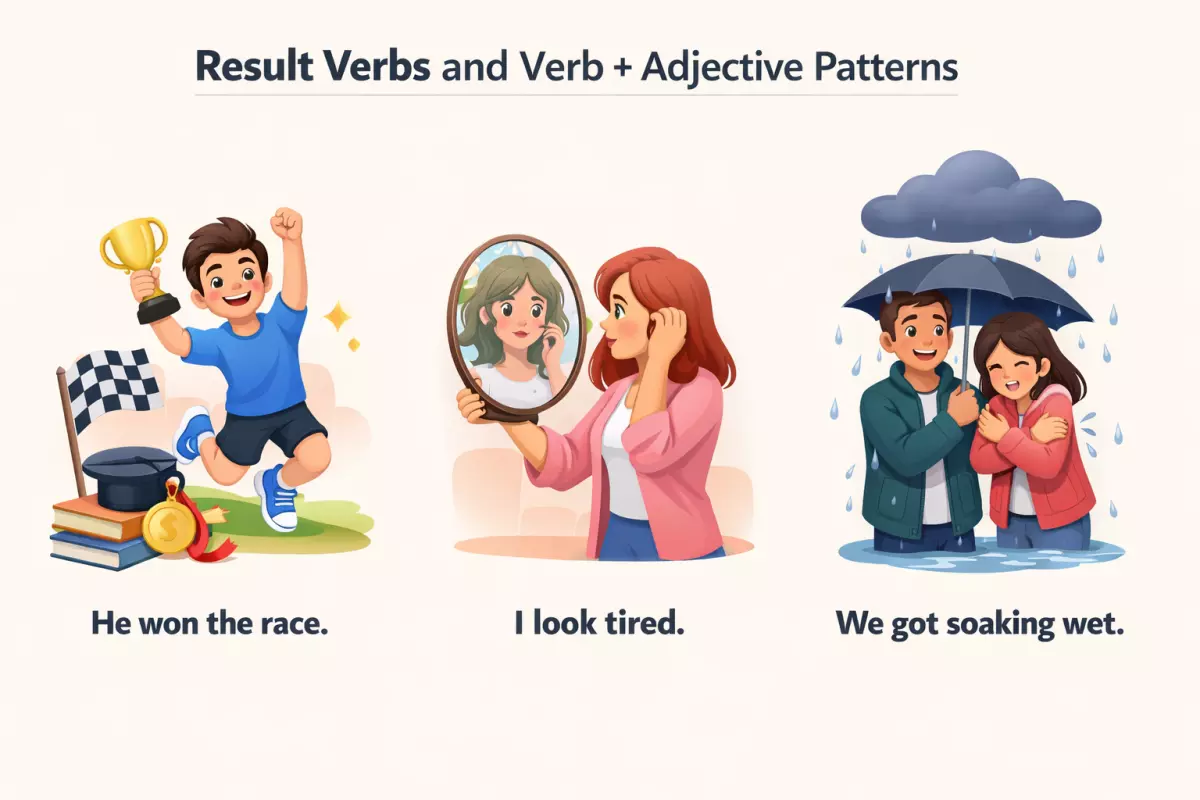 This article explains what result verbs are, how verb + adjective structures work, and how make, leave, and render take object complements. It compares result patterns with linking verbs, flags common learner mistakes, shows writing uses, and ends with homework practice tasks.
English can show a change of state, not just an action, using result verbs and verb plus adjective pairs. In everyday speech we say wipe clean, paint red, or push open to highlight what happens after the action. This article explains how these patterns work, when they sound natural, and how to pick the right adjective so your meaning stays clear and confident.
What result verbs are
Some verbs do more than describe an action; they also tell you the outcome that action creates. In these structures, the verb points to a change in state, and an extra element (often an adjective) names the new condition. This is why they commonly appear in patterns like verb + object + adjective or verb + adjective when the subject changes.
These patterns are especially common when you describe transformations, effects, or consequences. The key idea is that the adjective (or similar complement) is not just extra description; it completes the meaning by stating the result.
Core patterns
- Verb + object + adjective: the object ends up in the adjective state.
✅ The joke made everyone happy. - Verb + adjective: the subject ends up in the adjective state (no object needed).
✅ The sky turned dark. - Verb + object + past participle: the object ends up in a “completed/affected” state.
✅ The news left him shocked. - Verb + object + noun phrase: the object is assigned a new role/identity (a result of naming/choosing).
✅ They elected her president.
How to recognize a result complement
- It answers “In what state?” or “As what?” after the action is done.
- It cannot be removed without changing the core meaning.
✅ The paint dried. (complete) → The paint dried hard. (adds the end state) - It often pairs naturally with change-of-state verbs (become, get, turn) or causative verbs (make, drive, render).
- It differs from a simple manner adverb: “He spoke loudly” describes how; “He spoke himself hoarse” describes the outcome.
Common verbs used in result patterns (with typical complements)
- make + object + adjective: make it clear / make people nervous
- get + object + adjective: get the room ready / get everyone excited
- leave + object + adjective/participle: leave the door open / leave them confused
- keep + object + adjective: keep the children quiet
- drive + object + adjective: drive me crazy / drive prices higher
- push + object + adjective: push the door shut / push it open
- turn + adjective: turn cold / turn nasty
- grow + adjective: grow tired / grow impatient
- become + adjective/noun: become stronger / become a leader
- fall + adjective: fall silent / fall asleep
- come + adjective: come loose / come clean
- paint + object + adjective: paint the wall white
- cut + object + adjective: cut the rope short
- wipe + object + adjective: wipe the table clean
- hammer + object + adjective: hammer the metal flat
- shoot + object + adjective: shoot the target dead
In all of these, the complement describes the end point of the action. That is the defining feature: the verb and the complement work together to express “X causes Y to end up Z” or “X ends up Z.”
Verb + adjective meaning and structure
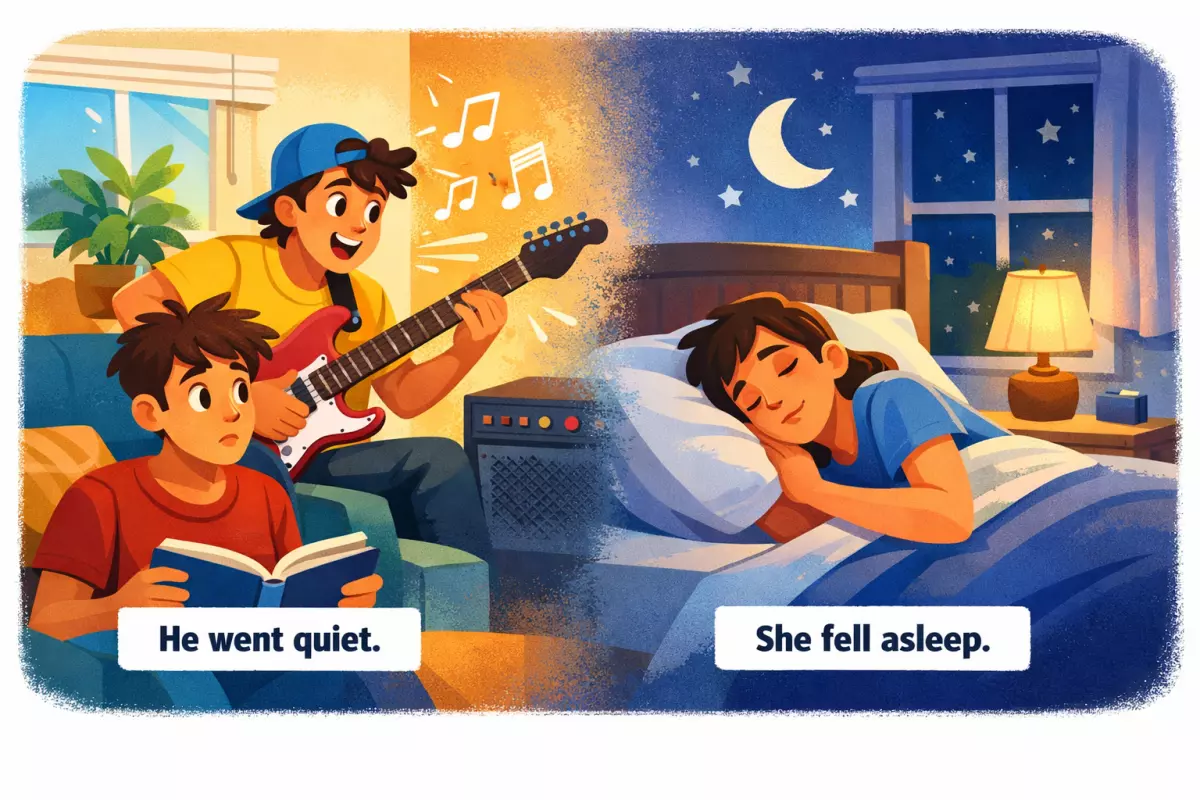
This pattern links an action to the state that results from it. The adjective describes the subject (or sometimes the object) after the verb happens, so the focus is on the end condition rather than the action itself.
Core structure and what it expresses
- Form: verb + adjective (e.g., go quiet, fall asleep, come ready).
- Meaning: the verb signals change or continuation, and the adjective names the resulting state (quiet, asleep, ready).
- Typical question it answers: “What state does X end up in?” or “What state is maintained?”
- Common verbs in this pattern: be, become, get, grow, go, turn, come, fall, run, remain, stay, keep.
Two main uses: change vs. staying the same
- Change into a new state: verbs like get, become, go, turn, grow, fall often mark a transition.
- ✅ The room went silent.
- ✅ He grew impatient.
- ✅ The leaves turned yellow.
- ✅ She fell ill.
- Remain in a state: verbs like stay, remain, keep emphasize no change.
- ✅ Please stay calm.
- ✅ The door remained closed.
- ✅ Keep quiet during the test.
Subject-focused vs. object-focused patterns
- Subject-focused: the adjective describes the subject after the verb.
- My phone died dead ❌ (wrong adjective choice)
- ✅ My phone went dead.
- ✅ The sky grew dark.
- ✅ He came alone.
- Object-focused (result on an object): some verbs take an object and the adjective describes that object’s resulting state (a “result” meaning).
- ✅ They painted the wall white. (the wall becomes white)
- ✅ She wiped the table clean. (the table ends up clean)
- ✅ He cut the rope short. (the rope becomes short)
- ✅ We pushed the door open. (the door ends up open)
Adjective choices that commonly fit
- Physical/visible states: open, closed, clean, dry, wet, flat, smooth, empty, full.
- Condition/health: ill, sick, well, better, worse, tired, awake, asleep.
- Emotion/attitude: angry, calm, quiet, nervous, confident, impatient.
- Quality/degree changes: dark, bright, cold, warm, loud, clear, strong, weak.
Common constraints and frequent errors
- Not every adjective works with every verb: usage is partly fixed by convention. For example, go is natural with wrong/bad/silent, but many other combinations sound unnatural.
- Adjective vs. adverb: when the word describes a state, use an adjective; when it describes how an action is performed, use an adverb.
- ✅ The children grew quiet. (quiet = state)
- ✅ The children spoke quietly. (quietly = manner)
- Result meaning vs. simple description: They left angry usually means they were angry when they left (state at departure), while They made him angry means the action caused the state.
- Passive-friendly results: object-result patterns often become passive while keeping the adjective.
- ✅ The wall was painted white.
- ✅ The table was wiped clean.
Common result verbs: make, leave, render
Some verbs regularly pair with an object + adjective to show a change of state. The adjective names the result, and the object is the person or thing affected. These patterns are common in both everyday English and more formal writing, but each verb has its own typical uses and constraints.
Core pattern: verb + object + adjective
The basic structure is:
- make + object + adjective: The action causes a new condition. Example: “The noise made the room unbearable.”
- leave + object + adjective: The action results in a remaining condition (often after an event). Example: “The delay left the passengers angry.”
- render + object + adjective: A formal way to say “cause to become,” often used in technical, legal, or academic contexts. Example: “The update rendered the device incompatible.”
How the meanings differ in practice
- Make focuses on direct causation and is the most flexible in everyday speech: “made me nervous,” “made the task easier,” “made the plan possible.”
- Leave highlights the state that remains afterward, often implying an unintended or secondary result: “left the door open,” “left him speechless,” “left the surface wet.”
- Render is more formal and often appears with adjectives describing functionality, legality, or status: “rendered invalid,” “rendered unusable,” “rendered ineffective.”
Common adjective choices (useful collocations)
- make: happy, nervous, angry, confident, aware, ready, clear, easier, difficult, possible, safe, worse
- leave: alone, open, closed, empty, unfinished, uncertain, vulnerable, speechless, intact, unchanged, homeless, stranded
- render: invalid, void, obsolete, ineffective, unusable, inaccessible, irrelevant, unnecessary, impossible, uncertain, liable
Grammar notes and common pitfalls
- Use an adjective (not an adverb) after the object: ✅ “It made me angry.” ❌ “It made me angrily.”
- With make, the object is required in this pattern: ✅ “The news made him anxious.” (Not “made anxious” unless you add a subject like “He was made anxious,” which is less natural.)
- Leave often works well for physical states and “still” conditions: “left the lights on,” “left the window open,” “left the report incomplete.”
- Render is usually chosen when you want a neutral, formal cause-and-result tone; in casual conversation, make is typically the natural option.
- Negative results are common with all three, but especially with leave and render: “left them disappointed,” “rendered the agreement invalid.”
Extended examples (object + adjective in context)
- “The new schedule made the commute manageable.”
- “That comment made the situation awkward.”
- “The instructions made the process clear.”
- “The storm left the roads dangerous.”
- “The argument left both sides exhausted.”
- “The power cut left the building dark.”
- “A missing signature rendered the form invalid.”
- “The policy change rendered several roles redundant.”
- “A corrupted file rendered the data unusable.”
- “The revised evidence rendered the earlier claim unlikely.”
Result verbs with object complements
Some verbs can take an object plus a complement that describes the new state of that object. The complement is usually an adjective (or adjective phrase), and the meaning is “X causes Y to become Z.” This pattern is common when you want to focus on the outcome rather than the action itself.
Core pattern and meaning
- Form:
Subject + verb + object + adjective - Meaning: the object ends up in the state described by the adjective.
- Typical verbs:
make,get,keep,leave,drive,push,send,turn(in some uses), and some verbs of impact likeknock(often with a particle).
Common verbs and how they behave
make + object + adjective(cause a change): “The news made him anxious.”get + object + adjective(cause/arrange a change, often informal): “We got the room ready.”keep + object + adjective(maintain a state): “Keep the door closed.”leave + object + adjective(resulting state after an action/decision): “They left the window open.”drive + object + adjective(strong effect over time): “The noise drove me crazy.”push + object + adjective(force a change, often figurative): “Deadlines push teams productive.” (More natural with “to be”: “push teams to be productive.”)send + object + adjective(cause a sudden reaction): “That message sent her silent.”
Example set (object + adjective)
- “The joke made everyone quiet.”
- “The long walk got the kids tired.”
- “Keep your hands clean.”
- “Please leave the lights on.”
- “The delay left passengers angry.”
- “Her comments made the situation worse.”
- “The new policy kept prices low.”
- “The cold weather turned the roads dangerous.”
- “That ringtone drives me mad.”
- “They got the report ready by noon.”
- “The argument left him speechless.”
- “The extra practice made the routine smooth.”
- “The instructions kept the process simple.”
- “The announcement sent the crowd wild.”
- “The lighting made the room bright.”
- “The medication made her drowsy.”
Choosing the complement: adjective vs. other options
- Adjective (most common): “They painted the door red.” / “The film made me emotional.”
- Past participle as an adjective: “Keep the documents protected.” / “The scandal left the company damaged.”
- Adjective phrase: “The change made the system easier to use.”
- Prepositional/adverbial complements (some cases): “Leave the engine on.” / “Set the bag down.” (These are closely related result structures, but they are not adjective complements.)
Common learner issues (form and meaning)
- ✅ “Keep the door closed.” → natural maintenance of a state.
- ❌ “Keep closed the door.” → possible but uncommon; object usually comes before the complement.
- ✅ “The news made him angry.” → adjective describes the object (“him”).
- ❌ “The news made angry him.” → incorrect word order.
- ✅ “They got the car clean.” → “get” often suggests effort or arranging a result.
- ✅ “They kept the car clean.” → “keep” suggests maintaining cleanliness over time.
When you use this structure, the key is agreement in meaning: the adjective must describe a state that the object can realistically reach. If the result sounds more like an action than a state, English often prefers an infinitive pattern instead (for example, “push someone to work harder” rather than “push someone hardworking”).
Result patterns vs linking verbs
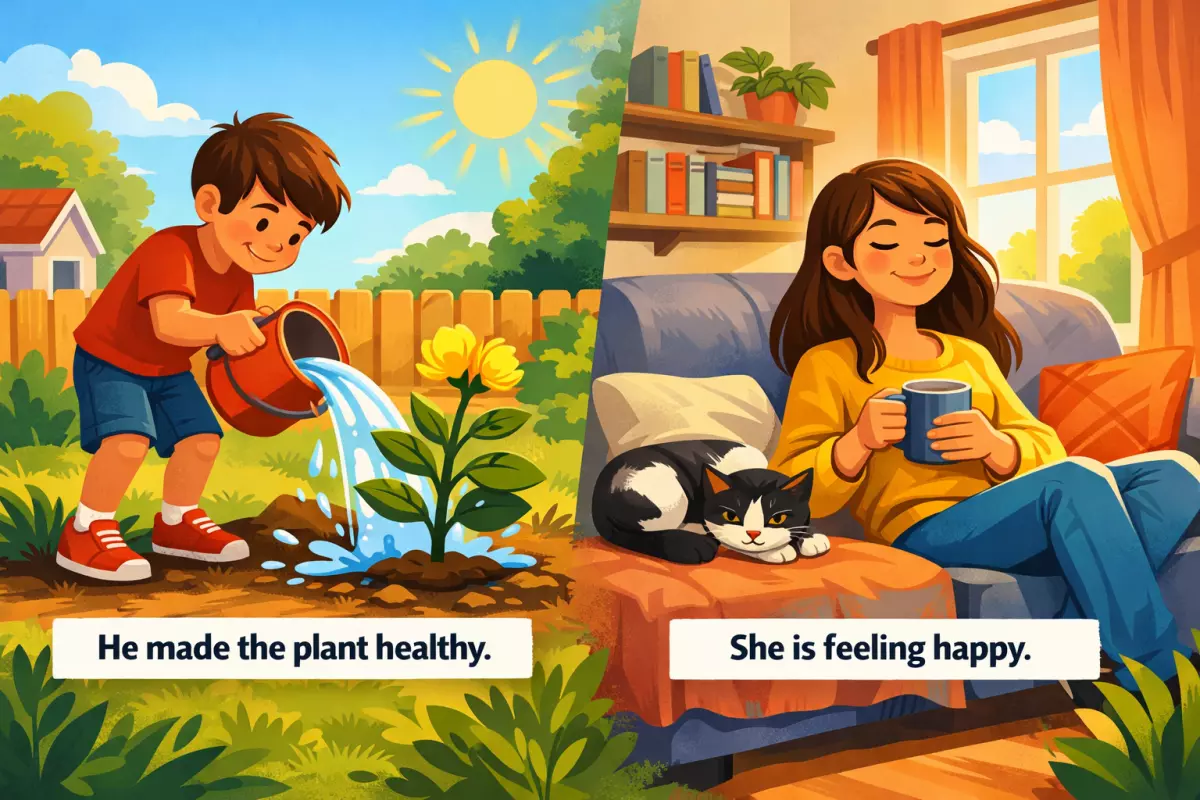
Some verb + adjective combinations describe a change caused by an action, while others simply describe a state. The difference matters because it affects meaning, what kinds of adjectives fit, and whether the adjective feels like an outcome or just a description.
Core distinction
- Result pattern (verb + adjective = outcome): the adjective names the new condition that happens because of the action. The verb is doing something, and the adjective is the result.
- Linking verb (linking verb + adjective = state): the adjective describes the subject; there is no “caused outcome” implied. The verb mainly connects the subject to a description.
How to tell which pattern you have
- Ask “Did something change?” If the sentence implies a change into a new state, it is likely a result construction (for example, “paint” creates a new color).
- Try a “be” paraphrase. Linking patterns often paraphrase naturally with “be”: “He seems tired” → “He is tired (apparently).” Result patterns usually do not paraphrase cleanly: “They hammered the metal flat” is not the same as “The metal was flat.”
- Check who controls the change. Result uses often involve an agent causing the outcome: “She wiped the table clean.” Linking verbs do not show an agent causing the adjective: “The table looks clean.”
- Look for a direct object. Many result uses are transitive and affect an object (“wipe the table clean”), while linking verbs typically do not take a direct object (“look clean,” not “look the table clean”).
- Test with “become/get.” Result meanings often align with “become/get”: “They boiled the eggs hard” → “The eggs got hard.” Linking meanings do not necessarily imply becoming: “The eggs smell bad” does not mean they became bad at that moment.
Common result-style verb + adjective patterns (outcome-focused)
- paint the wall white
- dye the fabric blue
- hammer the metal flat
- beat the eggs smooth
- whip the cream stiff
- wipe the table clean
- scrub the floor shiny
- rinse the vegetables clean
- polish the shoes bright
- slice the bread thin
- chop the onions fine
- grind the coffee coarse/fine
- freeze the lake solid
- boil the eggs hard
- cook the meat tender
- burn the toast black
- push the door open
- pull the lid off (particle result; similar “end state” idea)
Common linking-verb + adjective patterns (state-focused)
- be quiet / be ready
- seem tired / seem nervous
- look happy / look pale
- feel cold / feel confident
- sound strange / sound clear
- smell fresh / smell awful
- taste sweet / taste bitter
- remain calm / remain open
- stay silent / stay awake
- become famous / become difficult (change-of-state, but still linking: it describes the subject’s state rather than an object’s result)
- get angry / get busy (informal change-of-state linking)
Frequent learner errors (and how to fix them)
- ❌ “The soup tastes hot.” (often odd if you mean temperature) → ✅ “The soup is hot.” / “The soup tastes spicy.”
- ❌ “She cleaned.” (missing what changed) → ✅ “She cleaned the kitchen.” / “She cleaned the table clean.” (emphasizes the end state)
- ❌ “He looks the room clean.” → ✅ “The room looks clean.” (linking) / “He cleaned the room.” (action)
- ❌ “They became the door open.” → ✅ “They pushed the door open.” (result) / “The door became open.” (rare/unnatural; usually “opened”)
In practice, result constructions are chosen when the speaker wants to highlight the endpoint of an action, especially with tasks, preparation, and physical change. Linking verbs are chosen when the speaker wants to describe how something is, appears, or feels, without focusing on an action that produced it.
Typical learner mistakes
Errors with result verbs and verb + adjective structures often come from mixing up what can follow the verb (an object vs. an adjective), choosing the wrong verb for the intended meaning, or using an adjective where English expects a past participle. The points below focus on the most frequent pattern problems and how to fix them.
-
Using an adjective after a verb that needs an object
❌ She raised high. → ✅ She raised her hand.
✅ The price rose quickly. (no object; the subject changes by itself)
-
Confusing transitive vs. intransitive result verbs (especially raise/rise, lay/lie, set/sit)
❌ The sun raised at 6. → ✅ The sun rose at 6.
❌ He rose the box. → ✅ He raised the box.
-
Using a verb + adjective where English prefers a result verb
❌ She made the water hot. (possible, but often unnatural in simple contexts) → ✅ She heated the water.
❌ They made the room warm. → ✅ They warmed the room.
-
Using a result verb when the meaning is “cause someone to become…” rather than “become…”
❌ I grew the child tired. → ✅ I made the child tired. / I tired the child out.
❌ The news fell him sad. → ✅ The news made him sad.
-
Mixing up “become” vs. “make” patterns
❌ He became me angry. → ✅ He made me angry.
❌ I made angry. → ✅ I got angry. / I became angry.
-
Choosing an adjective when a past participle is needed (state vs. feeling/result)
❌ The movie was boring, so I was boring. → ✅ …so I was bored.
❌ I’m interesting in science. → ✅ I’m interested in science.
-
Forgetting that some verb + adjective patterns require an object
❌ It made angry. → ✅ It made me angry.
✅ It got dark. (no object; the subject changes state)
-
Using “very” with result verbs instead of adjusting the structure
❌ The joke amused me very. → ✅ The joke amused me a lot. / The joke really amused me.
❌ The noise frightened me very. → ✅ The noise frightened me a lot.
-
Overusing “make + adjective” when a fixed collocation is expected
❌ make a photo clear → ✅ clear up a photo / sharpen a photo
❌ make the computer fast → ✅ speed up the computer
-
Wrong complement after “get” (adjective vs. past participle)
❌ He got boring during the meeting. → ✅ He got bored during the meeting.
❌ The situation got confuse. → ✅ The situation got confusing. / …got confused. (depending on meaning)
-
Using result adjectives where English uses adverbs (describing the action, not the outcome)
❌ She spoke clear. → ✅ She spoke clearly.
✅ She made her instructions clear. (outcome for the listener)
-
Confusing “turn” meanings (change of state vs. rotate)
❌ He turned the milk sour. (usually the milk changes, not a person doing it) → ✅ The milk turned sour.
✅ He turned the handle. (physical rotation; object required)
-
Using an adjective after “become” when a noun phrase is needed
❌ She became a successful. → ✅ She became successful. / She became a successful engineer.
-
Incorrect word order with object + adjective
❌ They painted red the door. → ✅ They painted the door red.
❌ She pushed open quickly the window. → ✅ She quickly pushed the window open.
Quick checks that prevent most errors
-
If the subject changes by itself, prefer an intransitive pattern: rise, fall, grow, turn + adjective, get + adjective.
-
If someone causes the change, use an object: raise + object, make + object + adjective, or a transitive result verb like heat, widen, shorten, strengthen.
-
If the word describes a person’s feeling, check whether a participle is needed: bored, interested, tired, confused.
Using result patterns in writing
Choose result-focused verb patterns when you want to show a clear cause-and-effect relationship: an action happens, and a new state follows. These structures help readers track outcomes quickly, especially in instructions, reports, and narrative sequences where the end condition matters.
Where these patterns work best
- Instructions and procedures: highlight the intended end state (what the step achieves).
- Academic and technical writing: describe measurable changes and observed outcomes.
- Business updates: connect actions to performance or process results.
- Narrative writing: show how events change characters, settings, or situations.
- Problem–solution writing: make the “fix” and its effect explicit.
Core patterns to rely on
- Verb + object + adjective (make/keep/leave/drive/push + noun + adjective): focuses on a change in condition.
- ✅ The policy kept prices stable.
- ✅ The delay left customers frustrated.
- ❌ The policy kept stable prices. → The policy kept prices stable.
- Verb + object + past participle (get/have/leave + noun + V3): emphasizes a completed result, often passive in meaning.
- ✅ We got the form signed by noon.
- ✅ They left the door locked overnight.
- Verb + adjective (become/grow/turn/remain + adjective): highlights a subject changing state without naming an agent.
- ✅ The room grew quiet after the announcement.
- ✅ The situation remained uncertain.
- Verb + to + adjective (reduce/bring/drive + to + adjective): common for targets and endpoints in formal writing.
- ✅ The update brought response times to acceptable levels.
- ✅ The changes reduced errors to near zero.
Make the result precise (and easy to read)
- Name the affected thing clearly: put the object right after the verb (e.g., “kept the system stable,” not “kept stable”).
- Use adjectives that describe a state, not an action: “open/closed,” “clean,” “ready,” “safe,” “available,” “consistent.”
- Prefer measurable endpoints in formal contexts: “reduced defects to 2%,” “brought temperatures to 20°C,” “kept latency under 50 ms.”
- Match tone to genre: “left them stunned” fits narrative; “left the device unresponsive” fits technical reporting.
- Avoid vague results: “made it better” is weaker than “made the interface clearer” or “made the process faster.”
High-utility combinations you can reuse
- keep + (process/system/team) + stable / consistent / focused
- make + (message/argument) + clear / convincing / accessible
- leave + (audience/user) + confused / satisfied / reassured
- render + (device/account) + unusable / inactive / inaccessible
- drive + (costs/levels) + down; push + (prices/temperatures) + higher
- bring + (risk/exposure) + down; bring + (performance) + up
- get + (work/task) + done; get + (document) + approved / signed
- have + (report/data) + ready; have + (equipment) + checked
- turn + (sky/leaves) + dark / red; turn + (situation) + worse
- grow + quiet / tense / impatient; become + evident / common / critical
- remain + open / unchanged / uncertain; stay + calm / awake / alert
- reduce + (noise/errors) + to a minimum; raise + (quality) + to a higher standard
Common pitfalls to watch for
- Misplaced adjective: ❌ “They made clear the plan.” → ✅ “They made the plan clear.”
- Wrong complement type: some verbs prefer an adjective, others a participle (e.g., “left the door locked,” not “left the door lock”).
- Overusing “make”: rotate with “keep,” “leave,” “render,” “bring,” “reduce,” or “get” to match nuance.
- Unclear agent: if responsibility matters, choose an active pattern (“The update made the app faster”) instead of only describing the state (“The app became faster”).
Homework: result verb practice tasks
Use these tasks to practice patterns where a verb is followed by an adjective (or adjective phrase) that describes the new state caused by the action. Focus on meaning: the verb shows the action, and the adjective shows the result.
1) Choose the best result adjective
Complete each sentence with the most natural adjective. Use only one adjective per blank.
- The sun dried the clothes ____.
- He wiped the table ____ after dinner.
- The joke made everyone ____.
- They painted the door ____.
- The long walk left me ____.
- She pushed the window ____ to let in air.
- The news shocked him ____.
- We boiled the eggs ____.
- The storm blew the gate ____.
- The teacher’s explanation made the instructions ____.
Show answers
- dry
- clean
- happy
- blue (or another color adjective)
- tired
- open
- speechless (or silent)
- hard
- shut (or open, depending on context; “shut” is most common here)
- clear
2) Fix the pattern (verb + adjective, not adverb)
Each sentence has one problem with the complement after the verb. Rewrite each one so it uses a result adjective (or adjective phrase) correctly.
- She scrubbed the floor cleanly.
- He hammered the metal flatly.
- They painted the wall beautifully.
- I cut the paper straightly.
- The movie made me nervously.
- We heated the soup hotly.
- The trainer worked the team hardly.
- She rinsed her hair softly.
Show answers
- She scrubbed the floor clean.
- He hammered the metal flat.
- They painted the wall beautiful. (Or: They painted the wall a beautiful color.)
- I cut the paper straight.
- The movie made me nervous.
- We heated the soup hot.
- The trainer worked the team hard. (Meaning: trained intensely.)
- She rinsed her hair soft. (More natural: She rinsed her hair until it was soft.)
3) Match verbs to likely result complements
Pair each verb (1–12) with the most natural result adjective or adjective phrase (A–L). Each letter is used once.
- freeze
- slice
- knock
- tear
- polish
- tighten
- burn
- shake
- push
- wake
- dry
- calm
- A. awake
- B. apart
- C. loose
- D. shut
- E. smooth
- F. thin
- G. dry
- H. tight
- I. black
- J. calm
- K. solid
- L. off balance
Show answers
- K
- F
- C
- B
- E
- H
- I
- L
- D
- A
- G
- J
4) Expand with “so + adjective + that …” (result meaning)
Rewrite each sentence to include a clear result using so + adjective + that. Keep the meaning as close as possible.
- The water was very cold. It froze the pipes.
- The lecture was very boring. I fell asleep.
- The music was very loud. We couldn’t talk.
- The road was very icy. The car slid.
- Her explanation was very clear. Everyone understood.
Show answers
- The water was so cold that it froze the pipes.
- The lecture was so boring that I fell asleep.
- The music was so loud that we couldn’t talk.
- The road was so icy that the car slid.
- Her explanation was so clear that everyone understood.
5) Short production: write your own sentences
Write one sentence for each pattern. Use a different main verb each time.
- Verb + object + adjective (result): ____________________.
- Make + object + adjective: ____________________.
- Leave + object + adjective: ____________________.
- Verb + object + adjective phrase (with a preposition): ____________________.
- Verb + object + adjective + enough + to…: ____________________.
- Verb + object + adjective + for + noun/pronoun: ____________________.
- Checklist before you submit: the adjective should describe the object’s new state, not how the action happened.
- If you want to express manner, use an adverb: “She scrubbed the floor thoroughly” (manner) vs. “She scrubbed the floor clean” (result).
- Prefer concrete results when possible: “painted it red,” “cut it short,” “wiped it dry,” “pushed it open.”