Aspect in English Verbs: Simple, Continuous, Perfect

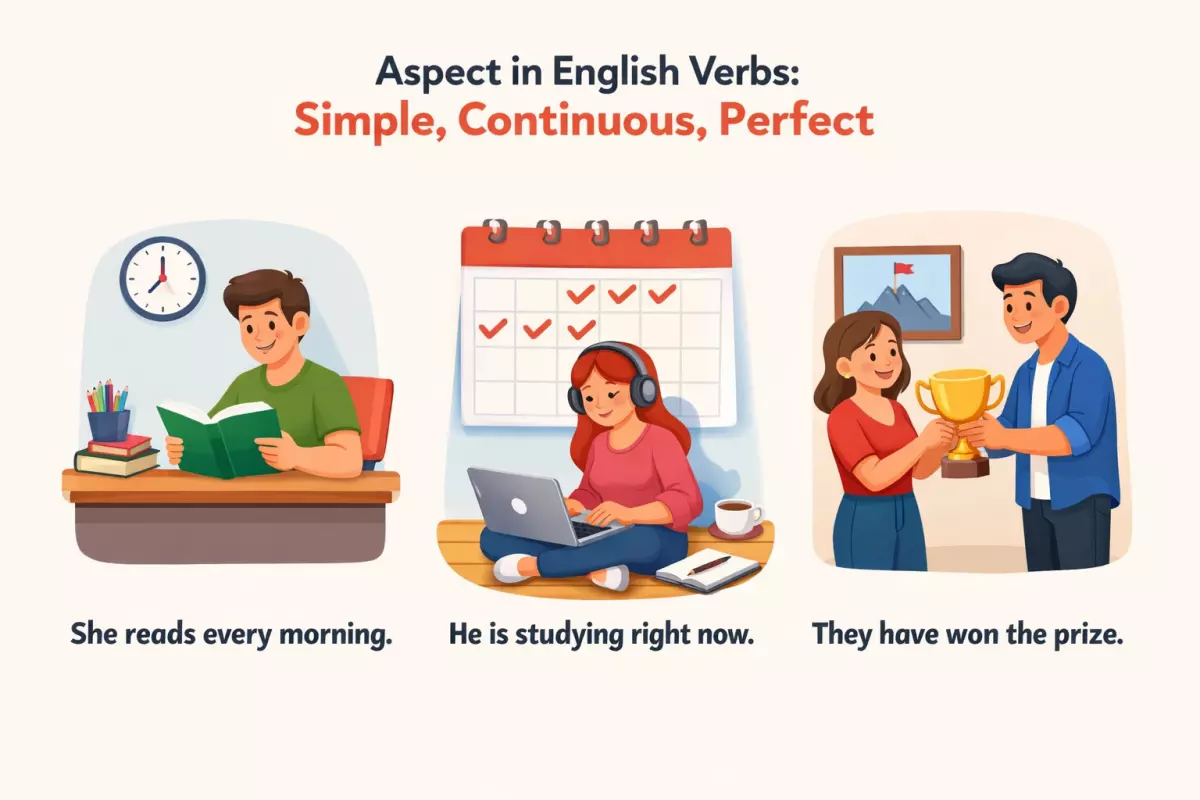 The article explains what aspect means in English grammar, focusing on simple, continuous, and perfect forms and what each one expresses. It shows how to choose aspect by meaning rather than time words, how stative vs dynamic verbs affect aspect, common mistakes, and homework practice tasks.
English verb aspect shows how an action unfolds in time, whether it is a routine fact, something happening now, or something completed with a present result. In everyday speech, this choice guides what listeners imagine and what feels most important in the moment. Here we link simple, continuous, and perfect forms to familiar situations so you can choose the right one confidently without getting stuck on rules.
What aspect means in English grammar
In English verb grammar, aspect is the pattern that shows how a speaker views an action in time: as a simple fact, as in progress, or as connected to another time by completion or experience. Unlike tense (past/present/future), aspect is about the internal “shape” of the event—whether it is ongoing, finished, repeated, temporary, or relevant to a later moment.
English uses a small set of aspect choices that combine with tense. These choices are expressed through verb forms and auxiliaries (especially be and have), so recognizing the structure helps you predict meaning and usage.
Core aspect patterns and what they signal
- Simple (no progressive/perfect marking): presents an event as a whole, as a habit, or as a general truth.
- Continuous (Progressive) (be + verb-ing): highlights an action in progress, temporary situations, or background activity.
- Perfect (have + past participle): links an earlier action to a later time (often “now” or another reference point), focusing on result, experience, or completion.
- Perfect Continuous (have been + verb-ing): combines the link-to-a-time idea with duration or ongoing activity up to that point.
How aspect differs from tense in practice
- Tense answers “When?”: past vs. present (and future meaning often expressed with modals like will).
- Aspect answers “In what way over time?”: ongoing vs. complete vs. habitual vs. temporary.
- The same tense can carry different meanings depending on aspect:
- Past simple: I lived in Paris. (a finished period)
- Past continuous: I was living in Paris. (an ongoing background situation)
- Present perfect: I have lived in Paris. (experience or relevance now)
- Present perfect continuous: I have been living in Paris. (duration up to now, possibly continuing)
Form clues: what to look for in the verb phrase
- Continuous is easy to spot because it uses be + -ing: am/is/are/was/were + working.
- Perfect is marked by have + past participle: has/have/had + worked.
- Perfect continuous stacks both markers: has/have/had been + working.
- Simple aspect uses the base verb (or -s in the present third person): work/works/worked, without be or have as aspect markers.
Common usage signals (quick patterns to notice)
- Habits and routines often choose simple aspect: She walks to work.
- Actions happening “around now” often choose continuous: She is walking to work this week.
- Finished actions with present relevance often choose perfect: She has walked to work, so she’s tired.
- Duration up to a point often chooses perfect continuous: She has been walking for an hour.
- Background vs. main event in narratives often contrasts continuous and simple: I was cooking when he arrived.
- Temporary vs. permanent often contrasts continuous and simple: He lives in Rome vs. He is living in Rome (for now).
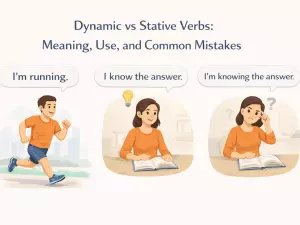
- State verbs (know, believe, own, like) usually avoid continuous in standard use: ✅ I know the answer. ❌ I am knowing the answer.
- Time words can hint at aspect choice:
- Simple: always, usually, every day
- Continuous: now, at the moment, currently, these days
- Perfect: already, yet, just, ever, never, so far
- Perfect continuous: for, since, all day/week, lately
Simple aspect and typical meanings
Use the simple forms to present actions and states as facts: things that are generally true, repeated, completed at a definite time, or viewed as a whole. The focus is not on the process; it is on the event or state itself (often with a clear time reference or a routine pattern).
Core uses and what they usually signal
- Habits and routines: repeated actions, often with frequency adverbs.
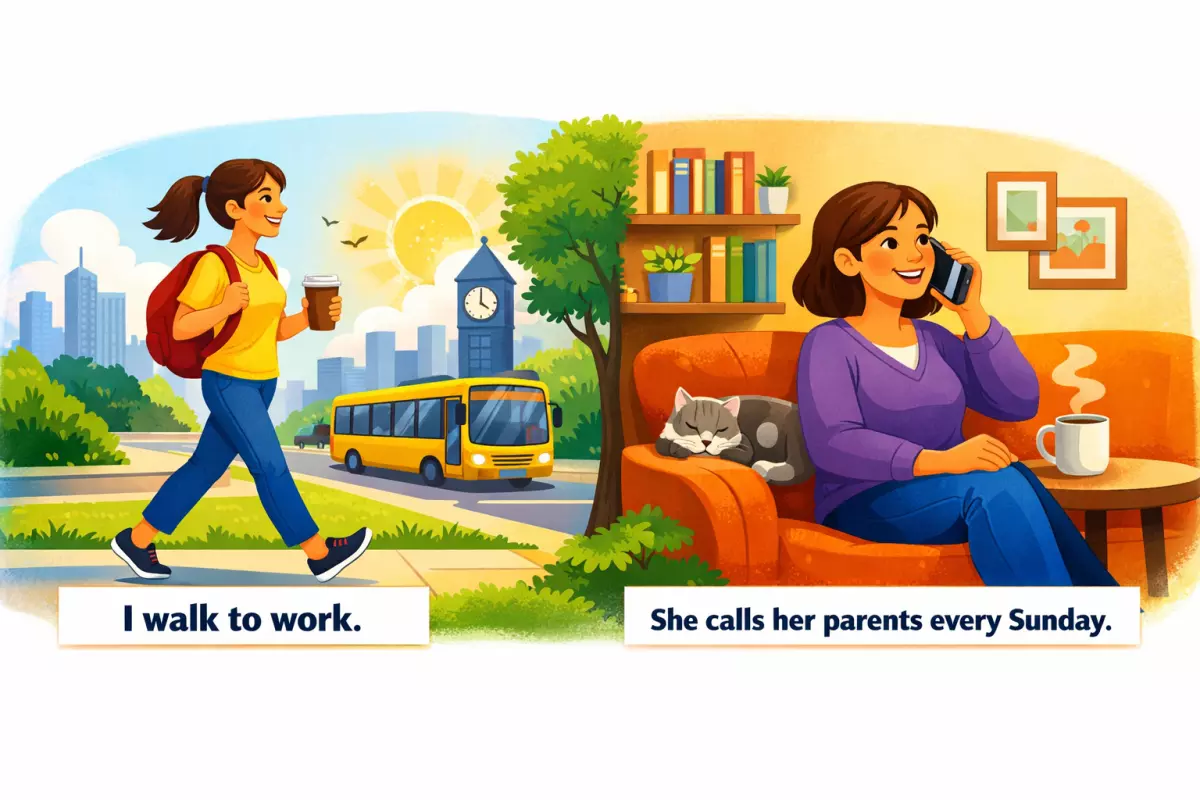
Examples: “I walk to work.” “She calls her parents every Sunday.” - General truths and facts: statements that are stable or widely true.
Examples: “Water boils at 100°C.” “The museum opens at 10.” - Permanent or long-term states: situations seen as stable rather than temporary.
Examples: “He lives in Leeds.” “They own a small business.” - Completed events in the past (simple past): a finished action at a finished time.
Examples: “We met in 2019.” “I sent the email this morning.” - Sequences of events (storytelling): one event after another, especially in narratives.
Examples: “She opened the door, looked inside, and left.” - Timetables and schedules (simple present for future meaning): fixed plans, often with transport, classes, events.
Examples: “The train leaves at 6:40.” “The course starts next week.” - Instructions and directions: concise steps, common in recipes and manuals.
Examples: “Add the flour.” “Turn left at the lights.” - Commentary and headlines: a “live” reporting style that treats actions as immediate facts.
Examples: “Smith passes to Lee.” “Company announces new policy.” - Performative verbs (saying = doing): the act happens by speaking, often in formal contexts.
Examples: “I apologize.” “We agree to the terms.” - Cause-and-effect statements: patterns and results, often in explanations.
Examples: “If you heat ice, it melts.” “This button resets the device.”
Common time expressions that fit the simple forms
- Simple present: always, usually, often, sometimes, rarely, never, every day/week, on Mondays, at weekends.
- Simple past: yesterday, last night/week/year, in 2010, two days ago, when I was a child, then, at that moment.
- Simple future (will): tomorrow, next week, soon, in a few minutes (often for predictions or decisions made now).
Patterns learners rely on
- Frequency adverbs typically go before the main verb: “She often eats out.” but after be: “He is usually late.”
- Third-person singular in the present adds -s/-es: “I work,” “she works,” “he watches,” “it goes.”
- Simple past is a single finished form: regular “-ed” (worked, played) and irregular forms (went, took, made).
- Simple forms pair naturally with “complete” time references: “I finished at 5,” “We arrived on Tuesday.”
Typical contrasts with continuous and perfect
- Routine vs. activity in progress: “I read before bed” (habit) vs. “I am reading now” (in progress).
- Whole event vs. background action: “She called” (completed) vs. “She was calling when I arrived” (background).
- Finished time vs. connection to the present: “I lost my keys yesterday” (past time finished) vs. “I have lost my keys” (present result).
- Fixed schedule vs. personal arrangement: “The meeting starts at 9” (timetable) vs. “We are starting at 9” (arrangement in context).
Notes on stative verbs in simple forms
- Many verbs about states commonly use simple forms rather than continuous: know, believe, like, love, hate, need, want, prefer, understand, remember, belong, own, seem.
- Compare: “I know the answer” (state) ❌ “I am knowing the answer” (not typical).
- Some verbs can shift meaning: “I think it’s true” (opinion) vs. “I am thinking about it” (mental activity).
Continuous aspect and ongoing actions
The continuous (progressive) form is used to show an action in progress around a time reference. It highlights the activity as temporary, unfolding, or in the middle of happening, rather than presenting it as a simple fact.
Core form and time references
- Form: be + verb + -ing (am/is/are/was/were + -ing).
- Time anchors: now, at the moment, today, this week, at 7 p.m., when/while + clause.
- Meaning focus: the process (what is happening), not the completion (that it finished).
- Typical contrast: simple = routine/fact; progressive = activity in progress/temporary situation.
Common uses (with examples)
- Action happening now: “She is talking on the phone.”
- Action happening around now (temporary period): “I’m working from home this month.”
- Background action in a story: “It was raining, and people were running for cover.”
- Two actions in progress at the same time: “While I was cooking, he was setting the table.”
- Action in progress interrupted by a shorter event: “I was driving when the phone rang.”
- Planned future arrangement (often with a time expression): “We’re meeting the client at 3.”
- Repeated activity with emotional coloring (often with always/constantly): “He’s always leaving the lights on.”
- Changing or developing situations: “Prices are rising again.”
- Polite, tentative questions: “Were you hoping to speak to the manager?”
- Temporary behavior (not a permanent trait): “You’re being very quiet today.”
- In-progress work with “currently/presently”: “They’re currently reviewing the proposal.”
- Ongoing activity at a specific past time: “At 9 p.m., I was studying.”
Patterns to notice
- With “when” and “while”: “While she was reading, I was writing notes.” / “I was reading when you called.”
- With “today/this week/these days”: these often signal a temporary situation: “He’s taking the bus this week.”
- With “always/constantly/forever”: the progressive can express annoyance or emphasis: “She’s constantly interrupting.”
- With future time: “I’m flying to Berlin on Friday.” (arrangement already set)
Stative verbs and common exceptions
Many verbs describing states (not actions) usually avoid the -ing form because they describe a condition rather than an unfolding event. However, some can appear in the progressive when the meaning changes to an activity or a temporary behavior.
- Often not progressive (state meanings): know, believe, like, love, hate, want, need, prefer, understand, remember, belong, own, seem, appear.
- State vs. activity shift: ✅ “I think it’s correct.” (opinion) → ✅ “I’m thinking about it.” (mental process)
- Perception verbs (typical vs. special uses): ✅ “I see the problem.” (understand) → ✅ “I’m seeing a doctor tomorrow.” (arrangement)
- “Have”: ✅ “I have a car.” (possession) → ✅ “We’re having dinner.” (activity)
- “Be”: ✅ “He is polite.” (general quality) → ✅ “He’s being polite.” (current behavior)
Frequent learner errors to avoid
- ❌ “I am knowing the answer.” → ✅ “I know the answer.”
- ❌ “She is having a car.” → ✅ “She has a car.”
- ❌ “I’m understanding.” → ✅ “I understand.” (or “I’m understanding it better now.” when emphasizing a developing process)
- ❌ “We are meet tomorrow.” → ✅ “We are meeting tomorrow.”
- ❌ “He is always forgeting.” → ✅ “He is always forgetting.”
Perfect aspect and past-to-present links
Use the perfect to connect an earlier time to a later reference point. In many sentences, that reference point is now, so the form highlights a present result, a life experience up to now, or a situation that started in the past and continues.
Core meaning: earlier event + current relevance
The perfect does not simply report a past event; it frames it as meaningful at the reference time. This is why it often appears with time expressions like already, yet, just, ever, and never, or with “up to now” phrases such as so far and this week.
- Result now: the past action explains the current situation. → “I’ve lost my keys (so I can’t open the door).”
- Experience: something happened at an unspecified time before now. → “She’s visited Japan.”
- Continuing situation: a state or repeated action began earlier and continues. → “They’ve lived here for ten years.”
- Recent news: a fresh event is introduced without focusing on when exactly. → “The train has been delayed.”
Common patterns with time expressions
Certain adverbs and time phrases strongly invite the present perfect because they point to a time window that includes the present, or they focus on completion relative to now.
- already: “We’ve already sent the email.”
- yet (negatives/questions): “I haven’t finished yet.” / “Have you finished yet?”
- just: “He’s just arrived.”
- ever: “Have you ever tried scuba diving?”
- never: “I’ve never seen that movie.”
- so far: “So far, we’ve raised $500.”
- up to now: “Up to now, nothing has changed.”
- this morning / this week / this year (when the period is still open): “I’ve had three meetings this morning.”
- recently / lately: “She’s been working late recently.”
- in the last + time period: “In the last few days, I’ve slept badly.”
- for + duration: “We’ve waited for an hour.”
- since + starting point: “I’ve known him since 2019.”
Present perfect vs. simple past: choosing the frame
Choose the present perfect when the time is not finished or the focus is on what it means now. Choose the simple past when the time is finished or explicitly stated as a completed point in the past.
- ✅ “I’ve seen that film.” (experience; time not specified) ❌ “I saw that film.” (sounds incomplete without a past time context)
- ✅ “I saw that film last night.” (finished time: last night) ❌ “I’ve seen that film last night.”
- ✅ “We’ve had two tests this week.” (the week is still in progress) ✅ “We had two tests last week.” (the week is over)
- ✅ “Have you eaten yet?” (relevance now) ✅ “Did you eat at 7?” (specific past time)
Perfect simple vs. perfect continuous: result vs. activity
Both forms link earlier time to the present, but they highlight different things. The perfect simple often emphasizes completion or a result; the perfect continuous emphasizes duration, repetition, or an activity that explains a current state.
- Result focus (perfect simple): “I’ve written the report.” (it’s done)
- Activity focus (perfect continuous): “I’ve been writing the report.” (explains why I’m busy/tired; may be unfinished)
- Quantity/result: “She’s read three chapters.”
- Time spent: “She’s been reading for two hours.”
- Repeated actions: “They’ve called me three times today.” / “They’ve been calling me all day.”
Typical learner issues to avoid
- Using present perfect with finished-time adverbials: ❌ “I’ve met her yesterday.” → ✅ “I met her yesterday.”
- Forgetting the link to now: if the sentence is only about a completed past event, the simple past is usually the better choice.
- Overusing “since” with a duration: use since + starting point (“since Monday”), and for + length (“for two days”).
- Mixing forms in one time frame: keep the reference point clear. “I’ve lived here since 2020” (still true) vs. “I lived there in 2020” (finished).
Choosing aspect by meaning, not time words
Time expressions like yesterday, now, or for two years can suggest a tense, but they do not automatically decide the aspect. Choose the verb form based on what you mean: a complete event, an activity in progress, a result that matters now, or a duration up to a reference point.
Use meaning first: four common intentions
- Simple: you present the situation as a fact, habit, or complete event (the whole is more important than the process).
- Continuous: you highlight an activity in progress, a temporary situation, or an unfinished “middle” of an action.
- Perfect: you connect an earlier time to a later time (result, experience, or “up to now/then” meaning).
- Perfect continuous: you connect earlier-to-later time and also stress the ongoing activity or its duration.
Time words that often mislead learners
- “Now” does not force continuous: “I ✅ agree now” (state) is natural; “I ❌ am agreeing now” is unusual unless it means “I’m giving my agreement at this moment.”
- “Always” is not only simple: “She ✅ always loses her keys” (habit) vs. “She ✅ is always losing her keys” (repeated behavior with annoyance).
- “Today/this week” can take simple or perfect depending on whether you see the time period as finished: “I ✅ sent it today” (done) vs. “I ✅ have sent it today” (still within today, relevance now).
- “For/since” often points to perfect, but not always: “I ✅ have lived here for years” (up to now) vs. “I ✅ lived there for years” (finished period in the past).
- “Already/yet” often fits perfect, but simple is possible with a finished past time: “I ✅ have already eaten” (relevant now) vs. “I ✅ already ate at 6” (past time is stated).
- “At the moment” usually supports continuous, but states still use simple: “She ✅ knows the answer at the moment.”
Practical patterns: choose the aspect by the message
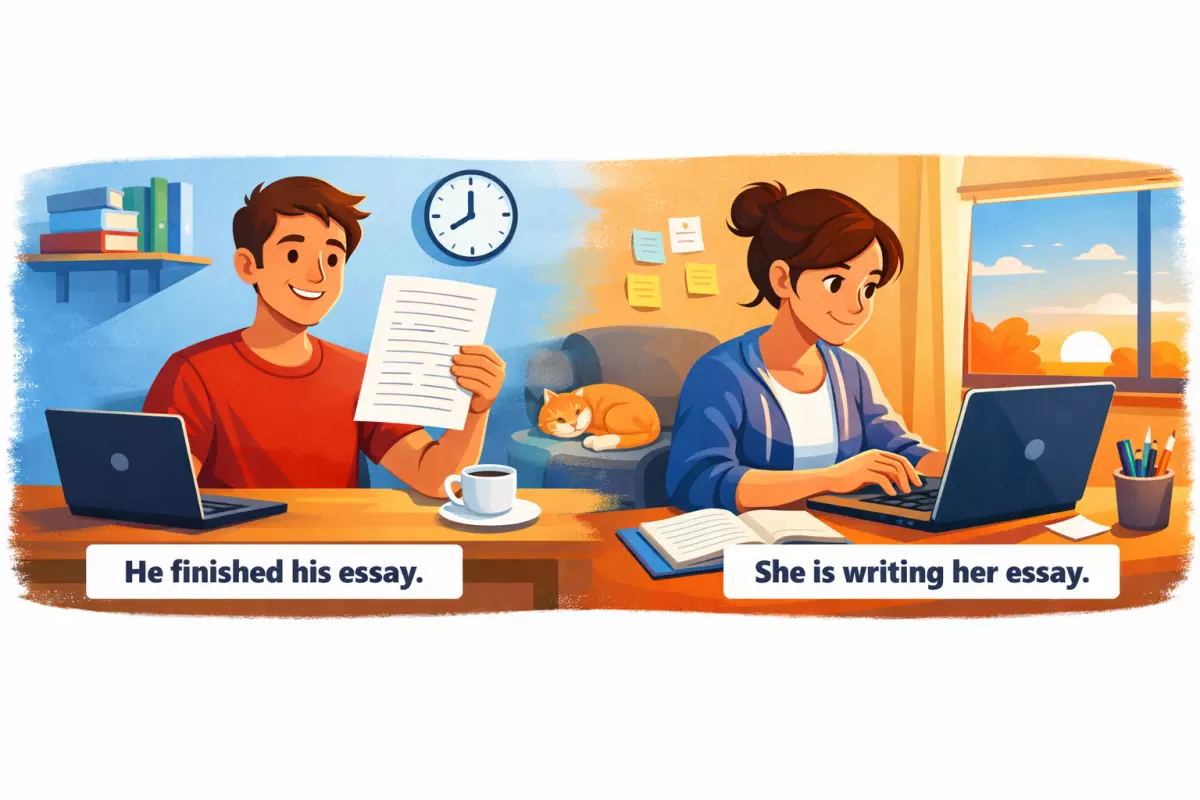
- Completed event (focus on the whole) → simple: “We finished the report.”
- Action in progress (focus on the middle) → continuous: “We are finishing the report.”
- Result matters now → perfect: “We have finished the report (so you can read it).”
- Duration up to now → perfect (often with for/since): “We have worked on it for weeks.”
- Duration + activity emphasis → perfect continuous: “We have been working on it for weeks (and it’s been intense).”
- Temporary situation around now → continuous: “I am staying with a friend this month.”
- Regular routine → simple: “I take the train every day.”
- Repeated behavior with emotion (often irritation) → continuous + always/constantly: “He is always interrupting.”
- Background action + short event → continuous + simple: “I was cooking when the phone rang.”
- Earlier event before another past point → past perfect: “She had left before I arrived.”
- Experience up to now (no specific time stated) → present perfect: “I have seen that film.”
- Specific finished time mentioned → simple past: “I saw that film last year.”
- State verbs (know, believe, own, like) usually → simple: “I own a car.” (Continuous is only for special meanings: “I’m loving it” = a temporary feeling.)
- Developing change → continuous: “It is getting colder.”
A quick self-check before you choose
- Is the action viewed as a complete unit, or do you want the listener to notice the process?
- Do you mean “earlier than now/then, with a connection to now/then” (perfect), or simply “at a past time” (simple past)?
- Is it a stable state (usually simple), or a temporary/active situation (often continuous)?
- Are you emphasizing how long it has been happening (perfect continuous), or the fact that it has happened (perfect)?
Aspect with stative vs dynamic verbs
Choosing between simple, continuous, and perfect forms often depends on whether the verb describes a state (a condition that is generally stable) or an action (something that happens or changes). Many “state” verbs strongly prefer simple forms, while action verbs freely use continuous forms to highlight duration, temporary situations, or in-progress activity.
Stative verbs: usually simple, not continuous
Stative verbs commonly describe thoughts, feelings, possession, senses, and relationships. In standard usage, they typically avoid the continuous because they don’t naturally present as “in progress.”
- Opinions/thoughts: “I think it’s correct.” ❌ “I am thinking it’s correct.” (unless “think” = consider)
- Knowledge: “She knows the answer.” ❌ “She is knowing the answer.”
- Belief: “They believe you.” ❌ “They are believing you.”
- Preference: “He likes jazz.” ❌ “He is liking jazz.”
- Love/hate: “I love this song.” ❌ “I am loving this song.” (informal exceptions exist)
- Want/need: “We need more time.” ❌ “We are needing more time.”
- Possession: “She has a car.” ❌ “She is having a car.” (unless “have” = experience/consume)
- Belonging: “This coat belongs to me.” ❌ “This coat is belonging to me.”
- Appearance: “It seems fine.” ❌ “It is seeming fine.”
- Measurement: “The box weighs two kilos.” ❌ “The box is weighing two kilos.” (unless a process of weighing)
- Cost/value: “It costs $10.” ❌ “It is costing $10.”
- Senses (often stative): “This soup tastes salty.” ❌ “This soup is tasting salty.” (unless “taste” = test)
- Perception: “I hear music.” ❌ “I am hearing music.” (unless “hear” = meet for a hearing/appointment)
- Existence: “The problem exists.” ❌ “The problem is existing.”
Dynamic verbs: continuous highlights “in progress” or “temporary”
Dynamic verbs describe actions, events, and processes. The continuous is natural here because it frames the activity as ongoing, temporary, or incomplete.
- “She is running right now.” (activity in progress)
- “They are building a house.” (process, not finished)
- “I am working from home this week.” (temporary arrangement)
- “He was driving when it started to rain.” (background action)
- “We have been waiting for an hour.” (duration up to now)
- “She had been studying before the exam began.” (earlier ongoing activity)
Verbs that can be stative or dynamic (meaning changes the aspect)
Some verbs switch category depending on meaning. When they describe a state, simple forms are typical; when they describe an action or a deliberate process, continuous forms become normal.
- think: “I think it’s true.” (opinion) → “I am thinking about your idea.” (considering)
- have: “She has two sisters.” (possession) → “She is having lunch.” (activity)
- see: “I see the problem.” (understand) → “I am seeing a doctor tomorrow.” (arrangement/meeting)
- feel: “I feel tired.” (state) → “I am feeling the fabric.” (touching/examining)
- taste: “It tastes sweet.” (state) → “The chef is tasting the sauce.” (testing)
- smell: “It smells strange.” (state) → “She is smelling the flowers.” (deliberate action)
- look: “You look happy.” (appearance) → “He is looking at the map.” (action)
- weigh: “The package weighs 5 kg.” (measurement) → “They are weighing the package.” (process)
- be: “He is polite.” (general trait) → “He is being polite today.” (temporary behavior)
Perfect aspect with stative and dynamic verbs
Perfect forms work with both types, but the meaning differs. With states, the perfect often emphasizes how long the condition has been true; with actions, it often emphasizes completion, results, or repeated experience.
- State up to now: “I have known her for years.” (duration of a state)
- State before a past point: “He had believed the story until he saw the evidence.”
- Completed action/result: “She has finished the report.”
- Experience: “They have visited Japan twice.”
- Ongoing activity with duration: “We have been working all morning.” (process continuing or recently continuing)
When a continuous form sounds odd, check whether the verb is expressing a stable condition rather than an activity. If the meaning can shift to “deliberate action” or “temporary behavior,” the progressive often becomes acceptable and natural.
Common learner mistakes
Problems with verb aspect usually come from mixing up “time” (past/present/future) with “viewpoint” (simple/continuous/perfect). The patterns below show where learners most often choose the wrong form, and what to use instead.
- Using the continuous with stative verbs (verbs of states, feelings, possession, perception).
❌ I am knowing the answer. → ✅ I know the answer.
❌ She is having a car. → ✅ She has a car.
Note: some stative verbs can be dynamic with a change in meaning: ✅ I’m having lunch. / ✅ She’s being rude. - Using the present continuous for routines or facts (where the simple present is expected).
❌ I’m going to work by bus every day. → ✅ I go to work by bus every day.
❌ Water is boiling at 100°C. → ✅ Water boils at 100°C. - Overusing the present perfect with finished time expressions (yesterday, last week, in 2019, two days ago).
❌ I have seen him yesterday. → ✅ I saw him yesterday.
Rule of thumb: present perfect needs an “unfinished” time frame or a present connection (today, this week, recently, so far). - Choosing past simple when the result matters now (present relevance).
❌ I lost my keys. (when you still can’t find them) → ✅ I’ve lost my keys.
❌ He broke his leg. (still injured) → ✅ He’s broken his leg. - Confusing present perfect and present perfect continuous (result vs duration/activity).
Use present perfect for completed results or number: ✅ I’ve written three emails.
Use present perfect continuous for ongoing activity or emphasis on time spent: ✅ I’ve been writing emails for two hours. - Using “since” and “for” incorrectly with perfect forms.
❌ I’ve lived here since five years. → ✅ I’ve lived here for five years.
❌ I’ve lived here for 2020. → ✅ I’ve lived here since 2020. - Forgetting that “since” clauses often use past simple (the starting point is a past event).
❌ I’ve known her since I’ve moved here. → ✅ I’ve known her since I moved here. - Using the present perfect as a “general past” in narratives and sequences of events.
In stories, use past simple for the main timeline: ✅ He opened the door, walked in, and sat down.
Use past perfect to show an earlier past event: ✅ He sat down because he had been running. - Skipping the past perfect when two past times are compared (earlier vs later in the past).
❌ When I arrived, she left. (unclear order) → ✅ When I arrived, she had left.
Past perfect is especially helpful with when, after, before, by the time. - Using the continuous with “always” to mean a neutral habit (it often sounds like complaint/annoyance).
✅ He always forgets his keys. (neutral fact)
✅ He’s always forgetting his keys. (speaker is annoyed; repeated and irritating) - Mixing “will” and “going to” with the wrong viewpoint (plans vs predictions vs decisions).
❌ Look at those clouds! It will rain. → ✅ It’s going to rain. (evidence now)
❌ I’m going to answer the phone! (instant decision) → ✅ I’ll answer the phone! - Using future continuous for simple future facts when no “in progress” meaning is intended.
❌ The train will be arriving at 6:00. (plain schedule) → ✅ The train arrives at 6:00 / will arrive at 6:00.
Use future continuous for an action in progress at a future time: ✅ At 6:00, I’ll be driving home. - Using “I’m working here for five years” instead of a perfect form to express duration up to now.
❌ I’m working here for five years. → ✅ I’ve been working here for five years.
(Or ✅ I’ve worked here for five years, when focusing on the fact/achievement rather than the ongoing activity.) - Choosing continuous when the verb describes a single completed action (especially with short, finished events).
❌ I was seeing him yesterday. (unless meaning “dating/meeting repeatedly”) → ✅ I saw him yesterday.
❌ She was dropping the glass. (odd unless describing the moment in progress) → ✅ She dropped the glass. - Overusing “already/just/yet” with the wrong tense in British/American patterns.
Many learners do better by matching the time meaning: “just/already” often pair naturally with present perfect for recent news: ✅ I’ve just finished.
Past simple is common in American English for the same idea: ✅ I just finished.
Quick self-check questions
- Is this a routine/fact? → prefer simple forms.
- Is it temporary or in progress around a time? → consider continuous.
- Do I connect it to “now” (result, experience, unfinished time)? → consider present perfect.
- Am I talking about an earlier past before another past moment? → consider past perfect.
Homework: aspect choice practice tasks
Choose the verb form that best fits the meaning in each context. Focus on the time reference (now, around now, finished before a point, repeated habit), the speaker’s viewpoint (event vs. process), and whether the result matters more than the action itself.
Task 1: Choose the best aspect (Simple / Continuous / Perfect)
- Right now I ______ dinner, so I can’t answer the phone. (cook / am cooking / have cooked)
- She ______ to work every day, but this week she ______ the bus because her car is in the garage. (drives / is driving / has driven; takes / is taking / has taken)
- We ______ the report yet, but we ______ on it since Monday. (don’t finish / aren’t finishing / haven’t finished; work / are working / have been working)
- By the time you arrived, they ______. (left / were leaving / had left)
- He ______ three emails this morning. (writes / is writing / has written)
- Look at those clouds— it ______. (rains / is raining / has rained)
- I ______ that movie twice, so I don’t need to see it again. (see / am seeing / have seen)
- When I was a child, we ______ to the sea every summer. (go / were going / have gone)
- Sorry I’m late. I ______ for a parking space for twenty minutes. (look / am looking / have been looking)
- They ______ in this apartment since 2021. (live / are living / have lived)
- Don’t call at 8— I ______ a meeting then. (have / am having / have had)
- She ______ her ankle, so she can’t play today. (twists / is twisting / has twisted)
Show answers
- am cooking
- drives; is taking
- haven’t finished; have been working
- had left
- has written
- is raining
- have seen
- went
- have been looking
- have lived
- am having
- has twisted
Task 2: Fix the aspect (one correction per sentence)
- I am knowing the answer.
- She has been to Paris last year.
- We’ve finished the meeting at 3 pm.
- He is working here since May.
- When I called, she cooked.
- I have seen him yesterday.
- They are usually going to bed at 10.
- By next Friday, I finish the course.
- How long do you wait?
- I’ve been writing this email and I finally sent it. (choose one aspect to match “sent”)
Show answers
- I know the answer.
- She went to Paris last year.
- We finished the meeting at 3 pm.
- He has been working here since May.
- When I called, she was cooking.
- I saw him yesterday.
- They usually go to bed at 10.
- By next Friday, I will have finished the course.
- How long have you been waiting?
- I wrote this email and finally sent it.
Task 3: Meaning choice (pick the sentence that matches the situation)
- You want to say the activity is temporary and happening around now:
- I work from home.
- I am working from home.
- I have worked from home.
- You want to emphasize a completed result with a present effect:
- She is losing her keys.
- She lost her keys.
- She has lost her keys.
- You want to describe an action in progress at a specific past moment:
- At 9 pm, we watched TV.
- At 9 pm, we were watching TV.
- At 9 pm, we have watched TV.
- You want to show one past action happened before another past action:
- After I arrived, the train left.
- After I arrived, the train had left.
- After I arrived, the train was leaving.
- You want to describe a repeated habit (not necessarily “right now”):
- He is drinking coffee every morning.
- He drinks coffee every morning.
- He has been drinking coffee every morning.
Show answers
-
- I am working from home.
-
- She has lost her keys.
-
- At 9 pm, we were watching TV.
-
- After I arrived, the train had left.
-
- He drinks coffee every morning.
Task 4: Production (write your own sentences)
- Write 3 sentences about your routine using the present simple (habits, schedules).
- Write 3 sentences about what is happening this week using the present continuous (temporary situations).
- Write 3 sentences using the present perfect (life experience, recent results, unfinished time: today/this week).
- Write 2 sentences using the present perfect continuous (activity continuing up to now, with “for/since”).
- Write 2 sentences using the past continuous + past simple (background action + interruption).
- Write 2 sentences using the past perfect (earlier past before another past event).
When checking your work, match the aspect to the intended meaning: use simple for facts and repeated patterns, continuous for actions in progress or temporary trends, perfect for “before now/before then” with relevance, and perfect continuous for duration and ongoing activity.