Progressive Aspect and Its Special Meanings

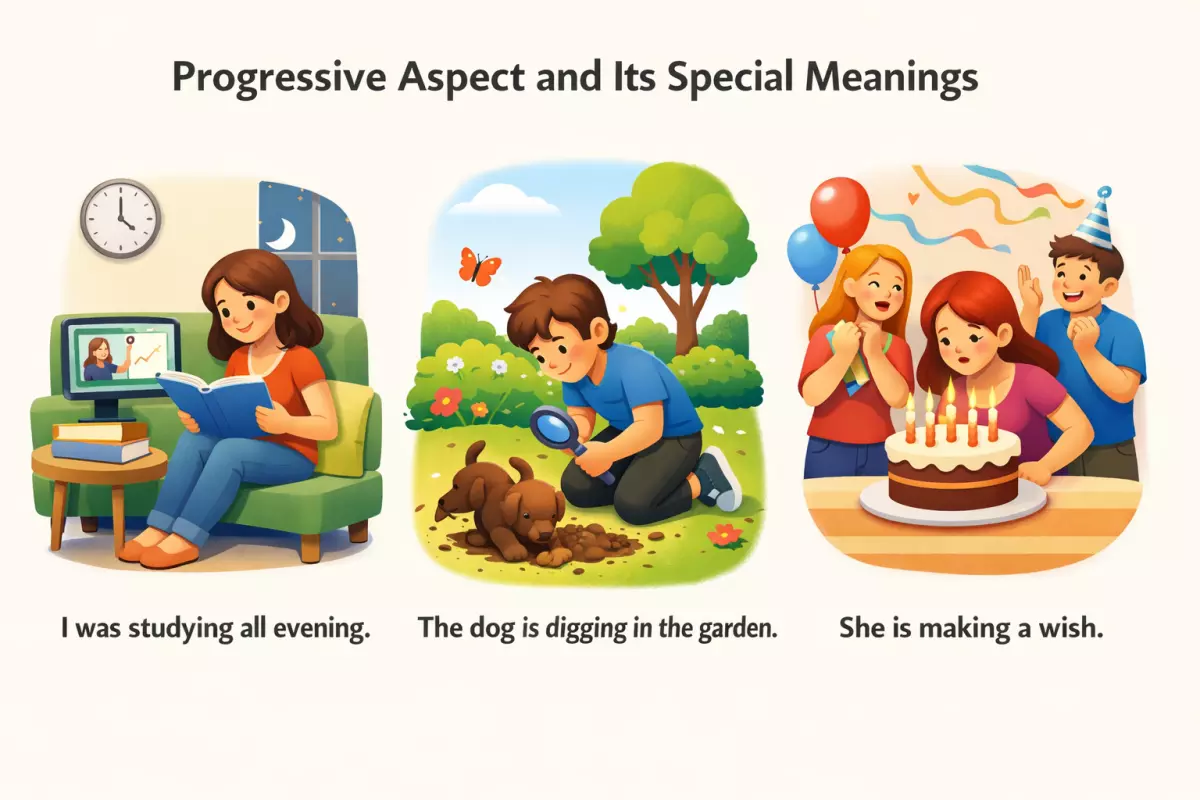 The article explains what the progressive aspect really expresses: temporary actions and situations, changes and trends, repeated annoyance, and future arrangements. It also covers stative verbs and exceptions, typical learner mistakes with fixes, and homework practice tasks.
Using the continuous form to describe an action in progress often adds meaning beyond time. In everyday speech it can imply something temporary, in transition, repeated with irritation, or generally happening these days rather than right this second. This article helps you spot these cues in real conversations and choose the form that best matches what you intend.
What the progressive aspect expresses
The progressive form (be + -ing) highlights an activity as unfolding in time. It often frames an event as temporary, incomplete, or in progress, and it can also add speaker attitude (for example, irritation) or signal change and development.
Core meanings and common usage patterns
- Action in progress at a specific time: used to “zoom in” on what is happening around a reference point.
- At 8 p.m., I was cooking dinner.
- Right now, they’re meeting with the client.
- Temporary situation (not seen as permanent): the -ing form suggests “for now” rather than “in general.”
- She’s living with her sister this month.
- I’m working from home these days.
- Activity around a time (not necessarily at the exact moment): especially with longer actions and time expressions.
- I’m reading a great book at the moment. (not necessarily right now)
- He’s training for a marathon this spring.
- Background action that sets the scene: often paired with a simple past event that interrupts or occurs within it.
- I was walking home when it started to rain.
- They were arguing when the phone rang.
- Repeated actions with a “temporary trend” feel: repeated events are presented as a current pattern rather than a timeless habit.
- She’s taking the bus a lot lately.
- We’re eating out more these weeks.
- Change, development, or gradual movement: emphasizes a process that is evolving.
- The weather is getting colder.
- Prices are rising again.
- Your English is improving.
- Planned future arrangement: common with verbs of movement and schedules fixed by people.
- We’re meeting Anna on Friday.
- I’m flying to Berlin tomorrow morning.
- They’re moving next month.
- Polite inquiries about plans (softer than simple present): can sound less direct or less demanding.
- What are you doing this weekend?
- Are you staying long?
- Annoyance or criticism with “always/constantly/forever”: the -ing form can signal that the speaker finds the repetition excessive.
- He’s always borrowing my charger.
- They’re constantly changing the plan.
- Emphasis on limited duration: highlights that something is ongoing but expected to end.
- I’m just waiting for a call.
- She’s staying until Monday.
- Incompleteness or “not finished yet”: focuses on the middle of an action rather than its endpoint.
- I’m writing a report. (it isn’t finished)
- They’re building a new bridge. (work is ongoing)
- Limited control or “things happening to/around someone”: common with events that unfold regardless of intention.
- My phone is acting up.
- More people are getting sick this week.
Useful contrasts to avoid common mistakes
- General facts vs. current activity:
- ✅ She works in finance. (general situation)
- ✅ She’s working on a merger this week. (temporary project)
- Habit vs. temporary repetition:
- ✅ I go to the gym on Tuesdays. (routine)
- ✅ I’m going to the gym a lot lately. (current phase)
- State verbs and the -ing form: many stative meanings usually avoid the progressive, but some verbs can shift meaning when used in -ing.
- ✅ I think it’s a bad idea. (opinion)
- ✅ I’m thinking about your offer. (mental process in progress)
- ✅ She has a car. (possession)
- ✅ She’s having lunch. (activity)
Temporary actions and situations
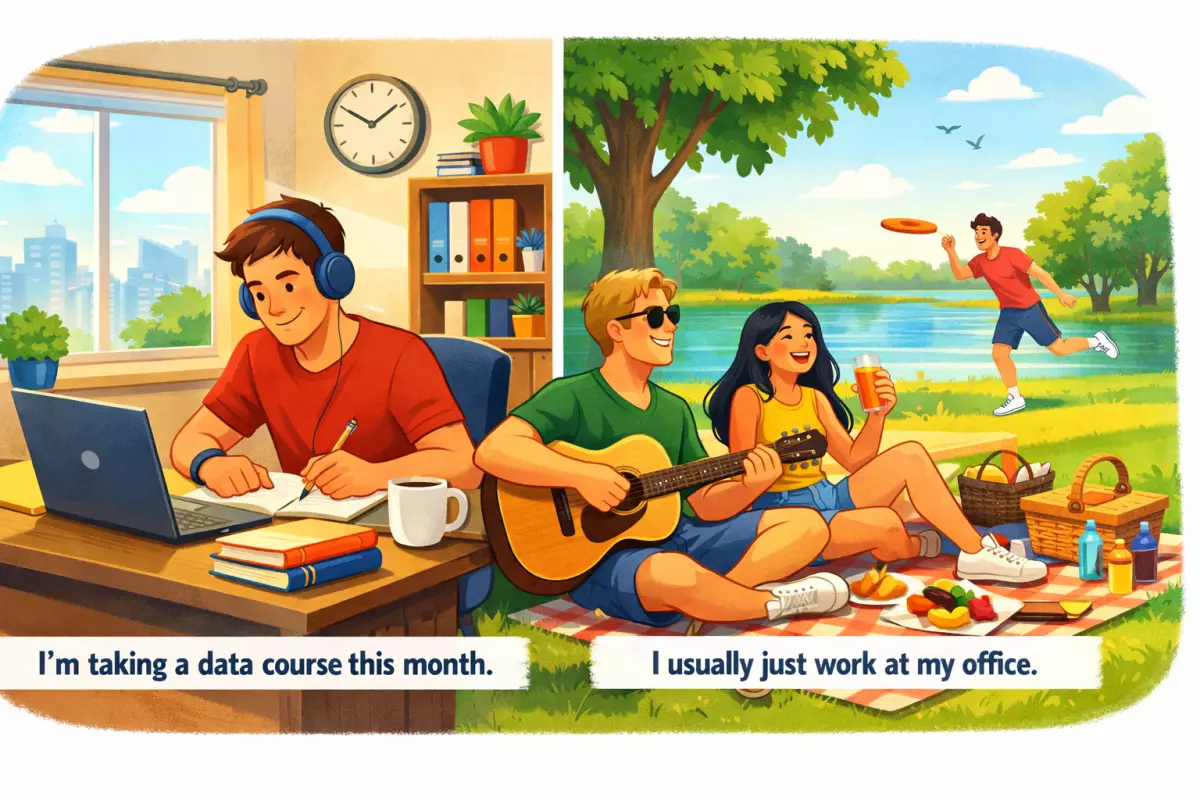
Use the progressive aspect to show that an activity or state is limited in time, connected to “around now,” or true only for a short period. The key idea is contrast: the progressive often implies “this is not permanent” or “this is not the usual situation.”
Common patterns and when to choose the progressive
- Around now (current period): Use present progressive for something happening in the current phase of life, even if not happening at this exact second. Example: “I’m taking a data course this month.”
- These days / at the moment: Time markers that naturally fit the progressive. Example: “She’s working from home these days.”
- Short-term arrangements: A planned, limited situation. Example: “We’re staying with friends until the apartment is ready.”
- Temporary work or roles: A role that is not permanent. Example: “He’s teaching at the university this semester.”
- Projects in progress: Ongoing tasks with an expected endpoint. Example: “They’re rebuilding the bridge.”
- Changing or developing situations: Use progressive to highlight movement or evolution. Example: “Prices are rising again.”
- Repeated activity in a limited period: A series of actions during a temporary phase. Example: “I’m meeting clients a lot this week.”
- Temporary habits (not lifelong): A routine that is only true for now. Example: “I’m going to bed earlier lately.”
- Background action in narratives: Progressive sets the scene for a shorter event. Example: “I was driving home when the phone rang.”
- Polite, tentative questions: Progressive can sound less direct when asking about current plans. Example: “Are you working tomorrow?”
Progressive vs. simple: the meaning difference
| Simple aspect (more stable / general) | Progressive aspect (limited / in progress) |
|---|---|
| I work in marketing. (job/identity) | I’m working in marketing this year. (not necessarily permanent) |
| She lives in Berlin. (home/base) | She’s living in Berlin for a few months. (temporary stay) |
| He teaches English. (regular profession) | He’s teaching English this term. (short-term assignment) |
| They meet on Fridays. (routine) | They’re meeting on Fridays until the project ends. (limited-time schedule) |
Useful time expressions that often signal a limited situation
- this week / this month / this semester
- these days / lately / recently
- for now / for the time being
- at the moment / right now
- until + time/event (until Friday, until the repairs are finished)
- currently / at present
- during + period (during the summer, during the trial period)
- while + clause (while we’re waiting, while she’s recovering)
Common learner issues
- ✅ “I’m staying with my cousin this week.” → temporary arrangement
❌ “I stay with my cousin this week.” (sounds like a fixed routine or unnatural without extra context) - ✅ “He’s working nights at the moment.” → limited period
❌ “He works nights at the moment.” (can sound like a general schedule) - Some verbs rarely take the progressive when they describe stable states (know, believe, own). If the meaning changes to an active/temporary sense, the progressive can become possible: “I’m thinking about it” (mental activity now) vs. “I think it’s true” (opinion).
Progressive for changes and trends
Use the progressive aspect to present a change as an ongoing process, not a finished result. It’s common when you want to show that a situation is developing over time, often with evidence “right now” (recent data, repeated observations, visible movement) rather than a permanent fact.
Core patterns
- be + -ing to show a current development: “Prices are rising again.”
- be + getting/becoming + adjective for gradual change: “It’s getting colder earlier in the evenings.”
- be + -ing with time phrases to frame a trend: “More people are working remotely these days.”
- be + -ing with “more and more / less and less” to emphasize direction: “Traffic is getting worse more and more each year.”
- be + -ing with “gradually / increasingly / steadily” to describe pace: “The company is steadily expanding into new markets.”
- be + -ing with comparison language: “The gap is widening between rents and wages.”
- be + -ing in reports and commentary to describe what the numbers show: “Unemployment is falling, while wages are climbing.”
When the progressive is the natural choice
- When you want the reader to focus on the process, not the endpoint: “The river is drying up.”
- When the trend may be temporary or reversible: “Sales are dropping this quarter.”
- When you’re describing a visible shift happening around the present time: “Neighborhoods are changing fast.”
- When you’re contrasting two simultaneous movements: “Costs are increasing, but demand is slowing.”
- When you’re describing repeated, accumulating change: “People are spending more on experiences than on things.”
Examples you can reuse
- Temperatures are climbing earlier in the spring.
- The days are getting shorter already.
- Housing costs are rising faster than incomes.
- More students are choosing online courses.
- Public opinion is shifting on this issue.
- The city is becoming more bike-friendly.
- Our workload is increasing week by week.
- Energy prices are fluctuating again.
- The market is cooling after a strong year.
- Customer expectations are changing rapidly.
- Small businesses are adapting to new rules.
- Sea levels are rising along the coast.
- The team is improving with each match.
- Manufacturing is moving closer to consumers.
- People are talking less on the phone and more by text.
- The company is gradually reducing its carbon footprint.
Common contrast: progressive vs. simple
- ✅ “The climate is warming.” (a developing process) → ✅ “The climate warms in summer.” (a general, repeated pattern)
- ✅ “Prices are increasing this month.” (current movement) → ✅ “Prices increase when demand is high.” (general cause-and-effect)
- ✅ “My English is improving.” (change in progress) → ✅ “My English improves when I practice daily.” (habitual condition)
Be careful with verbs that usually describe states (know, believe, belong). They don’t typically take the progressive for trends unless the meaning shifts to a temporary or changing attitude, as in “People are believing less in traditional institutions” (uncommon, but possible in a specific context). In most cases, choose a dynamic verb like “are losing trust” or “are becoming less confident” to express the change clearly.
Progressive for repeated annoyance
Use the progressive to show that an action happens again and again in a way the speaker finds irritating, unreasonable, or surprising. The meaning is not simply “in progress”; it adds an attitude: “this keeps happening, and I don’t like it.” This use is especially common with always, constantly, forever, and similar adverbs.
Core pattern
- Subject + be + V-ing + (always/constantly/forever) + … → repeated behavior + speaker complaint
- Subject + (always/constantly/forever) + be + V-ing + … → same meaning; adverb placement shifts emphasis slightly
- Typical time reference is “these days / lately,” but the irritation can also be about a long-standing habit.
How it differs from simple present
- Simple present often sounds neutral or factual: “He always leaves the door open.”
- Progressive + frequency adverb highlights the repetition as excessive or problematic: “He’s always leaving the door open.”
- The progressive version often implies “more than is acceptable,” even if the frequency word is the same.
Common adverbs and what they signal
- always: the default choice; strong sense of “too often.”
- constantly: emphasizes nonstop repetition.
- forever: informal; often exaggerates for effect.
- all the time: conversational; can sound more direct and personal.
- continually: slightly more formal; similar to constantly.
- perpetually: formal or humorous; very strong exaggeration.
Example sentences (typical situations)
- She’s always borrowing my charger and forgetting to return it.
- They’re constantly changing the meeting time at the last minute.
- He’s forever interrupting people before they finish.
- You’re always leaving dishes in the sink overnight.
- My phone is constantly buzzing during class.
- The neighbors are always playing music late at night.
- Our boss is forever asking for “one more quick revision.”
- The kids are constantly arguing over the same toy.
- She’s always pointing out mistakes in front of everyone.
- He’s constantly misplacing his keys and blaming the dog.
- You’re forever saying you’ll start tomorrow.
- They’re always canceling plans after I’ve rearranged my schedule.
- The app is constantly asking me to enable notifications.
- He’s always making jokes at the worst possible moment.
- My internet is forever cutting out during video calls.
- You’re constantly checking your phone while I’m talking.
Form notes and frequent learner errors
- ✅ “He’s always complaining.” → correct: be + V-ing + frequency adverb
- ❌ “He always is complaining.” → possible but usually less natural; prefer “He’s always complaining.”
- ❌ “He is always complain.” → missing -ing; must be “complaining.”
- Negatives work too, often with a critical tone: “You’re not exactly helping; you’re just always criticizing.”
- Questions can sound confrontational, so they’re often softened: “Why are you always changing your mind?”
Pragmatics: when it sounds too strong
- Because it carries judgment, it can escalate conflict; in sensitive contexts, replace it with a neutral description (“You often…”) or a specific example (“Yesterday and today you…”).
- In friendly teasing, it can be light rather than angry, especially with context and tone: “You’re always finding the best snacks.”
- It works best for observable repeated actions, not permanent states: “He’s always being tall” is not natural, but “He’s always being rude” can work because it describes behavior.
Progressive with future arrangements
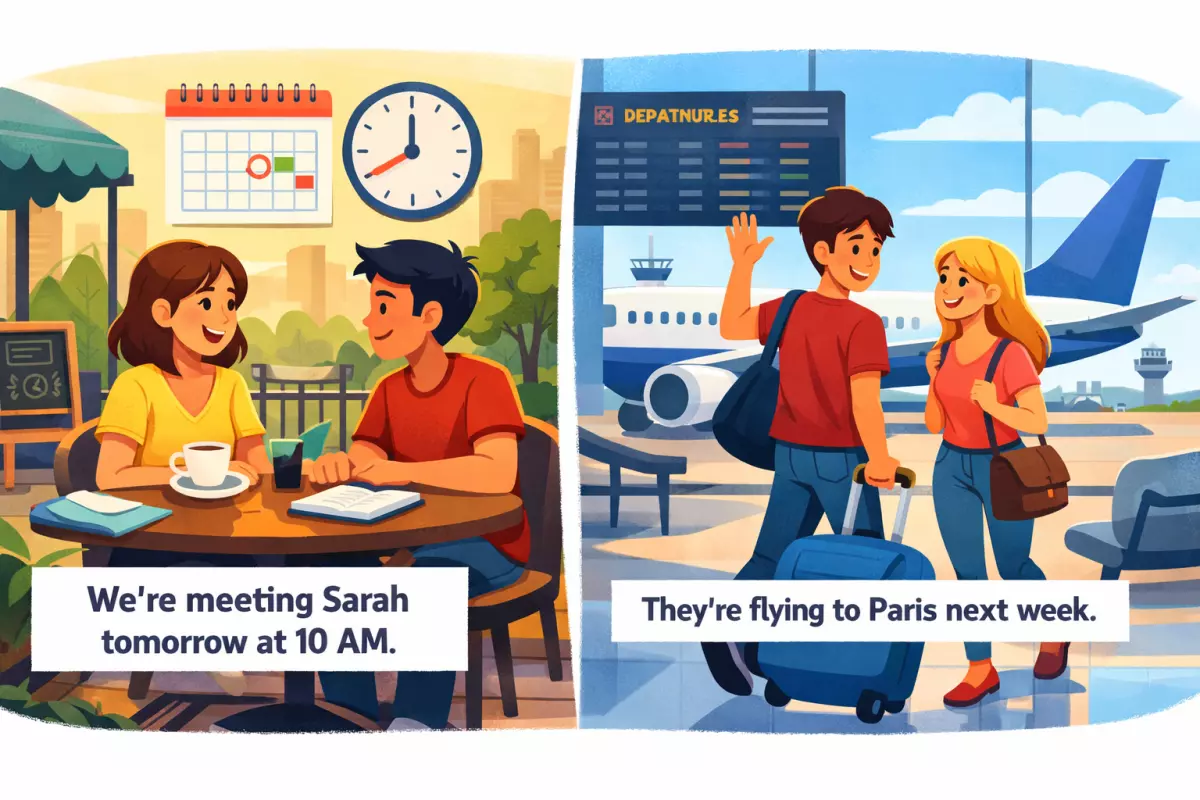
Use the present progressive to talk about a planned, specific event in the near future, especially when the plan is already decided and often fixed by a schedule, booking, or agreement. This use is common in everyday conversation because it highlights that the arrangement is “in progress” in the sense of being set up, not that the action is happening right now.
Core pattern and meaning
The form is the same as for actions happening now: am/is/are + -ing. The time reference comes from a future time expression or the situation.
- Form: am/is/are + verb-ing
- Typical meaning: a decided plan with a specific time/place
- Common signals: tomorrow, on Friday, next week, at 6, this evening, in two days
- Often implied: tickets booked, meeting arranged, people informed, transport scheduled
When this choice sounds natural
- When the event is already arranged with other people: “We’re meeting the client at 2.”
- When there is a fixed time or place: “I’m flying to Berlin on Monday.”
- When you want to sound practical and definite (not just an intention): “She’s starting her new job next month.”
- When the plan is part of a sequence: “I’m seeing Sam after work, then we’re having dinner.”
- When the arrangement is temporary or time-limited: “They’re staying with us for a week.”
Example sentences (planned future)
- I’m having lunch with Maya tomorrow.
- We’re meeting outside the station at 7.
- He’s taking his driving test next Friday.
- They’re moving to a new apartment in April.
- She’s seeing the dentist this afternoon.
- We’re hosting a small party on Saturday.
- I’m working late tonight, so I’ll call you tomorrow.
- My parents are visiting us next weekend.
- The team is presenting the proposal on Tuesday.
- I’m picking the kids up at 5.
- We’re leaving early in the morning.
- He’s playing in the final this Sunday.
- I’m taking the 8:10 train tomorrow.
- She’s joining us for dinner tonight.
- We’re staying at the Riverside Hotel for two nights.
Common contrasts and pitfalls
- ✅ “I’m meeting Ben tomorrow.” (arranged) → ❌ “I meet Ben tomorrow.” (simple present usually needs a timetable meaning)
- ✅ “We’re having dinner at 8.” (a plan) → “We’ll have dinner at 8.” (can sound more like a decision/promise, depending on context)
- ✅ “She’s flying on Monday.” (booked/organized) → “She’ll fly on Monday.” (more neutral prediction or formal statement)
- Avoid using this form for distant, uncertain ideas: “I’m buying a house someday” sounds odd unless the process is already underway.
- Some verbs don’t fit well unless they describe an arranged event: “I’m knowing the answer tomorrow” is not natural; use “I’ll know the answer tomorrow.”
Quick guidance for choosing the tense
- Choose present progressive when the future event is fixed or coordinated with others.
- Choose be going to when you mean intention or a plan without a clear arrangement yet.
- Choose will for on-the-spot decisions, offers, promises, or predictions.
- Choose simple present mainly for timetables and official schedules: “The train leaves at 6:05.”
Stative verbs and exceptions
Some verbs mainly describe a condition, opinion, possession, or perception rather than an action. In those cases, the progressive is often avoided because it suggests a temporary, developing activity. When speakers do use the progressive with these verbs, it usually signals a special meaning: change, limited duration, repeated behavior, or a deliberate stance.
Common state-type verbs that usually avoid the progressive
- Mental states: know, believe, understand, remember, forget, mean, doubt, suppose, realize.
- Emotions and preferences: like, love, hate, prefer, want, need, fear, envy, mind.
- Possession and relationship: have (own), own, belong, possess, contain, include, consist, depend (on).
- Senses (as passive perception): see, hear, smell, taste, feel (when it means “experience a sensation”).
- Appearance and measure: seem, appear, look (resemble), weigh (measure), cost, fit (be the right size), measure.
When the progressive is possible: meaning shifts to “temporary” or “in progress”
- Temporary feelings or attitudes: ✅ “I’m loving this class” (right now, strong current reaction) vs. ❌ “I love this class” (general, stable preference).
- Developing understanding: ✅ “I’m understanding the problem now” (change over time) vs. more typical “I understand the problem.”
- Behavior (not a permanent trait): ✅ “You’re being rude” (current behavior) vs. “You are rude” (general characteristic).
- Intentional listening/looking: ✅ “I’m listening to the radio” / “She’s looking at the painting” (active effort) vs. “I hear music” / “I see a bird” (passive perception).
- Trying or testing a perception: ✅ “I’m smelling the milk” (checking) vs. “The milk smells sour” (state/quality).
- Repeated or annoying habits (often with always/constantly): ✅ “He’s always forgetting his keys” (complaint about repeated behavior).
High-frequency exceptions and “two-meaning” verbs
- have
- ✅ “I have a car” (possession; usually not progressive).
- ✅ “I’m having dinner / a shower / a good time” (activity or experience).
- ✅ “She’s having trouble” (temporary situation is possible in many varieties).
- think
- ✅ “I think it’s true” (opinion).
- ✅ “I’m thinking about your idea” (mental activity in progress).
- see
- ✅ “I see the problem” (understand).
- ✅ “I’m seeing the doctor tomorrow” (arrangement/meeting).
- feel
- ✅ “I feel tired” (current condition; simple is common).
- ✅ “I’m feeling better today” (change over time; temporary improvement).
- taste / smell / look
- ✅ “The soup tastes salty / The room smells damp / It looks expensive” (describing a quality; simple form).
- ✅ “He’s tasting the soup / She’s smelling the flowers / They’re looking at the menu” (deliberate action).
- weigh / measure / cost / fit
- ✅ “It weighs 10 kilos / It costs $50 / The jacket fits” (facts and measurements; usually simple).
- ✅ “They’re weighing the package / We’re measuring the room / I’m trying on jackets to see what fits” (actions, not states).
Practical checks for choosing simple vs. progressive
- Ask “Is it an activity?” If someone is doing it on purpose, the progressive is often natural (listening, looking, tasting, weighing).
- Ask “Is it temporary or changing?” If the meaning is “for now” or “in the process of,” the progressive becomes more likely (I’m feeling, I’m thinking, I’m understanding).
- Watch for judgment about behavior: “be” in the progressive typically comments on current conduct (You’re being helpful/quiet).
- Use adverbs as clues: always/constantly with the progressive often signals irritation or emphasis about repetition.
Typical learner mistakes and corrections
Errors with the progressive often come from overusing it, mixing it with stative verbs, or choosing it when a simple form is needed for facts, routines, and completed events. The fixes below focus on common patterns and what each form signals in context.
Frequent problems (and how to fix them)
- Using the progressive with stative verbs
❌ I am knowing the answer. → ✅ I know the answer.
Many verbs about states (know, believe, like, own, need, seem) usually avoid -ing when they describe a stable condition. - Forgetting that some “state” verbs can be dynamic in special meanings
❌ I see your point (when you mean “meet/visit”). → ✅ I’m seeing my doctor tomorrow.
Some verbs change meaning in the -ing form (see = “meet,” think = “consider,” have = “experience,” be = “behave”). - Using the progressive for permanent facts
❌ Water is boiling at 100°C. (as a general fact) → ✅ Water boils at 100°C.
Use the simple present for general truths; use the progressive for what is happening in a specific situation. - Using the progressive for habits without an “annoyance” meaning
❌ I’m going to school by bus. (neutral routine) → ✅ I go to school by bus.
The -ing form can describe a temporary arrangement, or (with always/constantly) repeated behavior that feels noticeable or irritating. - Missing the “complaint” meaning with always/constantly
❌ He always forgets his keys. (intended: speaker is annoyed) → ✅ He’s always forgetting his keys.
The progressive with frequency adverbs often adds attitude: surprise, criticism, or irritation. - Confusing “temporary” vs. “permanent” situations
❌ She is living in Paris. (intended: permanent) → ✅ She lives in Paris.
✅ She’s living in Paris this year. (temporary)
The progressive commonly frames something as limited in time, not necessarily happening at this exact second. - Using the progressive with time clauses after “when/while” incorrectly
❌ When I was walking home, I fell. (if the walk is not background) → ✅ When I walked home, I fell. (odd meaning)
More natural: ✅ While I was walking home, I fell.
Use while + past progressive for background action; when + past simple often introduces the interrupting event. - Choosing past progressive when you mean a completed event
❌ I was watching that movie yesterday. (if you finished it and that’s the point) → ✅ I watched that movie yesterday.
Past progressive highlights an ongoing background; past simple highlights completion or a finished event in a timeline. - Overusing “now” with the progressive
❌ I’m studying now every day. → ✅ I study every day.
✅ I’m studying a lot these days. (temporary trend)
“Now” points to the current moment; “these days/this week” often fits better for a current period. - Using present progressive for scheduled events that are fixed (timetables)
❌ The train is leaving at 6:10. (not wrong, but may not match intent) → ✅ The train leaves at 6:10.
Simple present is typical for timetables; the progressive is common for personal arrangements, especially with people. - Mixing up “will” vs. present progressive for future meaning
❌ I’m helping you tomorrow. (if it’s a spontaneous offer) → ✅ I’ll help you tomorrow.
✅ I’m helping you tomorrow. (planned/arranged)
The progressive often implies a plan already in place. - Using the progressive with “be” in standard descriptions
❌ He is being tall. → ✅ He is tall.
✅ He’s being polite today. (temporary behavior)
“Be + -ing” usually describes behavior or a temporary manner, not a permanent characteristic. - Forgetting the “developing change” meaning
❌ The weather becomes colder and colder. (possible, but less natural for an ongoing trend) → ✅ The weather is getting colder and colder.
The progressive commonly expresses gradual change, trends, and developments. - Using the progressive in conditional sentences where simple forms are expected
❌ If you are wanting help, call me. → ✅ If you want help, call me.
In many conditionals, the simple present is preferred; the -ing form is possible only when it clearly adds a temporary/ongoing sense. - Wrong form after “look/sound/seem”
❌ It is seeming fine. → ✅ It seems fine.
These are typically stative in meaning; use simple forms unless you deliberately change the meaning (rare). - Confusing present perfect progressive with present perfect
❌ I have worked here since June. (intended: ongoing, with emphasis on duration) → ✅ I have been working here since June.
Present perfect progressive emphasizes duration/continuity; present perfect simple often emphasizes results, completion, or “how many/how much.” - Using present perfect progressive with “finished” time expressions
❌ I have been studying yesterday. → ✅ I studied yesterday.
Present perfect (simple or progressive) generally avoids finished past-time markers like “yesterday/last week/in 2019.” - Leaving out the auxiliary “be”
❌ She working right now. → ✅ She is working right now.
Progressive forms require a form of “be” + verb-ing (am/is/are/was/were/been/being). - Spelling mistakes in -ing forms
❌ makeing / lieing / runing → ✅ making / lying / running
Watch common spelling changes: drop silent -e (make → making), change -ie to -y (lie → lying), double final consonant in some stressed patterns (run → running).
Quick self-check before choosing a progressive form
- Is the meaning about an activity in progress, a temporary situation, or a developing trend? If yes, -ing is likely.
- Is it a fact, routine, timetable, or completed event? If yes, a simple form is often better.
- Is the verb describing a state (opinions, possession, senses, emotions)? If yes, avoid -ing unless the meaning shifts to an action/behavior.
- Do you want to add attitude (especially with always/constantly)? If yes, the progressive can signal annoyance or emphasis.
Homework: progressive aspect practice tasks
These activities focus on choosing the progressive (be + -ing) when it signals an action in progress, a temporary situation, a developing change, a repeated pattern with attitude, or a planned future arrangement. Work through them in order; later tasks reuse the same patterns in new contexts.
1) Form building (affirmative, negative, question)
- Rewrite in the progressive: “She studies for the exam right now.”
- Make it negative in the progressive: “They are waiting outside.”
- Make a yes/no question: “You are using my laptop.”
- Make a wh-question about the object: “He is cooking dinner.”
- Make a short answer (Yes) to: “Are we leaving now?”
- Make a short answer (No) to: “Is it raining?”
Show answers
- She is studying for the exam right now.
- They aren’t waiting outside.
- Are you using my laptop?
- What is he cooking?
- Yes, we are.
- No, it isn’t.
2) Choose simple vs. progressive (meaning first)
Pick the best option. Use the progressive for “in progress now,” “temporary,” “changing,” or “arranged,” and prefer the simple form for habits, facts, and permanent states.
- I usually (take / am taking) the bus, but today I (walk / am walking).
- Listen! The baby (cries / is crying).
- My sister (works / is working) in Seoul this month.
- Water (boils / is boiling) at 100°C.
- Prices (rise / are rising) again this year.
- We (meet / are meeting) the client at 3 p.m. tomorrow.
- He (doesn’t understand / isn’t understanding) the instructions.
- She (has / is having) lunch right now.
- They (live / are living) with relatives while their house is renovated.
- I (think / am thinking) this plan is risky.
Show answers
- I usually take the bus, but today I am walking.
- Listen! The baby is crying.
- My sister is working in Seoul this month.
- Water boils at 100°C.
- Prices are rising again this year.
- We are meeting the client at 3 p.m. tomorrow.
- He doesn’t understand the instructions.
- She is having lunch right now.
- They are living with relatives while their house is renovated.
- I think this plan is risky.
3) Progressive for special meanings (match the intention)
Rewrite each sentence so it matches the intention in brackets. Keep the original time reference.
- “He visits us.” (complaint about repeated behavior)
- “I see what you mean.” (make it sound more tentative/polite in a discussion)
- “She becomes more confident.” (emphasize a gradual change)
- “They talk about the same topic.” (annoyance)
- “We leave on Friday.” (future arrangement, already planned)
- “You don’t listen.” (criticism about a current pattern)
- “I consider your offer.” (temporary, ongoing process)
- “He is polite.” (describe behavior in a limited situation, not a permanent trait)
Show answers
- He is always visiting us.
- I’m seeing what you mean.
- She is becoming more confident.
- They are always talking about the same topic.
- We’re leaving on Friday.
- You aren’t listening.
- I’m considering your offer.
- He’s being polite.
4) Error correction (spot the pattern problem)
Each item has one issue with form or usage. Rewrite it naturally.
- ❌ I am knowing the answer.
- ❌ She is working here since 2021.
- ❌ They are always help me.
- ❌ We are go to the gym right now.
- ❌ He’s having a car. (meaning: possession)
- ❌ Are you wanting some tea?
- ❌ I look at my phone and I’m seeing a strange message. (meaning: sudden perception)
- ❌ The train is arriving every day at 6:10. (meaning: timetable fact)
- ❌ She’s being tired today. (meaning: feeling)
- ❌ I’m thinking you’re right. (meaning: opinion)
Show answers
- I know the answer.
- She has been working here since 2021.
- They are always helping me.
- We are going to the gym right now.
- He has a car.
- Do you want some tea?
- I look at my phone and I see a strange message.
- The train arrives every day at 6:10.
- She’s tired today.
- I think you’re right.
5) Short production (use the progressive intentionally)
Write one sentence for each prompt. Aim for clear meaning, not long sentences.
- An action happening now (include “right now”).
- A temporary situation (include “this week” or “these days”).
- A trend or gradual change (include “more and more” or “increasingly”).
- An annoying repeated behavior (use “always” in the middle position).
- A future arrangement (include a time and place).
- A contrast between a permanent fact and a temporary action (two clauses).
- A polite, tentative statement in a conversation (use a verb like “hope,” “wonder,” “think,” or “see” carefully).
- A “behavior vs. character” contrast using “be” (one sentence).