Perfect Aspect: Result, Experience, and Duration

 This article explains what the perfect aspect means and how it links past actions to the present through results, life experience, and duration with since and for. It also covers already, yet, just, ever, never, contrasts it with past simple, flags common mistakes, and ends with practice homework.
In everyday English, perfect tenses link a past event to what matters now, whether you are focusing on a present result, describing life experience, or showing how long something has continued. Rather than memorizing rules, decide what you want to communicate: a current effect, something you have done before, or time stretching up to now. This guide helps those choices feel natural in real conversations.
What perfect aspect means
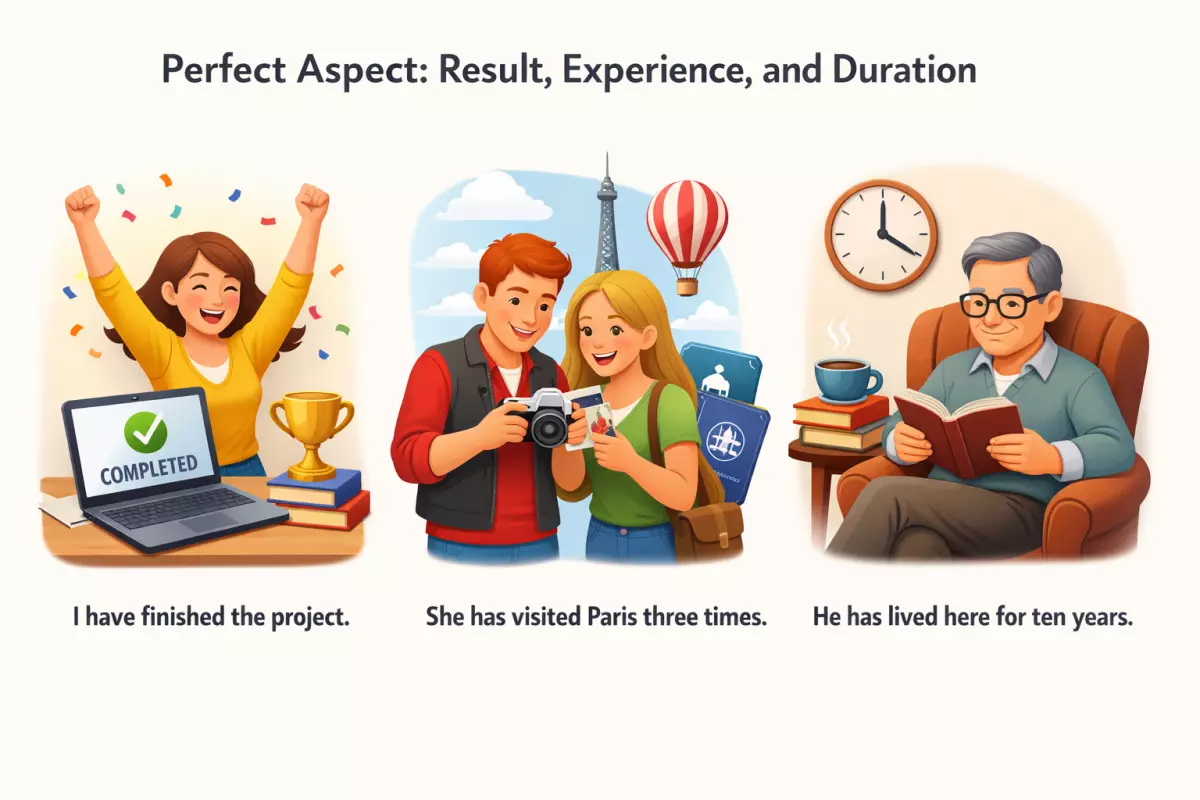
The perfect is an aspect that connects a past situation to a later time (often the present). Instead of simply placing an event on a timeline, it highlights a relationship: a result that matters now, an experience up to now, or a state that has continued to now (or to another reference point).
Core idea: “earlier than the reference time”
Perfect constructions typically mean that something happened or started before a reference time and is relevant at that reference time. The reference time can be the present (as in the present perfect) or another point in the past (as in the past perfect).
- Present perfect: earlier than now, with a link to now. (“I have finished.”)
- Past perfect: earlier than a past point, with a link to that past point. (“I had finished before you arrived.”)
- Future perfect: earlier than a future point, with a link to that future point. (“I will have finished by noon.”)
Three common meanings
In real usage, the perfect most often signals one of these patterns. Context and time expressions (like already, yet, since, by the time) help listeners choose the intended reading.
- Result (current relevance): the earlier action produces a present (or reference-time) outcome.
- ✅ “She has lost her keys.” (Result: she doesn’t have them now.)
- ✅ “They had closed the shop.” (Result at that past point: it wasn’t open.)
- Experience (life events up to the reference time): something has happened at least once; the exact time is not the focus.
- ✅ “I have visited Japan.” (At some time up to now.)
- ✅ “He had never seen snow before that trip.”
- Duration (state continuing): a situation began earlier and continues up to the reference time (often with for or since).
- ✅ “We have lived here for ten years.”
- ✅ “By 2010, she had worked there since 2002.”
Usage signals and common patterns
- Unspecified time: use the perfect when the exact “when” is not important or not given. (“I’ve read that book.”)
- “Up to now” time words: already, yet, just, recently, so far, ever, never, lately often pair naturally with the present perfect.
- Since + starting point: “since 2020,” “since Monday,” “since I moved.”
- For + length of time: “for three hours,” “for a long time.”
- By + deadline: “by noon,” “by the time you arrive,” commonly triggers a perfect (often future perfect or past perfect).
- Before another past event: past perfect clarifies sequence when two past actions are involved. (“She had left before I called.”)
- Change of state verbs often read as “result”: lose, break, finish, forget, arrive, stop.
- Stative verbs often read as “duration”: know, live, have, believe, like (when describing an ongoing state).
- Repeated events: “I’ve called three times.” (experience/accumulation up to now)
- Negative and question forms frequently use “yet/ever”: “Have you finished yet?” “I haven’t seen it yet.”
- Not a simple past substitute: if the focus is a finished time in the past (especially with a specific past-time adverbial like “yesterday” or “in 2019”), the simple past is typically the better match. ❌ “I have went yesterday.” → ✅ “I went yesterday.”
Overall, the perfect aspect is less about “past time” and more about how an earlier event or state matters at a chosen reference point—through a present result, accumulated experience, or continuing duration.
Perfect for results and present relevance
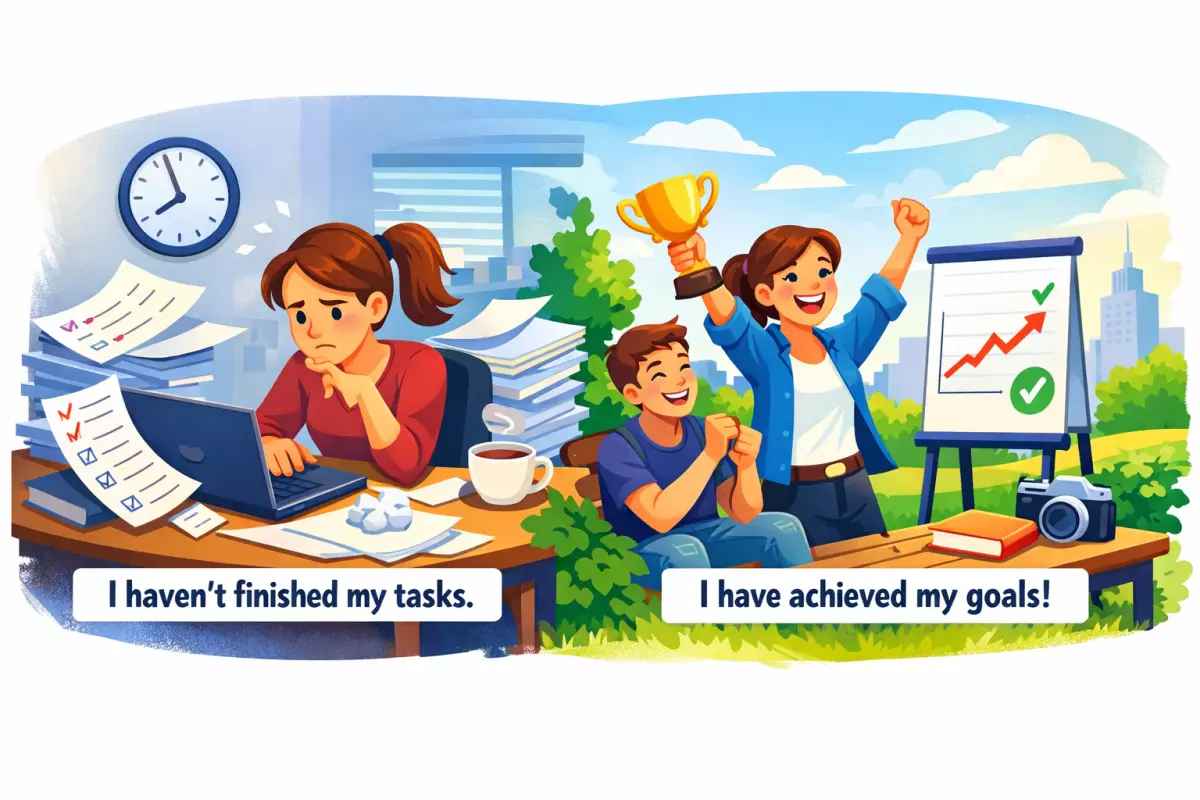
Use the present perfect when a past action matters now: it produces a current result, it affects the present situation, or it describes a change up to the present moment. The time is not presented as finished; the focus stays on what is true or relevant at the moment of speaking.
Core pattern: past action → present consequence
This use highlights what has changed or what is available/true now because of something that happened earlier. It is common with achievements, completed tasks, discoveries, and changes in condition.
- Form: have/has + past participle (I have finished, she has moved, they have found).
- Main idea: the action is completed, but the result is still important now.
- Typical question: “What’s the situation now?” rather than “When did it happen?”
- Common signals: already, just, yet, recently, so far, up to now, since then (these often point to present relevance).
- Negative form: haven’t/hasn’t + past participle (I haven’t sent it yet).
- Questions: Have you + past participle…? / Has she + past participle…?
Examples that show a present result
- I’ve locked the door. (It is locked now.)
- She has broken her phone. (She can’t use it now.)
- They’ve changed the schedule. (The current plan is different.)
- We’ve finished the report. (It’s ready now.)
- He has lost his keys. (He doesn’t have them now.)
- The bus has arrived. (It’s here now.)
- I’ve updated the file. (The latest version is available now.)
- Prices have increased. (They are higher now.)
- Someone has opened the window. (It’s open now.)
- Our team has improved the process. (The process is better now.)
- The company has hired three new designers. (They work here now.)
- My headache has gone. (I feel better now.)
- We haven’t received your message yet. (As of now, it hasn’t arrived.)
- Have you saved your work? (Is it safe now?)
Present perfect vs. simple past: choosing the focus
- ✅ I’ve sent the email. (The important point is: it’s sent now.)
- ✅ I sent the email at 9:05. (The important point is: the finished time.)
- ✅ She has moved to Berlin. (She lives there now.)
- ✅ She moved to Berlin in 2022. (The move is placed in a completed past time.)
- ❌ I’ve sent the email yesterday. (A finished past-time marker like “yesterday” normally requires simple past.)
- ❌ We’ve finished the report last week. (Use simple past with “last week.”)
Common usage patterns to practice
- Already for completed actions earlier than expected: “I’ve already paid.”
- Just for very recent completion: “She’s just left.”
- Yet (questions/negatives) for “up to now”: “Have you called yet?” / “I haven’t called yet.”
- So far / up to now for progress to the present: “So far, we’ve solved three issues.”
- Since to connect a starting point to now: “He has worked here since May.”
- Change-of-state verbs (become, grow, improve, decline): “The situation has improved.”
- News and announcements: “The manager has announced a new policy.”
- Problem reporting: “The system has stopped responding.”
Perfect for life experience
Use the present perfect to talk about what someone has done (or hasn’t done) at some point up to now, when the exact time is not the focus. The listener learns about the person’s background, not a dated event. This is common for life events, achievements, travel, and “first-time” experiences.
Core meaning and typical context
This use answers questions like “What have you ever done?” or “What has happened in your life so far?” It often appears in introductions, interviews, small talk, and when comparing experiences. The time period is understood as “up to now,” so it can still continue.
- Form reminder: have/has + past participle (I have visited, she has tried, they have met).
- Use it when the time is unknown, unimportant, or not mentioned: “I’ve met her.”
- Use it when the experience is part of someone’s life record: “He has worked abroad.”
- Use it to show something is possible again (the door is still open): “We’ve traveled to Japan.”
- Avoid it when you give a finished past time (yesterday, in 2019, last week). That usually needs past simple.
Common patterns for experience
Several adverbs and structures strongly signal the “life experience” meaning. These help you keep the focus on whether it has happened, not when it happened.
- ever: “Have you ever ridden a horse?”
- never: “I’ve never eaten sushi.”
- once / twice / three times: “She’s visited Rome twice.”
- before: “I’ve seen this movie before.”
- in my life: “I’ve never felt so nervous in my life.”
- so far / up to now: “So far, I’ve worked in two industries.”
- recently / lately (when time is still “up to now”): “I’ve read a lot lately.”
- this is the first/second time…: “This is the first time I’ve driven in snow.”
- the best/worst… I’ve ever…: “That’s the best concert I’ve ever seen.”
- Have you ever + past participle…?: “Have you ever spoken in public?”
- I’ve + never/ever + past participle…: “I’ve never flown business class.”
- How many times have you…?: “How many times have you moved house?”
Examples: experience vs. dated past event
Choose present perfect to report the experience, and past simple to add a specific finished time. A common pattern is: present perfect first (life record) → past simple next (details).
- ✅ “I’ve been to Mexico.” → “I went there in 2022.”
- ✅ “She’s met the CEO.” → “She met him at the conference last Friday.”
- ✅ “We’ve tried scuba diving.” → “We tried it on our honeymoon.”
- ❌ “I’ve been to Mexico in 2022.” (finished time given) → ✅ “I went to Mexico in 2022.”
- ❌ “Have you ever seen him yesterday?” → ✅ “Did you see him yesterday?”
Useful life-experience example set
These model sentences keep the time open or unspecified, which is exactly what this use needs.
- “I’ve lived in three different cities.”
- “They’ve worked with international teams.”
- “He’s never driven a manual car.”
- “Have you ever failed an exam?”
- “I’ve learned a lot from that job.”
- “She’s traveled alone before.”
- “We’ve had to make a difficult decision.”
- “I’ve met someone famous once.”
- “Have you ever given a speech?”
- “I’ve never broken a bone.”
- “He’s changed careers twice.”
- “We’ve seen that play several times.”
- “I’ve tried to quit sugar, but it’s hard.”
- “She’s taken part in a marathon.”
- “Have you ever had culture shock?”
- “I’ve forgotten my passport before.”
Perfect for duration with since and for
Use the perfect aspect to connect a past starting point to the present (or to another reference time). Two common time expressions help you show duration clearly: since (a starting point) and for (a length of time). The choice depends on whether you name the beginning or the amount of time.
Core meaning and patterns
- Present perfect + since + starting point → the situation began in the past and continues now (or has relevance now). Example: “I have lived here since 2019.”
- Present perfect + for + period → the situation has lasted a certain length of time up to now. Example: “I have lived here for five years.”
- Since is followed by a time point (a date, a day, a moment, or a clause). Example: “since Monday,” “since 2 p.m.,” “since I started this job.”
- For is followed by a time period (a duration). Example: “for two hours,” “for a long time,” “for three weeks.”
- Negative forms are common when talking about how long something has not happened. Example: “We haven’t seen them for ages.”
Choosing between since and for
- ✅ “She has worked here since 2021.” (2021 = starting point)
- ✅ “She has worked here for three years.” (three years = duration)
- ❌ “She has worked here since three years.” → Use for: “for three years.”
- ❌ “She has worked here for 2021.” → Use since: “since 2021.”
- Since + clause often clarifies the start: “I have felt better since I changed my routine.”
- For + a period can be specific or vague: “for ten minutes,” “for a while,” “for ages.”
Present perfect vs. present perfect continuous
- Present perfect often emphasizes a state or a completed set of results over time: “I have known her for years.”
- Present perfect continuous often emphasizes an ongoing activity and its duration: “I have been studying for two hours.”
- Some verbs are more natural in one form: “I have known” (state verb) is usually better than “I have been knowing.”
- With activities, both can work with a small meaning shift: “I have worked here for years” (fact/experience) vs. “I have been working here for years” (ongoing, emphasizes continuity).
Common sentence frames (ready-to-use)
- “I have + past participle + since + (year/day/moment).”
- “I have + past participle + for + (number + time unit).”
- “We haven’t + past participle + since + (event/clause).”
- “They haven’t + past participle + for + (a long time/ages).”
- “How long have/has + subject + past participle?” → “Since…” / “For…”
Example set (mix of since/for)
- “I have been here since 8 a.m.”
- “I have been here for two hours.”
- “They have owned this house since 2010.”
- “They have owned this house for fourteen years.”
- “She has felt much calmer since the exam ended.”
- “She has felt much calmer for the past few days.”
- “We have used this system since last summer.”
- “We have used this system for months.”
- “He hasn’t called since the meeting.”
- “He hasn’t called for three weeks.”
- “I have been trying to reach you since yesterday.”
- “I have been trying to reach you for hours.”
- “How long have you lived in this city?” → “Since 2018.”
- “How long have you lived in this city?” → “For about six years.”
Typical pitfalls to avoid
- Don’t use since with a duration phrase (two days, three years); switch to for.
- Don’t use for with a point in time (Monday, 2019, 2 p.m.); switch to since.
- Be careful with finished time periods: “I have lived here since last year” works because it reaches the present; “I have lived here last year” does not (use past simple: “I lived here last year.”).
Perfect with already, yet, just, ever, never
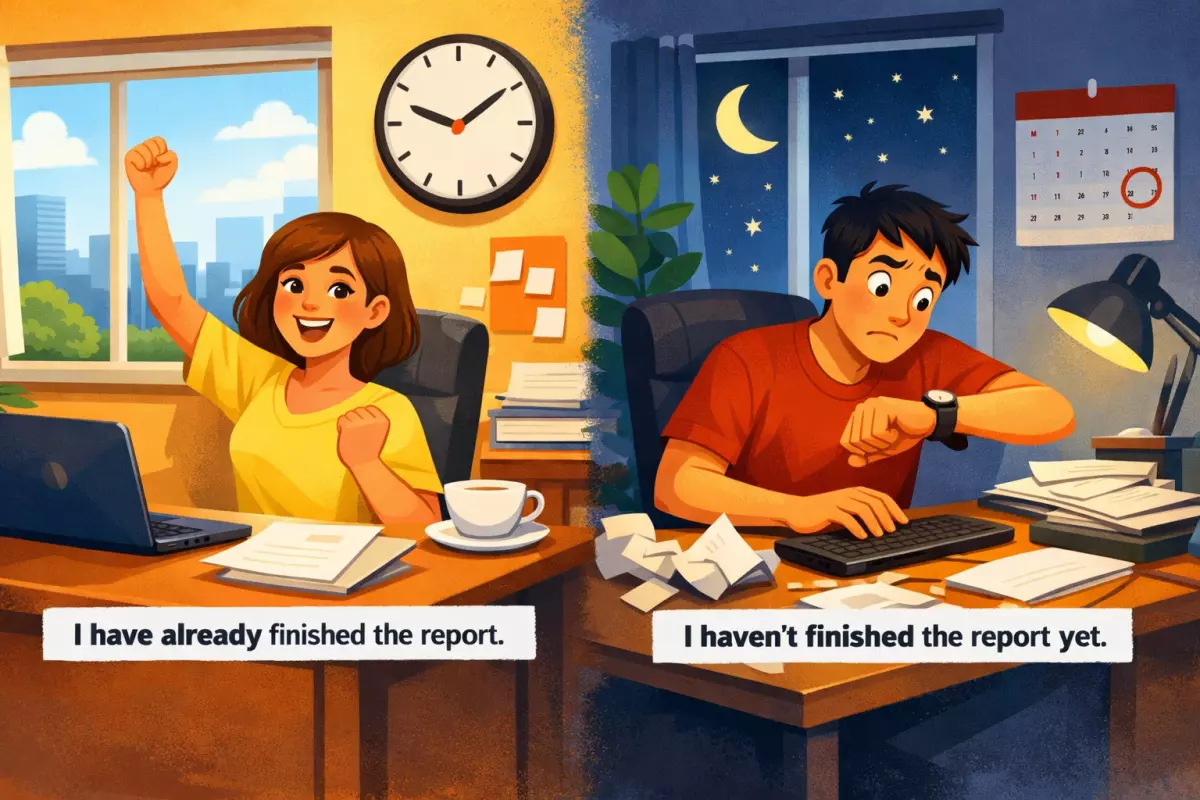
These time words often pair with the present perfect (and sometimes the past perfect) because they highlight a completed result, a life experience, or the timing of a recent change. They typically sit in predictable positions in the sentence and strongly influence whether a statement sounds natural.
Core placement patterns
- already: usually in the middle position (after have/has, before the past participle). It suggests something happened earlier than expected.
- ✅ I have already finished the report.
- ✅ She has already left.
- ✅ Have you already eaten?
- End position is possible for emphasis: ✅ I’ve finished already. (more informal/expressive)
- yet: most common at the end of the clause, especially in negatives and questions. It signals “up to now” with an expectation of change.
- ✅ I haven’t finished yet.
- ✅ Has he called you yet?
- ❌ I have finished yet. → ✅ I haven’t finished yet. / ✅ I have already finished.
- just: usually in the middle position; it means “very recently” and often points to a fresh result that matters now.
- ✅ They have just arrived.
- ✅ I’ve just sent the email.
- ✅ Have you just heard the news?
- ever: used mainly in questions (and with superlatives) to talk about “at any time in your life up to now.”
- ✅ Have you ever been to Japan?
- ✅ Has she ever worked night shifts?
- ✅ It’s the best meal I’ve ever had.
- never: a negative meaning “not at any time up to now,” commonly in the middle position. It often replaces not.
- ✅ I have never tried sushi.
- ✅ He has never been late.
- ❌ I haven’t never tried sushi. → ✅ I have never tried sushi.
Meaning links: result, experience, and “up to now”
- already often implies a present result: “It’s done, so we can move on.”
- ✅ We’ve already booked the tickets, so we don’t need to worry about prices.
- just emphasizes a very recent change with a current consequence.
- ✅ I’ve just broken my glasses, so I can’t read the screen.
- ever/never focus on life experience rather than a single finished time.
- ✅ Have you ever met a celebrity?
- ✅ I’ve never seen that kind of error before.
- yet frames an unfinished situation up to the present moment (often with an expectation it will happen later).
- ✅ She hasn’t replied yet, but she usually answers quickly.
Extra patterns that sound natural
- Already in questions can show surprise or checking progress: ✅ Have you already decided?
- Yet with “still” is common in conversation: ✅ I still haven’t heard back yet. (informal; “still” already carries the idea)
- Ever with superlatives and “first/only” is very frequent: ✅ That’s the first time I’ve ever felt that way.
- Never can be used for emphasis with “before”: ✅ I’ve never done this before.
- Typical word order reminder: subject + have/has + (already/just/never) + past participle.
- ✅ She has never visited Rome.
- ✅ They have just started.
Perfect vs past simple differences
Choose between the present perfect and the past simple by checking one thing first: do you mean a finished time in the past, or do you mean a past action connected to “now” (result, life experience, or a situation continuing up to the present)? The two forms often describe similar events, but they organize time differently.
| Meaning focus | Present perfect (have/has + past participle) | Past simple (verb in past form) |
|---|---|---|
| Finished time vs. “up to now” | Time period is not finished or not stated: “up to now” | Time is finished and usually stated or understood |
| Result in the present | Highlights a current result or relevance | Reports what happened; result is not the main point |
| Experience | Life experience at any time before now (no specific time) | A specific experience at a specific past time |
| Duration to now | States how long something has continued until now | States duration in a completed past period |
| Typical time expressions | already, yet, just, ever, never, recently, so far, this week (if still ongoing) | yesterday, last week, in 2019, two days ago, when I was a child, this morning (if finished) |
| Common question type | “Have you…?” (asking about experience or recent events) | “Did you…?” (asking about a particular time/event) |
Time words that force the past simple
Use the past simple when the sentence includes (or clearly implies) a completed past time. These expressions “close” the time period, so the perfect aspect usually sounds wrong.
- ✅ I saw her yesterday. ❌ I have seen her yesterday.
- ✅ We moved here in 2018.
- ✅ He called two minutes ago.
- ✅ They met last summer.
- ✅ I worked there for three months (and I don’t work there now).
- ✅ She finished the report this morning (if the morning is over).
- ✅ When I was a student, I lived in a dorm.
- ✅ After the meeting ended, we went for coffee.
When the present perfect is the natural choice
Use the present perfect when you avoid a specific past time and instead emphasize relevance now, experience, or continuation to the present.
- Result now: ✅ I’ve lost my keys (so I can’t open the door).
- Recent news: ✅ The train has arrived.
- “Just” for very recent actions: ✅ She’s just left.
- Already/yet with an unfinished situation: ✅ Have you finished yet? / I’ve already sent it.
- Life experience (no time stated): ✅ I’ve been to Japan.
- Ever/never questions and answers: ✅ Have you ever tried sushi? / I’ve never tried it.
- So far / up to now: ✅ So far, we’ve had no complaints.
- Unfinished time period: ✅ I’ve had three meetings this week (and the week isn’t over).
- Duration to now: ✅ We’ve lived here for ten years.
- Since + starting point: ✅ I’ve known her since 2012.
How meaning changes when both are possible
Sometimes both forms are grammatically possible, but they signal different time frames or different emphasis.
- ✅ I have read the book. → The reading is relevant now (for discussion, decision, or result).
- ✅ I read the book. → A completed past event; often followed by “when/where” details.
- ✅ She has worked here for five years. → She still works here.
- ✅ She worked here for five years. → That period is finished; she doesn’t work here now.
- ✅ We have had lunch. → Result now: we aren’t hungry; the next plan can start.
- ✅ We had lunch. → Past narrative: describing what happened earlier.
- ✅ I have seen that movie. → Experience; no time specified.
- ✅ I saw that movie last night. → Specific time is given.
Practical selection checklist
- If you can naturally add “yesterday / last… / in 20xx / ago,” use the past simple.
- If the question is “When did it happen?”, the answer typically uses the past simple.
- If the question is “Has it happened (up to now)?”, the answer typically uses the present perfect.
- If the time period is still open (today, this week, this month), the perfect aspect often fits; if it’s closed, the past simple usually fits.
- If you are telling a story in sequence (then… after that… later…), the past simple is the default narrative tense.
Common learner mistakes
Learners often mix up when to use the perfect for a present result, for life experience, or for an action that started in the past and continues until now. The errors below focus on the most common pattern problems and how to fix them.
- Using the past simple when the present result matters
❌ I lost my keys. (said while still looking for them)
✅ I have lost my keys. → The result is true now: I don’t have them. - Using the perfect when the time is finished or clearly stated
❌ I have met her yesterday.
✅ I met her yesterday. → “Yesterday” is a finished time. - Adding a finished-time adverb to the perfect
Avoid: last week, in 2019, two days ago with the present perfect.
✅ I went there last week. / I have been there many times. - Forgetting the auxiliary verb
❌ She finished her work already.
✅ She has finished her work already. - Confusing
been
andgone
✅ She has gone to the store. → She is not here now.
✅ She has been to the store. → She went and returned (experience). - Using
since
andfor
the wrong way around
❌ I’ve lived here since three years.
✅ I’ve lived here for three years. / I’ve lived here since 2021. - Using the perfect for duration with verbs that don’t describe a continuing state (without the right meaning)
❌ I have bought this phone for two years. (buying is a completed action)
✅ I have had this phone for two years. / I bought this phone two years ago. - Mixing up
How long…?
questions
❌ How long are you here?
✅ How long have you been here? (still here now) - Using the perfect with a specific, completed life event time
❌ I have graduated in 2020.
✅ I graduated in 2020. / I have graduated. (no time given; focus on current status) - Overusing
ever
in affirmative statements
More natural patterns:
✅ Have you ever tried sushi? (question)
✅ I’ve never tried sushi. (negative)
✅ I’ve tried sushi before. (affirmative) - Confusing experience vs. result signals
Experience often uses:ever
,never
,before
,many times
.
Result often uses:already
,just
,yet
(especially in negatives/questions). - Using
yet
in affirmative sentences (in standard usage)
❌ I’ve finished yet.
✅ I haven’t finished yet. / Have you finished yet? - Placing
already
,just
, andyet
in the wrong position
Common order: subject + have/has + adverb + past participle.
✅ She has already left. / I have just arrived. - Using the present perfect continuous when the focus is a completed result
❌ I’ve been fixing the computer. (but you mean it’s done)
✅ I’ve fixed the computer. → Result is complete now. - Using the simple perfect when the focus is the activity itself (especially with visible evidence)
❌ You’re sweaty. Have you run?
✅ You’re sweaty. Have you been running? → Emphasis on the activity and its evidence. - Confusing stative vs. action verbs in continuous forms
❌ I’ve been knowing her for years.
✅ I’ve known her for years. - Using
from
wheresince
is needed
❌ I’ve worked here from 2022.
✅ I’ve worked here since 2022. - Answering with the wrong tense after a perfect question
✅ A: Have you seen my email? B: Yes, I have. / Yes, I saw it this morning. (time given → past simple)
Quick pattern reminders
- Result now: have/has + past participle (often with
just
,already
,yet
). - Experience in life up to now: have/has + past participle (often with
ever
,never
,before
,many times
). - Duration until now: have/has + past participle (state verbs) or have/has been + -ing (activities) +
for
/since
.
Homework: perfect aspect practice tasks
Use these tasks to practice choosing between present perfect, past perfect, and perfect continuous forms when you want to express a result, a life experience, or a duration up to a reference point. Focus on the time reference (now vs. a past point) and on whether the action is finished or ongoing.
1) Choose the best perfect form (result, experience, duration)
- I can’t log in. Someone (change) __________ my password.
- She (never / try) __________ sushi before, so she was nervous.
- We (wait) __________ for forty minutes. Is the doctor running late?
- By the time the meeting started, I (send) __________ the agenda to everyone.
- He’s exhausted because he (work) __________ all night.
- They (live) __________ in this neighborhood since 2018.
- After I (finish) __________ the report, I realized I had missed a page.
- My phone is gone. I think I (leave) __________ it in the taxi.
- How many countries (you / visit) __________ ?
- At 9 a.m. yesterday, I (already / speak) __________ to three clients.
- She looks upset. (she / hear) __________ the news?
- By noon, the kids (play) __________ outside for hours, so we made them come in.
Show answers
- has changed
- had never tried
- have been waiting
- had sent
- has been working
- have lived / have been living
- had finished
- have left
- have you visited
- had already spoken
- Has she heard
- had been playing
2) Fix the mistake (tense choice or form)
- ❌ I have seen him yesterday. → Rewrite correctly.
- ❌ She has been finished her homework. → Rewrite correctly.
- ❌ By the time we arrived, the film has started. → Rewrite correctly.
- ❌ I am here since 9 o’clock. → Rewrite correctly.
- ❌ How long do you know her? → Rewrite correctly.
- ❌ They have gone to Japan last year. → Rewrite correctly.
- ❌ He had lived here since 2022 (and he still lives here). → Rewrite correctly.
- ❌ I’ve been to the store, I bought milk. → Rewrite as one clear sentence.
Show answers
- ✅ I saw him yesterday.
- ✅ She has finished her homework. / ✅ She has been finishing her homework. (depending on meaning)
- ✅ By the time we arrived, the film had started.
- ✅ I have been here since 9 o’clock.
- ✅ How long have you known her?
- ✅ They went to Japan last year.
- ✅ He has lived here since 2022. / ✅ He has been living here since 2022.
- ✅ I’ve been to the store and bought milk. / ✅ I went to the store and bought milk.
3) Build sentences from prompts (choose the most natural perfect)
- (I / lose / my keys) + (so / I / can’t / open / the door)
- (she / work / here / for / ten years) + (she / know / everyone)
- (they / never / meet / before) + (so / the conversation / be / awkward)
- (by 6 p.m. yesterday / we / finish / the installation)
- (he / study / all morning) + (now / he / need / a break)
- (how long / you / wait) ?
Show answers
- I’ve lost my keys, so I can’t open the door.
- She has worked / has been working here for ten years, so she knows everyone.
- They had never met before, so the conversation was awkward.
- By 6 p.m. yesterday, we had finished the installation.
- He has been studying all morning, so now he needs a break.
- How long have you been waiting? / How long have you waited? (continuous is more natural for an ongoing wait)
4) Mini writing task (use all three meanings)
- Write 6–8 sentences about a stressful week. Include: two present perfect results (e.g., “I’ve broken…”), two present perfect experiences (with “ever/never/already/yet”), and two duration sentences (with “for/since”).
- Write 5–7 sentences about a past event (a trip, exam day, or project). Include: three past perfect sentences to show earlier actions, and one past perfect continuous sentence to show an action in progress before a past moment.
5) Quick pattern checklist (use while correcting your work)
- Result now: present perfect (something happened earlier; the effect is visible now): “I’ve spilled coffee on my shirt.”
- Experience up to now: present perfect with “ever/never/before/once/twice”: “Have you ever taken a night train?”
- Duration to now: present perfect (state) or present perfect continuous (activity) with “for/since”: “She’s lived here since May.” / “She’s been studying for hours.”
- Earlier than a past point: past perfect: “I had saved the file before the computer crashed.”
- Ongoing up to a past point: past perfect continuous: “They had been arguing for hours when I arrived.”