False Friends and Confusing Verb Pairs

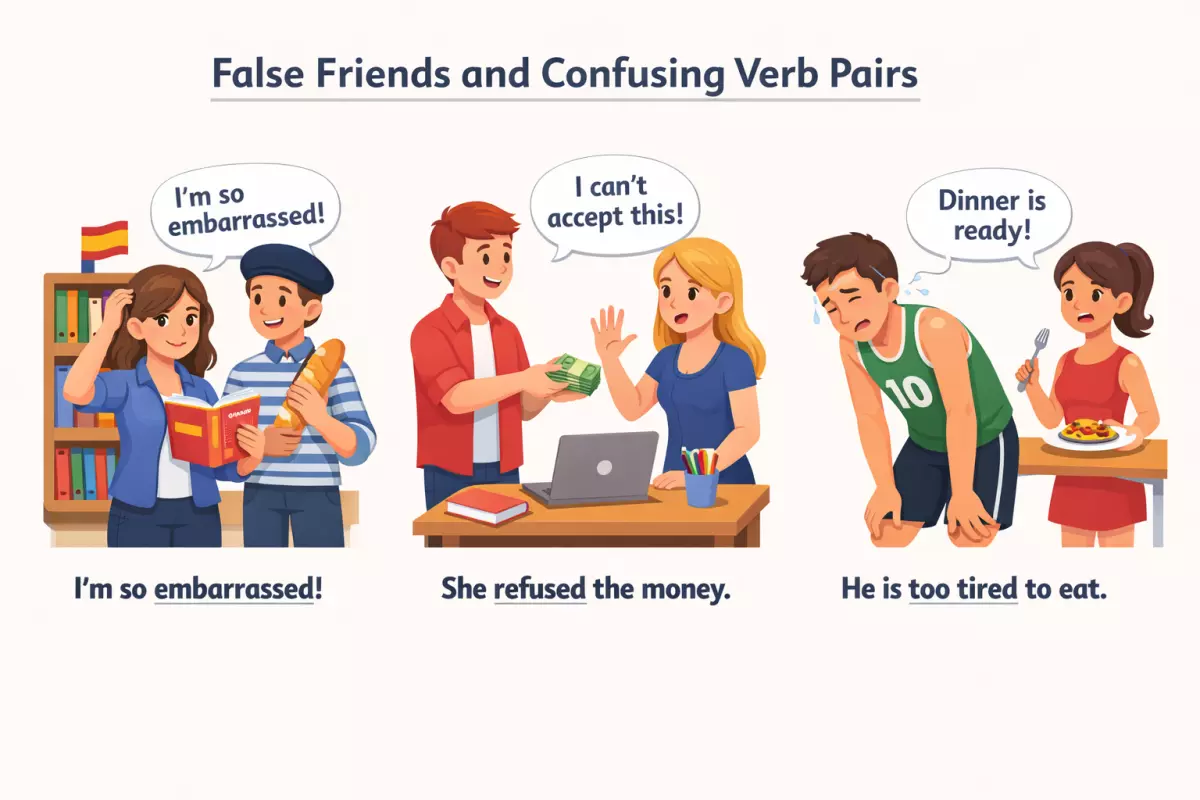 This article explains why verb pairs confuse learners, highlights common false friends and similar verbs with different meanings, and shows frequent writing mix-ups with corrections. It also teaches context clues, efficient study methods, and ends with practice homework tasks.
- What makes verb pairs confusing
- Common false friends for learners
- Similar verbs with different meanings
- Commonly confused verb pairs in writing
- Context clues for choosing the right verb
- Typical learner mistakes and corrections
- How to learn confusing verbs efficiently
- Homework: confusing verb pair practice tasks
Familiar words can still mislead you, especially when similar terms and near-twin verbs carry different meanings in everyday English. You may pick a safe option in a meeting and end up sounding rude, vague, or oddly formal. This article clears up common mix-ups with practical examples so you can speak and write confidently in real situations.
What makes verb pairs confusing
Verb look-alikes tend to cause trouble for the same reasons: they resemble each other in form, but they follow different usage rules. The safest approach is to notice the pattern behind the difference (object vs. no object, meaning shift, preposition choice, register) and then learn each verb in a typical sentence frame.
Common patterns that create mix-ups
- Transitive vs. intransitive splits: one verb needs a direct object, the other usually doesn’t. Learners often copy the structure of their first language and end up with a missing or extra object.
- One verb is “general,” the other is “specific”: a broad verb covers many situations, while its partner is restricted to a narrower meaning (often physical vs. abstract, or everyday vs. technical).
- Different prepositions after similar verbs: near-synonyms can require different prepositions, changing the relationship (e.g., “depend on” vs. “rely on,” or “apologize for” vs. “apologize to”).
- Particle verbs that change meaning: adding up/out/off/on can create a new sense that is not predictable from the base verb. Confusion increases when the base verb also exists with a related meaning.
- Register and tone differences: one option sounds neutral and common, the other formal, literary, or old-fashioned. Using the formal one in casual speech can sound stiff; using the casual one in formal writing can sound imprecise.
- Collocation pressure: certain nouns “prefer” one verb, even when another seems logical. These pairings are learned through exposure (e.g., “make a decision” vs. “do a decision” ❌).
- Aspect and completion: one verb highlights the process, the other the result or completion. This is especially tricky when both translate to the same verb in another language.
- State vs. action meanings: some verbs describe a condition (know, belong), while their partners describe an action (learn, join). Using the wrong one can flip the meaning.
- Cause vs. experience: one verb means “make something happen,” while the other means “have it happen to you” (raise vs. rise; lay vs. lie). The grammar usually shifts with the meaning.
- False-friend influence from another language: a familiar-looking verb is assumed to match meaning, but it doesn’t. This often leads to sentences that are grammatical yet semantically off.
- Similar spelling or pronunciation: pairs like affect/effect (and other near-homophones) get swapped in fast writing or speech, especially when both exist as verbs.
- Different argument patterns: one verb takes an infinitive, the other a gerund, or one allows both with a meaning change (stop to do vs. stop doing). Memorizing the “what follows” pattern prevents many errors.
- Passive behavior differences: some verbs are natural in the passive (“be allowed”), while others sound odd or change meaning when passivized. This can mislead learners who rely on passive-heavy structures.
- Idiomatic extensions: a verb may have a literal meaning plus an idiomatic one, while its partner stays literal. Learners may choose the “logical” verb and miss the idiom.
How to reduce confusion in practice
- Learn each verb with a short “frame”: “verb + object,” “verb + to + person,” “verb + for + reason,” etc., rather than as an isolated dictionary item.
- Check whether the verb answers “what?” (direct object) or “where/how/why?” (often prepositional), and build the sentence around that.
- Store examples as pairs of mini-contrasts: ✅ “She borrowed a book from him.” → ✅ “He lent a book to her.”
- Notice the noun partners that recur (typical objects), because collocations often decide which verb sounds natural.
- When two verbs seem interchangeable, test them in the same sentence; if the meaning shifts (process vs. result, state vs. action), treat them as different tools, not true synonyms.
Common false friends for learners
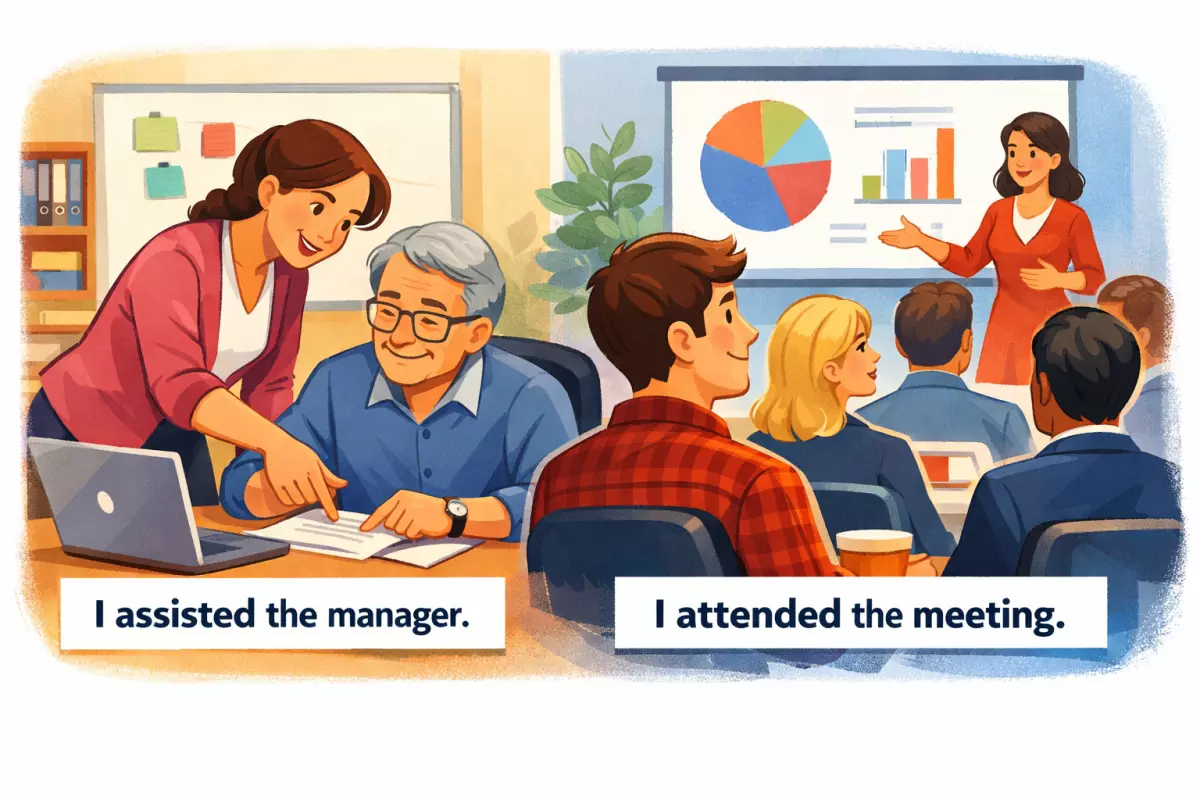
Many mix-ups come from verbs that look like a direct translation of a familiar word, but actually follow different patterns in meaning, grammar, or collocation. The safest approach is to learn each pair with a typical context (what it is used with, and what it usually implies) rather than as isolated “equivalents.”
- assist vs attend: assist usually means “help,” while attend means “be present.” ✅ “I attended the meeting.” ❌ “I assisted the meeting.”
- pretend vs intend: pretend = “act as if something is true,” intend = “plan/mean to.” ✅ “I intend to call.” ❌ “I pretend to call” (unless you mean “fake calling”).
- resume vs summarize: resume = “continue again,” summarize = “give a short version.” ✅ “Let’s resume after lunch.”
- realize vs make real: realize most often means “become aware/understand,” not “create.” ✅ “I realized I was wrong.”
- eventually vs currently: eventually = “in the end,” not “at the moment.” ✅ “Eventually, we agreed.”
- actually vs currently: actually adds correction/contrast (“in fact”), not time. ✅ “It’s actually cheaper online.”
- sensible vs sensitive: sensible = “practical/reasonable,” sensitive = “easily affected/emotional.” ✅ “That’s a sensible plan.”
- sympathetic vs nice/friendly: sympathetic means “showing understanding for someone’s trouble,” not simply “pleasant.” ✅ “She was sympathetic about the delay.”
- library vs bookshop: a library lends books; a bookshop sells them. ✅ “I borrowed it from the library.”
- parents vs relatives: parents are mother and father; relatives include the wider family. ✅ “My relatives live abroad.”
- chef vs chief: chef cooks; chief leads (chief executive, police chief). ✅ “She’s the chief of staff.”
- college vs university: usage varies by country; in many contexts college is not automatically “a full university.” Learn the local meaning in your setting.
- fabric vs factory: fabric is cloth/material; factory is a place of production. ✅ “This fabric is cotton.”
- control vs check: control often means “manage/command,” while check means “inspect/verify.” ✅ “Please check the figures.”
- convenient vs comfortable: convenient = “fits your needs/time/location,” not “physically pleasant.” ✅ “Is Tuesday convenient?”
- journal vs newspaper: a journal is often academic/professional or a personal record; a newspaper is daily news. ✅ “It was published in a medical journal.”
Patterns that help you avoid these traps
- Watch for “looks similar, but shifts meaning”: words like actually, eventually, and realize often signal logic or understanding rather than time or creation.
- Learn the typical object or complement: attend + event/meeting/class; assist + person/team (or assist with + task).
- Check whether the word names a place, a role, or an action: library (place) vs bookshop (place), chef (role) vs chief (role).
- Prefer short “safe” paraphrases when unsure: use “in fact” for actually, “in the end” for eventually, and “be present” for attend.
Similar verbs with different meanings
Some verb pairs look almost interchangeable because they share roots, spelling, or sound patterns. In practice, they follow different grammar, collocations, and levels of formality. The safest approach is to learn each verb with its typical object (what comes after it) and a couple of “home” phrases where it naturally appears.
-
Borrow vs. Lend
Borrow focuses on the receiver; lend focuses on the giver.
- ✅ I borrowed a book from Maya. (receiver)
- ✅ Maya lent me a book. (giver)
- ❌ Maya borrowed me a book. → Maya lent me a book.
-
Raise vs. Rise
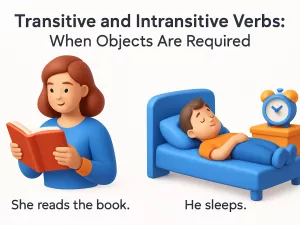
Raise is transitive (needs an object); rise is intransitive (no object).
- ✅ They raised prices again. (object: prices)
- ✅ Prices rose again. (no object)
- ❌ Prices raised. → Prices rose.
-
Lay vs. Lie
Lay takes an object; lie describes the subject’s position. Past forms cause extra confusion: lay/laid/laid vs. lie/lay/lain.
- ✅ Please lay the keys on the table. (object: the keys)
- ✅ I want to lie down. (no object)
- ✅ Yesterday I lay down early. (past of lie)
-
Say vs. Tell
Tell typically takes a person as an indirect object; say does not require one.
- ✅ She said that she was busy.
- ✅ She told me that she was busy.
- ❌ She said me that… → She told me that…
-
Speak vs. Talk
Speak often sounds more formal and is common with languages; talk is common for conversation and informal situations.
- ✅ He speaks Spanish.
- ✅ We talked for hours.
- ✅ Speak to the manager. / Talk to your friend.
-
Look vs. Watch
Look is about directing your eyes (often briefly); watch suggests attention over time, especially to movement or a program.
- ✅ Look at this photo.
- ✅ We watched a movie.
- ✅ Watch the road. (continuous attention)
-
Hear vs. Listen (to)
Hear is passive perception; listen is an intentional action and usually takes to.
- ✅ I heard a strange noise.
- ✅ Listen to this song.
- ❌ Listen this song. → Listen to this song.
-
Make vs. Do
Make often means “create/produce”; do is common for tasks, work, and activities. Many uses are fixed collocations.
- ✅ make a cake, make a plan, make a mistake
- ✅ do homework, do the dishes, do research
- ✅ do business (but) make money
-
Bring vs. Take
Bring moves something toward the speaker/target location; take moves it away from the current location.
- ✅ Bring your notes to class. (to the place you’re going)
- ✅ Take these boxes to the garage. (away from here)
- ✅ I’ll take an umbrella with me. (carry along)
-
Come vs. Go
The choice depends on viewpoint: come is toward the speaker or a reference point; go is away from it.
- ✅ Are you coming to the party? (toward the party location as reference)
- ✅ I’m going to the party. (from where I am now)
-
Refuse vs. Deny
Refuse means “say no to doing/accepting”; deny means “say something isn’t true” or “withhold.”
- ✅ He refused to answer.
- ✅ She denied the accusation.
- ✅ They denied him entry. (withheld)
-
Win vs. Earn
Win is about competitions, prizes, and elections; earn is about receiving money/credit through work or effort.
- ✅ She won the match.
- ✅ He earned a promotion.
- ✅ You can win a prize, but you earn a salary.
-
Remember vs. Remind
Remember is what you do; remind is what someone/something does to help you remember.
- ✅ I remembered her name.
- ✅ Remind me to call her.
- ✅ This song reminds me of summer.
-
Find vs. Found
Found is often just the past of find, but as a separate verb it means “establish/create” (especially organizations).
- ✅ I found my keys. (past: found)
- ✅ They founded a company in 2010. (establish)
- ❌ They found a company in 2010. → They founded a company in 2010.
-
Assure vs. Ensure vs. Insure
These look like close variants, but each has a typical target: assure a person, ensure an outcome, insure against risk (often via insurance).
- ✅ I assure you everything is ready. (person)
- ✅ Please ensure the door is locked. (outcome)
- ✅ They insured the car. (policy/risk)
-
Advise vs. Suggest
Advise commonly takes a person + infinitive or a that-clause; suggest commonly takes a noun/gerund or a that-clause (without an object pronoun like “me” in between).
- ✅ She advised me to wait.
- ✅ She suggested waiting.
- ❌ She suggested me to wait. → She advised me to wait. / She suggested that I wait.
-
Accept vs. Agree
Accept is for receiving/approving something; agree is for sharing an opinion or reaching a decision with someone.
- ✅ I accepted the offer.
- ✅ I agree with you.
- ✅ We agreed to meet at six.
When two verbs feel “almost the same,” check two things: (1) whether the verb needs an object, and (2) which preposition or structure it prefers (to + noun, to + verb, that-clause, or gerund). Those patterns usually explain why one option sounds natural and the other sounds off.
Commonly confused verb pairs in writing
Many verb mix-ups come from similar spelling, overlapping meanings, or different grammar patterns (transitive vs. intransitive, or verb + preposition choices). The quickest fix is to learn what each verb typically takes: an object, a preposition, an -ing form, or an infinitive.
| Verb pair | How they differ in use (with examples) |
|---|---|
| Say / Tell | Say focuses on the words; it usually does not take a direct person-object. ✅ “She said that the meeting was canceled.” / ✅ “She said hello.” Tell normally needs a person-object. ✅ “She told me that the meeting was canceled.” ❌ “She told that the meeting was canceled.” |
| Lie / Lay | Lie = rest (no object). ✅ “I lie down at 10.” (past: “lay”) Lay = put/place (needs an object). ✅ “Lay the book on the table.” (past: “laid”) A common error is using “lay” when no object follows. |
| Rise / Raise | Rise happens by itself (no object). ✅ “Prices rise every year.” Raise needs an object (someone raises something). ✅ “They raised prices.” ✅ “Raise your hand.” |
| Borrow / Lend | Direction matters. Borrow = take temporarily from someone. ✅ “Can I borrow your charger?” Lend = give temporarily to someone. ✅ “Can you lend me your charger?” |
| Bring / Take | Use bring toward the speaker/target location; use take away from it. ✅ “Bring the file to my office.” ✅ “Take the file to the archive.” In writing, define the viewpoint (who/where is “here”). |
| Assure / Ensure / Insure | Assure + person (reduce doubt). ✅ “I assured her that we were on schedule.” Ensure = make certain. ✅ “This step ensures accuracy.” Insure = provide insurance coverage. ✅ “They insured the building.” |
| Affect / Effect | Affect is usually a verb meaning “influence.” ✅ “Noise affects concentration.” Effect is usually a noun meaning “result.” ✅ “The effect was immediate.” (Less common: “to effect” = bring about.) |
| Imply / Infer | Imply = hint (speaker/writer does it). ✅ “The report implies that costs will rise.” Infer = conclude from evidence (reader/listener does it). ✅ “From the data, we can infer a trend.” |
| Compliment / Complement | Compliment = praise. ✅ “She complimented his presentation.” Complement = complete or match well. ✅ “The summary complements the appendix.” |
| Accept / Except | Accept = receive/agree to. ✅ “We accepted the proposal.” Except = exclude (often a preposition). ✅ “Everyone agreed except Tom.” |
| Advise / Advice | Advise is the verb. ✅ “I advise you to back up the files.” Advice is the noun. ✅ “My advice is to back up the files.” |
| Practice / Practise | In American English, practice is both noun and verb. In British English, practice (noun) vs. practise (verb). ✅ “Daily practice helps.” / ✅ “They practise daily.” |
Patterns that prevent these mix-ups
- Check whether the verb needs a direct object: “raise something,” “lay something,” “tell someone.”
- Watch for viewpoint verbs: “bring” and “take” depend on where “here” is in the sentence.
- Separate “speaker action” from “reader action”: writers imply; readers infer.
- When two forms look alike, confirm the part of speech: “advice” (noun) vs. “advise” (verb).
- For near-homophones, test meaning in a short rewrite: “ensure” (make certain) vs. “insure” (cover with insurance).
Context clues for choosing the right verb

When two verbs look similar across languages or sit in a confusing pair, the surrounding words usually tell you which one fits. Look for the “signals” in the sentence: the object type, the preposition that follows, the time frame, and whether the action is intentional, completed, or just attempted.
Fast checks that narrow the choice
- Check the object’s category. Some verbs prefer an object that is a person (invite, advise), while their look-alikes prefer a thing or an action (invent, inform). If the object is a person, that often rules out the “thing-focused” verb.
- Notice whether an object is required. If the verb must take a direct object (raise, lay), using it without one is a red flag. If the sentence has no object, the intransitive partner (rise, lie) is usually the match.
- Watch for “to + base verb” vs “-ing”. Many confusing pairs split by complement pattern: one verb typically takes to (manage to do, refuse to do), while another favors -ing (avoid doing, consider doing). The form after the verb is often the best clue.
- Look at the preposition that follows. Verb choice can be “locked in” by a specific preposition: depend on, belong to, succeed in, insist on. If the preposition is fixed, swapping the verb usually breaks the pattern.
- Identify whether the meaning is “say” or “tell”. If the sentence includes a listener (“me,” “us,” “the team”), you often need a verb that allows an indirect object (tell someone, inform someone). Without a listener, a “say/report” verb may be more natural.
- Check for intention vs result. Some pairs separate trying from achieving: attempt/try vs manage/succeed. If the context includes a clear result (finally, in the end, successfully), choose the “achievement” verb.
- Use time markers to choose between a state and an action. If the verb describes a continuing condition (for years, since 2020), a stative option (know, belong, own) is more likely than an action verb (learn, join, buy).
- Spot “cause” vs “happen”. If the subject is an agent (a person, a policy, a decision), you may need a causative verb (raise prices, increase output). If the subject is the change itself (prices, output), the “happen/change” verb (rise, increase) often fits.
- Decide whether the action is one-way or two-way. Some verbs imply mutual action (meet, marry in some varieties), while others are one-directional (introduce, invite). If only one side is acting, pick the one-way verb.
- Check register and setting. A formal context (reports, legal language) may prefer verbs like “require,” “request,” “permit,” while everyday speech may prefer “need,” “ask,” “let.” If the tone is clearly formal, the “official” verb is often the intended one.
- Look for typical collocations. Certain nouns “pull” certain verbs: make a decision, do research, take responsibility, pay attention. If the noun is strongly tied to one verb, that’s usually the correct pairing.
- Confirm whether it’s about perception or opinion. See/hear/notice tend to describe sensory input; think/believe/suppose describe judgment. If the sentence includes evidence from senses (a noise, a smell), choose a perception verb.
- Check for passive compatibility. If the sentence is in passive voice, the verb must allow a meaningful passive (was built, was approved). Some intransitive verbs cannot form a natural passive, which helps eliminate them.
- Look for the “missing piece” in meaning. If the sentence needs the idea of “provide” (give someone something) vs “receive” (get something), the direction of transfer decides the verb. The presence of “to someone” or “from someone” is a strong hint.
Common sentence patterns that act like signposts
- Verb + person + thing (give, lend, teach, show) → if the structure has two objects, a verb that supports double objects is expected.
- Verb + thing + to + person (explain something to someone, describe something to someone) → if “to + person” appears, choose a verb that naturally takes that frame.
- Verb + to + base verb (agree to do, decide to do) → the following infinitive often rules out the “-ing” competitor.
- Verb + -ing (avoid doing, finish doing) → if the next word is an -ing form, the verb is usually from the “-ing” group.
- Verb + that-clause (suggest that…, insist that…, admit that…) → if the sentence continues with a full clause, pick a verb that commonly introduces one.
- Verb + preposition (rely on, approve of, apologize for) → the preposition is part of the verb’s normal behavior; changing it usually changes the verb.
Mini “diagnostic” questions to ask while editing
- Is the subject doing the action, or is the subject changing by itself?
- Do I need a listener/receiver in the grammar, or only in the meaning?
- Does the verb describe a process (ongoing) or a completed outcome?
- What word comes immediately after the verb (object, preposition, to-infinitive, -ing, that-clause)?
- Does the noun after the verb form a common collocation with it?
- If I replace the verb with a simpler synonym, does the sentence still match the intended meaning?
Using these cues turns verb choice into pattern matching: identify the structure first, then confirm the meaning. If both verbs seem possible, the deciding factor is often the complement (what follows the verb) rather than the dictionary definition.
Typical learner mistakes and corrections
Confusing verb pairs and false friends often lead to errors that sound logical in a learner’s first language but are unnatural (or change meaning) in English. Watch for patterns: verb + preposition choices, “do vs. make” collocations, and verbs that look familiar but don’t match the same meaning.
- ❌ “I assist to the meeting.” → ✅ “I attend the meeting.” (In English, assist usually means “help,” not “go to.”)
- ❌ “Can you borrow me your pen?” → ✅ “Can you lend me your pen?” (You borrow from someone; you lend to someone.)
- ❌ “I will lend a book from the library.” → ✅ “I will borrow a book from the library.” (Libraries lend; you borrow.)
- ❌ “She explained me the problem.” → ✅ “She explained the problem to me.” (Explain + thing + to + person.)
- ❌ “He said me to wait.” → ✅ “He told me to wait.” (Tell + person; say + words/that-clause.)
- ❌ “She told that she was tired.” → ✅ “She said that she was tired.” (No direct object after say in this pattern.)
- ❌ “I did a mistake.” → ✅ “I made a mistake.” (Make is used for creation/production of results: mistakes, decisions, plans.)
- ❌ “Let’s make homework.” → ✅ “Let’s do homework.” (Do is typical for tasks/activities: homework, housework, exercise.)
- ❌ “I made a photo.” → ✅ “I took a photo.” (Take a photo/picture is the standard collocation.)
- ❌ “I passed a good time.” → ✅ “I had a good time.” / “I spent a nice evening.” (Pass time exists, but “pass a good time” is not idiomatic.)
- ❌ “I’m expecting to see you at 8.” → ✅ “I’m planning to see you at 8.” / “I expect you’ll be there at 8.” (Expect = believe/think likely; plan = intend.)
- ❌ “I wait you outside.” → ✅ “I’ll wait for you outside.” (Wait normally needs for + person/thing.)
- ❌ “We discussed about the problem.” → ✅ “We discussed the problem.” (Discuss is transitive: discuss + noun.)
- ❌ “They married with each other in June.” → ✅ “They got married in June.” / “He married her in June.” (Marry is usually direct: marry someone; get married has no object.)
- ❌ “Please control if the door is locked.” → ✅ “Please check if the door is locked.” (Control = manage/command; check = verify.)
- ❌ “I’m very sensible to noise.” → ✅ “I’m very sensitive to noise.” (Sensible = practical/reasonable; sensitive = easily affected.)
- ❌ “This is an actual problem.” → ✅ “This is a real problem.” / “This is a current problem.” (Actual often means “real” in contrast, or “current” depending on context.)
- ❌ “I will advise you to come tomorrow” (meaning “inform”). → ✅ “I will let you know tomorrow.” (Advise = recommend; inform/let someone know = give information.)
Quick pattern checks that prevent repeat errors
- Ask “Who receives the action?” If it’s a person, many verbs need a different structure (tell + person; explain + to + person).
- Check the preposition: wait for, listen to, depend on, belong to. Missing or wrong prepositions are a common source of “almost correct” sentences.
- Confirm the collocation: make a decision vs. do a task; take a photo vs. make a photo; have a good time vs. pass time.
- If a word looks similar to your language, verify meaning and register: sensible/sensitive, actual/current/real, assist/help/attend.
How to learn confusing verbs efficiently
Progress with tricky verb pairs comes from noticing what changes when you swap one verb for the other: the type of object it takes, the preposition that follows, and the “typical situation” it describes. Instead of memorising two translations, learn each verb as a small pattern you can reuse.
Use patterns, not single-word meanings
- Learn the verb with its usual object type. Ask: does it take a person, a thing, an activity, or a clause? (Example frame: “verb + person,” “verb + to-infinitive,” “verb + -ing.”)
- Record the preposition as part of the verb. If one verb requires a preposition and the other doesn’t, treat that as the main difference, not a detail.
- Attach a “typical context label.” For each verb, write a short tag like “formal request,” “physical movement,” “starting a process,” or “continue after interruption.”
- Keep one contrast sentence pair. Store two short sentences that are identical except for the verb, so the meaning shift is obvious.
Build a mini-checklist for each confusing pair
- Who controls the action? Some verbs imply intention (deliberate action), others describe a result or accident.
- Is the focus on process or result? One verb may highlight the activity; the other highlights completion or outcome.
- Is it about change, exchange, or replacement? Many mix-ups happen when learners don’t separate “become different” from “swap with something else.”
- Is it about giving information or receiving it? Confusions often come from direction: “tell” vs “ask,” “borrow” vs “lend,” “teach” vs “learn.”
- Does it describe a state or an action? If one verb is stative in common use, it may resist continuous forms or sound unnatural in progressive tenses.
- Does it require a direct object? If one verb is typically transitive and the other intransitive, that’s a reliable separator.
Drill with “frames” (fast, reusable sentence templates)
- Frame: “I VERB + (someone) + (something) + (time).” Fill it with both verbs and see which one stays grammatical.
- Frame: “I VERB to + base verb” vs “I VERB + -ing.” Many pairs split here (plan/hope vs enjoy/avoid, etc.).
- Frame: “It VERB that + clause.” If only one works naturally, you’ve found a key usage rule.
- Frame: “VERB + object + preposition + object.” This exposes preposition-dependent verbs quickly.
- Frame: “VERB + for + noun” vs “VERB + to + noun.” Preposition choice often signals different intentions.
Practice with minimal pairs (10–20 quick contrasts)
- ✅ “I borrowed a book from Sam.” → I received it. ❌ “I borrowed Sam a book.”
- ✅ “I lent Sam a book.” → I gave it temporarily. ❌ “I lent a book from Sam.”
- ✅ “She told me the answer.” → information goes to me. ❌ “She told me for the answer.”
- ✅ “I asked her a question.” → information requested. ❌ “I asked her the answer.” (unless meaning “requested the answer” in a specific context)
- ✅ “They raised the price.” → they caused the increase. ❌ “The price raised.”
- ✅ “The price rose.” → it increased (no direct agent). ❌ “They rose the price.”
- ✅ “Please remind me to call.” → help me remember. ❌ “Please remember me to call.”
- ✅ “I remember meeting him.” → memory in my mind. ❌ “I reminded meeting him.”
- ✅ “We discussed the plan.” ❌ “We discussed about the plan.” (common learner error)
- ✅ “We talked about the plan.” → “talk” commonly needs “about.”
- ✅ “I made a mistake.” → create/produce. ❌ “I did a mistake.”
- ✅ “I did my homework.” → perform a task. ❌ “I made my homework.”
- ✅ “He wore a suit.” → clothing on the body. ❌ “He dressed a suit.”
- ✅ “He dressed quickly.” → put clothes on (no clothing item needed). ❌ “He wore quickly.”
- ✅ “I stopped smoking.” → quit the activity. ✅ “I stopped to smoke.” → paused another action in order to smoke.
Make corrections stick with short retrieval routines
- Two-step recall: (1) say the meaning you want, (2) say the structure that matches it (“verb + object,” “verb + to,” “verb + -ing”).
- Error log, but only for patterns: write “discuss + noun (no about)” rather than copying a full sentence every time.
- Micro-quizzes: cover the verb, keep the rest of the sentence visible, and choose the verb that fits the grammar and context.
- One-minute contrast review: for each pair, produce one sentence for each verb aloud; if you hesitate, add a clearer context label and a stronger example frame.
Homework: confusing verb pair practice tasks
These exercises focus on choosing the right verb based on meaning, grammar patterns (object vs. no object), and common collocations. Work through them in order: first decide the meaning, then check whether the verb needs an object, and finally adjust tense and form.
1) Choose the correct verb (meaning + pattern)
- I’m going to (borrow / lend) my sister’s laptop for the weekend.
- Could you (borrow / lend) me $20 until Friday?
- Please (say / tell) me the truth.
- He didn’t (say / tell) a word during the meeting.
- We (look / watch) a documentary every Friday night.
- She (look / watch) at the timetable to find the next train.
- I (hear / listen) to podcasts on my commute.
- Did you (hear / listen) that strange noise last night?
- Can you (bring / take) this package to the post office?
- Don’t forget to (bring / take) your passport when you travel.
- They (make / do) a lot of money from that app.
- I need to (make / do) the laundry tonight.
Show answers
- borrow
- lend
- tell
- say
- watch
- look
- listen
- hear
- take
- bring
- make
- do
2) Fix the mistake (one change per sentence)
- Can you borrow me your notes from yesterday?
- She told that she was tired and went home.
- I watched at the painting for a long time.
- Please listen the instructions carefully.
- He said me he would call later.
- Take me that book, please.
- I did a mistake in the last question.
- Did you hear to the new album yet?
- He made his homework after dinner.
- She brought the kids to school and then took them back home.
Show answers
- Can you lend me your notes from yesterday?
- She said that she was tired and went home.
- I looked at the painting for a long time.
- Please listen to the instructions carefully.
- He told me he would call later.
- Bring me that book, please.
- I made a mistake in the last question.
- Did you listen to the new album yet?
- He did his homework after dinner.
- She took the kids to school and then took them back home.
3) Complete the sentence with the correct form (tense + verb choice)
- Last night I __________ (hear / listen) a loud bang outside.
- Right now, I’m __________ (hear / listen) to a voice message.
- He __________ (say / tell) he was busy, but he didn’t __________ (say / tell) why.
- Can you __________ (bring / take) some chairs from the kitchen into the living room?
- I __________ (borrow / lend) my bike to a friend yesterday, so today I had to walk.
- She __________ (make / do) a decision quickly when there’s pressure.
- We __________ (make / do) research before we chose a hotel.
- He stood up to __________ (say / tell) a few words.
- Could you __________ (look / watch) the kids for ten minutes while I answer this call?
- I __________ (look / watch) at the email, but I still don’t understand the last paragraph.
Show answers
- heard
- listening
- said; say
- bring
- lent
- makes
- did
- say
- watch
- look
4) Pattern drill: match the verb to the structure
Rewrite each prompt as a full sentence. Use the verb that fits the structure shown.
- (tell + person + information) / you / the answer / now
- (say + words) / he / something / rude
- (listen + to + thing) / we / the announcement / carefully
- (look + at + thing) / she / the map / for a minute
- (lend + person + thing) / I / my neighbor / a ladder
- (borrow + thing + from + person) / they / a car / from their uncle
- (watch + thing) / I / the match / tonight
- (bring + thing + to + place) / please / these forms / to reception
Show answers
- I’ll tell you the answer now.
- He said something rude.
- We listened to the announcement carefully.
- She looked at the map for a minute.
- I lent my neighbor a ladder.
- They borrowed a car from their uncle.
- I’m watching the match tonight.
- Please bring these forms to reception.
5) Short production task (collocations)
Write 10 original sentences. Use each item once, and keep the meaning clear from context.
- make a mistake
- do homework
- make a decision
- do the dishes
- tell a story
- say hello
- listen to advice
- hear a rumor
- watch a movie
- look at a photo
- borrow money
- lend a hand
- bring a gift
- take a seat
- take someone home
Checklist before you finish: (1) Does the verb need an object? (2) If there is a person, is it “tell/lend” rather than “say/borrow”? (3) If you used “listen,” did you include “to”?