Strong vs Weak Verbs in Writing and Style

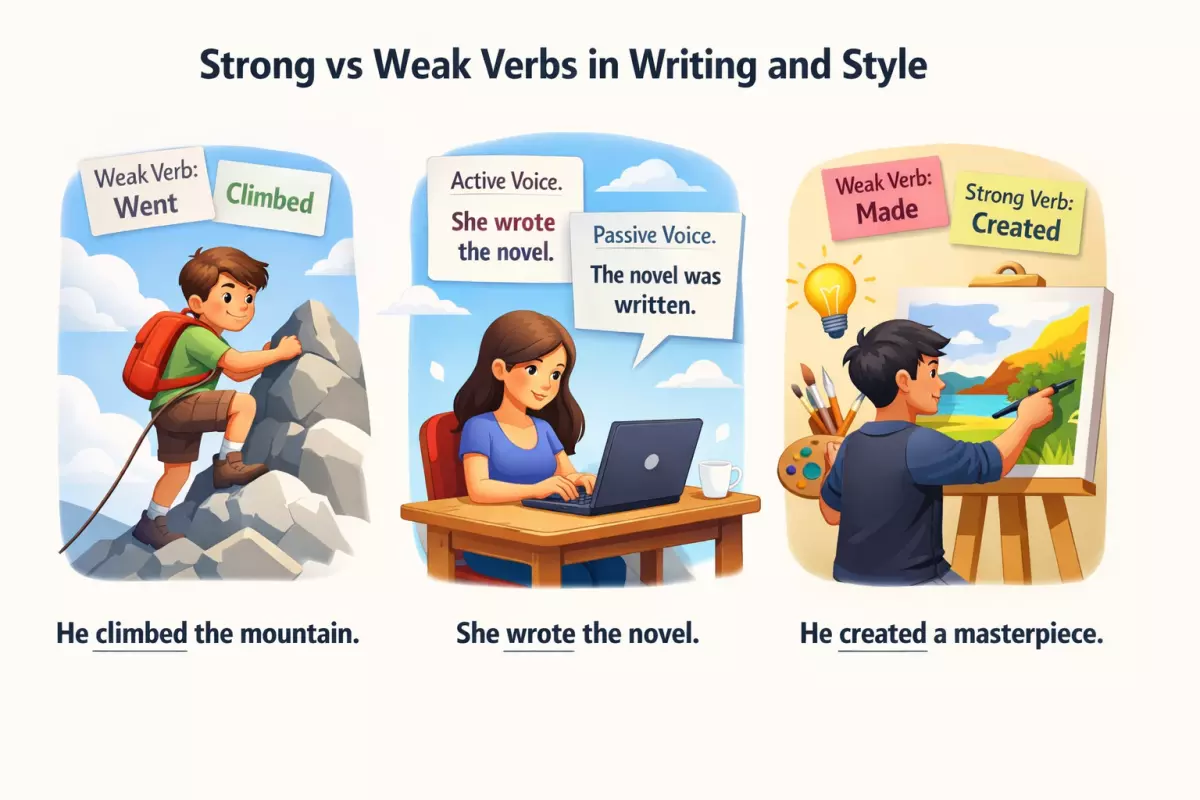 This article explains strong vs weak verbs, why weak ones dull your writing, and the common patterns to avoid. It shows how to upgrade sentences with stronger verbs while staying clear, flags typical learner style mistakes, then gives an editing checklist and homework rewrite tasks.
Strong action verbs can make writing feel vivid, while vague ones leave sentences limp. As a teacher, I often see students rely on safe choices like is, have, or do, then wonder why their ideas sound flat. This article shows how to spot dull verb habits and replace them with precise, specific verbs that express the exact movement and meaning you intend.
What strong and weak verbs are
In style terms, a verb is “strong” when it carries the main meaning by itself, and “weak” when it needs extra wording to do the same job. The difference is less about grammar rules and more about how directly the sentence delivers action, change, or judgment.
How strong verbs behave on the page
Strong choices usually name a specific action and reduce the need for helper phrases. They make sentences shorter, more concrete, and easier to picture.
- They are specific: “slice” is clearer than “cut.”
- They show movement or change: “collapse,” “expand,” “stabilize.”
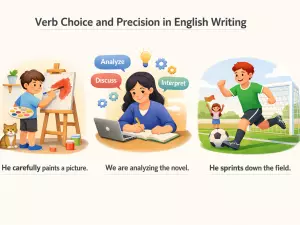
- They often replace verb + adverb combinations: “sprinted” instead of “ran quickly.”
- They reduce reliance on abstract nouns: “decided” instead of “made a decision.”
- They keep the subject doing something: “The committee rejected the proposal.”
Common patterns that create weak verb phrases
Weakness often comes from a pattern, not a single “bad” word. Many sentences become vague when the verb is a generic carrier (like “be,” “have,” “do,” “make,” “get”) and the real meaning is pushed into a noun or an adjective.
- Be + adjective: “is important,” “was difficult,” “are unclear” (often revisable to a more active verb).
- There is/There are openers: “There are three reasons…” (sometimes fine, often wordy).
- Have/has + noun: “have a discussion,” “has an impact,” “had a look.”
- Do/does + noun: “do an analysis,” “do a review,” “do research.”
- Make + noun: “make a recommendation,” “make a change,” “make an attempt.”
- Give + noun: “give an explanation,” “give permission,” “give a response.”
- Take + noun: “take a walk,” “take a look,” “take action.”
- Get + adjective/past participle: “get involved,” “get confused,” “get completed.”
- Passive voice without a reason: “The report was written” (agent missing, action feels distant).
- Nominalizations (verbs turned into nouns): “implementation,” “evaluation,” “development,” especially when paired with generic verbs.
Side-by-side examples (same meaning, different energy)
| Weaker construction | Stronger alternative |
|---|---|
| We made a decision to postpone. | We postponed it. |
| She gave an explanation for the delay. | She explained the delay. |
| The policy has an effect on hiring. | The policy shapes hiring. |
| They did an analysis of the results. | They analyzed the results. |
| There are several errors in the file. | The file contains several errors. |
| The instructions are unclear. | The instructions confuse new users. |
A practical definition you can apply while revising
- A verb is strong when it communicates the sentence’s main action without leaning on a “helper” noun (for example, “investigated” rather than “did an investigation”).
- A verb is weak when it mainly props up another word that carries the real meaning (for example, “is” + adjective, or “make” + abstract noun).
- “Weak” does not mean “wrong.” Generic verbs are useful for linking ideas, describing states, or keeping emphasis on a noun; the issue is overuse where a specific action would be clearer.
Why weak verbs make writing dull
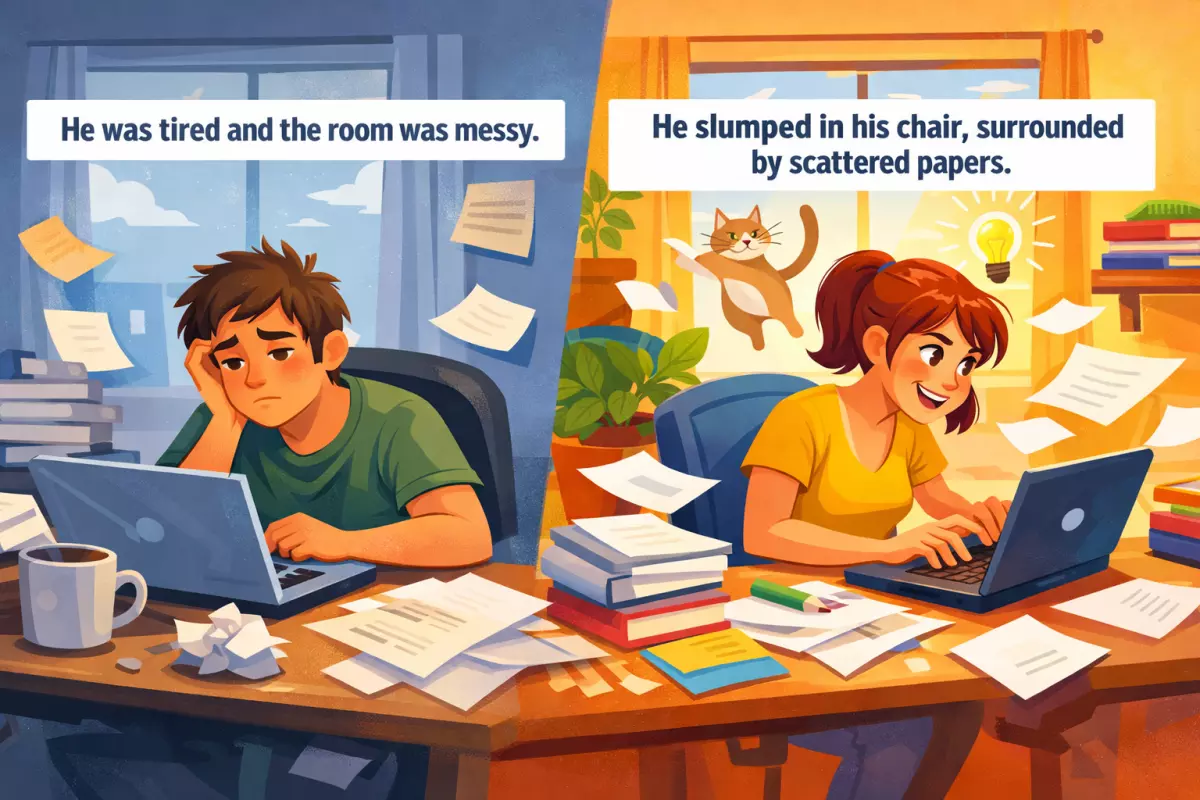
Overreliance on low-information verbs (especially forms of be, have, do, get, and make) often drains energy from sentences. These verbs can be correct and grammatical, but they frequently leave the reader with a vague picture of what actually happened, who caused it, and how it unfolded.
Weak verb choices tend to show up in predictable patterns. Learning to spot those patterns is more useful than memorizing a list of “bad verbs,” because the same few structures repeat across drafts.
Common patterns that flatten meaning
- “To be” + abstract noun: “The plan was a success.” (Labels the result instead of showing the action that created it.)
- “There is/There are” openings: “There are several reasons…” (Delays the real subject and often produces wordier sentences.)
- Nominalizations (verb turned into a noun) + weak verb: “We made a decision” instead of “We decided.”
- Passive voice with an unnamed agent: “The policy was implemented” (Hides who acted and can reduce accountability.)
- Generic “do/make/get” verbs: “She did research” (Doesn’t specify whether she analyzed, reviewed, tested, or surveyed.)
- “Have” + noun: “They had a discussion” (Often inflates word count without adding detail.)
- “Be” + adjective: “He was angry” (States a condition; may skip the behavior that reveals it.)
- “Be” + prepositional phrase: “The files are in the folder” (Sometimes fine, but can become repetitive in instructions.)
- Hedging with weak verbs: “This seems to be…” “It appears that…” (Useful for caution, but can pile up and reduce clarity.)
- Overuse of “feel” statements: “It feels like the project is stuck” (Can be replaced with observable facts: “The project stalled after…”.)
- “Be” + -ing (progressive) without purpose: “We are working on it” (May sound evasive unless paired with specifics.)
- Vague reporting verbs: “He said it was bad” (Sometimes better as “argued,” “warned,” “admitted,” or “explained,” depending on intent.)
What readers lose when verbs are weak
- Clear action: The sentence names a state rather than an event, so the scene doesn’t move.
- Specificity: Broad verbs force the reader to guess the real activity (compare “got” with “earned,” “collected,” “retrieved,” or “received”).
- Agency: Passive or agentless constructions can blur responsibility and weaken arguments.
- Texture and tone: Precise verbs carry attitude and pacing; generic ones often sound flat or bureaucratic.
- Efficiency: Weak-verb structures commonly add extra words (for example, “make a recommendation” vs. “recommend”).
Quick diagnostic checks for revision
- Circle forms of be (is/are/was/were/been/being). For each, ask: is this sentence describing a necessary state, or could it show an action?
- Search for “there is/there are.” Try rewriting with the real subject first.
- Look for “make/take/have/do/give/get” followed by a noun. Test whether a single verb can replace the phrase.
- Identify nominalizations ending in -tion, -ment, -ance, -ence (decision, implementation, agreement). Consider restoring the original verb.
- Check passive voice (“was/were” + past participle). If the actor matters, name it and use an active verb.
- When you use a cautious verb (seems/appears), confirm it reflects genuine uncertainty rather than habit.
Common weak verb patterns to avoid
Weak verb constructions often show up as extra words, vague actions, or “helper” phrasing that delays the real verb. The goal isn’t to ban any one word, but to notice patterns that drain energy from a sentence and replace them with clearer, more specific actions.
Patterns that dilute action (and what to do instead)
- “To be” + abstract noun: “The result ❌ was a reduction in errors” → “Errors ✅ decreased.”
- There is/There are openers: “There are three reasons…” → “Three reasons explain…”
- It is/It was + adjective + that: “It is important that we review…” → “We must review…” or “Review…”
- “Have/has/had” + noun (hidden action): “We had a discussion” → “We discussed…”
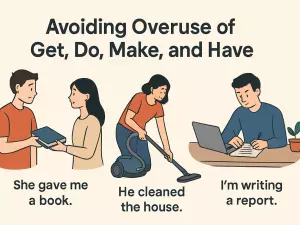
- “Make/give/take/do” + noun: “Give an explanation,” “make a decision,” “take a look,” “do an analysis” → “Explain,” “decide,” “look,” “analyze.”
- Nominalizations (verbs turned into nouns): “implementation,” “evaluation,” “movement,” “utilization” → “implement,” “evaluate,” “move,” “use.”
- Passive voice that hides the actor: “The file was deleted” (by whom?) → “Jordan deleted the file.” Keep passive when the actor truly doesn’t matter.
- Overuse of “get/got”: “got better,” “got worse,” “got done,” “got changed” → “improved,” “worsened,” “finished,” “changed.”
- Vague “go” verbs: “go over,” “go through,” “go about” → “review,” “examine,” “approach.”
- “Start/begin to” + verb: “She began to write” → “She wrote.” Keep “began” only when the start matters.
- “Try to” as a hedge: “Try to reduce costs” → “Reduce costs” (directive) or “Aim to reduce costs” (if uncertainty is real).
- “Need to” when you mean “must” or a plan: “We need to update the policy” → “We must update the policy” (requirement) or “We will update the policy” (commitment).
- “In order to”: “In order to improve performance…” → “To improve performance…”
- Prepositional pileups: “the process of evaluation of results” → “evaluating results” or “the evaluation process.”
- Empty intensifiers: “really,” “very,” “quite,” “extremely” (when they don’t add measurable meaning) → choose a stronger verb or a concrete detail.
- Reporting verbs that stall the point: “This section will discuss…” → “This section explains…” or simply state the claim directly.
- Over-reliance on “is/are” for definitions: “Leadership is the ability to…” → “Leaders align teams by…” (use a verb that shows behavior).
How to revise efficiently
- Circle the main action in each sentence, then rewrite so the subject performs that action with a single, specific verb.
- Convert noun-heavy phrases back into verbs (analysis → analyze; improvement → improve) and cut the helper verb that was carrying them.
- Keep weak constructions when they serve a purpose: passive for unknown actors, “began” for emphasis on timing, and “need to” for softer tone in collaborative contexts.
Upgrading sentences with stronger verbs
Stronger verb choices often come from swapping a vague “helper” verb (like is, have, do, make, get) for a verb that names the action more precisely. The goal is not to sound dramatic; it’s to make the sentence carry meaning in the verb instead of leaning on extra adverbs, abstract nouns, or filler phrases.
Common patterns that weaken verbs (and how to revise them)
- Replace “be + adjective” with a specific action verb. Instead of stating a condition, show what happens.
- ❌ The room was noisy. → ✅ The room hummed with conversation.
- ❌ She was angry. → ✅ She snapped at the question.
- Convert “there is/there are” openings into subject-driven sentences. Put the real subject first and choose a verb that does work.
- ❌ There are several reasons for the delay. → ✅ Several issues caused the delay.
- ❌ There was a change in the schedule. → ✅ The team shifted the schedule.
- Cut “do/make/have/give/take + noun” and use a single verb. These “light verb” phrases often hide the real action.
- ❌ We made a decision. → ✅ We decided.
- ❌ She gave an explanation. → ✅ She explained.
- ❌ They had a discussion. → ✅ They discussed.
- ❌ He took a look at the file. → ✅ He reviewed the file.
- Trade “get” for the actual change. “Get” is flexible but imprecise; name the shift (increase, improve, recover, obtain, become).
- ❌ The situation got worse. → ✅ The situation deteriorated.
- ❌ She got the job. → ✅ She landed the job.
- ❌ He got better after a week. → ✅ He recovered after a week.
- Replace “started/began to” when the start isn’t the point. If the action matters more than its onset, use the main verb alone.
- ❌ She began to cry. → ✅ She cried.
- ❌ The engine started to shake. → ✅ The engine shuddered.
- Reduce reliance on adverbs by strengthening the verb. Many “verb + adverb” pairs can become one vivid verb.
- ❌ He walked quickly. → ✅ He hurried.
- ❌ She spoke softly. → ✅ She whispered.
- ❌ The car moved slowly. → ✅ The car crawled.
- Turn nominalizations into verbs. Abstract nouns ending in -tion, -ment, -ance often signal a buried action.
- ❌ The committee made an assessment of the risks. → ✅ The committee assessed the risks.
- ❌ The team conducted an investigation. → ✅ The team investigated.
- ❌ We reached an agreement. → ✅ We agreed.
- Prefer active constructions when the actor matters. Passive voice isn’t “wrong,” but it can dilute impact when it hides responsibility.
- ❌ The report was submitted late. → ✅ The contractor submitted the report late.
- ❌ Mistakes were made during testing. → ✅ The team missed key checks during testing.
Quick swap list: light verbs to stronger alternatives
- make → decide, craft, assemble, produce, cause, create, enforce
- do → perform, complete, execute, handle, solve, revise
- have → possess, experience, face, suffer, enjoy, require
- give → provide, grant, deliver, offer, assign, explain
- take → grab, accept, adopt, remove, capture, choose
- get → obtain, receive, earn, become, reach, recover
- be → remain, seem, appear, become, stand, exist (when needed)
- go → travel, head, leave, return, proceed, drift
- put → place, set, position, install, store, insert
- say → argue, claim, suggest, admit, insist, announce
- look → watch, observe, scan, inspect, glimpse, stare
- feel → sense, suspect, believe, ache, relish, dread
- help → support, enable, improve, strengthen, assist, guide
- change → shift, transform, adjust, revise, replace, convert
- show → reveal, demonstrate, display, prove, indicate, highlight
When revising, keep the original meaning and tone, then ask what the subject actually does. If the sentence relies on “is/are” plus an adjective, or on a “make/do/have” phrase, that’s often a cue that the main action has been pushed into a noun. Pull that action back into the verb, and the sentence usually becomes shorter, clearer, and more energetic without adding extra words.
Balancing strong verbs with clarity
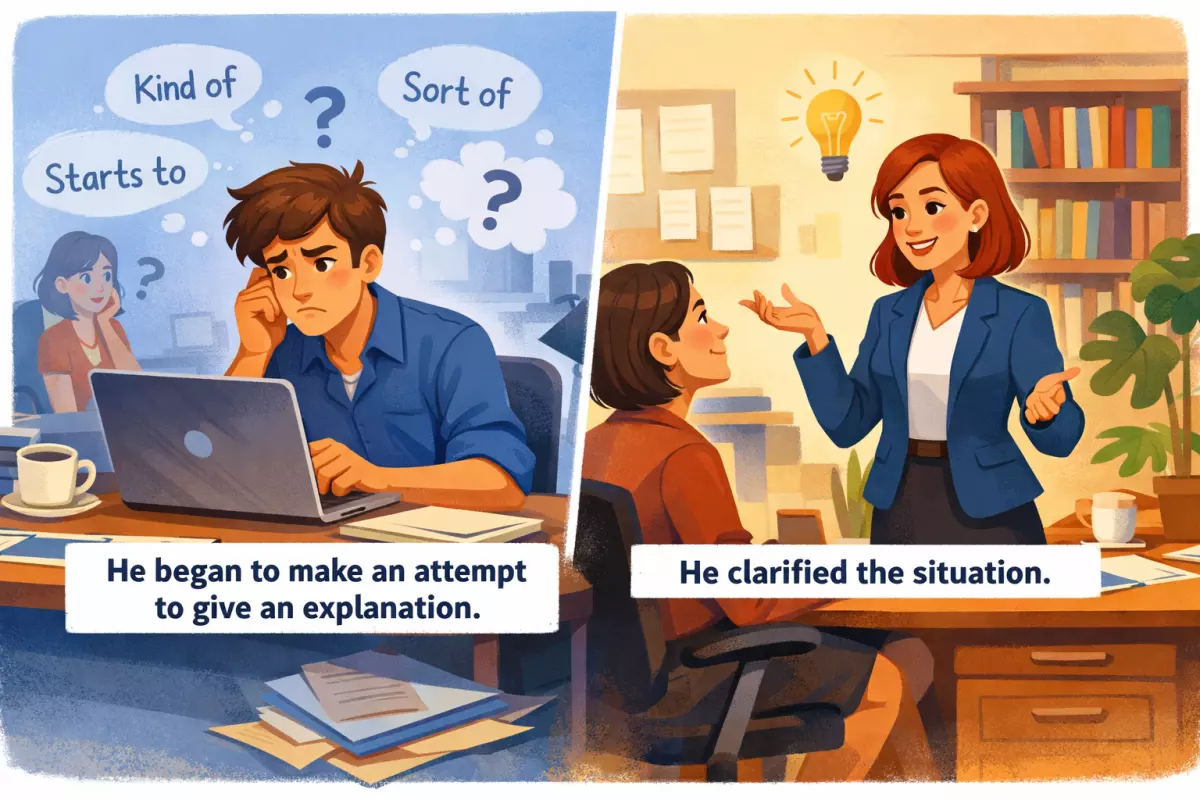
Choose vivid verbs when they sharpen meaning, not when they force the reader to decode your intent. The goal is a sentence that moves with energy while staying precise about who did what, to whom, and how. Strong word choice helps most when it replaces a vague verb plus extra wording, but it can hurt readability when it adds drama, ambiguity, or an unintended tone.
When a stronger verb improves the sentence
Upgrade the verb when it reduces clutter or makes the action more exact. A good test is whether the new verb lets you delete an adverb, prepositional phrase, or abstract noun without losing information.
- Replace a general verb with a specific action: “went” → “rushed,” “wandered,” “returned,” “entered.”
- Swap “is/are” + adjective for an action when it clarifies behavior: “was angry” → “snapped,” “glared,” “argued.”
- Trade “make/do/give” constructions for direct verbs: “gave a reply” → “replied.”
- Prefer concrete process verbs in instructions: “do the setup” → “install,” “configure,” “calibrate.”
- Use exact reporting verbs when the distinction matters: “said” → “admitted,” “claimed,” “confirmed,” “warned.”
- Choose verbs that encode the manner if it’s relevant: “walked” → “strolled,” “limped,” “marched.”
- Replace “get” with the real action: “got better” → “recovered,” “improved,” “stabilized.”
- Replace “put” with placement verbs: “put it down” → “set,” “dropped,” “stacked,” “filed.”
- Use verbs that show change over time: “became smaller” → “shrunk,” “narrowed,” “diminished.”
- Use verbs that show cause when needed: “made it happen” → “triggered,” “prompted,” “enabled.”
- Replace “looked at” with attention verbs: “looked at the chart” → “scanned,” “studied,” “reviewed.”
- Prefer verbs that state the outcome in summaries: “did the analysis” → “identified,” “measured,” “estimated.”
When strong verbs reduce clarity
Dial back intensity when the verb adds attitude, implies a motive you can’t support, or introduces multiple possible meanings. In many contexts, a plain verb is the clearest option because it stays neutral and predictable.
- Overly metaphorical verbs can confuse: “the policy devoured resources” may be less clear than “the policy used resources.”
- Unintended tone can bias the reader: “the manager barked” implies hostility; “said” or “told” may fit better in neutral reporting.
- Ambiguous specificity can mislead: “the team demolished the proposal” suggests ridicule or destruction; “rejected” is clearer.
- Inflated intensity can distort facts: “obliterated” rarely matches real-world outcomes; “reduced” or “removed” is often accurate.
- Jargon verbs can exclude readers: “operationalize” may be less readable than “define and apply.”
- Novelty verbs can distract: unusual choices pull attention away from the point, especially in technical or academic writing.
- Implied causation can overclaim: “proved” is stronger than “suggested” and should match the evidence level.
- Unclear agent remains unclear even with a vivid verb: “Mistakes plagued the rollout” hides who made them; name the actor when possible.
Practical patterns for choosing the right verb
Use these patterns to keep sentences forceful without sacrificing accuracy. They work across genres because they focus on meaning and structure rather than “fancier” vocabulary.
- Prefer “specific verb + concrete object” over “weak verb + abstract noun”: “We decided the schedule” is less clear than “We set the schedule.”
- Keep the verb’s strength proportional to the claim: “indicates” vs. “demonstrates” vs. “proves.”
- Match verb choice to viewpoint: in close narration, “flinched” may fit; in a report, “reacted” may be better.
- Don’t stack strong verbs in one sentence; one precise verb usually carries the action.
- Replace adverbs only when the verb truly contains the meaning: “walked quickly” → “hurried,” but “walked quietly” may not equal “sneaked.”
- Use “be” verbs strategically for definitions and states: “A catalyst is a substance that…” is clear and appropriate.
- Check collocations and expectations: readers accept “make a decision” in some contexts, but “decide” is often tighter.
- Revise for the real action: ask “What happened?” then choose the verb that names that event.
- Watch for verbs that smuggle judgment: “boasted,” “whined,” “confessed” add interpretation; use them only when supported by context.
- Read the sentence aloud for friction: if the verb draws attention to itself, consider a simpler alternative.
Typical learner mistakes with style
Many writers learn the “use stronger verbs” rule and then apply it too broadly. The result is often prose that sounds forced, loses accuracy, or becomes harder to read. The goal is not to ban certain verbs, but to choose verbs that match meaning, emphasis, and rhythm.
- Replacing every form of “be” without checking meaning. ❌ “The policy is unclear.” → “The policy confuses.” (This changes the meaning: the policy may be unclear without actively confusing anyone.)
- Swapping in a vivid verb that adds unintended emotion. ❌ “She said she disagreed.” → “She snapped she disagreed.” (Now the tone implies anger that may not exist.)
- Choosing a “strong” verb that is less precise than the original. ❌ “The data suggest a trend.” → “The data prove a trend.” (Overstates the evidence.)
- Overusing “power verbs” so the paragraph feels inflated. Stacking verbs like “ignite,” “unleash,” “transform,” and “dominate” can make neutral topics sound melodramatic.
- Turning simple statements into clunky action sentences. ❌ “There are three reasons for the delay.” → “Three reasons exist for the delay.” (More abstract, not clearer.)
- Confusing intensity with clarity. “Devastate,” “obliterate,” and “shatter” are strong, but they fit only when the situation truly warrants that level of force.
- Using a thesaurus swap that breaks collocation. ❌ “make a decision” → “forge a decision” (Sounds unnatural in most contexts.)
- Replacing a clear phrasal verb with a Latinate verb that slows reading. ❌ “find out” → “ascertain” (Not wrong, but can feel overly formal depending on audience.)
- Fixing weak verbs while leaving the real problem: vague nouns. ❌ “The team improved things.” → “The team enhanced things.” (The verb changes, but “things” still hides meaning.)
- Converting adjectives into verbs that sound unnatural. ❌ “The room was quiet.” → “The room quieted.” (Works only in specific contexts; often the original is better.)
- Forgetting that “be” verbs are useful for definitions and classifications. “A catalyst is a substance that speeds a reaction” is appropriately direct; forcing action can distract from the concept.
- Overcorrecting into constant active voice. Active voice is often clearer, but passive voice can be the best choice when the actor is unknown, irrelevant, or intentionally backgrounded.
- Using “strong” verbs that require a different grammatical pattern. ❌ “discuss about” or “emphasize on” often appears after swapping verbs without checking what prepositions (if any) the verb takes.
- Creating accidental ambiguity by removing linking verbs. ❌ “The main issue is timing.” → “The main issue involves timing.” (Now it suggests multiple issues and shifts the focus.)
- Making sentences heavier by nominalizing the verb. ❌ “We analyzed the results.” → “We conducted an analysis of the results.” (Longer and less direct unless formality is needed.)
- Relying on “strong” verbs to carry weak structure. If the sentence buries the main point, a punchier verb will not fix the logic; lead with the key idea and keep modifiers tight.
How to self-check before replacing a verb
- Test for meaning shift: Does the new verb add certainty, emotion, or blame that the original did not?
- Test for precision: Is the verb accurate for the evidence (suggest vs. show vs. prove)?
- Test for tone: Does it match the genre (academic, business, narrative) and the level of formality?
- Test for rhythm: Would a simple linking verb make the sentence easier to process?
- Test the noun: If the object is vague (“things,” “issues,” “factors”), revise that first; verb choice becomes easier afterward.
Editing checklist for stronger verbs
Improve verb strength by scanning for places where the action is diluted, delayed, or hidden inside nouns and modifiers. The goal is usually to move the main action into a specific verb, reduce reliance on helpers, and make the subject clearly do something.
1) Find the “verb light” patterns first
- Be-verbs + abstract noun: “is a problem,” “was a factor,” “are a reason.” Replace with a verb that names the action (cause, block, reduce, trigger).
- There is/There are openings: “There are three issues…” often becomes “Three issues remain…” or “Three issues block progress…”
- It is/It was as a placeholder subject: “It is important to…” can become “Prioritize…” or “The team needs to…”
- Have/has + noun: “have an impact,” “has a preference,” “have a discussion.” Convert the noun to a verb (affect, prefer, discuss).
- Do/make/take/give + noun: “make a decision,” “take a look,” “give a response.” Use decide, review, respond.
- Passive voice without a reason: “The report was written…” may become “Dana wrote the report…” when the actor matters.
- Adverbs propping up weak verbs: “really want,” “very helpful,” “quickly got.” Consider a more precise verb (insist, assist, sprint, seize).
- Vague verbs: get, go, do, make, put, set, handle. Replace with what actually happens (obtain, travel, build, place, configure, resolve).
2) Convert nominalizations into actions
- Look for nouns ending in -tion, -ment, -ance, -ence, -ing when they carry the sentence’s main action (implementation, improvement, assessment, monitoring).
- Ask: “Who is doing this?” Put that actor as the subject and turn the noun into a verb.
- Prefer direct constructions: “We analyzed the data” instead of “An analysis of the data was conducted.”
- Watch for stacked nouns that hide the verb: “policy implementation timeline” may need a verb-driven rewrite: “Implement the policy by June.”
3) Tighten verb phrases (keep one main verb)
- Reduce chains of helpers: “is going to be able to” → “can” or a stronger action verb.
- Cut empty starters: “began to,” “started to,” “continued to,” “tried to” when they add no meaning.
- Replace “in order to” with “to” unless the emphasis on purpose is essential.
- Prefer active, specific verbs over “be + adjective”: “is aware” → “knows”; “is certain” → “expects.”
4) Check for clarity before “punchiness”
- Keep a weak verb if it preserves meaning, tone, or logical structure (definitions, states, measurements, and neutral description often need is/are).
- Use passive voice when the actor is unknown, irrelevant, or deliberately backgrounded: “The samples were contaminated” (actor unknown) can be appropriate.
- Avoid forcing intensity: “obliterates” is not a better choice than “removes” if the action is routine.
- Match the verb to the evidence: “suggests” vs. “proves,” “may cause” vs. “causes.”
5) Quick swap list for common weak constructions
- ❌ “make a recommendation” → ✅ “recommend”
- ❌ “take into consideration” → ✅ “consider”
- ❌ “give an explanation” → ✅ “explain”
- ❌ “do an analysis” → ✅ “analyze”
- ❌ “have an effect on” → ✅ “affect”
- ❌ “is in agreement” → ✅ “agrees”
- ❌ “is in violation of” → ✅ “violates”
- ❌ “is responsible for” → ✅ “manages,” “owns,” or “handles” (choose the real duty)
- ❌ “there are concerns about” → ✅ “critics worry about” / “the team worries about”
- ❌ “it is necessary to” → ✅ “must” / “need to” (pick the right level of obligation)
- ❌ “is able to” → ✅ “can”
- ❌ “is going to” → ✅ “will”
- ❌ “came to the conclusion” → ✅ “concluded”
- ❌ “performed an evaluation” → ✅ “evaluated”
- ❌ “made improvements” → ✅ “improved”
6) Final pass: test each sentence
- Underline the main verb in each sentence. If you can’t find it quickly, the action is probably buried.
- Ask “Who does what?” If the subject isn’t doing anything concrete, revise the structure.
- Check distance: keep the subject and main verb close together to avoid sluggish, indirect phrasing.
- Read for momentum: if the sentence relies on multiple prepositional phrases (of, in, for, with), see whether a stronger verb can replace the whole cluster.
Homework: strong verb rewriting tasks
Build the habit of choosing precise, active verbs by rewriting sentences that rely on weak verb phrases (is/are/was/were, have/has/had, do/did, make, get, go) or abstract “nouny” constructions (make a decision, give a description). The goal is not to sound “fancier,” but to make the action clearer, faster to read, and easier to picture.
How to rewrite (a repeatable pattern)
- Find the real action: underline the main verb phrase and ask what actually happens.
- Replace “to be” + adjective/noun: swap “was + adjective” or “is + noun” for a verb that shows the change or behavior.
- Convert nominalizations: change “make/perform/conduct + noun” into a single verb (decision → decide; analysis → analyze).
- Remove padding verbs: replace “started to,” “began to,” “tried to,” “attempted to” when the stronger verb already implies the effort.
- Choose the most specific verb: “walked” vs. “strode,” “crept,” “marched,” depending on context and tone.
- Keep meaning and tense: strengthen the verb without changing facts, time, or level of certainty.
Task set A: replace weak verb phrases
- The meeting was long and it was unproductive.
- There were several complaints from customers about the new checkout.
- She is in charge of the training program.
- The instructions were unclear, so the team was confused.
- He was angry about the delay and he was loud about it.
- The report is a summary of the findings from last quarter.
- The app was slow during peak hours.
- The room was silent after the announcement.
- My first draft was a mess.
- The policy is a barrier for small teams.
Show answers
- The meeting dragged and produced little.
- Customers filed several complaints about the new checkout.
- She runs the training program.
- Unclear instructions confused the team.
- He fumed about the delay and shouted.
- The report summarizes last quarter’s findings.
- The app lagged during peak hours.
- Silence fell over the room after the announcement.
- My first draft rambled and contradicted itself.
- The policy blocks small teams.
Task set B: turn “verb + noun” into one strong verb
- We made a decision to postpone the launch.
- The analyst did an evaluation of the risks.
- The team conducted an investigation into the outage.
- She gave a description of the process.
- They made an improvement to the onboarding flow.
- He did a review of the contract.
- The committee made a recommendation to expand the program.
- We will do a comparison of the two proposals.
- The manager had a discussion with the vendor.
- The editor made a suggestion about the ending.
Show answers
- We decided to postpone the launch.
- The analyst evaluated the risks.
- The team investigated the outage.
- She described the process.
- They improved the onboarding flow.
- He reviewed the contract.
- The committee recommended expanding the program.
- We will compare the two proposals.
- The manager discussed the issue with the vendor.
- The editor suggested a different ending.
Task set C: replace vague verbs with precise ones
- She got the data from the server.
- He went through the document quickly.
- They got into an argument during the call.
- I did the presentation for the group.
- The new rule got people upset.
- We put the files in the shared folder.
- He said the plan was bad.
- She looked at the chart for a long time.
- The company got a lot of attention after the announcement.
- The intern helped with the research.
Show answers
- She retrieved the data from the server.
- He skimmed the document.
- They argued during the call.
- I delivered the presentation to the group.
- The new rule angered people.
- We uploaded the files to the shared folder.
- He criticized the plan.
- She studied the chart.
- The company drew attention after the announcement.
- The intern assisted with the research.
Optional constraint drills (for stronger control)
- One-verb limit: rewrite each sentence so it contains only one main verb (no “is/was” plus a second action).
- Concrete action: replace any abstract verb (impact, affect, handle, deal with) with a verb that names the action (reduce, block, trigger, repair, negotiate).
- Subject swap: if the subject is “there is/there are,” rewrite so the real actor becomes the subject.
- Tone match: write two versions of the same sentence—one neutral (businesslike) and one vivid (narrative)—using different strong verbs.
Self-check checklist (before you submit)
- Each rewrite keeps the original meaning, tense, and level of certainty.
- At least half of the sentences avoid “to be” as the main verb.
- Most sentences use verbs that show what changed, what moved, what caused, or what someone chose.
- No rewrite becomes longer just to sound “more advanced”; clarity stays the priority.